Tinkering with a Typewriter – The Underwood No. 5 Standard – POST NO. 1


Yesterday I went to a huge antiques center and moseyed around. While there, I found an Underwood Standard No. 5 typewriter…Which I did not buy.

I did not buy it because I wasn’t convinced it was worth it. Given its condition and the price wanted for it, I couldn’t justify coughing up the cash and lugging the thing home.

Fast forward twenty-four hours, and while at my local flea-market, I spied for sale, one…Underwood Standard No. 5 typewriter!

What’s the chances of seeing two in two days?

This typewriter was in better condition, mechanically and cosmetically (which is saying a lot, when you see it). It had a few issues with it, which I was sure I could repair. So I got it for a decent price, and wheeled the thing home.

It’s currently on a table in my room, being restored.

You’ll notice at once that there’s a few issues with it. All the rubber needs replacing, the spacebar has to be glued back together, the right platen-knob is missing (I wonder if I can fix that somehow…) and it needs a damn good cleaning!

I spent most of the day working on this thing. And what a thing it is!

It weighs exactly 28.5lbs. It certainly ain’t light! The entire frame is cast iron, painted black. The mechanism inside the machine is in, so far as I can tell, perfect working order, barring the necessity for a serious cleaning. Once it’s cleaned and repaired, I’m confident that it’ll work significantly better.

The typewriter needs a lot of work. Here’s what has to be done:

– New rubber EVERYWHERE.

I had hoped that the platen was salvageable, but it doesn’t look like it. Heat-shrink tubing and rubber tubing or piping works best for applications such as this. I’ll have to remove the rubber from the paper-bales, the platen, and the feed-rollers underneath. None of the rubber on this machine is the least bit usable. Not even the feet underneath – they’ll have to be replaced as well.

– The space-bar needs to be glued back together.

I had considered replacing it, but I’ll only do that if the gluing doesn’t work first. It’s a relatively simple operation.

– Everything needs cleaning.

This is a very long, dirty and fiddly process. Recommended equipment: Needle-nosed tweezers, watchmaker’s bulb-puffer, flashlight, cotton-buds, tissues.

– Typing Mechanism requires Cleaning.

Methylated spirits in a bowl, and a brush to wash it through the machine. This is easily the most time-consuming part of restoring this machine. It can take days to do it properly.

– Everything needs lubrication.

Break out the sewing-machine oil. This thing needs hardcore lubrication. I oiled the tab-stops, the margin-stops, and anything else on this thing that moves. Normally oil isn’t recommended, due to its dust-catching properties, but when you’ve got a machine in front of you that hasn’t been used in 30-40 years, oil is the only thing that will free-up all the mechanisms that have frozen or jammed.

I even oiled the screws before I started pulling anything apart.

The Underwood Standard No. 5 Typewriter – A Profile in Print

I’ve been after a desktop typewriter (in their day, also called standard, or office typewriters) for a while. And the Underwood 5 was one of the main machines on my hit-list.

The Underwood 5 came out in 1900. Preceding it were the Underwood 1, 2, 3, and 4. All the machines were more-or-less the same, but with small changes and improvements made along the way. For example, the Underwood 3 is unique among Underwoods as coming with extra-long carriages as standard. Anywhere from 14 to 16 inches, all the way up to a foot or more!


This Underwood Standard No. 3, from 1923, has a carriage that’s over three feet long! 38 inches! It’s designed for typing out material for accounting ledgers. Photograph from Machines of Loving Grace

The No. 5 is famous for a number of reasons. First, the sheer quantity produced. Nearly four million of them in over 30 years of production.

Second, the quality of construction. This machine is 86 years old. It’s been unused for at least 40 years. It’s caked in crap and everything on it that can perish, has perished…but it’s still in essentially working order.

Name me something made today that’ll still work in 86 years’ time. Apart from cutlery, I can’t think of anything.

Third, the ease of use. Early typewriters were something of a hit-and-miss thing. You had downstrikes, sidestrikes, thrust-action, upstrikes, blind-writers, pocket typewriters…the Underwood Standard series was one of the first typewriters that took the best and most sensible innovations and put them all into one machine. The Underwood Standard was sturdy, strong, and pretty easy to operate.

You could type on an Underwood Standard at high speed without fear of anything jamming up or breaking. You could SEE what you were typing (not true of all machines of the era), and even when it wasn’t doing anything – it sat on your desk looking cute. Again, not something that could be said of other machines of the era.

The Underwood Standard had a famous, open-frame design. Originally a cost-cutting measure, it’s kinda like a skeleton watch – you can see everything working inside the typewriter. Cool, huh? It also makes cleaning it and checking out how things work, much, much easier!

In the 1910s, Underwood famously built a giant-sized Underwood No. 5 as a marketing gimmick. Yes, it’s a real typewriter, yes, it really did type! It was used to type out the daily attendance-figures of those who came to gawk at it, during the World’s Fair! 

The Underwood No. 5 was produced from 1900, all the way to ca. 1933. In that time, Underwood became a household name for typewriters, much like Royal, Remington, L.C. Smith, Corona, Woodstock, Olympia, Continental, and other famous manufacturers.

Back to My Typewriter…

The Underwood 5 came with a number of nifty little features, such as the fold-away paper-stay…

…the steel bar that sticks out, between the two ribbon-spools.

Manual ribbon-adjustment wheels, seen below, on the bottom left of the frame:

Margin-stops with ruler, at the front (on most typewriters, these things are at the back):

If you’ve never used one of these things before, then the margin-stops on the Underwood Standard will trip you up a bit – The LEFT stop controls the RIGHT margin (and therefore, when the bell rings). The RIGHT stop controls the LEFT margin (and how far back you push the carriage for each line). The settings of the stops correspond to the cursor and arrow which you see in the middle of the scale, sticking out of the carriage. On most typewriters, it’s left-stop, left margin, right stop, right margin – Not here!

Behind the typewriter, where the margin-stops usually are on other machines, we have the tabulation-stops, instead! Five in total:

These can be adjusted along the tabulation-rack to set predetermined indentations for sub-headings, lists, etc. Tabulations are operated from the front of the typewriter using the Tabulation Key (today called the ‘Tab’ key). It’ll run much more smoothly once I’ve replaced the crumbling rubber feed-rollers. Right now, the deteriorating rubber is jamming the mechanism.

At the bottom of the frame, you can see the long list of patent-dates:

Also on the Underwood, you have the handy seesaw ribbon-selector:

In that photograph, it’s currently set to “RED”. Pressing it down the other way, would set the machine to BLACK. A lot easier to use (and see!) than on some machines where the ribbon-selector is just some tiny little nub sticking inconspicuously out of the corner of the machine.

On the very left of the machine, you’ll see the margin-release button. It’s on the same level as the ribbon-selector. It’s in the same position on the much smaller Underwood Standard PORTABLE.

This machine was built in late 1927. It is Underwood Model 5, serial no. 2,284,724!

2,284,724…that’s a lot of Underwoods!

I wonder where the other 2,284,723 machines are?

As my restoration journey on this typewriter continues, I’ll update this story with future postings.

55 Days at Peking: The Siege of the Peking Legation Quarter


For purposes of continuity, the Chinese capital shall be referred to by its old name of ‘Peking‘ throughout this posting.

Anyone who’s seen the 1963 film “55 Days at Peking”, may think that they know all about the events depicted in this legendary epic, starring such names as David Niven and Charleton Heston. But in actuality, as with most historical films, the details and broader picture of the inspirational event have been swept aside, dulled or diluted in the name of dramatic license.

So what really happened during those fifty five days, and what is the wider picture?

The Events in the Film

55 Days At Peking” is a historical film about the infamous siege of the Foreign Legations in Peking, China, in the year 1900. It is a fictionalised version of a pivotal and groundshaking event in Chinese history.

What really happened? Why were the legations put under siege? What led up to this, and what happened after the siege was lifted? Let’s find out…

China at the Turn of the Century

Chinese history in the 19th century is filled with conflicts and struggles. Two opium wars, foreign invasions and occupations, drug-trafficking, Christian missionaries, Western interventions, humiliating trade and concession-treaties…the list goes on.

Between the legalisation of opium, the opening of the Treaty Ports, and the loss of Hong Kong, China was steadily being carved up by each of the great powers of the world – Great Britain, the United States, France, Germany, Russia, Italy, and the rising power of the Empire of Japan.


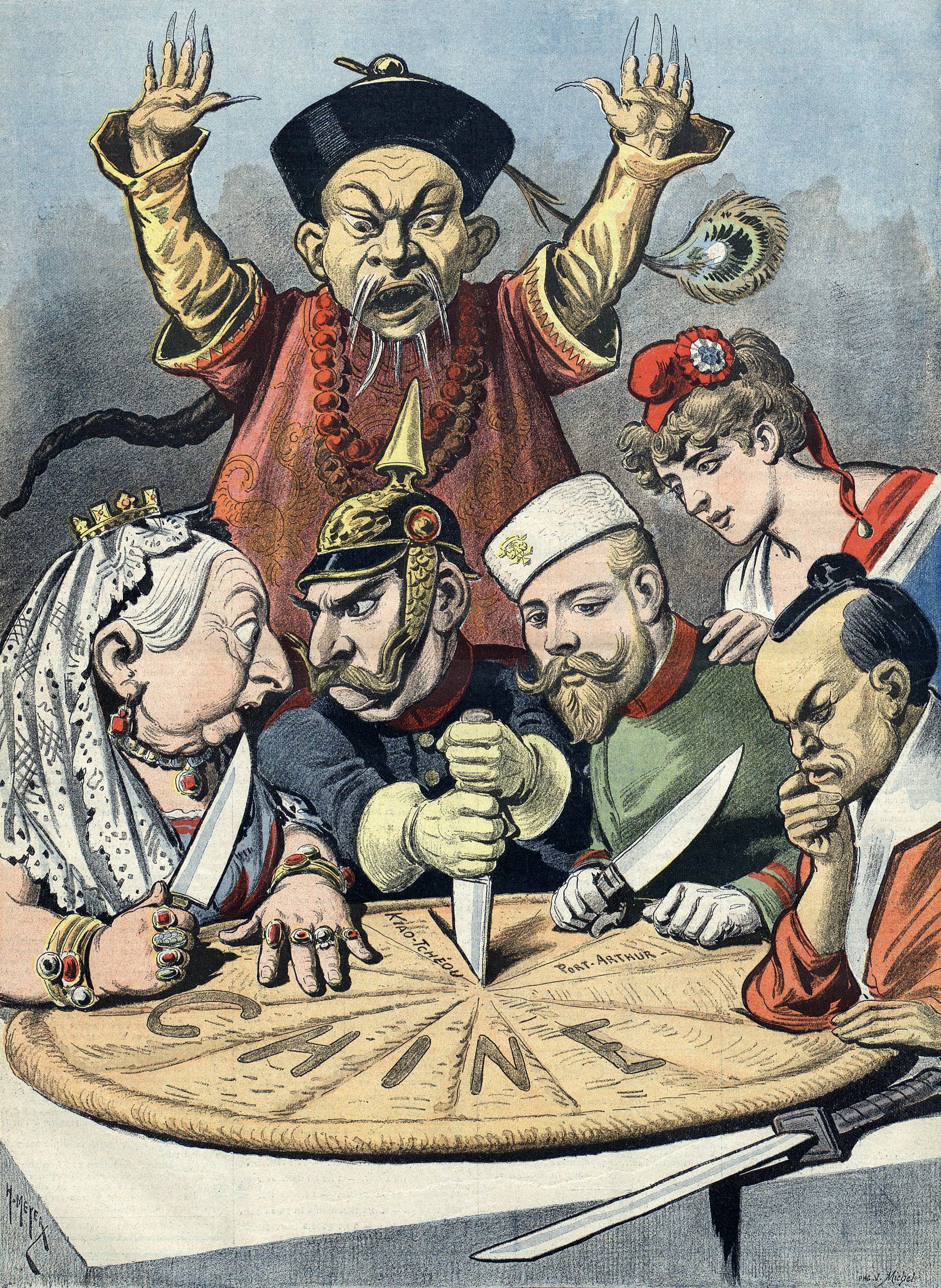
This famous French cartoon from the turn of the century depicts China as a great pie being carved up by the foreign powers. From L-R: Queen Victoria (Britain), Kaiser Wilhelm II (Germany), Tsar Nicholas II (Russia), Marianne (France), and the Emperor of Japan. Behind, a Chinese Mandarin looks on in horror as his country’s fate is decided and divided

By the 1890s, the foreign powers have set up enclaves and concession-zones in almost all major Chinese cities. Canton, Shanghai, Tientsin, Nanking, and the ancient imperial capital city of Peking. Each has its own foreign concession-zones held by the Western powers and by the Empire of Japan. In Shanghai, it is the infamous Shanghai International Settlement, which would become notorious for fast living, gambling, drugs, racing, prostitution, gangsters and expensive lifestyles. In Peking, it is the walled citadel of the Peking Legation Quarter, where foreigners live in isolated splendor, immune and untouchable from and by the Chinese who dwell from without their confines.

In previous generations, the idea of “Barbarian” legations, concessions and embassies within China was unthinkable, and certainly not in the ancient Imperial capital of Peking! But China, weakened and humiliated by defeat after defeat, was forced to allow the Western powers to set up their quarters just miles from the Forbidden City, the seat of Chinese imperial power for centuries.

Foreign presences in China were deeply resented. Christian missionaries desecrated Chinese temples and shattered Chinese belief-systems, insulting centuries old traditions and customs. Chinese ports were run by Western merchants, particularly in Shanghai and Canton. Soldiers, marines and guards from all nations were stationed in and around foreign settlements to protect the civilians and diplomats who worked in or near to their concession-zones.

The foreigners enjoyed diplomatic immunity in China – They could not be prosecuted under Chinese law, another injustice which the Chinese were infuriated about. And they imported opium into China, which had previously been illegal. Despite all the stereotypes about doped up Chinks lying on beds huffing away at their pipes, the Chinese themselves had long fought to REMOVE opium from China – it wasn’t even grown there! It came from British India in trade-ships sailing for the foreign-controlled treaty-ports.

The Peking Legation-Quarter

Established in the 1860s after the Second Opium War, the Peking Legation Quarter was originally a hodge-podge of European consulates, legations and embassies, established and built within an area east of Tienanmen Square, partially divided from the rest of Peking by enormous and ancient defensive walls. Over time, it grew and became the heart of foreign, mostly Western life, in the middle of Imperial Peking.


The Peking Legation Quarter, 1912. Click the image for a higher resolution to read the text beneath the map

The Quarter held the embassies and diplomatic missions of many of the most prominent Western powers, along with several smaller ones. Housed within the compound, or on the land immediately outside it, were embassies and legations belonging to…

– The United States.
– The Kingdom of Belgium.
– The French Republic.
– The German Empire.
– The Russian Empire.
– The Japanese Empire.
– The British Empire.
– The Kingdom of Spain.
– The Kingdom of Italy.
– The Austro-Hungarian Empire.
– The Dutch Empire.

Showing the extent of foreign interest in China, there was even a Mexican Legation within the Foreign Legation Quarter!

Also included within, or immediately without this partially-walled community was a power-station,  two hospitals, post-offices, shops, banks, a telegraphic office, the offices of the Peking-Hankou Railroad, the offices of the Peking-Mukden Railroad, two hotels, houses and villas, one church, and an English-style men’s club. Even the Peking branch of the Hong Kong-Shanghai Banking Corporation was located here. Sound familiar? Today it’s called HSBC.


The Legation Quarter, Peking

For thirty-nine years, Westerners and foreign Asians lived within the walled diplomatic compound, ignorant and uncaring of China. But at the turn of the last century, everything went pear-shaped.

The Boxer Uprising

Growing resentment of foreign influence, control and abuse in China was beginning to cut deep. China had been defeated in war, humiliated by treaties, and corrupted by the introduction of opium. Chinese were getting fed up of their ways of life, and their culture being attacked, fed up of their cities being overrun by Western barbarians, and were tired of having to trade with Western merchants on their terms.

In 1897, a society was formed. Officially, it was called the Society of Righteous and Harmonious Fists! To the Western press, it was simply called ‘The Boxers’.

The Boxers were a loose gathering of groups, which all shared the beliefs and goals that Western domination in China had to end, and that Westerners themselves had to be driven out of China, to preserve a way of life that had remained unchanged for thousands of years.

Foreign imperialism and colonisation, the settting up of concession-zones and other Western activities had ruined the lives of these people – they could no longer visit certain parts of their own cities and towns, which were under foreign control – they could no longer do business on their own terms.

They had their lives disrupted by Christian missionaries who were actively moving through the Chinese interior, setting up churches, monasteries, and destroying traditional Chinese belief-systems centuries old. Ancestor-worship, Buddhism, Confucianism, and Taoism were out. Jesus, God and the Holy Cross were in. Imagine being raised to believe one thing for generations, only to have strangers from across the seas show up and tell you overnight that your entire way of life was backwards, heathen, immoral and above all…UN-CHRISTIAN!!

And you can’t do anything about it. You can’t complain to imperial officials or village elders or city politicians – these priests and missionaries all have diplomatic immunity – they can show up, destroy everything – and there’s absolutely NOTHING you can do about it.

These attacks infuriated the Boxers, and they resolved to put an end to them.

All these grievances finally exploded in the late 19th century, resulting in targeted raids on any and all Christian missionaries in China. No heed was paid to which country they came from, or which denomination they preached of, they were attacked and slaughtered without pause or mercy.

Word by letters and telegrams spread around China’s coastline, from Nanking to Shanghai, Canton to Peking. Western refugees flooded the population-centers of China. Telegrams were cabled across the Atlantic and Pacific to foreign governments in London, Washington, Paris, Moscow, and Tokyo, to name but a few. By the close of the 19th century, the situation is going increasingly desperate.

German, Russian and French governments were quick to act, sending detachments of troops from their South Pacific colonies to China. From Indochina came French soldiers, from Port Arthur came the Russians. In the United States, any sense of panic and fear is dampened, the government doesn’t think that there is any reason for undue alarm.

The Chinese Reaction

From the famous Forbidden City in Peking…nothing.

The Qing Government does not actively support the Boxers…but on the other hand, they don’t really want to STOP them, anyway. As Boxers go from town to town, local government officials do not bother to halt their advances, or to arrest their leaders. There are no prosecutions of the Boxers in courts of law.

Ruler of all China, the Empress Dowager, Cixi (“See-Chee“) begins to see that the Boxers may actually be of help to her. If she can harness their anger and rage towards the foreigners, she might be able to drive out the devils and restore China for the Chinese! She gives the order that the Imperial Army is to back up and actively assist the Boxers in driving out the Western powers!

Eventually, the Boxers reach and occupy many major cities, including Peking and the city of Tientsin. Here, they lay siege to the foreign communities within the city boundaries.

The Start of 55 Days

On the 19th of June, 1900, the Imperial Court issues a decree – All westerners and foreigners MUST leave Peking and its legation quarter within 24 hours. They are to pack their bags, trunks, furniture, whatever they can push, pull or carry, load it onto the nearest railroad train, and leave the capital for Tientsin by 4:00pm the next day. If, by that time they have not complied, the Boxers, with Army support, are given permission to open fire against the Legation Quarter and start an all-out assault against the foreigners.


Legation Street, Peking

The foreign powers decide not to leave by majority vote. To set foot outside the walls of the Legation Quarter is almost certain suicide, as proved by the murdering of the German foreign minister, Baron Von Ketteler, as faithfully depicted in the film, ‘55 Days at Peking‘. They do not wish to tempt fate.

At 4:00pm on the 20th of June, 1900, the deadline expires. From this point on, all foreign diplomats, their families, their friends, businessmen, religious missionaries, civilian expats, and Chinese Christians holed up inside the Legation Quarter can be attacked at any time from any side, by the Boxers and the Imperial armed forces of the Qing Empire.

The legations are woefully unprepared for surviving the trap they’ve caught themselves in – Of 3,700 people, there are only 409 soldiers. Of 409 soldiers, most do not have weapons. Those which have weapons have only the ammunition which is loaded into it. Only the United States Marines, recently arrived, have sufficient ammunition for any serious engagement.

Their heavy armaments include three machine-guns and two cannons. Just like in the film, there really was a cannon nicknamed “Betsy“, and just like in the film, it was quite literally made from bits and pieces found all over the compound, from older firearms. Because of this, it also had the nickname of “The International”, because its various components of barrel, ammunition, carriage and wheels were taken from all corners of the Legation Quarter!

The Siege of the Peking Legation Quarter

Initially, nobody knew what was going to happen – defenders had no clear idea on how they would defend themselves against an attack that might never come, and the Chinese had no clear plan on how to attack the legations and what sort of resistance they might encounter.

Within the Legation Quarter, certain strongholds developed. The British Legation, as the largest structure, became an unofficial headquarters of the siege. Some legations which were too isolated from the others were abandoned, and their civilians and diplomatic staff moved into legations which were closer to the others.

Of crucial importance was protecting the walls which surrounded the Legation Quarter, in particular the Tartar Wall, which formed the southern boundary of the bulk of the Legation Quarter. If Boxers or Qing army forces scaled the wall, they could fire straight down into the streets, having an unobstructed field of fire running the entire length of the compound. The wall is shown at the bottom of the Legation Quarter map, further up in this posting.


U.S. Marines stationed within the Legation Quarter, 1910. The huge structure behind them is the Tartar Wall. The tower to the right is the Chien Men, one of the gates into the Legation Quarter

The Situation with the Legations

The Quarter had sufficient food and water, but nowhere near enough medical supplies, ammunition, fighting men, or weapons. Anything and everything that could be pressed into service was used. Women filled sandbags, 15 bags an hour, 360 bags a day. Chinese Christians constructed barricades along the streets, bridges and crossroads within the Quarter in the event of a hostile breakthrough. Throughout the siege, constant Chinese attacks forced the defenders to retreat back from their eastern barricades several times.

The British Legation was heavily fortified and hospitals and sickrooms were improvised in basements of major buildings.

Roughly half the Legation Quarter had walled boundaries. To the South, the Tartar Wall, To the north, walls which made up the ancient Imperial City also served as a boundary. To the east and west, there were no such walls. In the event of an attack from these directions, buildings were fortified and barricaded, and roads had blockades built across them made of sandbags and furniture.

The Start of the Siege

In the beginning, nobody really knew what was going on. There were divisions within the Chinese government about what to do with the foreigners. Force them to evacuate? Storm the Quarter? Orchestrate a ceasefire? Sign a truce?

Everything was up in the air.

The real fighting did not start until three days later. Trying to smoke the foreigners out, the Boxers and the Qing set fire to many buildings within the Legation Quarter. One of them was the Hanlin Academy. Housed within were several priceless and irreplaceable books and other records. Their destruction infuriated both sides, and at the same time, neither side agreed to take responsibility for the library’s destruction.

From then on, fighting was almost nonstop for nearly a month. From the 23rd of June until the 17th of July, battles were almost daily occurrences, despite attempts on both sides to quell the violence.

Fighting was particularly brutal around the Chien Men  (modern Pinyin: “Qianmen“), or ‘Front Gate’ of the Imperial City, the walls of which made up some of the Legation Quarter’s boundaries, such as the Tartar Wall.


The ‘Qianmen’ today, in the background

Explosives and cannons were used to try and breech the massive gatehouse. The photograph below, taken shortly after the siege, shows the sheer level of destruction wrought upon it. The entire top third of the structure has been blasted away in the fighting. Compare it with the photograph above to see the full extent of the damage.


After the Siege. Destruction to the ‘Qianmen’ of Peking

Fighting around the gate and the nearby Tartar wall which it punctuated, was intense. It was defended by a mix of Americans and Germans trying to drive off a force of thousands of Chinese who used scaling-ladders to climb the walls and push the defenders off. The Boxers and Qing did temporarily occupy the wall, but before they could do any serious damage, they were driven off and never again managed to retake this position.

The International Response

For over a month, until late July, no word got in or out of the Legation Quarter. Telegraph lines to the coast and other cities had been cut by the Boxers, preventing electronic communications. On the 28th of July, the first message from the outside world entered the besieged Legation Quarter. The message: Help was on the way!…eventually.

The First Relief-Attempt

The first attempt to break the siege of the Legation Quarter came just days after it started – On the 26th of June, 1900, Vice Admiral Edward Hobart Seymour tried to break the siege using a combined international force numbering 2,000 men, from Britain, Germany, Russia, Italy, Japan, France, the United States and Austria-Hungary.

This was not the famous Eight-Nation Alliance, it was a small band, a mix of soldiers and sailors from various nations all with a common purpose, up against a force more than twice their number (5,000 Chinese strong).

This relief-attempt came at the request of British Minister to China, Sir Claude Maxwell MacDonald (1852-1915), who sent a telegram for help, informing the outside world that the situation within Peking was deteriorating by the hour, and that soon, the whole situation could go up in flames.

The Seymour Expedition, as it was called, was a failure in every sense of the word. They were attacked every step of the way to Peking, and then attacked every yard they retreated. Railroads were sabotaged, bridges blown up, and the Expedition itself was running out of food – they hadn’t brought enough to last them there AND back! – They assumed that, once their mission was successful, they could restock their supplies and head home. The idea that they would have to make their supplies last twice as long as they needed to, or to bring extra supplies, never crossed their minds.

The Second Relief-Attempt

While the soldiers of the Legation Quarter had been fighting for their lives, the governments of the foreign powers represented within the Quarter had been organising military relief for the besieged. This came in the form of the Eight Nation Alliance.

In this alliance, between Austria-Hungary, Germany, Russia, France, America, the United Kingdom, Japan and Italy, the collected countries pooled their colonial military resources and resolved to send a relief column to China to break the siege.

Coming from India, Hong Kong (British), Indochina (French), Port Arthur and Vladivostok, (Russian), the Philippines (American), Japan, Port Athur (again!, this time, Austria-Hungary), Tsingtao (German), and finally, Italy, the various military detachments converged on the northern Chinese coastline in July of 1900.

Among the people who came to answer the call of distress from the Legation Quarter was one Capt. Georg Ludwig Von Trapp, as an officer of the German Navy. Sound familiar? The life of his family was immortalised in the film ‘The Sound of Music‘.

If the Eight Nation Alliance thought that ploughing through China to Peking was going to be easy, they had another think coming. Landing on the Chinese coast in an assortment of naval vessels, the military detachments marched through China.

First, they had to blast through Teintsin. Here, the Boxers and Imperial Chinese forces held back the Eight Nations for an amazing…24 hours, from the 13th-14th of July.

Even after making their way through Teintsin, the Eight Nation Alliance would not reach Peking for another month. On the 13th of August, they were still five miles away, and fighting for every yard.

The End of the Siege

The Eight Nation Alliance finally reached Peking on the 14th of August. At the time, Peking was still an ancient, walled city. There was a wall around Outer Peking. Then another wall around Inner Peking. Then a wall around the Imperial City. And another wall around the Forbidden City. Peking was a gigantic Russian nesting-doll with the Empress Dowager as the tiny dinky toy in the very center.

To break the siege, the Eight Nations divided their forces and they each attacked a gate leading into the Outer City or Inner City. The Legation Quarter was between the two cities, so this strategy would ensure that the Qing and Boxers would be attacked from both sides.

The British got there first at 3:00pm.  The Americans arrived two hours later.

The French never did reach their objective – they got lost on the way.

With such a show international military might, the Chinese forces retreated. The siege was officially lifted and ended on the 14th of August, 1900.

It had lasted fifty-five days.

The Aftermath

Military casualties of the siege were appalling. The Foreign powers within the Legation Quarter had not collapsed to Chinese aggression, but they had just about exhausted their ammunition supplies, and had lost 45% of their total fighting-force. Their original lines had fallen back on the Eastern side, and there were thirty-seven civilian casualties and injuries.

To ensure no repeat performance of a similar kind, the Foreign Powers occupied Peking. Cixi, the Empress Dowager, fled from the Forbidden City with her entire court. She wouldn’t return until 1902!

What happened after the ending of the siege is not recorded in the famous 1963 film…probably because it isn’t very pleasant.

Prior to the lifting of the siege, false news-reports were somehow telegraphed to the Western world. How is uncertain, due to the fact that electronic communications had been severely interrupted by the siege. But the information claimed that the Chinese had forced the entrances of the Legation Quarter, stormed in and had shot, beheaded, bayonetted or otherwise killed every man, woman and child within the Legation Quarter.

By the time this news-report was discovered to be nothing more than a Chinese hoax to piss off the Western powers, it was too late.

Filled with hatred over the apparent atrocities, the assembled Western powers and the Japanese, raided, robbed, raped, burglarized and trashed Peking. They even forced their way into the Forbidden City, something unheard of in the history of China, and ransacked the palace buildings, stealing priceless antiques and artifacts centuries old, and shipping them back to Europe.

When the Chinese newspaper hoax was finally proven, the Europeans and Americans found themselves doing a lot of soul-searching. Famous American novelist, Mark Twain, was just one of thousands who forced the Western powers to consider their motives and actions in China, and the morality of forcing their cultures and religions upon a country which not once had raised a hand in war against them, except to protect their own way of life.

More Info?

In Search of History: The Boxer Rebellion

“55 Days at Peking”

Trove.nla.gov.au – Sydney Morning Herald – Thursday, 22nd Nov., 1900. 

What’s That Tune? The Stories Behind Famous Pieces of Music – No. 2


Title? “The Danse Macabre”
Who? Camille Saint-Saens.
When? 1874
What? Symphonic Poem

The Danse Macabre (the first word spelt with an ‘s’), is a medieval allegory; a representation of the universal nature of death. In the Middle Ages, when death was everywhere, and few people were expected to live beyond their mid-thirties, the theme of all-encompassing death was a grim comfort to the peasant classes. As dismal and short as their lives would be, they knew that sooner or later, even the great kings and lords would also follow them into their own graves, and that wealth, riches and power did not spare one from the scythe of the Grim Reaper of Death.

The actual ‘Danse Macabre’ or ‘Dance of Death’ is an ancient European superstition. It holds that every year, on the night of All Hallows’ Eve (“Halloween” in modern English), the Grim Reaper calls the souls and skeletons of the dead from their graves, to lead them in dance and merriment, from strike of midnight until break of dawn. This was another way of softening the harsh realities of life and death, and providing people with the belief that death, while universal, couldn’t possibly be so bad.

The Danse Macabre as written by French composer Camille Saint-Saens in 1874, is the most famous of the many musical representations of Death leading the spirits of the dead in dance on Halloween. Although this piece can be played on the piano, it was actually written for a full orchestra.

The piece starts with the twelve strokes of midnight. As the church-tower rings the last bell of midnight, Death enters a graveyard, tapping and knocking on all the gravestones, to rouse the dead from their slumber. The wavering, continuous melody throughout the majority of the piece (in orchestral arrangements, performed by a solo violin), represents the personification of Death dancing through the churchyard, playing his violin, with the ghosts and skeletons of the dead dancing around after him.

The piece ends several minutes later, with the gradual rising of the sun, the rooster’s crowing, and the souls and skeletons of the dead crawling back into their graves, to await the Halloween dance of the next year…

Title? “Omphale’s Spinning-Wheel”
Who? Camille Saint-Saens
When? 1872
What? Symphonic Poem

Who knows what evil lurks in the hearts of men? Muahahahahaha!

The Shadow knows…

Composed in 1872, this is another of Saint-Saens’ most famous pieces. Another symphonic poem, it’s known to modern audiences mostly for the bridge in the middle of the piece, which was used in the 1930s radio program, “The Shadow”.

If you’ve ever wondered about the origins of that famous, slow, haunting theme, it came from here. In the video provided above, it starts at 3:22. It was performed on organ, for the radio-program by legendary organist Rosa Rio, who died in 2010…at the age of 107! 

Title? “Funeral March of a Marionette”
Who? Charles Gounod
When? 1872
What? Piano Solo

Fans of Alfred Hitchcock will probably recognise the slow, steady, rocking pace of this music as the theme to the 1950s TV series “Alfred Hitchcock Presents…“.

Composed in 1872 by Frenchman Charles Gounod (“Gouno‘”), also famous for “Ave Maria“, it was originally written as a piano solo, but was rewritten in 1879 as an orchestral piece. Hitchcock selected it as one of the pieces of music he would have a recording of, if he were trapped on a desert island.

Title? “Powerhouse”
Who? Raymond Scott
When? 1937
What? Novelty

Anyone who grew up watching Warner Brothers cartoons on weekend television will be familiar with the 1930s novelty tune “Powerhouse“, by Raymond Scott and His Orchestra.

Scott was famous for his whacky, novelty tunes which were highly popular in the 1930s and 40s. He used a lot of early electronic instruments to produce the weird sounds for which his music is famous. “Powerhouse” is best known for the bridge in the middle, with the slow, methodic, “Assembly-line” theme. It starts about a minute and a quarter, into the original 1937 recording, which is shown above.

Title? “Song of the Volga Boatmen”
Who? Unknown. Compiled by Mily Balakirev.
When? Unknown. Published by M. Balakirev in 1866.
What? Traditional Russian Folk-Song

Anyone who grew up watching Disney cartoons of the 30s and 40s is probably familiar with this ancient Russian folk-song, ‘The Song of the Volga Boatmen‘. Its origins are lost to history, but it was saved for posterity by Russian pianist and composer Mily Balakirev (1837-1910), who added it to his published book of traditional Russian folk-songs in the 1860s.

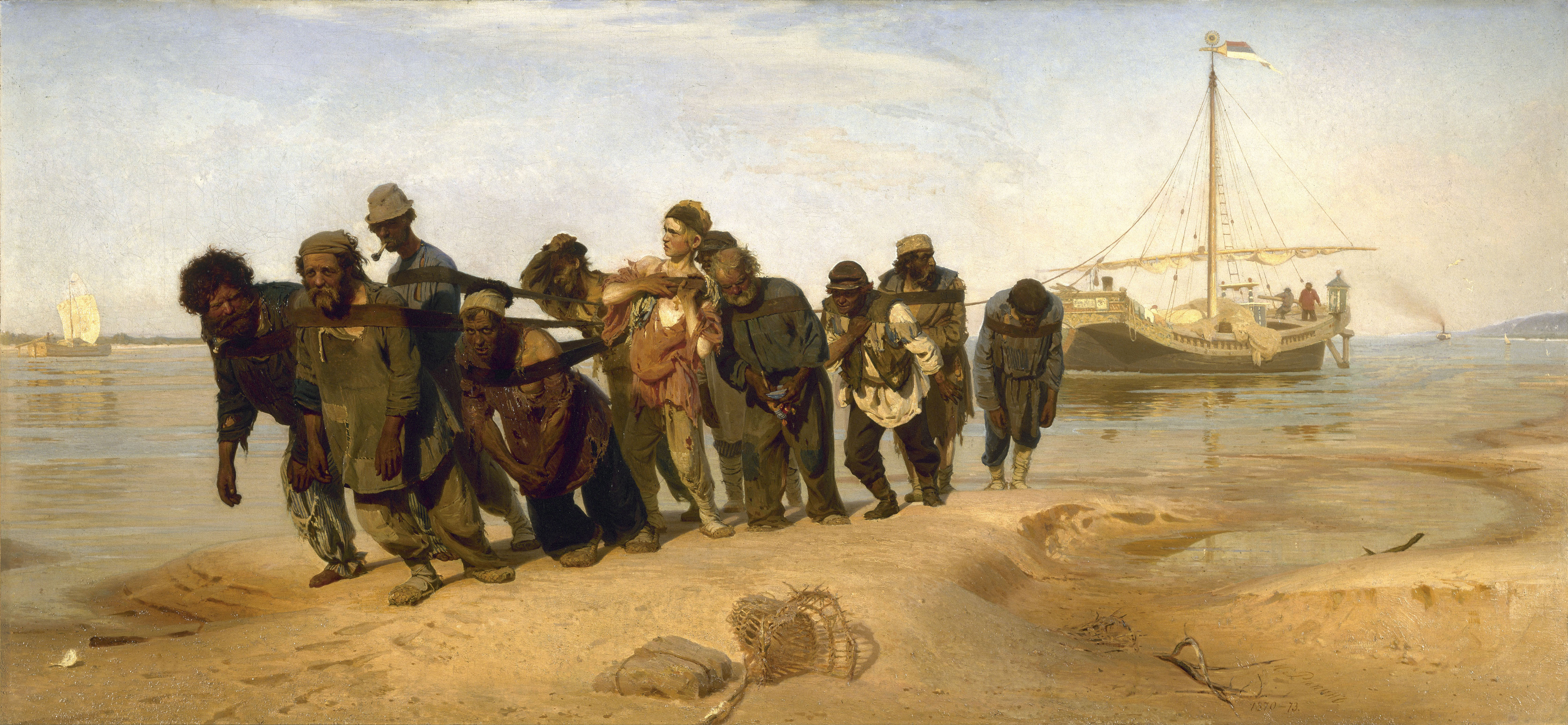
Barge-Haulers on the Volga (1873), painted by Ilya Y. Repin

The original lyrics tell the story of the Volga Boatmen, teams of peasant labourers who dragged barges and boats along the Volga River in Russia during the time of the Russian Empire. This backbreaking, thankless task worked many poor Russian peasants into their graves, but the song (used to help keep time during barge-hauling) was inspirational for its depiction of hard work and determination, and remained popular, even through the communist era of the 20th century.

The Volga is the longest and largest river in all of Europe, and runs through the hearts of many famous Russian cities, such as Moscow, and Volgograd (what used to be known as ‘Stalingrad’ during the Second World War).

Now Boarding: A History of Airports


Every day, hundreds of thousands of people travel through airports and millions of people travel by airplane. You grumble and bitch and complain about everything, don’t you? It’s far to walk, your bags are too heavy. You can’t take this, that, the other, and another thing, onto the plane. The gates and terminals are miles apart and you’re running late. Security-checks, baggage snafus, X-rays, immigration, and that endless standing and watching and waiting and walking and running…and at all possible hours of the day and night!

Airports are such a pain in the ass.

So, who do we have to blame for this nightmare? While you’re waiting for that flight which is three hours late, and which will last twelve hours from London to Singapore, why don’t you sit back and find out about the history of airports?

Before Airports

From the 19th century up until the 1950s and 60s, almost all international travel was done by railroad or ocean-liner. You rode in comfortable and luxurious Pullman cars across the vast expanses of the United States. You rode the Orient Express across the Continent. From ports like Southampton, New York, Melbourne, Sydney, Shanghai, Singapore, Hong Kong, Calais, Port Sa’id, Tokyo and Bombay, your ship or ocean-liner took you all over the world. Shipping lines such as the Hamburg-America, White Star, Red Star, French, Nippon Yusen Kaisha (better known as the NYK Line) and Pacific & Oriental (better known today as P&O) were world-famous, and shipping lines were all in direct competition with each other to grab as big a slice of the customer pie as possible.

Ports and railroad stations were major hubs. Victoria Station in London, Victoria Harbour in Hong Kong. The Port of Shanghai, New York Harbor, Grand Central Terminal, Union Station, King’s Cross, Paris Gare du Nord, Victoria Dock in Melbourne; all names which were once as familiar to us today as United Airlines, Qantas, British Airways, Singapore Airlines, and Pan-American.

We think that the Golden Age of Travel, the era when international large-scale passenger transport was possible for the first time, was confined solely to smoke-belching trains and ocean-liners, but even in the 1910s, airplanes and airports were beginning to make a name for themselves. And this is their story.

The Airfield

Starting in the mid-1910s, airplanes started becoming a serious form of transport. The First World War saw the first large-scale use of airplanes, for bombing, reconnaissance, artillery-spotting and the most thrilling of all – aerial combat – dogfights!

But what to do when the war was over?

Yes, airplanes had proved their worth, but for the large part, airplanes were still very experimental – most of them were made of nothing but wood and canvas, with struts and wire stays to hold the whole flimsy thing together.

But with the end of the war, there was suddenly a surplus of planes…and skilled pilots…who were suddenly out of a job!

So began the first experimental passenger flights, in the early interwar period.

With the first flights, came the first ‘airfields’.

Early airfields were nothing fancy – quite literally a field, with precious little besides, and usually belonging to, or purchased from a farmer. Fields owned by farmers were of necessity, flat, smooth, dry, and free of stones, tree-stumps and other impediments; ideally suited for aircraft landing. There were no terminals, no control-towers, not even any runways to speak of – nobody envisioned that air-travel would be used for anything more than the delivery of mail, anyway!

Early airfields were simply open fields…with grass. Handy for landing, not so great for taking off. Grassy fields created drag on the undercarriage and landing-wheels of early aircraft, which inhibited takeoff. Things were improved slightly when someone got out the lawnmower and the grassy field was replaced by dirt runways, but even these had issues – in wet weather, dirt runways turned to roads of sludge, making it impossible to take off, or land! It was clear that proper aircraft-handling facilities were required.

So when and where did the first airports pop up?

The World’s First Airports

The oldest airport still in operation was built so long ago, it was barely older than the machines it was built to handle! Opened in 1909 by Wilbur Wright, the College Park Airport, in Maryland, the United States, is the oldest airport in the world!

Originally, the College Park Airport was a training-ground, for the Wright Brothers to show off their new invention – the airplane! But by 1911, it had become an established airport, with wealthy civilians using the area to land and house their own machines. Among other historic events, College Park saw the first experimental helicopter test-flights in the 1920s.

In the postwar period of the 20s and 30s, large-scale passenger transport was still done with ocean-liners and steam-trains. But eventually, airlines started being formed, and they blossomed into the companies which we know today.

In Australia, a company called the Queensland And Northern Territory Aerial Services commences operations in 1921. In 1926, Germany establishes Deutsche Luft Hansa (three words). The same year, Northwest Airways is established…wasn’t that in a movie somewhere, starring Cary Grant?

A year later in 1927, in the United States, something called Pan American World Airways first takes to the skies, in 1927 with its famous seaplanes.

In Europe, where there was an established flying culture because of the First World War, and where short distances between countries made early passenger flights practical, the first airports were established.

In 1927, Tempelhof Airport was built near Berlin. Around the same time in England, land near an old race-course is used for aerodrome purposes. In 1930, it will become the famous London Gatwick Airport.

The old Tempelhof Airport, Berlin

Early Airlines and Airplanes

Aerial services were slow to catch on in the United States. With such vast amounts of land to cover between major cities from state to state, it wasn’t possible for many early airplanes to make the distance. They simply didn’t have the size or the fuel capacity to fly that far. Instead, the Americans focused on transatlantic flights.

With the establishment of the famous Pan Am Airways in 1927, America had an airline that could fly its passengers to countries like those in South America, but also to Europe and up and down the east and west coasts of the United States. The early passenger planes were romantically called the Pan Am Clippers. The word ‘clipper’ comes from a type of fast sailing ship, so fast that it ‘clips’ or skims along the water. The analogy was transferred to aircraft which would ‘clip’ through the air. An age of romantic and stylish air-travel had begun.


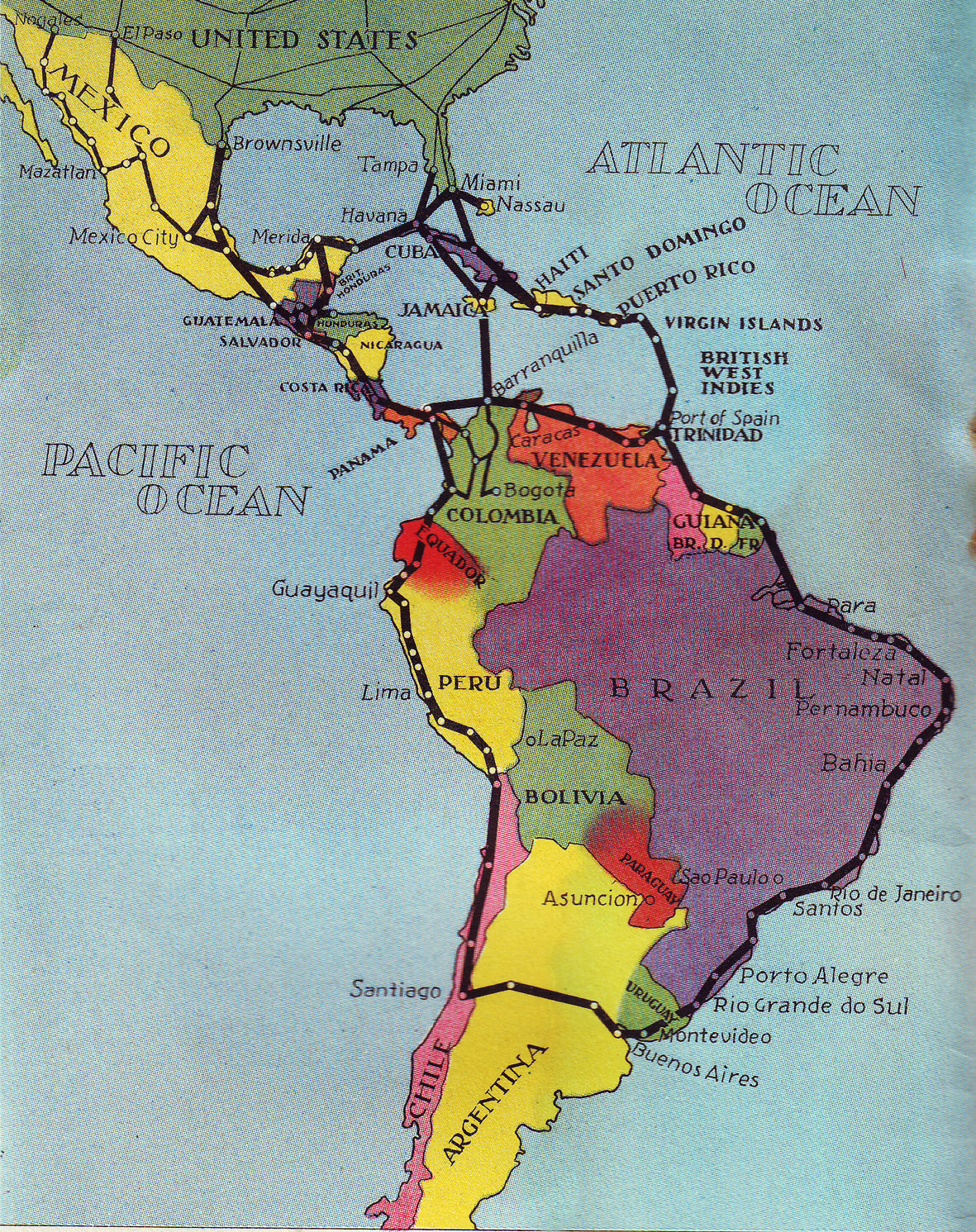
Pan American route-map, 1936

Travelling by Pan Am clippers was expensive, and could only be done from certain cities – all the planes were seaplanes, which took off from, and landed at, coastal regions. Pan Am was one of the first airlines to offer transatlantic flights.

The limitations of aircraft in the 1930s meant that not all flights were direct. Although Pan Am was flying the latest seaplanes, as designed by the famous Boeing aircraft-manufacturers, sometimes, a plane flying from America to Europe might stop at Newfoundland, Greenland and Iceland for refueling, before finally arriving in France or the United Kingdom. Some simply did not have the fuel-capacity or size to brave direct routes across the Atlantic Ocean. To restore passenger confidence, Pan Am had among the best pilots in the world – specially trained and carefully selected for their long-haul routes, where pilots were expected not just to fly the plane, but also fix it, if it had to make an emergency landing on the ocean, and get it back into the air again!

Come fly with me, let’s fly, let’s fly away…
A Pan American clipper seaplane, typical of the 1930s and 40s

Despite technological limitations of the times and low passenger-capacities, the old ‘clipper’ seaplanes did have one advantage which most modern aircraft do not. As they were designed to take off and land on water, the likelihood of surviving an emergency landing on water (a real possibility in those days!) was generally quite high. One such Pan Am aircraft, the Honolulu Clipper, flying Pacific Ocean routes, was forced to land in the middle of the ocean in 1945, when its starboard engines failed. The plane made a safe water-landing, but the pilots were unable to restart or repair their dysfunctional engines. Radio-contact with passing ships saw the passengers safely offloaded, but attempts to tow or fly the plane back to a coastal service-area failed, and it was left to drift and sink.

The same thing happened again in 1947, when another Pan Am ‘clipper’ (this time, the Bermuda Sky Queen) ran out of fuel halfway across the Atlantic! In the middle of a fierce storm, the aircraft was forced to make a crash-landing on the heaving Atlantic Ocean. Against all probability, the seaplane survives the impact with the water, and remained afloat for 24 hours! Long enough for pilots to send out distress messages, and to offload passengers into inflatable life-rafts stored on the airplane. The U.S. Coast Guard responds to the radio call for help, and rescue all passengers and crew.

It was incidents like this that assured the flying public of Pan America’s safety, boosting their numbers of passengers and increasing the need for better airports. Even if their ‘clipper’ got into strife, they knew that they would be able to land safely and be reliably rescued, thanks to radio communications.

Airships

From the 1900s until the late 1930s, what with airplanes being unable to travel long distances with safety, most people thought that the way forward for air-travel lay in the famous Zeppelin airships made famous by the Germans. Airships were slower than planes, but faster than ocean-liners, and could carry passengers in comfort. However, a series of devastating crashes in the 1930s, most famously, that of the Hindenburg, scared the flying public away from airship travel. And at any rate, by the end of the Second World War, aircraft design and capabilities had improved enough to make airships a thing of the past!

Airport Development

As air-travel becomes more and more appealing and romantic, the larger numbers of passengers all around the world means that serious thought must now be given to airport design and functionality. Below, we’ll find out about the origins of some of the features that would be found in any modern airport today.

Air-Traffic Control

A crucial component of all airports is one which most people never notice. Air-traffic control. Without it, no airport could possibly operate with any degree of safety or efficiency.

Air traffic control as we might know it today, has its origins in 1920s London. At Croydon Airport outside of the city, the first radio-operated air-traffic control systems are put in place in the early 1920s after two aircraft, one flying towards, and one away, from the airport, collide in midair.

To get better fixings on airplane-locations in the future, all airplanes are fitted with radio-beacons which send out waves. Three receivers around the airport bounce back the radio-waves, and by using three points of reference, are able to get an accurate fix on the location of any one aircraft at a time. This is the birth of modern aircraft tracking and positioning, which is eventually improved in the 1930s and 40s, with the arrival of 1st-generation RADAR.

Gates

As airports began to be more established in the 1930s, serious thought was finally being given to airport design. At the height of the Art Deco craze, airports of the 1930s were typically modeled after the only other example of large, passenger-handling buildings familiar to architects and designers at the time – grand railroad stations.

Modelling airports after the great railroad stations of Europe and the Americas had their pluses and minuses. Having large halls and gathering areas was convenient, but it could be tricky when it came to separating arriving and departing passengers. It would be too easy to get lost in the big central terminal which comprised the bulk of early airports. It was now that architects realised that some way of separating and organising passengers would need to be inbuilt into any future airport designs.

The idea of airport gates as we might know them today, came about in the 30s with London’s Gatwick Airport.

In order to load, offload and service as many airplanes as possible, Gatwick’s main terminal was built in a stylish “Beehive” shape:

The ‘Beehive’ meant that planes could circle around the central terminal, load up or offload passengers, and then taxi away smoothly, without the danger of crashing into other aircraft. This also allowed for passengers to be spread out, and be more easily organised, instead of being huddled up and being channeled through two or three doors. Corridors, walls and partitions inside the circular building could divide passengers into arrivals and departures. Now, they could move smoothly through the building, and in and out through multiple entrances and exits, speeding service and easing congestion.

Welcome to…’The Beehive’!

The first prototype gates were introduced at Gatwick. Previously, boarding a plane was an unpleasant experience – you left the terminal and crossed the tarmac and climbed a set of boarding-stairs onto the aircraft. This was bearable during good weather, but when it was rainy or windy, or even snowing, you probably felt more comfortable taking a train!

To provide passengers with greater comfort and protection from the elements, Gatwick Airport installed the first retractable, telescopic corridors ever to be used in airports – and which are the grandparents of all the covered boarding-ramps which we have today.

Numbering six in total, the telescoping corridors slotted neatly into each other and could be retracted when a plane was taxiing into position, and then rolled out once the aircraft was in place for boarding. Having six gates allowed for greater passenger organisation, and prevented overcrowding.

As airports boomed in the 1950s and 60s, with the arrival of the jet-age and the ‘jet-set’, and the vast advances made in aircraft design during the Second World War, airport improvements struggled to keep up. Organising passengers, providing amenities, providing parking, baggage-handling and other services became constant struggles.

Terminals

Terminals, large buildings which organise passengers, and provide them with the facilities and amenities which they need and require, are a key part of every airport in the world.

Imagine trying to board a plane, when you have to run from one building to another, to another, to another, then out onto the tarmac, and then onto the plane…

You’d rather walk from San Francisco to Chicago.

It was buildings such as the ‘Beehive’ (mentioned further up) that showed how all airport facilities could be housed, and how passengers could be sorted, all inside one building – comfortably, efficiently and without wasting time or money.

Airport terminals continued to evolve in the postwar period. Larger passenger-numbers meant that organisation was crucial. New York’s famous La Guardia Airport, which opened in the late 1930s, took the Gatwick model and upgraded it for even larger passenger loads, and better organisation.

The difference was that the ‘Beehive’ terminal at Gatwick is just one level – restaurants, ticket-counters and facilities are all on the ground floor – and upstairs is all offices. And arriving and departing passengers are all handled in that one, ground floor area. Yes, you can sort them out as they enter or leave, but not while they’re in the actual building. For the city which coined the phrase a ‘New York Minute‘, having thousands of passengers wandering around aimlessly inside their new airport terminal is a huge waste of time!

La Guardia Airport, 1940s. Note the seaplane dock, for Pan Am ‘clippers’

To nip this problem in the bud, the terminal at La Guardia is built on two levels! Departures are upstairs, arrivals are downstairs! They never mix, they never mingle, there’s no chance for someone to get lost. Passengers arriving at La Guardia can go straight in, where waiting friends or relations can meet them on the ground floor, without having to find their way upstairs and get lost. Departing passengers head to the upper level when they reach the airport, and wait for their aircraft, well out of the way of arrivals from overseas or other parts of the country. Also located in the departing area were restaurants, bathrooms, shops, lounges, public telephones and other facilities which allowed a departing passenger to kill the time between arriving at the airport, and actually sauntering out to his airplane.

Airport Security and Baggage Check-In

The one thing which everyone can’t stand – airport security. Metal-detectors, x-ray machines, dipweeds standing around waving wands up and down trying to find stuff on your body that ain’t there, and all eating up valuable time which you could be using to buy duty-free items. Like those chocolates. Or wine. Books for the flight, or CDs for your friend back home.

In the postwar era, airport security became a serious issue. With more and more people boarding aircraft and with more people flying, it became increasingly difficult to run security checks. Skyjackings forced the hands of many airports to try and find ways to stop terrorists at airports, before they boarded the planes.

Skyjackings were at an all-time high in the 60s and 70s; up to forty attempts were made on American aircraft in 1969 alone! Airports could not turn a blind eye to this. If people were afraid to fly, then airports would be bleeding money and losing customers nonstop, which would be a disaster.

The first airport metal-detectors and luggage-scanners entered terminals in the 1970s, taking inspiration from the log-scanners used at sawmills, to detect foreign bodies buried in tree-trunks, such as nails and bullets. Electromagnets on all sides scan a person as he goes through the metal-detector, and any metal on the body is reflected back to the magnets, which triggers that annoying beeping sound that we all hate so much!

At around the same time that airport security started becoming an issue, airport baggage-handling was taking a step up.

Previously, all luggage was handled by human bag-handlers. And generally, most of it still is. But the innovation came in how bags were sorted and organised in the airport. The way forward was shown in the mid-1970s, when barcodes, like those found on almost every type of consumer-product today, started becoming commonplace.

The idea of barcodes started back in the 1940s, but it wasn’t until the 70s that reliable printing methods (which didn’t smudge the ink, rendering the codes illegible) allowed barcodes to become part of everyday life. Poor printing of barcodes meant that the laser-scanners which read the codes could not distinguish between the different bars, when the ink smudged or ran together.

Now, when you check in, a tag is stuck onto your suitcase or roller-bag, with a barcode on it. And a simple scanning of the code tells the conveyor belts and baggage-handling systems where any particular bag is meant to be, and which flight it is destined to.

The Golden Age of Flight

The 1930s-1960s was the ‘Golden Age’ of commercial aviation. The time when it was new, exciting, and changing all the time. Yes, it’s still changing, but now it’s part of everyday life, and it’s frustrating and boring and just a means for getting from A to B. How much air-travel has changed since this period up to the modern day is staggering. And not just because now, we all have our own little movie-screens in our seatbacks, and can no-longer pack knitting-needles and crochet-hooks into our carry-ons.

Differences between aircraft travel then, and now, is the incredibly relaxed nature of older air-travel. Not just in security and luggage-allowances and whatnot, but also in the positioning of seats and greater attention being paid to style and passenger comfort, which to a certain extent doesn’t exist anymore.

For one, aircraft interiors were designed to be much more open-plan, in a manner which most (unless it’s a private aircraft) are not, today. This flexibility and openness is sadly missing, from much of modern air-travel, where people have to fight for leg-room and moving-space, instead of being crammed into airplanes like sardines. The idea that ‘legroom’ was an issue on older aircraft is probably laughable! And before the days of personal video-screens, passengers had much more creative ways of killing time during those long flights.

Bored? Why not show off your music chops on the keys, and provide some live entertainment for fellow passengers? If they vote you off, a parachute is stored under the piano-bench.

Our Final Approach

The next time you’re hauling your luggage through the terminal, patting yourself down to make sure you didn’t forget your tickets, passport, wallet, photographs, iPad, pens, favourite book, keys, or other essentials, spare a thought for the long, trial-and-error journey that the modern airport took.

It’s come a long way from a farmer’s field that’s had a once-over with a lawnmower. The modern airport has everything from hotels, restaurants, shops, medical clinics, cinemas, internet-access and prayer-rooms. Even a multistory slide, if you’re stuck in Singapore’s Changi Airport for a few hours with nothing to do.

Weeeeeeeeeeeeeeeeeeeeeee!!

Few other buildings have had the challenges of airports – organisation, people-management, security, luggage-handling, segregation and amenities. And yet without them, modern air-travel would be thoroughly impossible.

Want more information?

Documentaries:

Big, Bigger, Biggest:

Episodes – ‘Aircraft’, ‘Airports’.

Modern Marvels: ‘Airports’

Ten Things We Miss About Air-Travel

Wierd World Wars – Things You Probably Never Knew about the two World Wars


Did you know that…

During the First World War…

Soldiers used urine for almost anything! They pissed on their boots to soften the leather. They pissed on their handkerchieves to make gas-masks. They even pissed on their machine-guns to stop them warping from overheating! Urine was ideal for several applications in the trenches. It was easily accessed and in plentiful supply. Any duties where water was not absolutely required, or where urine was an acceptable substitute, this freely available fluid was utilised. Pee for victory!

Australia had the only 100% volunteer army. While other nations that participated in WWI had standing armies, the newly-federated (1901) nation of Australia did not have an army of its own. All its troops and officers sent to fight in the Great War were volunteers drawn up from ranks of civilians. Most of them had no prior combat-experience, and received only the most basic of outdated infantry training!

The first air-raids on a large population center were carried out. In 1915, the first-ever air-raids over a major city were carried out by the German ‘Zeppelin’ airships. Although highly inaccurate, these raids brought war to a civilian population that was previously untouchable. But for the first time, the people of Britain realised that the Channel was no guarantee of safety. The raids were carried out on London and other major British cities, starting in January 1915, and lasting until August of 1918.

The Underwood Typewriter Company manufactured a gigantic, working typewriter as a marketing gimmick in 1915!…It was later melted down for the war-effort. 

Despite the fact that the war started in Europe, the first allied shot was fired from Fort Nepean in Victoria, Australia!

Just two and a half hours after the declaration of war, Australia, a country on the other side of the world, fired the first allied shot of the war, using the coastal artillery cannon at Fort Nepean.

During the Second World War…

Despite the fact that the war started in Europe, the first allied shot was fired from Fort Nepean in Victoria, Australia!…Again! 

Just as in July of 1914, on the 3rd of September, 1939, the first allied shot was fired by the coastal artillery cannon at Fort Nepean, in Victoria, Australia, on the other side of the world! By the same gun, from the same fort…and the shot was even ordered by the same man! In both instances, gun-captain, Commander Veale, ordered shots fired across the bows of two ships which refused to heave-to. In both instances, just hours after the official declarations of war.  And before any other allied nation had fired so much as a flare gun.

Cities were bombed with pianos! Okay, not really. But…Starting in 1944, pianos were parachuted into bombed out, but liberated cities across Europe, as the Allies advanced eastwards towards Berlin. Manufactured by Steinway & Sons, and called “Victory Verticals“, these lightweight, cheap, upright pianos were designed to provide a form of entertainment for troops and liberated civilians, whose own instruments were damaged by air-raids and artillery-barrages during the earlier years of the war. 2,436 Victory Vertical Steinways were manufactured.

A Steinway ‘Victory Vertical’ piano, sourced from pianoworld.com

The British tried making aircraft carriers out of ice! Those crafty Limeys. They tried concealing convoy ships as icebergs, and tried to make aircraft-carriers out of ice, to save up on precious steel.

No such ships ever made it off the drawing-board.

American psychologists produced a Freudian-style profile of Adolf Hitler. As part of trying to understand their enemy, the Americans drew up a psychological profile of Adolf Hitler. Theories about Hitler’s personality and possible future actions were built up from known facts about the Fuhreur. These were gleamed from his published works, body-language in films, and from the few people who knew him intimately and had escaped to America. One of them was Dr. Eduard Bloch!

Dr. Eduard Bloch in his medical office in Austria, 1938. Two years before he fled to America with his family

Bloch (1872-1945) was the Hitler family doctor…and a Jew. For Bloch’s attempts at treating Hitler’s mother for breast-cancer (from which she subsequently died), Hitler gave Bloch special protection from Nazi antisemitic persecution. Despite this, Bloch felt unsafe, and fled from Austria to America in 1940.

Over a three year period, from 1941-1943, he was interviewed extensively by the Office of Strategic Services or “O.S.S.”, the precursor to the CIA. He provided the Americans with valuable insight into Hitler’s personality and early life, which helped them produce their psychological profile. He told them about such things as the death of Hitler’s mother, how Hitler reacted to the news, and details about Hitler’s childhood and upbringing.

Bloch settled in New York City. He lived long enough to see the defeat of Germany, and Nazism in Europe. He died on the 1st of June, 1945, at the age of 73.

The profile drawn up by the Americans was surprisingly accurate. It correctly predicted the July 20 bomb-plot of 1944, Hitler’s increasing withdrawal from public life, and even Hitler’s suicide in 1945!

During the war, many companies ceased production of their peacetime consumer-goods, and started manufacturing materials for the war-effort. Where possible, companies were asked to build things using materials or techniques and qualities which they already had. It wasn’t always a great success.

Steinway & Sons, the piano-manufacturers, produced lightweight wooden gliders for the Allies. These were used during D-Day, for the invasion of Normandy.

The Singer Manufacturing Company, world-famous producers of sewing-machines, was tasked by the Americans to produce sidearms for the army. They were given a contract to produce 500 Colt .45 automatic pistols. The pistols did not all pass muster, and Singer did not produce any more guns for the duration of the war. It produced bomb-sights instead!

Singer lost the pistol contract to Remington-Rand, the famous typewriter manufacturer! Remington was producing M-1911 pistols from 1942 until the war ended in 1945. In total, it cranked out 877, 751 firearms for the U.S. Armed Forces!

The Royal Typewriter Company ceased all production of civilian typewriters during WWII. From 1942 until the war ended in 1945, it cranked out rifles, bullets, machine-guns, and spare parts for airplane engines! It didn’t start making typewriters again until the war had been over for two months!

The Underwood Typewriter Company produced M1 carbines for the war-effort. In the late 1930s, it manufactured a gigantic, working typewriter as a marketing stunt for the World’s Fair:

Just like in 1915…this too, was melted down for the war-effort! This typewriter was a giant version of the Underwood Master standard typewriter:

Rationing on the British Home-Front was so severe, some people came up with interesting substitutes for some rare, rationed foodstuffs and goods…

Makeup for women was in short supply. Beetroot-juice was used for lipstick, gravy and pencil-marks were used to create the illusion of stockings.

Eggs were almost nonexistent. And if you wanted them, you had to open a can of egg-powder, instead! (Eugh…) Egg-powder was mixed with water, and the resultant slurry was fried on the pan.

Restaurants continued to operate throughout the War, but were not allowed to charge more than 5s (five shillings) per dish. Vegetables were not rationed in any way at all.

Fish and Chips were not rationed. But getting plaice, cod and other regular varieties of fish was almost impossible. Instead, Britons had to eat Snoek, (“Snook”), imported from South Africa.

Winston Churchill was an impossible workaholic. He worked day and night. He worked on the toilet. He worked in the bathroom. He worked in bed. He would stay up for hours and hours at a time, working. By comparison, Hitler enjoyed his shut-eye.

The British Army had its own magician! No, I’m serious. It really did.

His name was Jasper Maskelyne (1902-1973). Born into the famous Maskelyne stage family, Jasper was originally a magician performing in London’s West End theaterland. When war broke out, Maskelyne was recruited by the British Army to provide morale-boosting performances to allied troops. He soon grew bored of this, feeling that he was not doing enough for the war-effort. He offered his services to the army as an expert in camouflage and deception. The Army was not exactly taken by the idea. They thought Maskelyne was mad!

Maskelyne’s argument was that as a stage magician, he had a lifetime of experience in deception, trickery and illusion, which could surely be handy for the Army! But they weren’t interested. To this, Maskelyne famously retorted:

“If I could fool an audience only twenty feet away, I could certainly fool the enemy, a mile away, or more!” 

Maskelyne supposedly convinced the army that he had something to offer, when he successfully created the illusion of a German battleship. He was employed as a camouflage expert, and together with his team of men (the “Magic Gang” as they were called), Maskelyne set to work putting on his greatest show ever.

Among other things, Maskelyne disguised tanks as trucks, to make military-buildups look like harmless goods-deliveries. He set up blackouts, and fake lights at night, to shift the position of Alexandria Harbour (a key attack-point for the German air-force), and most amazingly, shrouded the Suez Canal (a vital link between Britain and its Empire) beneath ‘dazzle-lights’.

Dazzle-lights were powerful searchlights aimed at the sky. Twenty-one massive search-lights would have revolving heads, each head with two dozen smaller lights. Aimed at the sky and constantly spinning, the hundreds of lights created a glittering, dazzling effect. It was very pretty, but its purpose was to disorientate German pilots. Blinded by the dazzle, they wouldn’t be able to look down from their aircraft to spot the canal, and therefore wouldn’t be able to bomb it.

The canal is still here, so it obviously worked.

So there you have it. These are just a few of the weird, whacky little facts about the two World Wars which you probably won’t find in your history books.