The Long Slow History of Fast Food


Sweet, sugary, salty, greasy, filling, sinfully delicious and atrocious for your waistline.

Yeah, whatever…

Fast Food doesn’t have a good reputation. And ever since the 1950s, it’s been blamed for everything from heart-attacks, strokes, diabetes and an increasing global girth.

Delightful.

But just how long has fast food been around? Where did it come from? And how did it take on the form which we know today? Put down your milkshakes, pick up your burgers, and let’s find out…

What is “Fast Food”?

Fast food, by definition, is any food which can be prepared quickly, cheaply, and eaten on the go. Generally, such food ain’t too good for you, on account of the fact that it’s usually full of crap that you probably shouldn’t eat.

…but it tastes so good.

Given this definition, how far back can we trace fast food? Fifty years? A hundred? Two? Three? A thousand or more? Hmm.

The First Fast Food

Fast Food as we might know it today has ancient roots. Literally. Places where you went for quick, cheap bites to eat, which were open to the public, and which provided prompt service for a paltry fee are surprisingly old. Ancient, in fact.

The first people who we know for certain operated fast food outlets were the same people responsible for underfloor heating, sports stadiums, running water and Rent-A-Chariot services – The Ancient Romans!

The Romans were busy people. And when you’re a busy Ancient Roman, going out conquering ancient lands, bringing back animals for the Colosseum or trying to invade Germania, you need cheap, filling meals. Enter fast food.

We know the Romans had fast food because such fast-food establishments have been found in Ancient Roman settlements, most notably, the wonderfully preserved city of Pompeii. So, what did the busy Roman eat?

Forget burgers and fries, Roman fast food was far simpler, and far more alcoholic.

Staples of Ancient Roman fast food included fried fish (but no chips), sausages (but no hotdogs), fried eggs, and bread rolls. To add flavour to their food, the Romans used…ketchup!

No, not really.

Instead, they used a festering fish-based sauce called garum. Garum (which is, shall we say, a matured fish sauce), was added to almost anything. It was incredibly potent and the ancient Romans loved it. And like Heinz Ketchup today, it was carted all over the Empire.

Ancient Romans didn’t have soda or milkshakes to quench their thirsts. Instead, they had…wine! And they loved it!

If you should find yourself suddenly transported to Ancient Pompeii and looking for a quick feed, these fast-food establishments were called cauponae, and in case you couldn’t find any, just look for the signs.

No, not the Golden Arches, this dude:

Anyone who is a connoisseur of fine wine ought to know who this is.  And for those who don’t, meet Bacchus. Roman God of Wine! Along with his buddy Mercury (God of Commerce), paintings of this dynamic duo were often found in, or directly outside fast food joints in Ancient Rome. Praying to these Gods was seen as a way to ensure good business and fine wine.

Sadly, the glory days of Roman fast food died with the Empire. After the collapse of the Roman Empire in the 400s, almost everything that they had created was swept under the rug. Running water, paved roads, fancy robes, tiled rooves, central heating, indoor plumbing…even apartment-blocks! And for centuries, mankind had to survive on what he could grow, catch, kill or create. No quick and easy meals here.

At least, that was the case if you lived in the country.

If you were fortunate enough to live in a major city, such as London, Paris, Venice, or Rome, during the Middle Ages, you could still get fast food.

Don’t forget that during this period, cooking at home was relatively rare. If you were poor, you probably didn’t have a kitchen. Most people only had a fire, and a pot, and cooked whatever they could chuck into it. Actual kitchens were rare, and reserved for the wealthy. The money spent on building brick or clay stoves, the expense of firewood (which had to be bought if you couldn’t get it free), and the price of ingredients often made cooking at home prohibitively expensive.

The Increase of Fast Food

Fast Food of a sort has always been around in one form or another, because there will always be people who can’t, or won’t, cook for themselves. What constituted fast food depended on where you lived.

Coastal regions sold foods such as oysters. In fact, until the end of the 19th century, oysters were considered cheap, filling snacks in the United Kingdom. They were sold on the streets to working stiffs, or sold in public houses and taverns to the drunks. It wasn’t until uncontrolled pollution and over-fishing destroyed Britain’s oyster-beds that they started becoming the sought-after luxury item that we think of today.

In the 18th and 19th centuries, something happened called the Industrial Revolution. The massive increase in urban populations caused by the need for cheap labour to run factories and mills meant that suddenly, lots of people needed food! And most of these people couldn’t afford to cook at home. They either couldn’t, because they lived in tenements (which rarely had proper kitchens), worked long hours and slept whenever they could, or wouldn’t, because they didn’t know how.

To stop the masses of great cities like London from starving to death and dropping dead in the streets, fast-food vendors popped up all over town. People realised that a quick shilling could be made by selling cheap food to the masses. Welks, baked potatoes, oysters, sheep’s trotters, bowls of pease pudding, or pea soup, and other quick, cheap, hot, delicious, albeit, questionable delights were soon all over the place.

Questionable being the key word here. There were absolutely no food-safety laws in existence, and in 19th century Europe and America, a large amount of food sold to the unsuspecting public was adulterated, to make it last longer, increase bulk, or yield, or to make it look more appealing. Building-plaster was added to bread to increase its bulk and make it look really white. Paint was added to clumps of candlewax…toffee, anyone?

The Industrialisation of Fast Food

With the spread of railway networks in the 1800s, fast food got even faster, and cheaper. One of the most significant examples of this is Britain’s national dish – Fish and Chips.

For a long time, fish was rather expensive. It was expensive to catch, it was expensive to transport, it was expensive to store. But with the growth of railways, it was now possible for a fishing-boat to offload its catch, pack it into crates of ice, and send it to London by rail, where it would arrive within 24 hours!

This meant that the price of fish dropped significantly, and in 1860, England’s first fish-and-chip shop opened!

Once considered a poor man’s meal or a working stiff’s lunch, fish and chips gradually became acceptable fare for all classes of British society during the 19th and 20th centuries. In fact, by the 1900s, fish and chips were SO popular, that they were one of the FEW things UNRATIONED during the Second World War (other unrationed foods included vegetables). That said, fish was pretty hard to get during the war. So even if it was off-ration, it wasn’t easy to find. Chips, on the other hand, were freely available – you were limited only by the number of potatoes that you could grow in your ‘Victory Garden’.

It was during the 19th century and the Industrial Revolution that many of our most favourite and desirable fast foods were created. More about that, later…

The Fast Food Restaurant

The notion of a fast-food restaurant, of the kind that we might recognise today, did not arrive until the early 20th century. Most would trace its origins back to about 1902, with the opening of the first “automatic restaurant”, in New York City.

The ‘automat‘ served fresh, hot meals in glass-fronted cabinets. The hungry diner simply walked up to the case, selected the dish he wanted, and fed coins into the slot next to the door. Once the price was paid, the door fell open, and the meal could be retrieved. The door was then closed, and the slot was marked for refilling. The empty slot in the cabinet was refilled with another meal, prepared fresh in the kitchens behind the display-cabinets.

A typical automat setup from the early 20th century

The automat remained one of the most popular forms of fast-food service in the United States until the 1960s. They eventually died out when it was no-longer economical to pay for full meals using loose change. Could you imagine trying to pay for a burger, fries, coke, chicken-nuggets and a slice of chocolate-cake by constantly feeding dimes or quarters into a machine, over, and over, and over again?

Branching off from the automat came the more familiar styles of fast-food restaurants which we know today.

The Burger Kings!

Fast-food restaurants which are familiar to us today had their origins in the early 20th century, and starting in the 1930s, 40s and 50s, many famous names were established, mostly in the United States.

In 1921, White Castle burger-restaurants opened their doors in the United States. The original Kentucky Fried Chicken opened its doors in 1930…in…Kentucky! But it would not become a franchise until 1952.

The most famous of all fast-food restaurants was opened in 1940. Originally run by a pair of brothers named Richard and Maurice McDonald.

I wonder what their restaurant was called?

The First McDonalds

Burger King was opened in 1954. Taco Bell and Subway followed in 1962, and 1965, respectively.

The Main Ingredients

Ask anyone the main components of a typical fast-food meal, and they’d probably say a burger, with fries, or a hotdog, or wedges, or pizza, or something of that nature. But where do they come from?

The Hamburger

The Hamburger comes from…Hamburg, Germany.

Or at least, the word itself does.

Originally “Hamburger” referred to someone from the German port city of Hamburg, just as how Londoner refers to someone from London, or Berliner, a person from Berlin.

The ancestors of the hamburger-sandwich date back almost to antiquity, but one of the first dishes to share the name, and not just some vague similarity, might be the “Hamburgh Sausage“. A recipe for this sausage is mentioned in a book written by English cook, Hannah Glasse, in her famous tome: “The Art of Cookery (Made Plain and Easy)“, from 1763. However, the resultant dish is more of a large sausage, rather than a meat-patty sandwich.

It’s believed that the hamburger may have another ancestor – the Steak Tartare! In this form, ground up, or minced beef recipes immigrated from Russia to the German port of Hamburg during the 1600s. However, neither England, Germany, nor Russia can lay claim to being the birthplace of the hamburger-sandwich.

No. The prize goes to the Americans.

Hamburg was a major port during the 19th century, and large numbers of German and European immigrants to the New World would board steamships departing from Hamburg, bound for ports such as New York. To make a quick buck off hungry German sailors who docked in America, American cooks started making “Hamburg-style” steaks, using the ground-up beef patties which the Germans had inherited from the Russians. They’re similar to the more familiar Salisbury Steaks, but with slightly different ingredients.

From a Hamburg Steak to a hamburger-sandwich was the simple step of…sandwiching…the ground up steak between two slices of bread, or in later years, two halves of a bun.

Exactly WHO created the hamburger as we know it today is unknown. There are loads of conflicting stories, but its creation in America is the one thing that we do know for certain.

French Fries!

Aah. French Fries! Viva La France!

Idiots…can’t have a burger without fries! But to get the authentic thing, you should go to Paris…right?

Wrong.

Sorry folks. French Fries are not actually French! They never were! French Fries actually have their origins in that little country just to the north of France. It’s called Belgium. Most people think that the Belgians only make chocolates, but no, they make fries, too!

But if they originate in Belgium…why are they called French Fries?

It’s believed that they received this name due to the manner in which thin slices or sticks of potato were prepared. They were fried in the “French Style”, meaning that they were cooked in a vat of hot, bubbling oil. Today, we’d call that deep-frying. Originally, they would’ve been “French-fried Potatoes”, meaning potatoes fried in the French manner. In time, the ‘potatoes’ was dropped off, and the term shortened, leaving us with just ‘French Fries’.

However, if you go to France, or Belgium, for that matter, and asked for French Fries, there is still a chance that people wouldn’t understand you. French Fries aren’t called French fries in Belgium. Or Belgian fries, for that matter. They’re called Flemish fries! Try getting your head around that mess…

Hotdogs!

Mustard? Ketchup? Onion-rings? Cheese? Relish?

What do you put on your hotdogs? Or do you eat them plain? Have you ever wondered where they came from?

Who invented the hotdog, a sausage wedged inside a bun, is unknown. But the sausages which make up the meat in these tubular sandwiches, like the Hamburger before them, came from Germany.

Not for nothing are sausages also called Frankfurters, or Wieners. That’s because the varieties of sausages used in hotdogs came from the German city of Frankfurt, or from the capital city of Austria, Vienna. Vienna also gave us another delicious nibble – the Wiener Schnitzel!

Although it is unknown who invented the hotdog, historical records tell us that they have existed since at least the last quarter of the 19th century, and were first sold in New York City, starting in the 1870s.

That said, hotdogs were not called hotdogs in the 1870s. Although ‘dog’ had been a common nickname for sausages since the 1880s, the complete phrase ‘hotdog’ did not make its first appearance in the English language until the 1890s. Fred Shapiro, the editor of a number of publications detailing the histories of famous quotes, words and phrases, could trace the word ‘hotdog’ back no further than 1892.

Milkshakes

I don’t care who you are. Everyone loves milkshakes! But where do they come from?

Milkshakes in their present form, being a drink made of milk, ice-cream/cream, sugar, fruits and other delicious additives, date back to roughly the same time as the hotdog, the 1880s-1900s. They received the name ‘milkshake’ because prior to the spread of easily-accessed electricity (and the subsequent invention of the electric blender/mixer), milkshakes were quite literally shaken by hand. The ingredients were added into a metal cup, which was then sealed. The whole concoction was then shaken up, much like a cocktail-shaker, and then the drink was served.

With the invention of proper milkshake blenders in the early 1900s, milkshakes became wildly popular, and there were (and still are) countless varieties out there. Peak time for milkshakes was during the postwar “Long Boom”, of the 1950s and 60s. Teenagers flocking to drugstores, corner shops, and cafes, theatres and drive-in cinemas made the drink extremely popular – a popularity that has never waned.

Ketchup!

Mmm, ketchup! Rich, sweet, tangy, slightly sweet sauce, that goes well with almost anything.

But what is it?

The word ‘ketchup‘ originally referred to any sort of slightly-thickened, slightly sweet table-sauce. It could be made out of almost anything! Mushroom ketchup, oyster ketchup…How about Banana ketchup? That was invented in the Philippines during the Second World War, when rationing made it impossible to obtain the necessary tomatoes. Sauce-makers simply removed the crushed tomatoes and added pureed bananas to the mix, instead!

Ketchup as we know it today, tomato ketchup, or tomato-sauce as it’s called outside the ‘States, is generally made of crushed tomatoes, vinegar, salt and sugar, thickened or flavoured with the addition of other spices or herbs.

But where does the word ‘ketchup’ come from?

Believe it or not, it’s Chinese.

‘Ketchup’ was originally a sauce used for flavouring fish-dishes. It was called “Gui Zhi“, in Chinese, or more familiarly – “Gwai-Zap“, in Cantonese. Eventually, the Cantonese pronunciation (from the south of China) won out, and the words eventually morphed from the Canto “Gwai-Zap”, to…Ketchup.

Ketchup was invented in China sometime in the 1600s. It migrated across Asia and Europe thanks to the Silk Road, arriving in England by the end of the century. Originally, it was called “Catchup”, but the more familiar ‘ketchup’ had replaced this spelling by the early 18th century.

Ketchup used to be homemade. And indeed, even after commercial varieties were available, some people continued to make it at home. There’s a memorable scene in the 1944 film “Meet Me in St. Louis” (set from 1903-1904), where Mrs. Smith and Katie the cook are trying to make up a batch of ketchup in the family kitchen – only for every other member of the Smith family to find some reason to suggest altering the recipe!

The most famous brand of ketchup is of course, Heinz Ketchup. 57 varieties of it! Heinz started making ketchup in 1876, and it became wildly popular. By the start of the 20th century, it was being exported all over the world.

The Rise of the Fast Food Restaurant

The “Long Boom” of the 1950s and 60s saw the number of fast-food restaurants rise dramatically, and spread around the world. Everything from corner drugstores and diners, to large, purpose-built fast-food outlets. The rise of institutions like drive-in cinemas and increased movie-watching also spurred on the rise of fast-food. Sales of pizza, fish-and-chips, burgers, fries, soft-drinks, ice-cream and hotdogs all shot up in popularity, all gradually contributing to the fast-food culture which we have in the 21st century. Whoever complained that fast food was a scourge of modern living, however, would be very wrong indeed. Fast Food in one way or another, has always existed, and probably always will.

Hungry for More?

http://www.globusjourneys.in/fast-food-in-pompeii.aspx

http://ancientstandard.com/2007/08/11/mcroman%E2%80%99s-happy-meal-fast-food-in-ancient-rome-1st-c-ad/

Check the Lyrics #1 – Cultural References in Classic Songs


I’m a big fan of vintage jazz and classic pop. Everything from the rowdy days of Tin Pan Alley in the 1880s up to early rock and roll in the 1950s. I love listening to these songs and I love playing them on the piano, or even singing them in the shower.

What? Everyone sings in the shower.

These songs, written by greats such as Cole Porter, Benny Goodman, Fats Waller and Irving Berlin, are in most cases, approaching 80, 90, and 100 years old. The tunes are as enjoyable as ever. But the lyrics often make reference to cultural elements long-since obsolete or out of date. Ever wondered what something was, which was mentioned in an old jazz recording? Let’s find out together.

Song: “The Glow Worm” (1902)
Line:
“..You’ve got a cute vest-pocket Mazda,

which you can make glow slow, or faster…” 

Originally published in German, and then English, during the Edwardian era, this love-song about a glow-worm’s light enabling a man and his girl to spend time with each other, became wildly popular during the 1950s, when it was recorded by the famous vocal quartet, the Mills Brothers. Although more famous for their music recorded during the 1930s, ‘Glow Worm‘ was an unexpected hit, and was one of their later successes.

The original lyric was: “you’ve got a cute vest-pocket lighter“, referring to a pocket cigarette-lighter. But the Mills Brothers’ version of the song changes that to “pocket MAZDA”.

What is a ‘Mazda‘?

It has absolutely nothing to do with cars.

A ‘Madza‘ was a trademarked name for a type of lightbulb produced by the General-Electric company, starting in 1909. Produced until roughly the end of the Second World War, Mazda lightbulbs were supposed to be more energy-efficient and were meant to burn for longer than conventional lightbulbs of the era.

Song: “Puttin’ on the Ritz” (1929)
Line: “…High hats and ‘Arrow’ collars,
White spats, and lots of dollars…”

Arrow‘-brand detachable collars were manufactured by Cluett, Peabody & Co. starting in 1905. This was in an era when shirts came with adjustable sleeves, and removable cuffs and collars for separate washing. Although still used for more formal dress such as Black or White Tie, by the 1920s and 30s when this song was written, ‘tunic-shirts’, without attached collars, were going out of fashion. Cluett, Peabody & Co. ceased manufacturing Arrow collars soon after, and expanded their lines of men’s shirts and garments to make up the loss from falling shirt-collar sales.

During the era when detached collars were popular, however, Arrow collars were advertised using the “Arrow Collar Man”, as recognisable in his day, as Rich Uncle Pennybags, or Colonel Sanders is, today. In the 1920s, Cluett, Peabody & Co. used the ‘Arrow Collar Man’ to increase sales when they made the transition from tunic-shirts to the more familiar collared shirts which we have today. The company is no-longer in business, and closed down in the 1980s.

Song: “From Here to Shanghai” (1917)
Line: “…And I’ll have Ching Ling Foo,
Doing all his magic tricks!…” 

This song from the era of the First World War is one of the lesser-known songs produced by the famous songwriter and composer, Irving Berlin. It celebrates the exoticism and cultural diversity of the Shanghai International Settlement (1843-1943), that existed in the heart of China for a hundred years, between the First Opium War, and the end of World War Two. This expatriate enclave hosted the high-life of China, boasting bars, casinos, brothels, race-courses, lavish hotels and grand department stores. Drugs, sex, gambling, corruption and vice reigned supreme.

Ching Ling Foo was a real person, and in his day, he was as famous a stage-illusionist as David Blaine, Penn & Teller, Harry Houdini, or Criss Angel. His act involved everything from conjuring up live babies from seemingly impossible places, to decapitations, to shock and amaze his audience.

A picture-postcard of Ching Ling Foo, from 1898.

Born Zhu Liangkui, Ching Ling Foo was his stage-name, and he gained international fame at the turn of the last century after he traveled to the United States with his acting-troupe, and toured the continent. He lived from 1854-1922, and was the first Chinese magician to gain widespread fame and acceptance in the West.

Although virtually unknown today, Ching Ling Foo’s one-time fame lives on in this Irving Berlin classic.

Song: “Anything Goes” (1934)
Lines: Numerous

Anything Goes” is one of Cole Porter’s most famous songs. Like another of his famous songs, “Let’s Misbehave“, “Anything Goes” was a commentary on the relaxed social and sexual attitudes and changes experienced around the western world in the 1920s and 30s, after the disaster of the Great War.

The song is full of references to many people who were as famous in their day as Donald Trump or Bill Gates would be, today. So, who were they? Some of them you may recognise. Others have faded into obscurity…

The people, terms or companies mentioned in this song (in order of appearance) include:

Mae West, the famous Hollywood star of the 1930s and 40s, who created scandal where-ever she went due to her risque, double-entendre movie-lines. “Is that a pistol in your pocket, or are you just happy to see me?” is one of them.

Mrs. Ned Mclean is Evalyn Walsh Mclean (1886-1947). She was a prominent socialite and mining-heiress of the early 20th century. She was also, incidentally – the last owner of the Hope Diamond, before it was put on public display. Although she maintained that the famous Hope Diamond Curse never affected her family, it still remains fact that her husband broke up with her, that her grandson died in Vietnam, she lost one son to a car-crash, a daughter to a drug-overdose, and the family-owned newspaper, the Washington Post, went belly-up!

Rockefeller is the famous billionaire, John D. Rockefeller. He once said that he had two aims in life: To earn $100,000, and to live to 100 years of age. He surpassed his first aim by leaps and bounds. And, dying at the age of 98, in 1937, came within two years of achieving his second!

Max Gordon was a New York theatre and film-producer, who lived from 1892-1978.  During the Depression, when a quarter of all Americans were out of work, Gordon still managed to put on theater-shows, something which was almost impossible to do without wealthy patrons…like Mr. Rockefeller!

Jitneys, ‘Bilts, and Whitneys. A ‘Jitney’ is another term for a jalopy, a cheap, battered old automobile. The ‘Bilts’ are the illustrious Vanderbilt family. The ‘Whitneys’ were another prominent, old-money family, on-par with the Rockefellers and Vanderbilts, although they’re not as well-remembered today. They were famous for their philanthropy.

Sam Goldwyn, of Metro-Goldwyn-Mayer fame.

Anna Sten was a Russian-American actress (1908-1993), who was under contract to Sam Goldwyn during the 1930s. She was most active from the 1920s-1940s, and from the 50s until the 60s, only acted occasionally, retiring from acting entirely by 1965. She died in 1993 at the age of 84.

Mrs. R. and Franklin are of course, Franklin D. Roosevelt and his wife, Eleanor. ‘Simmons‘, is a mattress manufacturer. Established in 1870, it’s still kicking today.

Song: “Hop, Skip, Jump” (1936)
Line: “…I don’t want to sail through the seven seas,
Even if the boat were Normandie…” 

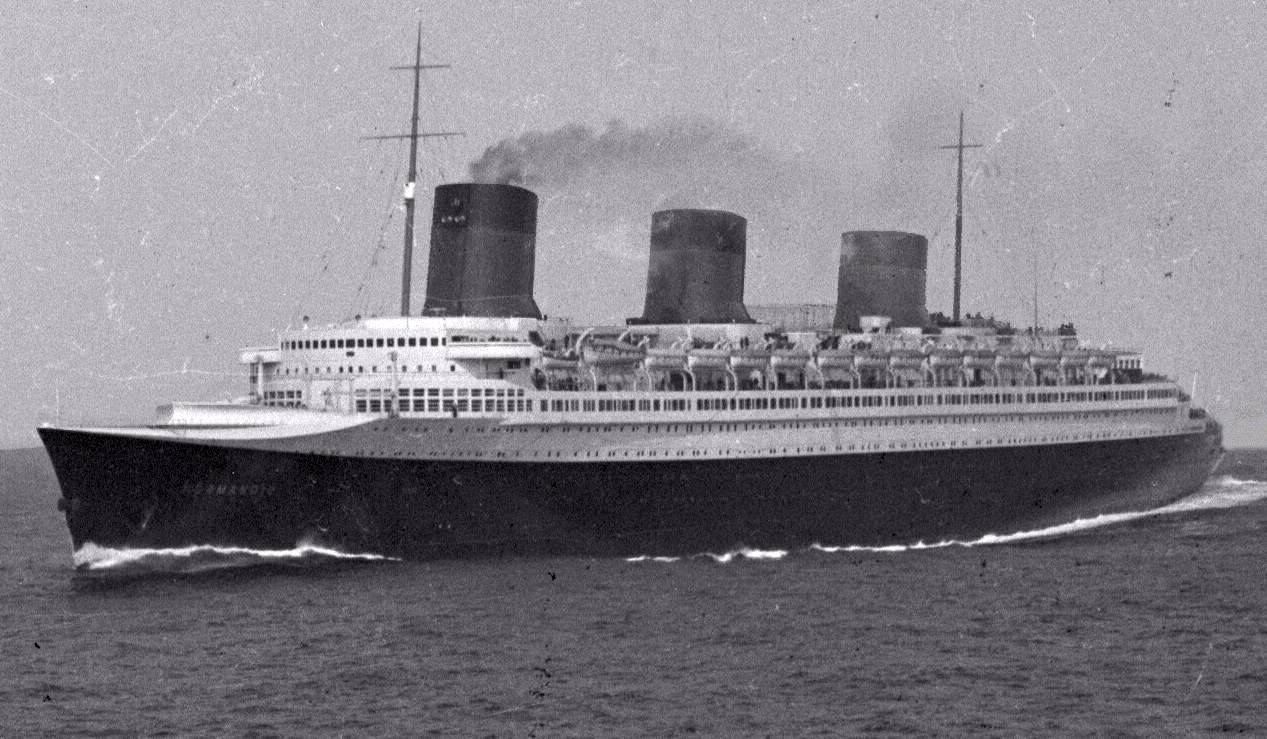
The S.S. Normandie was the pride of the French Line back in the 1930s. A floating, Art Deco palace, it was sadly lost to fire, and capsized while being fitted out for military service in New York Harbor, during the Second World War.

The S.S. Normandie photographed at sea

Song: “Pack Up Your Troubles” (1915)
Line: “…As long as you’ve a Lucifer
To light your fag, smile boys, that’s the style…”

Anyone who’s ever studied the First World War will be familiar with this song. And anyone who’s ever had grandparents who lived through it will probably have heard them singing it. My grandmother was born in 1914, and she used to sing this song all the time.

‘Fag’ in this context refers to the British slang-word for a cigarette. Most people know that today. ‘Lucifer’ refers to a brand of friction-matches manufactured in the 1800s. By the time of the First World War, it had become rather generic. People asked for ‘Lucifers’, not matches. Like how you might ask for an ‘esky’, instead of an ice-chest.

Song: “Hooray for Hollywood” (1937)
Line/s: Numerous. 

If you’ve ever seen a film-industry awards ceremony on television, you’ve probably heard this song. Written for an obscure film (“Hollywood Hotel”) back in 1937, this song celebrated the golden age of Hollywood and the American filmmaking industry, that lasted from the 1920s up to the end of the 1960s. It’s packed with all kinds of obscure references to people and machines that have faded into history. On top of that, the lyrics have themselves, changed with the times. The original lyrics from 1937 said that, “…any shop-girl can be a top-girl, if she pleases a tired businessman…”, would get raised eyebrows even today! Forget the conservative 1930s! Let’s go through the lyrics…

A “good-looking pan” means a good complexion or a handsome appearance. ‘Pan’ was an old slang-word for your face!

The lyrics referenced many famous Hollywood actors or institutions of the 1930s. Among them, child star Shirley Temple, and evangelist Aimee Semple. Later versions also mentioned Donald Duck. More obscure references include Max Factor, who was a noted makeup-artist and cosmetics salesman of the 1930s, and Tyrone Power, the Hollywood pretty poster-boy of the 1930s, comparable to someone like Brad Pitt today.

One of the most obscure technological references in the song is “Rotos“. Obsolete today, the Rotoscope was a revolution in enhancing film-making back in the early 20th century.

In layman’s terms, rotoscoping was the process of tracing animated cartoons into film, so that cartoon characters would appear in live-action scenes. This was incredibly laborious work – it had to be done frame, by frame. But the results were amazing. The process was pioneered by the Fleischer Brothers (of “Betty Boop” fame). The process was also used to trace and draw out animated characters over the movements of an actor in a live-action film (to imitate running, or dance-moves, for example, in a realistic manner).

Rotoscoping survived into the late 20th century (the earliest Star Wars movies still used rotoscope technology to create the classic glow of the light-sabres), but it’s now mostly obsolete, with most of its work being done by computers.

Song: “Chicago” (1921)
Line: “…The town that Billy Sunday could not shut down!…”

William Ashley Sunday (1862-1935), was an American athlete and baseballer. But he’s most famous today for being an evangelical preacher, who spoke strongly in support of Prohibition in the United States during the 1920s.

Remember those guys who went around going on and on about the “evils of drink” and how whiskey was the “Devil’s Poison” and how it was “sacrilegious to drink on Sundays” (or any other day of the week)?

That was Billy Sunday. And needless to say, while some people supported his views, folks who were fighting Prohibition’s stranglehold on the United States, saw him as the Antichrist.

Chicago, being well in the grip of Al Capone and his fellow Mafia gangsters, was floating in booze, thanks to illegal rackets, speakeasies, moonshine and bootlegging. The Chicago Police Department was one of the most corrupt in the nation. Everyone from the mayor to the chief of police, the police commissioner, down to your friendly neighbourhood patrolman pounding his beat, was a bent as a broken fish-hook. It really was one of the towns in which Billy Sunday’s Fire and Brimstone preaching had no effect.

Song: “Doin’ the Raccoon” (1928)
Line/s: N/A

One of my favourite novelty jazz-songs of the 1920s, ‘Doin’ the Raccoon’ was all about college boys who were all into the latest fad fashion of the 1920s – wearing coats made of raccoon-fur. Raccoons, a huge pest-problem in big American cities, were hunted and trapped for their furs, which were sewn together into coats. Before the days of animal rights, this was considered the best scenario out of a bad situation.

The fad for raccoon coats lasted from about 1926-1930. Only about four years, five at most. But long enough for there to be a pop-song made about it. Could you imagine someone making a song about designer-stressed sagger jeans today? Urgh. The song captured the nature of college education in the United States in the 1920s, when a much smaller percentage of the population went to university. Granted, the song concentrates on the famous “Ivy League” universities such as Harvard and Yale.

Buying a Vintage Sewing Machine – What You Need To Know


I’ve done one for TYPEWRITERS. I’m not sure why I haven’t yet done one for sewing machines. Anyway, here goes.

Modern sewing machines have all kinds of advantages and features which make them desirable. But they also have numerous disadvantages which make them undesirable. You can perform a wider variety of stitches and functions, at the expense of poorer quality workmanship, disposable parts, and lack of portability. Unless you can physically carry it ANYWHERE and sew with it, without being tied to a power-outlet, it ain’t truly portable.

People are attracted to antique and vintage sewing machines for a number of reasons. Strength, power, durability, classic designs, and a quality of workmanship and construction which literally cannot be found today in modern machines. So, why might you want to buy a vintage or antique sewing machine?

Reasons for Buying a Vintage or Antique Sewing Machine

It Looks Nice.

First-Impressions are everything. Would you rather use a glossy black and gold, wood-cased classic, or a cheap, flimsy, cloud-white modern machine? Even when your classic Singer, Jones, Wheeler-&-Wilson, Domestic, Butterfly, Stowa, or Frister & Rossman isn’t being used, you can put it on a shelf, or on a side-table, and it can sit there as a beautiful piece of industrial art.

Can your modern sewing machine do that? I don’t think so. The problem with more modern machines is that they’re more about function and feature, rather than style and longevity. They’re meant to do something, and once it’s done, you chuck it away into the cupboard.

Antique sewing machines were designed to appeal to people’s sense of style – Don’t forget that buying a sewing machine was a HUGE investment in the second half of the 1800s – they were so expensive, Singer had to come up with a whole new way of paying for them, just so that folks could own one! Few folks could just PAY for one. So Singer allowed for trade-ins in return for discounts, or organised installment-plans and lay-by for customers.

Considering that the machines cost so much, folks weren’t willing to spend the money on something unless what they received in return was ABSOLUTELY SPECTACULAR. And that is just one reason why vintage and antique machines look so much damn nicer than modern ones.

It Has Better Construction.

In my mind, this is not even debatable. Sorry. No. It isn’t.

Vintage and antique machines have better construction, better quality of parts and materials, full-stop. Everything on them is steel or cast iron. Nothing is going to break, snap, wear out, warp in the heat, crack in the cold, melt under desert sun or split in arctic winter.

Old sewing machines are workhorses which will run forever, provided they are maintained properly. Your latest machine, which you paid hundreds of dollars for, is history the moment the electronics crap-out. Now, you have a white, plastic doorstop.

Vintage and antique machines were designed to last until doomsday. Breaking down was not an option, and throwing the machine away and buying another one was UNTHINKABLE! As a result, they had to be made of the very best materials, and made to work forever!

It’s Fun!

I don’t do that much sewing. I repair clothes, I make bags, pouches, the occasional cover or slip for a pillow or cushion, the odd alteration to a pair of trousers, but I enjoy it because it’s fun.

It is. It’s fun to make stuff. But it’s more fun to use something that’s been around for ages, and which will continue to be around for ages. It’s fun to turn that crank, pump the treadle or force the lever, to get those old machines going. The mechanical beauty, the synchronisation of parts, is what makes it fun.

They Work Better

Vintage and antique sewing machines may only do a single, straight lockstitch. But they do it incredibly well. Everything about these machines was designed to work, and to be as durable as possible. Everything was made of steel or iron. And compromising on quality was never even considered. Unlike today.

Why?

Like I mentioned before, it’s because they were so damn expensive. If the machines even DARED to suggest that they weren’t absolutely the BEST that you could buy, then nobody would buy them, because nobody was prepared to spend their hard-earned dollars and pounds on junk!

On top of that, vintage sewing machines had to do a lot more than just repair a torn sleeve. In an age when most people made their own clothes, even domestic sewing machines had to be incredibly tough and rugged. They had to chew through everything from silk, to denim, to cowhide leather. And they were expected to do it without complaint or fault. And they did!

Most people only owned a few sets of clothes, and keeping them repaired and neat meant that a sewing machine had to be able to cope with absolutely anything that was passed under the presser-foot. As a result, they were made to last! Singer even used to do a gimmick where they would sew together two sheets of aluminium metal together, to prove that their machines were powerful enough to punch through solid metal, too!

How to Buy a Vintage Sewing Machine?

So. After reading that whole marketing spiel, you’ve decided that you might like a nice vintage sewing machine. Perhaps you like making your own patchwork quilts. Perhaps you like making clothes? Or maybe like me, you like making pouches and bags and covers, with the odd bit of repair-work thrown in? What do you need to know about buying a vintage sewing machine?

Makes and Models

You need to know what make or model you want to buy. The most popular brand in the world is Singer, of course. But there are others. Wheeler and Wilson, Jones, New Home, White Rotary, and a whole heap of others were American machines. However, Germany was another sewing-machine mecca – brands like Sidel & Naumann, Pfaff, Frister & Rossman, Stowa, Wertheim, and Vesta (among countless others) dominated the European market.

What type of machine you can get your hands on will depend on where you live in the world. If you live in America, Canada, or a country that was part of the former British Empire, chances are, Singer will be the machine of choice. If you live in Europe, then a German machine will be the most common. If you live in Asia, Butterfly (a Singer knockoff-brand based in Shanghai), or one of the numerous Japanese knockoff-brands, will be most prevalent.

Age Before Beauty

When buying a vintage sewing machine, no matter where it was made, or by what company, keep in mind the old adage of Age before Beauty. By that, I mean, pay more attention, first-off, to how OLD a machine is, before anything else.

Why? A number of reasons.

While older machines are certainly very beautiful, and many will still create an excellent stitch, they come with drawbacks. Chief among these are:

Needles

What I shall term ‘1st Generation’ (transverse-shuttle) sewing machines used Singer 12-type needles. These needles are perfectly cylindrical and are unlike any other needle in the world.

Which makes them extremely rare. They’re not manufactured anywhere, anymore. Not even in a reproduction manner. Transverse-shuttle machines are therefore almost useless for sewing with in the 21st century. Unless you have a huge stockpile of these old-fashioned needles lying around – you simply can’t use these anymore. Some later-model transverse-shuttle machines were modified to take modern needles (back in the 1920s and 30s), and you might get lucky using one of those. For more information, see further down).

A German transverse-shuttle sewing machine. Transverse-shuttle machines are easily distinguished by their cross-shaped needle-and-slide-plates underneath the machine-head

Sticking with needles for the time-being (ouch!), keep in mind the following: Some sewing-machine manufacturers actually produced machines which would ONLY take the needles made BY that company FOR their machines. This was prevalent in the United States. This means that, once the company stopped, so did the needles. And while sewing machines will live forever, needles don’t. And once they break or blunt or bend out of alignment, you’ll have to get another one. And if you can’t get another one, your machine is useless.

Bobbins and Shuttles

Another BIG issue is bobbins and shuttles. Early sewing machines, from the 1850s up until the turn of the 20th century, used what are called ‘long bobbins’, and operated on a flying-shuttle stitch-mechanism. 1st gen. sewing machines used transverse-shuttle (‘T.S.’) mechanisms (see above), where the shuttle (with the bobbin inside) sat in a carriage, and ran back and forth across the machine, catching the top thread on every forward pass, to form one lockstitch with every backwards pass.

Then, came the vibrating-shuttle (‘V.S.’) mechanism. This used a shuttle, mounted in a side-swinging carriage that pivoted back and forth under the machine, to form stitches with every forward swing.

Both these stitch-forming mechanisms are extremely old. REALLY old. They date back to at least a decade before the American Civil War. The result is that transverse and vibrating shuttles (and the bobbins stored within them) are no-longer manufactured. This can make them tricky to use. I’ll talk about this more, soon.

Where To Find Them?

Search online. Ebay or Gumtree, or sewing forums. Or try flea-markets, antiques shops or charity shops. I’ve seen plenty of antique sewing machines work their way through charity thrift-shops. Flea-markets, antiques shops and sewing-forums are also great ways to get your hands on things like original attachments and add-ons, missing parts and other accessories for your vintage machine. Stuff like shears, measuring tapes, extra feet, bobbins, oil-cans, original instruction-manuals and spare parts.

My grandmother’s Singer 99k. Complete with extra bobbins, motor-grease, sewing-oil, accessories box, attachments, original manuals, knee-lever, and bed-extension-table. Not shown are the buttonholer, the zigzagger, all the other bobbins, spare winder-tires, case-lid and key, and extra needles in original packaging.

Finding missing parts for your machine is a real adventure, and a great exercise in patience. In a pinch, you can sometimes find substitutes. The replacement slide-plate for my Singer 128 isn’t for a Singer machine. It actually belongs to a German-made Frister & Rossmann machine, but I found it in a box of old bits and pieces, sans machine.

What Price to Pay?

Sewing machine prices vary WILDLY depending on where you live. But keep in mind that antique machines are extremely tough. They can be over a century old, and still work PERFECTLY. These things were NOT designed to break down, and they were NOT designed to be thrown out. They were designed to last for centuries. And they do!

That being the case, they are not as rare as you might think. And since they’re not that rare, they are also not that valuable, and should not be very expensive. A vintage sewing machine in working, functional condition can be purchased for $100 or less in many, many cases. In some instances, even less than $50, or $25, depending on how lucky you are. You may even get one for free! You might even have inherited one! The key is not to spend more than is necessary.

Sewing machines were VERY common. There was a time when EVERY HOUSEHOLD HAD to have one! I don’t mean because it was some sort of fashion-accessory, I mean that they HAD to have one, or else, the whole family would be ass-naked. There was simply no other way to get clothing! The result is that there are still billions of them out there. Don’t be bought in by all that crap about “It’s old”, “it’s antique”, “It’s rare”.

It’s NOT. Old it may be. Rare? No. Expensive? Certainly not. Valuable? I wish. The vast majority of old sewing machines can be bought for a pittance. You needn’t spend the earth.

What to Buy?

As with anything, the older it is, the harder it is to find replacement parts. Keep that firmly in mind when buying any old sewing machine. As much as possible, stick to big, well-known brands. Market-leaders. And buy wisely.

These are all things that you must keep in mind when you go shopping for an old sewing machine. Now, let’s move onto actually buying a sewing machine…

Buying Your Machine – T.S. Machines

Purchasing a transverse-shuttle machine is bit of a mixed bag. And care should be taken when purchasing one.

Originally, several countries made T.S. machines. The U.K, Germany and America, to name a few. And these used old-fashioned, round-shank Singer-12 type needles, which are almost impossible to find today. If you have a machine which takes these needles, it’s basically an ornament now.

However, in Germany, sewing-machine manufacturers held onto transverse shuttle technology for a lot longer than in other countries, which had moved onto vibrating-shuttle and round-bobbin, rotary-hook machines. They were still producing transverse-shuttle machines well into the 1920s and 30s.

To compete with more modern machines, these old German designs had to be updated. And to do this, they had to swap out the old round-shank needle-bars with modern needle-bars which take conventional, modern-style machine-needles. If you DO buy an old T.S. machine, make sure that it is a later model which is capable of taking modern needles.

(Thanks to Lizzie Lenard for this titbit!)

Buying Your Machine – V.S. Machines

Vibrating-Shuttle machines are very popular. They’re whimsical, cute, they work very well…and they’re extremely old. The vibrating-shuttle mechanism was invented before the American Civil War! So, how do you buy one?

Let’s use my V.S. machine as an example:

My hand-cranked Singer 128k V.S. sewing machine. Manufactured in 1936

I purchased this at the Camden Lock Market in London about a year ago, for fifteen pounds. When I bought it, it didn’t have a base-lid, it didn’t have a key, and it didn’t have a front slide-plate (all of which it now DOES have!). But what do you need to keep in mind?

Vibrating-shuttle machines are the oldest machines which you can still use today. The reason for this is because the vast majority of them will use modern machine-needles, despite the fact that some of them can be over a century old! The style of needle used in most domestic sewing-machines has not changed greatly since the 1880s. As a result, the machine-needles that you buy today will, in most cases, still fit into an antique vibrating-shuttle machine. But there are still a couple of shortfalls.

Further up, I said I’d come back to the issue of vibrating-shuttle bobbins and shuttles. Well, here’s when that happens.

Vibrating shuttles are no-longer manufactured. They haven’t been manufactured since at least the 1960s. But the bobbins which they contain are manufactured as reproductions, on a small scale. And you can buy these online. Try eBay. They follow the generic, Singer-style long bobbin, so they should work with Singer vibrating-shuttle machines like the 27 and 28 series.

Here are a few things to keep an eye out with vibrating-shuttle machines, if you wish to buy one.

Check for Bobbins and Shuttles

Make sure that the machine has at least one shuttle, and at least two bobbins, before you buy it, and that these shuttles and bobbins MATCH THE MACHINE! Shuttles and bobbins are NOT generic, and they are NOT interchangeable!

A Jones shuttle will NOT fit a Singer machine, a Singer bobbin will not fit into a Wheeler & Wilson shuttle. Do not buy a machine with mismatched shuttles and bobbins, hoping that you can just marry them off and everything will work fine – it WILL NOT work fine. Shuttles will jam inside the machine, or bobbins will fall out and tangle up. And you’ll be in all kinds of strife, using language your grandmother would whip you for!

Check the Needle

Most antique vibrating-shuttle machines use modern-style needles, but just to be safe, always check the needle. A modern needle has a thicker shank than it has a tip, and one side of the shank is flattened, so that it looks like a ‘D’. In most cases, you won’t have any problems, but it’s best to be sure.

Check the bobbin-race

The thread’s in the bobbin, in the shuttle, in the carrier, in the race, in the bed of the sewing-machine…in the bed, in the bed, in the bed of the sewing-machine. All together, now…

The race is the little channel underneath the sewing-machine base where the shuttle lives. Open the slide-plates and rotate the balance-wheel until the little steel carriage appears. Press down on the shuttle-tip, and the shuttle should just pop out. Check inside to make sure that the shuttle has a bobbin in it. The machine is useless without these components. You do not need extra shuttles, but it pays to have at least two bobbins, so that you can have at least one choice of thread. Most old vibrating-shuttle machines came with sets of between four, five and six bobbins. Singer 27s came with a standard set of five.

Buying Your Machine – Treadle-Power!

Treadle machines, the old, foot-operated ones which sit on those cute, wooden tables with the wrought-iron frames, are great. But they come with their own issues. Chief among these is weight.

Treadle-operated machines are extremely heavy. If you buy one, you must keep in mind how you’re going to cart the machine and the treadle-table back home. On top of that, treadle-machines require more maintenance – the treadle mechanism must be oiled regularly to prevent jamming. And the drive-belt has to be in good condition, with no knots or frays. And operating a treadle-machine requires quite a bit of hand-foot-eye coordination! To prevent snapping threads, the balance-wheel (and by extension, the drive-wheel on the treadle) must be running anti-clockwise (so that the wheel spins up, over and forwards, TOWARDS you). If it spins the other way, the sewing-mechanism fouls up and the thread snaps.

Buying Your Machine – Hand-Cranked Wonders

Most antique machines are crank-operated. Like my 1936 Singer:

Round and around and around it shall go. Where does it stop? Nobody knows…

Crank-operated machines are extremely handy if you intend to take your sewing machine to places where electricity isn’t available, or where it’s too cumbersome to take your treadle-machine (not that treadle-machines are designed to be moved from place to place!). These are the ultimate in portable sewing-machines.

Crank-operated machines are prized because of their extreme portability. They don’t have any cables or motors or levers or foot-pedals to lug around, they aren’t bolted to a huge, wooden table. They’re just what they are, and that’s what they do. And people love them, because of it!

Crank-operated machines come with advantages of reduced weight, extreme portability, but they deprive you of one hand in the process, to operate the machine. If you’re willing to put up with that, a cranked machine could be for you!

One of the beauties about hand-cranked machines is that they’re surprisingly easy to convert, should you wish to do so. This is yet another reason why they’re extremely popular.

Let’s say you have a vintage electric sewing machine with a dead motor. It doesn’t work, it’s not gonna work, and it’s a waste of time to try and get it working.

But you really like the machine.

Easy. Get out a big screwdriver, unscrew the sewing-motor from the machine (save the bolt that comes off the machine), and chuck it out, along with all the cables and leads and lights and other crap that comes along with it.

Now, get your crank-assembly (either an original antique one, or a modern reproduction, either are available on eBay), and bolt it onto the machine, using the same bolt that held your machine-motor in place. Screw it in tightly with the screwdriver, and then run the crank-arm through the spokes of your sewing-machine’s balance-wheel.

Keep in mind that, although extremely easy a conversion to do, this only works with older sewing-machines with spoked balance-wheels, such as my Singer 128. It will work with solid, non-spoked balance-wheels as well, but it will require you to mutilate your machine by cutting a notch in the wheel, for the crank-arm. You may, or may not wish to do that, depending on how much you love the machine. Alternatively, you can remove the solid balance-wheel, and fit on a spoked wheel, instead.

Buying Your Machine – The Marvel of Electricity

Vintage and antique sewing-machines worked very simply. As a result, it’s surprisingly easy to convert them so that they run off electricity. And a number of machines underwent this conversion in the early 20th century.

Having an electrically-powered machine has many advantages – it’s extremely fast, you have both hands free, you have a sewing-machine lamp to see what you’re doing, and it’s very powerful. The downside is always having to plug the machine in, and having to check the cables. Another potential downside is having to ensure that the electronics on your machine (which can be up to 90 years old, in the case of Singer’s earliest electric machines) are functioning properly. This can be assessed by a sewing-machine repairman, or by you, if you have the necessary skills.

Buying Your Machine – Tips, Tricks, Hints. Dos, Don’ts, Etc. 

Here are some things to consider when you buy your machine, whether it’s cranked, treadled, or electrically powered. Keep the following details in mind when you’re out machine-hunting, and consider them, before you actually pay for any machine that you might be interested in:

Ensure that it takes modern-style needles. This is especially important if it’s an antique vibrating-shuttle machine. In most cases you won’t have to worry, but there are the odd ones out there, where you do.

Ensure that the machine comes with at least two bobbins. You can usually buy more at sewing-shops, or online, but if it’s an older, V.S. machine, it’s not always so easy. Ensure that the bobbins that DO come with the machine fit the machine and work properly!

Ensure that the bobbin-winder mechanism works! Fewer things are more frustrating than trying to wind a bobbin by hand!

Ensure that the clutch-wheel (the smaller knob inside the balance-wheel) engages and disengages smoothly. This switches the machine between sewing-mode, and bobbin-winding mode!

Ensure that the machine-body is affixed FIRMLY to the machine-base/case/treadle-table, and that the case-handle is affixed FIRMLY to the lid! Old wooden cases can rot and crack, and bolts and screws can work themselves loose. If possible, tighten them before you buy the machine! Or tighten them the moment you get it home! The average antique sewing-machine can weigh up to, and over, 30lbs! You do NOT want that falling on the ground, or even worse, landing on your feet! Damage to the machine or case will likely be irreparable!

Ensure that all electronics function properly. Lights turn on. Pedals and leads work. They’re not frayed, bent or cut, melted or cracked! You don’t want to zap yourself when you get home!

DO buy your machine from a market-leader! Replacement-parts for machines (reproduction or otherwise) are usually only made to fit antique machines which are extremely common. If you are buying a machine with a view to getting these missing pieces later on, buy a machine that was POPULAR!

There ARE people out there who manufacture replacement slide-plates, replacement keys, replacement bobbins. But these are usually for Singer machines! Unless you’re very lucky, chances are, they will not work on your obscure little American machine that you found at a country junk-sale. The older, or more obscure your machine is, the harder it is to fix, and the harder it is to find missing parts!

DO check bobbin-winder tires. These things can wear out or dry up and crack. In some cases, they can even MELT into puddles of ugly black goo! Replacements are manufactured, and you can buy them online. If you’re unwilling to do that, existing bobbin-winder tires can be resurrected or have their working lives prolonged by wrapping them around tightly with adhesive tape, to protect the rubber from further deterioration.

DO, if possible, sew with the machine before you buy it. You don’t want to find out when you get it home, that it’s defective and keeps dropping stitches!

DO fiddle around with the machine before you buy it. Turn the crank at high speed, get the wheel spinning and pump the treadle. You want to be sure that there’s nothing that jams up, or breaks or rattles around.

DO open the machine-bed, and have a peek inside. You never know what might be hiding in the basement.

Underneath my Singer 99k.

DON’T worry if the vintage machine you’ve bought (or want to buy) is stiff and doesn’t move! This is an EXTREMELY common problem. And the way to fix it is extremely easy!…and fun! These old machines drink oil. If you don’t lubricate them at least every now and then, the oil dries up and they will eventually jam. And I mean REALLY jam – my grandmother’s 60-year-old Singer 99 was so stiff you couldn’t get it going even if you smashed it with a sledgehammer! If you DO have a machine that’s jammed up, follow my restoration-guide, to get it running again!

DON’T panic if you’ve bought a Singer sewing machine in a bentwood case, and it’s locked…and you can’t get the damn thing open! Yeek!

A 3mm flat-head screwdriver (and maybe, a couple of squirts of oil into the lock) will easily open the case for you. Simply push the screwdriver into the key-slot, and turn it clockwise. This releases the lock. Now, lift up the left side of the case, slide the case to the left (to disengage the lock on the right side), and then lift up, and away! Then, say hello to your machine.

DO make sure that your machine-lid is placed correctly onto the base, and is LOCKED before lifting the machine up by the lid-handle to take it anywhere! You don’t want the machine parting company with the lid and smashing on the ground!

DO oil your machine every now and then, if you use it regularly (regularly means at least once every month). Although very robust, a lack of oil will cause the moving parts to seize up and jam. And then you’ll have a bugger of a time unjamming them again with even more oil.

DO check to see if your machine comes with any attachments! Most machines came with a wide variety of attachments and add-ons. Buttonholers, zigzaggers, seam-guides, hemmers, tuckers, and all other bits and pieces. They’re usually stored somewhere inside the machine-bed, or inside the case-lid.

In most electric machines, boxes of attachments are stored inside the machine-lid (the green cardboard-box on the left).

On most handcranked machines, attachments are stored in compartments underneath the balance-wheel and crank-assembly (green box, on the right). The black steel panel on the left is the cover that goes over the top of the storage-compartment.

DON’T be misled by people who try to sell old sewing machines as “semi-industrial” or “industrial”, and ask an inflated price, just because they can sew through multiple layers of leather or denim. There is a HUGE difference between a domestic sewing machine, and an industrial sewing machine.

This is a domestic sewing-machine

This is an industrial sewing-machine!

Sewing Machines – Care & Feeding

You bought a beautiful antique or vintage sewing machine. Or maybe you inherited one. I inherited my grandmother’s Singer. That’s what got me interested in these things. However you got it, here’s a few things to keep in mind…

Before using your machine, clean it thoroughly and oil it liberally. You don’t want the machine operating with any unnecessary stress or friction. Consult my restoration-guide (see link, further up) about how to do this in detail. Use high-grade machine-oil to lubricate the sewing machine.

Make sure that you put your machine on a sturdy surface! Antique and vintage machines had cases made of wood, and machines made of cast iron and steel. This makes them MUCH heavier than most modern machines made of plastic – it’s a tradeoff that you get with better quality.

That being the case, you do not want to put your sewing machine on a table or bench-top that is going to shake and vibrate when you operate the machine. Not only is it extremely annoying, it could be dangerous!

When not in use, keep your machine covered and locked. This will prevent sun-damage, and will stop things from getting dusty or from components getting lost. But also keep the machine (case and all) out of direct sunlight when not in use. Otherwise, the sun’s rays will damage the finish on the case. Best to keep the machine in a cupboard when it’s not being used.

Sewing-machines are not toys. And antique ones can be surprisingly powerful. Keep them away from kids! If you want to let them fiddle around with it, then at least remove the needle, first! Don’t worry, they’re unlikely to actually break the machine – these things were extremely tough – but they do stand a chance of stabbing themselves with the needle!

Although, you might want to buy a Singer Model 20, if your son or daughter wants a machine all for themselves:

A Singer Model 20. Cute, huh?

These are REAL machines, in the sense that they will sew. They do a simple chainstitch, but the needle never rises up high enough for a child to get his or her finger stuck underneath it. For size-comparison, here’s the Singer 20 with my Singer 128:

Singer 128 (behind), and Singer 20 (front). All Singer 20 machines came with a little clamp, to bolt the machine securely to a table during use.

Conclusion

This concludes my guide in what to look for and how to buy a good vintage or antique sewing machine. Questions or comments are welcome, and feel free to leave them below.

The Night the World Exploded – The Eruption of Krakatoa


In the South Pacific, between the islands of Java and Sumatra, in the midst of the old Dutch East Indies, is a small island called Krakatoa. The name doesn’t mean much today, but during the last quarter of the 19th Century, Krakatoa was the site of an event which rocked the world, figuratively and literally, and which was on the front page of every newspaper within hours. It was an event heard around the world, it was THE news sensation of 1883, it was the Victorian equivalent of the Kobe Earthquake or Hurricane Katrina, or the Indian Seaquake Tsunamis of 2004.

It was the catastrophic eruption of Mount Krakatoa.

This posting looks into the history of one of the most famous volcanic eruptions in the world, and the effect it had on the surrounding populations.

What and Where is Krakatoa?

Krakatoa is a tiny volcanic island between Sumatra and Java in the Dutch East Indies, as they were called back in 1883 when our story takes place. Today, they’re called Indonesia, instead. Its existence, and its volcanic eruptions had been recorded by mankind as far back at least, as the 17th century. The fact that Krakatoa was active again was no surprise to anybody. Legends and fables from the Javanese people, and Dutch colonial records held since the 1600s proved that Krakatoa was a very active volcano. As a result, not many people were that concerned about the fact that the volcano was acting up. It was doing what it did, and that was just how it was. This was normal, and there was nothing to worry about.

How wrong they were.

In May, 1883, Krakatoa was a bubbling, belching, restless monster; but a monster that seemed to be satisfied enough to keep itself to itself. Or so the locals believed. This changed in August of that year, when, on the 27th of that month, one of the largest and most violent, the most destructive, and one of the loudest ever volcanic eruptions in recorded history blew the island to pieces and wiped Krakatoa off the map. It sent shockwaves around the world, literally and figuratively. News of this monumental catastrophe was flashed across newspapers from Shanghai to San Francisco, London to Los Angeles, as fast as electric cable-telegraphy, the quickest means of communications at the time, could send it.

The eruption was one of the deadliest in human history. 36,417 people were killed. How many died in the 79A.D. eruption of Vesuvius? Just 3,000. Just as impressive as the death-toll was the sheer power of the explosion produced by the eruption. The noise and the shockwaves from the event were so loud that they could be heard and felt up to 3,000 miles away!

Just how far is 3,000 miles?

Within that radius, you have…

– Australia.
– Siam.
– Singapore.
– Malaysia.
– Japan.
– China.
– India.
– New Zealand.
– Burma.

And most famously, the tiny island of Rodrigues. Rodrigues is part of the chain of islands that make up the Republic of Mauritius in the Indian Ocean. At a distance of 3,000 miles from the explosion, Rodrigues holds the record as being the furthest distance that the sound of the 1883 explosion of Krakatoa had reached. This, by the way, also makes the August 27th, 1883 eruption the LOUDEST SOUND IN RECORDED HISTORY!!!!!

Now that’s impressive!

What Happened in 1883?

In 1883, the volcanic island of Krakatoa, in what was then the Dutch East Indies (modern Indonesia), was busy erupting. This was nothing new. It had erupted plenty of times in the past. In 416 A.D., and again in 535 A.D. It erupted again in 1530, and yet again in May, 1680. The 1680 eruption was recorded by Dutch sailors based in the Indies. When the eruption was over, they’d even collected chunks of floating pumice to keep as souvenirs!

The eruption of August 26-27, 1883, stands out, however, as being the most destructive eruption of Krakatoa in recorded history, as well as producing the loudest sound recorded in human history.

20-21, May, 1883

The volcano had been erupting steadily for several months during 1883. Small-scale explosions happened all the time, and this was considered normal activity. Life continued as it always had in the Dutch East Indies. As far back as May, there had been earthquakes and minor eruptions, which continued, on and off for several weeks. The most significant earthquakes and eruptions, though small in size, happened in mid-May, continuing, on and off, until June. But then for a while, the island was quiet. For three months, nothing happened. Everyone thought the Krakatoan volcanic eruption season for 1883 had come to an end. People grew complacent and life returned to normal. The only people who paid Krakatoa any interest were the local geologists and pioneering volcanologists, who visited Krakatoa to examine the island. They recorded the atmosphere and the conditions on the ground, making special note of the scalded, scorched, ashy landscape, and the plumes of gas and smoke belching out of the crater. The air was thick, sulfurous, and almost impossible to breathe.

The August 26-27 Eruption of Krakatoa

On the 11th of August, 1883, a Dutchman, Capt. Ferzenaar, stopped at Krakatoa to study the destruction wrought by the May and June eruptions. He noticed great damage and signs of ongoing activity, such as smoke and steam columns issuing from the mouth of the volcano. He advised colonial authorities in Jakarta to suspend any visits to the island in the near future, as a precautionary measure. The authorities would’ve been foolish to ignore his advice.

Capt. Ferzenaar’s warning came in the nick of time. Just over two weeks after his visit, Krakatoa started acting up again. At first, the volcano let off a few, small-scale eruptions on the 25th. Little notice was taken by the locals; this stuff had been going on for years. But the next day, at 1:00pm on the 26th of August, the island exploded!

The blast was mindboggling. All three craters on the island of Krakatoa were firing out tons of built-up rock, solidified magma and ash which had been causing dangerous pressure-buildups inside the volcano for centuries. Ships in the South Pacific area were being pelted by rocks and chunks of pumice up to four inches in size, hitting their decks and bouncing off their deck-house roofs! The earthquakes that followed triggered small-scale tidal-waves that hit the surrounding islands and coastlines that evening. The Dutch East Indies were suddenly not as peaceful and relaxing as they seemed to be!

And the worst was yet to come.

The eruptions continued throughout the day, into the night, and into the next day. Another eruption was recorded at 4:25pm, and still they continued. Ash and smoke blocked out the sun and thick haze coated the entire East Indies region.

On the 27th, the most destructive eruptions took place. At 5:30am, 6:44am, 10:02 and 10:41am, four massive eruptions blew the island of Krakatoa to pieces! The explosions could be heard thousands of miles away and earthquakes rocked the entire Pacific region. Powerful pyroclastic flows, huge landslides of rock, soil, ash, gas and scalding air, devastated the region, obliterating everything in their path: Trees, houses, wildlife and people. Entire communities on the islands closest to the volcano were completely wiped out in a matter of minutes! Huge waves rocked the world as far away as South America, the east coast of Africa, the West Coast of the United States, and even as far north as the English Channel!

This 1888 lithograph print is one of the most famous images of the eruption of Krakatoa in 1883.

The massive shock-waves generated by the volcano rocked the world. Sailors on ships in the Sunda Strait were deafened by the blasts of the explosions. The barometers at the Batavia Gasworks, which supplied the town with gas-lighting, recorded a pressure-jump of 8,500pa, a deviation so extreme, that it went off the scale! The 10:02 eruption produced a sound-wave so powerful and so far-reaching that to this day, it remains the loudest sound ever recorded.

The eruptions that happened on the 27th of August, 1883, were so powerful that they were heard on the remote island of Rodrigues in the Indian Ocean. The sounds were so loud, locals thought they were cannon-blasts being fired by some unseen ship beyond the horizon. Local officials grew so alarmed, they even sent warships out to intercept this mysterious ‘ship’, but it was never found.

Cities and towns all around Java and Sumatra were affected. Ports were wiped out. Ships were thrown inland by the powerful waves. Entire towns were obliterated by powerful tsunamis and pyroclastic flows. There was so much ash in the sky, lights were turned on before midday, as morning turned to night when the sun was blocked out by the tons of ejected ash and soil that were fired into the atmosphere.

The Story of the S.S. Governor-General Loudon

What could be worse than being in Ketimbang, a town on the southern shores of Sumatra, or in Java across the Sunda Strait, and watching the volcano Krakatoa explode before your eyes, blasting millions of tons of rock, soil and ash into the sky? What could be more terrifying than watching gigantic tsunamis surging towards you due to the mountainous landslides and powerful shock-waves generated by the blasts? What could be more unnerving than being in the lantern-room of a lighthouse and watching a towering, 40ft wall of water surge towards you, knowing that you couldn’t possibly escape?

How about being on a tiny little steamship in the Sunda Strait, and getting a front-row seat to the destruction?

This is the remarkable story of the S.S. Governor General Loudon.

The S.S. Loudon was a small ship. Lanched in 1875, it was used for delivering passengers and cargo around the Dutch East Indies. Its captain, Johan Lindemann, was due, on Sunday, the 26th of August, 1883, to steam from Anjer in Java, to Telok Betong, on the southern coast of Sumatra in Lampong Bay. On-board were 100 passengers – Chinese coolies going to Sumatra for work, and curious colonial day-trippers hoping to get a close look at Krakatoa.

Ever since it had started becoming more active, day-trips and sightseeing voyages to, or around Krakatoa, provided by small, local steamships, had become extremely popular. Passengers onboard Capt. Lindemann’s ship paid 25 Guilders apiece, for a ticket, and a chance to see the volcano up close and personal. It was one way for struggling local sailors to scrape together a few more coins on each voyage. The passengers on the Loudon were expecting something amazing – real bang for their buck!

And they wouldn’t be disappointed – The voyage from Anjer to Telok Betong took the S.S. Loudon right across the Sunda Strait. If the passengers onboard stared off the port side of the ship, they would get the view of a lifetime of the most terrifying explosion on earth.

They just didn’t know it yet.

Having picked up its passengers, the S.S. Loudon set a course northwest. It would cut through the Strait and steam directly towards Telok Betong, hugging the coastline as it went. At 1:00pm, the first eruptions started.

Rumbling away for months before, Krakatoa was now ready to explode. And the passengers and crew of the S.S. Loudon were right in the blast-zone.

All afternoon on the 26th of August, the volcano blasted rocks and ash into the air. When the second eruption on the 26th happened, at 4:25 in the afternoon, the S.S. Loudon, its passengers and crew, were among the closest living beings to the volcano. A mere 12 miles (19km) away! Amazingly, there was one ship which was even closer to Krakatoa – The Charles Bal from Ireland – just 9 miles (16km) away. The Charles Bal went down in history as the ship which was the closest to the volcano during its most violent eruptions.

That evening, the Loudon reached Lampong Bay, outside of the port town of Telok Betong. Radio-contact between the port and the ship indicated that it was impossible to dock. The sea was far too rough and dangerous, and the ash and smoke so thick that navigation was almost impossible.

Deciding that it would be suicidal to stay where he was, Captain Lindemann ordered the ship about. At 7:30am on the 27th, after two eruptions had already rocked the ship that day, Lindemann ordered that the Loudon be turned around. It was to make all speed for Anjer. There, they would drop anchor and report their experiences and sightings to the colonial authorities. Lindemann knew that to stay in Lampong Bay was almost certain death. The shallow sea-floor would force waves upwards to incredible heights that could swamp the ship in seconds. They had to get away.

On the 27th of August, the volcano started early. From 5:30 in the morning, there were four gigantic explosions that blotted out the sun, all before midday. Ash poured down like black snow, and the air was charged with electricity. The landslides and shock-waves from Krakatoa set off massive waves that slammed into coastlines as far away as Western Australia and India. And the S.S. Loudon was right in the middle of it!

This is a map of the Sunda Strait. The S.S. Loudon was sailing from ANYER (on the west coast of Java), to TELUK BETUNG, in Sumatra. The ship’s route towards its destination hugged the southern Sumatran coastline. It’s route away from Telok Betong was southeast, hugging the coast, then west to Legundi, then south-southwest, heading for the Indian Ocean, before eventually returning to Anjer. Unfortunately, this escape-route took them perilously close to the volcano of Krakatoa

Ash and rocks pelted the ship. If the ash-buildup on the deck became too heavy and the weight shifted, the entire ship could tip over. The captain ordered all passengers into the hold to redistribute the ship’s weight, and ordered all hands not part of the ship’s essential operations, to immediately start shoveling the ash over the sides.

The continuing eruptions blacked out the sky. It was so dark, the ship could’ve been sailing at midnight. Despite the fact that it was only 10:30 in the morning, Captain Lindemann ordered the ship’s navigation-lamps to be fired up. He wouldn’t risk slamming into another ship in this ashy blackout. They had to get out of here. But trying to send your ship through a volcanic storm to safety is perilous work, and the Loudon faced constant danger from gigantic waves, vicious lighting-strikes and tons of falling ash, which all threatened to sink the ship.

Remember that scene in “The Perfect Storm“, where the fishing boat ‘Andrea Gail‘ tries to ride over a gigantic wall of water?

Imagine doing that with a steam-powered, coal-fired passenger-ship, loaded with passengers, in the middle of a volcanic eruption. Because that’s what the Loudon was doing.

Keep in mind that the Loudon is now sailing south, out of Lampong Bay, hugging the Sumatran coast. With every mile, it must tackle enormous tsunamis generated by the shallow, narrow walls and floor of the Bay. The water is forced upwards to create gigantic swells and waves. To stabilize the ship and lower its center of gravity, Captain Lindemann ordered the port and starboard anchors to be let loose. The extra weight pulling on the ship would hopefully prevent it from being knocked over as it encountered each wave as it left the Bay. Lindemann turned his ship directly towards any waves headed in their direction and ordered the engines All Ahead. Full, to hit the waves with the bow of the ship and not lose precious momentum, which would leave them at the mercy of the sea.

Even as they tried to escape, conditions grew even worse. The powerful volcanic storm blasted hatch-covers off the deck. Anything not bolted down or securely tied to the ship was thrown off in the storm. The mainmast was afflicted with the electrical discharge called St. Elmo’s Fire. The electrically-charged ash which Krakatoa blasted into the atmosphere also caused powerful lighting-bolts to form.

While St. Elmo’s Fire is relatively harmless, lightning bolts are not. In his logbook, Lindemann wrote that he witnessed the ship’s mainmast being struck at least seven times by powerful lightning strikes. Fortunately, the lightning-rod fixed to the top of the mast prevented the ship from catching fire. While the ship was safe from fire, there were still other concerns.

The ash, rocks and thick, gooey, ashy rain that was splattering down all over the ship was making it top-heavy, and the thick, low-lying ash-clouds were making it hard to navigate. Ash was falling so thickly that the crew couldn’t see where the ship was going. And it was rising so fast on the deck that within ten minutes, they were shoveling piles of ash off the ship that were six inches deep!

Twelve inches of ash, rock and mud would be enough to throw the ship off-balance. After that, all it would take was one wave to hit the side of the Loudon, and it would be capsized in an instant.

Deciding that hugging the coast was too dangerous, Lindemann instead ordered the ship out to sea. Tsunamis have less power in deeper water – when they’re near the coast, it’s the sloping shelves of land that force the waves up into the air. Sailing southwest towards the Indian Ocean and safer waters saved their lives.

At least one passenger onboard the Loudon, N.H. Van Sandick, a public-works engineer and day-tripper, recorded his experiences that day. The following are excerpts from his book “In the Realm of Vulcan” (published 1890), detailing what he saw from the deck of the Loudon in 1883.

Describing the morning of the 26th of August…

Clearly the lighthouses of Java’s Fourth Point silhouetted itself against the sky. The Dutch flag on the grounds of the Assistant Resident flapped happily; every house could be distinguished and subconsciously the thoughts wander back to the first arrival in the Indies from Europe. Anjer is then the first place which brings welcome greetings from a distance. If we, who were aboard the Loudon in the roads of Anjer, would have declared that the last day of Anjer’s existence had already begun, we definitely would have been considered deranged…

Describing the volcano, Krakatoa…

When our coolies were aboard, the Loudon set course past Dwars-in-Weg and Varkenshoek into the Bay of Lampong toward Telok Betong. To portside we saw in the distance the island of Krakatau, known for its first volcanic eruption several months ago [May 1883]. Krakatau is an old acquaintance of the Loudon. When, after the first eruption, a pleasure trip was made to see the volcano, the Loudon brought passengers to the island for 25 guilders each. Many landed that time and climbed the volcano; and all experienced a festive and pleasant day.

The volcano on Krakatau gave us a free performance. Although we were far away from the island, we saw a high column of black smoke rise above the island; the column widened toward the top to a cloud. Also there was a continual ash fall. Toward evening, at 7 o’clock, we were in the Bay of Lampong, in the roads of Telok Betong, where anchor was dropped and it soon became night.

Van Sandick goes on to describe how the ship’s crew tried to make contact with the port at Telok Betong, so that they could dock the ship and offload passengers, but no reply was received from the Harbor. The ship lowered one of its lifeboats and sent sailors ashore to examine the situation. They eventually rowed back to the ship, saying that it was impossible to fight the currents, and that the smoke and ash were too thick to see anything.

Deciding that they couldn’t stay where they were, Lindemann ordered the ship about, to return to Anjer in Java. Van Sandick writes of the moment the ship changed course and headed back into the teeth of the volcanic storm:

Suddenly, at about 7 a.m., a tremendous wave came moving in from the sea, which literally blocked the view and moved with tremendous speed. The Loudon steamed forward in such a way that she headed right into the wave. One moment… the wave had reached us. The ship made a tremendous tumbling; however, the wave was passed and the Loudon was saved. 

Another ship, the P.S. Berouw, was not so lucky. The tsunami that wiped out the harbour at Telok Betong hoisted the paddle-steamer and its 28 crew-members into the air, and threw it inland. This sketch of the ship was made after the waves receded. The ship is wedged across a river…two miles up from the coast! 

Steaming away from Telok Betong, and watching the harbour behind them being smashed to pieces, Van Sandick then described what happened when the ship sailed once more past the volcano, attempting to reach Anjer:

Meanwhile we steamed forward and soon the roads of Telok Betong were lost from view, and we hoped soon to be out of the Bay of Lampong. But we would not get away that easily. It became darker and darker, so that already at 10 a.m. there was almost Egyptian darkness. This darkness was complete. Usually even on a dark night one can still distinguish some outlines of, for instance, white objects. However, here a complete absence of light prevailed. The sun climbed higher and higher, but none of her rays reached us. Even on the horizon not the faintest light could be seen and not a star appeared in the sky.

This darkness continued for 18 hours. It is self-evident that the Loudon during this pole-night had to “winter over” in the bay. Meanwhile a dense mud rain fell, covering the deck more than half a meter thick and penetrating everywhere, which was especially bothersome to the crew, whose eyes, ears, and noses were liberally filled with a material which made breathing difficult. Off and on again, ash and pumice fell. The compass showed the strangest deviations. Fierce sea currents were observed in diverging directions. The barometer meanwhile read very high, which certainly was difficult to explain. Breathing, however, was not only made difficult by ash, mud, and pumice particles, but the atmosphere itself had also changed. A devilish smell of sulphurous acid spread. Some felt buzzing in the ears, others a feeling of pressing on the chest and sleepiness. In short, the circumstances left something to be desired, since it would have been quite natural if we all had choked to death.

Captain Lindemann’s actions on the 27th of August, 1883, saved the lives of everyone onboard. Staying away from land and powerful tidal-waves, attacking waves head-on and redistributing the ship’s weight to lower its center of gravity to prevent capsizing had all contributed to the eventual safe deliverance of everyone onboard the S.S. Governor-General Loudon.

Sailing out to sea into deeper water ensured the ship’s survival. Once the Loudon made landfall, everyone was offloaded safely. Capt. Johan Lindemann was eventually awarded by the Dutch colonial authorities, and given a medal for his bravery and courage in the face of incredible dangers. He died in 1885.

Remember the unfortunate P.S. Berouw? This is all that remains of it:

This is the Berouw’s mooring-buoy. When the Telok Betong Tsunami hit, the ship was ripped from its buoy and thrown inland. The buoy itself was carried with it. It remains where it was found, and was later used as a sculpture in a memorial to the Krakatoa dead.

…It’s now in the middle of a traffic roundabout.

Effects of the Eruption

The official death-toll, as recorded by Dutch authorities in Indonesia, was 36,417. This was due to a mixture of tsunamis, pyroclastic flows, shockwaves, and falling volcanic debris. The eruptions sent debris charging up into the sky, to a height of 20,000ft (to put this into perspective, commercial aircraft fly at around 30,000ft). Ships all around the world were rocked by powerful waves caused by the earthquakes and shockwaves generated by the eruptions. 11,000,000 cubic miles of ash, rock, soil and magma had been blown into the sky, blocking out the sun around the Dutch East Indies for three days.

165 villages, towns and settlements were destroyed, including Telok Betong, a town in southern Sumatra called Ketimbang, and the Fourth Point Lighthouse, on the west coast of Java (mentioned in Van Sandick’s book). Here, despite the fact that the lighthouse was ripped off its foundations by a colossal chunk of coral weighing several tons, the lighthouse-keeper somehow survived. Today, the only thing that remains of the original Fourth Point Lighthouse is its foundations, but another lighthouse, built just a few yards away, was opened just a couple of years later.

Photographed in 1883, this massive chunk of coral was scraped off the seabed and dumped on the western coastline of Java during the eruptions of Krakatoa. It’s believed a chunk similar in size to this, smashed into the Fourth Point Lighthouse, ripping it off its foundations.

The shock-waves from the eruptions circled the globe, bouncing off coastline and mountains and reverberating and reflecting and intensifying and returning. The tsunamis and sound-waves rippled around the globe seven times, before they died down.

For weeks and months after the eruptions, bodies and skeletons washed up on beaches throughout the Pacific area. Some even floated across the Indian Ocean, ending up in Africa!

Rogier Diederik Marius Verbeek

Rogier Verbeek (1845-1926) was a Dutch geologist, scientist, and a pioneer in the field of volcanology – the study of volcanoes and their effects. In the 1880s, Rogier was living in the Dutch East Indies. As one of the most volcanically active places on earth, where better to study volcanoes?

As an active volcano, Krakatoa was naturally of great interest to Verbeek. He set himself up in the Javanese town of Buitenzorg (today, Bogor, Indonesia), a good 100 miles from the volcano. He considered this to be a safe-enough distance from danger, but still close enough to watch the volcano.

His accounts of the volcano, and of its legendary 1883 eruptions became bestselling books in the scientific community of the late-19th century. His journal on the subject made him a celebrity, and brought volcanology into mainstream scientific studies for the first time. His records of the disaster gave scientists all over the world rare, valuable, first-hand insights into the power and the various stages of volcanic eruptions.

The Strange Story of Edward Samson

One of the most famous stories about Krakatoa is not about how many people died, or how loud it was, or how big the eruption happened to be. It’s about a man. A man named Edward Samson.

Whether or not this story is even true is uncertain. It’s been repeated ad nausea throughout the internet, in history-books, and even on TV shows about unexplained events, for at least thirty years. I’ve searched throughout the internet and through documentary films and books…is it real? Maybe. At any rate, it makes a hell of a story. And it goes like this…

Edward Samson was a journalist. He was the news editor of the Boston Globe, an American newspaper based in Boston, Massachusetts, in the United States. One night, Samson, bored, a bit drunk, sleepy, and without a story, passed out in his office. In the midst of his slumbers, he had a fantastic dream: He imagined a tropical island paradise; an equatorial dreamland named ‘Pralapae’. He dreamed of a powerful volcanic eruption, that in the space of a few hours, had decimated the entire island. Suddenly, Paradise had been transformed into a hell of raining fire and ash, choking smoke, powerful earthquakes and rocks and lava all around. He imagined thousands of people dead, all of them variously scalded, drowned, buried alive, or blown to pieces in the disaster.

When Samson awoke, he wrote the whole thing down. His dream…for what else could it possibly be?…was so vivid that he felt that he had to record the whole thing. He didn’t know what else to do! Perhaps he could sell it to a magazine as a short story? Or put it in the newspaper and publish it as a piece of fantasy? He punched out the whole account of his vivid volcano vision on his typewriter, rang the thing off, ripped it out, stacked it up on his desk, and then staggered home to sleep.

When he awoke, fresh and sober the next morning, he picked up a copy of the Boston Globe. He was horrified to find that his work of fiction had been taken as fact! The Editor of the Globe had plastered it right across the front page!

Panicking, Samson ran to his office to explain that the story on his desk was merely meant as a piece of fiction, but the ball was already rolling. The story was going to be retracted, and an apology printed to readers of the Globe, when telegrams flooded in from around the world – Singapore, Shanghai, Melbourne, San Francisco…a catastrophic series of eruptions in the Sunda Strait in the Dutch East Indies had devastated the region, wreaking havoc and obliterating an island volcano called Krakatoa.

That night when Samson had passed out and had his dream, was the 25th of August, 1883. Had he really had a premonition of the most famous volcanic eruption in history?

Whether or not this story is true is up for debate. The eruption is certainly true. And the Boston Globe is a real American newspaper – it was first published in 1872, and certainly existed at the time of the 1883 eruption. But was there ever a famous, premonition-fueled front-page volcanic sensation?

Unless anyone ever manages to go through the Globe’s archives and checks the headlines for the 25th-31st of August, 1883, for mentions of a volcanic eruption on Krakatoa, or Pralapae, we may never know.

More Information?

Mr. Van Sandick’s book, “In the Realm of Vulcan” (pub. 1890). Chapter detailing the voyage of the Loudon

Van Sandick’s book was originally published in Dutch, and has been transcribed onto the internet in that language. Use Google Translate to translate it into English if necessary.

Eyewitness Accounts of Krakatoa. Capt. J. Lindemann, and Mr. Van Standick’s report and book-chapters are accounts No. 2 & 3.

Documentary: Krakatoa – The Last Days (AKA Krakatoa – Volcano of Destruction). 

Documentary: Krakatoa

The Volcanic Nightmare

The Day the World Exploded – This link provides some interesting information about the ships in the Sunda Strait at the time of the 26-27th August eruptions.

New Bobbins! Yay!


About a year or so ago, I got my hands on a very nice interwar Singer V.S. 128 sewing machine…

The machine had a number of issues. To begin with, it did not have both slide-plates. Fortunately, I managed to pick up a slide-plate at my local flea-market, along with a box of loads of other things and bits and pieces.

The machine also lacked the classic bentwood base-lid…and the key that went with it. I managed to pick those up at an antiques wholesaler outside of town.

But the biggest problem with these antique vibrating-shuttle sewing-machines is finding bobbins. These machines are not like Singer 15s, 99s or 66s. They do not use conventional flat, spool-shaped bobbins, which you can still buy today. They use what are called “long bobbins” or “Shuttle bobbins”, which look like free-weights for mice.

This machine did come with its original shuttle, and two bobbins, but that was it. I also had to source an attachments box…and attachments to fill it!

The machine could now be used, carried, locked and stored without any issues, but it still had only two bobbins. And with machines this old, extra bobbins are hard to find.

That’s why I got so excited when I found more bobbins yesterday afternoon, at a local thrift-shop. Granted, there were only two, but two is better than nothing!

The two bobbins on the bottom are the originals which came with the machine. The two lying across the top are the new ones I managed to find. It’s a small triumph, but it’s a triumph nonetheless. And even better – they were free!

And it beats having to pay for them on eBay. You can buy reproduction long-bobbins on eBay, for your V.S. machines, but it’s better, and safer, to try and find the originals – those, you know for certain, will fit into the shuttle properly, and will work correctly when you run them through the machine.

The Ultimate Book of Mysteries: The Voynich Manuscript


This posting marks the 4th Anniversary of my blog, which I started on the 29th of October, 2009.

This is a blog about my biggest passion – History. And in this posting, I’ll be writing about one of history’s greatest, most amazing and most puzzling, and still-unsolved mysteries: The Voynich Manuscript.

What could be written and said about the Voynich Manuscript is extensive, despite the fact that nobody has read it in 600 years. This posting won’t cover the manuscript in exhaustive detail, but will cover all the main facts, deductions and inferences made about it and its contents. If you want to know more, read the links and videos at the end of this posting. Maybe one day, someone will figure out how to read this amazing book. But until then, we can only guess as to its true contents…

The Mysterious Manuscript

Imagine if you will, that one day you found a book.

It’s an old book. Very old. Centuries old. It’s filled with colour illustrations, and strange, nonsensical text, written in a language, and using an alphabet known to no culture or nation on earth. It’s enormous, it’s mysterious, it’s methodically and carefully written and illustrated.

But it’s impossible to read.

It’s impossible to read because it’s not written in any known recorded language in the history of mankind which had a written system. It’s not German, Italian, Chinese, Latin, French, Old English, Russian or Greek.

The text may possibly be encoded, but all attempts to break the code have been in vain. It’s impossible to find out who wrote the book, and for what purpose. What would you do with such a book?

Such is the puzzle that surrounded American antiques and rare books dealer Wilfred Michael Voynich, when he stumbled across a mysterious volume in an Italian villa in 1912, during an antiquing trip to Europe.

This is the story and mystery of one of the most famous and mysterious historical artefacts ever found: The Voynich Manuscript.

The Discovery of the Manuscript

So, what is the Voynich Manuscript?

The year is 1912. American-Polish antiques dealer and book-collector Wilfred Michael Voynich (1865-1930) is in Italy, seeking out rare books and manuscripts to add to his collection, or to flip on the American antiques market back home. He visits the Villa Mondragone, where local monks in financial difficulties agree to sell off some of the villa’s priceless antique volumes to the American book-dealer.

The Villa Mondragone, Italy

They allow him to inspect the contents of an ancient trunk. It’s loaded with books taken from the library of the late Athanasius Kircher (1602-1680), a famous German scholar and scientist.

Voynich eventually purchases thirty books from the Villa’s monks. One of them is an approximately 240-page codex, handwritten in an unknown language or code, and filled with dozens of colour illustrations. Voynich soon realises that this document is not written in ANY known language, and neither does it fit any known code, broken or unbroken, then in existence. Voynich struggles to solve the mystery of his amazing discovery, but he dies in 1930 having almost no clue about what it is that he has found. Today, this mysterious tome is given a title that bears the name of the man who saved it for the world: The Voynich Manuscript. 

The Voynich Manuscript is about 240 pages of parchment, bound together in a codex. It’s not a ‘book’ as such, it’s a manuscript, something that is entirely handwritten, using iron-gall ink and a quill pen. Using the manuscript’s illustrations as a guide, experts believe that it contains chapters or sections related to botany, medicine and astrology, as well as a number of pages on recipes related to plants and flowers, and how to prepare them for medicinal use.

Investigating the Manuscript

Nearly a century later, and the top scientific and historic minds of the 21st century are not much closer.

Through inscriptions in the book, and carbon-dating, it’s clear that the book has had at least four previous owners:

Anathasius Kircher (1602-1680)

Who was given the book by…

Johannes Marcus Marci (1595-1667)

Who said, in a letter dated 1666, found in the manuscript, that it was written by…

Roger Bacon (1214-1294)  Struck off, for reasons explained below.

Before this, the book was owned by…

Rudolf II, the Holy Roman Emperor (1552-1612)

After the emperor dies, one of his creditors is given the book as payment of his debts. It now passed into the hands of Jacobus of Tepenec (1575-1622).

Some believe (although this is contested) that the book was also once owned by famous English astrologer, John Dee, royal adviser to Queen Elizabeth I of England. And that it was Dee who sold the book to Emperor Rudolf, who was a patron of arts and sciences. Dee lived from 1527-ca.1608, so he certainly lived at the same time as Rudolf. But whether or not Rudolf received the book from Dee is not known.

Therefore, as far as its ownership can be determined, the Manuscript can only be dated back reliably to the late 16th century, between about 1590-1610.

However, carbon dating shows that the book is almost 200 years older, going back to about 1405-1440. Who owned the book in that gap of almost two centuries? Where did it go, what became of it, what was it used for, and how did it end up in the hands of its first confirmed owner?

No-one knows.

Right off the bat, one owner is automatically removed from the list. Roger Bacon lived and died a full century before the book was thought to have been made. And none of its confirmed owners could possibly be the author. What clues do we know about it?

Manuscript Facts

We do know, thanks to carbon-dating carried out in 2009, that the manuscript dates from the first half of the 15th century, somewhere in the fifty-year window between 1400-1450.

We know that the book’s pages are made of parchment. But parchment, especially of the quality used to make the manuscript, is expensive 

Judging by the illustrations and pictures found within its pages, many have surmised that the Voynich Manuscript, rightly or wrongly, is a book about botany, medicine, herb and plant-use, astronomy and/or astrology, and possibly, natural history. But not being able to decipher the curly, unreadable script which makes up the entirety of the book’s text means that these suppositions are mere conjecture.

Although not a ‘fact’ as such, some have theorised that the manuscript was written in Italy. Not just because it was found there, but because of one of the book’s illustrations. On one page of the Manuscript, there is a clear drawing of a castle, or walled city. The castle walls are topped with what are called “Swallow-tail” battlements, or to use the correct term: crenelations.

The castle illustration in the Manuscript.
Note the split crenelations on the walls

Actual ‘swallow-tail’ crenelations

Swallow-tail crenelations were found in various places in Europe, but in the early 15th century when the Manuscript was produced, they’re only found in one country: Italy. The author’s knowledge of this style of crenelations points strongly to the manuscript, or at least its author, coming from Italy.

The Voynich Hoax?

Unsurprisingly, some people have suggested that the Voynich Manuscript is a hoax. Whether or not this is true is impossible to determine, but it is an idea entertained by some, nonetheless.

A Modern Hoax

Some have suggested that the Manuscript is a modern hoax, concocted in the 19th or early 20th centuries. Possibly even by Voynich himself, as a way to make some quick and dirty money. Create a phony document, and then claim it’s a centuries-old mystery-book that nobody can read! Ooooh…

Unfortunately, this falls down flat. The problem is that the parchment of which the book is composed does not support this claim. The parchment is from the 15th century. To get that amount of parchment together, and for no better reason than a hoax-document, would’ve been prohibitively expensive. And to create something so long ago that would be able to stand up to carbon-dating, decades before it was invented in the late 1940s, must show incredible foresight…

Yeah it doesn’t work out.

A Medieval Hoax

People have been faking things for years. Decades. Centuries. Like how there were only 10 Commandments…

Could the Voynich Manuscript be a really, really, really old hoax?

Now let’s consider a few things here…

The Manuscript is entirely handwritten. Entirely hand-drawn and painted. This would take months, possibly even years to complete. Whoever wrote it obviously had a lot of time on his hands, and a lot of education, or creativity. Who had the time and money to waste on something like this?

The Manuscript is made of parchment. Admittedly, rather large sheets of parchment, in some cases. The expense of the parchment and ink, to say nothing of expense of time, must’ve been considerable.

To what purpose was the Manuscript written, if it was so incredibly expensive and laborious to produce? Who would buy an obvious fake? Or who would fund the production of a fake?

The book was written during the time of the Italian Renaissance, a period from the late 1300s until the 17th century. The Renaissance literally means the Rebirth. The rebirth of culture, science, art and learning, after the apocalyptic disaster of the Black Death of the 1340s.

The Renaissance was all about new ideas, and old ideas. Studies of ancient texts and languages, alongside amazing new inventions, like the Gutenberg Press. New texts and books were being eagerly snapped up by the aristocracy, the literate trading and merchant classes, by kings, queens and emperors.

Anyone who could produce a book written in one of these “ancient languages”, and which seemed to contain important information about botany, medicine and nature, could possibly make himself a fortune!

Is this what happened?

It is a possibility. An extremely expensive and risky possibility, but a possibility nontheless. It may be what happened, it may not be. And we may never know.

The Contents of the Manuscript

Assuming that the Voynich Manuscript is not a hoax, then what on earth is contained within this amazing document? Unable to decipher the text, our biggest clues to the book’s contents are the dozens of colour illustrations found throughout its pages. So, what’s inside the Voynich Manuscript?

Using the illustrations as a guide, the book is thought to be divided into…

Botanicals. Concerning plants and flowers, their properties and uses, although even here, there are illustrations of flowers and plants which researchers are not convinced, are found in nature.

Astronomy and Astrology. Concerning the stars. We see stars, maps of the Heavens and so-forth, in intricate sketches and diagrams. We see drawings of the sun, the moon, and various Zodiac starsigns.

Biology. Mostly showing the female form. There’s numerous drawings of pregnant women in the Manuscript.

Pharmacy. There’s plenty of drawings of herbs, flowers and plants.

Recipes. There is a section in the Manuscript which many believe to be a series of recipes, relating to the flowers and plants mentioned in earlier sections, and how to prepare and use these for medical purposes.

Deciphering the Manuscript

The greatest puzzle of the Voynich Manuscript is not who wrote it, or who owned it, or when, where or how it was written, what it was made of or what the paints in the pictures are made of.

It’s what it says.

The Manuscript is written in a language, or code, or cipher, using an alphabet which nobody can read. Everyone from WWII, enigma-cracking cryptographers to the brightest codebreaking minds of the past fifty years have seen the manuscript, and nobody can figure out what it means!

The script of the Voynich Manuscript is so unique, it’s even got its own name: Voynichese 

The script of the Manuscript does not conform to any known patterns of language, or to any known patterns of any writing-system known to man, either existing or extinct. So what is it?

There are three different theories…

1. The manuscript is just jibberish made up by someone 600 years ago, which may support the ‘ancient hoax’ theory.

2. The manuscript is code. Although if it is a code, it does not conform to any known method of encoding, or decoding known to mankind. In 600 years, it has never been broken.

3. The manuscript is written in a dead language, with the writing-system of that language, which has been lost to history.

Given the implausibility of theory #2, theories #1 and #3 are most probable. But if the Manuscript is a legitimate document, and not a hoax, then the answer is most likely #3: That it’s written in a dead language which nobody has read, written or spoken in nearly 1,000 years.

Recent research in the 21st century has suggested that theory #3, that the entire document is written in a dead or unknown language, may be the most likely one. Scientists and scholars who published their findings and theories as recently as June, 2013, believe that the script in the Manuscript follow specific patterns. Although these patterns do not seem to conform to any known language, it would suggest that the script is in fact a language, and not just plain jibberish!

Where is the Manuscript?

The Manuscript is held at the Beinecke Rare Book & Manuscript Library at Yale University, in Connecticut, U.S.A.

Interested in trying to solve the mystery of the manuscript yourself?

There’s a freely accessible scanned copy of the manuscript available at the library’s website. Here’s the link.

There, you can examine every single page of the Manuscript in enormous, high-definition scans.

More Information?

If you want more information…not that there is much…you can look here…

The Voynich Manuscript

This is the most exhaustive website I could find on the Manuscript.

“The Book That Can’t Be Read” (History Channel documentary).

“Key Words and Co-Occurrence Patterns in the Voynich Manuscript”

BBC News Article on the Voynich Manuscript

Tinkering with a Typewriter – The Underwood No. 5 Standard – POST NO. 3.


The Underwood undertakings continue…

The next step in this saga is to resurface the platen. The platen is the fat, round cylinder which the paper wraps around when you feed it into the typewriter. It’s also the impact-point of all those hammer-blows when you type. So its restoration is essential to the smooth running of the machine.

The exterior diameter of the platen and rubber is 45mm. 

The interior diameter of the platen, sans rubber, is 42mm. 

Therefore, the thickness of rubber required on the platen is 3mm. 

This is harder to achieve than you might imagine.

The first step is to remove the platen from the typewriter, explained in my previous posting on this topic.

Having removed the platen, it was then necessary to break off the old rubber. I did this quite effectively using a flathead screwdriver. I broke off the old glue which had crusted up around the edges of the platen, forced in the screwdriver-blade, and started jemmying away, levering the dried rubber up, and breaking it off as it came away from the cylinder underneath.

If you should intend to do this to your own machine, BE WARNED:

Early typewriters have platen cylinders cored with WOOD, not steel. Do NOT use anything overly sharp, that will gouge out or dig into the wood and cause it to crack or splinter. Otherwise you’re stuck doing even MORE work. That’s why I picked a blunt-point instrument like the screwdriver.

Resurfacing the Platen

To resurface the platen, you need fresh rubber tubing. If you’re lucky, you can find this at a hardware shop, a rubber-supply shop or other similar establishment.

However, specialty rubber like this is not as common in some places as once it was. Here, you must be creative.

There are two options available to most people:

1. Heat-Shrink Tubing. Easily purchased at electronic-supply shops and hardware stores, this stuff comes in a variety of widths, from a few milimeters, to several inches wide. If you have wide-diameter heat-shrink tubing on hand, buy some of that, along with the smaller sizes, to do both the platen, and the feed-rollers.

2. Bicycle Inner-Tubes. I wasn’t lucky enough to find extra-large heat-shrink tubing locally, and ordering it online was prohibitively expensive. However, there is another alternative. Not many people use and restore typewriters anymore, but fortunately for us, lots of people still go…cycling!

Every bicycle must have inner tubes which expand and hold air inside the tires. Nip down to your local bicycle-shop and ask about the largest-diameter tubing that they have available. This is a bit of a hit-and-miss affair, and it’s not nearly as neat and easy as using heat-shrink tubing, but it does work, and other restorers have gone down this path with success.

The tubes that you get need not be brand-new. If the shop is the kind that does in-house repairs for customers, chances are, they’ll have a whole bin or crate of used, punctured tubes lying around. Fish around in there until you find what you’re after.

Having found the right size/s (you may need more than one) of tubes, new or used, take them home and cut them open at the nozzle so that you have the longest length of tube available. Measure and cut the tube to the length of the platen. Also: Curl the tube inside-out. This will expose the SMOOTH inner-inner tube to the surface, which is better for the typewriter. Bicycle inner-tubes are filled with TALCUM POWDER to stop them sticking. You may have to dust or wash this off once the tube has been pulled over the platen.

Next comes the process of resurfacing the platen.

Having removed all the old rubber with care, ensure that the platen CORE or CYLINDER is free of imperfections and damage. Now, start layering heat-shrink or rubber tubing onto the platen.

If you have heat-shrink tubing, this should be much easier. If you have to do it with rubber tubing, it may be more fiddly and time-consuming, but it is possible. You may want to heat the rubber to expand it and make it more flexible while stretching it over the platen-core.

TIP: When removing the old rubber from your platen, keep the ends of the old rubber sheathing intact. This will serve as a guide about how thick to make the new platen-covering. 

An Interesting Observation

During my resheathing adventures involving the feed-rollers and the platen, I noticed that the shift and shift-lock mechanisms on the typewriter seemed to be malfunctioning.

I almost had a panic-attack! I didn’t come THIS far to screw up now! What happened!? What’d I do!?

The carriage kept jumping up and sticking in shift-lock mode, and I couldn’t figure out what was wrong. I decided to sleep on it and mull it over in the morning.

Taking a Holmesian approach, I examined all the evidence and analysed my movements, thinking about what I had done, changed or removed on the typewriter. I also examined the shift-mechanism itself to see how it operated.

As Holmes said: “Whatever remains, however improbable, must be the truth“.

The only truth I could think of was that I had removed the platen, and that, judging from the construction and operation of the shift-mechanism, the entire thing was weight-tensioned.

On a hunch, I dropped the platen-core back into the typewriter. Bingo!

As I suspected, the shift-mechanism works ONLY when the platen is in position. The added weight of the platen is what keeps the springs that operate the shift-mechanism in correct tension. Boy was that a relief!

Once the platen is fully resurfaced (it’s taking a while), another post will follow.

Tinkering with a Typewriter – The Underwood No. 5 Standard – POST NO. 2.


“There’s so little to see and so much time!…Wait! STOP! Strike that! Reverse it! Thank you! Follow me…” 

– Willy Wonka. 

This machine is a marvel and a headache at the same time.

Since my last posting, I’ve glued the spacebar back together, and it’s holding fine:

Before…

…and after!

I replaced the paper-bales, somewhat inelegantly, with strips of rubber-band, cut and stuck to size. The way these things are constructed, I can’t actually use rubber tubing like I wanted to. The rollers are riveted on, not screwed. I can take them off the machine, but I can’t take the rollers out of their housings.

The next step was to remove the platen. What a damn nightmare.

To remove the platen, you take off both side top-plates (the decorative things at the top). Then you remove the right platen-knob. Then you remove the detent mechanism and carriage-release lever on the LEFT side of the platen. Then you unscrew the platen-shaft screws.

Add a bit of oil.

THEN you pull the whole rod out, from the left. Then, you push the paper-bales back, and fish the platen out.

Now you can remove the old rubber from the platen and the rollers.

Resurfacing the Feed Rollers

The Underwood No. 5 is possessed of TWO SETS of feed rollers. Front rollers and back rollers, held in place by the steel PAPER DEFLECTOR.

The paper-deflector clips into place on the typewriter. Just tug it up and slide it out. Once it’s removed, you can turn your attention to the feed-rollers.

The front rollers sit on a pair of forks inside the machine. Just lift them out and they’ll come out in one long rod.

Removing the rear feed rollers, or the back feed rollers, from an Underwood Standard No. 5 typewriter is a real lesson in patience, research, observation and lateral thinking.

Heed me now: There are NO INSTRUCTIONS AT ALL on how to do this ANYWHERE on the internet, and NO INSTRUCTIONS on how to do this in ANY of the antique typewriter manuals that I have read – not even Underwood’s official repair-manual from 1920, produced specifically for this machine.

THIS is how it is done…

To Remove the Rear Feed-Rollers on an Underwood No. 5 Standard Typewriter

1. RAISE the paper-release lever (on the RIGHT SIDE of the carriage).

2. The rear feed-rollers are CLAMPED between two sets of forks. One pair goes over the TOP of the roller-rod, one pair goes UNDERNEATH the roller-rod. How to remove them, you ask?

In this photograph, you can clearly see the two “claws” that lock onto the roller-bar, between the two feed-rollers (the two clumps that look like antique liquorice).

There are two of those sets. One on the left side, one on the right.

The claws that hold the rollers from the UNDERSIDE are tensioned on SPRINGS.

3. Once you have raised the paper-release lever, the upper claws will move. NOW, push DOWN on the lower, supporting claws (which are on springs and therefore, movable). This will allow you to wriggle the feed-rollers out, to replace the rubber.

To replace them, simply wriggle them back in again on both sides, and then drop the paper-release lever, to lock them back in place.

Resurfacing the Feed-Rollers

Having extracted the feed-rollers, it was then necessary to resurface them. As you see in that picture up there, they are in an atrocious state. A typewriter without functioning feed-rollers is like a car on blocks. It just don’t do what it’s supposed to.

Using a very sharp knife, I hacked off all the dead rubber on both sets of rollers. This was a very long, fiddly process. The rubber is probably as old as the typewriter.

Having removed the rubber, it was then necessary to resheath the rollers in fresh rubber.

To do this, I used HEAT-SHRINK TUBING.

Easily purchased at any hardware shop or electronics supplies shop.

Heat-shrink tubing is normally used for sheathing electrical cables and wires. But it’s excellent for this purpose. You cut off the length that you need, and then slide it over the rollers. Get a cigarette-lighter (or use a low setting on your gas stove), and watch the magic!

The heat causes the rubber/plastic tubing to shrink, and form TIGHTLY around the rollers. It’s a simple matter of doing this to each roller, until you have uniform thickness around each one.

I recommend using two different widths of tubing – a thinner one for the front rollers, and a wider one for the back rollers (which are significantly larger).

Behold:

Up the top, the crumbling, hardened, swollen rear feed-rollers. Below, the cleaned, and resurfaced front feed-rollers. Spot the incredible difference.

Once the rollers have been resheathed…

It’s time to put them back inside the typewriter…

The next step is to resheath, and replace the platen. To do this, I shall be using bicycle inner-tubing. For future reference, the diameter of the Underwood 5 platen with rubber sheathing is: 44.5mm. You can round that up or down as necessary.