The Jazz Age and the Roaring Twenties


I’ve read frequently in the past, that professional historians (as opposed to the person writing this article), have often dubbed the decade of the 1920s, to be the decade of the 20th century, the decade which was most interesting, most exciting and the most culturally significant, both in the United States and elsewhere.

What Were the Roaring Twenties?

The 1920s are known to history as the Roaring Twenties (taken from the Roaring 40s, 40 degrees south latitude), and it was a name aptly given for one of the most vibrant and tempestuous decades in world history.

The Roaring Twenties essentially saw the birth of modern society as we know it today. The consumer. The homeowner. The driver. The moviegoer or the nightclub patron. While all these people existed before the 1920s, it was in this decade that they really took off. The 20s saw rapid technological changes and innovations and all kinds of flashy new inventions and new cultural phenomena which would change the world and affect it for the next 80 years.

The postwar boom (that’s the First World War, folks; some people forget that there were two of them!) saw America and other countries (such as the United Kingdom and Australia and various European countries) enter a golden age. The age of radio, crime-sprees, prohibition, jazz-music, the Charleston and a new innovation in filmmaking technology: The Talkie!

All of these things are instantly associated with the 20s, a time when many of our grandparents (or if we’re old enough…parents!, or young enough, great-grandparents!) were growing up. People tend to think that before television, folks did the housework, read, sewed, knitted, chatted, had dinner and then went to bed with the chickens. This couldn’t be further from the truth. Just because the sun went down at seven o’clock was no reason for people to do the same, and this was when people started going to what some people probably think is a brand-new invention…the nightclub.

Music of the 1920s.

Then, as now, nightclubs had loud music, smoke, drinks and well-dressed customers…well perhaps that bit hasn’t lasted the test of time….but the rest has. Nightclubs and restaurants of the 1920s were a bit more formal than what we would recognise today, but it was all still there: the dance-floor, the tables, the partying patrons and the cigarette-smoke. Famous nightclubs in the 1920s and 30s included the Stork Club and the 21 Club in Manhattan and the Empress Club in London. The 21 Club still exists today, although it’s now more of a restaurant rather than the speakeasy nightclub it would’ve been, back in the 1920s.

Jazz was the pop music of the 1920s and it was as popular in its day as rap is today. Neither was considered cultured or polite and both took considerable time to be accepted by the more conservative peoples of the world. Jazz was loud, vibrant, fast and raunchy, thoroughly unlike the more delicate parlour-songs of the early 1900s. It was born out of ragtime piano-music of the turn of the century and gradually evolved into its own, distinct genre by the late 1910s. Many famous songs still widely known today, were published in the 1920s…How about…

The Charleston.
Puttin’ on the Ritz.
Blue Skies.
Ain’t Misbehavin’.
There’ll Be Some Changes Made.
I’m Sittin’ on Top of the World.
The Sheik of Arabay.
Tootsie.
It Had to be You.
Let’s Misbehave.

The Charleston is considered the ‘theme song’ of fhe 1920s, much like how ‘In the Mood’ was considered the theme-song of the 1940s. It claimed to be the most popular and instantly-recognisable of all the tunes of the 20s and was synonymous with the popular dance known as the Charleston (named for the city of Charleston in South Carolina). Both the song and its accompanying dance were brought to public attention in the musical play ‘Runnin’ Wild’ which premiered in 1923. They were an instant hit! Like the music, the dance was also considered scandalous and offensive, while others saw it as something fresh, bold and fascinating to watch. Actress Ginger Rogers was considered one of the best Charleston dancers ever.

The 20s saw the rise of commercial radio, where people could sit back, turn on the set and enjoy listening to radio serials, the news or popular music. The first commercial radio-station in the USA went on the air in November, 1920 in Pittsburgh, Pennsylvania. For the first time, people were able to listen to public messages and eletronic entertainment from the comfort of their own homes, without having to go hunting for a newspaper. More information on the Golden Age of Radio can be found here.

Films of the 1920s.

The 1920s saw the rise of the film-industry as we know it today. While film or ‘moving pictures’ had existed since the 1890s, it wasn’t until the 1920s that it really started taking off. Early films were short and the actors remained anonymous. By the 1920s, the idea that the people in the films should *gasp!* be recognised for their talent!…had taken hold, and film-credits were introduced, to tell the viewers who played which part, who had produced the film, who had directed it, and so-on. The era of the movie-star had been born!

Famous early movie stars included such notables as…

Sir Charles Spencer Chaplin.
Mary Pickford.
Rudolph Valentino.
Clark Gable.
Buster Keaton.
Harold Lloyd.

Some were successes, some were failures, some made the successful transition to talkies in the 1930s (such as Gable and Chaplin), some were sad failures. Valentino didn’t even make it to talkies, he died in 1926!

A Changing World.

The 1920s saw incredible changes, not just technologically, but also culturally. People started taking to the road in their flivvers, Stutzes, Mercers, Stanleys, Pierces, Maxwells and…dozens of other motor-cars whose brands you probably also have never heard of. The Road Trip became the new craze, and families packed up their picnic baskets and went for long adventures around the country, visiting seaside resorts or quaint villages or going fishing and hunting. The availability of the automobile to the common man (and later, woman) allowed people a new kind of freedom which they had not previously known. No-longer restrained by horses, timetables and trains, they could hop into their cars and drive off whenever they liked.


Looks kinda cute, doesn’t it? This is a 1920 Stanley Steamer. All cars manufactured by Stanley were steam-cars, meaning they worked like locomotives: You boiled the water, the water made the steam, the steam-pressure drove the car. They took forever to get going, but cars like these lasted from the dawn of motoring until the late 1920s. Steam cars were the fastest cars in their day, capable of reaching upwards of 100mph when most gasoline cars struggled to make 60.

Women changed a lot in the 1920s, they wore shorter, more revealing skirts, they started smoking cigarettes, they started drinking, hanging out in nightclubs and even driving motor-cars. Men didn’t believe that women were able to handle such technologically advanced machines such as cars, so this was quite a change.

A new kind of superhero was invented in the 20s as well: Pilots. People could now see that airplanes were here to stay, and that they could serve a practical purpose in the civilian world, delivering mail and packages and helping people fly from A to B. Aerial stunt-pilots and the stuntmen (and women!) who worked with them…colloquially known as ‘barnstormers’ were popular fixtures at fairs and carnivals, where people would come to watch daring aerobatics. Barnstorming was a fad or a phenomenon which is almost fixed in the 1920s, unfortunately. Though it proved very popular, both to participate in as well as to observe, safety regulators put all kinds of rules and guidelines on pilots and barnstormers in the late 1920s to prevent them from hurting themselves. In the end, barnstormers had had enough and stopped performing altogether, because they couldn’t do their tricks AND satisfy the safety-requirements at the same time.


Two men playing tennis on top of a biplane in this 1920s barnstorming photograph. Note the lack of almost all safety equipment.

The End of the Roaring Twenties.

The celebrated, much-loved and sorely-missed 1920s came to an abrupt end in October of 1929. The Wall Street Crash left millions out of work worldwide and the lack of money meant that the postwar extravagance of the 1920s was, to many at least, soon nothing but a distant memory of what life once was.

“I never guess, it is a shocking habit!”: The Myths of Sherlock Holmes.


Holmesian Myths.

    “…Any truth is better than indefinite doubt…”

– The Yellow Face.

As with any great person, there have been all kinds of myths and legends and suppositions about Holmes. How many of them are actually true? Here are some of the more common ones:

1. Holmes took drugs.

Yes he did. Holmes did occasionally take morphine and cocaine. Don’t forget, when Doyle was writing these stories in the 1880s and the 1890s, cocaine was legal. You could buy it over the counter at a chemist’s shop just as easily as Panadol today.

2. Holmes was a drug-addict.

No. Holmes was never a drug-addict, per-se. At least, not in the sense that most people would understand the term. Holmes shot himself up with cocaine because he required an artificial stimulus when he had not his natural one (which was of course, a case, to keep his mind occupied).

3. Holmes wore a deerstalker hat.

No. No stories mention Holmes ever wearing such a hat. The hat was the invention of Sidney Paget, the illustrator that The Strand Magazine commissioned, to illustrate the Holmes stories. In one publication, he read of a hat, to which Doyle had given no specific name, and imagined it to be a deerstalker.

4. Holmes smoked a calabash pipe.

No. Holmes never smoked such a pipe in his life. He smoked cigars, cigarettes, clay pipes, briar pipes…but not calabash. This was an invention of Hollywood.

5. 221b Baker Street really exists!

Yes and no. Certainly, it never existed in Doyle’s time. Doyle deliberately exaggerated or falsified addresses in his stories, because they were set in (then) contemporary London, and he couldn’t risk having people knocking on actual doors, looking for his detective. He originally had Holmes living at 21 Baker Street, but when he realised that that particular address was occupied, he changed it to ‘221b’, an address which, in his lifetime, did not exist. Later, when Baker Street was lengthened and the houses were all renumbered, there did come into existence, a ‘221 Baker Street’, which still exists today.

6. Holmes & Watson were gay lovers.

You’d be surprised how often this one pops up. They were flatmates, colleagues, friends, partners…but not lovers. Holmes was so detatched and at times, inhuman, it’s nearly impossible to think of him loving anyone at all. In Watson’s case, he was constantly jumping from one wife to another, ending up, as some believe, with the grand total of six wives, throughout the run of the canon.

7. Holmes once said: “Elementary, my dear Watson!”.

No. Never once in all of the sixty original publications that he appears in, did Holmes ever say that line. While he certainly said “my dear Watson!” dozens, if not hundreds of times, and “Elementary” just as frequently, the phrase never appears in its entirety throughout the entire Sherlock Holmes canon. It did appear at the end of a 1929 film called “The Return of Sherlock Holmes”.

8. Holmes owns a Stradivarius violin.

Yes. Holmes does own, and play, a violin, and he mentions it as being a Stradivarius worth at least “five hundred guineas”, and which he bought from “a Jew broker in Tottenham Court Road for fifty-five shillings” (The Cardboard Box).

“Come Watson, come! The game is afoot!”: The Elementary Fame of Sherlock Holmes.


“Come Watson, come! The game is afoot! Not a word! Into your clothes and come!”

And so begins one of Holmes and Watson’s most famous and interesting adventures, ‘The Abbey Grange’.

For over 120 years, men, women and children have been fascinated and enchanted, amazed and delighted, by the adventures of Mr. Sherlock Holmes and his friend and colleague, Dr. John H. Watson. But nearly all their stories were written over 100 years ago, the last ones were not completed until 1927, and even those are over 80 years old by now. All their exploits happened well over a century ago in a completely different world to our own. That being the case, why, after all these years, are the immortal duo, Holmes and Watson, still alive and well in literary circles? Why is it that there’s a movie on Holmes and Watson coming out this Christmas, in just a few weeks’ time? What is it about Holmes and Watson that keeps them forever coming back for people to read and wonder about?

Undying Popularity.

The Guiness Book of World Records states that:

    “…the most frequently portrayed character on the silver screen is Sherlock Holmes…The Baker Street sleuth has been portrayed by around 75 actors in over 211 films since 1900…”

– Guiness World Records (2003).

There has to be SOMETHING about Mr. Holmes which makes us all love him. What is it? Or indeed, is it possible at all, to nail it down to that ONE some…THING? Or are there, in fact, dozens, or hundreds of reasons why Holmes and Watson have enjoyed undying popularity for the past 100+ years? The very name ‘Sherlock Holmes’ is synonymous with crime, detection, good against evil and…the um…calabash pipe and deerstalker hat. Why has Holmes remained so famous when other fictional detectives disappeared into the mists of time and history? He’s up there with Miss Jane Marple or Monseiur Hercule Poirot…but what is it about him that means he deserves to be placed up on a pedestal like this?

It was not just the man himself, it was the world in which he lived in. Sir Arthur Conan Doyle, the British doctor who started writing about Holmes in his spare time while waiting for patients to show up at his surgery for their appointments, captured a world which is, in the 21st century, an intricate and detailed and minute portrait of late Victorian London, as complete as any encyclopedia. The stories contained all these fascinating little details which bring Holmes to life. The infamous London fog, the gaslight, the clattering horses hooves, the hansom cabs, the beggars, the filthy docks, the disreputable East End. Posh, West End gentlemen’s clubs, horse-racing and scandals. All these features transport us back to a time where we can lose ourselves in the smoke and chill of Holmesian London and to follow the great detective as he charges off into the mist, in search of another killer, thief or desperado. London was the perfect setting for crime and for the criminal agents who brought them to justice.

“The Only One in the World”.

    “…I have chosen my own particular profession, or rather created it, for I am the only one in the world.”
    “The only unofficial detective?” I said, raising my eyebrows.
    “The only unofficial consulting detective,” he answered. “I am the last and highest court of appeal in detection…”

– The Sign of Four.

One of the chief reasons why Holmes has remained popular for so long, is because the man who created him, Sir Arthur Conan Doyle, did something to detective fiction which had been almost unknown at the time of his writing, in the late 1880s. That something was to have a detective who actually solved his cases and who explained every single step along the way. Until Doyle came along, no other writer had managed to do this. In his own words, Doyle said (in the one and only filmed, audio-recorded interview that he ever gave, literally months before he died):

    “…it always annoyed me, how, in the old-fashioned detective story, the detective always seemed to get at his result, either by some sort of lucky chance or fluke, or else, it was quite unexplained how he got there! He got there, but he never gave an explanation how! Well that didn’t seem to me, to be quite ‘playing the game’. It seemed to me that he’s bound to give his reasons!…”

Before Sir Arthur Conan Doyle came along, detective fiction was weak, boring, uninteresting and generally poorly written, with writers having no idea how to successfully get their detectives to solve a crime convincingly. What Doyle did was to create a detective who not only solved his crimes, but could show every single step he took, in order to solve it, through the ‘science of deduction’ and the ‘art of observation’, as they were called in the Holmesian canon. For the first time ever, readers could read a detective story and they could follow this detective through his entire case and learn how he solved his crimes. Such a thing had never been seen before; it was a revolution! This, in a nutshell, was what made Holmes so immensely popular to begin with.

The Man Behind the Man.

But who was Sir Arthur Conan Doyle?

Doyle was a Scotsman born in 1859. He studied medicine at the University of Edinbrugh and spent his younger years as a ship’s surgeon, sailing around the world. When he was a bit older, he turned his medical skills to becoming a civilian doctor and set himself up in practice in Southsea, England, near the town of Portsmouth. While Doyle was a skilled physician (for the day), he had constant financial struggles. In fact at one point, he was so poor, he had only just enough money to furnish the rooms in his house that his patients would see! In his spare time between patients, Doyle wrote stories to pass the time. He had little else to do, and having his younger brother, Innes Doyle, who helped in the surgery, always nearby, meant that Arthur had a lot of spare time.

Struggling to make ends meet, Doyle decided to try his hand at detective fiction, dissatisfied with the detective-fiction then in circulation. He based his legendary sleuth, Sherlock Holmes, on Dr. Joseph Bell, who was one of his lecturers at the University of Edinbrugh. Bell had introduced Doyle to the science of observation and deduction, and had the uncanny ability to diagnose patients’ ailments the moment they stepped into his office. Doyle was much impressed by this skill, and decided that it could just as easily be transferred from medical diagnosis to the detection of crime. One does not have to look far to see that Doyle based Dr. Watson, Holmes’s medical colleague, friend, chronicler and narrator of most of the stories, on himself. In 1887, Doyle published his first Holmes story: “A Study in Scarlet”. It was a runaway success. Within a few years, Doyle had made a name for himself as a detective-fiction writer and he was now living very comfortably from his royalties from his Holmes stories as well as his other writings.

Doyle got his ‘Sir Arthur’ title, his knighthood, in 1902, due to services rendered during the Boer War. He gave up writing Holmes in the early 1900s and only started writing about Holmes again when publishing-houses paid him big money to resurrect the character. He had initially killed Holmes off when he decided that his character was distracting him from what he considered his better and more important writings. In a letter to his mother, Mary, Sir Arthur wrote that:

    “[Sherlock Holmes] keeps me from better things”.

Doyle wrote his very last volume of Holmes stories, ‘His Last Bow’, in the mid 1920s, just a few years before his death in 1930.

The Science of Deduction and the Art of Observation.

    “…You know my method. It is founded upon the observation of trifles…”

– The Boscombe Valley Mystery.

Sherlock Holmes solved his cases through what was called the ‘science of deduction’, where one examined minute details and drew conclusions from them. But one could not examine minute details if they did not first observe them. Mr. Holmes was like a radar or a heat-seeking missile dressed in a three-piece suit with a top hat and cane. He had the ability to seek out tiny details about his clients’ dress, appearance and accessories, to tell him who they were, why they had come to see him, and what their occupations were. He first observed them and then drew deductions and inferences from what he had observed. From one item, he could deduce its entire history. Using these skills, he was able to read into things, information that had eluded less observant investigators. And it’s not that hard to do. I’ve done it myself and, with practice, it does work. Think of this for example:

A letter with smudged handwriting with deep troughs in the paper from where the pen-point has been pressed into the page, combined with bleedthrough of the ink. What inferences might be drawn from this?

1. The writer is left-handed. Only a left-handed writer would smudge his ink, as his hand moves across the page (and thus, across the ink) as he writes.
2. He wrote with a ballpoint pen on a soft surface (perhaps on top of some newspaper or a notepad). Only a ballpoint pen requires such force in writing that it leaves trenches in the paper. And yet, these trenches would not exist if the paper had been on a perfectly hard, flat surface, like a desk. The ‘give’ provided by the padding of the extra sheets of paper, allowed the fibres of the page to crease under the pressure of the pen-point.
3. The paper is cheap notepad paper. If it was expensive or of a better quality, the ink would not stain all the way through.

It’s really not that hard.

Despite the fact that deductions, observation and inferences had existed before Doyle famously made them the traits of his master detective, nobody had ever thought to use them for the detection and solving of crimes before. This was what made Sherlock Holmes so revolutionary. It made his cases seem believable, possible…it made them seem…real. It was this realism that made him a success. It made people believe that it was possible to solve crimes, if one just spent enough time observing and studying the things that were in front of them every single day.

Having observed all the little details, it was then necessary to make the correct inferences and to draw the correct conclusions from the clues given to you, by applying various theories, until you found a likely one that held all the facts together.

    “…It is a capital mistake to theorise before one has data. Insensibly, one begins to twist facts to suit theories, instead of theories to suit facts…”

– A Scandal in Bohemia.

Drawing the correct inferences could be easy, or it could be almost impossibly hard. It’s like trying to put together a puzzle and getting everything to fit together correctly, by removing what is obviously not possible, and examining all the real probabilities.

    “When you have elminated the impossible, whatever remains, however improbable, must be the truth”.

– The Sign of Four.

Sherlock Holmes: The Man.

    “My name is Sherlock Holmes. It is my business to know what other people don’t know”.

– The Blue Carbuncle.

Although Sherlock Holmes was a fictional character, Sir Arthur Conan Doyle made him seem incredibly real and again, it was this realism that led to his fame. Sherlock Holmes wasn’t some secret sleuth or caped crusader who lived in a cave in a mountain on the other side of the Valley of Doom, sitting on a throne made of marble…he lived in London. At 221b Baker Street, in the well-to-do West End, in a nice, central, normal-sounding address. He wore ordinary clothes, he ate ordinary food. He had a housekeeper, Mrs. Hudson, an elderly Scotchwoman. He had his older brother, Mycroft. He even had his best friend: John Watson, M.D. This homely and seemingly real portrait of Sherlock Holmes endeared him to his readers as a real, physical being whom they could visit, talk to and whom they could go to for help.

Sherlock Holmes had his vices, like any other man would. He was rude, he was arrogant, he drank, he shot himself up with morphine and cocaine. He would stay awake for days and nights at time, he chain-smoked, he denied himself food when on a case, and he got injured during the course of his investigations, as any detective might. He carried firearms and other weapons and he had his enemies who wanted to kill him. Holmes never married and he rarely spoke of his family. The only one of Holmes’s relatives whom Doyle explicitly mentions (and even introduces the reader to), is Holmes’s brother, Mycroft, who is described as being seven years older than Sherlock and possessing even greater deductive and observational powers than his younger and more famous brother.

Holmes was described as being tall (6′-6’3″), lean, hawk-like, pale and with black hair. He said himself, that he was ‘exceptionally strong in the fingers’ (Beryl Coronet) and that he had ‘some knowledge of Baritsu’ (Empty House). He was able to hold his own in a fight and he had considerable acting ability, being able to fool Watson (and others) into thinking that he was…an Italian priest…a clergyman…a bookseller…an old man…and a common loafer.

Sherlock Holmes’s very name was a mix of the real and the fantastic. Holmes is an ordinary enough surname, but with a name like ‘Sherlock’, he was bound to stand out, the same with his brother, with a name like ‘Mycroft’. And yet, I suppose we should be thankful that Sherlock is just plain old…Sherlock. Early drafts of his first story had Doyle naming him Sherrinford Holmes! In the end, he decided this name was too flowery and flamboyant and that a simpler, but still stylish name, might be better-suited.

Behind every Good Detective is a Sidekick.

You coudn’t have a detective without a sidekick, a partner in crime-detection, someone whom you could rely on to assist you in your investigations. Holmes’s investigative partner was a man named Dr. John. H. Watson, whom Doyle based on himself. Doyle’s original name for Holmes’s friend and colleague was…Ormond Sacker, however, good taste and common-sense prevailed, and Doyle decided that such a name was unrealistic and too colourful. He decided that his narrator and Holmes’s colleague should have a simpler, more down-to-earth name. Something which everyone could relate to. An everyman name…such as…John Watson. Simple, plain, unpretentious and which could belong to any man in London.

Like Doyle, Watson was a physician with a military background. Doyle was a ship’s surgeon and a medical officer during the Boer War. Watson was a medical officer during the Second Afghan War of the 1880s. Watson’s physical description closely mirrored Doyle’s, being a man of average height, solidly built and who sported a neat moustache across his upper lip. Like his creator, Watson had money-troubles, betting his army pension on the horses and losing it in gambling. In “The Dancing Men”, we learn that Holmes keeps Watson’s chequebook locked in a drawer of his desk, where the good doctor cannot get at it, to spend his money unwisely.

The Holmesian canon is a peep into Victorian era medicine, thanks to Watson. In this Watsonian world, brandy is a cure for everything from fainting to suffocation to physical exhaustion. Tuberculosis is still called by its archaic name of ‘Consumption’ and sulphuric acid is still called ‘Oil of Vitriol’. Horrendous wounds such as having one’s fingers hacked off with a butcher’s cleaver are treated professionally and quietly, and Watson’s medical skills have come to the aid of Holmes and other canon characters on numerous occasions, whether it be injuries from being mauled by a dog, being beat up in a pub brawl or being set upon by a group of streetpads (an old, Victorian term for muggers).

The Ultimate Villain.

Doyle had created the ultimate sleuth, the ultimate sidekick…and now, he had to create the ultimate villain. Professor James Moriarty.

Prof. Moriarty is Holmes’s arch-nemesis, and the leader of a large and powerful gang which operates all over London. Holmes called him the ‘Napoleon of Crime’, and considered him his intellectual equal. Like Holmes, Moriarty was brainy, sly, careful, calculating and observant. This made him an excellent criminal. It also meant that it was very hard for Holmes to ever catch him, and they played a constant cat-and-mouse game throughout the canon. Moriarty meets his end in “The Final Problem”, the story in which he had wanted to kill off Sherlock Holmes as well. Moriarty, apart from being crafty and evil, also encapsulated the physical appearance of a master criminal. He was tall, thin, hawk-like, gruff, dangerous and uncompromising.

Immortal Holmes.

Even though he was created so many years ago, even though his world seems alien to us, he remains, as Holmes himself once said to Watson: “…the one fixed point in a changing age”. His world, his skills, his cases and the man who created him, will remain legendary for decades to come. His very, phyiscal profile is instantly recognisable, the world-over; the deerstalker hat, the cape and the curved, calabash pipe.

Ebony and Ivory: The History of the Piano.


One of the most beloved, one of the most expensive and one of the most versatile and influential instruments in the world, the piano has been part of our lives for the past three hundred years. It has shaped Western music in innumerable ways and has influenced endless genres of music from classical to jazz to rock and roll, filmscore music and classic pop. But what is the history of the piano? Where did it come from? Who made it? And what does the name ‘piano’ actually mean? This article will cover the history and influence that one of the most famous musical instruments in the world, has had on Western civilisation from the start of the Stuart Period, up to the modern day.

Before the Piano.

Keyboard instruments have existed for centuries. Before the piano, there was the harpsichord and clavichord. Before the harpsichord, there was the hurdy-gurdy. Of these three instruments, the piano most closely resembled the harpsichord, which could be considered the modern piano’s birth-instrument. Before the piano came along, keyboard instruments worked by pressing on the keys, which moved a series of wooden pegs (called ‘jacks’) which sprung upwards, pluckng strings inside the instrument-case. Clavichords and harpsichords worked like this. There was one jack for each key, and each jack had a small spike or ‘quill’ in it, which plucked (and vibrated) the string as it went up, and which dampened (or dulled) the string as it came down again. Instruments such as the harpsichord and clavichord produced very twangy, metallic-sounding music, a cross between a piano and a guitar, lute or a harp. The sound of harpsichords is commonly associated with grand, European royal courts in the 17th and 18th centuries.


An 18th century harpsichord. Note the lack of pedals underneath the keyboard.

While such instruments as harpsichords and clavichords looked very much like pianos, and while they worked similarly to a piano, they differed greatly in the sounds they produced. Harpsichords, as I said, produce sound by plucking the strings, not striking them, like a modern piano. This plucking sound creates a sharp, metallic ‘twang!’, a bit like a guitar-string. Furthermore, as the harpsichord-jack fell the moment you removed your finger from the key, the damper in the jack immediately dulled the the string, preventing harpsichordists from holding notes for very long. This limited the kind of music which people could produce on these instruments. Sooner or later, someone was going to get fed up with all this stuff, and do something about it…and that someone was an Italian instrument-maker…

The Birth of the Pianoforte.

As we’ve seen, while keyboard instruments existed before the piano, they had deficiencies in how they produced sound and how well that sound could be manipulated and used by the musician, to create music. Something better and more conducive to musical creativity was needed. Something with more variety and possibilities. Something that could allow the instrumentalist to control every facet of how he played the instrument and that would allow him to get the most out of his playing. That something, was a newfangled invention, called, in its native Italian, the clavicembalo col piano e forte. Literally: Clavichord with soft and loud (capabilities). It was called this because it was the first keyboard instrument (a clavichord), which allowed the instrumentalist to control how hard or how softly he desired to strike the keys and how loud, or how soft the resultant notes would sound. It was an incredible invention!

So…who invented the piano?

Thorough musical historical research has attributed the invention of the fortepiano (later changed to the pianoforte and later still, to just ‘piano’) to one man. This one man was an Italian instrument-maker who lived in the 17th and 18th centuries. His name was Bartolomeo Cristofori. Signor Cristofori was born in the Republic of Venice (modern day Venice, Italy), in 1655. By the time of his death in 1731, he had created one of the most legendary instruments ever known.

Reliable historical documents date the first mention of Sig. Cristofori’s new instrument to the year 1700. By that stage, he had invented a keyboard instrument which worked by having hammers strike the strings, instead of having jacks which plucked them. The inclusion of pedals allowed musicians who tried out Sig. Cristofori’s new toy, to regulate how long a note hung in the air for, before releasing their foot (and lowering the damper), to muffle the vibrating piano-strings.

The piano was an incredible success. By the time a young man named Wolfgang Amadeus Mozart appeared on the scene, Europe had been living with the piano for some fifty-six years. Indeed, by 1728, the first commercial piano-manufacturer had set itself up in business. John Broadwood & Sons is the oldest piano-manufacturer in the world…and nearly 300 years later…it’s still making pianos!


Piano made by John Broadwood & Sons, dated 1799. Note the two pedals jutting out of the two front legs.

Such was the piano’s popularity that by the 1790s, Mr. Broadwood and his sons had given up making harpsichords entirely. Prior to that date, they manufactured both pianos and harpsichords, but the Broadwood family must’ve been pretty brainy, for they saw rather quickly that the piano was the new thing that everyone wanted. The harpsichord’s days were now numbered and in 1793, the firm stopped making harpsichords altogether and concentrated on creating the best pianos that they possibly could. As of the year 2000, J. Broadwood & Sons holds a Royal Warrant from the British Royal Family, as official supplier (and tuner) of pianos provided to the Queen’s court and household.

The Rise of the Piano.

Such was the popularity of Sig. Cristofori’s new invention that by the early 1800s, the harpsichord was more-or-less obsolete. Nobody wanted them, and new piano-manufacturers were popping up almost overnight. While Mr. Broadwood and his family paved the way, being the first commercial manufacturer of pianos, they would not be alone for very long. Following closely behind the Broadwoods were the manufacturies of Erard (France, 1777), Challen (England, 1804), Chappell (England, 1811) and eventually, one of the most famous piano-manufacturers of all…Steinway & Sons, in 1853.

The impact of the piano on society was immense. Once the toys of only the rich, famous and powerful, towards the middle and end of the 19th century, the piano, now produced in significant quantities in factories and workshops around the world, started being made available to the upper and middle-classes of society, which were formed with the rise of the Industrial Revolution.

By the early 19th century, piano had firmly cemented its place in Western music. By this time, there were three distinct styles of pianos…


The Upright Piano. The most common, domestic piano today, the upright piano is characterised by having the soundboard and strings placed vertically, perpendicular to the keyboard.


The Grand Piano. This style of piano had its origins in the 17th and 18th centuries. Early pianos copied the case-styles of pre-existing harpsichords which were similarly shaped. Grand pianos are generally associated with larger homes or with institutions such as concert halls, schools and musical academies.


The Square Piano. Also called a square grand. The square piano was a style of piano manufactured in the earlier days of the piano’s existence and this case-style was made from the 1700s until the first half of the 1800s, when it finally died out. Very few, if any people, still make square pianos, and the majority you see today would all be antiques at least 150 years old.

The Influence of the Piano.

The rise of the piano was fast and phenomenal, and its influence on Western popular culture and the musical scene was just as intense. For the first time, an instrument with almost endless musical possibilities, was placed within the reach of ordinary men and women. Prior to the 19th century, pianos were expensive and carefully made, meant only for the wealthy and powerful. The rise of the Industrial Revolution, however, allowed pianos to be made more rapidly and more cheaply, and people started buying them and putting them in their homes, their schools, community halls and other places of social gathering. The range of notes on the piano allowed for endless musical possibilities and this saw the rise of the popular song during the last quarter of the 19th century.

The Rise of Popular Music.

With pianos now becoming more abundant and more accessible to the average man and woman, people began to see that there could be a booming music industry just over the horizon, that clever composers could make millions out of. And so, the first mass-produced, popular songs started coming onto the market.

The center for popular piano sheet-music in the United States (at least), from around 1880 until the 1950s, was a small section of Manhattan on West 28th Street, between 5th and 6th Avenues…colloqually called…Tin Pan Alley.

The name was originally a derrogatory one, and reflected the sounds of dozens of pianos being played on, all at once, which supposedly sounded like a bunch of idiots beating away at a heap of tin pans. Despite the fact that people passing through Tin Pan Alley might not have liked the din of all the clashing pianos, Tin Pan Alley produced and published some of the most famous songs of late 19th century and early 20th century popular music. These are all Tin Pan Alley songs…how many do you know?

In the Good Old Summertime.
Give My Regards to Broadway.
There’ll be a Hot Time in the Old Town Tonight.
Danny Boy.
Alexander’s Ragtime Band.
Hello Ma Baby.
Come Josephine in my Flying Machine.
Yes! We have no Bananas.
Under the Bamboo Tree.
Chinatown, My Chinatown.
Daisy Bell (A Bicycle Built for Two).
Take Me Out to the Ball Game.

You may recognise a few of them. These were all popular songs of the late 19th and early 20th century, and they all came from Tin Pan Alley. None of this would have been possible without the invention of the piano. Without the piano, popular music as we know it today, simply could not, and never would have existed. Tin Pan Alley’s popularity was assured in the turn of the century because the middle-class people of New York, who had pianos in their apartments, were always on the lookout for new and better and more interesting songs to play. Broadway musicals and vaudeville shows, together with popular ragtime music (which was the mainstay of American popular music from the 1880s until the 1910s), kept Tin Pan Alley in business for years. It wasn’t until the rise of Rock and Roll in the early 50s that classical popular music began to gradually slide away, out of the public consciousness.

The Piano Today.

But, none of this stuff. Not the jazz, the ragtime, the pop music, rock and roll, classical, classic pop, classic rock or showtunes would be possible today, if not for that one instrument…the piano, which was invented over 300 years ago, by an Italian keyboard-manufacturer known as Bartolomeo Cristofori. The piano remains an immensely popular instrument today, both for commercial and private residential musical enjoyment.

Public Enemy #1: The Birth of the ‘Public Enemy Era’.


If you’re a fan of the “golden age of gangsters”, if you’re a fan of the Roaring Twenties and the Great Depression in the United States or if you’re a fan of criminal history, you’ll probably know that from 1920 until the end of the Depression in 1939, the United States of America experienced its biggest-ever crime-wave. Maybe you’ve watched that new film “Public Enemies”? What is a ‘public enemy’ and where did they come from? How were they viewed in society and what was done to stop these crooks?

Before the Public Enemy.

The 1920s was an exciting time to be alive. Hot jazz, sweet jazz, flappers, smokes, new inventions, radio, film and flashy nightclubs! People had money to burn and it was believed that this era of prosperity would go on forever. There was just…one problem. There was nothing to drink. During WWI and the late 1910s, the Temperance Movement had gained considerable steam in the United States. Various groups demanded a prohibition of alcohol on a natonal level, saying that it was for the nation’s own good. The government bowed to popular pressure and in January of 1920, one of the most controversial ammendments to the Constitution in American history, became law, creating national prohibition.

Prohibition was not popular. In fact, it was very unpopular. So unpopular that some people started doing something about it. Gangsters. The 1920s saw a dramatic rise in crime in the United States, as gangsters fought to gain control of the million-dollar illegal liquor industry that popped up almost overnight, all over the United States. Gangsters such as Johnny Torrio, Bugs Moran and the legendary Al Capone became bigtime bootleggers, smuggling and seling liquor illegally throughout America for the next decade. Just how lucrative was the bootlegging business? Why was it so popular and why were people fighting so much to get in on it? Well, in 1928, Al Capone was making…wait for it…$100,000 a year, from bootlegging. If that doesn’t sound like much, perhaps I should convert it to 2009 dollars? Imagine making $1,200,000 a year from illegal booze. It’s suddenly looking a lot nicer now, isn’t it?

Prohibition brought all kinds of hell to the authorities, such as corruption, bootlegging, gang-wars, shootouts and assassinations…but most people didn’t care, so long as they got their booze. Police-officers didn’t worry about the gangsters breaking the law, because they wanted booze just as much as everyone else! And a few, carefully-placed banknotes ensured that officers suddenly developed temporary blindness in the presence of alcohol.

The Great Depression.

If prohibition was what concieved the Public Enemy, then the Great Depression was what gave birth to it. Up until 1929, people tolerated the corruption and greed and vice and the gang-wars and everything else. All they wanted was their booze! But a tiny event called the Wall Street Crash of 1929, changed that forever. Suddenly, hundreds, thousands of people, were out of work. They had no money for booze and they didn’t care for it. Now, they were struggling to survive. Struggling to scrape together enough pennies and dimes to appease the landlord before he threw them out, trying to find enough nickels to get something to eat at the local restaurant or to buy their groceries. And of course, this lack of money and the desperation that it caused, brought up a whole new kind of criminal who was both loved and hated by the American public.

The Rise of the ‘Public Enemy’.

The term, ‘Public Enemy’, was popularised by a man named Frank J. Loesch who, in April of 1930, was the chairman of the Chicago Crime Commission. ‘Public Enemies’ was the name he used for notorious gangsters who were making the headlines of newspapers every other week, and who he saw as a threat to the safety of the American public. They were quite a crowd of gangsters, too. Maybe you recognise some of the names? The original top-ten “public enemies” were:

Alphonse Capone.
Ralph Capone.
Franklin Rio.
Jack “Machine Gun” McGurn.
Jake “Greasy Thumb” Guzik.
George “Bugs” Moran.
Joe Aiello.
Edward “Spike” O’Donnell.
“Polack” Joe Saltis.
Myles O’Donnell.

Al Capone became Public Enemy #1 after an infamous massacre, which was carried out under his orders. Maybe you’ve heard of it? It’s called the St. Valentine’s Day Massacre of February, 1929. On that day, members of the rival gang belonging to George ‘Bugs’ Moran, were lined up inside a garage by Capone gangsters (posing as policemen), who machine-gunned them down in cold blood. Moran would have been snuffed too, but he accidently showed up late to the meeting and so missed the one-way ticket to the graveyard.

The ‘Public Enemy Era’, which is the subject of this posting, was a period of roughly five years, from ca. 1930-1935, when police officials and gangsters fought out vicious running gun-battles with each other, that spread all over the western USA. Names such as “Baby Face” Nelson, John Dillinger, The Barker Boys and Bonnie & Clyde, became famous, nationwide. Public enemies were viewed with a mixture of admiration and disgust by the American public. They were admired because they attacked institutions such as banks, robbing them throughout the American Midwest. Banks were popular targets for crooks, obviously, because that’s where all the money was, in a time when money was hard to find. Folks admired the gangsters’ balls and courage for raiding banks and sorta tolerated this, because they couldn’t stand banks either. Banks stole their houses and possessions when they couldn’t pay off their debts, so gangsters targeting banks were supported by the public.

On the other hand, gangsters also robbed ordinary people and performed kidnappings and murders. This made the public turn against them, and they began to lose their liking for these modern folk-heroes pretty quickly after that. It became clear to the American government that something serious had to be done.

Tracking Down the Enemies.

Tracking down the Public Enemies and dispatching them or capturing them, fell to the BOI. Wait…surely you mean the…FBI? No, I mean the BOI. The Bureau of Investigation, which was its name from its creation in 1908 until 1932, when it became the DOI (Division of Investigation), until 1935, when it was finally given its current name…the FBI. The Federal Bureau of Investigation.

Working with local police-forces, the FBI, or the BOI/DOI as it was known back then, set about tracking down the various Public Enemies and either arresting them or killing them in gun-battles or ambushes. The FBI was responsible for tracking down such notables as John Dillinger, Baby-Face Nelson, Pretty Boy Floyd and the Barker Boys.

Thanks to the persistence of the FBI and the police-forces which collaborated with it, FBI agents were able to close in on the gangsters. The Barker Boys, Bonnie & Clyde and John Dillinger were killed in shootouts or ambushes with either the FBI or local law-enforcement…but what happened to the crooks who weren’t killed?


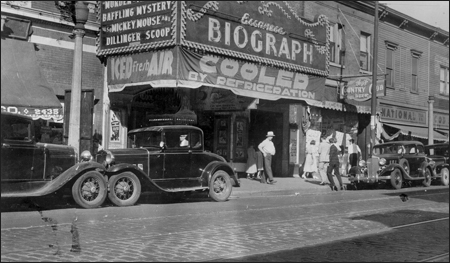
The Biograph Theater. FBI photograph taken in 1934, shortly after Dillinger was shot dead outside the theater, by FBI special agents.


The Bonnie & Clyde death-car. Texas and Louisiana Sheriff’s officers opened fire on this vehicle in an ambush, killing Bonnie & Clyde as they tried to escape.

Fighting with the Enemy.

Killing Public Enemies was not easy. They were often heavily-armed with shotguns, pistols and machine-guns. One of the most famous machine-guns in the world made a name for itself during the 1920s and 30s; they called the Chopper, the Chicago Piano, the Chicago Typewriter…they called it…the Tommy Gun.

The Tommy Gun, or the Thompson Submachine Gun, was the brainchild of General John T. Thompson. He envisoned a compact firearm, capable of firing bullets in quick succession, and which was light enough to be used by one man. His invention was the Tommy Gun. The first prototypes came out in 1918, and they were meant to be used by Allied soldiers fighting in the Western Front of WWI, but by the time the guns were ready for shipment, the war was over. However, gangsters soon found that the Tommy Gun, being easy to operate, relatively light, compact and with a high rate of fire (600rpm!), answered all their prayers about an efficient killing-machine. The Tommy Gun came in several designs, but the most famous one was the M1928, with the distinctive, drum-magazine.


The Thompson M1928.

The Thompson was used extensively by both gangsters, police and FBI agents in their war against crime and against criminal agents. It was a gun that remained popular well into WWII and Vietnam, even though by that stage, it had already been declared obsolete. Even though the Tommy Gun performed admirably during WWII, it remains as the iconic weapon of the gangsters of the 1920s and 30s and the Public Enemy Era.

The End of the Line.

In the event that lawmen or FBI agents actually arrested these robbers and kidnappers, thieves and murders, these gangsters, these…Public Enemies…what happened to them after the trial?

It was pretty clear that they couldn’t just be chucked in jail. Oh no. Not just any jail. Regular jails weren’t good enough for these guys. And I mean that literally. John Dillinger alone, busted out of at least two. It became abundantly clear to the FBI and other law-enforcers, that a special place had to be created for these bozos. And so…they did create a special place. A special place that still exists today. You can even go and visit it. I’ve done it myself. What is this special place?

A little island off the coast of San Francisco, California, located in the middle of San Francisco Bay. A tiny, little island with a big past and even bigger residents. A little joint called…Alcatraz Island.

Alcatraz had been a prison almost from the day European settlers discovered it. It was a military prison, it was an army barracks, it served as a temporary prison after the 1906 San Francisco earthquake…but in the 1930s, it recieved a new name. US. Federal Penitentiary: Alcatraz Island; popularly known as…The Rock.

And Alcatraz Island really was a rock. When US. law-enforcement and prison officials decided to build a prison there, they had to ship EVERYTHING that they wanted to be on the island, TO the island; even the soil! Alcatraz was a rock in the truest sense of the word, in that barely anything grew there, as there was no soil for it to grow in! But by 1934, the prison was opened. It recieved some very famous inmates, such as Al Capone himself. Such as Robert Stroud, Machine-Gun Kelly and Alvin Karpis, to name but a few of the famous, 1920s and 1930s crimnals who contributed to the Jazz-Age and Depression-Era crime-wave. A famous line from the film “Escape From Alcatraz” summed up Alcatraz’s role very nicely: “When you disobey the laws of society, they send you to prison. When you disobey the laws of the prison, they send you to US. Nobody has ever escaped from Alcatraz…and nobody ever will”.


Alcatraz Island as it appears today. At the very back you can see the lighthouse (still operational today). In front of it is the main cellhouse, where prisoners were kept. In front of that is a high, walled yard, which was the exercise yard. Prisoners arriving on the island got off at the dock, located on the east side of the island (on the left, in this photo).

And yet, despite these bold words, no less than 14 escape-attempts, involving a total of 36 inmates, were carried out, during the prison’s 29 years of operation. Of these, only one was ever truly successful (if you can call slumping ashore in San Francisco half-dead from hypothermia ‘successful’). But despite this, for nearly 30 years, Alcatraz was America’s dumping-ground for its most hardened crooks. Some prisoners were sent straight there, while others were transferred from other prisons. When the prison was opened, messages were sent out to all the prison-wardens throughout the US, inviting them to wash their hands of their most dangerous inmates, and to send them on to Alcatraz where they could be locked up, safely and securely.

The End of the Public Enemy.

By the end of 1934/35, the FBI had risen to prominence. With its brutal efficiency and fast actions, it had managed to sweep up nearly all the major players in the Public Enemy game, and a legendary crime-wave was soon a thing of history.

Archie, Aces and Airspeed: Aerial Combat during the First World War.


In 1903, two brothers who ran a bicycle-repair shop, created the world’s first successful, heavier-than-air…gasp!…FLYING machine! People marvelled at a new contraption called the ‘airplane’ which could take off, fly where-ever the pilot wanted it to, and then land safely again. They thought that this was a magical new invention that could do marvellous things for mankind and spur it onwards to a new age of technology, science and transportation.

Well, Orville and Wilbur Wright thought so, anyway.

In fact they thought so, so much, that once their newfangled ‘flying machines’ were perfected and reliable, they took their courage by the balls and went off to all the national militaries of the early 1900s. They approached the American, British and even French armies, toting their new toy as a practical weapon and machine of war. With airplanes, you could spot troop-movements, direct men and see the entire battlefield! Armies were so excited about these amazing possibilities, that they jumped on the new invention!

Or…they would have, in a perfect world.

The truth was that most of the commanding officers and generals, all thought the Wright Brothers’ invention was something of a joke, and saw no practical application for this contraption in their arsenals and warehouses.

Just over ten years later, however, they were singing a different tune.

The first Airplanes.

The very first airplanes were used purely to demonstrate that powered, controlled flight was possible. But that was all they were used for. People just didn’t see how such flimsy, wood and cloth machines could be practical in any way other than to provide cheap, five-minute thrill to excited little boys and girls at funfairs! However, this perspective quickly changed with the onset of the First World War.

In the hell of the Somme, Flanders, Passchendeale, Ypres and the Marne, generals began to realise that having ‘eyes in the sky’ that could tell you where things were, would be a huge advantage. Suddenly, the allies didn’t think the Wright Brothers were stupid after all, and a few months after the war had started, airplanes were being used in warfare.

The first planes used in warfare just flew around taking photographs. Fun, huh? They were reconnaissance aircraft, gathering valuable military information. Airplanes were able to fly over enemy trench-systems, photograph them and then fly home, relatively unscathed from enemy fire. Knowing the layout of enemy trenches allowed generals the opportunity of finding weak-spots in enemy defences.

Fighter-Planes.

Originally, German, English and French pilots just flew around each others trench-systems taking snapshots, but soon it was realised that such activity should not be tolerated! The airspace above your trenches was YOUR airspace, and to hell with anyone trying to break into it! To this end, pilots started becoming more aggressive with each other. Pilots began taking to the air with revolvers, grenades, rocks and lengths of rope, to shoot, bomb, damage or entangle their enemies. New weapons called anti-aircraft guns were placed around entrenchments to shoot down hostile aircraft. They fired explosive or incendiary rounds, known during WWII as ‘flak’, known during the Great War, by the name ‘Archie’. A new era of warfare had begun.

On the 1st of April, 1915, April Fools’ Day, a French pilot named Roland Garros made history. His plane, the first of its kind in the world, flew into the skies and shot down a German pilot and his plane. While this was not the first air-to-air kill (people had been shooting, bombing and throwing stuff at each other, 1,000 feet up before Garros came along), this was significant because of the type of plane that Garros was flying. It was the first plane specifically designed for aerial-combat, having machine-guns and triggers which the pilot could aim and fire during flight! The Fighter Plane and the Fighter-Pilot had been born!

Aerial-combat, in which planes fought against planes, pilots against pilots, was the latest form of warfare in a war which was rapidly changing everything it touched. Unfortunately for the allies, Garros was shot down and his plane crashed in German territory. Garros survived and was taken prisoner, but his valuable flying-machine was not completely demolished on impact. Before he could set the plane on fire, the Germans had captured it and were soon turning out fighter-planes of their own!

The affect on Allied morale was devastating. Until that point, the British and French had ruled the skies, but now, the Germans had planes that could match theirs! The French and British started making newer, faster, more powerful planes and the era of Aces had begun.

Aerial Aces.

An ‘Ace’ is a pilot who is exceptionally skilled, and who can successfully shoot down enemy aircraft. Now that aerial combat was well-and-truly established, it was time for men with courage and balls to really show what they could do.

To understand just what this was like, you need to understand just how the men were fighting. If you’re picturing sleek, modern airplanes with enclosed cockpits and armour-plating and all that stuff…forget it! WWI fighter-planes were little more than box-kites with engines on them! The majority of the plane was made of wood and canvas! The fuselage was wood, canvas, two pairs of wings, an engine, cockpit and propeller and a wooden rudder and tail-fins at the back. These planes were very light, but also very delicate. If you put your foot in the wrong place, it ripped through the canvas and out you went!

Pilots in planes such as these could expect to be incredibly uncomfortable. Enclosed cockpits did not exist, and the only protection they would have had against the stinging, freezing wind, would have been their leather jackets, flying caps, goggles and maybe some gloves to stop their hands freezing from the windchill! Oh, and scarves. Pilots wore nice, long white scarves. Not to look cutesy for the ladies, but to prevent…skin-irritation, of all things. Without radar, the only way to spot enemy planes was to literally turn your head left and right to search the skies for them. All this twisting and turning rubbed your neck against the collar of your jacket and this could make you very uncomfortable. In a situation where the last thing you want to be, is uncomfortable, the scarves provided much-needed padding to prevent skin-chafing, as well as an extra layer of badly-needed warmth!

Back then…and even today…an instance of aerial combat between two opposing pilots is called a ‘dogfight’. They were called dogfights, probably, because pilots literally flew at each other like mad dogs. Planes could come within inches of smashing into each other and they fired their guns willy-nilly, trying to hit each other. Dogfights were fierce, fast, lethal battles of skill, courage, balls and determination. If you got shot down, you could expect a plunge of several thousand feet to the earth below. Your plane could explode in mid air, it could catch fire, or you could fall out of your cockpit. Few pilots carried parachutes back then.

When planes flew out in ‘sorties’ (a ‘sortie’ is a mission), they would fly out in groups set in strict formations. Pilots organised their planes so that they could attack the enemy as effectively as possible. Planes and their pilots were organised into groups called ‘squadrons’. Each squadron, or squad, had a ‘sqaudron leader’, usually the best pilot with the most experience. His job was to lead his men into battle and to direct the other pilots through the air so that they would know where to go and how to act. In the days before aerial radio-communications, hand-gestures were used to direct your fellow pilots through the air. Squadron leaders usually had their planes painted or marked in some way, so that they would be easily-recognised by Allied pilots during combat. The universal sign of ‘rocking wings’ (moving your wings up and down), was the signal to return to home-base. Better to crash on home soil than in enemy territory.

Taking down an enemy aircraft was difficult at best. Machine-guns were still fairly new weapons back then, and they were prone to jamming during dogfights. Apart from that, you had to find your target before you could shoot at it. And when your target is a plane zooming all over the skies, this is difficult at the best of times. There’s no heat-seeking missiles, there’s no target lock-on, there’s no laser sights, it’s just you, your plane, your guns and your eyes. Everything was done by hand and everything was done manually, using your own judgement, timing and skill.

The most famous Ace of all, was a German pilot. His name was Manfred von Richtofen, more famously known as ‘der Rote Baron’;…The Red Baron. The Baron was credited with somewhere in the neighbourhood of 80 confirmed kills. While 80 doesn’t seem very impressive today, it was damn impressive back in 1917, when aerial-combat was how I described it above. Unfortunately for Richtofen, he was shot down and killed on the 21st of April, 1918. The man credited with shooting down the Red Baron and killing him, with a bullet to the chest, was an Australian soldier named…Cedric Popkin! Popkin was a soldier in the First AIF (the First Australian Imperial Force). At the time of Richtofen’s death, Popkin and his men were manning Vickers anti-aircraft machine-guns and it was Popkin’s firing which shot the Baron and brought down his airplane, his famous Fokker Dr. 1, painted bright red.

Bombing Raids.

Apart from reconnaissance, protecting airspace and spying, airplanes in WWI had another major role to play – air-raids.

Various aircraft, such as the famous Sopwith Camel, were combination fighter-and-bomber aircraft, meaning that they could drop bombs as well as fire machine-guns. In later stages of the war, generals began to see even more possibilities for these newfangled machines, specifically in their ability to bring death to the enemy in ways previously unimaginable.


The Sopwith Camel, a typical, WWI-era fighter biplane.

By 1917, when aerial-combat and warfare was firmly established, Allied airforces and Allied armies began to collaborate with each other in an effort to pool their resources, skills and manpower to win battles. Some later battles went like this…

First there would be an intense artillery barrage, bombing and shelling the enemy trenches. At an appropriate time, rows and rows of tanks rumbled across No Man’s Land, shooting at the enemy soldiers who had survived the artillery barrage. While the tanks moved forward, infantry marched behind, taking advantage of the covering fire provided by the tanks, to engage enemy infantry. Upstairs, Allied bomber and fighter-planes flew overhead, strafing (raking) the ground with lethal swathes of machinegun-fire, killing soldiers in the enemy trenches, followed by intense, aerial bombardment, while below them, their Allied army buddies pressed on to take their target trenches. The airplane had proved its worth as a practical and useful machine of war.

“Over the Top!” – Life in the Trenches during WWI (Pt. I)


From early 1914 until November 1918, the world was at war. The ‘Great War’, as it was then called, inflicted upwards of six million casualties from over six different countries and mankind saw a new kind of mechanical warfare so devastating that many prayed that it would never happen again.

Known today as the First World War, this conflict pitched the countries of Canada, France, Italy, Australia, the USA, Great Britain and Russia against Turkey, Germany and Austria-Hungary in battles where men died in their thousands for just a few yards of earth. WWI was a disaster of epic proportions, throwing 19th century tactics against 20th century technology, the resultant explosion reverberating across the following decades to the present day.

One of the most enduring images of the Great War was trench warfare. Trench warfare was brutal, sloppy, slimy, smelly and sickening. Vomit-inducing, sleep-depriving, smelling of piss, shit, rotting flesh, stagnant water…and that was when you weren’t being shot at, gassed, shelled to Kingdom Come or having to shoot back at enemy soldiers charging towards you!

From mid 1914 right up to the day the war ended in 1918, trench-warfare remained a staple of life during the ‘Great War’. It remained like it did for so long because nobody could figure out how to successfully attack trenches without having the living shit blasted out of them or being mown down by machinegun-fire. Commanding officers pitched men against men using 19th century tactics and strategies and 20th century technology, which is about as useful as trying to storm a building filled with heavily-armed terrorists with a peashooter. Given that trench-warfare lasted so long…what was it actually like living in a hole in the ground for so long?

Digging the Trenches.

Before you could live in a trench, you had to dig it out. Digging took ages, even with the thousands of men with shovels. Trenches were roughly seven to eight feet deep, about six feet wide, with a drainage channel at the bottom, which was covered over by a type of planking (which would create a semi-sturdy walkway), called duckboards. Trenches literally stretched for miles and miles and miles and MILES. From southern France, they headed north, all the way to the North Sea. And it wasn’t just the ONE trench. There were dozens of them. First you had the ‘Front Line’ trench, and then behind that, you had communications trenches, and behind that, more trenches, and then to protect everything, you had machine-gun nests, barbed wire, landmines and sandbags. It’s little wonder that these things were so damn hard to capture! Trench-systems could be small cities in themselves!

Apart from the trenches, there were also ‘dugouts’. A dugout is a tunnel or underground chamber where officers could live and work, relatively protected from the rain outside. Dugouts were reinforced with wood and sheet metal and they provided a tiny bit of comfort for the men. The trenches themselves, once they had been dug out, were reinforced with wood, metal and reeds, woven to form a sort of basket-type mesh. All these things prevented the walls from caving in.

Living in the Trenches.

You’ve dug the trenches, you’ve fortified them, laid down duckboards, put in reinforcements and planking and dugouts and electric lighting…you can pack up and go home!…Right?

No.

You actually had to live IN the trenches. Not for very long, perhaps a few days, a couple of weeks at any one time. That was provided you actually survived the two weeks. If you did, you could head back behind the lines and chill out on leave. Otherwise…it was in the trenches. And life in the trenches was crap at the very best of times.

One thing the commanders hadn’t counted on when they ordered their men to ‘dig in’, was the lay of the land. Unknown to the French and British COs, the land in which they were going to dig their trenches, had the water-table just a few feet below the ground! In some places it wasn’t so bad and you could go down the whole six, seven or eight feet into the earth. But in other places, the water table was barely four or five feet below the ground! If you dug any further, you’d be standing in a canal! In cases like this, soldiers stopped digging at four feet, and just stacked up sandbags to make up the additional three feet, but with trenches so close to the waterline…you can imagine what happened next.

Flooding. And a lot of it.

Not just a few inches or milimeters of water to grumble over that got into your socks…I mean SERIOUS flooding. Water could reach two or three feet deep and men would be sloshing through trenches turned into rivers, in muck up to their waists! Given that even in the nicest of weather in Europe, it can still pour down and be freezing cold, you can bet this was one of the worst things that soldiers had to put up with.

Well…you’d be wrong. Because there’s worse. Much worse.

If you just said ‘Aww rats!’…you’d be right.

As the war continued, there were thousands of dead bodies all over the battlefields and nobody had the time (or indeed, the PLACE!) to bury all the corpses. These corpses brought rats. Hundreds of them. They feasted on dead bodies, eating at them until only skeletons remained. They grew fat and even hungrier and it wasn’t uncommon for soldiers to go around shooting all day long…not at the enemy, but at rats! They tried to do everything to get rid of the rats…drown them, gas them, club them…Some would even spike cheese onto their bayonets. When the rat started eating the cheese, the soldier pulled the trigger on his rifle. BAM! Rat gone! But for every rat they killed, there were hundreds to take their place.

Food in the trenches was pretty basic, too. The support-trenches, further back from the front line, were supposed to be able to supply soldiers with hot, freshly-cooked food, but since the trenches were being shelled, gassed or bombed every other day of the week, you can bet they didn’t get much of that home-cooked goodness. You try preparing a meal for 10,000 starving soldiers when artillery-shells and mortars are crashing all around! It’s not easy!

Most men survived on canned or otherwise preserved food. They ate biscuits, salted meat, whatever vegetables and fruit they could find, together with…chocolate. Yes, chocolate. When you’ve got almost nothing else to look forward to, a nice bit of Cadbury’s or Whitman’s goes a long way. In fact in both world wars, the Whitman chocolate company (famous for its yellow ‘Whitman’s Samplers’ boxes), sent boxes of candy overseas to Europe to feed Allied soldiers!

What goes in has to come out…right? Where did you go to the toilet?

Well…you see that empty patch of land there which nobody’s using? Take your trowel, some old newspapers..and commune with nature. There were no toilets, and if you had to go, you had to make your own toilet, digging a hole in the ground. Some trench-sysems actually had specifically-dug sewerage-channels where soldiers could go and relieve themselves. But after three days of heavy rain…you can imagine where all the stuff in the sewerage-channel ended up…Yep…right back in the trenches!

Health in the Trenches.

Given the appalling living-conditions, it’s no surprise that disease was a BIG problem on the Western Front. Common trench ailments included headlice and ‘trenchfoot’. Headlice were such a problem that most men gave up trying to keep the lice out of their hair! Instead, they just got a pair of scissors and a razor and shaved themselves bald! The other common trench disease was something called ‘trench-foot’.

Trenchfoot is a bit like ‘athlete’s foot’…only a hell of a lot worse. It comes as a result of spending hours every single day, standing in stagnant, freezing, disgusting water and never giving one’s feet enough time to fully dry out. When you consider that the trenches were flooded half the time, you can imagine how bad trenchfoot could get. A soldier was useless if his feet were so infected that he could barely walk! Commanding officers had to make it a rule that ALL MEN were to change their socks on a regular basis to keep their feet dry and clean to prevent trenchfoot. As the war progressed, trenchfoot did eventually go down, but it never completely went away and isolated cases continued to pop up throughout the duration of the war.

Another medical condition which came to prominence during the war in the trenches was a mental incapacitation called ‘shell-shock’, what people today like to euphamistically call ‘post-traumatic-stress disorder’. Shell-shock had been known of before the Great War, but it had never been seriously examined until so many cases of shellshock started popping up during the mid 1910s! And shellshock is a lot more than just irritability or not being able to sleep…it could turn men into shivering, jibbering, glubbering wrecks, barely able to function in civilian society.

Shell-shock got its name because it was caused by artillery-shells. Before a big offensive move, the enemy (or you, depending on who was moving where), would shell the other fellow’s lines with artillery and mortar-fire. INTENSE fire. I don’t mean just a few minutes of ‘boom-boom-boom, let’s go boys!’, I mean REALLY INTENSE FIRE. A proper artillery-barrage could go on for hours…even days! Shell-shock was caused by the mental anguish inflicted by these barrages. Imagine that you’re a soldier in a trench…and you hear artillery-fire in the distance. Sooner or later, you’ll hear the high-pitched shriek of the shells sailing downwards towards you. In most cases, you won’t see them until it’s too late. You’ll have about a split-second to run before the shell slams into the ground and destroys everything around it! That’s just one shell. Imagine a hundred, two hundred, three hundred shells…all being fired at once, for hours and hours on end, day and night. The noise, the panic, the fear and the severe sleep deprivation was enough to send a man literally raving mad. Some cases of shell-shock were so bad that the men literally became shivering, nervous wrecks.