A Random History of Popular Foodstuffs – #2


This is a continuation of a previous posting, which I wrote a couple of years back. And it will cover the histories behind more popular foods which we take for granted today.

Jelly!

Mmm, jelly. Cold, jiggly, wobbly, sweet, wiggly, wriggly jelly! Or, as the Americans call it…Jello, which is actually a brand-name, not an actual foodstuff. But jelly it certainly is.

These days, we associate jelly with dessert, with children, with ice-cream, and with catchy little TV jingles (“I like Aeroplane Jelly, Aeroplane Jelly for me…“). But for centuries, jelly was a luxury food. Incredibly laborious and time-consuming to produce, it could only be eaten by the richest of people, during only the most special of special feasts, dinners, parties, holidays or other significant occasions in a history that dates back to medieval times.

We’re familiar with jelly as that stuff that you buy in a packet. You pour the powder into a bowl, you mix it with water, you pour the sloshy, syrupy mixture into a mold, and then chuck it in the fridge or freezer to cool and set, into pretty, jiggly shapes which are red, and green, and yellow and purple, and which look like everything from flowers to pyramids.

That’s what jelly is today. But in older times, jelly was obtained only after hours and hours and hours of extremely labour-intensive work. Jelly wasn’t simply mixed with water and chucked in a cold spot. It was boiled, and strained, and purified, in a process that would eat up almost all the hours of the day. This is why it was eaten by only the wealthiest people, who could afford the servants and the time to make it.

So how do you make jelly the old fashioned way?

To make jelly as they might’ve done back in the Middle Ages, you first required gelatin. Gelatin comes from collagen, a type of protein. And you get collagen from…

…pigs.

For centuries, well up to the Georgian era, the only way to make jelly was to boil the feet of pigs or cattle. In an incredibly time-consuming process, the salvaged pig’s feet would be placed in a pot of boiling water. The pig’s feet and water would be left to boil for the better part of eight or ten hours. This intense boiling extracted the gelatin from within the pigs’ feet, and mixed it with the water. Once the gelatin had been boiled out, the entire mixture had to be strained. First, it was strained to remove the pigs’ feet. Then it was strained to remove any debris. Then it was strained to remove any fat. Then it was strained to remove any impurities. And then it was strained again. And again. And again.

The repeated straining and purification removed all the impurities from the mixture so that in the end, you were left with nothing but water, and gelatin.

Left on its own in a suitably cool spot, the gelatin would eventually solidify. If you wanted flavoured jelly, then it was simply a matter of mixing in the required fruit-juices, such as lemon, lime, orange, strawberries and so-forth. These extra ingredients being added, the entire mixture was stirred up, poured into a mold, and then dunked in the cellar (or other suitably cold room) to solidify and set.

It seems easy, but when making jelly could take the better part of the entire day, and could require the efforts of at least two people (there’s a lot of water to strain!), you can understand why, for centuries, it remained a food for the wealthy. Poor people simply did not have the time, the money, or the space to dedicate, or waste, on such a frivolous dessert.

It was not until the mid-1800s, when it was discovered that you could dry out the mixture and create gelatin powder, that it was possible to sell gelatin in a convenient packet for the average consumer. All the buyer had to do was mix it with water to help the powder congeal, flavour it to his or her taste, pour the mixture into a mold, and set it. Before that was possible, hardcore boiling and tiresome straining and purifying was the only way to make jelly.

Sausages

Oooh, we all love sausages. Beef, pork, chicken, lamb…delicious!

These days, sausages are made out of synthetic casings, although there is a significant number of sausage-makers and butcheries, which are manufacturing sausages the old-fashioned way.

We love sausages. Convenient, easy to cook, easy to hold, easy to store and easy to hang up on a peg. We even have gourmet sausages stuffed with herbs and spices and cheese. But the origin of the sausage is far from gourmet.

Imagine a cow, or sheep, or chicken, or a pig. You’ve gutted it, you’ve taken off the ham, the bacon, the ribs, the cutlets, the various cuts of steak, the wings, the legs, the breasts, and everything really worth eating. What did you do with the rest? The carcass that’s left over?

Bones might be used to boil up for soup. Feathers, wool or fur might be removed for clothing. But there’s still the leftover carcass and the organs and innards that nobody wants. Now what?

If you lived in older times, you certainly did not throw it out. Catching and killing animals was hard work, and cooks were encouraged to cook and eat every single part of an animal which was worth eating…even the organs. Or the feet (if they weren’t being saved for jelly…). Or the head. The cheeks. Anything that wasn’t already removed. The offal, basically.

But how to dress the dregs of animals so that they looked appealing?

One way to do this was to take the intestines of the animal, pump water through them, wash them clean, and then fill the intestines with ground up animal leftovers, twist them into convenient lengths…and sell that, if you were a butcher, to your unsuspecting customers, or serve it to your diners, if you were a cook. It was still meat. It was still beef. Or pork. Or chicken. Or lamb. It was just…um…’modified’.

And that’s all a sausage is.

…did I put you off of your dinner yet?

In older times, all the leftovers from a dead animal were diced, sliced and minced up. Then, these animal unmentionables were pumped into the cleaned out intestines of the animal in question. The big long sausage was twisted around, every few inches, to make sausages of convenient lengths, and then the whole thing was cooked up.

Some butchers still make sausages like that today, although most cheaper sausages use edible plastic or synthetic sausage-skins instead. But it is, nonetheless, how it was done.

…Hotdog, anyone?

Pies


Pies…Cake is the lie

Mmm. We like pies. Chicken pie, beef pie, steak and kidney, apple, blueberry, custard-cream…sweet, savory, spicy, simple, splendid. We love pies!

One of the reasons we love pies is because they’re fun to make. We love creating pretty, patterned crusts, with cris-crossing strips, vents held open by pie-birds, pastry-leaves, and pretty, rippling, wavering sides.


A pie-bird. These painted clay birdies are stuck into the middle of pies to stop the pie-crusts from sagging during baking, and to provide a vent for steam to escape

But for all the effort, we know that before long, the crust and sides will be broken up, carved up, and devoured. And all our efforts will be dashed in a flurry of gravy, cream, sugar and crumbs.

But our love-affair with pies is only the end of a very long journey.

With pies, cakes and tarts, comes an interesting history.

Takeout Pies

For a long time, pies were not even baked at home. We have a romantic image of pies cooling on the window-sill after they’ve been baked, the wonderful smells wafting around the neighbourhood. Which they may well have done; but it’s a rather modern thing.

For centuries, pies were never baked at home. Until the introduction of the range stove in the 1700s, it was well outside the ability of the ordinary man or woman to do his own baking at home. Most homes did not have ovens. They had fireplaces. Fireplaces are great for roasting meat, for cooking stews, boiling soup and providing heat and warmth, but they’re impossible for baking on. The smoke and flames and soot from the fire would destroy the pie, and the constantly wavering heat from the flames meant that the pie wouldn’t bake properly, anyway.

For a long time, pies were actually sent out to the nearest bakery to be baked. Here, the village baker would bake your pies for you. You dropped them off, and he marked the top of your pie in a manner that made it stand out (so you knew which one was yours, to differentiate it from the dozens of other pies in town!). He baked it, and then you came back later and picked it up.

The nursery-rhyme ‘Pat-a-Cake‘ recalls this era of history:

“Pat-a-cake, pat-a-cake,
Baker’s man, 
Bake me a cake as fast as you can,
Prick it, and poke it, and mark it with a B,
And put it in the oven, for baby and me!”

In the rhyme, just like in real life, a cake or pie was marked (‘with a B’, in this case), to differentiate Baby’s cake, or pie, from all the others in town, which were being baked at the same time, in the communal oven.

But before you even baked the pie, you had to put something into it. Filling! Back in medieval times, pie-fillings were a little more creative than what they are today. Two of the most common filling-choices gave us two of the most lasting, pie-related nuggets from history.

Before people got the idea of grinding up animal-guts and turning them into sausages, animal entrails were chopped up, boiled, and stuffed into a pie-casing. This pie was baked in an oven, and then served to the peasantry, low-ranking servants, and paupers. Entrails and guts and organs were called “umbles”. Serving “umble pie” to the poor gave the peasantry a constant reminder (as if they ever needed one!) that they were on the lowest rung of the social ladder, because all they could eat was…’Umble Pie”, or “humble pie”, as it eventually became to be called.

These days, we’re used to separating sweet from savoury. You’d hardly have a beef and custard pie, would you?

…would you?

Sweet’n’Savory

Believe it or not, but in medieval times, pies that mixed sweet with meat, were pretty common! Beef would be mixed with raisins and dates and prunes, and baked together in a pie. This wasn’t necessarily because people liked it…but rather because it was one of the few ways that people had, to stop food going stale!

The natural sugars found in fruit were used as a preservative to prevent the meat from going rotten. And often, fruit and meat were baked together, for this purpose.

These days, we don’t bake our meat and fruit together in a pie anymore. But we do have a leftover from that period – the Christmas “mince pie”. There isn’t any beef mince in these pies, but they’re called mince pies because they were originally made with meat, with the fruit acting as a preservative. Over time, the beef was removed, giving us a simple fruit ‘mince’ pie, the kind we know today.

Empty Shells

No, not shotgun-shells or bullet-casings…pie-casings!

The tradition of eating a pie, sweet, savoury, or a mix of the two, together with the crunchy pastry crust and casing, is actually a pretty modern development.

For much of history, when a pie was eaten, the pastry lid was removed, the contents (today, the fillings) eaten, and then the pie-casing (and the lid) was put back in the kitchen to be reused!…Again…and again…and again! For as long as the crust and casing remained fresh.

Why bother using the crust and casing when you have a pie-dish, though?

You have to understand a couple of things here…

This is a time before widespread refrigeration. Meat had to be cooked and eaten within 48 hours of being purchased fresh from the local market. There was nowhere to store it for longer than overnight without it going stale (unless you froze it, smoked it, or salted it).

To prevent meat going bad, cooks would bake it in a pie. And cooking the meat meant that it lasted longer and you could eat it, of course!

But why save the pie-crusts?

Until relatively recently, flour, the main ingredient in pie-casings, was an expensive commodity. Very expensive. In medieval times, the only way most people could get flour was to grow their own wheat, thresh their own grain, winnow their own wheatgrain, and then grind it by hand, or grind it at the mill owned by the local landlord (for which the peasantry had to pay taxes to use!). Even in later times, flour was expensive, and only the wealthy could afford to eat the fine, sifted, refined white flour which we love so much today. This was because the extra effort required to refine it made it more expensive.

The result? Most people couldn’t afford enough flour to bake a pie for every day of the week. You’d use up your flour to bake your pie and the meat inside. Then you’d use the same pie-crust over and over and over again until it started going bad, before eating it on the last night of the week. This was to make your flour last for as long as possible.

And the pie-crusts of older times are a lot different to the ones made today. Most people would complain…loudly…if you served them a pie with a crust that was too thick, since it would be impossible to crunch into, or get a fork or knife through. In the days of serfdom and lords, pie-crusts could be upwards of an inch or two in thickness! This was so that they would last through the repeated bakings without burning and charring in the oven.

Bread

Not for nothing is bread nicknamed “the staff of life”. For centuries, millenia even, all over the world, mankind has survived on bread of some variety. Whitebread, wholemeal, mixed-grain, sourdough, rice-bread, cornbread, pita-bread…the list is almost endless. But what is the history of bread?

The origins of bread go back to the dawn of civilization. And its importance is just as up-there as its history. Hell, the Romans even created a whole ROOM just for bread. Ever wondered why your kitchen has a ‘pantry’? It comes from the Latin word ‘Panna’ or…bread. A ‘pantry’ was the room in which bread, a staple of life, was stored. But here’s a few things you may not know about bread…

The Upper Crust

The “upper crust” is a common expression meaning those of a higher social status, up there in the upper-class economic group. But have you ever wondered where the term ‘upper crust’ came from?

Yep. Bread.

Before the first modern stoves were invented in the Western world (Ca. 1700), baking bread was a hot, dangerous and ashy affair. Here’s how it was done…

The dome-shaped bread oven was filled with wood, which was then set on fire. The oven door was left open and the huge fire inside the oven was allowed to burn for hours, until it finally burnt out. Once the fire was out, the baker had the unenviable task of raking out the hot ash, charcoal and cinders, and shoving in dozens of loaves of bread at a time, using those big, wooden baking-paddles (so he didn’t burn his hands).

Burning a fire in the oven, and letting it burn down to ash made the brick (or stone) inside the oven extremely hot. And it’s this heat, and not the heat from the fire, which actually bakes the bread. Once the bread was shoved in as quickly as possible, the oven door was shoved on, and extra bread-dough was stuffed around the edges of the door. This had the double-job of sealing in the heat, but also acting as an oven-timer. You could tell when the bread inside was baked by checking whether or not the dough on the door was also baked.

When the bread was baked, the door was ripped off, and the bread hauled out on paddles again.

Everything about baking bread relied on speed. It took so long to build, light and burn down the fire that bakers wanted to get the ash out of there, and the bread in there, as fast as possible. The result is that there was always a thin layer of ash on the oven-base. And during baking, this ash and soot would stick to the bottom of the loaves of bread. Eugh!

Picky rich people who wanted the best bread, would slice the loaves horizontally instead of vertically, so that the burnt, sooty bottom crust of the bread was given to the poor – the paupers, beggars and lepers, while they…the rich…kept the crunchy, soft, soot-free…upper-crust…for themselves!

Don’t Sit Under the Apple Tree…

Anyone who’s ever baked bread at home will know that one of the most frustrating things is the wait while the dough rises. After the bread-dough has been mixed and kneaded, it’s necessary to leave it alone so that the yeast inside the dough can expand and let off gas, which allows the dough to rise, before it can be put into the oven.

But what if you didn’t have yeast, one of the key ingredients in breadmaking?

If you don’t have yeast, you could do what medieval bakers used to do. Take the bread out into the back yard, or nearest available orchard, find a suitable apple tree, and stick the yet-to-rise bread-dough underneath it! And let nature take its course, as they say.

Yes. This actually works. And it works because apples, which grow on apple trees (see, you learn something reading this blog…), are full of yeast. And apples on the ground, rotting off, let off yeast fumes, which will help your flaccid loaf to fluff into life before its date with destiny. The yeast in the apples is the same reason why it’s possible to make alcoholic apple cider; yeast is also a key ingredient in beer!

Hungry for More?

The “If Walls Could Talk” documentary episode “The Kitchen”, and the documentary “Tudor Feast” will supply you with some tasty information.

What’s that Tune? The stories behind famous pieces of music


You hear them all the time on television, in kids’ cartoons, in movies, in advertisements on the radio and in the ad-breaks between your favourite TV shows. But what are the stories behind these iconic pieces of music? Here’s a selection of some of the most famous pieces of music you might not know anything about, and the stories behind them.

Title? Ride of the Valkyries
Who? Richard Wagner
When? 1870
What? From the opera “Die Walkure

Commonly used in cartoons, and TV shows to symbolise impending doom, destruction or the coming of some great conflict, the Ride of the Valkyries dates back to 1870. It was originally written for the German opera “Die Walkure” (“The Valkyries“), by Richard Wagner. The Valkyries was one of a series of four operas written by Wagner at the time.

Ride” plays at the start of the third act in the opera. Its dramatic and triumphal melody is designed to accompany the arrival of the valkyries (characters of viking mythology), whose task it is to select which viking warriors will die in battle, and the souls of which, the valkyries deliver to the god, Odin, ruler of Valhalla, the Viking world of the dead, where warriors who have died in battle are honoured for their bravery and skill.

Today, the “Ride” is most famously remembered from the film “Apocalypse Now”, but its fame dates back over a hundred years to the grand opera-houses of Germany and Austria.

Title? Tocata & Fugue in D Minor, BWV 565
Who? Johanna Sebastian Bach
When? Ca. 1704
What? Organ piece

Although most people have never listened to the whole thing, the first eight notes of Bach’s Tocata & Fugue in D Minor are recognised around the world, for their haunting, eerie, creepiness. Used in cartoons and other TV shows for setting the scenes in scary old Victorian houses, isolated haunted mansions, spooky abandoned castles, and grandmother’s dusty basement, where the lightbulb never seems to work properly, the Tocata & Fugue in D minor has remained famous for over 300 years!

Exactly WHEN Bach wrote the Tocata & Fugue is unknown. The closest date that anyone can figure is ca. 1704/5. In fact, it’s not even established that he wrote it. See, the problem with Bach’s collection of work is that he never signed any of his compositions! So it’s almost impossible to say if he wrote anything at all. The only method of determining what works can be genuinely attributed to him, is by reading the diaries, letters and other accounts left by his contemporaries.

Indeed, almost no copies of Bach’s original compositions, penned by his own hand, survive. Nearly all of the oldest copies which we have today, were once copied out by Johannes Ringk. Ringk (1717-1778), was a German composer, organist and music-teacher. And its his copies of Bach’s works which are among the oldest known to survive. Ringk’s copy of Bach’s famous organ-piece is likely taken from another copy, by Ringk’s fellow organist, Johann Peter Kellner (1705-1772), who copied the original Bach composition, ca. 1725. The original composition, which Kellner likely copied, has been lost to history, and no copies of the Tocata & Fugue, as penned by Bach, survive today.

Title? In the Hall of the Mountain King
Who? Edvard Grieg
When? 1876
What? From the Norwegian opera “Peer Gynt

One of the most famous operatic orchestral pieces in history, ‘In the Hall of the Mountain King’ is recognised instantly from its tiptoe start, its gradual increase in volume, and the eardrum-busting crescendo! But what purpose does this piece of music serve?

Mountain King” comes from the 1873 opera, “Peer Gynt“, a fantastical theater play, or…fairytale!

Originally, the story was called “Per Gynt” (“Peter Gynt”), and was a traditional Norwegian fairy-tale. Norwegian dramatist, Henrik Ibsen used the fairy-tale as the basis for his grand masterpiece theater-production, and Edvard Grieg’s famous piece of music was written for one of the scenes.

In the play, the main character, Peter Gynt, is disgraced. After dashing the hopes that his mother had held, for him to marry the daughter of a wealthy local farmer, Peter is banished from his community.

During his travels, Peter meets a wide range of people, and finds himself inside an enormous mountain, ruled by a troll-king, hence the title of the piece.

Peter meets a girl who is daughter of the troll-king. When the courtiers find out, and realise that Peter might have made her pregnant, everything goes awry, shown by the dramatic change in the piece of music during its later stages.

Title? Overture – The Barber of Seville
Who? Giaochino Rossini
When? 1816
What? From the Italian comic opera “The Barber of Seville”

The overture to the Barber of Seville is one of the most famous pieces of music in the world. To most people, it’s the soundtrack to a certain Bugs Bunny cartoon that came out in 1950…

The overture (‘opening piece’) to the Barber of Seville has remained one of the most famous and iconic pieces of music ever written, and its various elements has been used in TV, movies and commercials for years.

Title? Overture – 1812
Who? Pyotr Ilyich Tchaikovsky 
When? 181…no. 1880
What? Commemoration

Jangling church-bells and the reports of cannon-blasts going off is the most famous part of the 1812 Overture, one of Peter Tchaikovsky’s most famous works. But what is it actually about?

Contrary to popular belief, the 1812 Overture has NOTHING to do with the War of 1812. That’s a sheer coincidence.

The 1812 Overture, written in 1880, commemorates the Russian defeat of Napoleon’s forces in 1812, driving back the French emperor from the Russian homeland. The cannonfire for which the piece is so famous, commemorates the Patriotic War of 1812, the Russian name for the failed French invasion of Russia, from June to December of that year.

Title? The Typewriter
Who? Leroy Anderson
When? 1950
What? Novelty orchestral piece

‘The Typewriter’, from 1950, is one of the most famous pieces of novelty orchestral music ever written. It is unique because of the one instrument that it uses which isn’t an instrument: a typewriter.

Anderson wrote this quirky little piece to immortalise one of the most important inventions in the history of mankind, the humble typewriter. It is the typewriter’s clacking keys, the famous ring of the warning-bell, and the grating sound of the carriage being pushed back at the end of each line that people remember in this piece of music. However, there’s more to this piece than that.

To actually perform this piece, you require the orchestra, a functional typewriter, and a call-bell. The call-bell is there to facilitate the extra bell-chimes which the typewriter itself, cannot provide. And when the piece was first performed and recorded, a modified typewriter with only two functional keys, was used to provide the sound-effects!

Title? Galop – Orpheus in the Underworld
Who? Jacques Offenbach
When? 1858
What? Dance

Today, most people just know this piece as the Can-Can. Written in 1858, the Galop from the opera ‘Orpheus in the Underworld‘, by Jacques Offenbach, is one of the most famous pieces of dance-music ever produced.

A ‘galop’ is a French term, and the title of a type of dance. It comes from the word ‘gallop’, as in a galloping horse. The title reflects the lively, quick pace of a style of dance which became popular in the 1820s, which was full of speed and activity.

Title? “Music for Royal Fireworks”; ‘La Rejouissance’
Who? George Frederic Handel
When? 1749
What? Fireworks Accompaniment

George Handel’s ‘Music for Royal Fireworks‘, was written in 1749, to accompany a fireworks display being put on by King George II of England. This huge public spectacle was to celebrate the end of the War of the Austrian Succession, the year before. Sadly, the fireworks were not as spectacular as the music, which remains popular even to this day, nearly 300 years later. It’s well-known for its use in triumphal, royal scenes depicting splendor, pomp and ceremony.

Title? Symphony No. 40., in G Minor (1st Mvt)
Who? Wolfgang Amadeus Mozart
When? 1788
What? Nokia ringtone…?

Anyone who’s ever had to answer their mobile or cellphone will probably be familiar with this tune. Written by child prodigy, Wolfgang Amadeus Mozart, in 1788 (by which time he was in his 30s), this tune remains one of Mozart’s most famous compositions. It was also one of his last; Mozart died in 1791, at the age of 35.

Sweet, Cold and Delicious: The History of Ice-Cream


As I write this, the second-southernmost state of the Commonwealth of Australia is steadily being slow-roasted into hellish oblivion. For the third week in a row, we’re having temperatures over 30’c. And that is what has inspired this posting about the history of ice-cream.

Heaven, I’m in Heaven, and my heart beats so, that I can hardly speak.
And I seem to find the happiness I seek… 

Where Does Ice-Cream Come From?

Variations of ice-cream have existed for centuries. Cold, sweet foods which contained ice as a main ingredient date back to ancient times, in cultures as far apart as China and Ancient Persia (Iran, today), all the way to the Roman Empire. But how did ancient man produce these sweet, cooling treats, without freezers or refrigerators?

The First ‘Ice-Cream’

The first versions of ice-cream, which emerged in these ancient cultures, used crushed snow as the main ingredient. To the snow (stored in caves during hot weather, or harvested from mountains which remained cold all-year-round), various ingredients were added, depending on the tastes of the consumers, and the country of manufacture.

The first ice-creams of a sort, were fruit-based, and one of the main ingredients were fruit-juices, or purees. Of course, you could add anything you wanted to the ice; other ingredients included rosewater, saffron, or the crushed pulp of berries.

Living in the boiling climates that they do, it was the Arabians who developed ice-cream as we might know it today. Originally, the fruit that they added to crushed ice was not only to give it flavour, but also to sweeten it.

Eventually, Arabian innovators changed the recipe to improve taste and texture. To do this, sweetened milk was added to the ice instead of fruit, to create bulk and substance. And they used pure sugar, rather than the sugars found in fruit, to provide the sweetness. For the first time in history (about 900A.D.), we had our first ‘iced cream’, which literally combined ice, and cream (okay, milk…), to form a dessert that would remain popular for millenia.

The Spread of Ice-Cream

It took a while, but by the early 1700s, ice-cream was becoming popular all over the world. Recipes varied from country to country, but it was catching on fast. There were a few false starts and mistakes during the early years, but even these apparent failures gave us desserts which have survived the test of time, and became regional varieties of ice-cream; Italian gelato is one example of this.

Ice-cream became very popular in Europe. In France and Italy, and then eventually in England, too. By the late 1600s and early 1700s, ice-cream recipes had appeared, printed in a number of languages, including French and English. One of the earliest recipes for ice-cream in English dates to 1718! “Ice Cream” first appears as a dictionary-entry in 1744!

During the 1790s and the early 1800s, French aggression (remember a little chap named Bonaparte?) on the European mainland was driving Italians away from their homes. Italian refugees fled across the Channel to England, bringing their ice-creaming technology and skills with them.

Even before then, however, the popularity of ice-cream was spreading even further, and this sweet, cool dessert reached the Americas in the mid-and-late 1700s. The first ice-cream parlour in the ‘States opened in New York City in 1776. Ice-cream had been introduced to the colonials by Quaker migrants from Europe. Thomas Jefferson’s favourite flavour was supposedly vanilla.

How Do you Make Ice-Cream?

I hear you. How do you make ice-cream? They didn’t have freezers back then. They didn’t have fridges. And surely you can’t get ice and snow all year ’round? How did they make it in the summer, for example, when ice-cream would’ve been most popular? What, and more importantly, how, to do, when all the ice and snow is gone!?

Come to our aid, O great science of chemistry.

As far back as the early 1700s, housewives and professional ice-cream sellers had cracked the code of making ice-cream without all the fancy freezing and chilling apparatus which we take for granted today. Here’s how it’s done.

First, you need a pot or a can made of metal. Into this can, you put the ingredients of your ice-cream. The cream or milk, the flavorings and so-forth.

Find a larger pot. Line the bottom of the pot with ice. Lots of it. Put the smaller pot inside the larger pot, and pack in the space on the sides with even more ice. Now, just add salt.

A LOT of salt.

One particular recipe calls for a whole pound of salt.

what happens here, you ask?

The salt mixes with the ice, and the ice begins to melt.

The salty water is kept cold by the ice that hasn’t melted yet. And since salty water has a lower freezing temperature than pure water, the remaining ice can act on the salty water for a lot longer than it might otherwise do. And this drives the temperature of the salt-water-ice mix down even further.

This whole process is aided by putting the entire concoction of ice, salt, water and ice-cream, into the basement or cellar. The cold air slows down the melting of the ice that hasn’t already melted, and so the whole process is prolonged and lengthened out. The result is that the ice and saltwater slurry chills the sides of the interior pot or canister inside the main ice-pot. This, in turn, freezes the ice-cream mix inside the inner pot. Once the process is complete…you have ice-cream!

Simple.

Okay, not so simple.

The problem with this method is that, while it worked, it took a very long time. Up to four hours. When’s the last time you waited four hours to eat ice-cream?

A faster method of making ice-cream was needed. And in the early 1800s, that method arrived, in the United States…

Machine-Made Ice-Cream!

Since the early 1700s, ice-cream had been made the slow way. You filled a can with ice-cream, you sat it in a basin of ice and salt, and let basic laws of science do the rest. It produced a great result, at the expense of a lot of time. Something better had to be found to produce ice-cream in greater quantities, or at least, smaller quantities at a faster pace!

Enter…this:

Believe it or not, but this is the world’s first-ever purpose-built ice-cream maker.

Yes. That.

It was invented in 1843 by Nancy Johnson, a lady from New Jersey, in the United States.

How does it work, you ask? It works more or less the same as the previous method mentioned above, except this one takes more muscle. It produces ice-cream in the following way:

1. Put your ice-cream mixture into the interior canister.

2. Fill the bucket with ice, and salt.

3. Turn the crank.

And how exactly does this produce ice-cream?

Constantly turning the crank moved the interior can around in the slurry of saltwater and ice. This nonstop agitation mixed up the ice and water, but also mixed up the ice-cream. The result is that more of the ice-cream mixture gets to contact the freezing cold sides of its metal container, which means that the temperature of the ice-cream batch on a whole, decreases much faster. The faster you crank, the faster this happens, and the sooner you get ice-cream!

A bonus of the Johnson method of ice-cream making was that you also got ice-cream of a much better texture. The previous method, of simply freezing the cream in a bucket of icy saltwater produced a sort of ice-cream lump, similar to an ice-cube. The constant agitation produced by the hand-cranked freezer was that mixing the ice-cream around inside its receptacle prevented it from clumping together into chunks and blocks, and aerated it at the same time. The result was smoother, creamier ice-cream!

The result of this was that in 1843, you had the Johnson Patent Ice Cream Freezer. There are conflicting reports about whether or not Ms. Johnson ever patented her machine. Some say she did, in September of 1843, while others say say it was never patented at all. A Mr. William Young patented a similar machine and named it after her, in May, 1848. Whichever version of events is true, we have Nancy Johnson to thank for the first machine-made ice-cream in the world!

Ice-Cream, You Scream, We All Scream for Ice-Cream!

From its crude beginnings in the Middle East, up until the mid-1800s, ice-cream was a delicacy and a treat. Phenomenally expensive and extremely fiddly, labour-intensive and tricky to make in any decent quantity, ice-cream was originally available only to the super-rich.

But it’s so easy. You get the cream, the sugar, the flavourings, you put it in a pot, you put the pot in the ice-water and the salt and…

It’s not so easy.

First, you need the ice. To get that, you had to carve it out of frozen lakes. Or haul it down from the mountains and store it in ice-houses during winter. And you needed to have an ice-house to begin with! And the labourers or slaves to cut, dig and haul the ice.

Then, you needed the salt. Salt was so tricky for most people to get that for centuries, it was traded as currency. It’s where we get the word ‘salary’ from, because people used to paid in salt, or paid money so that they could then go and buy salt for themselves. Salt was only obtained at great expense in time, from evaporating great quantities of seawater to obtain the salt-crystals, which would then have to be washed and dried and purified. Or else it had to be dug out of salt-flats, crushed, and purified again. This made salt extremely expensive, and out of the reach of mere mortals like you and me.

The relative scarcity of the ice required to cool down the cream, and the salt needed to provide the reaction, meant that large quantities of ice-cream were very difficult to make, and thus, were only available to the richest of people, who could afford the expense of the ice and salt. Most ordinary people wouldn’t have bothered to waste precious salt (used to preserving fish and meat) on something as wasteful and as extravagant as ice-cream! The damn thing melted if you left it on the kitchen table. What use was that all that fuss over something that didn’t last?

It wasn’t until large quantities of ice and salt were able to be produced, harvested or sold cheaply enough for anyone to buy it, that making ice-cream for everyone really became a going concern. Before then, it was simply too expensive.

Nancy Johnson’s ice-cream machine from the 1840s made efficient manufacture of ice-cream possible for the first time. Granted, these early hand-cranked machines could only freeze a small amount of ice-cream at a time, but they were a big improvement on waiting for hours and hours and hours for the same thing from a can sitting in a pot of salty slush!

Building on inventions such as the Johnson ice-cream freezer, by the mid-1800s, it was possible to produce ice-cream in commercial quantities, and the first company to do so was based in Maryland, in the United States.

The man responsible for the birth of commercial ice-cream manufacture was named Jacob Fussell. Fussell was a dairy-produce seller. He made pretty good money out of it, but he struggled constantly to sell his containers of cream. Frustrated about the fact that this cream would otherwise constantly go to waste, Fussell opened his first ice-cream factory in 1851.

Fussell spread the gospel of ice-cream, and as more ice-cream manufacturers sprang up around the ‘States, you had ice-cream for the common man.

Ice-Cream in Modern Times

By the 1900s, ice-cream was becoming popular everywhere. In the 1920s, the first electric refrigerators, and by extension, the first electric freezers, made ice-cream production, selling, buying, storing and of course, eating, much easier. It was during this time that companies and distributors like Good Humor (1920), Streets (1930s) and Baskin-Robin (1945) began making names for themselves…and which they still do today.

Since the invention of the Johnson ice-cream freezer in the 1840s, ice-cream could now be made faster and cheaper. Refrigeration technology, and the technology to manufacture enormous, commercial quantities of ice also aided in the ability to make ice-cream available for everyone. This also led to ice-cream being served in different ways for the first time in history.

Ice-Cream on a Stick!

If as a child, or even as an adult, you ever went to the corner milk-bar, drugstore or convenience-shop, and opened the ice-cream bin, and pulled out an ice-cream bar on a little wooden paddle or stick, then you have two little boys to thank:

Frank Epperson, and Harry Burt Jnr.

Ice-cream-bars, or frozen, citrus-based popsicles, or icy-poles, were invented in the early 20th century by two boys living in the United States.

The first popsicle was invented in 1904, by little Frank Epperson. Epperson was eleven years old when he tried to make his own, homemade soft-drink. He poured the necessary ingredients into a cup, and stuck a wooden paddle-stick into it to stir the contents around. Epperson left the mix outside in the garden overnight, and went to sleep.

During the night, the temperature plunged to frigid, subzero temperatures. When little Frankie woke up the next day, he found that his mixture had frozen solid inside the cup! Undaunted, as all little boys are, he simply turned the cup upside down, knocked out the frozen soda-pop, grabbed his new invention by the stirrer-cum-handle, and just started sucking on it. The world’s first-ever popsicle!

The invention of the world’s first ice-cream bar can be attributed to young Harry Burt.

Okay, so Burt wasn’t so young. But he did invent the ice-cream bar on a stick.

Burt’s father, Harry Burt senior, was experimenting with a way to serve ice-cream on the go. To make the ice-cream easier to sell, he set the cream into blocks. To keep the customer’s hands clean, he dipped the blocks in chocolate and froze them so that clean hands need not be soiled by contact with melting ice-cream.

The problem was that…what happens when the chocolate melts?

This was the point brought up by Harry’s daughter, Ruth Burt. Harry wasn’t sure what to do about it. That was when Ruth’s younger brother, 20-year-old Harry Junior, came up with the idea of freezing the ice-cream with little wooden sticks already inside them, to give the customer something to hold onto, and minimise the chances of ice-cream going all over the customer’s hands.

Daddy liked the idea so much that he gave it a shot, and success ensued! Between them, the three Burts had invented the ice-cream bar on a stick!

Sundaes on Sundays?

Ah. The joys of having a dish made almost entirely out of ice-cream. Sinful, isn’t it?

Apparently, someone thought so, because in the United States, it was illegal to eat ice-cream on Sunday!

Is that true?

Honestly, nobody knows. Maybe it is. Maybe it isn’t. The legend goes that since selling  ice-cream was illegal on Sundays, ice-cream vendors would sell ‘sundaes’ instead, deliberately mis-spelling the name to circumvent the religious morality laws (‘blue laws’) which were killing their businesses.

Something else that nobody knows is where the sundae as an entity, was invented. The United States. But which city? And state? Nobody knows for sure.

Whoever invented sundaes, and for whatever variety of reasons, we should thank them for inventing one of the most enjoyable and most variable ways of consuming ice-cream  ever thought of.

…Banana split, anybody?

Sweet, Creamy Goodness

Looking for more information? Here are some links…

http://firesidelibrarian.com/projects/s532/icecream.html

http://inventors.about.com/od/foodrelatedinventions/a/ice_cream.htm

http://www.idfa.org/news–views/media-kits/ice-cream/the-history-of-ice-cream/

Up in Smoke: A History of Firefighting


Fire. One of man’s greatest creations. It allowed for light, heat, and the invention of the barbeque! For millenia, fire was essential to survival in one form or another. But fire was, and remains, a constant threat. Handled properly and safely, fire provided light, heat and the ability to cook delicious meals. But an act of carelessness or a lack of foresight could turn one of the most important forces known to man, into a destructive cataclysm far beyond our control.

To prevent and to manage events of the latter nature, we have firefighters, and firefighting equipment. Fire-fighters have been around ever since Ancient Rome, and they have a long and fascinating history, which this posting will explore.

Ancient Firefighting

Firemen have existed for centuries, in one form or another. There are fire-fighting teams that go back to Ancient Egypt and even Ancient Rome.

The first fire-fighting brigade of significance was established in Rome, by a man named Marcus Licinius Crassus. A wealthy businessman, Crassus employed a team of 500 men whose job it was to extinguish structural fires in the city of Rome…for a fee…to be paid…before the firefighters would even tip so much as a thimble of water…

So much for that.

The Emperor Augustus liked the idea of Rome having a firefighting force. He established the world’s first professional fire-brigade. Called the Vigiles, these men patrolled the streets at night. Upon the alarm of fire, they formed bucket-brigades and teams of laddermen and hook-men, who extinguished fires, or pulled buildings down, to prevent the fire from spreading to other structures in the surrounding areas. The Vigiles did double-duty as an early-form of police-force as well, keeping an eye out for crime, and making sure that the city was safe from both fire and thieves and generally, being vigilant. Yes, that’s where the word comes from. It’s also where we get the term “Vigilante”.

Ancient Firefighting Tools

For centuries, up until the 1800s, firefighting equipment was rudimentary. Buckets of water, long fire-hooks, to pull down buildings, ladders to reach high windows, primative hand-powered water-pumps and only moderately effective “Water-Squirts” (a handheld water-dispenser which was a bit like a modern child’s water-gun), were the main tools of the trade. Fighting a fire was less to do about putting the fire out, and more about preventing its spread. Fire-hooks were used to pull down burning buildings in danger of collapse, or to destroy buildings in the fire’s path, to create a firebreak which the flames couldn’t jump, thus containing its destructive force.

During the medieval period, firefighting was largely self-organised. Various European monarchs (such as Louis IX of France), set up state-funded fire-fighters, but also encouraged regular citizens to form their own “fire-bands”. These acted like Neighbourhood Watch committees, which patrolled the streets at night, keeping an eye out for fires and crimes in progress.

The Great Fire of London and Advances in Technology

In 1666, the ancient city of London was razed to the ground by a fire started by the King’s baker, the unfortunate Mr. Thomas Farynor. The Great Fire was a disaster unprecedented in the history of London. Sure, there had been fires before, but no fire had ever burnt down 4/5 of the city! The Great Fire of London also instituted the start of a newfangled concept in the world…insurance! For the first time ever, you could now pay for fire-insurance! An insurance-company would open an account and upon consideration of a few pounds each year, you would have fire-protection in the event of your property going up in flames. In return for your patronage, the insurance-company gave you a big, fancy metal “Fire-Mark”. This plaque was to be affixed to your residence in a prominent place (such as next to the front door), to indicate to the company’s private fire-brigade, that you were a paying customer who they were expected to help, in the event of a house-fire. And now, fighting fires was slowly getting easier, too!

By this time, the first really successful fire-pumps had been developed. They were heavy, lumbering things that needed a horse to pull them, but they did work. Their main issue, however, was that they had a very short range. You had to be right in front of the fire for the pump to be any good at all.

These early pumps were called ‘force-pumps’. This meant that water filled a piston-shaft, and the piston forced the water up a pipe and out of a nozzle on each down-stroke. On the up-stroke, the piston-shaft was again filled with water from the tank, and again, forced out by the down-stroke.

These pumps were ineffective and rather time-wasting. The man who improved them was a German inventor named Hans Haustch. He developed a suction-and-force pump in the 1600s. This meant that pumping the handle up and down both pumped out water from the piston-shaft, but also pulled more water in from the tank, creating a constant and more powerful flow of water.

Although it was an improvement, this new double-action pump was useless, relatively speaking, until the intervention of Dutchman, Jan Van Der Heyden.

van der Heyden (1637-1712), developed the one crucial bit of equipment so vital to firefighting that centuries later and every fire-station on earth still has one!…in fact, every fire-station probably has dozens of these things!

The fire-hose.

Jan van der Heyden was a Dutch inventor. He developed his newfangled ‘fire-hose’ in the 1660s. His brother Nicolaes was a hydraulic engineer…a handy person to have when designing fire-fighting equipement…and together, they developed a perfected version of the fire-hose in 1672.

Affixed to the spouts of the new double-action water-pumps, the van der Heyden Brothers’ new fire-hoses (made of leather, the only material sufficiently strong enough to cope with the pressure), allowed people for the first time to have directional, pressurised water as a means for attacking a fire. No longer was the range of your attack limited by how far you could throw a bucket or how close you could park the fire-engine, but rather, by how fast you could pump the handle. Everything else was managed by the hose. Direction, height, distance…all you had to do was point and shoot. A great improvement from standing six feet from a blazing building holding a piddly bucket of water. Despite these advances, however, in Colonial America, it was still the law in many towns that every household kept a bucket of water outside the front door at night, as a safeguard against fires. The buckets were used by the local fire-watch, and would be returned to the home-owner once the fire had been put out.

The Development of the Fire Engine

The first fire-engines, with the new water-pumps and leather hoses, hooks and ladders, axes and buckets, were developed in the 1700s. By the Georgian era, firefighting had developed to a point that it was finally practical to make a mobile firefighting unit, the fire ENGINE.

The fire-engine had been in development in the 1600s, but the first really successful versions took root at the dawn of the 18th century. Horse-drawn fire-wagons could now to be directed to any part of a city with its supply of water, hose, pump, men and equipment, to tackle a major conflagration.

It was around this time that the first modern firefighting brigades were developed. While there were still penny-pinching, profiteering private fire-companies around (they were particularly notorious in the United States), city and state governments were now establishing the first paid fire-fighters.

The first city to have such a fire-brigade was Paris. Created by order of King Louis XIV, the “Company of Pump Guards“, as it was called, was the first professional, state-funded, uniformed fire-brigade in the world.

To prevent the squabbling and fighting that had attended the Ancient Roman firefighters, and even the colonial firefighters and private firefighters in the United States, the French Government decreed that ALL firefighting missions were provided by the city, to the victim, FREE OF CHARGE.

As the 1700s progressed into the 1800s, more and more city-funded fire-brigades were established. Big cities such as London, Edinburgh and New York soon had city fire-services and organised firefighting had become a reality.

Fire-Trucks

Fire-trucks are famous aren’t they? Jangling bells, wailing sirens, flashing lights, and that distinctive “fire-engine red” paintjob!

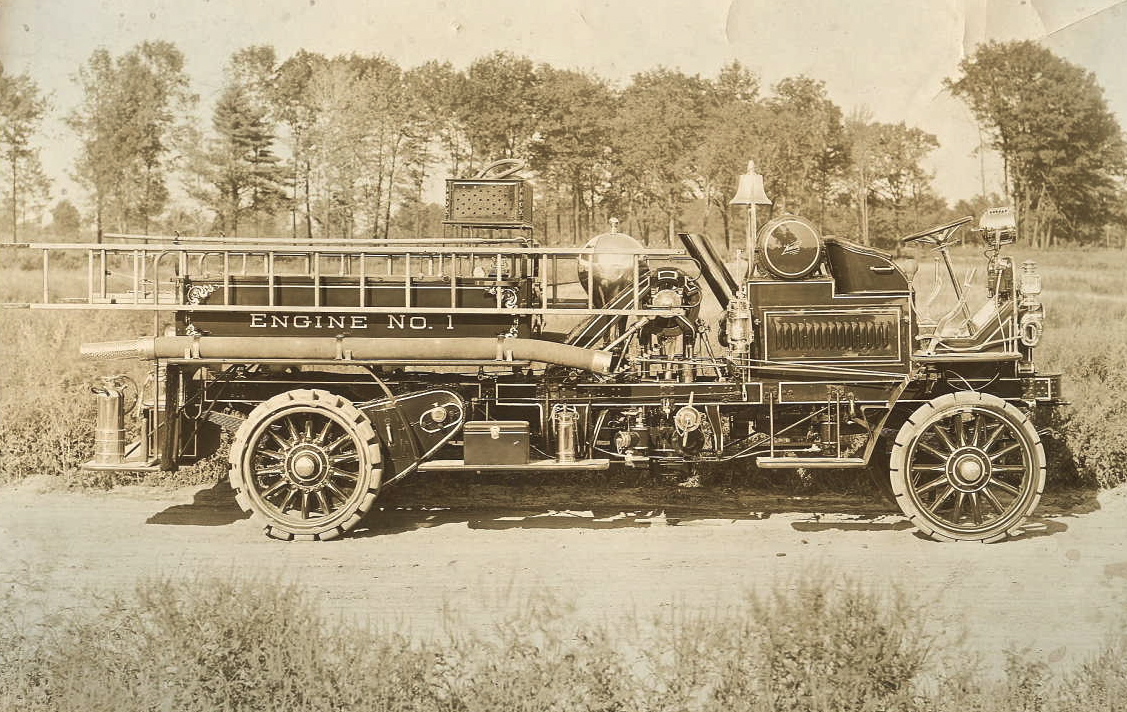
The first-ever modern fire-truck came out in the early 1900s, and belonged to the Springfield Fire Department in Springfield, Massachusetts, USA. Here’s a photograph of it:

This fire-truck was made ca. 1905, an age when most motorised vehicles were still the handmade, and extremely expensive preserve of the upper classes. But it is, nonetheless, the world’s first modern fire-truck.

Victorian-era Firefighting

The 1800s saw a huge rise in urban populations, industry, and…fire. By now, most big cities had their own, state-funded fire-services. But technology was still rather primitive. To improve firefighting, a number of changes had to be made.

Fire-wagons were still horse-drawn, but to improve efficiency, the first coal-fired, steam-powered water-pumps were installed on fire-engines in the 1800s. These allowed for longer fire-fighting times, and for more men to be used fighting the fire, rather than manning the pump.

It was around this time that the fire-dog became famous.

Dalmatian dogs are a common symbol of fire-stations in the United States. They’re famous for being white with black spots, for wearing classic red fire-helmets and for rescuing people from burning buildings!

But why are they there in the first place?

Fire-dogs, the Dalmatian dogs which are so strongly associated with firehouses, are descendant from 18th and 19th century “carriage dogs”. Carriage dogs (an ancestor of the modern Dalmatian) were the canine companions of coachmen back in the days of horse-drawn carriages. They were a sort of car-alarm with fur.

In the 17 and 1800s, when nearly all transport was horse-drawn, the welfare of the horse that did the drawing was extremely important. Especially when the transport happened to be a fire-engine. To protect horses from harm, such as horse-thieves, it was common for stable-boys, grooms and coachmen to keep dogs near to the horses, to drive away people intending the animals harm.

When a fire-engine went out on a call, the dogs went along with it, again, to guard the horses against people who might want to steal or harm the horses, which in the 1800s, were valuable assets.

The 1900s saw the end of the horse-drawn carriage, but the Dalmatian dog remained. They don’t run alongside, or guard the wheels of modern fire-trucks anymore, but they have stayed a symbol of firefighting ever since.

Fire Extinguishers

For most of history, the most widespread fire-extinguisher of any kind was a bucket of water stored next to the stove, or on the front porch.

The first modern fire extinguishers were developed in the 1800s.

Capt. George William Manby, a writer and inventor from England, created the first modern fire extinguisher in 1813.

It was designed to be portable, but it was made of copper, and weighed about 12kg! But it was, nonetheless, a fire-extinguisher.

It was filled with a water-and-potassium-carbonate solution, contained under pressure. In the event of a fire, the pressurized solution could be sprayed out of the nozzle to extinguish the blaze.

In the second half of the 1800s, numerous inventors came up with extinguishers which did more than just spray ordinary water onto a fire. Starting in the 1860s, inventors created the “soda-acid” fire extinguisher, which was particularly useful for fires where there might be poisonous chemicals around.

The soda-acid extinguisher worked by having the main canister of the extinguisher filled with a mix of water, and sodium bicarbonate…baking-soda!…and a separate phial filled with sulphuric acid, sealed inside the main canister, along with the water-soda mixture.

In the event of a fire, the extinguisher (depending on the design) was either tipped upside down, or a plunger was pushed or pulled. The idea was that this motion would break the glass phial inside the extinguisher. This released the acid into the water-soda mixture. The resultant reaction created high pressure, and a lot of carbon-dioxide gas. This could be forced out of the nozzle of the extinguisher to put out the fire.

One of the more interesting types of fire-extinguishers developed during the 19th and early 20th centuries was the so-called “fire-grenade”.

An antique glass ‘grenade’ fire-extinguisher

The fire “grenade” was a sphere of glass filled with either salt-water, or the chemical carbon tetra-chloride (“C-T-C”).

Fire-grenades could be used by firemen or people in distress, to put out a fire from a distance. One simply lined up the fire in one’s sight, and threw the grenade at its base. The glass shattered and the spreading water (or chemicals, as the case might be) put out the fire, with minimal risk to the firefighter or person in distress.

In some places, fire-grenades were placed on special hair-trigger harnesses above doorways in big, public buildings. This way, if there was a fire, the grenades could fall from their harnesses into the doorways above which they were installed. This kept the doorway clear of flames, allowing people a safe escape-route (so long as you were fine with running on top of broken glass!).

Fire-Helmet

Ah, the classic fire-helmet. Originally made of leather, or brass, and today more commonly made of special plastics, the fire-helmet was developed during the Victorian era, as a way of protecting firemen from two of the biggest dangers of fighting a fire: Collapsing buildings, and getting soaked.

Fire-helmets are famous for their long, sloping rear brims. These are designed to protect the neck and the back of the head, and to deflect falling water away from a fireman’s neck, and going down the back of his shirt. Meanwhile, the iconic shape is designed to protect against falling objects, such as collapsing scaffolding, bricks and other debris that might come crashing down out of a fire-weakened building.

Brass helmets were popular during the Victorian era. But they started being changed for safer plastic helmets in the 1900s because of the risk of electrocution from electrical fires. As a result, fire-helmets today are made of special, heat-resistant plastics and composite materials.

Fire Hydrants

The first ‘fire hydrants’ of a sort, were developed in the 1600s. Cities lucky enough to have running water had it transported around town in wooden mains-pipes, which were buried under the streets. In the event of a fire, firemen would dig a hole in the street to expose the water-mains below. A hand-drill was used to bore a hole into the pipe. As the water rushed out and filled the hole around the pipe, a bucket-line could be formed around the hole, filling buckets with water and sending them, hand-over-hand, to the blaze.

When the fire was extinguished, the hole in the mains pipe was plugged with a wooden bung. The hole in the street was filled in, and a marker was placed on the spot. This was so that any future firefighters would be alerted to the presence of a previous bore-hole in the area, if they ever needed to fight a fire in that street again. This is why some people still call fire-hydrants ‘plugs’ to this day; because they literally plugged the water-mains.

The modern fire-hydrant, which we see on street-corners, and which are painted bright red, came around in the 1800s. It was invented in 1801 by Frederick Graff, then chief-engineer of the Philadelphia Water Works. Ironically, the patent-papers for Graff’s invention were lost when the United States Patent Office in Washington D.C. burnt down in 1836!

The Firepole

It’s a scene played out in old movies, cartoons, T.V. shows, and in almost every episode of “Fireman Sam“; the call comes in, the alarm-bells start ringing, and firemen leap into action, jumping for the fireman’s pole, swinging around and sliding down the shaft to the ground floor of the firehouse, to jump into their uniforms, put on their helmets, start up the fire-truck and charge off to the scene of some catastrophe, red lights and sirens glaring and blaring.

The fire-pole was invented in Chicago in the 1870s. As with many inventions, necessity, and a certain level of ingenuity, gave birth to one of the most iconic pieces of firefighting equipment ever.

Firehouse No. 21 in Chicago was an all-black firehouse, and the resident captain, David Kenyon, was stupefied when he saw one of his firemen, George Reid, slide down a pole from the second storey of their three-storey firehouse to the ground floor to respond to an emergency.

At the time, fire-poles did not exist; Reid had actually used the lashing-pole which the firehouse used in transporting bales of hay for the fire-wagon horses. The pole was used as a securing-point when hay-bales were loaded onto the hay-wagon, to stop them rolling off during their deliveries.

Kenyon was so impressed that he pestered the Chicago fire-chief over and over and over again to give him permission to install a similar, purpose-built pole in his firehouse. Eventually, the chief gave in, and agreed – provided that the funds needed for the installation and maintenance of the pole came entirely out of the pockets of the firemen who used it.

And so it came to be, that in 1878, the world’s first fireman’s pole was installed at Chicago Firehouse No. 21.

At first, nobody paid any attention to the pole, and other firemen thought it was stupid and ludicrous. It was some ridiculous toy to play around with when the boys at firehouse 21 had nothing else to do!

But other firehouses began to sit up and take notice when they realised that Firehouse 21 was responding to emergencies much faster, especially at night.

Not having to deal with doors, staircases, landings and overcrowded corridors meant that the firemen could literally slide into action and be ready to go in just a few minutes; compared to having to run down stairs, hold doors open, and risk tripping and falling over, especially in the dark.

With the benefits of fire-poles established, every firehouse in the world began to be fitted with them. To make them stronger and longer-lasting, the world’s first metal fire-pole (made of brass), was installed in Boston, in 1880.

An old fire-pole with important safety-features:
Double trap-doors, and a safety-cage

These days, fire-poles are sometimes considered more of a hindrance than a help, because of the dangers of sprained or broken legs and ankles, and risks of losing one’s grip, and falling. Some countries have outlawed them altogether, but other countries continue to use them, albeit, with better safety-measures in-place, such as protective railings, and padded landing-mats. These prevent accidental falls, and cushion any hard landings.

How to Buy Straight Razors and their Gear Secondhand


In glancing over my blog, I noticed that my posting on straight razors seems to be one of the most popular ones that I’ve written so far. If you want to read it, it may be found here. 

I’m writing this as a sort of follow-up, or companion-post to my previous one. This won’t go into all the nitty gritty details of every little bit of everything, but it will cover in-depth, how to buy a straight-razor (and associated gear) for far below retail price.

The Appeal of Straight Razor Shaving

In our money-conscious, green-guilt world that we live in today, where everything must be eco-friendly and reusable and everything else, more and more men are turning to the way their fathers and grandfathers shaved, and are moving back to using a straight-razor to shave with. Some like the challenge, the skill and the patience that it takes. Some reckon that every whisker shaved off their chin grows three on their chest. Others like the nostalgia of it. Some people do it because they reckon they can save money.

On that last score, however, some would begin to wonder. A brand-new strop, razor, mug, brush and soap can cost over $200-$300!

Suddenly it’s not looking so cheap and money-saving. And this is when most men, turned on by the idea of a good, old-fashioned shave, turn away, and go back to using their vibrating Mach 5.

This is a little guide about how to get all the things you need, on the cheap.

Buying a Second-Hand Straight Razor

Straight-razors come in a dizzying array of styles and types, and it can be tricky to know exactly what kind of razor you should buy. Keep the following things in mind when looking for a second-hand straight-razor:

Always pick quality. Buy a razor that was made by a reputable company, or from a reputable country or city. In England, the best straight-razors all came from Sheffield, and for centuries, Sheffield was the center of the English cutlery trade. Anything that cut anything, came from Sheffield. Kitchen-knives, tailors’ shears, the finest silverware, and the best, barber-quality straight-razors were all made here.

While any razor from Sheffield is almost certainly a winner, keep an eye out for the name Joseph Rodgers & Sons. For well over two hundred years, J. Rodgers & Sons has produced quality cutlery, since it was founded in 1764! Everything from paper-knives to silverware and straight-razors. You can date a J. Rodgers knife by examining what is engraved on the shank of the blade.

A Victorian-era Rodgers blade will have “Cutlers to Her Majesty” (Queen Victoria). A razor made after 1901, will have “Cutlers to Their Majesties”, (King Edward & Queen Alexandra, George V).

Other respected Sheffield razor-manufacturers were Bengall, and Wade & Butcher. Keep an eye out for them, as well. But in general, any Sheffield-made razor will be of assured quality.

Any razor marked “Thiers“, will have been made in the French town of Thiers, and is another sign of quality. The company of Thiers-Issard still makes straight-razors to this day.

One of the most recognised names in cutlery is that of “Solingen“. A town in Germany, Solingen is arguably the cutlery capital of the Western world. Everything from razors to kitchen-knives and scissors of all kinds are produced in Solingen. Even surgical blades are made there. Almost without exception, any razor made in Solingen will be a winner. The German company of Dovo still makes razors there to this day.

Check for Defects in the Razor. This goes without saying, but bears mentioning. Keep an eye out for such things as cracks, chips, uneven wear (from improper or overenthusiastic sharpening), water-spots, pitting and rusting. Light rust may be removed with fine-grit sandpaper and light steel wool. The razor will then be serviceable again after sharpening and stropping. Heavy rusting, cracks, chips and uneven metal-wear are all irreversible damage to a razor, and cannot be fixed. Discard any finds in such a condition.

Some razors have cracked or damaged scales (the handle part which the blade folds into). There are repairmen out there who craft and replace broken scales with new ones. So all is not lost on this front. You could even do it yourself. All you need are the pins (the little rivets), and the right materials and skills. Razor-pin sets may be purchased online. Try eBay.

Tarnishing, water-spotting and pitting are generally cosmetic issues, and should not affect a razor’s ability to function. Light rusting, once removed, will not affect a razor’s overall quality of function. As mentioned previously, heavy rusting cannot be safely removed, and it can seriously weaken a razor. Do not attempt to resurrect a razor with extensive rust-damage. It’s not worth your while.

Features of a Razor. Not all razors have all of these features. Some might have all. Some might have some. Some might have none at all. It’s all up to you, to decide what you want in the razor that you buy.

Some razors will have ‘jimps’. Jimps are the corrugations ground into the shank of the razor-blade (the part of the blade you’ll hold in your fingers). They are there to provide you with extra grip during shaving. Some razors don’t have them at all. Some have single jimps (corrugations on the bottom side of the shank), and some have double jimps (corrugations on the upper and lower sides of the shank).

Some razors have ‘transverse stablisers’. These are found at the end of the razor-blade (opposite to the point), next to the shank. They’re sets of slots or grooves, which were punched into the razor-blade when it was being formed. They serve to provide strength to the blade, and prevent cracking from blade-warp and metal-fatigue. Like jimps, not all razors have them. Some razors only have one pair of stablisers. Others might have two.

Most razors will have a ‘shoulder‘. The ‘shoulder’ is the definitive ‘break-off’ point between the end of the blade, and the shank, which you hold in your fingers. It serves as a barrier to stop your wet fingers sliding onto the blade (and getting cut!). The shoulder meets the shank at right-angles, to provide a safe ‘slot’ to place your fingers in, to stop them getting in contact with the blade. This is also where you’ll find the stabilisers.

Make a note of what the Scales are made of. The vast majority of vintage razors will have scales made of some variety of plastic; usually celluloid. Be warned that celluloid can degrade over time. This is rare, but it can happen. So keep an eye out for any razors with warped, cracked or otherwise damaged scales. You can buy the razor for the blade, and have it re-scaled, or you can disregard it altogether.

Straight-razors with pretty ivory scales are iconic. But also rare and expensive. Most white/cream-scaled razors will be made out of “French Ivory”…a fancy term for celluloid plastic which is coloured to look like ivory. Don’t be fooled. An easy way to tell the difference is to just feel the scales with your fingers. Ivory, especially old ivory, is never perfectly smooth, and should have a grainy touch. It’s a natural product, after all. Plastic will almost always be perfectly smooth.

How Much do I Pay for a Straight Razor? Most vintage straight-razors can be bought for peanuts. In most cases, below $25.00, in good condition. Some razors which are a bit more interesting/rare etc, might cost more. But a good, serviceable, second-hand razor, which will work wonderfully after a light refurbishment, should not cost the earth. One of my razors was just five bucks, made in Germany. Never fails to give an excellent shave. The more expensive razors are typically the ones with fancy scales, the ones made of ivory, tortoise-shell, bone, etc.

Care & Maintenance of your Vintage Razor. So. You’ve bought a nice, vintage razor. It’s nothing fancy, but it was cheap, good quality, and will get the job done. Now what?

Apart from the obvious – keep the razor sharp and the edge smooth – especially with vintage razors, it’s important to keep the blade DRY BETWEEN USES. After each shave, dry the blade COMPLETELY with a towel, and make sure that there’s no water trapped inside the scales. Vintage razors were made of carbon steel. There’s nothing wrong with that, apart from the fact that carbon steel rusts. Very easily. A few drops of water left on a razor overnight, is enough to start rust going. Also, it can lead to water-spots, unsightly corrosion left by water-droplets on the blade. So to prevent that, dry the razor thoroughly after each use.

Buying Secondhand Accessories

Now that you have your razor, from the local flea-market, antiques shop or off of eBay, let’s have a look at buying other things second-hand.

The Strop

Every good razor needs a good strop. And a good strop need not cost the earth. I bought a top-quality strop for about $25.00 at the flea-market. So, what should you look for?

There are a whole heap of shortcuts around this. You can make a strop out of an old belt, out of a pair of jeans. Even out of newspaper. And they’ll all work. So if you’re trying to save a lot of money, you could try that. An old belt will have to be smooth and without patterns or embossing. A strop made out of the legs of an old pair of jeans will have to be free of seams and stitching; this would interrupt the draw of the blade, and damage the edge of the razor. A strop made of newspaper (I’m not kidding. Yes, newspaper), will need to be thick, and strong, to stop it from ripping when you pull on it, in preparation for stropping.

Every time you strop, you remove a small amount of leather from the strop. So if you’re using a belt, make sure it’s not a belt that you’re going to wear anytime soon…or at all.

In buying an actual second-hand strop, you should keep an eye out for the following:

The Condition of the Leather. Every good strop is made of leather. Sometimes, you’ll have double-sided strops, which are both leather and canvas. But sticking to leather for the time-being, ensure that it is smooth, and free of cuts, scratches and cracking (from being overly dry). Some leather can be softened using additives which you can buy at your local hardware shop. That’s fine, and should not damage the strop or the leather (it better not!). But steer clear of any strop which has serious cracks and/or cuts in the main part of the strop. These will do no good for your razor when you run it along there.

The Condition of the Connections. A typical hanging-strop has two ends (I think…). The handle, and the hook. The hook can be a simple…hook…a ring, claw-fastener, or a clip. This is used to affix the strop to the wall of your bathroom (on a towel-hook/ring, or towel-rail). At the other end, is the handle which you pull tight while stropping. Make sure that any stitching or rivets which hold these connections to the strop, are in good condition. The last thing you want is for the stitching to rip, or for the rivets to break during stropping. You’ve got three inches of lethally sharp steel in your hand and you don’t want to chance cutting yourself in an accident if the strop breaks.

The Size of the Strop. You want a strop of a decent size. At least three inches wide, and at least a foot long, if not more. If you don’t, then you won’t be able to strop the entire length of the razor-blade when it comes to using the strop.

The Brush

To use a straight-razor, you need to wet-shave. And to wet-shave, you need a brush. A badger-hair brush is best. It holds water and retains heat. And that’s what you want.

You can buy brushes second-hand, although if you do, any purchase should be THOROUGHLY cleaned first, with hot water and soap. Or you could buy a modern brush instead, if you’re a little worried about contamination. A quality badger-hair brush, purchased brand-new, might cost a bit more, but properly maintained, it will last a lifetime.

N.B.: A brand-new badger-hair brush *may* smell a bit wonky when you first open it. That’s because well…it is animal hair. You can clean it up a bit using shampoo, to remove the smell. Or you could leave it as it is…regular use and contact with shaving soap/cream will remove the smell in time.

The Stone

Every straight-razor user needs to have a decent sharpening-stone. There are people who go crazy with this stuff, and buy pastes and solutions and three, four, five or six different stones, to get their razors sharp enough to cut glass. But enough of that. This posting is about how to get started in straight-razors on a budget. So, what you want is one good razor stone which you can use easily, and which gives reliable, consistent results.

If you want to really cheap it out, you can just use a regular, rectangular knife-stone, such as what you might sharpen your kitchen-knives on. And there’s nothing wrong with that, but there are specific stones which are made just for straight-razors. Most of them are vintage/antique stones, since not many people use straight-razors anymore. You can find them at flea-markets and antiques shops and, provided they’re not cracked really badly, or worn out, they should work just fine. Razor-stones are generally a lot smaller than a regular knife-stone, for the simple fact that…razors are smaller! Always remember to keep the stone wet with water while sharpening, to reduce friction and heat, and to keep the sharpening process smooth.

Mugs, etc 

The cheapest solution for something like this is to just take a cereal-bowl, or an old coffee-mug that you don’t want to use anymore, and use it as a lathering-bowl or cup for when you want to whip up lather for your shave, and there’s nothing wrong with that. But some people find it tricky to use a bowl with no handle on it (which can be important when your hands are wet with soap and hot water), and shavers who own big bushy shaving-brushes can’t always fit them inside a regular coffee-mug.

To get you out of this mess, you might want to invest in a shaving-mug or bowl, or a shaving-scuttle. Scuttles (little jug-shaped affairs with a soap-dish on top) can be found in almost any decent flea-market or antiques shop. Unless it’s something really fancy, though, I wouldn’t pay any more than about $20-$30.00 for one.

When you buy a mug or a scuttle, make sure that the base of it is smooth and level. This is so that it won’t shake, slide or rattle on your bathroom counter while you mix up your lather. Not only is it really annoying, but it can throw off your mixing arm, because the mug, bowl or scuttle is always sliding around everywhere.

Tips, Tricks, etc. 

Here’s a few things to keep in mind when buying or using second-hand shaving equipment. A few parting words:

– The majority of vintage razors, even the ones from quality companies, are rarely worth a great deal of money. Most of their value comes either from their uniqueness, rarity and/or scale-materials. Unless there’s something that really draws you towards a razor (it’s a cased pair, or it’s a seven-day set, it’s really pretty, it’s really old, or any other reasons), don’t pay more than about $20.00. It’s not worth more than that.

– Assume that any second-hand razor will require thorough cleaning before use. You don’t know where it’s been or what it’s been used for, or what it’s had on its blade. They weren’t nicknamed ‘cut-throats‘ for nothing. Same goes for any brushes that you should purchase second-hand.

– This bears repeating…again: After each use, dry your razor-blade thoroughly. Especially with older razors, rust can start on a wet blade literally overnight. And if it gets really bad, you’ll have no choice but to throw the razor out.

– Light rusting can be removed with fine-grit sandpaper, and this will not affect the operation of the blade. Heavy rusting compromises the structural integrity of the blade. So throw it out. You don’t want a razor-blade cracking or breaking in half (and yes, that can happen in extreme circumstances) during stropping or shaving. Especially with extra-hollow-ground blades, which are very thin and bendy.

– Until you’ve learnt from experience how much is enough, always sharpen and strop your razor more than you think is necessary, just in case. In general, fifty strokes on the hone, and fifty on the strop, should be enough. It may sound like a lot, but once you’re up to speed, you’ll have it done in about five minutes.

One of the chief causes of razor-burn and cuts is shaving with a dull, unsharpened/unstropped razor. A properly sharpened and stropped razor, used correctly, will not cut you or cause razor-burn.

The “Idiot Box” and the History of Television


The television, the T.V., the idiot-box, the electronic babysitter. That magical screen in our living-rooms which has brought us news, sports, weather, education, entertainment, excitement, bemusement and rage, has come a long way since its inception nearly 100 years ago.

This posting will have a look at the history of television, from its beginnings to the commencement of regular programming.

The Television and Us

For most of us in the 21st century, life without television is inconceivable. There are those of course, who were born without it, but with it or without it, chances are, if you watch it regularly today, you would be hard-pressed to imagine your current and future existence without this magical device in your living-room. How many incredible events have been brought to us through the television? How many amazing films have we seen? Famous and memorable TV serials, and even advertisements. Everything from “Happy Days” to “Brylcreem” (just remember, only use a LITTLE dab), to “Are You Being Served?”

Mankind’s love-affair with the TV is inseparable, unstoppable and unthinkable that it should ever go away. But where does TV come from?

A World Before Television

In a dark and soul-less time, before computers and fax-machines and mobile telephones, when eggs were 5c a dozen and penny-candy was really a penny, mankind tuned into the radio.

From the early 1920s, until the late 1950s, we enjoyed a roughly 30-year period where radio was king. When we literally had to tune in and warm up, to enjoy a program over the air. This was the Golden Age of Radio. It brought us such memorable events as the Hindenburg Crash of 1937, the Attack on Pearl Harbor in 1941, the Declaration of War in 1939 and countless famous old-time radio programs, from “Gang Busters” to “Dragnet”, to “Richard Diamond” and “Abbott & Costello”.

If you want to read more about that, have a look here.

Back then, the family radio-set was an important piece of household equipment. But even by the 1930s, its dominance in our living-rooms was being threatened by a new kid on the block called television.

The Invention of Television

The word ‘television’ comes from the Greek ‘tele’ meaning ‘from afar’. Just like how telephone, and telegraph mean sounds, and writing, or messages, from afar, television means pictures from afar.

So, who invented television?

As with many great inventions, from airplanes to motor-cars, telephones, the fountain pen and the typewriter, television cannot be wholly attributed to one man.

Experiments in transmitting images over a distance have dated back as far as the late 1800s, however, television as we would recognise it today, that is, moving images transmitted to a screen, did not emerge until the mid-1920s. The man responsible for its creation was Mr. John Logie Baird, a Scotsman (1888-1946). To this day, the Australian TV industry still holds the “Logie Awards” every year in his honour.

Mr. Baird was experimenting with transmitting images over the air for a long time, starting in the early 1920s. However, it was not until the early 1930s that the first TV sets that we might know today, ever appeared in shop windows.

Early Television

Named after its inventor, this is the Baird Televisor, ca. 1933, one of the first ever residential TV sets! It’s hardly widescreen, but it is a television.

Back in the 20s and 30s, radio was the dominant force for entertainment, education and news, and T.V. programming was often limited to a few hours, or even a few minutes a day, and nothing more than black and white film with no sound, or sound, with no pictures! T.V. during the interwar period was little more than a fairground attraction, or a toy for the rich.

By the second half of the 1930s, TV started becoming more accessible, and more advanced, although it still had a limited market. Picture-quality was not what it might be, but now, TV sets had sound! Sets were still expensive, but those who could afford them, bought them from famous department-stores like Selfridges in London. In the United States, T.V. broadcasting started in the 1930s and Franklin D. Roosevelt was the first American president to appear on television, at the 1939 New York World’s Fair.

Nazi-Vision

That’s right! Nazi-Vision!

Believe it or not, but it was the Nazis who created one of the world’s first national television networks. German factories started producing early TV sets in 1934, and the Nazis were among the very first people on earth to realise the potential for television to reach several audiences at once, and spread the glorious Nazi ideologies of Strength through Joy, racial purity and an abundance of bratwurst for all!

Based in the German capital of Berlin, the Nazi-controlled broadcasting station and studio produced everything from propaganda movies, to Nazi rallies, speeches and other material, which was transmitted to the screens of loyal Germans fortunate enough to own the first generation of home television-sets. While most of the programming was broadcast live, and was not recorded, some 250-odd reels of ancient film remains, which gives us a tantalizing look at television under the Nazis, from 1935-1944.

Although the Nazis could see that TV could be a great technology for spreading their ideologies and propaganda, they also realised that the technology would have to be greatly improved before it would work properly. The limitations of early cameras meant that picture-quality was mediocre at best. Their solution was to record their broadcasts onto film, and play it back later, like they did with any other movie. This not only improved quality, but it also had the unintended side-effect of giving us a record of Nazi television that has survived to this day.

Despite the Nazis grand vision, the relative expensiveness of television sets meant that the audience for their programming was always rather small. Few people owned sets. Those who did were usually party-members with the money to spend, people in positions of power, money or authority, and a chosen lucky few private citizens. The rest of the sets were set up in public “Television Parlors”, scattered around Berlin. They were little more than simple movie-theaters, where the big screen had been replaced by the small one.

Another opportunity for the Nazis came in 1936. That’s right, the Berlin Olympics of 1936, where Jesse Owens beat the Aryans and humiliated Hitler, were the first Olympics to be publicly televised!

However, the fact remained that, despite the Nazis best efforts, early television remained impractical on a large scale. They had improved some things, such as picture-quality and sound, but a limited audience meant that until the medium was more widely adopted and accepted, and better recording, broadcasting, and receiving means had been devised, TV would be little more than a toy. Indeed, even by the outbreak of the Second World War, the entire nation of Germany had only about 500 television sets, scattered around the country.

Television and the War

By the early 1940s, some semblance of regular TV broadcasts had begun. In 1941, CBS in the United States was broadcasting televised news in 15-minute bulletins, twice a day. Regular programming began to introduce the TV shows that we would recognise today, although the limitations of the studio-cameras and lights of the period left much to be desired when it came to picture-quality. The war itself played a big role in holding back the development of TV. Rationing and shortages of almost everything needed to make TV sets, from wood to metal to glass, made them expensive luxury-items. And at any rate, the companies that made TV. sets were more interested in making radios and other electronics for the war effort.

These shortcomings and interruptions severely affected the widespread use of televisions, and it wasn’t until after the war, in 1947, that regular T.V. broadcasting really took off in the United States.

In Germany, where television was being exploited for propaganda purposes, advances in technology had been made, but even then, programming was brief. Usually only a few hours a day, if at all. By autumn of 1944, with constant, heavy bombing-raids on German cities, and the war going badly for the Nazis, the national broadcasting company in Germany ceased transmissions.

Please Check your Local Paper for the Times

The war is over! Yay!

In the late 1940s, TV programming really started taking off. With the war over, more technology and research could be profitably spent developing and improving the emerging medium of television. For the growing number of television-owners, there were now more frequent telecasts and a greater variety of options, everything from news programs, sitcoms, and early kids’ shows like the famous “Howdy Doody” program, starting in 1947!

There was stiff competition from radio during this time, but one by one, popular radio programs of the 1930s and 40s slowly shifted from the old, to the new, setting up regular TV spots for themselves on the weekly schedule. For a while, some actors and performers ran concurrent TV and radio programs; “Dragnet” used to do it for nearly a whole decade!

By the early 1950s, TV was becoming more and more accepted, and popular shows such as “Amos & Andy” (1951) and the Jack Benny Program (1950), were big hits on TV. Radio-writers and musicians who found themselves suddenly unemployed, began scriptwriting for these newfangled television-series, and writing and recording music for TV shows.

The Shape of the Box

Early televisions of the 1930s and 40s closely followed the styles of furniture and radios of the period. A typical 1930s radio-set was large, with a handsome wood case, cloth-covered speakers and handsome bakelite knobs. Television sets were made in the same style. Here’s an RCA 360, from 1947, one of the first postwar televisions to be mass-produced and available to the public:

By the 1950s, as with many other things, from typewriters to radios to kitchen gadgets, sleeker lines, newer materials and different colour-palettes were the rage. Boxy old wood-case televisions were out. More simplistic and uncluttered looks were in…

In the 50s, televisions were the latest and greatest thing around. Some people who couldn’t actually afford a set, would just buy an aerial and stick it on their rooves, just to pretend that they did, so that they could keep up with the Joneses.

Remote Television

Almost as soon as TV started taking off, people started looking for ways to make the technology more appealing to the everyday user. Why should you have to get up and flip a dial and knob whenever you wanted to change the channel? That arduous, six, seven, or nine-foot trek to the set, and back again, is such an inconvenience! Surely there’s a better way?

I See the Light!

As early as 1950, the first TV remote-controls had been invented. Originally connected to the set itself by long cables, the first wireless TV-remotes, of the kind we recognise today, came out in the mid 1950s. One of the first wireless remotes was the Flashmatic, from 1955. It worked quite simply: You pressed the buttons on the controller and aimed it at the television. A beam of light from the remote hit a photoelectric panel on the TV set, which changed the channel.

Brilliant, but problematic. See, the light-sensitive electric cell on the television-set did not differentiate between the beam shot from the remote, and any other source of light. If you turned on an electric lamp near to the television, or even if you opened the curtains and let in the sunlight, the channel would change automatically, even without the remote!

A Click and a Switch!

Early TV remotes worked on light-beams affecting light-sensitive electric panels on the television set. They worked well enough, so long as you had a decent aim and there weren’t any interfering light-sources, but the drawbacks of their over-sensitivity and fiddly operation made them somewhat impractical. A better type of TV remote was invented shortly after, which relied not on light, but on sound. Pressing the remote-buttons let off clicks of different frequencies, which could be picked up by the TV-set. Each frequency related to a specific command – changing the channel, or the volume, as the case may have been. But even this could be problematic, when people with sensitive hearing could hear the pulses of sound (which were designed to be outside the human hearing-range).

Slice and Dice!

Don’tcha just hate it that, just when the show gets to the interesting bit, it suddenly breaks for a commercial?

You can thank TV remotes for that.

After the invention of the remote, it was discovered by studio bigwigs that airing commercials between shows was ineffective. Once a show was over, you could just turn the set off, or flip to another channel. And you didn’t have to watch the stupid commercial for Remington typewriters, or Brylcreem, or Pepsodent, or whatever other boring junk those commercial schmucks were trying to peddle in your own living room! How dare they invade your privacy like this!?

To remedy this, the modern format of television was created, where shows were split into segments or acts, just like a play at the theater. This allowed for advertising, but it also meant that people were less likely to flip away from the channel, in case they missed the return of their favourite TV episode, thereby increasing the viewer-numbers of TV commercials.

Crafty bastards…

The Golden Age of Television

The Golden Age of Television is defined as the period from the early 1950s up to the 1970s. It was during this period that many of the classic and famous TV shows that we know and love and remember, were broadcast. But more importantly, it was during this time (especially in the 50s and 60s), that TV gained dominance over radio for the first time in history. Also, it was during the 50s and 60s that TV developed its own style, format and language.

Previously, TV shows were modeled after radio-programs, but not everything used in radio was possible on television, which necessitated various changes, which led to the evolution of modern television. Shows produced on TV during and after this changeover, are considered classics of television.

What shows, you might ask? Well, how about Dragnet? The Jack Benny Show? Amos & Andy? Leave It To Beaver? Life with Luigi, and numerous other programs.

Good Night, and Good Luck

Along with regular programming, the television revolutionized the broadcasting of news. Previously, you had the radio and the newspaper. But now, the nightly, six o’clock bulletin was the mainstay of news, sports and weather. The news anchor and reporters became staples of nightly broadcasts. Programs like the 1950s “See it Now“, began to replace radio broadcasts as the method for spreading news to the public. The line “Good night, and good luck”, was the sign-off line used by famous reporter Edward R. Murrow, notable for reporting on the Blitz in London, and MacCarthyism during the 1950s.

We Return You to Your Regularly Scheduled Program…

By the 60s and 70s, TV had become the mainstay of most well-to-do households in the developed world, and had finally replaced radio as the main medium for electronic entertainment, music and news. It had by now, reached the format which we’re most familiar with.

The 60s and 70s saw many of the most famous TV shows in history take to the air, like Gilligan’s Island, the Addams Family, Are You Being Served?, Dad’s Army, Dragnet (which transferred from radio in the 1950s), and the Dick Van Dyke Show.

It was in the early 1970s that the first TV-recording equipment arrived on the scene. These days, we have DVD recorders and other technology that will allow us to pause, rewind, record and watch multiple shows at once. But we wouldn’t have gotten anywhere if the VCR and the video-cassette didn’t get there first. Entering the market in 1971, the VHS tape and the VCR remained the standard method for recording TV-programs for thirty years, until the end of the 20th century. Tricks like putting sticky-tape over the slots in the tape-cassette to disable the anti-recording feature on some cassettes, would enable people to use almost any cassette to record movies, TV shows and almost anything else that they wanted, right off their TV sets. VCDs, and eventually, DVDs, and their accompanying recorders, would of course replace them starting in the late 1990s, but VHS tapes paved the way.

That brings us more or less to the modern day, so far as TVs are concerned. Some things have changed, such as digital TVs from old cathode-ray tube (CRT) TVs, and the lack of a need for a pair of rabbit-ear antennae, but in the past few years, not much else has changed about the basics of television as we know it today.

Want to Know More?

“Television under the Swastika – The History of Nazi Television”

A History of Television from the Grolier Encyclopedia

The Elements of a Vintage Study or Office


It occurs to me that there’s a lot of blogs and forums out there these days, dedicated to the proposition that all men are not created equal. There are those who sail merrily on their way, oblivious to everything, and there are those who have thrown out the anchors at the top of the falls, holding back with all their might, mankind’s devilish attempts to hurl them into the abyss of blandness, cookie-cutterism and lack of personality and style.

Some Sort of Introduction

Websites and blogs such as the famous Art of Manliness, and The Gentleman, and forums such as the Fedora Lounge, were created to educate people about what life, mostly for men, but also for women, used to be. Before we all got tangled up in what Hollywood and the men from marketing and advertising wanted us to look like.

Some people have seen the older ways and in one way or another, have decided that they would like to return to them, or imitate their style in one way or another, ranging from behaviour, dress, grooming, style, and home decor.

In the 21st century world, the odious ‘man cave’ has made its appearance, both in peoples’ homes, and as a term on the internet. It is an odious term. Yes. I have said it, and it is said.

We already have ‘study’, ‘office’, ‘den’, ‘loft’, ‘workshop’, ‘games-room’ and ‘garage’ as sanctuaries of masculinity, and as places for men and their friends to hide themselves away from others, and enjoy themselves in their own privacy, or enjoy their privacy with their chosen circle of friends.

But apparently, none of these terms sufficiently captured the essence of what the ‘man-cave’ is, which is in itself, a rather fluid term which at times seems to defy definition altogether. A man-cave can be anything from a games-room, a home-theater, a library, an office,  study, a private bar or a model-making workshop, tinkering-room or gym. Perhaps this is why older terminology has been replaced by something more suited to capture such a diverse space that the man-cave has become.

But I’m kinda digressing here. Like…a LOT. I apologise…

The Actual Point of this Posting

One of the most common and popular rooms in the house, and one which may well become a person’s man-cave, is the room which in older times was marked as a study, office, or den. In an attempt to inject these traditionally masculine rooms with masculinity once more, some men have chosen to go the oldschool-route, and redecorate and redesign their studies so that they might look like the great chambers of thought and knowledge that they once were, full of books, wood, leather, whiskey and tobacco smoke.

This posting will cover the details that you’ll need if you want to try and pull off that classic, old-world man-cave study/office look from yesteryear. Those big, classy executive-style offices that you see in old houses, in period movies, and old photographs, with all the lashings of wood and leather and steel and brass, glass and soft, fluffy rugs. The traditional man’s office of yesteryear.

The Stuff You Will Need

The Desk

Every good study…has a desk. It goes without saying. But if you’re going for that old-world look, what kinds of desks should you be looking for? There are several to choose from.

The Rolltop

The rolltop desk is a traditional desk-form from the Georgian era, characterised by the curved rolling lid made of linked wooden slats. The desk typically comes in one of two styles: Either with a quarter-circle curved frontage and side-panels, or a more bendy “S”-styled roll, such as what is pictured above. One is not necessarily better than the other, and it’s up to personal taste which one you want.

The rolltop desk has plenty of space for storing little nicknacks, files, stationery and so-forth, and enough space on it to keep a typewriter, or a computer. Provided the computer or typewriter is of the portable, laptop variety, the rolltop lid in most cases, can be pulled down over the machine at the end of the day, without the top of the computer or the typewriter getting in the way.

The rolltop also has lots of little cubbyholes and pigeon-holes. These are extremely useful for things like stamps, bottles of ink, pens, paperclips, staplers, hole-punchers and other desktop equipment that you would need on an infrequent basis, but would need to access in a hurry when you did.

The Slant-Top or Bureau

The slant-top or bureau desk is characterised by its famous drop-down work-surface, which is usually supported by a pair of pull-out supports, either side of the top drawers. Much like the rolltop, this desk-form dates back to the 1700s, but remains popular with those people who like to keep things neat and tidy. Its rather small size forces you to keep clutter to a minimum, and like the rolltop, a simple flip of the lid hides everything neatly away from the sight of others.

The Secretary Desk

The secretary desk is instantly recognisable from its distinctive shape. It’s basically a bureau with a bookcase stacked on top. This is a handy desk-form if you find yourself constantly needing to flip through reference-books during your work, and you’re sick of having to trek across the study to your bookcases and back, to find the information you need. Simply stack your most-used reference-books in the case above your desk!

One of the great things about desks of this type is that the shelf at the top of the desk is the perfect place to put a desk-lamp where it will provide light, but not get in the way of your work. The upper part of the pigeonholes is also great for storing pencil-mugs, drinks and other things that you might want to access when the desk itself is closed and/or locked at the end of the day.

Rolltop and slant-top desks are almost strictly wall-desks. The backs of the desks are up against the wall, literally. Some people don’t like this. They like having a desk which they can access from all sides. What should you look for?

In this category, there are two common forms.

The Pedestal Desk

The pedestal desk is a desk-form so common that its creation goes back probably to the beginning of desk-building. It’s called a “pedestal” desk because it holds the desktop above two “pedestals” which house the drawers and storage-cupboards within. In its numerous guises and variations, the pedestal desk is the one desk-form that has survived well into the modern day.

The one small issue with pedestal-desks, and other all-round desks like this, is that there isn’t any back panel behind which you could hide wires and cables, so they can sometimes present a more messy appearance.

Particularly small pedestal desks with a narrow space between the two pedestals are often called “kneehole” desks, because the space under the desktop is just wide enough for the writer to slide in and put his knees in there. Compare the kneehole desk below, to the larger pedestal desk further up, and you’ll automatically see a difference in size.

The Partners’ Desk

The Partners’ desk is without doubt, the granddaddy of all desks. They’re called partners’ desks because they’re designed to be used by two business-partners, working face-to-face, sharing one big desk, which is essentially two pedestal-desks placed back-to-back.

Partners’ desks are MASSIVE. They’re about the size of a small car and have enough surface-area to double as an airfield during times of war. I’m pretty sure that during the Battle of Britain, Churchill allowed the RAF to use his desk as a runway for Spitfires when his majesty’s airfields were bombed out of action. Yes. Their finest hour was won thanks to desk-space.

Yes, I made that up. But the size of these desks was such that during the Second World War, those daring R.A.F. chaps used to refer to partners’ desks as “Mahogany Bombers”, due to their gigantic size. And that’s the truth!

These desks also weigh about as much as a whale after it’s gone through the krill buffet. If you’re looking for a power-desk, you must buy one of these. But be warned, they weigh a lot, and they take up a lot of real-estate. You need a BIG study, office, or man-cave, to fit this in!

Unless IKEA has invented a flat-pack version of this, you’ll never get one home in the boot of your car. You might succeed if you have a truck. Best bet is a trailer of some variety, a moving-van, or a pair of teleport-booths.

Classic Desk Accessories

Now that you’ve picked your desk, you need something to put on it. What kinds of things were common on desks 50, 70, 100 years ago? For the accessories and items that make up that classic desktop look of times gone by, read on.

The Lamp

Unless your awesomeness, sophistication and coolness is such that it generates its own, blinding glow of smug superiority, you’ll need a lamp on your desk. If you want something that will match your beautiful antique or solid-wood desk, and not some smunky piece of junk that you bought at IKEA, then you couldn’t go past a traditional Emeralite desk-lamp…

Commonly called “bankers’ lamps” because of their association with banks and their tellers, Emeralite desktop lamps have been manufactured since 1909! Talk about endurance of design! They were originally produced by the company of H.G. McFaddin & Co., in New York, U.S.A. To this day, the classic brass base and stem, and the swiveling green glass lampshade has remained a popular choice for those seeking old-world lighting charm. The brass is shiny and reflective, increasing the amount of light, and the green lamp-shade provides for a nice dash of colour!

But why is it green?

Although you can get these lamps with their shades in almost any colour, from frosty white to lemon yellow, its most common colour, and the colour which everyone associates with these lamps, is green. Why?

Emeralite lamps (note the name: “Emerald Light”) were made with green glass shades because light shining through the glass was softened by the colour green, and was easy on the eyes, while still providing enough light to be useful. The problem was that early electric lightbulbs could be a tad overpowering (some bulbs made in the Edwardian-era are still burning brightly to this day, a testament to their quality and longevity!). Placing a green shade between the light and the user was meant to soften it and make it less glaring on the eyes.

As bankers and accountants often had to update and check ledgers and balance-sheets, usually written in tiny script, having soft lighting that wouldn’t burn out their eyes was important. This is why the shades are green.

It’s also why those old-fashioned visors (such as worn by bank-tellers and accountants) are green. To diffuse the light and make it less intense.

Enough with the history, where do I get one? You can find them easily at antiques shops, second-hand shops, lighting-shops and office-supply chains. The design is so iconic that there are still people manufacturing the exact same style of lamp today, over a century later. You can pick one up, brand new, for not very much money at all.

A Leather Desktop 

You can’t go past the feel of real leather. Soft, cool, relaxing and smooth. And also an essential on any old-fashioned desk.

In the old days, leather-topped desks (such as the ones seen above), were considered the height of quality. The reason is not always obvious. Some people think that the leather is there purely because it’s there, and it’s there because it’s leather, and leather is expensive and if it’s expensive it’s gotta be quality and…yawn.

No.

Leather is found on old desks because it provides a smooth, soft, cushioned surface for writing. Don’t forget that until the 1950s, most people wrote with fountain pens, or dip-pens. Ever pricked yourself with the tip of a steel pen-nib? I can assure you that it hurts. A LOT.

A pen-nib is sharp enough in some cases, to literally draw blood. Since scraping such a needle-sharp pen-point on a wooden desktop would gouge marks and troughs into it, and make writing a very uncomfortable job, desks were lined with leather to give the nibs a smoother journey across the playing-field. These days, leather-topped desks are mostly purchased for their aesthetics, but if you intend to do a lot of handwriting at your desk (with a fountain pen or a dip-pen), then you should certainly buy a desk with a leather top.

Desk Blotters

What’s that, I hear you say? You can’t find a desk with a leather surface? Or they’re too expensive? Or they’ve been ripped up from years of poor use?

Fear not, intrepid study re-decorator, your grandparents already thought of a solution. They’re called desk-blotters.

Desk-blotters are those big leather pads that you see on executive desks, with the sheets of blotting-paper (yes, that’s what it is, blotting-paper) slotted into their corners. You can buy these things second-hand at antiques shops and places like that, or on eBay. Or you can buy them brand-new from homewares shops and large stationery-chains. Blotting-paper can be purchased in huge A1 sheets from places like arts-and-crafts shops, and big stationery-shops. You may need to cut the paper down to size for it to fit into your blotter, though.

Desk-blotters are handy for a number of reasons. Just like with the leather desk-surface, they protect the nibs of your pens from hard, friction-producing surfaces. They also arrest any drips or spills from ink, or drinks, or food (provided that they land on the blotting-paper, which may be changed and removed as necessary). The blotter also protected the leather surface of the desk underneath, if you didn’t want to damage it, but they also had a role in muffling sounds and providing stability which is necessary for the next item on our list.

The Typewriter

You can’t possibly have a nice, classic desktop setup like what you see in the movies, without a pretty, mechanical typewriter.

Remington Standard No. 16., Desktop Typewriter., Ca. 1933

For a machine that really pops and stands out for all the right reasons, and to match the traditional decor of the room, you’ll probably want a typewriter from the first half of the 20th century. A real vintage or antique machine with chrome and steel, and which has all those classic round glass keys with the chrome rings. Such machines ooze class and style.

However, be warned that typewriters of this style are getting harder and harder to find in working condition these days. All-steel typewriters with the flashy glass keys died out after WWII, and are almost unheard of after 1950. But if you’re looking for one (even a non-functioning one to act as a display-piece), then typewriter models likely to be found in old, pre-war offices and households include the Underwood Standard range, (Nos. 1-6), the Royal No. 10 model, the Remington Standard range (Nos. 10-16), and the L.C. Smith & Bros. Standard No. 8 model.

Be warned: A desktop typewriter of this size and vintage is EXTREMELY HEAVY. A Royal 10 weighs roughly 30 pounds. A Remington of a similar vintage weighs about twice as much. Make sure you have a STRONG desk that can take the weight, but more importantly, can handle the bone-jarring vibrations produced by the machine when it operates.

If a huge chunky desktop typewriter is too much to have on your desk, then you could get a nice vintage portable. You can choose from those made by companies such as Corona, Remington, Royal, Imperial, Continental, Olivetti and Underwood. Portables have the benefits of style, convenience, portability, compactness and smaller price-tags.

To find out more about how to buy your typewriter, read this. 

Having a typewriter in your study has many pluses. Apart from the fact that they’re extremely stylish and photogenic, a typewriter can save your ass if for any reason, you have a computer-failure. Anything from a crash to a blackout, to your printer packing up. Provided your machine’s in working order, in a pinch, a ribbon and a couple of sheets of fresh paper will have your letter, your essay, your business-report or other important document done in a few minutes.

Typewriters are also handy for things like typecasting on your blog, for keeping a diary or a journal, and for running off one-off documents that you really don’t want to have to save on your computer and waste disk-space with.

To muffle any undesirable clanking from your typewriter, and to stop it from shifting around on your desk, you may like to place a typewriter-pad underneath it. In the old days, you could buy these things from any stationery-shop. They’re just thick, square pads of foam or felt that you stick underneath your machine.

If you’re using a portable typewriter, a large mouse-pad, suitably orientated, can be an excellent substitute. A larger desktop typewriter will need something that covers more surface-area, and which will have to be much thicker, to cope with the significantly higher weight. To prevent irritating rattling, clinking or clanking while typing, remove any glass objects (jars, sets of drinking-glasses, etc) off your desk. Even the smallest portable typewriter can produce significant vibrations.

Fountain Pens

A man who loves to write should always have a good fountain pen. Not only are they infinitely classy, they are also much smoother and lighter writers than the modern ballpoint pen. For more information about these classic writing instruments, how to buy them, how to use them, care for them and other information, there is an entire category dedicated to them, which may be found on the menus back at the top of this page, on the left side of the screen.

Inkwell or Inkstand

You couldn’t have a classic desktop setup without one of these, could you? An inkwell, or an inkstand (a pair of inkwells on a stand, with slots and spaces for pens, nibs, and other bits and pieces) was a common desktop accessory, which remained popular long after dip-pens were obsolete. Some inkstands were given away as presentation-pieces or gifts.

The traditional inkstand or inkwell that might be found on a traditional desk would’ve been made of glass, silver, or brass.

Rocker Blotter

If you have a fountain pen, then you need a rocker-blotter. Rocker-blotters, in their various sizes and styles, have been desktop accessories since the Victorian era. They can be made of almost anything, from steel to silver, pewter, brass, leather, and a dizzying array of wood-types.

Rocker-blotters come apart into two-or-three pieces. A strip of blotting-paper (or in a pinch, paper-towel) is slipped over the blotter’s base, and it’s held in-place by the top-plate, which in-turn is held in-place by the knob at the top, which simply screws down. Paper is changed as necessary and as frequently as the blotter’s use requires it.

Magnifying Glass

Every household, or every study, and desk, should have some sort of magnifying device. For stuff like reading maps and small print, a standard, desktop magnifying glass is often sufficient. For a magnifier that won’t look out of place in your new study’s oldschool theme, look for a glass with a silver or brass frame, possibly with a cut-glass handle, like the one pictured above. Glasses like that are heavy and solid in the hands, unlikely to slide off the desk and provide good magnification.

Their extra weight means that they can also double as extra-classy paperweights, if need be.

A Good Drinking-Vessel

Either to be stored at the corner of your desk, or on a separate surface such as a sideboard, you should always have a nice drinking-vessel. What it is depends on what you like to drink. Fine glassware for top-quality alcoholic beverages, or even if you don’t drink alcohol, it can look fine filled with water. If you dislike having to constantly fill up your glass, search for something larger, like a traditional 1-pint pewter tankard.

Relax, modern pewter doesn’t contain any lead, so they’re perfectly safe to drink out of. But if you are the suspicious type, buy a traditional-style tankard with a see-through base. Traditionally made of glass, most modern tankards have see-through bases made of plastic (although some makers do still make tankards with traditional glass bases).

This was an innovation from Georgian times, and was created so that drunken bar-patrons would notice if a Royal Navy pressman had dropped a silver shilling into his beer. Press-gangs would enter a bar and look for drinkers. Accepting a shilling from a pressman was taken as your agreement to enter the Royal Navy. To trick drinkers, pressmen would drop a shilling into their tankards of beer. The drinkers would never see the shilling until the beer was all gone, and they were too drunk to notice it. They’d find the coin at the bottom of their mugs and were therefore hoodwinked into joining the navy.

To beat this crooked system of recruitment, people started making tankards with see-through bottoms so that drinkers could make sure there was nothing hiding at the bottom of their booze.

If you’re really worried about people slipping stuff into your drink, get yourself one of those German beer-steins with the lids on top.

Ash-Tray

Fewer people smoke today than they did back in the 30s, 40s and 50s, but an ash-tray is a nice thing to have on your desk, even if you don’t smoke. They’re handy as receptacles for things like loose-change, keys, business-cards and other important, but small, fiddly things that you don’t want to lose accidentally. The classic man’s ashtray is typically made of either brass, steel, or cut glass.

Bill-Spike

Anyone who is in the habit of writing down dozens of little post-it notes, phone-numbers, phone-messages, and other little details on small pieces of paper on a regular basis (like me!) will certainly appreciate a bill-spike.

Commonly found on shopfront-counters, reception-desks and other places where receipts are want to gather, these painfully sharp steel spikes on their metal bases are handy for keeping a tab on little bits of paper which are important enough to keep around, but not large or detailed enough to put in a folder, in a book, or in a drawer somewhere (where they’d probably get lost, anyway). You can pick these things up at places like stationery-chains and nick-nack shops for just a couple of dollars.

I have one on my desk, and without it, I’d forget where I put a person’s phone-number, or the address of someplace, within an hour of writing it down. Having a bill-spike is great for just poking down those flittery bits of paper that some people just have all over their bedrooms, offices and studies. Just write down your note, and poke it on down, and it won’t move anywhere until you want it to.

If your spike has a little coin-catcher, like that one in the photo (mine does), so-much the better. Handy for keeping your loose change in. If it doesn’t, then that’s why you’ve got the ash-tray on your desk for.

Letter Holder

For some people, having a steel bill-spike on their desk can be a safety hazard (if you have kids, for example). An alternative is the traditional letter-holder. Typically made of wood, brass or steel, these things can range from simple one-slot holders, to entire caddies that will hold letters, envelopes, incoming mail, outgoing mail, pens, pencils, scissors, stamps, paperclips, staples and oodles of other things. Handy for storing loose bits of paper in there.

Inbox

No, not one of those electronic things. I mean a proper inbox! Remember when they used to be made of wood? Handy for keeping documents that you’re working on, spare copy-paper and other things. If you need extra help with organisation, get a matching “outbox” too.

Stapler

You couldn’t possibly have a vintage office man-cave, without a stapler. And you couldn’t possibly have a stapler more vintage than the El Casco M5, from 1934.

Established in Spain in 1920, El Casco was originally a firearms manufacturer, producing revolvers. But the Depression hit the company like a kick in the nuts. Desperate not to keel over and die, the company turned its precision machining of firearms into precision machining of exquisite desktop accessories…which it still manufactures today. And the M5 stapler is one of its most iconic designs, and is the stapler that you would have to have in any vintage office.

Other Oldschool Office Fixtures

Oldschool Storage Solutions

Pigeon-holes and filing-cabinets kinda rule the roost here. I don’t believe in things really doing double-duty. An object should have a use, and it should be used for that purpose. Having things that double up as something else can be fiddly and frustrating to some people, just as much as it can be space-saving and time-saving for others. Keep a nice old-fashioned filing-cabinet in your office or study. Two or three drawers, possibly four, depending on how much filing you need to do.

And while you’re at it, invest in some of those old beige/custard/buff-coloured manila folders, the ones made of cardboard. I find these handy because you can just write whatever you need to, on the front of the file, in big letters, to save you having to fiddle around with tags and stickers. And some more modern files don’t have surfaces or colour-selections that lend themselves well to this function. Especially handy if you have poor eyesight.

Sound System

For most men, music is a must. To enjoy your favourite rock, jazz, classical, pop, Latin/South-American, or other genre of music, it sounds so much nicer when it’s coming out of something that looks pretty. Or even if it’s just listening to your favourite radio-station, talkback, music, or otherwise. What’s something that you can put in your new, revamped man-space that will look nice and sound nice?

For those of us who enjoy variety, you probably couldn’t go past a Crosley-brand radio-gramophone. Records are becoming more and more popular these days, and people young and old are collecting records, buying new records, resurrecting old records, and dusting off their old collections.  The Crosley record-player shown above is one of many reproduction units evoking the radio-styles of the 30s and 40s. It can tune into AM and FM radio, it can play all your records, ranging from 33, 45, up to 78rpm, and it even has audio-cassette capabilities. Some units of this style even have slots for CDs (keep an eye out for those, if that’s what you’re after).

Some people find themselves listening to the radio more than they listen to their CD, record, cassette or even MP3-collections. Good, old-fashioned tube or transistor-radios are ideal for this. Some people say that vacuum-tube radios, of the kind popular from the 20s-40s, are the ones that produce the very best sound.

Old-fashioned tube-radios came in a number of styles. The two most common are cathedral…

…and tombstone…

…named for their curved, and rectangular/square profiles.

You can buy an antique one that’s been restored, or you can buy a modern reproduction, which will look the part, sound the part, but cost a fraction of the price.

If you have an extensive collection of CDs or records, you might want to buy an old jukebox from the 1940s or 50s…

You can buy original vintage ones, or you can buy modern reproduction jukeboxes, which are designed to play a stack of CDs, instead of a stack of records!

 Seating Solutions

Don’t be a Victorian, and believe that ultra-comfortable seating is something to be considered immoral and rude. Every office man-cave should have a comfortable office-chair. The modern office-chair was invented in the mid-1800s, and was typified by the Centripetal Armchair:

In many ways, this was the first modern office-chair. It came with a swivel seat, rolling caster-wheels, and had models which came with additional features such as headrests and arm-rests. In fact, when it was unveiled in 1851, it was considered so modern and revolutionary that the uptight Victorians were completely horrified by it! Victorian morality dictated that such comfort and pleasure, derived from a piece of furniture, suggested relaxed, loose morals, quite shocking and improper in those days! As a result, despite its revolutionary design, the chair was a poor seller.

Fortunately, such starched, straitlaced attitudes are not so prevalent today, and you can easily go out and by a comfortable chair without fear of immorality.

You don’t have to buy a chair as fancy as that, but any desk-chair should be comfortable and fully adjustable. If you’re going for that vintage look, older chairs were typically made of wood and/or leather. Not plastic or other materials. Chairs like these (particularly ones made of wood) are often pretty cheap and can be bought almost anywhere.

If your room is large enough, then you might also consider the inclusion of armchairs and/or a couch. Handy for visitors, or just as a place to kick back, relax, and have a nap. Or read. Or write.

A Safe Place

What better place to keep things safe than…a safe?

Of course, there are other alternatives, but not all of them are particularly effective. Those pesky “personal” safes that you can buy aren’t really that effective. If it’s small enough to carry home, it’s small enough for someone to steal. And therefore…useless.

What kind of strongbox you buy depends on what you want to keep safe. Some desks come with lockable drawers. If you have a vintage desk with the keys intact, you could use that as your safe. Nobody’s going to try and carry away an entire desk. Some filing-cabinets also have the same feature, for storing important documents.

But if these two options aren’t suitable, and having a floor or a wall-safe isn’t an option, then your best bet is to get an actual, honest-to-goodness safe. Those old-fashioned steel ones that Wil-E-Coyote loves to drop on the Road Runner. A safe like that in working condition, with a known combination, will keep your valuables of all kinds…well…safe!

Of course, these safes come with a few strings attached – They take up quite a bit of space. And they are also extremely heavy! Be glad that some of them come with stands and wheels! But they are handy in storing stuff that you want to have protected. Now, nobody is going to be running off with your precious collection of ‘gentleman’s literature’.

Coat-Tree

A classic, bentwood tree is always handy. This one belongs to me. Traditionally, hats were placed on the top branches, coats on the lower branches, and things like umbrellas, walking-sticks and canes were placed in the ring around the base. Even if you don’t own a stick or a hat, these things can still be handy as a place to dump your coat when you come in out of the cold. Better than chucking them on the couch, anyway.

Open-Grille Fan

Back in the old days, when health and safety regulations were not what they are today, almost every office or study would have one of these perched somewhere around the room, either on the desk (if there was space…unlikely), or on a stand, pedestal or side-table. Old-style open-grille fans are stylish, easy to clean, and keep you cool the old-fashioned way. Just don’t put your fingers anywhere near it when it’s running, and keep the kids away from it. Or better yet, you could install ceiling-fans. Having a nice collection of paperweights (or paperweight stand-ins) would be important when you have a fan like this in your room.

Rotary Telephone

The old, rotary-dial telephones of the 20s and 30s are iconic, and no vintage office, if you’re trying to recreate one, would be found without one. You can still buy original telephones in working order. Simply plug it into the wall, and let it ring! Some of these old phones have bases and bodies made of steel, so they can be surprisingly heavy. But the good news with such solid construction is that after a heated conversation, you can literally slam down the handset without damaging the unit.

Some Concluding Remarks… 

These are more or less the bare bones essentials that you’ll need to buy, to pull off the look of a vintage office or study, if that’s the angle for your man-cave, or home-office redecoration. You can vary them around a bit and mix them up, but in completion, they’ll turn almost any room into a replica office or home study, straight from 1935.

Any other elements you add in are personal touches to add your own little spin to things. This is my vintage desktop at home:

As you can see, most of the things listed in this posting can be found there. It’s an ongoing project, inspired by my recent purchase of the banker’s lamp in the corner, which in-turn, inspired this posting, for any guy looking to dress up his study or office in a more interesting, vintage style.

A Little Wooden Jeeves – My Vintage Clothes Valet


The Valet Stand

I have wanted one of these things for years, to keep my clothes organised, instead of hanging them on hooks or draping them over the backs of chairs. Ever seen one? It’s called a clothes valet, or a valet stand…

Valet stands were once common in households of the well-to-do, typically, the Middle Class and upwards, who could afford nicer clothes, and could spend the money required for a stand to keep them neat and tidy.

Such stands were common from the 1800s up to the mid-20th century. When men’s daily fashion steered away from trousers, jackets, suits, sport-coats and blazers in the decades after the Second World War, valet stands became less and less useful, and eventually people stopped buying them, and making them. But they are handy pieces of kit for those who still tend to dress in a more conservative or traditional, vintage style.

Valet stands can range from the incredibly simple, to the amazingly elaborate. A really simple stand might just have a coat-hanger on top of a pair of legs with three connector-bars at the base to serve as a coat and shoe-stand. A really elaborate valet-stand can come with a coat-hanger, trouser-bar, shoe-rests, compartmentalised jewellery-caddy, tie-bar, hat-stand…even a chair with built-in nick-nack drawer!

The Backstory

A stand like this would’ve been typical of the style popular from the last quarter of the 1800s up to the postwar period, up to around the 1960s, when men’s fashion took a serious turn. I bought the stand featured in these photographs, today, at an antiques fair, for $5.00!

The clothes valet was standing outside one of the tent-stalls at the antiques fair, with some sort of advertising poster or sign clipped onto it, and it was obviously being used as a sandwich-board or an advertising-stand. And initially, I didn’t think it was for sale. But when I got right up close to it, I noticed a white price-tag hanging from it, which said: “$5.00”.

And my heart just went pitty-patter. I tracked down the stallholder and inquired about this amazing and under-appreciated piece of woodwork standing, unloved and ignored, outside her tent. She said that the price was indeed correct. $5.00. Once she’d removed the clips and the poster, I was welcome to take it, she said. So I coughed up a fiver and walked off with the stand.

The best five bucks I’ve ever spent. You’ll never find one of this vintage, of this style, in this condition, for that kind of money, not even if you tried. This was a real vintage score :D.

The Features of the Stand

So, let’s show you around the stand, such as it is…

Up the top here, we have the tie-bar, then below it, the shoulder-width coat-hanger. Underneath that is the recessed tray for things like watches, cufflinks, collar-bars, tie-bars and other such masculine jewellery.

Beneath the jewellery-tray is the trouser-bar, for hanging your trousers on. And right at the bottom is the…

…shoe-rest.

You simply can’t find beautiful vintage household pieces like this anymore, and I consider myself very lucky to have this, for such a super-low price. It’s in perfect condition, barring a few dings and scratches. Apart from that, it looks almost brand-new.

A valet-stand made today, brand-new out of the workshop, would probably cost you hundreds of dollars, even for a simple bog-standard one. A mid-range stand, looking something like this…I don’t even want to guess! Even antique ones aren’t cheap. I got this for a song, and I couldn’t be happier.

In retrospect, the song should probably be: “Top Hat, White Tie and Tails“. Hahaha!!

It’s absolutely beautiful, it’s been something I’ve chased after for at least five years, and I finally have one, for possibly the lowest price that one of these has ever sold for, barring one that was given away for free. And I don’t ever see something like that happening!

Clothes Valets Today

You can still buy clothes valets today. You can order them online and such. But nothing beats one that was built back in the days when they were an essential for any well-dressed man about town, and might’ve been found in almost any man’s bedroom. The quality, the style and the sturdiness comes as standard, and you can be assured that whoever used this thing before you was just as snappy a dresser as you are.