Throughout History

A blog about antiques and history!

Category Archives: Cultural & Social History

09/12/2010 by Scheong

For Jesus Christ our Savior was Born upon This Day – And other Myths, Legends and Traditions that created the Modern Christmas

As December finally makes it onto our calenders and as the year draws to a close, the time of year again has come, to relax and enjoy time with friends and family and to participate in everything that constitutes that most wonderful of all holidays and occasions…Christmas!

Yet, despite what we all might think, that Christmas is a time-honoured holiday that’s been around since before the Sun was born, the truth is that the modern Christmas that we have today, with presents and trees and puddings, birds and candles, tinsel and other little nicknacks, has only been around for a relatively short period of time. The Christmas that most of us would recognise today only ever came around about a hundred and fifty years ago during the early Victorian era during which, bit by bit, the various elements of Christmas now familiar with almost everyone, were slowly drawn into the big celebration that we know today.

What and When is Christmas?

Everyone will tell you that Christmas, celebrated on the 25th of December, commemorates the birth of Jesus Christ.

…but it doesn’t.

Because Jesus Christ was never born in December.

Jesus Christ was actually born in the middle of the year, probably during the spring months between March and May.

So if Jesus wasn’t born in December, and if by extension, Christmas therefore shouldn’t take place in December…why does it?

And so begins the first element of the Modern Christmas – Celebrating it in December.

The truth is that what we now think of as Christmas, as being a celebration of the birth of Christ, was actually stolen from someone else, like so many other things in history. But who was it stolen from?

The 17th to the 23rd of December in the Ancient Roman calender was the Midwinter Feast of Saturnalia, where Romans honoured Saturnus, the God of Agriculture. It was during this time that Romans gave each other presents, drank excessively, gorged themselves on food and was the one time in the Roman year where Masters and Slaves were considered equals. But what does this mean for Christmas? Well, just look at it! Booze, food, presents…everyone wants that, right? Well Christians tried to get people to celebrate the birth of Christ…only nobody was interested in that. They all wanted to celebrate Saturnalia instead. So, going with the age-old addage that if you can’t beat them, join them, Christians conveniently moved Jesus’s birth a few months ahead and did a bit of tampering with his heavenly birth-certificate to make it that Christ was born in mid-December…smack-bang in the middle of Saturnalia.

…Which is why we celebrate Christmas in December and not in April.

Santa Claus is Coming to Town

Aah, Santa. We like Santa. A big, fat guy with a white beard, a red suit and big, black boots who goes around handing out presents, giving cuddles, candy and…coal…to naughty children. But where did Santa and his happy little elves come from?

In recent years, with all kinds of lawsuits being plastered all over this poor old guy, from claiming that he promoted childhood obesity, to saying that his merry laugh was offensive to women, to joking that he liked his job because he knew where all the naughty boys and girls lived…we’ve kinda forgotten where Santa came from. Which is a pty. Because he knows where we all are, right?

“Santa Claus” actually comes from a fellow named Sinterklaas (see the similar names?). Sinterklaas comes from the Christmas traditions of northern Europe, particularly Belgium and Holland. He may also be better known by the name St. Nicholas, the patron saint of children. In early December, Sinterklaas would go around Europe, giving children presents and treats while they were asleep, hiding toys and candy in their shoes and socks. The Dutch traditionally celebrated Sinterklaas’s birthday on the 5th of December, and presumably, Sinterklaas decided to pay them back by giving the children little treats, which is why we hang Christmas stockings over our fireplaces today. It was from this European saint that we get the Santa Claus that we know today.

Rudolph the Red-Nosed Reindeer, Had a Very Shiny Nose

…and because of that, he was almost never created at all.

Rudolph is famous as being Santa’s annual headlight, who pulls the fat man’s sleigh across the skies during Christmas, delivering presents, guiding the bearded FedEx courier to every house in the world in just a single night. But it may surprise you to know that Rudolph isn’t part of Santa’s original set of reindeer!

In the famous poem “A Visit from St. Nicholas” (AKA – “A Night Before Christmas”), published in 1823, Santa has eight reindeer – Dasher, Dancer, Prancer, Vixen, Comet, Cupid, Donder and Blitzen! So as you can see, Rudolph ain’t a member of the original Reindeer Clique. So where did he come from?

Rudolph actually came on the scene over a hundred years later! He was born in the brain of a fellow named Robert May, a copywriter for the Montegomery Ward department-store chain. The Montegomery Ward Co. had asked May to create a Christmas story for them, something cheerful and fun and suitable for children. The bosses of Montegomery Ward were going to put it into colouring books and children’s picture-books, ready for Christmas in 1939! And given what happened in 1939, it was probably just as well that Rudolph was created, because people probably needed extra reason to be jolly that year – which might be helped if they had a cute, cuddly little reindeer to read about.

May had gone through several names for Rudolph. His story was about a reindeer who just didn’t fit in with anybody and May wanted a name that was simple but sweet. “Rollo” sounded too cute and playful. “Reginald” (another name May had dithered over) was also rejected because he thought it sounded too British (it’s also the first name of Mr. Wooster’s valet – Reginald Jeeves, and you can’t get more British than that!). Eventually, May selected the name Rudolph. It would work well with the sing-song poem that he was writing for his story.

May tested his new Christmas story bit by bit on his then four-year-old daughter, Barbra May. Little Barbra loved the story and thought it was wonderful…but as always, adults have a way of overreacting to things that kids find cute. The Montegomery Ward fat cats thought that a story about a red-nosed reindeer was terrible! Red noses were for people who drank too much and who got thrown in the holding-cell at the local police-station for being drunk and rowdy! No! It’s terrible!

May was furious about this refusal of his awesome new kids’ story, so he had a word with Denver Gillen. Denver worked in the art department at Montegomery Ward and was one of May’s best friends. Together, the two men went to the local zoo where Gillen sketched some deer to show their bosses exactly what would be seen in the final storybook. Eventually, May’s boss relented and, despite wartime rationing of paper, by 1946, over six million copies of May’s new Christmas story had been run off the printing-press!

The Twelve Days of Christmas

In today’s modern world, Christmas is Christmas. It happens on the 25th of December and that’s it. Right?

Well…actually no. You see, if you told that to everyone, then all the kids would be asking you what the hell happened to all the other eleven days of Christmas. You know, like in that song? With the partridge and the pear-tree and the ducks and chickens and milkmaids and the gold rings and all that.

First off, the 25th of December is not the first day of Christmas.

The very first day of Christmas is actually the day AFTER the 25th…the 26th of December, which is the Feast Day of St. Stephen. The feast lasts for three days, until the 29th of December, which is the Feast Day of the Holy Innocents. That continues until New Year’s Eve on the 31st of December. The 1st of January is the Feast Day of St. Basil. Feasting in honour of various events and saints continues until it finally ends on the 6th of January with the Twelfth Night which marks the coming of the Christian epiphany. And those are the twelve days of Christmas.

The Christmas Tree

Aaah, Christmas Trees. We love Christmas trees. For centuries, people all over the world have loved Christmas trees!

Wrong.

In actual fact, the Christmas tree is actually a rather recent invention. Although it has ancient roots, the Christmas tree that we all know today only showed up in the 1800s! It had been a big tradition in the German countries and states in the middle of Europe for centuries to decorate trees for Christmas. It was a tradition brought to England by Prince Albert, the husband of Queen Victoria. When a picture of the British Royal Family around a Christmas tree was published in 1848…
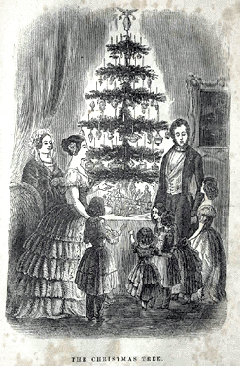
…tree mania struck the British Isles. As with everything that celebrities do, everyone else wants to do it too. And within a few years, the annual tradition of Christmas trees had gone from a small, German tradition to an almost worldwide annual event!

The Yule Log

The burning of a massive log at Christmas…the Yule Log…is a long and ancient tradition. The log is so big because it was needed to burn throughout the twelve days of Christmas, from the 26th of December until the 6th of January. But where does the tradition of the Yule Log come from?

It’s actually a Viking tradition. Vikings would burn huge logs during their holiday of Yula. Yula celebrated the death of the old year during winter, and the birth of the New year the following spring. As spring is the time for new growth and rebirth, praying for fertility was very important. To ensure fertility, what better way to get good crops, new baby animals and new children, than to set fire to one of the biggest phallic symbols in the world…a massive tree-trunk! The burning of a yule log eventually melded into the other traditions of Christmas that we have today.


Mmmm…fertility…

Christmas Pudding

Christmas pudding. Made of dried fruis and drenched with booze, it’s sweet, tangy, squeegy and delicious. Eating pudding at Christmas has been a tradition for centuries, but the modern pudding only came around during the Victorian era. Before then, Christmas pudding was something most of us probably woudln’t have touched with a punting-pole!

Christmas pudding has its origins in the 15th century. In the early 1400s, people would preserve their meat by drying it and wrapping it in pastry along with fruit. This is where we get those cute little mince pies that we love eating at Christmas, but it’s also where we get the modern Christmas pudding from.

Eventually, pies evolved to a food called ‘pottage’, ‘porridge’ or ‘pudding’ (from which we get the different versions of the song “Pease Porridge”). Pottage, to use the original term, got its name because meat and fruit were cooked in a cauldron, a huge pot, along with sugar and spices to perserve it. In the 16th century, Queen Elizabeth I, who had a bit of a sweet-tooth, decided to add more fruit to the mixture to make it taste better.

By Georgian times, preserving meat by mixing it with fruit was out of fashion and was also old-fashioned, because by the 18th century, people had figured out better (and more importantly – tastier) ways of preserving meat. It was around this time that the meat element of Christmas pies and puddings started disappearing and by the early Victorian era in the 1840s, the modern Christmas pudding and pie, with its sweet, tender fruits drenched in alcohol (traditionally – brandy) had arrived.

Eat up, everybody!

Christmas Cards

Christmas is a time for food, drink, family, friends, presents…and those gawd-awful tacky, cheesy, lame, pathetic, yawn-inducing bloody Christmas cards! Sometimes, don’t you wish you could just kill the guy who created the first one?

Well unfortunately for us, Old Father Time already beat us to the mark, because the guy who created the first-ever Christmas card is long dead.

That’s right, there was actually person behind this one, and not just some nameless legendary figure, either. His name was Sir Henry Cole and it was his dubious honour to be named the person who gave us the modern Christmas card! That probably wouldn’t make him too merry today, unlike His Majesty King Cole, to whom Henry was, probably thankfully, not related.

Sir Henry Cole invented the Christmas card, or rather, commissioned the idea of creating them, in the early 1840s. Together with the help of the artist Jon Callcott Horsley, Cole came up with the following:

This is literally the first store-bought Christmas-card that was ever made. It came out in 1843 and it started off a whole new tradition, that of posting Christmas cards to people every December.

When is a Door Not a Door?

Christmas Crackers, another cheesy crazy Christmas tradition. Invented by Tom Smith in 1847, the Christmas cracker had its origins in French traditions. While in Paris in 1840, Smith discovered the French almond candy, the ‘bon-bon’. Smith was a baker by trade, and was always looking for interesting ways to improve his business. He liked this idea of bon-bons, which lovers traditionally gave to each other at Christmas. Smith also took inspiration for the Christmas cracker from the Chinese fortune cookie, which is actually an American invention. He noticed that fortune-cookies had little messages and sayings stuck inside them, and he thought this might be a fun little tradition to do during Christmas.

By the mid-1840s, Smith’s prosperity was growing and legend had it that in 1846, while he was relaxing next to his fireplace, the crackling of the burning firewood gave him an idea! To make little exploding crackers with messages and candy inside them! The idea so-consumed Smith that he spent ages trying to figure out how to create little exploding packages. It wasn’t easy – He nearly blew off his hands in the process! He finally created two strips of cardboard coated with saltpetre (potassium nitrate) which, when rubbed together, let off an audiable ‘bang!’ without blowing your hands to pieces!

With more experimentation, Smith developed the modern Christmas cracker, that lets out a ‘bang!’ when you rip it apart and gives you a horrible, cheap joke written on a piece of paper inside it. By the turn of the century, Smith’s invention had taken the world by storm, and it was around this time that he also started adding not only candy, but also little toys to the crackers as well, and yet another tradition was born.

And there you have it. Santa Claus, crackers, trees, drunken, red-schnozzed reindeer who swilled the brandy that was going to be put on the pudding, and the Yule Log and Christmas card, all the symbols and traditions of the modern Christmas that we have today, during which we celebrate the birth of someone who actually popped into world nine months earlier…

…Merry Christmas, Everybody.


Share this:

  • Share on X (Opens in new window) X
  • Share on Facebook (Opens in new window) Facebook
  • Share on Pinterest (Opens in new window) Pinterest
  • Share on Tumblr (Opens in new window) Tumblr
Posted in Cultural & Social History
10 Comments
20/11/2010 by Scheong

Still More Common English Phrases

Pin Money

To have your ‘pin money’ means to have a bit of extra money…just in case. This expression dates to the 1500s in England. During the Tudor period, small brass and copper pins were essential for dressing. Without the modern safety-pin or an abundance of buttons and buttonholes, clothing was held together with simple, mass-produced pins. Your ‘pin money’ was the essential money that you needed at all times to buy dressing-pins for your clothing.

Uppercase and Lowercase

Capital letters and small letters in text are often called “uppercase” and “lowercase” letters. Why? Why are they up and why are they down? And what cases are there that we can see, anyway?

Uppercase and lowercase letters come from around the 18th century and it relates the occupation of professional printer.

Printing-presses were fairly common in the centuries after the 1500s, but printing was still a skilled art that required strict organisation of everything that the printer did, if a printed page was to turn out correctly. Printing with little metal blocks of movable type meant that there were literally hundreds of tiny little metal cubes and blocks all over the print-shop. To organise these blocks effectively, they were placed into wooden cases with little pidgeon-holes in them for each letter and punctuation-mark. These cases were stacked on top of each other for better organisation. Capital letters were placed in the upper case, where they would be out of the way of the more frequently-used smaller letters, which were placed in the second, lower case. The adoption of this system gradually led to the two terms “uppercase and lowercase”, referring to big and small letters.

The Wrong End of the Stick

To have the “wrong end of the stick” means to believe that you’re doing something correctly, only to find out later that you’re not doing it correctly at all. But why a stick? What does a stick have to do with anything? Why not a sword? Or a knife? Or a bow and arrow?

Again, this is a phrase that comes from the world of printing. The ‘stick’ in this case, refers to the composing stick or the compositor’s stick, which was a long, thin frame used by the printer when he was creating lines of text. Individual lines of text were composed in the composing stick before they were transferred, row by row, to the press-bed, until an entire page was completed, inked and made ready for printing.

To have the “wrong end of the stick” meant to have the stick by the…wrong end. This meant that when you transferred the letters from the stick to the press-bed, you rather spectacularly messed up the ordering of the letters, resulting in everything being printed out backwards! Thus, having the wrong end of the stick really is a big mistake!

Stool

A stool is a solid lump of faecal matter. Delightful. But why is it called a ‘stool’?

Like many things, this slang-term for faeces is shrouded in a big, stinking cloud of mystery. The word ‘stool’, meaning faeces, comes from the 1500s. Before the days of running water, one would use a piece of furniture called a ‘close stool’ to go to the toilet in. A close stool was basically a box with a padded lid with a hole in it. Inside the box, under the hole was a bucket. Over time, the evidence of the close stool’s use, which was collected in the bucket after each event, became known as…stools.

Bob’s Your Uncle

If someone says that “Bob’s your Uncle”, he means ‘there you are!’, ‘done!’, ‘You’re in the club! Huzzah!’. But who was Bob and what did it matter that he was your uncle? And what if your uncle was named Richard…what the hell did you do then?

But who is Uncle Bob, and what does he have to do with all this?

Uncle Bob was actually a real person. His name was Robert Arthur Talbot Gascoyne-Cecil and he was Prime Minister of the United Kingdom from 1895-1902. And it was his famous act of nepotism (nepotism is favouritism for family-members in matters of professionalism) regarding his nephew, Arthur Balfour in 1886, that gave rise to this popular phrase today. In 1886, Arthur’s Uncle Robert gave him the position of Secretary of Ireland. Many people think that the only reason Balfour got the job was because of his uncle’s favouritism and that he didn’t really deserve the post.

Yanking your Chain

If someone’s ‘yanking your chain’, it means they’re having a larf at your expense. Having a giggle. A bit of a practical joke. What is your chain and why are they yanking it?

The origins of this phrase go back to the mid 1800s to the United States. In parts of America where there was a lot of mining, for gold, coal or other raw materials found deep underground, miners often didn’t have a toilet nearby to relieve themselves in on their long, underground shifts. This situation was slightly remedied by the adaptation of mining-carts which became the port-a-potties of the 19th Century. The top of the mining-cart would be boarded over and these boards would be made into a hinged lid with a hole in it, leading to the bucket inside the cart which caught any bodily waste.

This commode on wheels was always kept near to where the miners were working so that they could relieve themselves if necesary, without having to go all the way outside. Of course, for obvious reasons, the cart was never kept too close to the mine-face. To stop it rolling down the mine’s railroad tracks and causing a disgusting and disasterous accident, a length of chain was looped over and under the cart’s wheels, to jam them in place and to keep the cart at a safe distance. A common practical joke was for, when one miner was using the cart to relieve himself, another miner would sneak up to the cart and start yanking away the chain that acted as the cart’s brake, causing the cart to rattle off down the mine. This gave birth to the expression, to yank someone’s chain.


Share this:

  • Share on X (Opens in new window) X
  • Share on Facebook (Opens in new window) Facebook
  • Share on Pinterest (Opens in new window) Pinterest
  • Share on Tumblr (Opens in new window) Tumblr
Posted in Cultural & Social History
Leave a comment
21/10/2010 by scheong

Ah! Sweet Mystery of…Chocolate! And its Fascinating History

Ah, chocolate! We like chocolate. Sweet, sweet, wonderful chocolate. Sweet, brown, sweet dark, sweet milk, sweet light, sweet, sweet, sinfully so. Food of heaven and love and…the bane of dentists the world over.

Chocolate has a magical place in modern society. It’s supposed to be good for you, it’s supposed to cheer you up, it’s said that we should always have a bit of chocolate in our diets to keep them balanced. That’s good news, isn’t it? Right after reading that, I bet you all ran off from your studies and bedrooms, computer-chairs spinning, off to get a nice, big bar of Cadbury’s or Whitman’s or Lindt or something like that, right? And well you might have. But what you’re probably grabbing onto, with your sugary-felching paws, right now and crooning over like a shriveled up bald guy with a gold ring…

…is only the end result of chocolate. The result of years, decades and centuries of chocolatey evolution. The actual chocolate bar as we know it today, block-chocolate, eating-chocolate, is only about two hundred years old, which is nothing in the scope of history. Interesting, isn’t it?

Where does Chocolate Come From?

The basic ingredient for all chocolate is cocoa-powder. Cocoa-powder comes from the…cocoa bean. And the cocoa bean comes from a big, round thing called a cacao pod. No, that’s not a spelling-mistake, the ‘a’ and ‘o’ change places. In its absolutely most raw state, ‘chocolate’ looks like this:


Cocoa-beans inside a cocao-pod

The cocao pod and the corresponding cocao plant from which it comes from, originally grew in South America. It was the Aztecs who first discovered chocolate, and invented the first use for it…as a rather spicy drink! Now when we think of chocolate, we don’t exactly think of it as spicy, but I guess South Americans are famous for spicy food…even thousands of years ago! Once the cocao-pods had been harvested and cracked open, the beans inside were scooped out and dried. Once dried, during which they transformed from that rather weird whitish appearance to a more familiar brown tint, the beans were smashed and crushed and chopped up. The resulting cocoa-flakes or powder was mixed in with crushed, chopped-up dried chili. The mixture was ground up even further, and then water was added to the mixture and the entire substance was stirred around to produce really…really…hot chocolate.

And for hundreds of years…this was chocolate. A spicy, sweet, bitter drink.

The First Chocolate

Chocolate was discovered by the Europeans in the 16th century, when Spanish explorers brought it back from South America. Experimentation with cocoa led to Europeans removing chili from the mix and adding in substances such as cream, sugar, butter and milk, in an attempt to sweeten the mixture and make it more palatable to European tastebuds. Chocolate became popular in royal courts around Europe and “chocolate houses”, much like coffehouses or teahouses, popped up where the people who could afford it, went to experience this new, sweet and delicious sensation. The first ‘chocolate house’ opened in London in 1657.

And what a sensation it was. Although by this time, from the 1500s until the end of the 18th century, chocolate was still “hot chocolate” or drinking-chocolate as we know it today, it became wildly popular throughout Europe. People started making vessels and utensils specifically for use with chocolate. We have teapots and coffeepots today, and teacups and coffee-cups and saucers today…but when is the last time you saw one of these on sale at the local shopping-centre’s kitchen-area?

This isn’t a communal coffee-tankard like you’d find in the office…it’s a chocolate pot. It was filled up with hot chocolate and dispensed to the drinkers through the spigot at the bottom. This particular one dates from the golden age of drinking chocolate, around the mid 1700s. It’s Dutch, it’s made of pewter and it’s a foot and a half high by a foot wide at its widest point. That’s a lot of chocolate.

But a chocolate-pot could, in theory, be used with any liquid. But there were utensils created which were created for chocolate, to be used with chocolate, and only for chocolate, and which could probably be used for absolutely nothing else. Like this curiosity:

This is called a molinillo. Although it looks extremely pretty and well-made and rather decorative…this was actually a kitchen utensil! Molinillos were invented by the Mexicans in the 1700s and spread around the world from there. What is it used for? Making hot chocolate, of course! Or rather, in the days before those fancy, stainless steel chocolate-making machines that we have today which create foam and froth with alarming hissing and gurgling sounds, a molinillo was used to create the rich, frothy texture to be found in any expertly made drinking-chocolate. This frothiness was achieved by dunking the larger end of the utensil into the drink and then rubbing the molinillo rapidly between your palms. This caused the molinillo to spin rapidly inside the chocolate, frothing it up and making it light and delicious. Traditionally, the molinillo would sit inside the hot chocolate pot, and the long, wooden handle would stick out of the top of the pot, through a specially-drilled hole in the lid. That way, anyone desirous of some nice hot chocolate could hand-froth their own drink before pouring it out into a cup.

Mmmmm…Chocolate…

By now, you probably know where chocolate came from, how it was consumed and the craze that it caused throughout the Western world at the time, but what you may not know is how ‘Chocolate’ got the name…’Chocolate’. Why chocolate? What did it mean? Where did it come from? How is it spelt!?

‘Chocolate’, meaning a sweet confectionary made from the beans of the cacao-pod, was originally spelt ‘xocolatl’. This word comes from the Nahuatl language, which was spoken by the Aztecs, who were for centuries the grand-high-hokey-pokey guardians of this amazing delicacy and who sacrificed bunnies on piles of sugar to appease the Cocoa-Gods…eh…no. The Aztec word ‘Xocolatl’ came from the two words, ‘Xococ’ and ‘Atl’. Literally, they meant “bitter water”, which reflected chocolate’s original status as a bittersweet, spicy beverage drunk by the Aztecs, who added ground-up chili to the mixture. The spelling and pronunciation were changed over the centuries, replacing ‘Xocolatl’ with a more conventional word…’Chocolate’.

The Arrival of Modern Chocolate

Modern chocolate…eating-chocolate, the kind that we know today, and which we can go into the supermarket and buy off the shelves, was rather late in coming in the history of chocolate. Block chocolate, the most common variety of chocolate that we consume today, was only invented in the 1840s! The man responsible for this groundbreaking revolution in chocolate production was a man named Joseph Storrs Fry. Fry was a chocolatier (chocolate-maker) by profession. His family had run a chocolate-making firm since the 1760s! It was founded by his father, also named Joseph Fry. When Old Joe died, his son, Joseph S. Fry, took over, with his mother’s help. A couple of business-partners who dropped in and dropped out later, and Joseph S. Fry returned the company to its family-based roots, with his three sons entering the chocolate-making business with their father. It was in 1847, when the company was known as “J.S. Fry & Sons” that the Fry Family hit on the production of modern chocolate!

The Frys revelation came when they melted cocoa-butter and added it to ‘dutched chocolate’ (or ‘cocoa-powder’ as it’s known today) and sugar. The result of this blending and careful measurement was that when the mixture cooled, they were left with a thick pasty chocolate which they discovered could be poured into moulds or blocks and then made to set hard…creating the world’s first chocolate-bars! The process was perfected over the coming years and by the 1860s, J.S. Fry & Sons were selling the world’s first commercially-successful eating-chocolate in the world!

This revelation of how to make chocolate that you could…EAT…instead of just drinking hot from a chocolate-cup, swept through Europe like the Plague did centuries earlier. In 1849, two Englishmen set up another chocolate-making firm. In the 1860s, a Swiss chandler and a German manufacturer of baby-foods joined forces and, combining their shared knowledge of experience in one’s father-in-law’s chocolate factory and the other’s background in specialty foods, they founded another company in 1866. Another Swiss invented a process to make chocolate more evenly blended, which led to smoother and more velvety chocolate. It was the machinery that allowed this process to happen that inspired an American confectioner who made hard candies, to turn his hands to making hard chocolate as well.

Who were these people?

John and Benjamin Cadbury
Daniel Peter and his partner Henri Nestle
Rodolphe Lindt
Milton Hershey

It was these giants of innovation and creativity and experimentation that launched the chocolate revolution that resulted in the modern, edible chocolate-bar that we know today. To this day, Cadbury’s, Nestle’s, Lindt’s and Hershey’s chocolates remain the most famous in the world. And if you’ve ever wondered what the Cadbury brothers’ slogan ‘A Glass and a Half’ means, it referred to adding a glass and a half of full cream milk to every half-pound of chocolate, to give it that distinctive milky taste.


Share this:

  • Share on X (Opens in new window) X
  • Share on Facebook (Opens in new window) Facebook
  • Share on Pinterest (Opens in new window) Pinterest
  • Share on Tumblr (Opens in new window) Tumblr
Posted in Cultural & Social History
4 Comments
16/09/2010 by scheong

Before the Revolution – Stuff that Plastic Replaced

Thought this might be an interesting little writeup to scribble out, the idea for it came to me while I was out for a walk on the town, as I’m sure a lot of ideas come to a lot of writers…anyway.

These days, almost everything is made from plastic. Not necessarily the same plastic, but a plastic nonetheless. Spoons, forks, knives, sporks, splaydes, dildos, lunchboxes, chopsticks, the vacuum-packed and frustratingly tightly-sealed plastic wrapping that some of your purchases come in, expressly packaged thus to “lock in freshness” and so forth.

With so much plastic all over the place, from the stuff our food is packaged in to the stuff that we squeeze our toothpaste out of…and onto!…What were things made of back in the old days? Don’t forget that plastic is a very new material. The first plastics such as shellac, bakelite and celluloid were only developed in the late 1800s and the early 1900s. Before then, everyday items had to be made out of something else. But what?

This article will look at some of the most commonly-used materials for the manufacture of everyday items prior to the invention of plastics in the late 19th century. Those who might be animal-rights campaigners…look away now.

Ivory

Ivory. A mythical material, purported to be white in colouration and smooth in texture, unseen by mortal eyes since at least the start of the 21st century. Historians are only now beginning to piece together what items early man used this wonder-material to create. Research is slow owing to a lack of funding, but we hope to get more information soon.

Yes indeed. Ivory. Almost unheard of in modern society, as little as fifty or a hundred years ago, ivory, taken from the tusks or teeth of hippos, walruses and most famously of all…elephants…was used in the manufacture of almost anything you could lay your hands on.

Apart from being purely decorative, ivory was used for hundreds of years in a variety of applications. The keys of early pianos were laid in ivory…

…billiard and pool-balls were made out of ivory…

…the scales of straight-razors were made of ivory…


Ivory-scaled straight-razor made by the famous Rodgers family of English cutlers

…as were the handles of fine silverware…

…the use of ivory in everyday items wasn’t just confined to the West, however. The Chinese used ivory to make chopsticks…


Chopsticks made of ivory and pure 24kt gold; Qing Dynasty, China

…and to make the tiles or blocks for the most famous Chinese game of all…mahjong…

Ivory had been used for all these applications and more throughout the centuries. Apart from the applications already listed, ivory was also used for decorative ornaments, musical-instrument mouthpieces, the handles of walking-sticks, the shafts of dip-pens, letter-openers, page-turners and a myriad of other applications.

Ivory has been used for centuries, hundreds of centuries, for almost anything you could imagine. But people enjoyed ivory at a price. The majority of ivory was taken from the tusks of elephants and thousands of elephants were slaughtered and hunted purely for their tusks. Although there were other sources of ivory, the elephant was the most common one and it was hunted to such an extent for its tusks that in the 1970s and the 1980s, a worldwide ban was placed on buying, selling or trading any ivory that came from an elephant that did not die a natural death. The hunting of elephants was declared illegal, as is the trade of poached elephant-tusks. Although it is not illegal to own either new or antique ivory and even though it is not illegal to buy and make things out of ivory, its rarity in the modern world, coupled with the prices which come along with it, to say nothing of the legal red-tape that ties it all together, means that luxury or even everyday items made out of ivory have long become a thing of the past. You can still get ivory today, but prices skyrocket and even a few small pieces of mammoth ivory (the tusks of extinct mammoths were also taken for ivory) shoot into the thousands of dollars and pounds sterling.

To understand why ivory was used for so very many things, you have to understand what ivory was. Ivory was more or less elephant-tooth. And as you know, teeth are very strong. It was this strength, combined with the pure whiteness of ivory (that hadn’t been exposed to sunlight) that made it a favoured material for making stuff with. The other reason why ivory was popular was the pure feel of it.

Very few people these days have ever SEEN ivory, and by that, I mean seen it in the flesh, and even fewer people have had the privilege of touching it, due to its incredible rarity. I was fortunate enough that my former piano-teacher had this grand, honking old upright piano in her living-room. It was a massive, German beast made by the German piano-manufacturers of Richard Lipp & Sohn, in about 1910. Despite everything, despite all the moves, the relocations, the pushings, the shiftings, the tunings and the loosenings and retightenings and being banged around in delivery trucks for what was then the better part of a hundred years, my piano-teacher’s piano had nonetheless retained every single one of its original eighty-eight ivory-laid keys. If the ivory fell off, she said she simply got some glue and stuck it back on again. Under no circumstances was she ever going to replace it with…*gasp*…PLASTIC!

It was a real treat to play that piano and to feel the cool, slightly grainy smoothness of the keys. The mix of slick, ice-cold smooth ivory and the slightly grainy feel that it also had, when you rubbed your fingers over it. It’s a touch, a feel and a sensation that only a lucky few have ever had pass over or under their fingers. But those who have will never forget it.

I know I never will.

Animal Hair

These days, the bristles on brushes are made of plastics or plant-fibres of some kind. In decades and centuries past, however, a completely different material was used to make the bristles on brushes.

Toothbrushes

You may never brush your teeth again after this, but the bristles of many early toothbrushes were actually made of pig-hair! Pig-hair was stiff and robust and from the mid 1700s until the 1940s, the majority of toothbrushes were made from pig-bristles! The modern toothbrush was invented by William Addis. In the 1700s, Addis was jailed for inciting a crowd to riot. While in prison, Addis was convinced that oral hygeine could be improved. Instead of rubbing salt and soot onto your teeth (Oh look at that black, crusted sheen!) with a rag (eeww!), Addis was sure that he could create a ‘tooth-brush’ to clean his mouth with. His prototype was made from a small animal-bone with holes drilled in it, a tufts of pig-bristles glued into the holes. This invention remtained the standard for oral hygeine for over 200 years.

Shaving-brushes

Many of our grandfathers, some of our fathers and a few of us modern men still shave the old-fashioned way, with a straight-razor or a safety-razor, traditional shaving-soap and a shaving-brush, to whirl up the lather and massage and rub it gently into our faces before commencing a dance of death with a merciless mistress of cold steel. Traditionally, the bristles of shaving-brushes were made from boar-hair or badger-hair. This is one aspect that hasn’t changed…even today, the best shaving-brushes are still made from badger-hair. The one in my bathroom has badger-hair bristles. They were…and are…prized as a brush-making material because of their ability to retain water. Plastic bristles let the water slide off their smooth surfaces, but badger-hair bristles held water much more effectively, which is why shaving-brushes were, and still are made from badger-hair.

Lead

As this period advertisement shows, lead was a delicious, nutritious and essential foodstuff back in the old days. It was essential to wellbeing, good health and pure, safe drinking-water. A lot of the stuff made today was once made with this dense, amazingly tough, but also incredibly poisonous metal. Drainpipes, waterpipes and other life-essential, water-carrying necessities were all made of lead. These days, most pipes are made from strong plastics which are easy to manufacture, easy to replace and significantly cleaner and healthier.

But apart from pipes, lead was also used to make little Jimmy Hamilton’s playthings! For hundreds of years, lead was used to cast children’s toys! Most famously, entire model armies of tiny, cute, intricately-cast soldiers…all made of lead. Apart from being amazingly effective as musket-ammunition a-la Mel Gibson in “The Patriot”, lead had a number of other properties. Lead poisoning was a terrible condition. It caused adbominal pains, headaches, siezures and in extreme cases, it can even be fatal.

Ebonite

Ebonite is sometimes confused with plastic. It isn’t. Ebonite is actually vulcanised, hardened rubber and the discovery of how this material was produced was made in the mid 19th century. Prior to the invention of the first plastics such as bakelite, celluloid, lucite, shellac and casein, ebonite was what most cast or moulded products were made of, that could not be made out of metal. Such products included the earliest fountain pens (from the 1880s until the 1920s), the mouthpieces of various musical instruments, smoking-pipes and an insulating material for early electrical appliances such as the first phonographs, radio-sets and even as cases for the first automobile-batteries!


The two black fountain pens in this photograph date from 1914 (top) and 1900 (bottom). Both of them are made from ebonite

Although fairly versatile, ebonite did not last. By the 1920s, it was rapidly replaced by what so many things these days are made of. Plastic. Ebonite’s Achilles’ Heel was that it was extremely brittle. It didn’t take much to destroy it and it was the quest to find something better that plastics were invented and the age of plastic domination began…


Share this:

  • Share on X (Opens in new window) X
  • Share on Facebook (Opens in new window) Facebook
  • Share on Pinterest (Opens in new window) Pinterest
  • Share on Tumblr (Opens in new window) Tumblr
Posted in Cultural & Social History
37 Comments
28/07/2010 by scheong

“What Hath God Wrought?” A Telegraphic Revolution

In the 21st Century, communications are instant. iPhones, iPads, mobile phones, blackberries, PCs, laptops, telephones, Instant Messaging, email and alpine yodelling provide all the instant communication, news-broadcasting and information dispersement that we need to run our complex, fancy-schmancy super-whizzy lives. We think of electronic communication as something new and amazing, belonging to the 20th century and not before.

And yet, this couldn’t be further from the truth. Long before the 20th century was ever thought of, back in the first half of the 19th century, in a world of steamboats, horses, carriages, top-hats, pocket-watches, dip-pens, gas-lighting and cobblestoned streets, the world’s first instant-messaging system was born. It was called…the telegraph.

Before the Telegraph

To understand the impact of the telegraph, one needs to understand what communications were like before it arrived, and what they were like after it had become part of everyday life, because in the truest sense of these words, the telegraph was the world’s first instant-messaging system.

Before the telegraph, the only means of long-distance communications was by foot, horseback, watercraft and railroad and the only mode of communication was by the handwritten letter or printed word. After a letter had been written, signed, enveloped, sealed and stamped, it could only travel as fast as a man could walk, horse could gallop, ship could sail or steam, or as fast as a steam-powered locomotive could move along its rails. Although these last two methods of transport were significantly faster than any kind of natural horsepower, it could still take anywhere from several hours to several weeks for a message to travel from one state to another, one county or province to another, or from one country to another. In this last instance, it could be months before the communication had reached its destination, and weeks more before a reply had been returned to the sender by the original letter’s recipient.

The problems with such slow communication were obvious: In medical emergencies, vital messages between hospitals and clinics were days or even weeks out of date. In warfare, slow communication affected the outcomes of battles, troop-movements and the delivery of ammunition and supplies.

To the man famous for inventing the telegraph, Samuel Finley Breese Morse, this aggravating slowness of communication hit a personal note in 1825. His father sent him a letter by horse-messenger that Morse’s first wife, Lucretia, had died on the 7th of February, one month after giving birth to their third child: James Edward Finley Morse (born January 7th, 1825). A distraught Morse rushes home from Washington to New Haven, Connecticut to be with his wife, only to discover that she’d already been buried and that he’d missed the funeral. Such was Morse’s distress that he actually left Washington halfway through painting a portrait of the famous French Field Marshal, Gilbert du Motier, Marquis de La Fayette…or as he was more popularly-known in the United States: Major General LaFayette, the man who led French forces (then allied with American colonial forces) to victory over the British during the Revolutionary War…which Morse had been commissioned to paint during Lafayette’s last visit to America.

The Development of the Electric Telegraph

For the sake of clarification, I’ll use the term ‘electric telegraph’ when referring to Morse’s invention, for the rest of the article, so as to prevent confusion with other forms of telegraphy.

What is ‘telegraphy’, you ask? In its most basic form, ‘tele-graphy’ literally means ‘Writing from Afar’, from the two Greek words ‘Tele’ (‘Afar’) and ‘Graphein’ (‘Writing’). Given this definition of the word, any form of long-distance communication, such as smoke-signals, light-flashes, semaphore-towers or even flags, could be defined (and indeed, were defined) as forms of telegraphy. However, Samuel Morse’s invention was the first kind of telegraphy to use that wonderful and most instantaneous of discoveries – Electricity! Electricity, which could send messages across a wire as fast as a person could tap them out! Electricity, which didn’t require someone to read flags or examine semaphore signals or know smoke-signs…just listen to the electric pulses and write down the message. How wonderfully simple is that?

To be fair, Morse didn’t actually invent the electric telegraph. He merely developed it and improved on existing designs and inventions to create a viable communications system. Basic, rudimentary, simple, elementary…and thoroughly useless electric telegraphs…had existed before Morse’s time, but these were all experimental communications systems, none of them of any quality or substance to be used as a global communications method. Morse changed all that.

Throughout the 1820s and 30s, Samuel Morse created his famous ‘Morse Code’, the coded series of “dots” and “dashes” that symbolised letters and words, that could be sent quickly over his telegraph wires. Morse was a bit slow off the mark, though. The British had already developed their own form of electrical telegraphy by the mid 1830s. In 1837, the year that Queen Elizabeth ascended to the throne, Sir William Fothergill Cooke and Charles Wheatstone, a pair of English inventors, successfully demonstrated the world’s first practical long-distance electric telegraph. By 1839, the telegraph was being used to send messages along railroad lines between cities and was proving pretty darn successful! Morse would have to get a move on if he intended to create something amazing for the Americans before the Brits managed to sell their idea to Washington!

Together with his assistant, Alfred Vail, who helped Morse develop his famous telegraph code, Morse patented his own telegraph-system in 1837 and sent the first-ever electric telegraph-message in the United States on the 6th of January, 1838. Sent over two miles of telegraph-wire, the message read: “A Patient Waiter is No Loser”.

Morse tried unsuccessfully to interest various organisations and institutions in his new invention, but few agreed to take on this newfangled ‘electric’ telegraph. It couldn’t possibly work! But eventually, Morse got his way. Wanting to prove just how capable Morse Code electric telegraphy was, in December of 1842, Morse travelled to Washington. He set up two Morse-Code transmitter-receivers in different rooms of the famous Capitol Building in Washington and successfully transmitted messages between the two machines. Congress was impressed enough with Morse’s invention to give it a shot. A shot worth $30,000! This money was provided so that Morse could set up a telegraph-line between Washington, D.C and Baltimore, Maryland…which was thirty-six miles away! Far enough that no kind of underhanded trickery would even remotely be possible!


A simple Morse key. Pressing down on the key completes an electrical circuit. Releasing the key breaks this circuit. By tapping the key in a specific pattern of long and short taps, a series of audiable, electro-magnetic pulses could be sent along a telegraph-wire in ‘Morse Code’, which was a code made up of a series of short (‘dots’) and long (‘dashes’) electric pulses for each letter of the alphabet

On the 24th of May, 1844, the Washington-Baltimore telegraph line was officially opened by Morse himself. The opening message was a line that Morse had selected from the bible. He transmitted it from the Mount Clare Railroad Station in Baltimore to the Capitol Building in Washington…36 miles away! What was the message?

“What hath God wrought?”

Taken from the Book of Numbers in the bible, Chapter 23, Verse 23, Morse asked the question of what wonders God had created? ‘Wrought’ is an archaic term for ‘worked’ or ‘created’ (from which we also get the term ‘wrought iron’). Of course, God had done nothing at all…but Morse had heralded in and had created a whole new way for people to communicate long-distance at the flick of a switch!

The Impact of the Telegraph

Just like the internet over a hundred years later, the electric telegraph spawned an age of rapid, mass-communications and news-broadcasting. For the first time in history, two people in two different places could send and receive messages faster than any train, horse, bicycle, carriage, riverboat, steamship or hot-air balloon could ever possibly transport it. Soon, telegraph companies sprang up across the United States and Europe, with cables being strung out across the land and slung up on telegraph-poles. For ease of maintenance and installation, telegraph lines would follow roads, highways and railroad lines and soon, towns and cities of all sizes had at least one telegraph office where people could go and send or receive telegrams from other people who might be living hundreds or thousands of miles away.

The power of electric telegraphy was phenomenal. It changed how people did everything, from finance and marketing, by telegraphing stock-prices over the wire, to warfare, by telegraphing troop-movements and battle-plans back to military headquarters, to crime-fighting, by telegraphing important details to law-enforcement agencies who might be hundreds of miles away, to be on the lookout for a dangerous criminal. For the first time in history, news and newspapers could be updated within a few hours, a few minutes, even, whereas it had taken days or even weeks for news or updates on current news-stories to come from far-flung corners of the world before the telegraph’s invention.

In the second half of the 19th century, a major communications milestone was reached: International telegraphic communications. Although it took nearly a dozen attempts over a period of almost ten years, by the late 1860s, the American continent and Europe, the New World and the Old World, were literally joined together by an underseas telegraph-wire. For the first time in history, instant communications across vast oceans was possible. Now, people didn’t have to wait for mail-ships to come steaming into harbour…they could go to the telegraph-office and send a telegram from London to New York. Melbourne to Singapore. Singapore to Hong Kong. The telegraph had become the world’s first internet – the first truly instant global communications system where news travelled as fast as you could operate a telegraph-key and as fast as the receiver could operate a typewriter or use a pen.

The Telegraphic Heyday

The electric telegraph and its children, the little telegrams which whizzed around the world, survived for an amazingly long time; from the 1830s until well into the 1950s, 60s, 70s and 80s! Western Union, the famous American telegraphic company, didn’t finally stop sending telegrams until January of 2006!

The heyday of the telegraph was between the 1850s until the 1950s, the hundred years (give or take a few decades) that bridged the gap between the 19th and 20th centuries. When you consider that the telephone was invented in the 1870s, you’re probably wondering why the hell telegrams and telephones tolerated each other for so long and why the switchboard-operator didn’t just boot the telegraph-operator off his podium and claim 1st Prize in Communications the moment it came along?

The reasons for this are numerous. The most obvious one is price. A telegram cost a few cents. For those few cents, you could send a message from New York to Los Angeles, Melbourne to Perth, London to Edinbrugh, Paris to Rome or Anchorage to Miami in a matter of minutes. Telephone-calls, even short ones, were expensive. And not everyone could afford these new and fancy machines that interrupted their lives with rattling, jangling bells, poor reception and nosy switchboard-operators, who could drink in their entire conversations (of course, telegraph-operators could do the exact same thing with telegrams, but people probably conveniently forgot that little similarity as soon as possible). A telegram required no new, expensive machinery and it didn’t cost as much…and, especially in the early days, a telegram could travel faster and further than any telephone could.

Such was the telegraph’s popularity that in the 1920s and 30s, it was actually quicker and more cost-effective to send a telegram to someone on the other side of the country than to call them long-distance, even though by now, the telephone was becoming a common household and business machine. Soon, people developed their own jargon and slang centered around the telegraph. A telegram was a ‘cable’ or a ‘wire’. The short, clipped, precise and to-the-point messages were written in “telegram-style” English and the word ‘Stop’ became synonymous with the ending of sentences and telegrams.

The cost of a telegram was determined by its length and number of words. A telegram with a longer message cost more, while shorter messages obviously cost less. Sometimes, telegraph companies and offices set their own telegram-rates, such as 8c for the first 10 words and 2c for every word after that. Because of this, telegrams were kept as short and to-the-point as possible. Sending telegrams could only be done through Morse Code and while letters and numbers were easy enough to remember, punctuation marks were not. Marks such as full-stops, question-marks, colons and hyphens were harder to send over the telegraph and it cost more to add them into a telegram compared to a regular word. For this reason, people usually just ended their sentences and telegrams with the word ‘STOP’, to save money.

Some of the most famous events in history were communicated over telegraph wires. The completion of the American Transcontinental Railroad in 1869 was announced to the world via telegraph. The miner’s strike and rioting at the Eureka Stockade in Victoria, Australia, in 1854, was communicated to law-enforcement through the telegraph. In 1903, the news about the success of the world’s first heavier-than-air powered flight by the Wright Brothers was telegraphed to their father. The telegraph-operator asked the Wrights if he might also inform the local media-outlets. They forbade him to do so, but he went ahead and spilt the beans anyway.


The telegram sent by Orville Wright to his father, informing him about the success of their experimental airplanes. Orville and Wilbur’s father was supposed to inform the newspapers officially, but the telegraph-operator who sent the message beat him to it

The electric telegraph revolutionised the world and mass-communications. Faster by far than delivering mail, and cheaper than telephone, it remained in use well into the first decade of the 21st century. When wireless telegraphy was developed by Marconi, for the first time it was possible to send telegrams and information and news to places without the need for wires and cables, opening up the airwaves to places such as ocean-liners, personal radio-sets and airplane pilots. The term ‘wireless telegraphy’ was coined to reflect the new technology’s amazing capabilities, and it was to play crucial roles in such famous historical events as the sinking of the Titanic in 1912, the famous ‘Dam Busters’ raid during the Second World War, and the disappearance of Amelia Earhart, the famous aviatrix.

The End of the Telegraph

From experiment to novelty, luxury to acceptance, acceptance to commonplace, commonplace to essential, essential to supplementary, supplementary to outdated and finally, outdated to obsolete, the electric telegraph survived over a hundred years, saw the births of two centuries and the ends of two centuries and lived alongside with the internet in its last practical days on earth, but even though today it’s little more than a novelty, the electric telegraph brought the world closer together and showed people that instant communication wasn’t a dream, but something real and practical, something that showed us that anything is possible if we think it through. As the telegraph came to an end in the early 21st century, this article has also come to its end, finishing with the one word which everyone associates with electrical telegraphy to this day…

STOP


Share this:

  • Share on X (Opens in new window) X
  • Share on Facebook (Opens in new window) Facebook
  • Share on Pinterest (Opens in new window) Pinterest
  • Share on Tumblr (Opens in new window) Tumblr
Posted in Cultural & Social History
4 Comments
14/04/2010 by scheong

The Lancet and Scalpel: A Brief History of Medical Science and Understanding

Special Note: I am not, never was and most likely, never will be, a student of medicine. With this in mind, be prepared for a few errors in the article to follow. All facts are presented as being true and correct according to the research I conducted and the sources that I’ve read. I approach this mostly from a historical point of view, being a student of history, rather than from a medico-scientific view.

For centuries, mankind has feared all kinds of things. The natural (floods, storms, fires, blizzards and the yeti), the supernatural (ghosts, demons, Criss Angel), the physical (murderers, rapists, George W. Bush) and the imagined (clowns, vampires and Frankenstein’s Monster). But all of these horrific, scary, angering or terrifying things, pale in comparison with one of man’s greatest fears, one which has lasted for centuries and which will last for centuries still.

The fears of injury, disease and death.

This article will explore the history of disease, injury, medical theories and the advancements of medical science from the middle ages to the modern era. A warning to the squeamish that this article may contain various unsightly visual media. Those prone to fainting at the sight of blood might want to click that nice, and doubtless,increasingly inviting ‘Back’ button, right now.

Back in the Old…Old…OLD…Days

These days, we probably don’t think much of medicine. If we break a leg or get sick or get injured, we go to the hospital or visit the chemist’s shop to get ourselves treated and fixed up. We get a day or four off of school or work and then get on with life. Today, minor things seem pretty…minor. But that’s because today in the 21st century, we have things like antiseptics, antibiotics and effective medications to deal with our problems and predicaments.

Things were not always this safe. Antibiotics were only discovered less than a hundred years ago and antiseptics not much further back. Imagine living in a world before all these amazing medical inventions, and wondering what your life must’ve been like. How were injuries and illnesses treated? How did doctors deal with infections? How did they understand the workings of the human body? And how did they understand the workings (or lack, thereof) of the medicines which they prescribed?

A Totally Humourous Theory

Any person who has studied the history of medicine, either for university, for school or even because they were bored at the doctor’s office and picked up one of his magazines lying on the coffee-table, will probably know this first medical theory. It is the oldest theory in the books, almost literally.

The theory of the Four Humours (officially called “Humourism”) lasted a surprisingly long time, from its formulation in Ancient Greece, right up to the 17th century. Hold out your hands and start counting on your fingers to see how long that was.

The theory of the Four Humours was the belief that the human body was made up of four…humours. These humors were four different liquids, these liquids being, in no particular order: Blood. Black Bile. Yellow Bile. Phlegm. This theory came from the belief in the “four natural elements”, said elements being Earth. Air. Fire. Water. At the time, it was believed that everything on earth was made up of a combination of these four ‘elements’. So by that logic, man and woman were also made up of four elements: the four humours.

The theory of Humourism stated that when someone was feeling fine, their four humors were in perfect balance. If the person was sick, this was a sign that the four humours were imbalanced in some way. To cure the person, the correct action was to restore the balance of fluids in the body and to restore the person’s humours.

Have you ever heard of someone being described a melancholy, meaning that they’re feeling sad, depressed, listless and bored? This is probably the only holdover from the Humourism theory that still survives in the 21st century. Originally, to be ‘Melancholy’ meant to have an excess of black bile in the body, which caused a mood imbalance which was thought to cause sadness and listlessness.

Let it Flow

Since, to medieval minds, a person’s body was made up of the four humours, if the person was sick, this indicated an imbalance in the humours. To ‘cure’ the person, the correct action was to remove the offending and ‘bad’ fluid from the body. This was meant to restore the patient’s balance of humours and cure them. Enter the surgeon with his lancet and bowl.


This set of lancets from the 1700s shows just how long the practice of bloodletting survived

More often than not, the medieval way of curing disease was a barbaric and totally pointless practice which was known as ‘bloodletting’. Bloodletting was an incredibly popular remedy and it lasted right up to the 1800s! If the body was sick, the idea was that the blood had become ‘poisoned’. To cure the person, the blood had to be let out of the body to remove the ‘pestillence’ from the body and to restore its natural balance. This was done with a lancet and a bowl. Squeamish folks…turn away now.

Bloodletting involved the doctor or surgeon taking the patient’s arm, leg or in desperate times, even the neck, and cutting into a vein with a razor-sharp implement known as a lancet. The cut having being made, blood was literally let out. That is, it was allowed to flow out of the cut in the limb (or if you were especially unfortunate…the neck) and the blood dripped or dribbled into the bowl which was held nearby. The point wasn’t to bleed the patient to death, but rather to systematically cure the patient of his ills. A pre-determined amount of blood (say, one quart) would be removed from the body. After this, the cut was bandaged and left to heal. Later, another quart…or two…might be removed from the body and again the limb would be left to heal. While this theory made perfect sense to medieval doctors, it actually has no practical benefit at all. Removing blood from an already infected body leaves it weaker and in an even worse state to fight the infection already in it. And using lancets and knives which probably hadn’t been washed properly and sterlised, meant that the doctor was probably introducing even more harmful bacteria into the body.


A late 18th century illustration, showing a doctor bloodletting a patient. Having made a cut into a vein in the arm, the doctor is now catching the blood that comes out of the open wound. The bowl isn’t just there to not make a mess of the floor, but to accurately measure the amount of blood removed

Medieval Medicines

Bloodletting was not the only thing that doctors and barber-surgeons did to try and save lives. They also had medicines to prescribe to their patients. But how beneficial they were was often a hit-and-miss affair. More often than not, though, the medicines probably missed the mark by a mile.

Medieval medicine was a jumble of natural remedies, hocus-pocus, quackery and religious balderdash. Very few medicines actually ever worked. Those which did, doctors were at a loss to explain. All they knew was that it worked, and that was good enough for them. So…what were some common Medieval medicines or drugs? Here are just a few things which medieval people used to treat themselves:

Honey.

Yep. Honey. Ordinary bees’ honey. Various types of natural bees’ honey have special chemicals and plant-material introduced into it by the bees when it is made. This means that honey was a very mild antiseptic. Medieval surgeons sometimes rubbed or spread honey onto a wound to try and clean it and remove the ‘pestillence’ from the patient.

Pearls and Cuttlefish Bones.

Not exactly a medicine, but these were two of the ingredients used in a rudimentary form of tooth-powder, the forerunner of modern toothpaste. Needless to say, it didn’t work very good. And with pearls as an ingredient, you can bet it was bloody expensive.

Stinging Nettles.

Although undoubtedly painful, stinging nettles did actually work. The nettle branches were slapped or struck across joints in the body (such as the wrists or knees) which were suffering from arthritis. Even today, nettle extracts are still used to treat arthritis and rheumatism.

Common Medieval Sickenesseseses…es

Due to the filthy conditions of several Medieval cities, you can imagine that disease was never far behind in the 1300s. Diseases which people feared particularly, included…

The Black Death

Recorded variously as the Plague, the Black Death, the Sickenesse (original Middle English spelling) and several other names, the Black Death was the king of all medieval diseases. The mere mention of its name literally sent people running for the lives. The Bubonic Plague was horrible, painful, unmerciful, indiscriminatory and lethal. Massive outbreaks of Plague throughout the centuries have become the stuff of legends.

Dysentery

Caused by bacteria in unclean food or water, dysentery was a massive killer in the medieval age. During great battles, when armies had to march for days and nights at a time, through filthy weather and on poor diets, dysentery could kill more knights, soldiers and archers than the enemy ever would.

Leporsy

One of the most famous diseases to come from the medieval (and indeed, the ancient) world is leporsy. Leprosy was a horrible disease: Physically deforming and disabling to the body, leprosy was feared almost as much as the plague. Medieval people believed that leprosy was contagious (it is, if the sufferer has not been treated), and lepers were often the most shunned people in society. It was the custom of benevolent noblemen to save the leftover food and trenchers (slices of bread which served as dinner-plates) from their lavish dinner-parties, and to give them to the poor and hungry in their communities. While noblemen would certainly give out food to starving beggars and peasants, they would not dare to approach a leper. Instead, food was thrown at the leper’s feet for him to pick up instead. Due to the deformities caused by the infection, lepers lived in isolated leper-colonies and if they headed out in public, lepers had to carry clappers or bells which they sounded or rang, to warn people of their presence so that they would have enough time to throw up their hands and run off, screaming in horror.

Punishment from Above

Apart from belief in the Four Humours, many medieval people believed that illness was due to punishment from God. Particularly nasty diseases such as Plague, were seen as evidence of God’s wrath upon his people. Some people believed that prayer helped their healing just as much as pills and potions did. If it wasn’t punishment from God that made one sick, then possession by demons, the devil and evil spirits was thought to be the cause of one’s ills. These were treated with crosses, bibles, holy water and exorcism. In particularly extreme cases of “possession”, the unfortunate victim (who was most likely just mentally ill), was subjected to the barbaric and pointless operation known as trepanning.

Trepanning, like the equally useless and damaging operation known as the lobotomy, was an attempt to cure someone of their mental illnesses. It involved drilling a hole into the skull, either to relieve pressure on the brain, or to release demons and evil spirits which were inhabiting the patient’s brain. The operation was carried out with a murderous looking instrument called a trephine…

First, a Y or X-shaped cut was made in the skull. The skin was peeled back and then the trephine was placed against the skull. With pressure placed against the bone, the trephine’s was turned around and around to operate the drill. The grinding of the metal teeth against the bone would’ve been very noisy to the patient and excruciatingly painful. Once the skull was successfully drilled through, the operation was considered a success, although some patients squirmed so much that a successful trephination wasn’t always possible.

There’s Something in the Air…It’s a Miasma!

Once the circulation of blood was discovered in the 1600s, the old understanding of the human body began to collapse. The foundation of medical colleges and hospitals allowed doctors and surgeons to examine bodies (usually the dead bodies of criminals), and this furthered the understanding of the makeup and operation of the human body. As the the Theory of Humourism began to lose favour, it was gradually replaced by another one: The Miasma theory, or the Maisamatic Theory of Disease.

A miasma (pronounced alternatively either ‘My-azz-ma’ or ‘Mee-azz-ma’), literally meant ‘bad air’, from the Greek words meaning ‘pollution’. This theory, which first took hold in the Early Modern Period (ca. 1500s) and which lasted right into the mid 19th century, purported that diseae was not due to the imbalance of bodily fluids. It had since been discovered that the body did not contain such fanciful fluids (except perhaps…blood. Lots and lots of blood). Instead, the Miasma Theory said, disease was spread by ‘bad air’. Bad air generally meant bad smells: noxious, foul-smelling stenches and strong odours. As strong odours often came from filth and rubbish and refuse and human waste, for the first time in history, the connection was made between filthy living conditions and disease.

With the miasma theory of disease in full swing by the 1700s and 1800s, real progress began to be made in the field of sanitation. People learnt that it was impossible to survive in filth due to the powerful and poisonous odours that were given off by the rotting garbage and other…refuse. Cities learnt the importance of proper waste and garbage management, which helped to keep down populations of bacteria and rats, which in the past, carried the fleas which transmitted the Plague to their unsuspecting and unfortunate victims. In medieval times, when refuse and the contents of chamberpots were literally just thrown out the window, rats and disease thrived causing incredible sickness. The rise of the Miasma Theory meant that people soon learnt that unhygienic conditions were life-threatening and had to be avoided at all costs. While the Miasma Theory has since been debunked, a remnant of its influence still exists in 21st century medicine today. The tropical, mosquito-carried disease malaria has its roots in words literally meaning “bad air” or “MALodorous AIR”.

Enlightened Thought

While medical theory advanced slightly in the 18th century, commonly called the Age of Enlightenment, medical fact was considerably further behind. A lot of the treatments and practices of decades and even centuries past, continued to be taught and administered by doctors and surgeons in the 18th century. Bleeding was still a common method of treatment, accompanied by the painful and thoroughly uncomfortable cupping-glasses.


A set of 18th century cupping-glasses

Cupping-glasses were little glass cups or bowls, which were heated up, either with the flame of a candle, or by burning a substance inside the cup. The hot cup was then placed over a certain part of the body (usually the limbs). The point of cupping-glasses was that the heat from the hot glass created a vacuum. This vacuum brought blood to the surface of the body, which allowed surgeons and doctors to let the blood more effectively. While cupping still exists today as an alternative therapy, modern medical societies have determined that cupping provides no relief and has no healing effect at all.

The 17th, 18th and 19th centuries were the periods when people really started experimenting with new and fantastic drugs. Mercury was used to treat syphillis, mustard patches were used to treat headaches, smoking tobacco was once thought to be a preventative against the Plague. Laudanum, a mixture of opium and alcohol, was used as a rudimentary painkiller during operations and amputations. In the days before antibiotics, when a patient’s limb became infected with gangrene, amputation was often the only way to save the patient’s life. Laudanum (or just plain whiskey) was used as a painkiller while the surgeon sawed off the patient’s infected limb with an amputation knife and hacksaw.

Medicines continued to be developed throughout the 18th and 19th centuries, some of which we wouldn’t dare think of using today. Apart from mercury, poisonous substances such as lead, arsenic, strychnine and turpentine were also used in the treatment of various diseases and conditions. Opiate drugs such as opium and heroin were also used for their calming and anti-depressent affects.

Safe Surgery

From the barber-surgeon of the Middle Ages to the ship’s surgeon of Napoleonic times and the civilian surgeons who worked in hospitals in the 18th and 19th centuries, one major obstacle in their profession made many operations futile.

Infection.

Even though the surgery performed might have been highly successful (although what was considered a ‘success’ varied from surgeon to surgeon), one major problem was that wounds that were left open too long, or which were attended to with unclean hands or instruments, were very susceptable to infection. For centuries, surgeons puzzled over this problem, unable to find a solution. While the Miasma Theory meant that hospitals were now nice and clean, there was little pressure on doctors and surgeons to clean their hands or the instruments that they used, due to the belief that disease was transmitted through the air, not by tiny, invisible bacteria.

While patient comfort during surgery was gradually improving, with the discovery of anesthetics such as ether and chloroform (although until the early 20th century, these were still largely in the experimental stages), infection and how to treat and more importantly, prevent it, was still a mystery.

Until a man named Joseph Lister started messing around in hospitals.

Joseph Lister, 1st Baron Lister (1827-1912), was an English surgeon who revolutionised safe surgery. Through observing the cleaning of sewers, Lister saw that sanitation workers sprayed carbolic acid in the air to clear and clean it. Lister also saw that midwives, who washed their hands regularly between delivering babies, had fewer fatalities than surgeons in busy hospitals, who often rushed from one patient to another without washing their hands. Because of these obserations, Lister drew the conclusion that tiny, microscopic things, invisible to the human eye, were causing disease, and not miasmas, as was previously thought.

Lister and the Germs

When Lister was a young man in the second half of the 1800s, the Germ Theory of Disease was still pretty new. Despite evidence from research conducted by such pioneers as Dr. John Snow (who successfully and correctly determined that cholera was waterborne, which proved that disease could be spread in ways other than through the air), most people still believed in the old Miasma Theory, which had survived since the 1600s. Men such as Louis Pasteur (after whom the process of pasteurisation is named), also theorised that disease was spread in ways other than through the air. Bit by bit, doctors, scientists and surgeons formed a new theory of how disease was spread and how the body contracted disease as the 19th century progressed.

Lister experimented with carbolic acid. By spraying a carbolic acid solution around his surgery and by spraying and cleaning his hands and instruments in carbolic acid, Lister discovered that incidents of post-operative infection began to decline. Sure that he was on to something here, Lister gave instructions to all the surgeons under his leadership at the hospitals where he worked, that they wear gloves whenever possible and that, when this was not possible, that they wash their hands in a carbolic acid solution. Washing instruments in carbolic acid was made mandatory and gradually, instances of post-operative infections due to germs entering the body through unclean instruments and hands, began to drop.

As the 19th century progressed, the Germ Theory became more and more accepted by the medical and scientific community. Soon, hospitals everywhere were obliged to keep their rooms, hallways, instruments and the hands which used those instruments, as sterile as possible, so as to best aid the people being served. Lister soon gained immense fame, and was even rewarded with a baronetcy, for introducing the world to safe antiseptic surgery. Lister’s name lives on today in a rather unusual manner…the popular mouthwash-liquid…Listerine…was named after him, in 1879.


Listerine, named after Joseph Lister, was invented in 1879 as a general-purpose antiseptic wash, but is remembered today as everyone’s favourite mouthwash

Lister’s fame and skill and innovations in surgery meant that in 1902, when Lister was well into his seventies, he was still considered one of the leading experts on safe, antiseptic surgery. Why 1902? Because in that year, the year of the coronation of King Edward VII, Queen Victoria’s son, his Majesty suffered terrible appendicitis. The king received the best surgeons and doctors available, but they did not dare proceed with the operation without the personal direction of Baron Lister, who was now a creaking, rattling seventy-four years old! Under Lister’s instructions, the operation was a success. Once the king had recovered from his operation, he told Lister that “I know that if it had not been for you and your work, I wouldn’t be sitting here today.”


Share this:

  • Share on X (Opens in new window) X
  • Share on Facebook (Opens in new window) Facebook
  • Share on Pinterest (Opens in new window) Pinterest
  • Share on Tumblr (Opens in new window) Tumblr
Posted in Cultural & Social History
10 Comments
23/02/2010 by scheong

The Iditarod: The Original Dash of Mercy

In the world of dog-sledding, probably the most famous dogsledding event is the Iditarod. Named for the town of Iditarod, Alaska. The race runs from Willow to Nome, Alaska and is one of the most physically dangerous and exhausting races in the world. The race is 1,800+ km (over 1,160mil) long and can take anywhere from nine days to up to nearly three weeks to complete in the worst conditions. The sledders and their dogs frequently race through blizzards, whiteouts and sub-zero temperatures that can freefall down to a teeth-chattering -100 degrees farenheit, or -73 degrees celcius.

The Iditarod, officially called the Iditarod Trail Sled Dog Race, was started in 1973. The race actually has two different routes, a northern trail run on even-numbered years, and a southern trail run on odd-numbered years. As of today, the fastest race-time was eight days, twenty-two hours, forty-six minutes and two seconds. This record was made in 2002 by Swiss competitor Martin Buser.

While the Iditarod has remained a popular race for almost the last forty years, its origins are rather obscure today. This article will tell how what is today simply a bit of fun and competition, had its roots in one of the most significant medical emergencies of the 20th century, which almost ended in disaster.

The Great Race of Mercy

The year is 1924. In the tiny mining town of Nome, in northern Alaska, a steamship, the S.S. Alameda, steams out of Nome’s harbour, the last ship to leave the town before the weather gets too cold and the water in the harbour freezes, leaving the town isolated from the rest of the world. It is December and the weather is freezing cold. Once the water in the harbour solidifies to ice, no ships will be able to sail in or out of the harbour. Blizzards and snowstorms would make the roads impassable to even the hardiest hikers, cyclists, skiiers and motorists. The whiteout conditions would make it impossible for airplanes to fly in.

Over the next few weeks, through December and leading into January of 1925, Nome’s resident physician, Dr. Curtis Welch, would be contacted several times by townsfolk, as well as by the local inuit eskimoes who live in villages nearby, to examine sick children. Dr. Welch suspects that it’s just the common cold, influenza or an irritating sore throat, easily treated with common sense and conventional medicines. As the weeks pass, though, Dr. Welch realises that it’s something more serious. He finally makes the correct conclusion that an epidemic of diptheria is gradually spreading throughout Nome and the surrounding villages.

Diptheria is a highly contagious respiratory disease, spread through physical contact. It starts off with a sore throat a fever and dizziness, all symptoms identical to the common cold, which is what caused Dr. Welch’s earlier misdiagnoses. In severe cases of diptheria, the lymph nodes swell up, causing breathing difficulties and partial paralysis. As the disease worsens, the patient could suffer heart-failure and liver-failure and die.

Fortunately, diptheria was a fairly prevelent disease during the early 20th century, so prevelent that medical science was able to create medications to deal with it. In the 1920s, the main form of diptheria control was dosing the patients with diptheria antitoxins which combated the toxins already in the body to cure the patients of their ills.

Unfortunately for Dr. Welch, no such antitoxins existed in Nome at the time. A small stash of it (8,000 units) was discovered at the local hospital but it was considered too out-of-date to be of any practical medical benefit, having expired the previous summer. Dr. Welch was not willing to risk the lives of children by using potentially lethal medicine. With the roads cut off, the skies declared a no-fly zone and the oceans frozen-over, the only way out of Nome was via the telegraph. Welch sent urgent telegrams to every single town which had radio contact with Nome, hoping against hope that another hospital had a ready supply of diptheria antitoxin. On the 22nd of January, Dr. Welch sent the following telegram to the United States Public Health Service in Washington DC:

    An epidemic of diphtheria is almost inevitable here. Stop.
    I am in urgent need of one million units of diphtheria antitoxin. Stop.
    Mail is only form of transportation. Stop.
    I have made application to Commissioner of Health of the Territories for antitoxin already. Stop.
    There are about 3000 white natives in the district. Stop.

By February of 1925, the number of cases was rising fast. As many as seventy people could be infected and with the disease so contagious, Welch feared a full-scale outbreak that could kill the community’s approximately 10,000 inhabitants.

Away from the impending disaster, US. government officials debated the best way to get what diptheria serum they had to Nome on time. Waiting for the weather to change so that a ship could steam the medicine up the US. western seaboard was considered too much of a waste of time. Driving through the snow was impossible and while flying the medication in via airplane was considered, the airplanes available were old-fashioned, WWI-style biplanes, with exposed cockpits and engines of questionable mechanical ability. If the pilots didn’t freeze to death in their cockpits, the fuel in the engines would solidify from the cold and cause the planes to crash to earth! At any rate, even if the planes made it to Nome, there would be nowhere for them to land.

In an age before helicopters and snowmobiles, the only other way to get medicine to Nome would be by dogsled.

On the 26th of January, a supply of 300,000 units of diptheria serum were found in the Anchorage Railroad Hospital. While nowhere near the one million units that Dr. Welch had so desperately telegraphed for, it would have to do. John Beeson, head of surgery at the Anchorage Railroad Hospital prepared the medicine for its journey. To prevent freezing and to stop the delicate glass phials of antitoxin from shattering from the bumpy dogsled ride that was coming up, they were packed into a cylinder with plenty of padding to stop them bumping around. They were then wrapped with canvas and fur to provide even more padding as well as much-needed warmth. Beeson transported the medicine from the hospital to the nearest railroad station where conductor Francis Knight was waiting for him.

Knight took the precious package and travelled 200 miles north from Anchorage to Nenana. From Nenana to Nome was another 675 miles, a distance that would have to be covered by dogsled alone. Ships wouldn’t be able to travel that far in the stormy artic seas and planes and cars would only freeze in the sub-zero temperatures. It would be a long and bumpy ride for the 20lb parcel of medication.

A total of twenty mushers (dog-sled men) and over 150 dogs sent the serum on a bumpy, rattly, shaky journey across the Alaskan interior on an around-the-clock run. The mushers were all warned in advance and they were all waiting at the various towns along the route to participate in the most important relay race they’d ever run in their lives.

The last musher, Gunnar Kaasen and his lead dog, Balto, came sliding into Nome’s Front St, at 5:30 in the morning on the second of February after travelling dozens of miles through whiteout conditions to get there. During the journey, Kaasen had suffered frostbite from the snow and his dogsled had been flipped over by the powerful, freezing winds that threw the parcel of serum off of his sled. He had to stop the dogs and dig through the snow in pitch black to find it before recommencing his journey.

The medicine was thawed out once it reached Nome and Dr. Welch successfully used it to inject several of Nome’s residents afflicted with diptheria. It wasn’t enough for everyone, but it allowed Nome’s residents to survive long enough for a second dogsled relay, carrying more serum, to arrive in Nome a few days later, with enough medication for the whole town. While the official death-toll for the outbreak of diptheria was listed as seven, Dr. Welch estimated that it could have reached over a hundred deaths in the eskimo villages outside of Nome, where records of fatalities were harder to keep.

Kaasen and his dog, Balto, were hailed as heroes throughout the United States. Throughout the 1920s and 30s, Balto shared a level of canine fame which some believe even outstripped that of famous moving-pictures dog Rin Tin Tin. There’s even a statue of Balto in Central Park in New York City. In the 1990s, an animated film, simply titled “Balto”, was made to tell the story of the famous 1925 dogsled-run (I watched it myself when I was a child). Balto died on the 14th of March, 1933.


Balto’s statue in Central Park

A plaque underneath Balto’s statue in Central Park reads:

Dedicated to the indomitable spirit of the sled dogs that relayed antitoxin six hundred miles over rough ice, across treacherous waters, through Arctic blizzards from Nenana to the relief of stricken Nome in the Winter of 1925.
Endurance · Fidelity · Intelligence

Today, over eighty years later, the Iditarod Trail Sled Dog Race is run every year from Willow (near Anchorage) to Nome, to commemorate this historic event.


Share this:

  • Share on X (Opens in new window) X
  • Share on Facebook (Opens in new window) Facebook
  • Share on Pinterest (Opens in new window) Pinterest
  • Share on Tumblr (Opens in new window) Tumblr
Posted in Cultural & Social History
Leave a comment
21/01/2010 by scheong

Even More Common English Phrases

Here are six more common English phrases and their backgrounds. How many do you recognise?

Toe the Line

Sometimes also spelt ‘tow’ the line, this expression means to conform to the rest of the group and to follow party procedure. It may also mean not to get ahead of oneself, but to stick with the group. This expression is generally believed to have come from the House of Commons in the Palace of Westminster, the British seat of Parliament. The floor of the House of Commons has two red lines on it, which party-members are fobidden to cross. The space between the lines is meant to be further than the blade-length of a pair of swords. This precautionary measure was carried out when one MP was killed on the floor of the House of Commons during a heated political debate. If a party-member crossed the line, the cry to “toe the line” (that is, to not let one toe step out or over the line) would be heard, ordering the impassioned MP to restrain himself from harming another politician.


The two red lines (in front of the benches) that run the length of the House of Commons

Put the Screws On

To ‘put the screws on’ means to place someone under pressure. Generally believed to have come from the medieval torture-device called thumb-screws. Thumb-screws were metal clamps placed over the thumbs (or other fingers) and then gradually screwed closer and closer together, until a confession was extracted. Failure to give a confession resulted in crushed fingers, hence the pressure to think fast and say something to prevent one’s digits turning into something resembling cooked pasta.

Fog of War

The ‘fog of war’ is the high level of confusion which occurs during large and frenzied events where mistakes might be made and where things can go wrong. This originated back in the 17th and 18th centuries when warfare was conducted with blackpowder firearms such as muskets and muzzleloading rifles. Black gunpowder produces incredible amounts of smoke and the constant firing of muskets en-masse soon created thick white ‘fog’ which was almost impossible to see through. Under circumstances like this, the unwary soldier or officer might well produce, or come under the attack of, friendly fire from their own troops or from allies who were unable to tell which side they were firing at, in the spur of the moment.

Going Berserk

If someone is said to be going ‘berserk’ it means that they’re working themselves up into a fit of uncontrollable rage. This comes from the Viking ‘Berserkers’; Viking warriors who worked themselves up into an insane rage before charging off into battle against their enemies.

Once in a Blue Moon

Once in a blue moon means ‘rarely’. But do blue moons actually exist? And how rare are they? Yes they do exist, but they show up only once every few years. The most recent blue moon was actually on the 31st of December, 2009! If the fireworks didn’t blind your sight, you might’ve seen it up in the sky.

Mad as a Hatter

To be insane or crazy, stupid or foolish. Comes from 18th and 19th century hatters (hat-makers), who produced hats by hand. Animal furs were commonly used in making top hats, the predominent headwear of the 19th century. Highly poisonous mercury was used in the felting-process, to make the animal furs nice and soft and comfortable and most importantly: Suitable for hat-making. The fumes from the mercury were breathed in by early hatters, who didn’t know about mercury-poisoning. The fumes caused irreversable brain-damage, coining the term ‘mad as a hatter’.


Share this:

  • Share on X (Opens in new window) X
  • Share on Facebook (Opens in new window) Facebook
  • Share on Pinterest (Opens in new window) Pinterest
  • Share on Tumblr (Opens in new window) Tumblr
Posted in Cultural & Social History
1 Comment
06/01/2010 by scheong

“Mary Had a Little Lamb”: The Birth of Audio-Recording

These days when we want to listen to music, we turn on the TV, tune into the radio, we put on a CD or we click on an MP3 file on our computers. Then we can listen to rock, classical, pop, jazz and anything else that we want. However, CDs have only been around for barely 30 years, and the records that preceeded it only for about 80 years. It wasn’t until the 1920s that disc-records made of shellac and later, vinyl, started replacing the archaic and fragile cylinder-records which dominated the recording industry up to the start of the Great Depression.

Although audio-recording and storage technology has existed since the 1860s, it wasn’t until the late 1870s that a man named Thomas Alva Edison invented the phonograph (or ‘gramophone’ in British English), the first machine capable of both recording, and then playing back, actual sound, and in a quality decent enough to be heard and understood. So, what was early sound-recording like?

Mary Had a Little Lamb

Thomas Edison announced the creation of his newfangled ‘talking machine’ during the last months of 1877. Edison’s machine was surprisingly simple for doing something that was thought impossible in the late 19th century: Recording sound! It relied on an amplification horn, a vibrating needle or stylus and a cylinder wrapped in tinfoil. As Edison spoke (or rather, SHOUTED!) into the amplifying horn, the soundwaves vibrated the needle which cut a long, continuous groove into the tinfoil cylinder while Edison turned the crank-handle on the side. The louder or softer Edison spoke, the deeper or shallower the grooves in the tinfoil turned out to be. By placing the needle at the start of the recording and turning the handle again, a very crackly, but nonetheless, discernable voice could be heard, saying the very first words ever heard on an audio-recording machine:

    “Mary had a little lamb, it’s fleece was white as snow. And everywhere that Mary went, the lamb was sure to follow!”

Edison’s initial recordings were nothing amazing. It took him a considerable time to figure out how to get everything to work. He had discovered that if he spoke loud enough, he could make a needle vibrate and that this vibrating needle would cut a groove into a material which would record sound. But he needed a material that would both record and play back the sound iin a better quality. When tinfoil at least showed him that his theory was correct, he moved onto other things, and eventually came up with a winning combination which heralded the dawn of the recording age.


A turn-of-the-century mechanical cylinder phonograph.

Wax Cylinders

When Edison showed that his newfangled recording machine actually worked, people really started getting interested. Until then, everyone thought the recording of sound was something impossible, but now it was here! But how could people record things that they wanted easily, cheaply and effectively? The big problem with tinfoil records was that the tinfoil had to be REALLY smooth when it was wrapped around the cylinder. Any creases or crinkles or folds in the foil, and it was useless, because it meant that the needle wouldn’t cut a neat groove around the recording-cylinder.

How was it possible for people to mass-produce easy recording-blanks which could be sold to people or which could be sold to recording-companies, to make easy, commercial audio-recordings? How about if they could be formed from a mould just like easter-eggs or waffles or candles?

Then a smart cookie came up with a wonderful idea: Making recording-cylinders out of…wax! Using molten wax and a mould, people could make hundreds, thousands of recording-blanks. The softness of the wax meant that the needle travelled around the cylinder better, and would cut better and more distinct grooves when it was capturing sound. The commercial recording-industry was born!


An Edison ‘Amberol’-brand cylinder-record, cast from wax. These were manufactured from 1912-1929, when the Depression put a lot of recording companies out of business.

The nice thing about cylinder records was that they were easy to produce and they were easy to use. People could buy recording-blanks, take them home and slot them into their phonographs. They could turn on their phonographs and record their own voices or music into the recording-blanks and then play them back. Long before walkmans, camcorders or audio-recording software, people were making home-recordings!

The big problems with cylinder records is that they did not produce a uniform playing-speed as smoothly as later disc-records. And being made of wax, they were easily broken and they could only be played so many times before the needle cut into the wax too much, damaging the already mediocre sound-quality.

The Disc-Record

The disc-record which most of us recognise today, was the idea of Mr. Emile Berliner. It was his belief that if the record went around horizontally rather than vertically, the needle wouldn’t be bumped and jolted as much and it would produce a clearer and more uniform sound and the record could play at a more uniform speed.


A typical phonograph-record.

By the time Berliner’s new record had come out, though, the cylinder record had already been established for several decades. It would take some careful and clever marketing to make people accept the new type of record. Berliner tried recruiting singers and musicians who claimed only to record for Berliner’s new kind of record for various reasons, claiming that the sound-quality was better or that the recording was smoother. One big pulling-point for the disc-record was that it was more compact than the cylinder-record, which made storage and transportation a lot more convenient and significantly easier than its bulkier cousin. These new records were also made of better materials. Originally shellac, but then celluloid and finally, vinyl, starting in the 1940s.

Make Some Noise!

When we listen to old-fashioned jazz music in movies or on the radio or even on MP3-recordings, one thing that is immediately noticable is the recording-quality. Some records are surprisingly crisp and bright and easy to hear, while other recordings are hazy, crackly, muffled or have a significant level of static and buzz. Why is this and why does it happen?

There were two ways of recording music back in the “good old days”. Either you did it acoustically or you did it electronically. These two, very different methods of audio-recording, created two very different levels of playback quality.

Acoustic recording came first and lasted from the birth of audio-recording and playback, until the late 1920s. It involved the singers or instrumentalists crowding around what was known as an amplification or recording horn. Singing or playing into the horn very loudly (or at least, louder than what we’d be used to), caused the soundwaves to vibrate the needle needed to cut the groove into the master record.


A band during a recording-session in the early 20th century. The huge cone to the left is the recording-horn. As you can see, the musicians all have to huddle around it and had to play a lot louder than they usually would, in order for the needle at the other end to vibrate enough to cut the master record.

While this type of recording was effective, the playback quality was mediocre at best. Similar-sounding words in the lyrics of songs might get garbled and meshed together; it was difficult to identify the individual instruments in any given recording. Instruments such as the piano, drums, saxaphone, trumpet or trombone were easy to pick up on early records because they were so loud and strong. More sweeter, high-pitched instruments such as violins and flutes were notoriously hard to record successfully because they couldn’t produce the required level of sound to vibrate the needle. Indeed, a modified instrument, the Stroh Violin, was invented, to try and remedy this problem.


Although this looks like a mutilated Frankenstein’s instrument, this contraption, resembling a cross between a violin and a tuba, is actually a Stroh violin. The horn on the violin allowed the violinist to amplify and project the sound of the usually, rather weak violin, so that it was loud enough to be picked up during early recording-sessions.

Apart from modifications to instruments, vocalists also had to modify the way that they sang. Early recording artists such as the notable Billy Murray, had to sing considerably louder than what they might do in other circumstances. Much like how talkies put silent-film actors out of business, the coming of electronic recording put acoustic singers out of a job. Murray described his style of forceful singing as ‘hammering’, since he practically had to hammer his voice out for it to be loud enough to be picked up on the master record. With newer, eletronic technology, Murray’s singing-style was too powerful and forceful for the new kind of vocalist, who sang more or less how they still do today.

In 1925, the electric microphone was invented, and all over the world, musicians relaxed their fingers and singers took big, grateful gulps of water. For the first time now, there was something to do the amplifying FOR them! And something to rotate the master record at a more uniform speed, and better recording-equipment to get a clearer sound! Find a recording from between 1900-1925 and listen to how grainy and crackly it is. Then find one recorded after 1930: The difference in sound-quality is immediate and stunning. Gone were the warbly, weak voices and the grabled and indistinct musical notes, to be replaced by clear, pleasant lyrics and crisp, bright notes. The era of electronic recording had begun!

The changing voice of audio-recording

From crackly, barely distinct sounds in the 1880s to recognisable and tolerable tunes in the 1910s, finally arriving with clear, crisp recordings in the 1930s, in less than sixty years, mankind had seen the rapid and amazing development of something once thought impossible: The capture and recording and the playing back of sound. And not just sound, not just voices, but music! For the first time, you didn’t need to know how to play an instrument to have music in your home. Instead, you had a machine that could play records which would fill your house with the relaxing parlour songs and ragtime tunes of the 1900s, the hot jazz beat of the Charleston, the energetic swing-dancing music of ’30s big-band or the jitterbugging, lindyhop-inducing rock of the 50s and 60s. We all know what happened after the record was replaced, so this is where this article ends.

Thank you for listening.


Share this:

  • Share on X (Opens in new window) X
  • Share on Facebook (Opens in new window) Facebook
  • Share on Pinterest (Opens in new window) Pinterest
  • Share on Tumblr (Opens in new window) Tumblr
Posted in Cultural & Social History
2 Comments
29/12/2009 by scheong

The Origins of More common English Phrases

Our language is always changing, some things stay, some things are forgotten forever. But the things which stay sometimes survive as insensible little phrases which we use every single day, but have no idea where they came from. This is my second article on the origin of some popular English phrases which we all know and love…

“Like Bedlam”

If a place is said to be loud and noisy and the people inside are rowdy and out of control, the place is said to be “like Bedlam”. What is ‘Bedlam’ and what is it like?

‘Bedlam’ is a corruption of the word ‘Bethlem’, that is, the Bethlem Royal Hospital in London, England. A madhouse (as they were then called) for the mentally ill, by that name, had existed in London since the early 14th century. It was in this delightful institution that people suffering various mental disorders were housed, to be kept away from the general public. The inmates were housed in appalling conditions with little food, water, sanitation or care. Some were locked in cells and chained to the walls, supposedly for their own protection. There was a time, in the 17th and 18th centuries, when you could head into the Bethlem Mental Hospital to view the ‘freaks’ and for a small fee, you could borrow a poking stick (if you were unfortunate enough not to have your own walking-stick), which you could shove between the bars of the cells and poke the inmates with, to enrage them. It’s no wonder that the chaos and noise that existed in this place meant that it has stuck around in the English Language for so long. The Bethlem Royal Hospital still exists today, but you’re not allowed to go there and poke the patients anymore.


Bethlem Royal Hospital as it appears today.

“Worth Your Salt”

Something said to be ‘worth its salt’ or if someone is said to be ‘worth his salt’, it means that the person is worthy and decent. It comes from the fact that in ancient times, sodium chloride…common table-salt…was a very valuable commodity. Extracting usable, commercial quantities of pure, clean salt-crystals for use in cooking was a tricky process in those days, involving large quantities of seawater, which were slowly evaporated by the heat of the sun, leaving the salt-crystals behind, which were then collected, purified, cleaned and then declared ready for consumption. Considering how hard it was to harvest and prepare salt back then, it’s not surprising how expensive it was. It was even used as money at one point, and was probably considered as valuable as gold. It’s for this reason that something said to be ‘worth its salt’ is in a way, synonymous with the term ‘worth its weight in gold’.

“Not Enough Space to Swing a Cat”

Having ‘not enough space to swing a cat’ means to be in a confined area. The ‘cat’ refers to the Cat o’ Nine Tails, the infamous flogging-implement made famous by the Royal Navy of the 18th century. Being in a confined space meant that there wasn’t enough space for the bosun (the man who usually administered the punishment by flogging) to swing the cat to deliver enough force for each blow.

“Whipping Boy”

A ‘whipping boy’ is a person who fairly or unfairly, takes the punishment for another person’s mistakes, similar to a ‘scapegoat’ who takes the blame for another person’s mistakes. In this case, a ‘whipping-boy’ was an actual person and believe it or not…an actual job! It originated in Medieval Europe. Back then, monarchs who believed in the Divine Right of Kings, the belief that the king was appointed by God and that the king was God’s represenative on Earth and that in effect, the king WAS God, further believed that, as this was the case…the children of the king (the crown prince and other princes, that is), were therefore untouchable. Under this system of belief, the king, as God’s representative, was the ONLY person permitted to lay a hand on the king’s son. Anyone else caught striking, caning or otherwise hurting the boy, would be severely punished.

A boy, prince, son of the king or not, is bound to act up in school. In these circumstances when the schoolmaster had to maintain order, instead of caning the prince for his misdeeds, the schoolmaster instead flogged the royal whipping-boy, a boy (usually the son of a nobleman, but who could also be a servant-boy, a slave to the prince or a charity-case who was given tuition in the palace) whose job it was to take the punishment for the prince. Princes often grew up in lonely isolation, so it’s likely that the whipping-boy was his only friend. The schoolmaster whipping the prince’s only friend was seen as an effective way to encourage the prince to concentrate on his studies. Not all whipping-boys had it hard, though…for all their pain and suffering, they could be richly compensated for by their masters later on, if the prince they served ever became king. One lad, William Murray, was whipping-boy to King Charles I in his childhood. When Charles became king, he rewarded Murray handsomely for his service by making him an earl, and giving him land and a house to live in.


Ham House, which was given to William Murray, whipping-boy to Charles I, in 1626, by the king himself. Pretty nifty reward!

“Close but No Cigar!”

“Close but no Cigar” is a common English phrase meaning to almost win something or achieve something, but…not quite. But…why a cigar? Why not an apple or a pear or a bag of gold?

This phrase comes from old fairgrounds where you could go and play various fairground games like the coconut shy or the ring-toss or target-shooting…in such games, a cigar was a popular prize back in the 19th century. Participating in a fairground game and losing by just a bit, meant that you lost out on the prize of a cigar, hence the phrase ‘close, but no cigar’.

“From the Horse’s Mouth”/”Don’t Look a Gift Horse in the Mouth”

To look a gift horse in the mouth means to examine the mouth of a horse which was given to you as a present, or in today’s English, to check the quality of something that was given to you as a gift, instead of just taking it and enjoying it. Similarly, the phrase ‘from the horse’s mouth’. But what do these two phrases mean? And why horses?

They both refer to quality of product and truthfulness. In days gone by, a horse was an important animal. A horse pulled the farmer’s plough, a horse powered your cart or carriage, a horse provided you with transport on its back. Buying a horse, or recieving one as a present, was a big deal. A fact of equine life is that as horses get older, their teeth get more and more worn down. A young colt is likely to have good, solid teeth, while an older horse is likely to have teeth that have been worn down by years of chewing on hay and grass. If you went to buy a horse and the salesman said that it was only a year old, you might not believe him, and so would take the truth literally ‘from the horse’s mouth’. By opening the horse’s mouth and checking the condition of its teeth, you could determine how old it was, and therefore, the truthfulness of the salesman. Similarly, looking a gift horse in the mouth (ie: checking its teeth), shows that you’re nitpicking on something that a person gave you as a gift, instead of taking it, saying ‘thanks’ and enjoying it for what it is.

“Pay through the Nose”

To pay through the nose means to pay a big price for something. Originally, this referred to a Roman punishment, where people quite literally paid for their crimes by having their noses sliced off! Nasty!

“Eating Humble Pie”

To eat humble pie means to take yourself down a peg and let the hot air out of yourself, to lower your social standing, knock you off your pedestal and stand among the masses of humanity for a while. To experience humility. But what is ‘humble’?

‘Humble’ or ‘numble’ as it was originally called, was the jumble and mess and leftovers from the insides of a deer! In the old days, the innards of a deer were given to the servants of powerful noblemen or the servants of royal courts, to eat however they wished, while their wealthy and affluent masters could feast on the best parts of the animal. ‘Humble Pie’ is actually a stew, and not a pie at all; it’s made by cleaning the innards and organs, tossing them into a pot of water, boiling them, fishing them out, chopping them up and cooking them again with vegetables and spices. The result was a truly…fascinating dish…which was called Humble Pie. Only the lowest of the low ate humble pie, so asking someone to eat ‘humble pie’ meant that you desire them to eat the kind of food that only the lowest of the servants were allowed to consume.

“Peeping Tom”

If you’re a ‘Peeping Tom’, it means you sneak around and peep and stare and peek at people in their privacy, when you’re not supposed to! But why are you called a peeping ‘Tom’? Why not Dick? Or Harry? And who was the original ‘Peeping Tom’ who gave the phrase its name?

To find out, we need to go back several hundred years to Anglo-Saxon England and acquaint ourselves with the thoroughly unpleasant man, the Earl Leofric, Lord of Coventry…that’s the town of Coventry, in England, the same one which was bombed to pieces in WWII.

Long before the Luftwaffe flew over Coventry and bombed it to Kingdom Come and blew up Coventry’s famous cathedral, Lord Leofric and his wife, Lady Godiva, ruled Coventry in the 12th Century. Lord Leofric was a mean old bugger who taxed his peasants unmercifully, while Lady Godiva had had enough of her husband’s bullying ways and begged, bullied, argued and fought with him over and over and over again, to make him drop the taxes. In a particularly heated argument, so the legend goes, Leofric said that he’d drop the taxes if his wife would ride through Coventry…completely…butt-…-naked.

To his horror, his wife agreed.

Lady Godiva asked the good people of her city to remain indoors and to shutter their windows while she rode through the town on horseback, completely stark-staring naked, with only her long hair to cover her. Apparently, Peeping Tom, then probably just known as ‘Tom’, one of the town’s tailors, drilled a hole in the shutter of one of his front windows so that he could observe Lady Godiva in all her naked glory as she rode by. The story goes that Tom was struck dead for disobeying her ladyship’s strict command, but despite that, Lord Leofric was forced to stay true to his word…and lowered the taxes.


Share this:

  • Share on X (Opens in new window) X
  • Share on Facebook (Opens in new window) Facebook
  • Share on Pinterest (Opens in new window) Pinterest
  • Share on Tumblr (Opens in new window) Tumblr
Posted in Cultural & Social History
Leave a comment

Post navigation

← Older posts Newer posts →

Advertisement

Pages

  • About the Blog
  • About the Blogger
  • Article Sources
  • Contact the Blogger
  • External Links
  • Selling on eBay!
  • The Encyclopedia Sherlockia
    • Entries A-C
    • Entries D-F
    • Entries G-I
    • Entries J-L
    • Entries M-O
    • Entries P-R
    • Entries S-U
    • Entries V-Z

Recent Posts

  • THREADS OF HERITAGE – A KEBAYA SHOWCASE!
  • “TAXI!!” – An Antique Cab-Call Whistle
  • LET THERE BE LIGHT – Retrofitting a Vintage Flashlight
  • SOUTHERN SOURCES – The Origins of Modern Chinese Food
  • A PROFUSION OF PERANAKANS – How Many Are There?

Categories

  • 17th Century
  • 18th Century
  • 19th Century
  • 20th Century
  • Antique & Vintage Sewing Machines
  • Antique and Vintage Silverware
  • Antiques
  • Chinese History and Legend
  • Creative Writing
  • Criminal History
  • Cultural & Social History
  • Edwardian Era (ca. 1901-1914)
  • Entertainment History
  • Fountain Pens and Typewriters
  • General History
  • Great Disasters
  • Historic Structures & Buildings
  • History Bits
  • History of Clothing
  • History of Communications
  • History of Food
  • History of Technology
  • History of Transport
  • History of Warfare
  • Household History
  • Imperial History
  • Medieval Period
  • Musical History
  • RMS Titanic and Other Ships
  • Sherlock Holmes
  • Sight Unseen
  • The Great Depression (1929-1939)
  • The Jazz Age (1919-1929)
  • The Peranakan Straits Chinese
  • The Victorian Era (1837-1901)
  • Tudor, Stuart and Georgian Periods (1500-1800)
  • Uncategorized
  • Videos
  • WWI (1914-1918)
  • WWII (1939-1945)

Recent Comments

  • James M McArthur on STEPPING OUT – A Colonial era Export Silver & Malacca Walking Stick
  • Dave on LET THERE BE LIGHT – Retrofitting a Vintage Flashlight
  • Oscar on LET THERE BE LIGHT – Retrofitting a Vintage Flashlight
  • Don Lampery on The Wonky Wertheim Winder
  • Sandra Blaney on Old School Lift-Arm Lighter. Ca. 1932

Archives

  • June 2026
  • April 2026
  • February 2026
  • October 2025
  • June 2025
  • March 2025
  • December 2024
  • September 2024
  • August 2024
  • July 2024
  • May 2024
  • April 2024
  • March 2024
  • October 2023
  • September 2023
  • August 2023
  • June 2023
  • March 2023
  • February 2023
  • January 2023
  • December 2022
  • October 2022
  • September 2022
  • August 2022
  • July 2022
  • April 2022
  • March 2022
  • January 2022
  • December 2021
  • November 2021
  • October 2021
  • September 2021
  • August 2021
  • July 2021
  • June 2021
  • May 2021
  • April 2021
  • March 2021
  • February 2021
  • January 2021
  • December 2020
  • November 2020
  • October 2020
  • September 2020
  • August 2020
  • July 2020
  • June 2020
  • May 2020
  • April 2020
  • March 2020
  • February 2020
  • December 2019
  • November 2019
  • October 2019
  • September 2019
  • August 2019
  • July 2019
  • June 2019
  • May 2019
  • April 2019
  • March 2019
  • February 2019
  • January 2019
  • December 2018
  • October 2018
  • September 2018
  • August 2018
  • July 2018
  • June 2018
  • May 2018
  • April 2018
  • March 2018
  • January 2018
  • December 2017
  • November 2017
  • October 2017
  • September 2017
  • August 2017
  • July 2017
  • June 2017
  • May 2017
  • April 2017
  • March 2017
  • February 2017
  • January 2017
  • December 2016
  • November 2016
  • October 2016
  • September 2016
  • August 2016
  • July 2016
  • June 2016
  • May 2016
  • April 2016
  • March 2016
  • February 2016
  • January 2016
  • December 2015
  • November 2015
  • October 2015
  • September 2015
  • August 2015
  • May 2015
  • April 2015
  • March 2015
  • February 2015
  • January 2015
  • December 2014
  • September 2014
  • August 2014
  • July 2014
  • June 2014
  • May 2014
  • April 2014
  • March 2014
  • February 2014
  • January 2014
  • December 2013
  • November 2013
  • October 2013
  • September 2013
  • August 2013
  • July 2013
  • June 2013
  • May 2013
  • April 2013
  • March 2013
  • February 2013
  • January 2013
  • December 2012
  • November 2012
  • October 2012
  • September 2012
  • August 2012
  • July 2012
  • June 2012
  • May 2012
  • April 2012
  • March 2012
  • February 2012
  • January 2012
  • December 2011
  • November 2011
  • October 2011
  • September 2011
  • August 2011
  • July 2011
  • June 2011
  • May 2011
  • April 2011
  • March 2011
  • February 2011
  • January 2011
  • December 2010
  • November 2010
  • October 2010
  • September 2010
  • August 2010
  • July 2010
  • June 2010
  • May 2010
  • April 2010
  • March 2010
  • February 2010
  • January 2010
  • December 2009
  • November 2009

Meta

  • Log in
  • Entries feed
  • Comments feed
  • WordPress.org
June 2026
M T W T F S S
1234567
891011121314
15161718192021
22232425262728
2930  
« Apr    

Mailing List & Newsletter

Advertisement

Top Posts & Pages

  • The Infamous IMCO - Lighter of Mystery!
  • WERTHEIM Manual Sewing Machine. Made in Germany! Ca. 1920.
  • Traditional Forms of Address - Their Histories and Origins
  • Lighting up History: Dunhill Model A 'Sports' Lighter (ca. 1924)
  • Cowboys and Indians: The Truth about the Wild West
  • Dropping In: Sterling Silver 'Drop-Action' gravity-operated pencil-holder. Sampson Mordan & Co. 1912.
  • A Classic of Luxury and Status: The Montblanc Meisterstuck 149 - Part II - Spotting Fake Montblancs
  • A Solid 9ct Gold Antique Toothpick
  • A Personal Touch - An Antique Silver Spoon (ca. 1698)
  • Antique Sewing-Machines - Cleaning the Decals

Subscribe to Blog via Email

Enter your email address to subscribe to this blog and receive notifications of new posts by email.

Join 52 other subscribers.
Proudly powered by WordPress | Theme: Dusk To Dawn by WordPress.com.