Throughout History

A blog about antiques and history!

Category Archives: Cultural & Social History

18/03/2012 by scheong

Darwin Awards: Charles Darwin and the History of Evolutionary Theory

To thousands of people, the Darwin Awards are a series of hilarious but tragic true stories that circulate the internet every few months and which each year, are updated with newer and even more hilariously sad award-winners who have done mankind the dubious honour of stepping up to receive this coveted, time-honoured and completely senseless imaginary prize.

For those who don’t know, the ‘Darwin Awards’ are fictional awards that should be given out each year to the people who, in the award’s own words: “remove themselves from the human gene-pool” either by rendering themselves sterile or by killing themselves in an increasingly stupid and hilarious range of ways.

Legendary Darwin Awards include the man who tried to check for the presence of petrol with a lit match, the bomb-disposal expert who tried to dispose of nitroglycerine by patting it down with a shovel and the youth who attempted to play ‘Russian Roulette’ with an automatic pistol.

The awards pay ‘tribute’, so to speak, to the legendary naturalist Charles Robert Darwin and his famous Theory of Evolution. The theory states that every species on earth improves with each generation by killing off the elements of that species which are detrimental to its progress…or in layman’s terms: ‘Survival of the Fittest’. The winners of the Darwin Awards have therefore done mankind a favour by removing themselves from humanity and in the long-run, contributed towards the betterment of mankind.

In the 21st Century, this is all that most people think about when they hear the name ‘Darwin’. Little thought is probably given these days, to the theorist and scientist who came up with this radical, revolutionary and groundshaking idea that has shaped modern biological science for the past 150+ years. So what is the Theory of Evolution? How did Darwin come up with the Theory and what happened when he did?

What is the Theory of Evolution?

There are a lot of mistaken beliefs about the Theory of Evolution, warped and twisted over time by those who attempt to give it credence and by those who would destroy it as heresy. So what exactly is it?

– The Darwinian Theory of Evolution is not an attempt to explain the creation of the world.

– The Darwinian Theory of Evolution is not an attempt to show how life came into being.

– The Darwinian Theory of Evolution is not an attempt to explain ‘where we come from’.

– The Darwinian Theory of Evolution is not an attempt to explain ‘where we go to’.

– The Darwinian Theory of Evolution is not an attempt to explain the creation of the known universe.

So if that’s what you’ve been told…forget it immediately.

The Darwinian Theory of Evolution attempts to explain none of these things. It was created to attempt to explain how and why a species changes over time and how animals of all kinds (including humans) can change through natural selection to better adapt to their surroundings. Nothing more. Nothing less. The story of how Darwin came up with this theory was revolutionary and mindboggling to medical, scientific and religious minds of the mid-1800s. Although his theory was fascinating and interesting, it was also wildly controversial…nearly 200 years after it was first published, it doesn’t seem like much has changed.

Who was Charles Darwin?

Charles Darwin was an English naturalist, born in Shropshire, England in 1809, into the wealthy and prominent Darwin-Wedgewood Family. His maternal grandfather was Josiah Wedgewood…Yes, the same Wedgewood who established the famous pottery firm. Darwin developed an interest in medicine and science from a young age. He was particularly interested in plants and animals, and fancied himself as something of a gardener.

Charles’s father was the physician Dr. Robert Waring Darwin, and as a man of science, was delighted at his son’s field of interests and encouraged him with his gardening and scientific research. Charles also helped his father in his medical research and attending to his patients.

As a student, Charles’s scientific interests were shared by his older brother, Erasmus Darwin. The two brothers set up a scientific laboratory in a garden shed in their house and Charles became his brother’s lab-assistant in their numerous experiements. It was this upbringing, surrounded by medicine, science, biology, a burning curiosity and a fascination for plants and animals, that would spur on Darwin to, in his later years, develop his famous evolutionary theory.

The World Before Darwin

Even today in the 21st Century, there are still people who believe firmly in the Theory of Creationism. This theory states that God created everything and that the Story of Creation as told in the Bible’s Book of Genesis, is to be taken as literal and true fact.

As it was in the 1800s, nearly two centuries ago.

Prior to Darwin’s development of the Evolutionary Theory, how did people explain the history of the natural world?

Taking the bible as a guide, scientists believed that the world was only a few thousand or tens of thousands of years old. They believed that everything was a divine creation from God above. And this would’ve been fine…except for one problem.

People kept finding fossils.

Fossil-hunting was just as popular in Victorian times as it is today. And whenever scientists were confronted with these, they had no idea how to explain it. It went against everything that religion had told them about the history of the world, and in the 1800s, religion was the bedrock of society. To question the Church, to question God, on anything, was strictly taboo. It simply wasn’t done!

…but the fossils were there. And they were an annoying little thorn in the side of the scientific and religious communities that wouldn’t go away. So how did they explain them?

The closest thing to the Evolutionary Theory that existed before it, was the belief in naturalism. In a nutshell, naturalism is the understanding that there are specific Laws of Nature. These laws regulated how and why certain things happened in the natural universe. The one that we see every day. Anything outside this order would not and did not affect the natural world, and had no bearing or significance to life on earth whatsoever, these elements being called ‘Supernatural’. Since God did not exist in nature and since nothing that didn’t exist in nature was thought to have a bearing on the operation and maintenance of the planet, God was seen as insignificant and imaginary. His presence or absence from the lives of everyday people was something of no consequence. As he wasn’t of the natural world, he couldn’t affect it or regulate it in any way.

In the earlier 1800s, naturalism was the only theory apart from Creationism, that had any followers. But Victorian conservatism forced naturalism underground. It went against the teachings and belief of the Church of England, and was quashed and discredited to the fullest extent possible.

…And we still have those pesky fossils.

Without naturalism to back up any theories, scientists of the early 1800s believed that fossils existed due to the theory of catastrophism.

The Theory of Catastrophism is exactly what it sounds like. According to this theory, scientists believed that every few thousand years, God caused great natural disasters. Tsunamis, volcanic eruptions, earthquakes, floods, raging infernos and great storms. These powerful, earthshaking, earth-changing, cataclysmic events or ‘catastrophes’ (giving the theory its name) was God’s way of wiping out everything that had existed before, and starting fresh with a new world every few thousand years. Fossils, argued catastrophism scientists, were merely the remants that God left behind of the stricken worlds that he had obliterated after each catastrophic event.

Once a catastrophic event had taken place and the earth was wiped clean, God would recreate the earth and its creatures out of nothing but thin air (because he’s like…God and can do…anything), set it up and then just sit back and watch, to see if his latest version of Earth would work out as he planned.

An awesome theory. But there were still people in the scientific community to whom this theory did not jive. To them, it did not explain the history of the world in a coherent and realistic manner that explained everything that they saw around them, or everything that they found on archeological digs. Amongst these naysayers of the Theory of Catastrophism, was Charles Darwin.

The Call of the Sea

In 1831, a young sea-captain was stocking his little ship for a voyage around the world. A voyage of scientific research, a voyage of adventure, a voyage of discovery!

This captain was Robert FitzRoy.

FitzRoy was a sea-captain, a navy man, and one of the first successful meteorologists, who made accurate weather-forecasting a reality. He helped design better and more accurate barometers to forecast the weather with greater accuracy (a barometer works by measuring atmospheric pressure, the same kind of ‘high pressure’ and ‘low pressure’ that your local weatherman talks about on the 6 o’clock news every evening, thereby allowing people to foretell the weather).

FitzRoy was looking for a naturalist – a scientist of the natural world – to follow him on his voyage and to be his travelling companion. He chose the young (22-year-old) Charles Darwin to be that naturalist.

The voyage was the chance of a lifetime for Darwin. A very long chance. The voyage took nearly five years! In that time, he and FitzRoy would literally sail around the world, leaving England in December of 1831 and heading west. They would sail down through the Atlantic, around the bottom of South America, across the Pacific, stop off at New Zealand and Australia, then sail all the way across the South Pacific, the Indian Ocean, around Africa, up the continent’s west coast and then back to England, in October of 1836.

The actual purpose of the voyage was to chart the world, to make corrections on earlier, less accurate maps, and to test out the new maritime chronometers. The maritime chronometer, the insanely accurate ship’s clock invented by clockmaker John Harrison at the turn of the century, was a relatively new invention in the 1830s. Although they were now relatively cheap enough that any ship with a wealthy-enough captain could purchase one, they still required rigorous in-the-field testing. When FitzRoy set sail in 1831, he carried twenty two of these clocks onboard his ship!
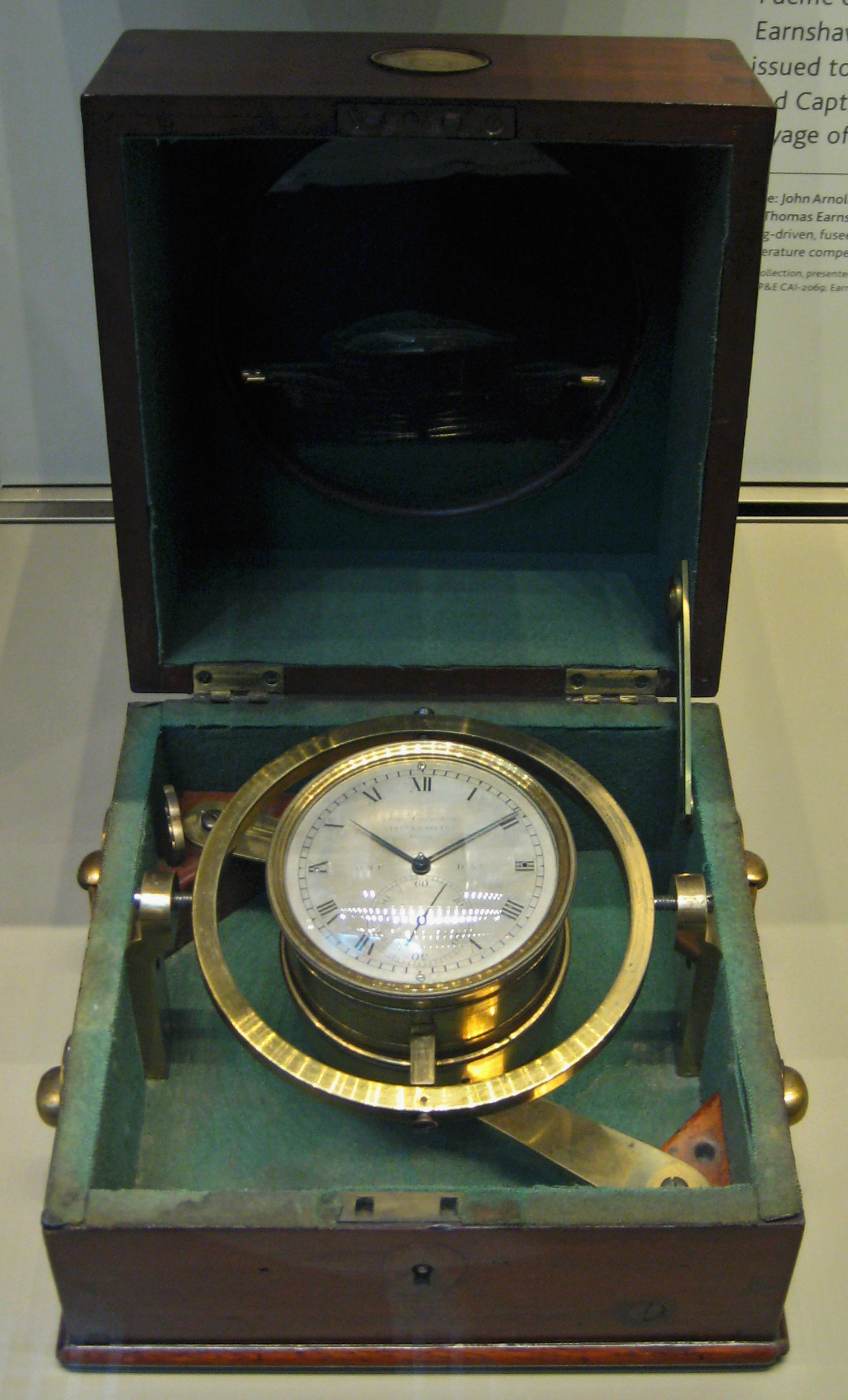

This maritime chronometer, housed in the British Museum, was one of nearly two dozen carried on FitzRoy’s ship during its 1831-36 voyage

And the name of this ship?

The H.M.S. Beagle. That’s the Beagle there, in the middle of this painting from 1841.

A Voyage of Discovery

The H.M.S. Beagle left England on the 27th of December, 1831. It initially sailed south to the Canary Islands, and then southwest towards South America. Regular stops allowed Darwin to get off the ship and to explore the South-American wilderness, where he examined plants, animals, bones and fossils. He would even arrange with Capt. FitzRoy, to have himself dropped off at one point along the coastline, while the ship sailed on without him. They would meet up further along the coastline at a pre-determined time and place, where Darwin would reboard the ship for the next leg of their voyage.

The Beagle reached the famous Galapagos Islands in the Pacific Ocean in September of 1835. Here, Darwin collected more specimens and wrote about his observations on the islands, such as the famous giant tortoises…He even tried to ride one!…but the tortoise failed to oblige him and retreated inside its shell.

It was while he was on the Galapagos Islands, that the seeds for Darwin’s Theory of Evolution were gathered. As he journeyed between the islands, examining the local wildlife, he noticed how the birds which existed on each island, although were all of the same species (they were all mockingbirds), no two types of mockingbirds were exactly the same. Each island had its own distinct type of bird. From this observation, Darwin concluded that the birds had to have a common ancestor – They had to, because they were all the same species of bird! This ancestor arrived in the Galapagos sometime in the distant past, and over several hundred years, its descendants adapted and morphed to make the best use of their local environments.

In January of 1836, the Beagle reached Australia. It dropped anchor in Sydney, a young city, then not yet fifty years old.

The ship then sailed across the Indian Ocean towards South America…again. Here, it turned northwards and it reached England on the 2nd of October, 1836.

The voyage had taken nearly five years, and Darwin had ammassed a library of observations, diary-entries, sketches, scientific specimens and stuffed animals. Before the end of the decade, he would publish his account of his journey on the Beagle and was in the process of writing an account of the flora and fauna that he had encountered on his voyage (finally published in 1843).

On the Origin of Origins

Charles Darwin did not develop his evolutionary theory on the voyage of the Beagle. He’d already been thinking about it before he left England. What the voyage allowed him to do was to carry out extra research and collect data to back up his theories on evolution.

Almost the minute he got off the Beagle when it docked in England, Darwin started thinking about his theory of evolution. His observations on creatures such as the mockingbirds of the Galapagos Islands had convinced him that he was onto something. He theorised that the birds got the way they did through evolution or ‘transmutation’. Transmutation being the belief that species mutate or change over time, to adapt to their environments, and that this was a process that took several successive generations, each one growing bigger, or better, or stronger, or more adept than the one that preceded it.

Sound familiar?

In 1838, Darwin read “An Essay on the Principle of Population“. It was written by the late (1766-1834) Reverend Thomas Malthus. Malthus was fascinated by populations, demographics and people, and he made the study of population and demography his hobby. In ‘The Principle of Population‘, Malthus observed that no population grows forever. Sooner or later, something happens that checks or culls the population. Famine. Fire. The Black Death in the 1340s. On the subject of sustaining and maintaining a population, Mr. Malthus wrote:

“Must it not then be acknowledged by an attentive examiner of the histories of mankind, that in every age and in every State in which man has existed, or does now exist, that the increase of population is necessarily limited by the means of subsistence, that population does invariably increase when the means of subsistence increase, and, that the superior power of population is repressed, and the actual population kept equal to the means of subsistence, by misery and vice.”

– Rev. Thomas R. Malthus, ‘The Principle of Population’, Chapt. 7.

19th-century writing is hideously convoluted, so what does that all mean? The reverend is saying that in every age and state of human existence, the ability of a population to grow is directly influenced by its means of subsistence – the things needed to survive – food, water, clothing, heat, discount-DVDs etc. If the necessities for survival increase, then the population that depends on them will also increase. But, if a population outgrows its means of subsistence, then it will end up decreasing in size (due to starvation, death, disease and vice), until such time that the population has returned to a level where the available resources can support it comfortably once more.

Darwin must have read this passage when he read the full text of Malthus’s essay in 1838. And it made him think of what is now one of the cornerstones of the Evolutionary Theory.

Figured it out yet?

The Survival of the Fittest.

Darwin’s observations during his voyage on the Beagle, and his research and brainstorming, caused him to suppose that a contributing factor to evolution was the supposition that only the strongest of any species survives when some great event happens, that threatens their existence. These survivors, these fighters, pass on these traits that allowed them to live, to their children, which make them even stronger, and so-on and so-forth, down the generations.

Linked to the ‘Survival of the Fittest’ idea, Darwin came up with another brainwave in 1840. He called it ‘Natural selection’. He possibly linked this to the older theories of naturalism (mentioned earlier), which stated that there were laws in nature that regulated how the earth worked. Surely, these laws regulated not only the plants and air and sky and water, the sun and the moon, but surely…the animals as well! These laws stated that nature selects which animals survive in which environments due to natural traits with which they are born…natural selection…and that the survival of the fittest determined which of these selected, came out on top as the dominant species or creature in a particular part of the world. As they say – Many are called, but few are chosen.

“On the Origin of Species”

Throughout the 1840s and 50s, Charles Darwin worked on his groundbreaking new book on science and the origins of different species of animals. And he took his time about it, too. Nearly twenty years! Wondering when the hell this long-fabled book of his was ever going to come out of the press and onto bookshop shelves, Darwin’s colleague, biologist Alfred Russel Wallace (who was also exploring evolutionary science), sent Darwin a package in June, 1858, to show Darwin that he wasn’t the only scientist out there who was stumbling around and thinking about evolution. The actual package turned out to be a book that Wallace had just recently published on the subject of evolution. Most likely, Wallace sent Darwin a copy of his essay entitled “On the Natural History of the Aru Islands”, which would’ve been his latest published work; it came out in 1857.

This little nudge encouraged Darwin to press on with his book. In 1859, he published:

“On the Origin of Species
by Means of Natural Selection,
or the Preservation of Favoured Races
in the Struggle for Life”

Now that is one hell of a long title. Fortunately for us, it was shortened to “On the Origin of Species” later on, and by the sixth edition, just “The Origin of Species”.

The ‘Origin’ was a bombshell of a book. It went against everything that science and religion had believed up to that point, and it was the culmination of years of research by Darwin and other emerging evolutionary scientists, all in one package.

‘Origin’ was both a popular and fascinating book, and also a hated book, and was received much better in some countries than in others. In the German states (actual ‘Germany’ as a country did not exist until 1871) of the Prussian Empire, the book was well-received, as well as in the United States and other countries around the world.

For all its popularity, the book also garnered plenty of controversy. The idea that humans were descendant from lower, earlier, more primative life-forms, just like all other animals, as the book suggested, flew right in the face of the Church. After all, God created humans in his OWN image. Not in the image of monkeys and chimps and apes! Darwin’s theories regarding the biological history of humanity were a prickly subject where religion was concerned…150 years later…and it still is.

Darwin after ‘Species’

Darwin followed the consumption of his book by the world’s reading public with great interest. He read letters sent to him, he received telegrams, he read book-reviews, newpspaper-articles and engaged in scholarly debates with colleagues and friends. The outcry over the publication of ‘Species’ was not as great as Darwin had feared, but there were still those who  grumbled about it. Some in religious circles dismissed it completely, while others saw evolution as proof of God’s great powers and his abilities to change animals to make them more at home in their environments.

Some people argued that miracles performed by God held no place on earth (linking back to the theory of naturalism again – what doesn’t happen on earth, doesn’t affect earth) and that such miracles would completely go against the natural workings of the world as were understood in the 1850s and 60s. Darwin’s new book, it was claimed, explained the history of the world in a comprehensive and understandable way, that made the best use of all the archeological and biological evidence then available. Perhaps predictably, it was the younger set of scientists and biologists who were more receptive to Darwin’s ideas, and the movement of evolutionary biology was called ‘Darwinism’ in his honour.

By the end of the 1800s, evolutionary explanations and theories had gained a foothold of acceptance in the Victorian scientific community. In 1871, Darwin published his next great work, “The Descent of Man”, in which he discussed his theories of human evolution. Apart from ‘Species’, this was his other great work. Despite increasingly frequent bouts of increasingly bad health, Darwin kept writing and publishing scientific and biological papers and books throughout his life.

The End of Darwin

Charles Darwin died on the 19th of April, 1882. He was seventy-three years old. His last words were to his wife, Emma Wedgewood-Darwin, and to two of his children, Henrietta and Francis Darwin. After petitioning by his friends and colleagues, Darwin was given the honour of a burial at Westminster Abbey in London.

Charles’s older brother, Erasmus, who had fuelled Charles’s early interests in science and biology, died a year earlier in 1881. He remained close and friendly to his younger brother throughout their lives, and Charles’s SEVEN children (originally ten, but three died young) fondly called him “Uncle Ras”. Erasmus was a confirmed bachelor and never married. He could be a rather quiet, sullen, grumpy person when he was alone, but was a bit of a party-animal when he was with friends and family. He received his brother’s book, ‘On the Origin of Species’ with enthusiasm and praised it highly, calling it the best thing he’d ever read. When Erasmus died, it was Charles’s wife, Emma, who broke the news of his brother’s death. Charles confessed joy at this development. He knew that Erasmus had been in poor and rapidly declining health for several years, and was glad that his suffering had finally ended.


Share this:

  • Share on X (Opens in new window) X
  • Share on Facebook (Opens in new window) Facebook
  • Share on Pinterest (Opens in new window) Pinterest
  • Share on Tumblr (Opens in new window) Tumblr
Posted in Cultural & Social History, General History, The Victorian Era (1837-1901)
Leave a comment
10/03/2012 by Scheong

The Histories of Nursery Rhymes

Nursery rhymes, so-called because they were told by wet-nurses to young children who slept in the nurseries of large houses, are little sing-song rhymes that have been passed down over the centuries and which are still told to children today. They’re cheerful, funny little poems and rhymes, designed to delight children and teach them language in a way that they will enjoy and understand. But that’s all. After all…they’re just nonsense-verses…right?

Wrong.

Here are the real stories and origins behind some of the most common nursery rhymes that you and I grew up with in our childhoods.

Jack Be Nimble

Jack be nimble,
Jack be quick!
Jack, jump over the candlestick!

A cute little poem, isn’t it? About someone jumping over a candle. But what does it mean?

This poem dates back to the 1500s. In Tudor-era England (1485-1603), a common superstition held that one’s fortunes could be foretold by jumping over a burning candle. How did this play out in practice? Well, you lit a candle, placed it on the floor and jumped over it.

If the candlle stayed lit, it signalled good fortune and a bright future.

If the candle went out, it signalled bad fortune and dark times ahead.

Sing a Song of Sixpence

Sing a song of sixpence,
A pocket full of rye!
Four and twenty blackbirds,
Baked in a pie!

When the pie was opened,
The birds began to sing,
O, what a dainty dish,
To set before the king!

This nursery rhyme also dates back to the rule of the Tudors. In Medieval and Early-Modern high society dinners, it was common practice for chefs to create showpieces for the dinnertable. These dishes or centerpieces weren’t designed to be eaten, they were there as a display-piece to show off the chef’s skill.

It was a common trick-dish that chefs used to bake, that appears in this nursery rhyme. A pie-base and walls were baked in an oven. The lid of the pie was baked separately. Live birds (or frogs or mice or any other suitably small animal) were put into the empty pie-crust, and the pastry lid was placed on top. The whole thing was then served at the table.

It wasn’t there to be eaten. It was meant to be a practical joke. The first person to cut the pie open would get the shock of birds (or mice or frogs) jumping out of the pie and flying or running all over the dining-room.

…Pie, anyone?

Lucy Locket

Lucy Locket lost her pocket,
Kitty Fisher found it,
Not a penny was there in it!
Only a ribbon ’round it.

In medieval times, clothes did not come with pockets. If you had anything small that needed to be put away, to keep your hands free, you would put it into a small cloth pouch, purse or ‘pocket’ tied to your belt. If the ribbon or cord holding the pouch to your belt came loose, then you literally..lost a pocket.

This is also the origin of the term ‘cutpurse’ (meaning an early type of pickpocket-criminal), who would quite literally cut the cord of your pocket away from your belt with a knife, and then run off with it!

Pease Pudding

Pease Pudding Hot,
Pease Pudding Cold,
Pease Pudding in the pot,
Nine days old.

Pease Pudding (also called Pease Porridge or Pease Pottage) was a staple-food of the peasantry in medieval times. Made of little more than peas, water and grains, this cheap, filling food made up one of the cornerstones of the medieval peasant diet. In times of famine, food was so hard to come by, that people relied on this simple vegetable stew to sustain them through even the toughest times, eating it…hot…cold…or even rancid stale! Pease pudding remained a popular quick-and-easy meal well into the Victorian era (during which, it was sold by street-vendors as fast-food, along with sheeps’ trotters, baked potatoes and of course…fish and chips!).

Tinker, Tailor, Soldier…

Tinker, Tailor, Soldier,
Sailor, rich man, poor man,
Beggar-man, thief!

Almost everyone knows this rhyme. It goes all the way back to the late 1400s. It appeared in its present form in 1695.

This simple poem, just three lines long, is actually a remnant of a much larger poem, sung by girls in centuries past, in a similar manner to a jump-rope song. The girl would ask such questions as when she would marry, where she would live, what she would wear on her wedding-day, how she would get the dress (indicating financial status) and lastly, what kind of husband she would marry. The poem lists out all the possible occupations that her future husband might have.

Monday’s Child

Monday’s child is fair of face,
Tuesday’s child is full of grace,
Wednesday’s child is full of woe,
Thursday’s child has far to go,
Friday’s child is loving and giving,
Saturday’s child works hard for a living,
But the child who is born on the Sabbath Day,
Is bonnie and blithe and good and gay.

If you ever wondered why Morticia and Gomez Addams’s daughter is named Wednesday Addams…that’s why.

This rhyme, from the 1830s, was supposed to predict a child’s future and temperment, dependent on the day on which he or she was born.

Pat-a-Cake, Pat-a-Cake

Pat-a-cake, pat-a-cake,
Baker’s Man,
Bake me a cake as fast as you can,
Pat it, and prick it, and mark it with a ‘B’,
And put it in the oven for baby and me!

This rhyme dates to the 1690s. But what’s the whole thing about ‘mark it with a B’ for?

Believe it or not, but people didn’t always do their baking at home.

Before the invention of the first real household stoves (the cast-iron range-cooker in the early 1800s), most people did their cooking on open fires, in pans or pots or cauldrons.

This was fine for things like spit-roasting meat, or cooking things in a pot, like stew…or soup…or 2-minute noodles.

But what if you wanted to bake a cake? Or a pie? It simply couldn’t be done in the comfort of your own home, because  the domestic oven didn’t exist at the time.

So if you did make a pie or a cake, and wanted to bake it, but didn’t have an oven, what did you do?

More often than not, you took it down the street to the village bakery. Here, the local baker would put your pie or cake into his big commercial oven, and bake it for you (for a small consideration, of course).

Because this was a pretty common practice before the widespread use of the first modern range-stoves (which had their own, inbuilt ovens), bakers would mark the tops of their customers’ pies and cakes with their owners initials. This was to prevent mix-ups and confusions when the baked goods were removed from the ovens and laid on tables to cool, before customers came to pick up their finished goods. Hence the line ‘mark it with a ‘B”.

Yankee Doodle

Yankee Doodle,
Went to town,
A-riding on his pony,
Stuck a feather in his cap,
And called it ‘Macaroni’!

This popular song dates from the mid-1700s in the British North-American colonies.

What the hell is ‘Macaroni’?

Well…it’s…pasta.

But in the 1700s, pasta was new. Especially to the English. And English travellers encountering ‘macaroni pasta’ for the first time, found it unique, exciting and oh-so next-big-thing. So it was, that anything new, amazing, and eventually – over-the-top, exaggerated and excessively decorated, came to be known as ‘Macaroni’.

The song was invented by British soldiers living in Colonial America at the time of the French-and-Indian Wars (ca. 1750s). It was designed to poke fun at the fashionable aspirations of the American colonials and how they strived to put on airs and graces, and dress up in the latest European fads and fashions…and failed miserably. Basically, it’s the British teasing the Yanks about how they’re pathetic tryhards at imitating the latest European fashions.

…Looks like nothing much has changed in 250 years.

Anyway. What is ‘Macaroni’?

Macaroni was a crazy European fashion of the mid-1700s. The word was used to describe anything new, flashy, outlandish and ridiculously foppish and exaggerated. The Macaroni fashion and style was closely linked to 18th century foppishness – a fop being someone who paid far too much attention to his appearance…basically metrosexuality before it was cool. It was this exaggerated attention paid to one’s appearance…and the thought that one looked GOOD…that the British poked fun at their colonial counterparts in the song.


Share this:

  • Share on X (Opens in new window) X
  • Share on Facebook (Opens in new window) Facebook
  • Share on Pinterest (Opens in new window) Pinterest
  • Share on Tumblr (Opens in new window) Tumblr
Posted in Cultural & Social History
6 Comments
27/01/2012 by Scheong

Terra Australis Incognitia – A Compact History of Early Australia

Australia. For most of the world, it’s a country that’s a million miles from anywhere. It’s land full of strange people who speak an alien language and which is populated by some of the most curious, and the most dangerous creatures in the world: Wallabies, kangaroos, echidnas, koalas, Fairy Penguins, drop-bears, Redbacks, White-tails, kookaburras, the Spotted Quoll, snakes and anklebiters.

But how did Australia come to be? What happened to it? How did it evolve?

Since it was Australia Day yesterday, this article will look at the earliest years of recorded Australian history up to the colonial period of the mid-1800s.

The Myth of Australia

Every people, every culture, every nation on earth, has a place of myth which they believe might exist. Atlantis. Middle Earth. 221B Baker Street. There are those who think these places are real. And who will do anything to find them.

The 1500s was the start of the Early-Modern Period. This was a time of great discovery. It was the start of the Age of Reason, the Age of Discovery and the Age of Colonisation.

By the 1500s, it was fairly well-established that the Earth was round…although in the 21st Century, some people still require some convincing, however, early geographers believed that the Earth posessed a sort of balance. In the northern hemisphere, there were several large countries like Russia, China and Canada, as well as huge landmasses like the North American continent. It was believed by the learned people of the time that somewhere in the South, there was another enormous landmass like the North American continent which balanced out the bottom half of the world and gave the planet a sort of ‘symmetry’.

This mythical and unseen landmass was tentatively called: “Terra Australis Incognitia“. For people who don’t read Latin, it literally means ‘Unknown Southern Land” (Terra = Land, as in ‘terra firma’; Australis = South; Incognitia = Unknown, as in ‘Incognito’).

In Search of Australia

For centuries, rumors persisted that there must be an enormous and, as-yet, uncharted landmass at the bottom of the world. This landmass was what gave the world balance. Like the ballast on a ship, this supposed Unknown Southern Land would prevent the world from tipping over. The only thing was…nobody knew where such an enormous landmass might be.

This map from 1587 shows mankind’s understanding of Terra Australis Incognitia before the continent itself was fully discovered:

The map is pretty hard to read at this size. You can click on it to enlarge it if you wish. But on the map, you can clearly see Ireland, England, Russia, Europe, Italy, the Middle East, China, India, the African Continent and both American continents. The world as we know it is pretty much fully represented in this nearly five-hundred year old document. But one country is notably absent. At least, in its current form. Down the bottom of the map you can see an enormous, shapeless landmass. It is marked on the map (bottom left hand corner) as “TERRA AUSTRALIS”; the Southern Land.

Wanting to find out more about this great unknown land, the European powers sent ships into the Southern hemisphere on treacherous and lengthy voyages to find this great continent, map it, figure out what exactly they’d found, and then report back home. Of course, in the age of sail, this took a long time. When Capt. Cook sailed to Australia in the 1770s it took him very nearly two whole years to get there!

Western Contact with Australia

So. We have an enormous, uncharted land at the bottom of the world. Or we think we do. Now…we need to find it, chart it and do something with it. But before we can do the other two, we have to do the first. We need to find it.

Who found Australia?

This is a question that is almost impossible to answer. Dozens of people sailed for Australia over the centuries and any one of them, provided that they knew exactly what it was that they’d found, could stake a claim as the discoverer of Australia. It might not even have been a Westerner who first discovered Australia; it might have been the famous Chinese sailor, Zheng He, who once commanded one of the biggest blue-water navys in the world, big enough to challenge the might of the British Royal Navy at the time…except that during Zheng He’s day, the Royal Navy didn’t exist.

Maps of the 1500s showed an enormous, shapeless landmass south of the Equator. This, it was believed, was the mythical land of Terra Australis. But that was all it was. A myth. To date, nobody had yet truly confirmed that such a place really existed. Sure, people had sent back sketchy charts and maps from their voyages…but in piecing all these snippets of information together, geographers knew that the Unknown Land of the South remained undiscovered.

…Until one day in the early 1600s.

Although there are those who believe that the Portugese discovered Australia in the 1520s, the first really solid proof that Australia actually existed came as a result of a voyage made by a Dutch sailor in 1606. This sailor’s name was Willem Janszoon (ca. 1570-1630). What Janszoon had unwittingly crashed into during his exploration of the South Pacific was the western coast of Australia. He mapped and charted the area and named the place “Nieu Zeeland“, after the Dutch province of Zeeland where he came from.

Fortunately for Australians, the name didn’t stick and it was trasnferred to a bunch of islands a few thousand miles to east which were discovered by another Dutchman in 1642, islands now called…New Zealand.

So convinced was Janszoon that he’d found the missing puzzle-piece, the ‘Unknown Southern Land’ that ten years later, he set out and tried to find it again. On the 31st of July, 1618, he once again arrived on the western shores of the Australian continent. He declared this new landmass to be an island…although he didn’t actually bother sailing all the way around it to find out!

Fast forward another thirty-odd years, and enter: Abel Tasman.  Tasman was the other Dutchman who was looking for Australia. He found it in the 1640s, and he’s the guy that Australians should thank for removing the title of ‘Nieu Zeeland‘ from their continent and tacking it onto the islands located a conveniently lengthy distance to the east. As information seeped in from explorers about this new continent that existed somewhere southeast of Asia, Tasman went exploring. It was Tasman who gave the Unknown (and thusfar, unnamed!) Southern Land its first title, which was rapidly printed on all new maps soon after. It was no longer some lengthy and fancy, scientific-sounding Latin landmass. It was called…

New Holland.

A name that would stick for almost all of the next two centuries.


Abel Tasman’s map of Nova Hollandia (“New Holland”); 1644

But Australia is famous for being found by the English, isn’t it? Well yeah…only they didn’t find it. At least, not until everyone else had. The first English eyes cast their sight upon ‘New Holland’ in 1688. They were the eyes of William Dampier. Dampier was a scallywag, a pirate, an explorer, cartographer (that’s a guy who makes maps) and scientist. He made the first observations, in English, of the Australian continent when he showed up there at the end of the 17th century.

Perhaps realising that everyone else who had found New Holland up to this point wrote down their discoveries in languages that he probably couldn’t understand, Dampier was the first man to write down an account of Australia in English. In fact, he wrote several accounts. Between 1697 and his death in 1715, he wrote six books about his explorations in the South Pacific. His work titled ‘A Voyage to New Holland‘ was so big it had to be published in two volumes six years apart!

Dampier was also something of a wordsmith. How many of these words do you know?

Avacado? Breadfruit? Cashew? Chopsticks? Barbeque?

They’re just five of the hundreds of words that Dampier coined during his voyage around the South Pacific at the turn of the 18th century. He was exploring lands that were so strange and fantastical that he had to create a whole new vocabulary just to document it all!

Colonising Australia

Well. We have a new landmass. New Holland. It’s completely uninhabited (apart from the natives that have been there for a few tens of thousands of years, but they’re complete savages and don’t count!), it’s in the middle of nowhere, it has absolutely nothing to offer anyone else on earth. What do we do with it?

The Europeans had no idea.


Map of New Holland made by French explorer Jacques-Nicolas Bellin in 1753

The problem was that Australia was so far from everywhere. It took over a year (if the going was rough, then over two years!) to get there! And once you were there, it was hot, dusty, uncomfortable and had nothing whatever to recommend it as a good place to set up shop.

But then, something happened in England that was to change everything.

Fencing off: The Enclosure Acts

The Georgian era was the era of enclosure. The Acts of Enclosure, passed by the British Parliament meant that common land, once open for everyone to use, were now being cordoned off, fenced up and had become part of the vast estates of Britain’s landed gentry and the nobles and aristocrats who owned enormous country manors. This meant that all the land once used by the pesantry to farm, fish, hunt, raise livestock, collect firewood and build their homes on, was all now private property! They couldn’t live there, work there or farm there. And if they did they had to pay rent to the landlord. The enclosure acts meant that farmers and their families had to leave their land and find work in the cities.

But the cities had no work.

So those without work turned to crime. A lot of crime.

The Georgian era was a high time for crime in England. People stole anything to get by. And the penalties were harsh. They ranged from execution, branding, imprisonment or being pressed into service onboard a ship of His Majesty’s Navy. It also meant being sentenced for transportation.

Transportation meant that you were stuffed onto a ship with a few hundred other sorry bastards, and shipped off to one of the colonies that the British were busy establishing during this time. In the Georgian era, the main dumping-ground for British convicts was the American Colonies. But in the 1770s and 1780s, the Americans fought back and kicked the Brits out. And the Brits still had to find somewhere to dump all their prisoners.

The crimewave in England was spiralling out of all control. Prisons were packed, dozens of prisoners to a cell. And then the prisons got full-up, so the authorities had to pack the prisoners into old, leaky, rotten sailing ships that were no-longer seaworthy. These ships, moored along the River Thames and other major waterways, were called hulks, and they were full of filth beyond anything you could imagine. No toilets. No fresh air. Little food. Rats. Lice. Fleas. Cockroaches and stinking, swilling bilgewater that seeped into the ships through the leaking planks. The British were desperate for a solution.

Cook’s Voyage

In 1766, the bigwigs at the Royal Society (Long name: The Royal Society of London for Improving of Natural Knowledge) decided that they wanted to track the progress of the planet Venus. It was due to swing past the earth, in front of the sun near the end of the decade. To get the best view of this rare event, it told a young Royal Navy lieutenant, Capt. James Cook (aged 39 at the time), to command a ship that would take a complement of artists, scientists and naturalists on a voyage of discovery to the South Pacific where this amazing celestial event could be observed. For the voyage, the Society purchased an old coal-carrying ship, cleaned it up and refitted it for the voyage. It was renamed the Endeavor.

The voyage to the South Pacific would take twenty two months. They started in 1768 and didn’t arrive until 1770. They had to stop four times along the way. Twice along the east coast of South America, once at New Zealand and once at the Tahitian Islands. Their observations of Venus complete, Capt. Cook broke the seal on a packet of papers given to him by the Admiralty back in England before he sailed. The papers were the instructions given to him that ordered him to find the land of New Holland and claim it for England in the name of His Majesty, King George III.

The voyage was really one of discovery. They were sailing to places that few people had ever seen. Not since Abel Tasman’s charting of New Holland a hundred years before, had anyone sailed to this mythical land. Cook himself wasn’t even sure the place existed! Indeed, the Admiralty that sent him there wasn’t sure, either! The maps they were working with were, more likely than not, over a hundred years old by then! They needed fresh information. But if New Holland did exist, then the Admiralty wanted Cook to snatch it up for Britain.

During his voyage across the Pacific, Cook charted the whole of New Zealand, claimed it for Britain, sailed to Tahiti, made friends with the natives, restocked his ship and then sailed for the great unknown continent…now known as New Holland.

It was a long, lonely and scary voyage, but it paid off. Land was sighted at 6:00am on the morning of the 19th of April, 1770; a Thursday. Cook charted his position and plotted the previously unseen eastern coastline of New Holland. He made landfall in a little cove which was thereafter named “Botany Bay”. Here, the crew and the scientists of the Royal Society explored this new land that they’d found. They recorded such things as the plants, the animals, and even the natives that they found there. They even shot and killed and…ate…a kangaroo. They also shot and killed and…stuffed-and-mounted…three more kangaroos, which they put onto the ship to take back home to England.

The Endeavor sailed up the coast of what is now New South Wales. They parked at a point off the coast which is now Port Jackson, did more mapping and then sailed even further north. When they reached present-day Queensland, they made landfall again; dropping anchor, lowering the boats and rowing ashore. Today, a town exists on this spot where Cook made his second landing on Australian soil. It’s name? ‘1770’.

A new Colony

After the early 1780s, the British lost a grip (literally) on their favourite criminal dumping-ground, the former colonies of what were now the United States of America (a name and concept so alien that George III barely agreed to recognise it’s existence!). The crime-wave in England was gathering momentum and a solution was desperately needed.

That was when it was decided that it would be advantageous to the British to have a trading post in New Holland. After all, nobody really lived there, and that chap, Cook, had already stuck a flag in it and called it for England, didn’t he? So technically, it was theirs!…Kinda. So the British got the idea to set up a penal colony in Australia. Ships were rounded up, crews were gathered, provisions stowed and the most essential ingredient of this new colonial experiment were herded onboard – the convicts that would be Australia’s first permanent white settlers.

So, this collection, this gathering, this hodgepodge of humanity, was drawn together and declared the First Fleet.

Alright. Let’s stop here for a minute. My word-count says that up to here, I have typed roughly 2,500 words of Australian History. But in Australia, the most that kids learn in school of their country’s history is that it started in 1788 when the Poms first landed here and…that was that. Well, sorry, History Teachers of Australia…that wasn’t where it all started. You left out about a century and three-quarters’ worth of history that you haven’t taught the kids. Shame on you.

Okay, back to our irregularly scheduled ramblings.

The First Fleet

Now, back to the Schoolboy History of Australia.

The First Fleet was a collection of 1030 people spread out over eleven ships. They were a collection of sailors, marines, husbands, wives, kids, officers, civillian officials and convicts. Their mission: Sail to New Holland and call it ‘Home’.

They left Portsmouth, England, on the 13th of May, 1787. The fleet weighed anchor at 4:00am and set sail for New Holland five hours later at 9:00 in the morning.

The voyage was going to be epic. Going as fast as they could, the ships took nine months to reach Australia. Twenty-three people died during the journey and seven babies were born on the way.

When the ships made landfall in Botany Bay in January of 1788, leader of the fleet, Capt. Arthur Phillip, was less than impressed. Reports by Cook and his pal, naturalist Joseph Banks, had filled Phillip with optimism. What he found was a swampy, uninhabitable wasteland. Packing up, Phillip and his boys sailed further up the coast to Port Jackson a few miles north. Here, they established a settlement. Today, it is called Sydney. The day that the First Fleeters arrived was the 26th of January, 1788; today called ‘Australia Day’.

The Birth of a Nation

And so, Australia was established and colonised by the White Man!

Only, it still wasn’t called ‘Australia’. Theoretically, Terra Australis Incognitia was still titled ‘New Holland’; the name that Abel Tasman had given it back in 1644. The bit of New Holland that the British had carved out for themselves was called ‘New South Wales’, a colony that eventually spread out to encompass roughly half of the Australian continent, minus Tasmania (then called ‘Van Diemen’s Land’).


This is the world’s first full and complete map of the Australian continent. It was drawn up by Capt. Matthew Flinders in 1804

And life in the new colony was hardly ideal. There were few animals, little food, and while there were muskets and pistols for hunting, there was almost no ammunition! And even if they’d brought grains and plants with them, there wasn’t a single farmer in the entire colony. The governor, former captain Arthur Phillip and a thousand of his fellow Englishmen, women and children, were quite literally stuck on a desert island with no way home.

Within months, things were beginning to deteriorate. While Governor Phillip had brought enough food (if rationed very strictly) to last about two years, once that food ran out, there was nothing to sustain the colonists. They needed a supply-ship and they needed it fast. They also needed a lot of women. And they needed them rather desperately. Men outnumbered women three-to-one in the colony and colonial officials feared that, without lots more women to balance out the population, the men would soon devolve into homosexual maniacs, engaging in sodomy, buggery and generally savage behaviour. Chicks were needed to bring the boys under control.

Enter the Second Fleet.

The need for women was so important that when the ships of the First Fleet sailed for England, a message was sent back with them that the next fleet back to New Holland had better be swarming with girls. So back in England, female convicts were rounded up in an almost exclusively all-girl transport-fleet bound for Australia. To be specific, a transport-fleet of young, vibrant women of marriagable and child-bearing age (this was mentioned specifically in the letter sent to England!).

The second mission to Australia comprised of a fleet of six ships. One ship, the Lady Juliana carried a cargo of 222 women onboard (originally 226, but four died on the way over). The ship gained a reputation for sex, prostitution and loose morals, leading to the nickname the ‘Floating Brothel’.

The Second Fleet dropped anchor off the coast of New South Wales and Port Jackson in 1790, two years after the establishment of the colony. The women who came aboard were horrified to see a town (Sydney) that was on the brink of collapse! The men that were still there were surviving on starvation-rations and despite the pleadings by the colonial officials, for women to be sent to the colony, when the girls finally showed up, the convicts and freemen living around Port Jackson at the time registered disgust and disbelief that the bigwigs back in London had sent them a boatload of girls, when what they really needed at that desperate time was healthy young men who would be able to work and build houses, chop down trees, split firewood and grow crops!

A bit too late to complain about that now.

Branching Out

As Sydney grew more and more crowded, people began spreading out across what was then ‘New South Wales’. The next major settlement was on the banks of the Yarra River in present-day Victoria. This settlement, eventually called ‘Melbourne’, was formally established as a town in 1835. It was the main urban center in what became known as the ‘Port Phillip District’, because it centered around Port Phillip Bay, into which the Yarra River empties. John Batman, the man who was responsible for establishing Melbourne, picked out a likely spot on the north bank of the Yarra River (around where the Central Business District is today), and declared:

“This will be the place for a village!”

And what a place it is. Fresh air. Lots of land. Running water! A hundred and eighty years later, and I reckon he was right. This will the place for a village.

Except that Batman overlooked the fact that he’d established Melbourne on a floodplain. Every time southern Victoria gets heavy rainstorms, the center of town becomes a lake. Nice going, Mr. B…or not.

Another important thing happened around this time. Or rather, it happened about ten years before.

The continent had gone from being Terra Australis Incognitia to ‘New Holland’, and in 1824, it officially received its current name: “Australia”.

The word ‘Australia’ had existed since the early 1600s, and European explorers (including the British) had referred to the continent as such, but probably only because it was easier to write than having to scribble out “Terra Australis Incognitia” over and over and over again. There had been pushes to name the continent ‘Australia’ ever since the early 1800s, when colonists and explorers had finally established a proper and functioning colony there. In 1824, the Admiralty in England finally agreed. New Holland was out. ‘Australia’ was in, taken from the continent’s ‘original’ Latin name, ‘Australis‘, meaning ‘South’.

The Victorian Gold Rush

The gold rush that most Americans know about is the California Gold Rush of 1849, that turned a tiny, sleepy, seaside town like San Francisco into a gigantic, bustling west-coast metropolis. And for a short while, at least, the gold rush in California attracted world attention.

Until in 1851, on the other side of the Pacific Ocean, colonists digging around in the newly-formed and separate Australian colony of ‘Victoria’ (named after Her Majesty, Queen Victoria of the United Kingdom), struck it rich.

To be fair, there had been gold found in Australia for quite a few years before 1851, but no news of these discoveries were widely circulated. But the 1851 gold-rush was a once-in-a-lifetime event! People charged into Australia from all over the world! America, England, Europe, China! Everyone wanted a piece of the action. Victoria’s population (and the population of Melbourne) skyrocketed upwards! Don’t believe me? Let’s see…

In 1835, when Melbourne was established, the population was negligable. Five years later, it had reached a population of 10,000 people. In 1851, when gold was discovered, the population shot up from 10,000 people to 29,000 people. And by 1854, the population had exploded to 123,000 people! Melbourne was growing so fast that soon, the original town established on the bank of the Yarra River was too small to contain everyone and Melbourne rivaled Sydney as the population center of colonial Australia. The incredible wealth produced by the goldmining operations meant that Melbourne could now boast exsquisite public buildings such as a parliament house, a university, a public library, post-office and a grand town hall. A lot of the old Victorian-era buildings found in central Melbourne today would not be there without the wealth (and the population-boom) triggered by the gold rush.

Australian-Aboriginal Relations

Australia has not had a good reputation with the natives, much like how America didn’t have a good reputation with the American ‘Indians’, and Australia’s record of handling aboriginal affairs is hardly something to boast about. Indeed, from the very start of European interest in Australia, the Aborigines were largely ignored altogether.

Tahitians, as described by earlier explorers were friendly, helpful, engaging people. They assisted the Europeans and welcomed them to their shores. Capt. Bligh wrote highly of them in his account of the Mutiny on the Bounty. The New Zealand Maori were a savage and warlike people. Europeans learned to respect  them if they didn’t all want to be butchered in their beds. This led to the signing of the Treaty of Waitangi in 1840, between representatives of the British Crown and the chieftans of the Maori tribes in New Zealand.

In Australia, however, there was no such friendship and no treaty. The Europeans recognised the Tahitians as owners of their land and they recognised the Maori as the rightful inhabitants of New Zealand, but no such recognition or courtesy was ever extended to the Aborigines of Australia. Mostly due to Terra Nullius.

Terra Nullius is a lovely-sounding Latin phrase. It means “No Man’s Land”, and was originally part of Ancient Roman law. The British revised the notion of Terra Nullius when they went around carving up the world.

They interpreted Terra Nullius to mean that a native people only had a right to sovereignty and rulership of their lands if they altered or changed it in a manner indicative of civilisation. Such indicators included farming, fishing, agriculture, the building of huts, villages, buildings, using tools and so-forth. In the eyes of the British, the Tahitians and the Maori were civilised, intelligent people, capable of construction, farming, fishing, making tools and utensils and generally displayed elements of civilisation. Because of this, the British saw them as being intelligent people who, like the British, had bent the land to their will. They could therefore be seen as having legitimate right to boot off, fight or negotiate with the Europeans who might want to live there. After all, they’d clearly shown that this was their land and they knew how to work it.

By contrast, the Aborigines were perceived, even by the standards of the day, to be backwards and simple-minded people. The Tahitians and the Maori, the two races of dark-skinned people that the British were most familiar with, had concepts of rulership, ownership, cultivation, farming, construction and the use of fire. Apart perhaps from the use of fire, the Aborigines appeared to have none of the other prerequisite characteristics, traits or abilities that would cause them to be seen, in the eyes of the British, at least, as legitimate rulers of their land.

Since Australian land was therefore ‘untouched’ by the Aborigines, who had not cultivated it, established settlements or reared livestock of any kind, it was deemed to be ‘uninhabited’, and therefore, free for the taking. And the British were the ones to take it.

The Aborigines were unlike any other race of people that the British had yet encountered. Tahitians were friendly and welcoming, helpful and curious. Maori were warlike and demanded respect or death. The Aborigines on the other hand, were simply stupified, and the British couldn’t work them out at all. This lack of understanding, as is generally the case in circumstances like this, led to severe and fatal communications breakdowns. Indeed, it was believed by the British that the Aborigines would soon just die out. It wasn’t until the 1960s that Aborigines were allowed to vote in Australian elections or were even considered Australian citizens! And it wasn’t until 1992 that Australian courts officially recognised Aboriginal sovereignty over Australian land (something that the original British explorers and settlers never did) and declared Terra Nullius to be invalid.

This is just a small part of Australia’s history on its slow march to nationhood. I wasn’t able to cover everything that I wanted in this posting, but I will cover more in any future posting made on this blog about the history of Australia.

Some handy documentary films if you want to find out more information:

“Tony Robinson Explores Australia” .

“The Floating Brothel”.


Share this:

  • Share on X (Opens in new window) X
  • Share on Facebook (Opens in new window) Facebook
  • Share on Pinterest (Opens in new window) Pinterest
  • Share on Tumblr (Opens in new window) Tumblr
Posted in 18th Century, Cultural & Social History
Leave a comment
31/12/2011 by Scheong

What’s In A Name? Occupational Surnames

A discussion I had with some friends recently about names made me think of…well…names. But specifically, the origins and meanings of what are called ‘occupational surnames’. That is, the surnames that are derived from various historical occupations. The following posting is a list of some of the more common occupational surnames that have sprouted up over the centuries, and the origins of the names and the professions which they spring from. Maybe your surname’s in here somewhere?

Bowyer

As in: Thomas Bowyer (witness in the ‘Jack the Ripper’ murders of 1888).

If your surname is Bowyer, chances are that centuries ago, one of your ancestors was active in the manufacture of the high-powered weapon of the Middle Ages. The longbow. When the longbow was in its prime, it was most often made of the wood of the Yew tree. Bowstrings would’ve been made from linen or in even older times, animal sinew. Not for nothing was it called the longbow, however. For maximum range, speed and penetrating force, longbows were made as big as possible, often being the same size as the person who shot it. So a bow could be anywhere from five to six feet in height.

Butler

As in: Rhett Butler (Character in ‘Gone with the Wind‘; of ‘Frankly, my dear, I don’t give a damn!’ fame).

The surname ‘Butler’ comes from the French word ‘Butuiller’, or ‘bottler’. The ‘Butler’ was therefore the guy who looked after bottles…of wine! It’s from the same root and the same word that we get the occupation of ‘Butler’ as a domestic servant. Although in popular culture, the Butler is the all-seeing, all-knowing, discreet and conniving head of the household servantry, the post actually started out as being the official custodian of the home’s wine-cellar where the bottles that gave him his title were stored.

Chandler

As in: Raymond Chandler (Famous American crime-fiction writer).

If your name’s Chandler or if your last name’s chandler, then once upon a time, quite possibly, a long time ago, your ancestors worked in the lighting industry. A ‘chandler’ was the name given to a maker of candles. From which we also get the word ‘Chandelier’. The chandler’s job was to manufacture candles using wicks and wax (either natural beeswax or cheaper tallow, a sort of waxy substance derived from…animal fat!). Candles were made in a variety of ways. Longer stick-candles were usually made by tying the wicks to wooden frames and suspending the frames over vats of molten wax. Dipping the candle-wicks into the hot wax over and over and raising them out after each dipping caused the wicks to be coated in wax. The wax then dried and the candles were dipped again…and again…and again.

This was a long, slow process but it produced nice, slender candles. The other method for candlemaking was to lower the wicks into the middle of a mold and to just pour the candle-wax into the mold around the wick. This was used to make larger candles, but pouring boiling hot liquid wax could be extremely dangerous. Anyone who’s ever had wax get onto their hands while trying to blow out those big fat ornamental pillar-candles will know how painful a wax-burn can be!

Collier

As in: Peter F. Collier (of ‘Collier’s Weekly‘ fame)

The title ‘Collier’ was given to any person who had anything to do with coal. Whether he mined it, sold it, dug it out of the ground or even made charcoal (by burning wood). The collier had an important job. Coal, in its various forms and varities, was needed for a lot of things. Blacksmiths required coal to fire their forges, manufacturers of gunpowder required specially-made ‘charcoal’ (crushed to a powder) to mix with potassium nitrate and sulphur to create old-fashioned gunpowder, and ordinary homes required tons of coal to fire stoves and fireplaces.

Cooper

As in: Merian Caldwell Cooper (American filmmaker who created the 1933 classic ‘King Kong’).

‘Cooper’ is another occupational name. In older times, the ‘cooper’ was the man who made barrels…you know, the stuff that wine’s stored in? The place he worked in was called the cooperage. The word ‘Cooper’ comes from the Dutch word ‘Kup‘, meaning ‘tub’.

Any settlement, village, city or town of significant size was likely to have at least one cooperage and at least one cooper. Barrels were required for a lot of things, and not just wine. In 1605, the Gunpowder Plotters stored eighteen hundredweight (nearly a ton!) of black gunpowder in barrels in the undercroft of the House of Lords in London, in their epic (but failed) assassination-attempt of James I of England. Two hundred years later in 1805, the cooper’s craft was used to store something else. When Lord Horatio Nelson was killed by a sniper’s bullet during the Battle of Trafalgar, his corpse was stuffed into a barrel and was preserved during the voyage home to England for his funeral, by being submerged in brandy!

Falconer/Faulkner

As in: William Faulkner (American writer).

If your surname is ‘Falconer’ or it’s variation, ‘Faulkner’, then it might be possible, once upon a time, a long time ago, that one of your ancestors might, just might, have had a very special job. Not a very comfortable job. But certainly one that was very special.

A falconer is a man who trains, looks after and handles a falcon. One of these things:

Isn’t he just the most adorable, cuddly, snuggly little birdie?

This is a falcon. The falcon is a bird of prey that attacks small game. Because of their speed (grown Falcons can dive at a speed of up to two hundred miles an hour!), strength and predatory nature, they were prized as hunting-birds by medieval royalty. Falcons were caught, tamed and then trained to hunt small game such as smaller birds and rabbits for their masters. The person who looked after the falcons was called the falconer. His job involved a large number of duties all related to this very prized bird. Duties which included housing the birds, feeding them, exercising them, carrying them around (such prized birds would never dare sully their royal wings by flapping through common air!) and of course, recovering any prey or quarry that the falcon had managed to capture. Given that only kings and queens were allowed to hunt with falcons, being a falconer meant that you were a servant of someone rich and powerful. Of course, failing to look after your master’s falcons could result in some nasty punishments. If the falcon went missing, you, as the falconer, had to go after it. And even if you found it, the falcon was then allowed to remove 6oz. (about a third of a pound) of flesh from your body as punishment! Ouch!

Fletcher

As in: Dustin Fletcher (Australian football player).

A fletcher is an arrowmaker. The name comes from the ‘fletching’ that the arrowmaker attaches to the ends of the arrow-shafts. Fletching being the nice, colourful bits of bird-feather which he sticks on the ends, to give the arrows the required aerodynamic properties to spin in the air and be as accurate as possible. Before the rise of firearms in the Early Modern period, the fletcher had the important job of creating the most advanced and lethal form of ammunition then in existence. Bowmen had to train every single weekend for hours at a time to ready themselves for battle. An arrow tipped with a steel point could be fired with enough force to pierce plate-armour, chainmail and penetrate flesh. In the Battle of Hastings, King Harold of the Anglo-Saxons was killed by an arrow to the eye. That is the fletcher’s craft at work.

Fuller

As in: Kurt Fuller (American actor).

‘Fuller’ is one of the less obvious occupational names that has survived through the centuries. A fuller was a cloth-worker. A worker who was occupied in the task of ‘fulling’. Fulling is the act of cleansing freshly-woven (but dirty) cloth, of impurities such as aminal-oils, dirt, grit or other gunk, and binding the fibres of the cloth together to make it thicker and stronger. Traditionally, the cloth was woven wool. And traditionally, people employed as fullers were given the privilege (probably) of being allowed as many urinary bathroom breaks as ever they could wish!

Why?

Because fulling used to be done by dumping the cloth into an open tub and then drenching it in gallons of stale piss! The chemicals in human urine (specifically, the ammonia, which gives it that delightful scent) help flush out the impurities in the fabric and binds the fibres of the cloth together to make it stronger. Fortunately, a cleaner method of fulling involving a type of earth (called ‘Fuller’s Clay’), replaced urinal fulling, which in turn, was replaced by a much, much cleaner fulling medium – soap!

Page

As in: Anita Page (American actress).

A ‘page’ is a knight in training. In medieval times, armies had footsoldiers, cavalry, archers and knights. Knights were the elite, specially-trained soldiers who fought on horseback. The training was gruelling to say the least. To become a knight, you went through three stages of training. Starting at age 7, you became a page, apprenticed to a full knight. You would be sent to live with the knight and with the local noble family. Obviously, to do this, your family had to be pretty rich, too.

Because you (or your family) paid for everything. That ‘everything’ included the chainmail, the sword, the shield, the horse and of course, the shining armour. For seven years, a page learnt reading, writing, music, languages, how to behave in a royal or noble court, and then he entered his formal training at the age of 14. From 14 to 21, he was a squire. As a squire, he learnt how to clean, repair, take off, put on, wear and move around in armour. He learnt how to fight on horseback and on foot. He would wear his armour as often as possible to get used to the weight. A suit of armour could weigh upwards of 100 pounds…not including the sword…scabbard…woolen undershirt…chainmail…and shield. If you had proven that you were brave, strong and intelligent enough, or had rendered a suitably courageous service, you would be knighted sometime after your 21st birthday.

Sandler

As in: Adam Sandler (American actor).

Derived from the Hebrew word “Sandlar” – “Sandal-maker” or “Shoemaker”. In times past, a shoemaker was a skilled and valued person. The manufacture of quality footwear was important in times when roads were little more than dirt tracks and most streets were rivers of filth and muck. Then, as now, most shoes were made of leather.

Sawyer

As in: Tom Sawyer (Fictional character created by Mark Twain).

In older times, a ‘sawyer’ was a woodworker. More precisely, he was a…sawyer. A man who worked with a wood-saw to cut long slats of wood (planks!) for people to use in building and the manufacture of furniture and other essential items made of wood (such as carts, gates, fences and so-on). The sawyer profession still exists today, but with the Industrial Revolution and the introduction of steam and water-powered sawmills with enormous automatic saws, it’s not as common as what it once was. Sawyers often worked in pairs because the logs they cut were so large and the massive saws that they used, so incredibly long and heavy.

To saw a plank, a prepared log was placed over a pit and was held in place by wooden beams called ‘dogs’. It’s from here that we get the expressions “top dog” and “underdog”. The ‘top dog’ was the sawyer who was ‘atop the dogs’ or outside the pit, holding the top end of the saw. The ‘underdog’ was the man down in the pit, holding the bottom half of the saw, quite literally ‘under the dogs’. It was the top dog’s job to guide the sawteeth. It was the underdog’s job to apply pressure on the downwards strokes, and to lift the saw on the upwards strokes. He was the underdog in more ways than one, though. All the sawdust that came from the constant abrasion of the sawteeth would fall into the pit and get all over the underdog. Not a pleasant job.

Slater

As in: Christian Slater (American actor).

Related to the thatcher and the tyler (or ’tiler’), the slater was the man who worked specifically with a type of rock…Slate…to tile the rooves of buildings. The characteristics of slate means that it can be split into thin sheets or plates. These plates or ‘shingles’ can then be hammered onto the roof in overlapping layers to create a leakproof roof.

Smith

As in: Dame Maggie Smith (British Actress).

Smith is one of the most common surnames in the world. But what is a ‘Smith’?

A smith was a metalworker. There are many kinds of smiths. Blacksmiths (who worked with iron and steel). Brownsmiths (who worked with copper). Tinsmiths. Silversmiths. Goldsmiths. Locksmiths. The list is almost endless. But almost without exception, a smith was a person who worked in some way with metal. The place where a smith worked, officially called a ‘forge’ was often nicknamed just the ‘Smithy’, as in ‘the village smithy’. The blacksmith is often considered the king of the Smiths…as well as the king of all artisans and workers. The blacksmith was the guy who made the stuff that everyone else used to make stuff with! He made the axes, the swords, the saws, hammers, nails, horseshoes, door-knockers, candleholders, knives, shovels…anything made of metal had to go through his hands first before someone else could use it!

A tinsmith (one of the varieties of smiths) was also called a ‘tinker’: Someone who fiddled around with small, metal household objects (such as pots, pans, ladles and other common household utensils).

But how does something like ‘Smith’ have anything to do with metal? The surname ‘Smith’ comes from the Old English word ‘Smite’. As in to ‘Smite them down!’. To ‘Smite’ someone or something literally meant to hit them. Since half a metalworker’s time is spent in beating the red hot metal to the correct shape before it cools (and becomes too hard to work), the word ‘Smite’ was applied to their professions, which eventually evolved to ‘Smith’, which is still used today.

A lot of our expressions today come from the humble village blacksmith. To ‘Strike while the Iron is Hot’. To go at something ‘Hammer and Tongs’.

Spencer

As in: Lady Diana Spencer (Princess Diana).

The surname ‘Spencer’ is originally of French origin. It comes from the occupation of the ‘Dispencier‘, or the dispenser of provisions. The surname ‘Spencer’ is unique in that it’s probably one of the few surnames that can be traced back to ONE person. That person being Robert d’Abbetot. d’Abbetot followed King William (William the Conquerer) to England during his conquest of the British Isles. His occupation was the royal dispenser (of provisions and materials for William’s armies). As such, his name was listed as “Robert le Dispencier’ (“Robert the Dispenser”). Robert eventually changed his name to that of Robert le Dispensier as opposed to Robert d’Abbetot. Over the following generations, le Dispensier became ‘Dispensier’, then ‘Spensier’ and eventually…’Spencer’.

Tanner

As in: Bill Tanner (Character in the James Bond universe).

A tanner was a processor of leather, the material produced from animal hides. The place in which he would have worked was the tannery. Being a tanner was a terrible and revolting job. For one, it involved stewing the cow-hides in vats of water and dog-droppings! The full tanning process went like this:

1. Stick cow-hides in vats of water and lime (the stuff you make old-style concrete out of, not the stuff that goes in your drink!) Let it soak. This loosens up all the hair on the hide.

2. Remove the hide after two weeks’ soaking. Place the hide on a sloped board while you shave off all the hair and fur with a massive knife.

3. Flip the hide over. Using another big, scary knife, slice and shave away all the fat on the inner-side of the hide.

4. Dunk the entire hide, free of hair, fur and fat, into a huge bath full of dog-doodies and water. Stew and simmer (literally. There would be a fire under the water-and-dog-poo pit to keep things nice and hot) for a few weeks. Let old Fido’s bowel-movements and the bacteria that they contained, work with the water to remove the lime (from Step 1) from the hide and soften up the skin until it’s nice and floppy. Then, remove the hide, hang it and leave it to dry.

All this made the leather nice and soft and pliable. And when you consider all the things that leather was used for back in the old days, this was a horrible, but very necessary job. You needed leather for…shoes, aprons, belts, book-covers, desktops, razor-strops, gloves, bags, boxes…all manner of things!

Tyler

As in: John Tyler (10th President of the United States of America).

The surname ‘Tyler’ comes from the occupation ‘tyler’. Or to be more precise…’Tiler’. As in the guy who installs tiles. In older times, the tyler was the man who repaired or installed rooves (roof-tiles) in villages or towns where rooves were more commonly made of slate shingles, clay tiles or wooden slats. In London, rooves used to be all made of dried grass which was stacked and bundled onto the roof creating a thatched roof. In 1666, the Great Fire burned damn near the entire center of town to ashes. When the city was being rebuilt, Charles II decreed that no buildings were to be built of flammable materials, and certainly not with thatched rooves. Tylers around London must’ve made sacks of gold fulfilling all their orders; over 13,000 buildings were burnt to the ground during the four days the fire lasted.

Webster

As in: John Webster (17th century English playwright).

A webster, webber or weaver was a person who worked with threads or cloth, weaving the strands and threads together to bond them and make fabric. The strips of cloth or fabric stretched across the frames of couches and chairs (which support the padded seat above) is still called ‘webbing’ today.

Wright

As in: Wilbur and Orville Wright (pioneer aviators).

A ‘wright’ was an Old English word for a woodworker. The word ‘wright’ was therefore applied to occupations that traditionally made things out of wood, such as a ‘shipwright’ or a ‘wheelwright’. A builder of boats and a manufacturer of cart and carriage-wheels.


Share this:

  • Share on X (Opens in new window) X
  • Share on Facebook (Opens in new window) Facebook
  • Share on Pinterest (Opens in new window) Pinterest
  • Share on Tumblr (Opens in new window) Tumblr
Posted in Cultural & Social History
Leave a comment
19/10/2011 by Scheong

The Sound of Music: The True Story of the Family Von Trapp

Love it or loathe it, sing along or plug your ears and scream, the famous Broadway musical and 1965 movie, ‘The Sound of Music‘, is one of the most famous stories ever recorded and told to the world.

…Wait.

…Recorded? By who?

Although famous for its Hollywood recreation, the true story of the Von Trapp Family, as recorded by Maria Von Trapp herself, is far deeper than the version we see on the screen or watch on the stage. That’s what this posting is about.

Wait. What…It’s REAL?

Yes. It is real. The Von Trapps were an actual Austrian family. There really was a Maria. There really was a captain. And there really were seven children. They really did leave Austria and they really did sing. The Von Trapp Family is still around today, although they’ve largely relocated to the United States of America. So, what parts of the movie-version of their exploits are actually part of their real story? After all, it was their real-life story that inspired the play and the movie. So; what’s fact and what’s fiction? Let’s find out…

“How Do You Solve A Problem like Maria?”

Was there actually a Maria Von Trapp? Did she live in a convent? Was she a nun? Did she become a governess and marry the captain?

Yes. Yes. Yes. Yes and…Yes.

The real Maria was born Maria Augusta Kutschera on the 26th of January, 1905. She came into the world in a hurry. She didn’t even wait for her mother to get to the hospital…instead, she was born on the train on the way to the Austrian capital of Vienna!

Maria A. Kutschera graduated from the State Teacher’s College of Progressive Education in Vienna, Austria, at the age of 18, wanting to become a teacher or a tutor. The year was 1923. Fate took her down another path, however, and she decided to become a nun at Nonnberg Abbey, just outside the city of Salzburg. While still at the abbey, she took up the post of schoolmistress there and started educating local children.


Nonnberg Abbey, Salzburg, Austria

In 1922, a lady named Agathe Whitehead died, leaving a husband and seven children. In fact, it was one of her children, her daughter (also named Agathe) who killed her, so to speak. Agathe the daughter contracted Scarlet Fever, but survived. She unfortunately passed the disease onto her mother, who died. Leaving her husband without a wife and her children without a mother.

Who was her husband? Captain Georg Von Trapp.

With his wife dead and his daughter still recovering from fever, Georg was desperate for another woman in the house. Someone who could teach Agathe her lessons while she was recuperating from her illness at home. He wrote to Nonnberg Abbey and they sent him…Maria. It’s now 1926 and Agathe has been sick for four years.

Maria was never engaged by the captain to become a governess, as the movie portrays. She was actually engaged as a tutor for the sick daughter, Agathe. And Maria was not the sweet girl seen in the movie. She was a lot firmer with children (as a schoolmistress probably had to be), but she did eventually grow to love Captain Von Trapp. In fact, as time passed, they grew to love each other so much that they decided to prove it in the bedroom. That proof meant that they then had to get married, and they did, on the 26th of November, 1927. Maria was a mere 22 years old, to the captain’s 47, and she was expecting her first baby.

Captain Von Trapp

Captain Von Trapp. The harsh, grumpy, strict, grouchy old man portrayed on the screen by Christopher Plummer. Who was he, really?

He was born Georg Ludwig Ritter Von Trapp on the 4th of April, 1880. Only ‘Ritter’ isn’t one of his names. It’s actually his title. Translated into English, it means ‘Knight’. Georg’s father, August Trapp, was a successful naval officer in the Austo-Hungarian Navy and his actions at sea had been rewarded with a knighthood for him and his descendants. Thereafter, all members of the Trapp Family were styled ‘Von Trapp’.

Georg followed his father into the Navy, while his brother Werner joined the army. He died in 1915 during the First World War. Georg was more fortunate and he led a long and distinguished naval career during the First World War. As a U-boat captain, he sunk or captured over a dozen enemy vessels.

For his actions, Georg was promoted and he retired from the sea with the rank of Korvettenkapitan (‘Corvette Captain’) and a Knight’s Cross medal for valour. The Central Powers lost the Great War and the Austo-Hungarian Empire was broken up. Austria-Hungary became just Austria, losing its coastline and therefore, its navy. Capt. Von Trapp was out of a job.

Georg married his first wife, Agathe Whitehead in 1911. She came from a wealthy family and her fortune allowed Georg and Agatha to start a family. She died in 1922 of scarlet fever.

The Von Trapp Children

There really were seven Von Trapp Children, but their names are not the same as the ones used in the movie and play. In real life, they were…

Werner Von Trapp (1911-2007) – “Kurt” in the movie.
Rupert Von Trapp (1911-1992) – “Friedrich” in the movie.
Agathe Von Trapp (1913-2010) – “Liesel” in the movie.
Maria Von Trapp (1914-Present) – “Louisa” in the movie.
Hedwig Von Trapp (1917-1972) – “Brigitta” in the movie.
Johanna Von Trapp (1919-1994) – “Marta” in the movie.
Martina Von Trapp (1921-1951) – “Gretl” in the movie.

Originally, Maria the tutor was employed purely to teach Agathe so that she wouldn’t fall behind in her schoolwork, but she eventually married the captain and added a further three children to the Von Trapp family, bringing the total number of kids up to TEN (but more about that later).

The Von Trapp Family Singers

The Von Trapp Family really did sing. And just like in the movie, Capt. Von Trapp was fiercely opposed to the idea of his family singing in public. He thought it was degrading and dishonourable. After all, he came from a wealthy, well-respected Austrian family. To, as it were, ‘sing for their supper’ was considered crass and beggarly. While he supported his children’s singing activities in private (he even taught his daughters how to play the guitar), he refused to allow them to sing in public.

…Until he lost all his money.

In the midst of the Great Depression, Georg Ritter Von Trapp made a disastrous decision.

The death of his first wife had left him a considerable fortune. Big enough for him and his children to live in their own mansion with their own staff and gardens, much like what you see in the movie. But what the movie doesn’t tell you is that all this was kind of a facade. In 1935, the Captain lost almost his entire family fortune. It was originally locked away securely in banks in London. But, feeling sorry for a friend who ran a struggling Austrian bank, he deposited the majority of his money into an account at his friend’s bank. As with a lot of things in the Depression, the bank went bust and nearly all of the Von Trapp fortune was wiped out. Previously opposed to the idea, Capt. Von Trapp now saw that his children’s singing talents could be used to give the family fame and hopefully…their fortune back!

“Edelweiss”

Despite what a lot of people think, the song ‘Edelweiss’ is not an Austrian folk-song. It never was. It was a showtune written in the 1950s by Rodgers & Hammerstein for the 1959 musical ‘The Sound of Music‘.But, what actually is ‘Edelweiss’?

The Edelweiss is actually a flower, from the German words “Edel” (‘Noble’) and “Weiss” (‘White’), or literally, ‘Noble Whiteness’.

The Edelweiss is a pure white flower that grows in cold climates at high altitudes in the German and Austrian Alps. The Edelweiss was used extensively as a symbol by German and Austrian soldiers in both of the World Wars. Because the Edelweiss grows at such inhospitable levels (it’s not found in altitudes below 2,000 meters), wearing an Edelweiss was seen as a sign of determination and strength, since the only way to get the flower was to climb the Alps personally and get one.

The Salzburg Festival

There really was a Salzburg music festival, just like the one in the film, and just like in the film, the real Von Trapp Family entered the conpetition. They needed the money badly. The loss of their fortune meant that they had to fire all their servants. They also had to rent out half of their villa to try and generate extra income. The family lived upstairs and the ground floor was used as a boarding-house.

After being discovered, the family toured Austria during the late 1930s, giving concerts where-ever they went. Things were looking up for the Von Trapps. They travelled around Europe, moving from city to city, country to country, earning a living; a necessity, now that the family fortune was gone. But the longer the Von Trapps stayed in Europe (especially Austria), the more uneasy they grew about the rise of Nazism, especially Captain Von Trapp, who was a firm anti-Nazi.

“So Long, Farewell…”

In the movie, the Von Trapps flee Austria after the music festival, hiding in the abbey before driving off into the night and hiking over the mountains into Switzerland and freedom. They were being hunted by the Nazis after all and Georg was likely to be drafted into the German Navy. But was that how it really happened?

No.

After the Anschluss (the annexation of Austria to Germany), the Von Trapp family felt increasingly nervous. Captain Von Trapp was a fierce anti-Nazi and he didn’t want to join a Nazi Navy, no matter what kind of salary, title or rank the Germans could offer him, and they had sent him job-offers, which he repeatedly turned down. As far as he was concerned, he was an Austrian and he lived in Austria. Not Germany. He had absolutely no allegiance and no obligation to Germany at all, and that was how it was going to stay. Increasingly uneasy with Nazism and the changing political landscape, the Von Trapps no longer felt safe in Austria and they decided that they just had to leave. So, they packed up their bags and got on the train.

…That’s right. The train.

But how is this possible? If you remember the movie, you’ll remember that the Austrian border was closed and that they can’t get out. But in a twist of fate and using a bit of legal trickery, the Von Trapps were able to leave Austria quite legitimately. How?

Well…It has to do with Capt. Von Trapp’s birth.

See, Capt. Von Trapp was born in the Kingdom of Dalmatia, once part of the larger Austro-Hungarian Empire. To be specific, he was born in the Dalmatian capital city of Zadar. In 1918, Zadar was annexed to Italy. Because Captain Von Trapp was born in Zadar, he could now claim Italian citizenship…as could the rest of his family.

He took advantage of this and so all his family had to do, as Italian citizens, was hop on a train going from Austria to Italy. Easy, huh?

Once they arrived in Italy, the Von Trapps boarded a steamship and sailed first for London, and then for the United States. According to Maria Von Trapp in an interview with her onscreen persona, Julie Andrews, the crossing from England to America took three weeks (22 days exactly), and Maria knew almost no English (although she quickly became fluent during her years in America).

The Von Trapps in America

In the U.S.A., the Von Trapp Family became famous for their singing and they toured America and Europe extensively before the outbreak of WWII. During and after the war, despite their Austrian background, they continued to sing and perform and when the war was over, they even set up charities to help Austrian civilians who had been displaced by the war.

After being pestered repeatedly by friends, Maria Von Trapp wrote down her family’s exploits in a memoir published in 1949. It was this memoir, “The Story of the Von Trapp Family Singers“, that was used for the Broadway musical and the world-famous movie in the 1950s and 60s.

In 1942, the Von Trapp Family moved to the city of Stowe in Vermont (where some of them still live). In 1950, they opened the Trapp Family Lodge, a ski-lodge and holiday resort which was the family home and business. It’s still run by the Von Trapp Family today. On the 20th of December, 1980, the lodge caught fire and burnt to the ground. The Von Trapp family and all the lodge-guests (but one) managed to escape the inferno, including Maria Von Trapp. The destruction of the family lodge allowed the Von Trapps to rebuild it as a traditional Austrian ski-lodge, reminiscent of their homeland.

The Von Trapp Family Today

So whatever became of the Von Trapp Family? Who lived? Who died? When did they stop singing?

Capt. Georg Ritter Von Trapp died in 1947 from cancer. Maria Von Trapp died in 1987 from heart-failure. Of the seven children from the captain’s first marriage, only one (his daughter Maria) is still alive. Of the captain’s three additional children by Maria, all of them are still living. Johannes Von Trapp (the youngest of the ten original Von Trapp Family Singers from the 1930s and 40s) manages the family lodge in Vermont.

The original Von Trapp Family Singers broke up in 1957, but believe it or not, descendants of the Von Trapp Family are still singing, recording and performing today.

The Von Trapp Children (Justin, Amanda, Melanie and Sofia, collectively called ‘JAMS’) are an a’capella group and they are direct descendants of the original Von Trapp Family Singers. Their great-grandparents are Capt. Georg Von Trapp and his first wife, Agathe Whitehead. Their grandfather, Werner Von Trapp, died in 2007. They originally started singing as a treat for their grandfather, but after his death, became a professional singing-group, giving concerts and going on tours. Their repetoire includes religious songs, folk-music, a’capella songs and of course…selections from the musical, ‘The Sound of Music‘.


Share this:

  • Share on X (Opens in new window) X
  • Share on Facebook (Opens in new window) Facebook
  • Share on Pinterest (Opens in new window) Pinterest
  • Share on Tumblr (Opens in new window) Tumblr
Posted in Cultural & Social History, Musical History
32 Comments
23/09/2011 by Scheong

A Forgotten Country: Germany Between the Wars

Germany is a terrible country.

Or at least, that’s the impression you get after reading about Germany in school. The Berlin Wall, Nazism, the Franco-Prussian War, the Great War, the Second Great War, concentration-camps, antisemitism and horrible, horrible, horrible food.

And that might all be true. Germany has not had the greatest of pasts. Why it was only about twenty years ago that Germany became a proper country again. Forever and always, it’s a country that’s been overshadowed by the two greatest conflicts in history, bullied by every other country on earth for starting wars that nobody wanted. A history teacher of mine once said that the Second World War was nothing more than Act II of a big and continuous conflict that had never really finished after the end of the First World War in 1918. And this is probably a view held by quite a few people, that Germany, sore and licking its wounds after being defeated in World War One, planned for twenty years to come back and kick butt again and…lose again…even more spectacularly.

Amazingly…this isn’t true.

Germany between the Wars was a struggling country that for about fifteen years, enjoyed a brief, oh-so-brief existence as a country with culture, music and entertainment and unity that wouldn’t be felt again until the fall of the Berlin Wall in 1989, fifty years after the start of the Second World War.

Germany after the First World War

Germany at the close of the First World War was a bloody mess. The humiliating Treaty of Versailles ruffled a lot of German feathers. Germany’s army and navy were forcibly downsized and Germany was not allowed to have an airforce. There were significant territorial changes as well. France, Denmark and Poland all took slices out of Germany and German shipping-companies were forced to sell all their new (or soon-to-be-completed) ocean-liners to the Allies as forms of war-reparations. One of the most famous of these ships was the R.M.S. Berengaria. Originally named the S.S. Imperator, the ship was sold to the British after the end of the First World War as part of Germany’s war-reparations. The Berengaria spent only a year and a month sailing for the German Hamburg-America shipping-line. It was used briefly by the U.S. Navy before being sent to the famous British shipping company, the Cunard Line in 1919 where it served for twenty years until 1939.


The S.S. Imperator/R.M.S. Berengaria

The First World War changed a lot of things in Europe. National boundaries were redrawn, maps were reprinted and monarchies and empires that had lasted for centuries, collapsed in less than a decade. The Russian Empire, ruled over by the fantastically wealthy Romanov Dynasty, vanished into history in 1917. In Germany, the king, Wilhelm the Second, abdicated at the end of the war and Germany was to become a republican democracy. And a republican democracy it would forever remain. Or at least, that was the plan.


Kaiser Wilhelm II. Notice that his right hand is clasped over his left. He posed like this deliberately so that nobody would see his deformed left hand

The Weimar Republic

The Weimar Republic was the Germany that never was. Like a line out of a certain Marlon Brando film, Germany could’ve been something. It could’ve been a contender, instead of a bum, which is what it became.

The Weimar Republic was the government that replaced the German Empire in 1918. It gets its name from the city of…Weimar, where this new form of governance was conceived. It was in Weimar that a new constitution was written up and the new government declared operational. It would start an era known as the Second Reich. In English, the German word ‘Reich’ roughly translates as ‘Realm’ or ‘State’. The first unified German state or ‘Reich’ (from 1871-1918) was the German Empire.

The Second Reich, the Weimar Republic, wanted to create a new, modern, glorious Germany. A country that would be strong, respected, cultured, diverse and learned. And for fourteen years, fourteen oh-so-short years, the German people and the people of the world, got a glimpse into what might have been.

1922: The German Hyperinflation Crisis

The Weimar Republic was shaken constantly by all kinds of economic and political earthquakes. It would take years to pay off Germany’s war-reparations to the victors of the Great War. The reparations cost money. And the Germans needed more money. So they started printing more German Marks. And so they did. But then the value of the Mark dropped, because money is only worth something if it’s relatively scarce. So because the value of the Mark dropped, it wasn’t worth as much. Which meant that the German government had to print even more money to compensate for the drop in value. Which caused even less scarcity, which caused a further drop in value, which necessitated more printing of more money for less value which required more printing of more money for…You get the picture.


You don’t have to read German to know that’s a lot of worthless money. Pictured here are German Mark banknotes that read “50 Million” and “20 Million” Marks. They date from 1923

By 1922, Germany was royally screwed. The crippling war-debts that it had to pay were wreaking havoc with the German currency system. In a matter of months, hundreds, thousands, tens of thousands, hundreds of thousands, millions, billions, trillions of Marks…became absolutely worthless. It was a disaster. People who had saved thousands of Marks to put their kids through school, or buy a car, or buy a house, or that new suit, or the new radio that they wanted…suddenly went to the bank to be told that their life-savings…were now worthless. Prices on ordinary, everyday items skyrocketed and housewives would go shopping with baby-perambulators. Not to hold the baby, but to hold the billions of Marks they needed just to buy a dozen eggs. Husbands carried home their paychecks from the banks in their wives’ washing-baskets and children played with stacks of thousands of Mark-banknotes as if they were building-blocks. At home, people literally had money to burn, and they fed their fireplaces and stoves with worthless banknotes to start cooking dinner. The German Mark was quite literally, not worth the paper it was printed on. By the November of 1923, the German Mark was in such dire straits that people were being issued with banknotes that had ‘values’ printed on them up in the billions of marks range.

The situation in Germany grew desperate. Businesses and shops were closing down and food-riots were becoming common. Businesses couldn’t do business and shopkeepers wouldn’t sell their wares to people who paid with money that wasn’t worth anything. Farmers refused to import their produce into towns to be paid in paper banknotes that were not worth anything. Ordinary, hardworking Germans were laid-off as their companies became unable to pay their skyrocketing wages and salaries and people started losing their jobs.

Like I said above, by November of 1923, the hyperinflation crisis was completely out of control. The old German Mark was completely worthless and the economy was in a shambles. To rescue the country, the banks found a simple solution to their problems. Instead of printing mindblowingly high denominations of the same currency all the time…why not print a new currency?

This currency reform resulted in the creation of the Rentenmark, named after the Renten Bank which created and issued this new German currency. Over the next few weeks, the currency finally stablised and things gradually returned to normal.

The Start of the Nazis

But what else was happening in Germany?

Well, in 1922, a small, insignificant political party was formed. The Nationalsozialistiche Deutsche Arbeiterpartei The NSDAP. The National Socialist German Workers’ Party. Big mouthful, huh?

Let’s call them something simpler. Let’s call them…

The Nazis.

Contrary to what you might think, the Nazis were not established by Adolf Hitler. He merely took hold of them once they were established. A man named Anton Drexler founded the Nazis in 1922. In 1923, the Nazis staged the famous Beer Hall Putsch, also called the Munich Putsch. ‘Putsch’ is a German word that basically means ‘Uprising’ or ‘Revolution’. It was meant to try and give the Nazis some standing and recognition in the political community. What it got them was legal trouble. Thanks to the putsch, Hitler got chucked in jail…where he wrote the book “Mein Kampf”, ‘My Struggle’.

With the Nazis temporarily out of the way, Germany enjoyed a wonderful decade in the sun.

The German Renaissance

From 1923-1933, Germany enjoyed a cultural high-time that would not be seen again until after the end of the Second World War. For ten short, wonderful years, everything was coming up roses. Germany became famous for its cafe culture, it’s jazz-clubs, it’s cabaret-shows, it’s saucy, naughty sex-shows, nightclubs, jazz-bands, popular music, crooners, a-capella harmony-groups, such as the appropriately named “Comedian Harmonists” and a rising film-industry. The 1927 German film “Metropolis” was one of the most famous films to come out of Germany in this time.

From 1919 until 1933, a design and architectual movement known as ‘Bauhaus’ swept across Germany. Bauhaus designs were sleek, angular and modern. Nothing like the ornate, highly-decorated, intricately crafted buildings of pre-war Germany. It was like the German answer to American and British Art Deco of the 1920s.

For at least ten of fourteen years, Germany was riding high. It had everything. Jazz. Sex. Drugs. Transvestites. A thriving music industry, film industry, automotive industry and fascinating architecture. But it was not to last.

The Great Depression

Like almost every other country in the world, Germany was knocked hard by the Great Depression. The Wall Street Crash of 1929 did little to shake things up, but by the start of the 1930s, things were looking bleak. By 1932 and 1933, the Depression had reached the lowest point that it ever would, and Germany was in desperate trouble. People were out of work again for the second time in less than ten years, and the German government had no idea what to do. The sensible thing of course, was to get people working again. To give them jobs. Any jobs. And if there aren’t jobs…create jobs by planning ambitious public-works projects, like what the American government was doing, with construction-projects like the Hoover Dam. If nothing else, big jobs like this would get people working, get people earning money, get people spending, and get the economy back on track.

But there’s a problem. Big public-works projects require big money. Not easy to get when the country’s bust. So how do they get more money? They have to print more money. But the last time they printed more money, they had hyperinflation that destroyed the economy. The Germans were desperate for a way out. They had no idea what to do.

The Reichstag Fire

The Reichstag is the enormous and grand Victorian-era building that houses the German Parliament. Here’s a photo of it:

On the 27th of February, 1933, the Reichstag was the target of a vicious arson-attack by an out-of-work bricklayer. The fire was so severe that a considerable portion of the building was gutted and the interior badly damaged. Public confidence in the government was shaken and people were nervous and scared. It was at this time that a man named Adolf Hitler approached the German president, Paul Von Hindenberg, who unwittingly signed into law, various emergency measures. Taking advantage of the public nervousness following the Reichstag fire, the Nazi Party with Hitler at its head, swept into power before year’s end, starting the Third Reich, and twelve years of increasing terror and oppression on a country that had come so far in so short a time, and with so much to lose…

The Effect of Nazism

“Why”, you might ask, did Nazism have such a negative effect on Germany? And why did the Germans vote for Nazism if they knew what a horrible thing it was?

Well, the fact was, that they didn’t know what a horrible thing it was. Don’t forget that in the early 1930s, Germany was so desperate for a way out of the Depression that they were willing to try anything. Including putting their faith in a scrawny guy with a toothbrush moustache and a half-jar of Brylcreem in his hair. While initially, the Nazi presence in Germany was welcomed, its racial policies soon destroyed everything that Germany had struggled for years to make for itself. The music, the jazz, the beautiful buildings, the nightclubs, the moving-pictures, the actors, the authors, writers, painters, composers and architects all vanished. And with it, Germany had lost irreplacable culture. Why did they all vanish?

Because they were all Jews.

The majority of German intellectuals (doctors, lawyers, scientists, professors, teachers, writers and architects) and artists (such as writers, filmmakers, musicians, singers, songwriters, painters and composers) were all Jewish, or were Jewish-sympathisers. The Nazi Party’s strong antisemitic policies meant that thousands of Jews fled Germany for England, America and China during the second half of the 1930s, taking all of the best of German culture with them. Just how strong was Nazi antisemitism?

I’m going to introduce you to a song. It goes by many names. In English, its translated title is “To Me, You’re Beautiful”. Isn’t that a wonderful title? It’s more commonly known by its German title: “Bei Mir Bist Du Schoen”. And it was a smash-hit around the world during the early 1930s, especially in Germany. It was extremely popular and dozens of artists recorded it. Want some names? Benny Goodman. The Andrews Sisters. Ella Fitzgerald. Guy Lombardo. Even legendary 1930s crooner Al Bowlly covered it. It was an extremely popular tune.


“Bei Mir Bistu Shein”, the original Yiddish sheet-music cover

But why am I mentioning this song?

Because it was extremely popular in Weimar Germany. In fact, it was extremely popular all over the world. And it was extremely popular with the Nazis.

…Until they discovered that the song’s title is actually “Bei Mir Bistu Shein“. Why is this a problem? Because that’s not German. It’s not English.

It’s Yiddish. One of the chief languages spoken by…Jews. You guessed it. This beautiful piece of music was written and composed by Jews.

The moment the Nazis found this out, the song was immediately outlawed and banned throughout all of Germany. Just one extreme example of the conviction of Nazi antisemitism and the shocking toll it took on the German Renaissance of the 1920s and 30s.

Continuing in this vein, the musical group I mentioned earlier, the ‘Comedian Harmonists’ had to break up because some of their members were Jews and they were terrified of the Nazis. They fled to America…where they couldn’t find work because being German in the 1940s was kind of dangerous…and the remaining, ‘Aryan’ German members of the group couldn’t continue with their work…because the Nazis had banned jazz! And if that wasn’t bad enough, they’d also forbidden musical groups from giving themselves English-sounding names! ‘Comedian Harmonists’ isn’t the translation of their name from German to English…It was their name and it was their only name. The only one they’d ever had.

Fritz Lang, the director who produced the famous film ‘Metropolis’, fled to America in 1936 because he felt intimidated by the Nazis…He was also a Jew. A lot of actors in Germany fled to America and worked in Hollywood. Bauhaus architecture died under the strict Nazi regime and the once free and easy Germany had lost freedoms that it wouldn’t know again until 1946.


Share this:

  • Share on X (Opens in new window) X
  • Share on Facebook (Opens in new window) Facebook
  • Share on Pinterest (Opens in new window) Pinterest
  • Share on Tumblr (Opens in new window) Tumblr
Posted in Cultural & Social History, The Great Depression (1929-1939), The Jazz Age (1919-1929)
6 Comments
17/09/2011 by scheong

They Don’t Make ’em Like They Used To…Thank God!

You hear this argument all the time these days. Crap is made of plastic. It’s never built to last. It breaks when you sneeze on it or drop it once. We all like to think back to the days when things were tougher, better-built, longer-lasting and looked nicer. But while some products were made from wonderfully innocent and safe materials, there are some things that you’ll be glad to know, aren’t made ‘the good old-fashioned way’. Here’s a few of them…

Matchsticks

Matches. Around since the 1820s, matches are used for everything from lighting cigarettes, candles, campfires, your annoying sister’s favourite dress and burning up incriminating documents. But have you ever noticed that most matches today are all tipped red?

Why?

Back in the 19th century, when matches were made by hand, one of the main ingredients in the chemical coating on the match-head was a substance called white phosphorus. White phosphorus is used extensively in explosives and other pyrotecnics, and in the 1800s, it was also used in matchmaking. However, white phosphorus is a nasty substance. It gives off fumes which were inhaled by the ‘match-girls’, the girls and young women who worked in match-factories in the second half of the 1800s. The fumes caused a condition called ‘Phossy Jaw’. Phossy Jaw started with toothaches…then bone-damage…then decay…eventually, your teeth would drop out, your gums would rot away and your bones would start glowing a flourescent green! Mmm. Healthy.

Prolonged exposure to white phosphorus made the bone-damage even worse to the extent that the only way to make it stop was corrective surgery. Well, corrective surgery in 1870 is hardly what it is today, and it would leave the patient horribly scarred for life. And if that ain’t bad enough, Phossy Jaw also causes brain-damage.

Eventually, match-girls in England went on strike and the less poisonous red phosphorus (which is used today) was introduced. It wasn’t until the first decade or two of the 20th century that red phosphorus started replacing white phosphorus in any large quantities, however.

Hats

A hat, a proper hat, is a wonderful thing. Warm, stylish, fuzzy, smooth and made of the nicest and most wonderful material ever. Felt! But the way hats are made today is a lot different from how hats used to be made, and it’s that process that gave rise to the term ‘Mad as a Hatter’.

Why?

From the 1700s up until the 1940s, the hatmaking process was highly poisonous. This was because it involved an activity called ‘carroting’. What’s carroting? It’s the process of removing the fuzzy fur from the pelts of beavers and rabbits (the animal-furs and skins used in hatmaking) to give the characteristic smooth, fuzzy underlayer that is turned into felt. This process was carried out by rubbing the pelts with a chemical solution, then putting the pelts into an oven to dry, then stretching the pelts and then shaving off the excess fur to expose the soft felt underneath. Pretty easy huh?

The only problem was the very start of this process. The addition of chemicals. Or specifically, one chemical.

Mercury.

Mercury is added to the pelts at the start of the hatmaking process. As the pelts heat up and dry in the oven (and turn a bright orange, hence the name ‘carroting’), the mercury-fumes would leech off the hats and hover in the air. Hatmakers would inhale these fumes coming out of the ovens and get mercury all over their hands during the rest of the hatmaking process. Continued exposure to mercury causes severe brain-damage. It also causes more visible symptoms such as loss of teeth, fingernails, itching and skin-peeling. Mental damage includes insomnia and memory-loss. In the United States, the use of mercury in the hatmaking industry didn’t finally end until December of 1941.

Glow-in-the-Dark Watch-Dials

I remember when I was a kid, one of the coolest things ever was having a watch that glowed in the dark. I remember laying in bed watching the glowing dashes on the watch-face and the disembodied point of the seconds-hand ticking slooowly around in a…boring and mindnumbing circle that would eventually send me to sleep. Forget counting sheep. Buy a luminous watch and stare at in the dark until you drop off.

Glow-in-the-dark watches have been popular for decades. They were especially popular during wartime when pilots in dark airplane cockpits could read their watches more easily, or soldiers on pre-dawn attacks or night-time black-ops could check the time without having to expose a light. But how do they make watches glow in the dark?

Radium.

As the name suggests, radium is a radioactive chemical element. From the 1900s up to the 1960s, it was commonly used in radium paint which would cause anything that it coated to glow in the dark…specifically, watch-dials and hands. But watch-hands and dials are tiny. How do you paint them with glow-in-the-dark paint?

With really tiny paintbrushes. But to get the precise tips that the brushes required, factory-girls would have to lick the brush-heads to produce the needlpoint tips necessary to carry out such eye-bending work. Continual licking of the paintbrush-tips (and of course, the paint itself) caused radium poisoning.


‘Radium Girls’ working in a watch-factory; 1928

Attention about radium poisoning came about in 1917 when a group of girls working at a watch-factory took their employer to court, suing for damages caused by the radium paint (which they had been told was harmless). It took years of fighting, but eventually safety measures were brought in and precautions were introduced to make the practice of radium-dial painting much safer. Radium continued to be used until the 1960s when it was replaced with a safer alternative. Symptoms of radium poisoning or radiation sickness include anemia and lack of bone-density (and therefore, an increase in fractures).

Lead Crystal

If you’re an appreciator of fine alcohol or if grandma just gifted you the antique decanter-set that’s been in the family for five generations…you might want to stop reading now.

Lead crystal, that pretty, glassy material that sparkles in the light, has been around for centuries.It’s frequently used to make decorative glass objects such as bowls, drinking-glasses and alcohol decanters. The addition of lead to glass makes it more glittery and easier to mould and shape, however, the presence of lead in the glass, which makes lead crystal, also makes the glass poisonous.

Alcoholic beverages which are normally stored in lead crystal decanters can leech the lead out of the glass causing the wine or brandy that’s in contact with the crystal to become highly and dangerously impregnated with lead. Continued use over several decades can cause lead-poisoning to people who drink from these decanters.

Laxatives

Nothing like flushing it out to flush it away. Or at least, these days. Back in the 18th and 19th centuries, man used something a bit more interesting than Ex-Lax to relieve blocked internal plumbing.

He used the fantastic, immortal, metallic and one-size-fits-all cure that was gauranteed to solve your constipation problems.

An everlasting pill.

The everlasting pill is just what it sounds like. It’s everlasting. You can use it over and over and over and over again. And when you’re done, your kids can use it over and over and over again. And when they’re done, your grandkids can carry on the proud tradition of…

…swallowing a pill of antimony, crapping it out, washing it and then putting it away for the next round of bowel-blockages in the family.

Antimony is a metal and it’s also a chemical element. Swallowing it causes…as you might guess…looseness of bowels, which made it a great laxative back in the old days. As you might also have guessed, antimony isn’t digested by the human body, so you can keep on using it. What’s the catch?

Antimony is toxic.

Although antimony as a solid is relatively safe, antimony dust that’s inhaled into the respiratory system can cause serious bodily damage. Symptoms of antimony poisoning include headaches, dizziness, liver and kidney failure and severe vomiting.

Paint

Everyone hates the smell of housepaint and once you’ve smelt it, you can never forget it. But you can be glad that these days, all we have to worry about are the smells. Back in the old days, as I’m sure countless of public health announcements have told you, commercially-available paint used to contain lead.

Why?

The addition of lead to paint has various benefits. To begin with, it makes the paint dry faster. It’s also used as a pigment (specifically lead carbonate, which is used to make brilliant, cloud-white paint) and causes the paint to last longer. On the downside, lead-poisoning is a serious problem.

Lead poisoning can affect almost the entire body. It causes insomnia, memory-loss, delirium, muscle-weakness, weight-loss, loss of appetite and constipation (for which the antimony pill might help!).

So the next time you go antiquing, you might want to do a bit more research about what you’re hoping to buy, and pay more attention to the fine print.

Useful information on poisons may be found in the book “The Elements of Murder (A History of Poison)” by John Emsley.


Share this:

  • Share on X (Opens in new window) X
  • Share on Facebook (Opens in new window) Facebook
  • Share on Pinterest (Opens in new window) Pinterest
  • Share on Tumblr (Opens in new window) Tumblr
Posted in Cultural & Social History
8 Comments
31/07/2011 by scheong

“Back in the Day…”: Life and How it was Lived a Hundred Years Ago II

Good evening and welcome to another edition of ‘Back in the Day…’, where I’ll look at how life was lived in the days before we had all our modern conveniences. If you’re wondering where the first posting covering this subject is, you can find it here.

I’ve always been interested in social history. How ordinary people lived ordinary lives in ordinary times. How did they tackle common, everyday tasks that we do today with machines and electricity and which take an hour or two? What took a hundred years ago, perhaps a whole day or more to complete? Here, I’ll be looking at more aspects of ‘household history’…

Subject: Laundry
Today: Washing-Machine, laundry-powder
Yesterday: Washtubs, dollysticks, washboards, crystals and bluing

These days washing clothes is pretty easy. You seperate them. You chuck them in the washer, you toss in the powder, set the buttons, press the big fat knob that says ‘START’ and then go off to watch ‘Two and a Half Men’ while a big white machine churns away to clean all your clothes. It’s convenient. It’s fast. You have more free time and you don’t have to worry about all that extra work. But how was clothing washed back in the days before automatic washing-machines and modern whizzydowhippy soap-powders and stain-removers and whiteners and fabric-softeners? Admittedly this isn’t something we think of every day. But perhaps it’s something we do occasionally wonder about. And that’s what I like writing about.

Back in the old days, before all our modern detergents and soaps and powders, housewives and their children battled the wash with two things. Soda crystals and bluing.

Soda crystals, also called washing-soda or more scientifically as ‘Sodium Carbonate’, are white crystals used as a washing-detergent on clothes. You can still buy them today, but they’ve largely been made obsolete by more effective cleaning-agents. Soda-crystals were used to clean clothes that had stains or grease or oil on them and they were effective in this job, if rather rough. Because of the coarse nature of the crystals, they were rather harsh on clothes, to say nothing of being hard on the skin of your hands, and in those days, washing was a very hands-on process.

Bluing was another product used in washing clothes back in the old days. You might still use this stuff today, actually. It’s used to wash linen such as napkins, towels and bedsheets. Bluing is a dye that is added to the wash-water. What it does is tints the whites a very light blue to counteract any greying that appears in bedsheets and linen due to extended use, cleaning them and returning them to their original bright, white condition.


Although it was generally sold in solid blocks or powders to be diluted in water, you could also buy Mrs. Stewart’s Liquid Bluing instead. This product is still available today

Of course, adding aggressive cleaning agents to the water (which you had to boil yourself) wasn’t the only thing that you needed to do to clean clothes. Once the clothes were chucked into the pot and the water and chemicals had been added, you still needed to run the wash through the good, old-fashioned spin-cycle. And it was you who would be doing the spinning.

Using this:

No, this isn’t some sort of weird milking-stool or broom or butter-churn. This interestingly-shaped wooden device is called a dolly-stick. So called because it’s the stick with which you did all the dollying with. What’s dollying? It’s the agitation of the clothes and wash-water. Before modern spin-cycles in washing-machines, shoving this into the wash with the hot water, the clothes and the soda-crystals and working the T-shaped cross-handle at the top back and forth, created your own spin-cycle. It did the same thing – mixed up the cleaning agents, water and clothes, as well as working the soda crystals through the clothes and agitating the clothes to remove grease, dirt, stains and sweat – only now, you got a free workout at the same time. If clothes were particularly dirty and whacking them around with the dolly-stick didn’t beat out all the dirt, you might also have to use a good old-fashioned washboard to clean them up with. No, not your boyfriend’s chest. This thing:

Washboards such as this one provided the washer with a hard surface against which clothes could be scrubbed and brushed to remove stubborn dirt and grime that hadn’t come out from the furious beating given to them by the dolly-stick. Scrubbing against the board also worked the cleaning-agents through the clothes in order for them to be more effective.

Once the clothes had been run through the washtub with the dolly-stick, you took the clothes out, rinsed them, washed them again, dollied them again, rinsed them again and then ran them through the mangle, literally:

Mangles like these were used to wring out as much water from the clothing as possible before the clothes were eventually hung out to dry.

Once the clothes had been washed, rinsed, scrubbed and dried, it was time for ironing. Before the days of modern, electrically-powered irons, housewives and laundresses would use old-fashioned, solid metal flatirons such as this one:

Flatirons like these were filled with red hot coals from the kitchen stove and once the metal was hot enough, they’d be used to quite literally, iron out the wrinkles in your clothes. Of course, if you didn’t have the benefit of a coal-heated iron, you would have to make do with an even older technology, solid metal irons heated on the stove, like these:

Irons like these were placed on hearths next to open fires, or on the kitchen stove, to heat them up until they were scorching hot. Because the heat from the iron would eventually disappate, housewives would often have two, three or even four such irons on their stoves or fireplaces so that when one iron cooled down, they could put it back on the hearth and just pick up another one and continue with their work. It’s where the phrase “to have many irons in the fire” comes from, meaning that you always had something else to fall back on.

During the ironing process, it was common for the washer to add household laundry starch to the clothing. Starching was often done to collars, shirt-cuffs and women’s undergarments to help them stay stiff and keep their shapes. But starch also protected the clothes from stains and sweat. When clothes got dirty, the grime would stick to the starch, not the fabric and the starch and grime would wash off more easily when the clothes went through that exhaustive wash-cycle again.

Because washing clothes by hand was such an intense process, it wasn’t uncommon for people to send their laundry out to big, privately-run laundries which would do a household’s load and then send it back fresh and clean, once a week. For those people who couldn’t, or wouldn’t send their clothes out to be washed, all this was done at home in a special room which was known, not as the laundry, but as the scullery. The scullery was the forerunner of the modern laundry and it was the room allocated in a house for the purpose of cleaning clothes (and sometimes, dishes as well). In grand houses, the person who spent most of her time here (and it would’ve been a ‘her’) was the scullion, more commonly known as the scullery-maid.

After all that work, which could take a day or more of effort, you would probably have incredibly sore or amazingly strong arms. But still, thank God for companies like Miele.

Subject: Cooking
Today: Microwaves, electrical and gas stoves
Yesterday: Coal and wood-fired range stoves

Cooking these days is an easy thing to do around the house…provided you know how to cook, of course. You fire up the gas or you turn the knob on your electric cooktop, you chuck on the pot or pan and while it heats up, you start preparing ingredients. If the stove’s too hot, you move the pot or you lower the heat and then raise the heat again when you need a real sizzle. But have you ever tried cooking without some sort of controllable flame or heat source, or a heat-source that was as dangerous and as unpredictable as it was intense, hot and wonderful? Try cooking on a range.

These days, the majority of people have modern stoves with adjustable temperatures which can be turned on and off in a flash, which come with ovens which can have their temperatures adjusted minutely to bake that perfect cake or that amazing roast. And on top of it all, these stoves are easy to clean and easy to look after. It wasn’t always so simple.

This labled photo of a typical range-stove comes from an old magazine. B is the BOILER. C is the OVEN. Between them is G, the FIREBOX. Above the oven, firebox and boiler would be E, the BOILER RINGS (hotplates on a modern stove). A are the doors that open into the flue behind the stove for cleaning the chimney. F are the DAMPERS that would open and close, regulating airflow into the firebox. D is FUEL HATCH through which extra coal could be added to the fire. In smaller ranges, the boiler-ring directly over the firebox was removable and with the aid of a metal rod, you levered it up to add in extra coal to the fire.

Before modern gas and electric stoves, range-stoves like this that were fired by coal (such as this one) or wood, were the norm in thousands of houses around the world and were to be found in kitchens from the smallest terraced house to the grandest of millionaires’ mansions. Stoves such as these were invented in the 1700s, but they lasted well into the mid-20th century in some places and a hundred years ago, they were the standard cooking-appliance that would’ve been found in every home. They varied by size but they all operated the same way and performed the same functions.

Cooking on a range was a considerable challenge compared with cooking on a modern stove. To begin with, you were still battling an open fire which required constant tending. Ranges had to be swept, poked and refuelled every hour if they were to function properly throughout the day. Failure to do this resulted a weak fire which wouldn’t cook food fast enough and which wouldn’t heat water fast enough. In many houses, the kitchen range did double-duty as the water-boiler. Pipes running through the back of the stove would be heated up by the range-fire which would then heat up the water running through them from the home’s plumbing network. Ranges have no real temperature control, so using one for cooking, baking, boiling, roasting or any other form of cooking, requires considerable skill to know how to manage the fire effectively. Adding too much coal would cause the fire to be too strong. This would create too high a temperature which might ruin a cake or a roast. Not having enough coal would mean that food would take too long to cook. Knowing when to add more coal to the fire so that your cooking-temperatures could be adjusted was a fine art that required mastery of the fire and precision-timing.

Using a range had its own set of hazards as well as difficulties. The risk of fire, although not as great as it once was with open fireplaces, was still present and grills, doors, shutters, boiler-rings and hearths existed to prevent sparks and embers from exiting the stove. The bigger risk, however, was that of exploding boilers and water-pipes. If the fire was too strong, the extreme heat could cause a buildup of pressure in the boiler that could cause catastrophic damage if pipes ruptured or if safety-valves failed to work.

Ranges also required constant cleaning. Ash-trays had to be emptied daily to prevent buildups and to allow proper airflow around the fire. Because ranges were often the only source of central heating in a house, they were usually kept burning nonstop and maintenance was vital.

By the mid-20th century, ranges were on the way out. Gas started replacing older coal and wood-fired ranges as early as the 1910s and electric ranges came around fairly soon after, but in most places, coal or wood-fired ranges remained the norm until after the Second World War.

Subject: Lighting
Today: Electric Lighting
Yesterday: Gas Lighting

These days, domestic lighting is as easy as flipping a switch and watching the glow of an old-style incandescent globe or a modern LED or a hideous old flourescent tube. But a hundred years ago, domestic lighting was made up of something significantly more dangerous. Gas.

In older times, domestic lighting was made up of candles, fireplaces and oil-lamps of various styles and designs, but starting in the early 1800s, a new form of lighting started to replace the old. This new form of lighting was more powerful and much brighter than candles and it removed the worry of smoke and soot from the house. It was gas!

Gas lighting started in the 1790s and remained largely experimental until the early 1800s. Gas lighting was originally restricted to public street-lighting and the lighting of large public buildings such as office-buildings, theatres, hotels and railroad stations. By the 1820s and 1830s, gas-lighting was beginning to spread in England, where it was conceived, America and Europe and from there, steadily around the world. Gas technology improved as scientists experimented with different types of gas, trying to find the one that would burn bright, burn clean and not produce unnecessary heat.

In 1891, the incandescent gas-mantle was invented. Much like how a fireplace mantle stands over a fireplace, the gas-mantle was a special sleeve that stood around the gas-fixtures within private residences, which were beginning to benefit from widespread gas-lighting from the second half of the 19th century. The chemicals with which the mantle was impregnated glowed extremely brightly when exposed to heat, so the flame from the gas-fixture was significantly intensified.


Gas mantles varied by shape, size and design, but most were sold as flat-pack meshes like this, which you then opened up and fitted over the appropriate gas-fixture

Gas lighting was a fixture in society for a long time. For a period, almost everything was lit by gas. Domestic lights. Lights on trains. Lights on ships. Streetlights were gas-fired. Lights in large public buildings were powered by gas. Even the lights on the first automobiles were powered by gas!

Subject: Communications
Today: Telephone, internet
Yesterday: Speaking-tubes, pneumatic tubes

I won’t be covering telegrams, radio and the telegraph here because I’ve already written an article on them, which you can find here. But what I haven’t covered are the probably more obscure communications methods that were used a hundred years ago: Speaking-tubes and pneumatic tubes.

Also called voice-pipes, speaking-tubes were common communications devices on ships and in large buildings such as grand manor-houses or large office-buildings and department stores. Before the age of the telephone, they allowed quick communication between the different rooms of large structures and were relatively compact and easy to use. Although made largely obsolete by the arrival of the telephone, some ships still have speaking-tubes installed. In case of an emergency and a loss of electrical power, they still allow quick communications through the vessel when the telephone-system might be out of action.


This desk has the brackets for four flexible speaking-tubes attached to it, which you can see on the left side of this photo

Speaking-tubes or voice-pipes were also sometimes called ‘whistle-pipes’ since it was common practice to whistle down the pipe to the other end to indicate the start of a conversation (much like how a telephone bell rings to signal the presence of someone at the other end).

In the days before email, the fastest way to send information around a large complex such as a busy office-building was through the use of pneumatic tubes.

Pneumatic tubes, such as the ones in the picture above, were used to whizz cylinders around large buildings using air-pressure and suction. Important documents were rolled up and pressed into special cylinders or capsules which were then sealed and shoved into the appropriate tube to be sent on its way to the correct department within a busy building. Tube-systems such as these were handy in buildings and businesses which had to handle large amounts of paperwork in a hurry, such as post-offices, office-buildings, telegraph-offices and hospitals. In some places (such as hospitals) pneumatic tube-systems are still used today due to their effectiveness and speed.

Subject: Keeping Clean
Today: A shower every day or every other day.
Yesterday: A bath once a week.

Concepts of cleanliness are a lot different today than they were a hundred years ago. Although we like to look at photographs of smartly-dressed men and glamorous women in their suits and hats and long, flowing dresses and think that they were all squeaky clean, the truth is that washing on a daily (or near-daily) basis, is very much a 20th century thing. At the turn of the last century, bathing was often done probably once or twice a week or even more rarely. With the lack of hot running water, the weekly scrubdown took quite a while to prepare. Water was boiled on the range-stove in the kitchen and then that water was used to fill up an old hip-bath until it was full enough to accomadate bathing.


An old hip-bath

Once the bath was full of hot water and soap, the entire family would wash themselves in that one bath, hopping in and out, one after the other. Hot water was so precious and took so long to prepare that not a drop of it was wasted and the one bath would do for the whole family for the rest of the week. Your parents or grandparents might even have told you stories of the bath doing double-duty as the wash-tub and having to clean dishes in the tub!

If your house was lucky enough to have running water, you might run the pipes through the boiler that was backed up onto the range-stove downstairs. Although only moderately effective, this would allow you a certain amount of running hot water so that you could have a big, comfortable bath upstairs in your own bathroom.

Not only did people not bathe as often as they do today, but they also changed their clothes a lot less frequently than they do today. We might be used to wearing a typical business-shirt for a few days or a week before washing it. However, in Victorian and Edwardian times, it wasn’t uncommon for men to wear their shirts for one week, two weeks or even up to a month, before having them washed. Washing took so long (as explained above) that people wanted to get the most out of their clothes before they needed to be washed again. Often, the shirt-collars and cuffs would be removed and washed on a regular basis and fresh collars and cuffs (held-on with button-studs and cufflinks) would’ve replaced them, before the shirt itself was finally washed after several weeks.

Subject: Musical Entertainment
Today: MP3-players, Winamp, radio, CDs
Yesterday: Phonographs, pianos

These days, music is at our fingertips and we really don’t think of it. And it’s changing so fast too! I remember a time when the most high-tech musical playback device was a bloody walkman! But what was musical enjoyment like back a hundred years ago?

Although today we’re used to slipping a CD into the radio or turning on our iPods, opening Winamp or Windows Media Player or iTunes on our computers or twiddling with radio-knobs to get the tunes that we like to chill out, rock out, or jazz out to, a hundred years ago, the idea of portable and easily-accessible music was only just coming out of the novelty-stage.

In the 1870s, American inventor Thomas Edison created the world’s first practical audio-playback device. The cylinder phonograph. Before the days of iPod nanos, discmans, Walkmans and even radio, this was what mechanical musical enjoyment looked like:

To operate a machine like this, you slotted a wax recording-cylinder onto the metal bracket and locked it in place. You cranked up the machine and then put the needle and amplifying horn against the cylinder-record before flicking the release-switch that let the mainspring unwind which turned the cylinder and spun the record past the needle. Records of this length typically ran for two to three minutes. Sound-quality was mediocre at best, but by the 1880s, the cylinder-phonograph was becoming a popular item in homes around the world. Cylinder phonographs like this one were popular from the 1870s up to the 1920s. Even at this early date, the phonograph actually did double-duty, not only as a playback device, but also as a recording-device. If you purchased blank record-cylinders, you could slot them onto the machine, hit the ‘record’ button and record your own voice or music (which had to be directed at the amplifying horn) and then switch the gears around so that the cylinder spun in the opposite direction, playing back your own compositions. Home recording like this wouldn’t really become possible again until the invention of the Walkman and the audio cassette-tape nearly a hundred years later!

In the late 1880s and early 1890s, a new technology began to replace cylinder records, the more familiar disc-records that are still manufactured today. Disc-records were more popular than cylinders because they took up less space, they were easier to store and they ran more smoothly under the playback needle, producing crisper and more uniform sound.

Of course, not everyone could afford these newfangled ‘phonographs’. Although they were becoming more and more popular, the main form of musical instrument continued to be the piano. Up until the Great Depression, the United States had dozens and dozens of little piano-companies that were churning out thousands of instruments a year. The Wall Street Crash put all but the most established companies out of business. Some notable pianomakers include companies such as Chickering & Sons, Steinway & Sons, Baldwin, Richard Lipp & Sohn, Erard and J. Broadwood & Sons (which holds the record for being the oldest pianomaker still in business, dating back to the 1700s).

In modern times, the popularity of music is determined by CD sales, download-figures, viewing-statistics on YouTube or how many people shove an earphone-piece into one of those holes either side of your head and says “Hey dude, listen to this!” A hundred years ago, the popularity of music was determined by record-sales but also by the sale of sheet-music. Music-shops sold the sheet-music to individual songs for a few cents or pennies each, a bit like how websites today let you download a song for free, so long as you pay 99c first (somehow the definition of the word ‘free’ has changed in the 21st century…). Learning how to play the piano was a popular pasttime engaged in by both men and women of all ages and having a piano in the house was as common in the 1890s and 1900s as having a TV is today.


Share this:

  • Share on X (Opens in new window) X
  • Share on Facebook (Opens in new window) Facebook
  • Share on Pinterest (Opens in new window) Pinterest
  • Share on Tumblr (Opens in new window) Tumblr
Posted in Cultural & Social History
34 Comments
13/04/2011 by scheong

Hot off the Press: The Gutenberg Revolution

These days, we don’t think much of books, do we? They’re here, they’re there, they’re everywhere. Right in your own house, you probably have hundreds of them! They’re cheap, mass-produced volumes of information, education, joy and delight. They’re full of fancy typography, bright pictures, diagrams and indices. They have paperback covers with pretty, colourful designs on them. It’s hard to imagine the world without books, isn’t it?

And yet…this was a reality for thousands of people, once upon a time. Once upon a time, centuries ago, before a German goldsmith looked at a wine-press and got a brainwave so big, it swept into Rennaissance Europe like a tsunami and changed everything forever. That brainwave was the printing-press and the little German goldsmith was a fellow named Johannes Gutenberg. Gutenberg the goldsmith had, almost singlehandedly, revolutionised the world when he invented his newest and greatest machine…the printing-press.

Before books went to Press

Of course, books existed before Gutenberg had his big idea. They were all big, handsome, leatherbound volumes sitting on shelves or in bookcases in massive institutions such as monastries, churches, schools and universities. Some people were lucky enough to own books in their houses, usually massive castles or manor houses with their own private libraries. While books certainly were not new in Gutenberg’s time, one thing that made these books different from the books that he would create, was that nearly all pre-Gutenberg books were handwritten! They were created by scholars, monks, scribes and priests in universities, abbeys, monastries and churches all over Europe and they were frightfully expensive! To write out by hand, a copy of the Bible, in Latin, with a quill pen, took months, even years of dedicated, daily hard work, and the poor scribe couldn’t afford to make a single mistake! Not easy to do when you’re in a freezing cold scriptorium writing by candlelight.

Because books were so hard to reproduce in the Middle Ages, they were naturally extremely expensive. Few people knew how to read or write, which made this reproduction even harder, and even fewer people could afford to buy such pretty things as books! This was what the world was like when Gutenberg came into the world, ca. 1398, as a kicking, screaming baby named Johannes Gensfleisch zur Laden zum Gutenberg!

The Birth of Gutenberg

Gutenberg’s date of birth is not precisely known. It could be 1395, 1398 or, to make it nice and tidy, even 1400! But nobody has ever figured it out for sure. What is known is that he was born in the city of Mainz in Germany, that his parents were Friele and Else Gensfleisch and that his original surname translates as “Goose meat” (or “Goose flesh”) in English! It would hardly do for a great inventor to have a name that sounded like a Christmas dinner, which is why it was later changed to the more acceptable ‘Gutenberg’, which was the name of his father’s ancestors.

Gutenberg came from a pretty well-to-do family which happened to be one of the wealthiest in Mainz. He grew up around the goldsmiths in Mainz and eventually, he became one himself, a profession that would prove invaluable to him in his later years. Gutenberg’s father died in 1419 and by the late 1430s, Gutenberg was making a living as a goldsmith.

The Birth of the Press

Growing up in (what is now) western Germany in the Rhineland, Gutenberg had probably seen the great successes of the German winemaking industry, which flourished in the rich valleys and soils of the region. It is thought that Gutenberg got the idea for his printing-press by examining the massive wine-presses then in operation at the enormous vineyards dotted throughout the countryside.

In the “old days”, wine was pressed by hand, with people climbing into big tubs of grapes and smashing them down with their feet to get out the grape-juice. In Gutenberg’s time, vinters were using the mechanical power of the threaded-shaft wine-press to crush the grapes to get out the juice. Machines like this were everywhere in the Rhineland and it’s not too hard to see where Gutenberg got the idea for his printing-press. In the mid-1400s, these were the modern equivalent of food-processors, taking something that previously took hours by hand (or, in the case of grape-crushing, foot) and speeding it up so that grapes could be crushed in great quantities in a matter of minutes, producing rich, concentrated and cleaner grape-juice.


A miniature model of a wine-press

Ideas were all well-and-good, but one big problem was that in order to create what was then a truly revolutionary machine, the printing-press, Johannes Gutenberg would need money. And lots of it. Even though Gutenberg’s family was wealthy, it wasn’t exactly swimming in gold. In the 1410s, the Gutenberg family (along with several other aristocratic Mainz families) were forced out of the city in an uprising and made to settle elsewhere. And at any rate, Mainz, once a bustling city, was no place for Gutenberg to try and start up a new business. It had been hit hard by the Black Death of the 1340s and 50s and it was now a shadow of its former self. In order to raise the money needed to create his new toy, Gutenberg would have to go to the city of Strasbourg, two days boat-ride down the Rhine from Mainz.

Over the next few years, Gutenberg met up with goldsmiths, carpenters and investors who were becoming interested in his idea. Of course, printing (of a sort) had existed before Gutenberg’s time, but such printing was woodcut block-printing; it wasn’t as versatile or as long-lasting as what Gutenberg had in mind. Wood-block printing could only be used to print copies of one specific thing, and since the printing-surface was made of wood, it didn’t last very long due to contact with water-based inks.

What Gutenberg had in mind was a proper printing-press with movable type. The stamps or more correctly, ‘type-pieces’, would be cast out of metal to make them long-lasting and they would be cast in individual letters so that the printer could rearrange them in any order and position that he desired, to create new words, new paragraphs and new pages, making it literally ‘movable type’.

The problems facing Gutenberg were numerous in number and considerable in their impediment of his progress. To get the money needed to build the press and mass-produce the hundreds of little metal letter-blocks needed to fill the press-bed and to get the vellum and the paper needed to print on, Gutenberg turned to a man named Johann Fust, a moneylender who loaned him 800 Guilders to help him on his way. Apart from all this, Gutenberg also had to get his hands on ink! Traditional handwriting ink, which was water-based, was too liquid to be used on the printing-press with its smooth metal type-pieces. Instead, Gutenberg had to create a whole new kind of oil-based ink which was thicker and which he could rub and work onto the type so that he could print pages reliably.

Making the metal type-pieces for his printing-press was one of the bigger challenges that Gutenberg faced. Although paper could be produced rather cheaply, for his printing-press to work, Gutenberg needed hundreds, possibly thousands of copies of the alphabet so that he could start printing. This involved extensive and tricky metalworking. To make one type-piece, he needed to engrave the letter into a block of metal, the engraved block was then used to strike a matrix, or a mould, which would be used to create the typeface. With the matrices and moulds created, Gutenberg was able to cast the hundreds of letters and punctuation marks that would be necessary to fill the press-bed and create a page of type.

By the 1440s, Gutenberg was ready to print. He had the press, the type, the paper and the ink. Now it was time to start working!

Going to Press

Gutenberg is most famous for printing the Bible, however, he didn’t start off with the Bible. Such a massive and important tome as that would have to wait until he had perfected his craft! Instead, he started by printing small pamphlets and leaflets, small religious documents and other test-pieces, to see how well his machine worked.

In the early 1450s, however, Gutenberg started with his grand dream: Printing the Bible!

When exactly Gutenberg started printing and therefore, how long it took him to finish the Bible, is unknown, but the first copies of Gutenberg Bibles became available in about 1455. The Gutenberg Bible was certainly a massive undertaking, and when you see what went into making just one bible, you’ll understand why Gutenberg practiced on smaller jobs first!


A modern replica of a Gutenberg Press

Gutenberg’s Bible (also called the ’42-Line Bible’ because each page had 42 lines of text) was not just a book, it was an elaborate artwork of illustrations, flourishes, colour-printing and typographical perfection. This amazing, illuminated manuscript was Gutenberg’s crowning achievement as a printer, something he must’ve felt very proud of.


A page of the famous Gutenberg Bible

Gutenberg experimented with a lot of things when he printed; by inking certain parts of the movable-type different colours, he was able to create colour-printing, with various parts of the text printed in red or blue ink, to make it stand out even more and make it more noticable.

Gutenberg’s press was a revolution. Although it would take a few years to catch on, Gutenberg had done what nobody else before had managed to do: make printing easier, more efficient and cheaper. It’s often believed that Gutenberg invented printing outright – this isn’t true. He merely improved on printing-methods of the day to produce something that would benefit mankind much more than any other system of mass-printing that had come before. By the 1500s, the press was spreading throughout Europe and for the first time in history, news, information and literature could be mass-produced cheaply and quickly and sent all around the continent.

The End of Gutenberg

Although Gutenberg had revolutionised the world of writing and printing in the same way that Henry Ford would eventually revolutionise the world of transport five hundred years later, unlike Ford, Gutenberg didn’t exactly live to see fame and fortune.

In 1455, Johann Fust, the moneylender who had loaned Gutenberg his much-needed start-up cash, demanded his loan be paid back. He took Gutenberg to court, claiming that the funds he had given to Gutenberg had not been used for the purpose that Gutenberg had borrowed them for. Fust’s determination and evidence caused the court to rule in his favour, leaving Gutenberg a broken and bankrupt man. It would be another ten years, in 1465, that Gutenberg finally got the credit he deserved, for the mark that he’d made upon technology. Gutenberg was rewarded by Adolph II of Nassau, Archbishop of Maintz with the title of ‘Gentleman of the Court’. This title came with a court outfit, a stipend and two tonnes of grain and wine, tax-free. Gutenberg, with the help of friends and relations, also eventually rebuilt his business as a printer, although he didn’t make the fortunes that he hoped he would, from his printing business. He died on the third of February, 1468, at the age of seventy.


Share this:

  • Share on X (Opens in new window) X
  • Share on Facebook (Opens in new window) Facebook
  • Share on Pinterest (Opens in new window) Pinterest
  • Share on Tumblr (Opens in new window) Tumblr
Posted in Cultural & Social History
8 Comments
12/01/2011 by scheong

Yet Even More Origins of Common English Phrases

Hello and welcome, to another edition of “Common English Phrases”, bringing you the origins of common English phrases and idioms from today and yesterday. Here’s another four phrases for this latest addition to our list…

“Red Carpet Treatment”

To be given the “Red Carpet Treatment” or to “Walk the Red Carpet” means to be pampered and treated like a celebrity. This phrase comes from the early 20th century in the United States. The famous express locomotive, the 20th Century Limited, ran a nightly rail service between New York City in New York, and Chicago in Illinois. To guide passengers of the express towards the train, porters and 20th Century Limited employees would quite literally…roll out the red carpet…so that passengers travelling on the exclusive train would know where to go.


Recieving the original “Red Carpet Treatment” on the 20th Century Limited

The Graveyard Shift

To work the ‘Graveyard Shift’ means to work late at night. This comes from the 19th century where police-officers would literally have to work an all-night shift in church graveyards to prevent people breaking into cemetaries to steal dead bodies for medical research.

“The Rule of Thumb”

The ‘Rule of Thumb’ is a rule or a consistency that never changes. The original ‘Rule of Thumb’ actually referred to wifebeating, which was common (and legal!) in several countries in the 19th century. Laws, such as those in England, stated that a man could beat his wife with a wooden stick, provided that the stick be no thicker than his own thumb, hence…the rule of thumb.

“Caught Red-Handed”

To be caught ‘red handed’ means to be caught in the act of committing a crime. This saying comes from the 19th century when modern policing was just being introduced. Without forensic sciences like what we have today, most of the time, the only way to catch murderers was to literally catch them in the act of murdering, with the blood of their victim/s on their hands…hence, to be caught red-handed.


Share this:

  • Share on X (Opens in new window) X
  • Share on Facebook (Opens in new window) Facebook
  • Share on Pinterest (Opens in new window) Pinterest
  • Share on Tumblr (Opens in new window) Tumblr
Posted in Cultural & Social History
Leave a comment

Post navigation

← Older posts Newer posts →

Advertisement

Pages

  • About the Blog
  • About the Blogger
  • Article Sources
  • Contact the Blogger
  • External Links
  • Selling on eBay!
  • The Encyclopedia Sherlockia
    • Entries A-C
    • Entries D-F
    • Entries G-I
    • Entries J-L
    • Entries M-O
    • Entries P-R
    • Entries S-U
    • Entries V-Z

Recent Posts

  • THREADS OF HERITAGE – A KEBAYA SHOWCASE!
  • “TAXI!!” – An Antique Cab-Call Whistle
  • LET THERE BE LIGHT – Retrofitting a Vintage Flashlight
  • SOUTHERN SOURCES – The Origins of Modern Chinese Food
  • A PROFUSION OF PERANAKANS – How Many Are There?

Categories

  • 17th Century
  • 18th Century
  • 19th Century
  • 20th Century
  • Antique & Vintage Sewing Machines
  • Antique and Vintage Silverware
  • Antiques
  • Chinese History and Legend
  • Creative Writing
  • Criminal History
  • Cultural & Social History
  • Edwardian Era (ca. 1901-1914)
  • Entertainment History
  • Fountain Pens and Typewriters
  • General History
  • Great Disasters
  • Historic Structures & Buildings
  • History Bits
  • History of Clothing
  • History of Communications
  • History of Food
  • History of Technology
  • History of Transport
  • History of Warfare
  • Household History
  • Imperial History
  • Medieval Period
  • Musical History
  • RMS Titanic and Other Ships
  • Sherlock Holmes
  • Sight Unseen
  • The Great Depression (1929-1939)
  • The Jazz Age (1919-1929)
  • The Peranakan Straits Chinese
  • The Victorian Era (1837-1901)
  • Tudor, Stuart and Georgian Periods (1500-1800)
  • Uncategorized
  • Videos
  • WWI (1914-1918)
  • WWII (1939-1945)

Recent Comments

  • James M McArthur on STEPPING OUT – A Colonial era Export Silver & Malacca Walking Stick
  • Dave on LET THERE BE LIGHT – Retrofitting a Vintage Flashlight
  • Oscar on LET THERE BE LIGHT – Retrofitting a Vintage Flashlight
  • Don Lampery on The Wonky Wertheim Winder
  • Sandra Blaney on Old School Lift-Arm Lighter. Ca. 1932

Archives

  • June 2026
  • April 2026
  • February 2026
  • October 2025
  • June 2025
  • March 2025
  • December 2024
  • September 2024
  • August 2024
  • July 2024
  • May 2024
  • April 2024
  • March 2024
  • October 2023
  • September 2023
  • August 2023
  • June 2023
  • March 2023
  • February 2023
  • January 2023
  • December 2022
  • October 2022
  • September 2022
  • August 2022
  • July 2022
  • April 2022
  • March 2022
  • January 2022
  • December 2021
  • November 2021
  • October 2021
  • September 2021
  • August 2021
  • July 2021
  • June 2021
  • May 2021
  • April 2021
  • March 2021
  • February 2021
  • January 2021
  • December 2020
  • November 2020
  • October 2020
  • September 2020
  • August 2020
  • July 2020
  • June 2020
  • May 2020
  • April 2020
  • March 2020
  • February 2020
  • December 2019
  • November 2019
  • October 2019
  • September 2019
  • August 2019
  • July 2019
  • June 2019
  • May 2019
  • April 2019
  • March 2019
  • February 2019
  • January 2019
  • December 2018
  • October 2018
  • September 2018
  • August 2018
  • July 2018
  • June 2018
  • May 2018
  • April 2018
  • March 2018
  • January 2018
  • December 2017
  • November 2017
  • October 2017
  • September 2017
  • August 2017
  • July 2017
  • June 2017
  • May 2017
  • April 2017
  • March 2017
  • February 2017
  • January 2017
  • December 2016
  • November 2016
  • October 2016
  • September 2016
  • August 2016
  • July 2016
  • June 2016
  • May 2016
  • April 2016
  • March 2016
  • February 2016
  • January 2016
  • December 2015
  • November 2015
  • October 2015
  • September 2015
  • August 2015
  • May 2015
  • April 2015
  • March 2015
  • February 2015
  • January 2015
  • December 2014
  • September 2014
  • August 2014
  • July 2014
  • June 2014
  • May 2014
  • April 2014
  • March 2014
  • February 2014
  • January 2014
  • December 2013
  • November 2013
  • October 2013
  • September 2013
  • August 2013
  • July 2013
  • June 2013
  • May 2013
  • April 2013
  • March 2013
  • February 2013
  • January 2013
  • December 2012
  • November 2012
  • October 2012
  • September 2012
  • August 2012
  • July 2012
  • June 2012
  • May 2012
  • April 2012
  • March 2012
  • February 2012
  • January 2012
  • December 2011
  • November 2011
  • October 2011
  • September 2011
  • August 2011
  • July 2011
  • June 2011
  • May 2011
  • April 2011
  • March 2011
  • February 2011
  • January 2011
  • December 2010
  • November 2010
  • October 2010
  • September 2010
  • August 2010
  • July 2010
  • June 2010
  • May 2010
  • April 2010
  • March 2010
  • February 2010
  • January 2010
  • December 2009
  • November 2009

Meta

  • Log in
  • Entries feed
  • Comments feed
  • WordPress.org
June 2026
M T W T F S S
1234567
891011121314
15161718192021
22232425262728
2930  
« Apr    

Mailing List & Newsletter

Advertisement

Top Posts & Pages

  • The Infamous IMCO - Lighter of Mystery!
  • WERTHEIM Manual Sewing Machine. Made in Germany! Ca. 1920.
  • Traditional Forms of Address - Their Histories and Origins
  • Lighting up History: Dunhill Model A 'Sports' Lighter (ca. 1924)
  • Cowboys and Indians: The Truth about the Wild West
  • Dropping In: Sterling Silver 'Drop-Action' gravity-operated pencil-holder. Sampson Mordan & Co. 1912.
  • A Classic of Luxury and Status: The Montblanc Meisterstuck 149 - Part II - Spotting Fake Montblancs
  • A Solid 9ct Gold Antique Toothpick
  • A Personal Touch - An Antique Silver Spoon (ca. 1698)
  • Antique Sewing-Machines - Cleaning the Decals

Subscribe to Blog via Email

Enter your email address to subscribe to this blog and receive notifications of new posts by email.

Join 52 other subscribers.
Proudly powered by WordPress | Theme: Dusk To Dawn by WordPress.com.