Oop-Boop-A-Doop! The History of Betty Boop


One of the most famous and iconic cartoon characters of the 20th century, up there with Donald Duck, Mickey Mouse, Bart Simpson and Peter Griffin (or not), Betty Boop hit the movie-screens of the world all of a sudden in the early 1930s, bringing untold joy and laughter to thousands of Americans who were out of work in the struggling times of the Great Depression. This article will explore the history of Betty Boop and what she meant to the world.

Made of Pen and Ink…

Betty Boop was created by animator Grim Natwick in 1930 as a character for the animated-film company Fleischer Studios (founded in 1921 as Inkwell Studios, reflecting the company’s area of production of animated films). She was originally a female cartoon dog (as in those furry things that go ‘woof!’), made to go with the cartoons then being produced and directed by brothers and company-founders Max and David Fleischer.

Betty Boop made her first appearance in the short film “Dizzy Dishes”, on the 9th of August, 1930. She had a more dog-like face, with long, flapping ears, to reflect her original role as an animal character in the studio’s line of films. Betty Boop was modelled after then-popular singer Helen Kane, whose distinctive scat-singing style gave rise to Betty’s well-known “Oop-boop-a-doop!” catchphrase. The fact that Kane was an inspiration for Betty was so well-known that in 1932, Helen Kane tried to sue Fleischer studios for the stupendous sum of $250,000! No that’s not a typo, that’s two hundred and fifty thousand dollars; an absolute fortune in the struggling, Depression-era years of the 1930s. Unfortunately for Kane, she wasn’t able to prove that her singing style was uniquely hers (other singers besides herself, who also sang in a similar ‘oop-boop-a-doop’ scat-style were brought forward as proof of this) and she was also unable to prove that her appearance had been copied by the artists at Fleischer studios (who had based Betty’s appearance on the likeness of equally-famous 1920s actress Clara Bow). Ultimately, Kane lost the lawsuit and Betty was here to stay.

Throughout the early years of the 30s, Betty’s appearance continued to change. Originally drawn as a dog, she eventually became more and more human until by 1932, Max Fleischer had decided to make her totally human. In keeping with 20s and 30s contemporary style, Betty was drawn up as a stylised flapper girl; a good dancer, young in appearance, innocent and with a short, above-knee length flapper dress. Her long, doggy ears became ordinary-sized ears, with large, hoop earrings.

…She can win you with a wink…

One of Betty’s biggest claims to fame was as one of the earliest known sex-symbols! Now I’m sure to many people today, the idea of getting your jollies on a hand-drawn, black-and-white ink-and-pen cartoon character sounds absolutely ludicrous! Betty surely had no more sex-appeal than Mickey Mouse! But therein lies the very reason. Betty wasn’t Mickey. Betty wasn’t an animal. She wasn’t a mouse. She was drawn as a person. As a human being. As…a woman.

Previous to Betty, all female characters were crudely drawn, basically looking like male cross-dressers. No thought was given to the female form…it wasn’t really seen as being necessary. But with Betty, that all changed. She was drawn with hips, breasts, big, batting eyes and a proper female figure, something which nobody had ever done before. This, combined with her (then) skimpy outfits, which showed off her arms and most of her legs, added to her sex-appeal.


Betty Boop, showing off her legs, shoulders and arms and sporting her signature hoop earrings

There was a great deal of sexual exploration in the 1920s and early 30s, with women dressing up in men’s clothing and men dressing up in clothing intended for females! Men tried on makeup and women smoked cigarettes, in a day and age when only men smoked! The popular song “Masculine Women, Feminine Men”, from 1926, shows that sexual exploration was nothing new in the 20s and 30s!

Because of all this, Fleischer studios were simply going with the times and decided to make a more overtly sexual character than had previously been allowed. Don’t forget that this was 1932; not too long before in the Victorian era, the mere glimpse of a woman’s arm or leg by anyone other than her husband or a medical doctor was considered scandalous!

Betty was also somewhat controversial because of her age. She is supposed to be only sixteen, although if you look at some cartoons, she does some very adult things such as running hotels and boarding-houses, and if you watch a few more cartoons, it’s implied that she is still a virgin and it’s been suggested that her ‘oop-boop-a-doop’ as a euphamistic nonsense term created to allude to her virginity.

…Ain’t She Cute?..

Betty was an instant screen sensation. Her popularity soared and she became famous the world-over. The Betty Boop cartoons had a cast of supporting characters which only added to the comedy and hilarity of all the insane and crazy situations that Betty found herself in. Most notably amongst these were Koko the Clown, a friendly, if clumbsy clown, Bimbo, a dog-like character and another one of Betty’s friends, and probably most famously, Professor Grampy, an eccentric, elderly inventor who helps Betty out of numerous jams. He was famous for his skittish dance and for putting on his thinking-cap (a mortarboard hat with a lightbulb on top) when trying to figure out solutions. The hat’s lightbulb would light up when he got an idea which invariably led him to jump up and cry out: “Haha! I’ve got it!”


Grampy with his thinking-cap on, hard at work

…Oop-boop-a-doop!..

Betty’s nonsense catchphrase, “Oop-Boop-A-Doop” was taken from the singing-style of Helen Kane, who was a popular 1920s vocalist, but probably more famous was Betty’s signature, high-pitched, teenage voice. This was provided by numerous voice-actors over the years, but Betty was most famously voiced by Mae Questel, who won the role of voicing Betty in a talent-contest when she was only seventeen, by imitating the singing-style of…you guessed it…Helen Kane!

From 1931 to 1939, Mae Questel voiced Betty in over 150 animated cartoon shorts, gaining worldwide fame as a voice-actress. Questel also voiced several other famous cartoon characters, including Casper the Friendly Ghost, Felix the Cat, Minnie Mouse and Olive Oyl, the longsuffering girlfriend of Popeye the Sailor.

Apart from voices, Betty’s cartoons were famous for including new and popular songs in their soundtracks, most notably, Cab Calloway’s “Minnie the Moocher”. Several short theme-songs were also written for the cartoon series. If you’ve been linking up all the subtitles in this article so far, you may have already figured out what one is.

Made of pen and ink,
She can win you with a wink,
Ain’t she cute?
Oop-Boop-A-Doop,
Sweet Betty!

That short ditty was played at the start of several of the Betty Boop shorts, occasionally substituted with this one:

She’s our little queen,
Of the animated screen,
Ain’t she cute?
Oop-boop-a-doop,
Sweet Betty!

A significantly longer theme-song went:

A hot cornet can go *wah-wah-wah!*
Playing hot and blue,
But a hot cornet can’t,
Oop-boop-a-doop,
Like Betty Boop can do!

A saxophone can go *doo-doo-doo*
Playing all night through!
But a saxophone can’t,
Oop-boop-a-doop,
Like Betty Boop can do!

This little miss,
Would never miss,
A chance for vocal tuning,
And anytime and anywhere,
You can hear this lady crooning!

An old banjo can go *plink-plink-plink*
That’s no news to you!
But an old banjo can’t,
Oop-boop-a-doop,
Like Betty Boop can do!

Sweet Betty!

For the past eighty years, Betty Boop remains one of the most famous and popular animated characters ever, with her distinctive voice, appearance and singing style. But Betty wasn’t always this sweet. While she was originally rather scantily clad, the Motion Picture Production Code (more famously known as the ‘Hays Code’, after the man who instituted it) put an end to all this. In the late 30s and into the 40s, Betty Boop’s figure had to be changed to meet the new, stricter censorship laws. Most notably amongst these changes was in Betty’s wardrobe. Betty’s dresses became less revealing, changing from the 1920s, sleeveless flapper dresses which showed off her legs from her knees down, to more conservative dressing which covered up her arms, back, shoulders and brought the hemline of her dress further down to below her knees.


This 1935 film-poster for a Betty Boop animated short, shows how the Hays Code affected Betty Boop’s appearance under the new censorship laws

Despite these changes though, Betty Boop has remained a popular and beloved character by thousands of people around the world.

It Sounds Like…History!: Obscure Musical Instruments


Over the centuries, mankind has invented all kinds of musical instruments, and some have stood the test of time better than others. Ever since we discovered that whacking a stick against another stick sounded awesome, we’ve created newer, better, stranger, more unique-sounding or just plain crazy instruments! Here are a few instruments that you might never have heard of. Or if you have, then might never see in a modern music-shop!

The Calliope

The Calliope (pronounced ‘kally-ope’) was a popular musical instrument which was invented in the mid 19th century; in 1855, to be precise. In October of that year, Joshua C. Stoddard patented an instrument that he’d invented, guaranteed to be heard for miles around, deafen anyone within that range, and produce warbly, wavy music for everyone to enjoy…or not.

The calliope is basically a steam-powered pipe-organ. Like a conventional organ, it works by opening and closing valved pipes, letting air rush out of the pipes to create audiable sounds. However, instead of air, the calliope used much more powerful steam instead! The result was a significantly louder instrument which took a bit of skill to play, since you had to control the steam-pressure as well as know how to operate a keyboard instrument.

Calliopes were popular throughout the second half of the 19th century and well into the early 20th century, where they became fixtures on Mississippi-style paddlesteamers. Onboard riverboats, the calliopes had a ready supply of steam from the steam-engines used to power the ship’s paddlewheels; the large size of many riverboats meant that calliopes were easily installed on these craft to provide music for passengers.

Calliopes could also be found in funfairs and carnivals, playing music and announcing the arrival of the funfair to everyone in town. They were often towed on their own trailers by steam-powered vehicles; their size and the necessity for steam-power meant that calliopes were not very portable or easy to use. The calliope died out in the 1950s as electrical power and compressed air replaced superheated water and steam-power to produce the necessary pressure to work the instrument. These days, you can still find calliopes on Mississippi paddlesteamers, where compeitions between different boats are often held to see which boat has the best calliope-player.

Here, you can see the calliopist on the P.S. Delta Queen performing a medly of songs on the boat’s calliope in a calliope-contest.

The Jew’s Harp

The Jew’s Harp is a weird little instrument. To begin with, it looks nothing like a harp!

See!?

The Jew’s Harp is a small, all-metal instrument which is played with the mouth and tongue. The rounded bit at the end is held with the hand while the straight part is placed between the lips. The long, flexible metal plate (called the ‘reed’) vibrates as it is flicked with the tongue, producing a distinct metallic twangy sound. It’s not that hard to get a sound out of one of these (I tried it myself once, when I was younger), but to make anything called ‘music’ takes considerable practice. The Jew’s Harp is one of the oldest instruments still around today. While its origins are not precisely known, it is believed to date several thousand years back into history.

Deagan Shaker Chimes

Deagan Shaker Chimes, also called Deagan Organ Chimes, are one of the most unique musical instruments that man ever thought fit to create.

Manufactured by the J.C. Deagan Company of Chicago, Illinois (a manufactury of chimes, bells and various novelty instruments) for the first 20-30 years of the 20th century, Deagan Shaker Chimes are among the rarest musical instruments around today. As their name suggests, the chimes are handheld and work by being shaken back and forth by the performer. As the chimes are shaken, they emit bright, metallic tones, similar to those made by tubular bells. The Dapper Dans, the famous Disneyland Barbershop Quartet, regularly use an antique set of Deagan shaker chimes (manufactured ca. 1901) in their performances. If you’re fortunate enough to see a performance of “Mr. Sandman” by the Dans, then you’ll be able to see the chimes at work:


The Dapper Dans. The triangular-shaped instruments in their hands are antique Deagan shaker chimes

John Calhoun Deagan (born 1853), the owner of the J.C. Deagan Company, died in 1934 at the age of 81, which may account for the rarity of Deagan shaker chimes today.

The Hurdy Gurdy

Even though it sounds like one of those crazy old jazz dances your grandparents might have done, like the Charleston or the Lindyhop, the Hurdy Gurdy is actually an instrument which has somehow survived some five, six or seven hundred years (or more!) from when it was first invented, waaaaaaaay back in the Middle Ages!

The Hurdy Gurdy is best described as a cross between an accordian and a violin, in my opinion. It’s like a violin in that it’s shaped roughly like a violin, it has strings, a bridge, tuning-pegs and sound-holes, but it’s like an accordian in that it has a small keyboard which you press on to play the melody.


A Hurdy Gurdy. Cute, isn’t it?

Due to its size (something like a small guitar) and the necessity to have both of your hands free to play the instrument, the hurdy gurdy was played by the instrumentalist in a seated position, with the hurdy gurdy on his lap, like a guitar, with the neck sticking out to the player’s left. On the right side of the hurdy gurdy is a crank-handle. Turning the handle turned a wooden wheel or disc inside the hurdy gurdy (which is hidden under the curved cover on the left). As the wheel turned, it rubbed against the strings inside the hurdy gurdy, much like how a violin-bow rubs against a set of violin-strings. As the wheel was turned, the friction and rubbing caused the strings to vibrate and produce sound. By turning the crank (and thus, the wheel) faster or slower, the instrumentalist could make the music louder or softer. On the underside of the hurdy gurdy was a keyboard which the player pressed with his left hand, while his right hand cranked the handle. Pressing on the keys pressed down on the various strings inside the hurdy gurdy, changing each of the strings’ tone and pitch. Once you were good enough at both cranking and using the keyboard, you could produce some pretty nice-sounding music.

The hurdy gurdy is still around today and while it’s a little different from its medieval grandparent in terms of shape, the modern hurdy gurdy still works the same way as it did back in the Medieval Era and is still played today in performances of European folk-music.

The Zither

Another somewhat well-known instrument, the zither, like the hurdy gurdy, is a European folk-instrument, characterised by having a large board, lots of strings, tuning pegs and a sound-hole to amplify the vibrations of the strings. The zither is played in a seated position, or at a table and, like the guitar, it’s played by plucking and strumming the strings. Most people might remember the zither because it became famous in the 1950s for playing the theme-music to the film-adaptation of Graham Greene’s novel “The Third Man”, as seen here; played by Anton Karas, the zitherist who both composed and performed this famous piece of music for the film.

The Theremin

Invented by Prof. Leon Theremin in the mid 1920s, the theremin holds the distinction of being the world’s first electronic instrument! Forget electronic keyboards, guitars and violins, this one trumps them all! And unlike the guitar, piano and violin, this instrument has no accoustic cousin; it works entirely on electricity.


Prof. L. Theremin, with his invention that bears his name

The theremin consists of a control-panel in the middle, from which two antennae extend outwards. The curved antenna on one side controls the frequency or pitch while the vertical antenna controls the volume. By moving his hands up or down, left and right in the space between these two antennae (when the instrument is turned on), the thereminist can produce music by interrupting the electronic signals which pass between the two antennas. The resultant sound-waves are sent through an amplifier and projected through speakers nearby.

Without the thereminist actually having to touch, hold or move anything at all, apart from his or her hands, the theremin is, rather obviously, a notoriously difficult instrument to play, and very few people in the world have been able to master this very unique instrument. One of the most famous thereminist is Celia Sheen. She uses a theremin to perform the famous, eerie, wavering theme-music that opens each episode of the British detective drama “Midsomer Murders”.

Daily Life in Medieval Europe


The Medieval Era of history is generally defined as being from 1066 to the early 1500s, from the Norman Conquest of England to the end of the Wars of the Roses in the 1480s. They’re also known as the “Middle Ages”. Middle of what? Between the Dark Ages and the Modern Era, of course! When people think of the Medieval era, they think of the Black Death, tunics, the church, knights in shining armour, good kings, good queens, evil kings and evil queens. Good-looking princes and glamorous princesses. We imagine quaint villages with thatched rooves and farms and fields and exciting village life.

But what was life like in the Middle Ages? It was certainly nowhere near as glamorous as many people might think from reading comic-books, watching movies or Monty Python. For many people, life was a daily struggle just to survive. Days were long, nights were cold, food was hard to come by and pleasures were few and far between.

Hatches, Matches and Despatches

Hatches…matches and despatches…births, marriages and deaths. The three basic stages of human life.

In the Middle Ages, the infant mortality rate was naturally high. The far-from-clean homes of the peasantry, the lack of modern medical care for the wealthy who could afford any kind of medical care, and a general lack of food meant that many children were lucky to survive their first few years on earth.

In an age before there were very many doctors around, births were usually aided with the help of this essential of Medieval society: The Midwife, whose job it was to help birth babies and bring them into the world. Of course, this wasn’t always easy. Any manner of complications could cause death: From deformities and birth-defects, later infections or the mother dying from postnatal complications.

Once born, however, a child was brought into the world as best as they could be. The children of wealthy families could expect to be raised by servants or a wet-nurse, to be pampered and babied to the point of spoilage. Children from poorer families had to rely on their parents or grandparents (if they were lucky enough to have any) to raise them. In a day and age where commoners worked from day to day to survive, children were seen, probably, as less of a joy, but more of a way to make more money. The moment they could, children were set to work in the fields or elsewhere, to earn money and food for the family. Children of all ages, from kids who had just learned how to walk, to teenagers, were expected to pull their weight and split firewood, plough fields, sow crops, harvest crops, store the grain, store firewood and help around the house. With so much work to do, you can imagine childhood obesity wasn’t a problem back then! One important aspect of birth in the Middle Ages was getting the child christened at the local church. Christening usually took place within a week of the child’s birth, where its name and date of birth might be recorded.

Once a child reached his or her teenage years, then the next stage of life came along: Marriage.

In the Medieval era, it could be fair to say that the main purpose of marriage was to advance one’s social-status, for advancing one’s social status was the only way to stave off the looming threat of death from starvation. Parents often got together to arrange marriages for their respective children, whether their children liked it or not. If the child managed to find a man or a woman who he or she actually loved, who also advanced the family’s social-status, then so much the better. But this was considered a secondary concern. In the Middle Ages, women were expected to be quiet, obedient, caring, good cooks, seamstresses, life-partners and above all, the property of men.

Due to the general filth of the Middle Ages, combined with a lack of understanding about hygeine, medical science and other factors which we today take for granted, the fear of death was never far away. Few diseases were curable in the Middle Ages and while broken limbs might be treated, if infection set in due to open wounds, there was no way to heal them. Medical aid was usually provided by monks in monastries, by the church, barber-surgeons or wise women: Something like a witch-doctor who knew all kinds of natural, herbal remedies.

Deaths were recorded by Seekers of the Dead, old women or pensioners who viewed corpses to determine cause of death. They would be paid a few pennies to examine the body and arrange for its removal from the household. It would not be until the 1500s, after the Middle Ages, that the Bills of Mortality, which were official records of deaths, were established in London and surrounding villages.

Upon death, the funeral had to be arranged. Often, simple coffins were used and the bodies buried in the local churchyards, marked by simple gravestones, enscribed with the person’s date of birth, death and his name. Some, more expensive gravestones might have had fanciful, death-themed carvings on them. Wealthier families, such as the local landowner, might have a family crypt. In small villages, a death was something that could affect the whole community and often, several people would show up for the funeral. The sandglass, symbolising life, was a common engraving on gravestones. A sandglass with sand drained through meant that life had ended. A sandglass on its side with sand in each of the two bulbs, indicated a life ended before its proper time.

Who was Who?

The Medieval social structure was defined by the Feudal System. The Feudal System was the belief that each person had his own special place in society and that in this place they would (unless something special happened) remain. At the top of the Feudal System was the King. Below him were the noblemen. Barons and Earls and Dukes and so-forth. Below them came the knights. Below knights came the various classes of the peasantry. Although divided into various classes (from freemen to villeins and serfs), there were few differences that actually set them apart, since life was generally a big struggle for all.

The king, as supreme head of his country, granted lands to his noblemen, who, as his representatives, were expected to carry the king’s law and the king’s word to parts of the kingdom where the king himself could not visit regularly. The noblemen swore an oath of alliegence to the king, and knights, further down, swore an oath to their local landlords. The peasantry, however, the lowest and poorest class of people in the Medieval world, were the most numerous in number. They fell under the direct rule of their landlord, who could tax them and use them as he wished. Far from the king’s eyes, some noblemen became greedy, corrupt and lawless, taxing their peasantry to exhaustion. Taxes were given in the form of harvest and grain. Crops such as wheat, rye, barley and whatever else the peasants could grow, were taxed, and a certain percentage of this food had to be delivered to the local lord. Food which the peasants kept for themselves which had to be ground from wheat to flour to make bread, had to be ground up and crushed in the only mill available in the village…the lord’s mill, for which the lord would charge another fee for the peasantry to use.

Medieval Food and Drink

Medieval food was pretty basic for the peasantry. Most of their food came from grains; the most common of which were barley, oats and rye, which they turned into porridge, gruel or bread. They also ate fruit, vegetables and whatever fish they could catch in nearby streams, rivers or lakes. Wealthier people such as noblemen, could afford to feast on game birds such as ducks and pheasants and anything else which the landlord could afford to flush out of the woods around his estate and shoot with a bow and arrow. Hunting on the lord’s estate only permitted at his lordship’s personal invitation, so peasants could not expect to get their hands on such delicacies as fresh meat.

Fresh meat was in fact, very hard to come by, and was eaten mostly by the upper classes, who could afford to eat, not only game birds, but also chicken, pork, bacon, ham and if they were lucky…beef. Due to the high costs of transportation and mediocre food-preservation methods available in the Middle Ages, exotic foods which were not locally available were often so expensive that commoners could not hope to ever eat them.

In the days before refrigeration, however, Medieval people did find ways to preserve food. Foodstuffs such as meat and fish were either dried, salted or smoked. This killed off bacteria, gave the food a nice (if salty) taste and allowed it to keep for longer periods of time. Fruit was either dried, sugared or preserved in honey. Where possible, some foods were kept in cold-houses, where snow or ice was used to lower the room-temperature and ensure that the food remained fresh.

While they were able to preserve food to a certain extent, Medieval people did not possess the technology or understanding to purify water. Drinking water was often dangerous due to the impurities and pollution that was to be found in local streams and rivers (in the days before sewers and toilets, rivers often served as drains!). Because of this, the most commonly consumed beverages were wine, beer and ale. Due to the general absence or lack of water in these beverages, they were considerably safer to drink than plain water. And everyone drank it…even children! In fact, there was even a special children’s ale brewed specifically for younger people to drink!

Ale and beer were often sold in alehouses, inns and public houses (‘pubs’) and a single village could have several of these institutions all over the place! Public houses lasted and continue to last for a long time. Some of the oldest pubs in the United Kingdom have survived from the Middle Ages, including Ye Olde Man & Scythe (est. 1251), Ye Olde Salutation (est. ca. 1240) and finally, Ye Olde Trip to Jerusalem, which claims to have been established in 1189!

Men of Letters

Education was a rare treat for people in the Middle Ages. A very rare treat. Most people could not read or write at all. The most learned places were churches, monastries, castles, palaces, universities, colleges and schools. If this sounds like a whole heap of educational institutions, think again. To be able to attend one of these places, you had to be rich. Really rich. Books and scrolls were worth their weight in gold in Medieval times. Before the days of the printing press in the fifteenth and sixteenth centuries, the main way of copying out texts was to do it by hand with a quill pen and an inkwell of ink. This took weeks, even months of daily writing in a special room known as a scriptorium (latin; a place for writing).
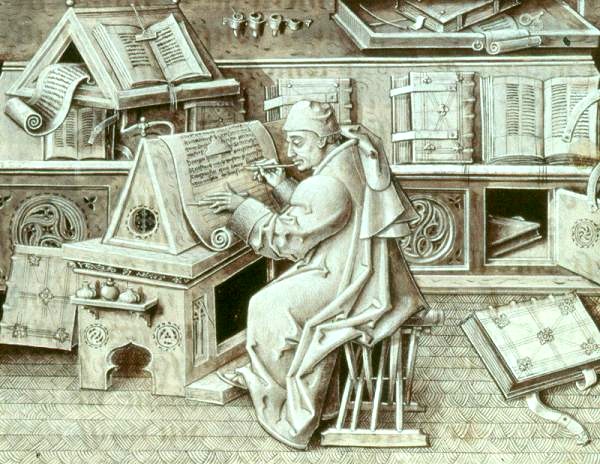

A Medieval monastry’s scriptorium with a scribe at work

Because so few people could do it, writing was considered a real artform in the Middle Ages, and bold, decorative hands were created, characterised by the gothic German ‘Blackletter’ script, of bold vertical lines and thin horizontal lines, which was achieved by writing with a flexible-point quill-pen. Other characteristics of Medieval texts included colourful borders and pictures, illuminated (coloured) letters at the tops of pages and paragraphs which were deliberately larger than other letters, so that people would know where to start reading each text. Scribes, learned persons and men of letters were so rare that only the wealthiest of people could afford to have an education. A king or queen would employ a tutor or a schoolmaster to educate their princes and princesses in reading and writing, skills as rare in the Middle Ages, as finding a competent watchmaker today.


A page of illuminated gothic Blackletter script from a Medieval manuscript

The main writing implements of the Middle Ages was another reason why many people were illiterate. The pen was a goose-feather quill, a tool which took considerable time to clean, dry, temper, slit and cut correctly. Paper, parchment and vellum were expensive, handmade commodities, far out of the reach of the peasantry, who were more interested in staying alive, rather than reading about how to do it!

Another huge barrier to education in the Middle Ages was that, as members of the Church were the only ones who could generally read, most documents were written in the language of the Church, and not the language of the People. The language of the people was…English! (Or German, French, Italian, Polish and so-on). However, the language of the Church was…LATIN! This rather significant language-barrier meant that, even if the peasantry were able to read and write, it would’ve been largely useless, because all the church-documents were written in a totally different language!

For those who could read and write, however, they enjoyed the rare ability of being able to send letters and record thoughts and ideas. In the days before organised postal services, messages were delivered by private messenger. Forget Private Messaging services on internet forums or MSN Live Messenger; this form of messenger-service was a rider on horseback! To protect the contents of their documents and letters, writers often signed and sealed their documents with sealing-wax, marking the hot wax with a sealing stamp or signet-ring, partially to ID them as the sender, and also to act as an anti-tampering device. Traditional sealing-wax dries fast and it dries hard and brittle. If a seal was broken by anyone other than the intended receipient, then it would be immediately obvious that the privacy of the document had been breeched. You can read about the history of seals, sealing-stamps and signet-rings here.


A signet-ring used to seal documents with wax. The coat of arms, monogram or family-name was deliberately engraved into the ring in mirror-fashion so that the imprint would turn out the right way around when the ring was pressed into the hot wax

Bubble, Bubble, Toil and Trouble

As Harry Potter learns in one of his History of Magic books, “Muggles were particularly afraid of witchcraft in Medieval times, but not very good in spotting it”.

These days, the idea of actual witches and wizards seems ludicrous: the stuff of fairytales, legends and novels by an acclaimed English childrens’ author. But in Medieval times, there were real and very intense beliefs and fears in witches. And not all witches were women, either!

In Medieval Europe, under the Feudal System, peasants lived and worked on the land owned by their landlord. They were not generally allowed to leave this land without their lord’s permission. Because of this, families grew, died, intermarried, mingled and gave birth to sucessive generations all in the one little village or town year after year, decade after decade, century after century. Small, close-knit communities in hamlets and villages, in a day where few people travelled beyond the village boundaries, were quick to spot any and all persons who were either new to the area, or who acted in a strange manner.

Anyone who did act in a strange manner, or who was new to the district, was always the first suspect in anything that went wrong. Witch-trials were popular and bloody spectacles throughout Europe and punishments for witches varied. In European countries, the common penalty for witchcraft was death by burning, whereupon the ‘witch’ was strapped to a post and had faggots (clear your minds out, perverts…a ‘faggot’ is a bundle of kindling!) tossed at her feet. The faggots were then lit and the victim died from either burns or smoke inhalation and suffocation. In England, however, hanging witches was the more common form of execution.

A lot of our modern stereotypes about witches (that they have black pointed hats, that they have warts, that they have flying broomsticks and black cats and all the rest of it) all have their origins in the Middle Ages. It was believed that witches kept demons (called ‘Familiars’) near them, in the shape of animals. It is from this belief that we get the stereotype of witches always having a black cat with them and where we also get the superstition that it’s bad luck to have a black cat cross your path. The presence of bodily blemishes (such as pimples or warts) was also seen as the mark of a witch. Such an evil person was sure to have marks of evil (characterised by warts!) all over them!

Law and Order

In Medieval times, with knights and crusades and wars and witches and the Black Death and fat, warty toads bouncing around all over the place, it’s probably little wonder that Medieval law and order was especially harsh and barbaric (gotta keep those toads in order, don’t we?).

Medieval laws were set by the King (or queen), or by the king and/or queen’s top subjects: Their noblemen. Laws covered everything from how many loaves of bread a baker needed to bake, what constituted proper ale and even what side of the road you were allowed to drive on. Local city or village laws also related to keeping what was known as the King’s Peace: The peace and tranquility which the monarch promised all his subjects. Keeping the peace was done by instituting such laws as providing each village and town with a ducking-stool (into which, chattery women could be strapped and ducked…dumped…into the nearest pool or pond) and the enforcement of curfews after dark. Noblemen were allowed to pass their own laws on their peasantry as they saw fit…and some noblemen saw fit to tax their peasantry very harshly indeed.

Medieval punishments were even worse than the laws for which the punishments were seen fit. Various medieval punishments included…

– The Rack – Being stretched on the rack until your arms and legs ripped out of their sockets.
– The Gallows – Being hanged by the neck until dead.
– Hanging, drawing and quartering – A particularly gruesome method of execution awarded to persons found guilty of High Treason (crimes against king and country).
– Impalement – Being impaled by a long, blunt wooden pike. A favourite of the Medieval king Vlad Tepeche, Vlad the Impaler.
– Sawing – Being strung upside down on a frame and having your body sawed in half lengthwise, starting between the legs, with a massive saw.
– Breaking on the Wheel – Being strapped to a wagon-wheel and having your limbs smashed and broken by a sledgehammer.
– Being boiled in oil – Another Medieval favourite! King Henry VIII of England (AKA Old Greedy Guts) sentenced a cook to be executed by being boiled alive in a pot of oil, for trying to poison his master’s gruel!

Other, lesser punishments included…

– The Whipping Post – Being strapped or tied to a post and flogged.
– The Stocks or Pillory – Being confined to a set of stocks (head & arms locked in a wooden frame) or pillory (feet, as well) and being left there for a pre-determined period of time. In rare instances, people actually died in the stocks or pillory, from abuse from passers-by.

Of course, if laws existed and punishments existed, someone had to uphold the law and someone had to deal out punishment. Who did what?

The job of upholding the law was given to various persons. Ordinary citizens were expected to keep law and order, of course, but there were persons whose job it was, to specifically keep the peace. Some might have been knights, or they might have been reeves of the shire. The local reeve of the shire, or the Shire Reeve, was the local custodian of the peace. Does the word ‘shire reeve’ sound kind of familiar? It should. The shire reeve still exists today…but probably not in a manner which medieval peasants would recognise. In Modern English, the job-title is spelt…Sheriff.

It was the local lord or if he was available…the king, who was generally in charge of meting out punishment. That was until naughty King John was given a small piece of paper to sign. The title of this piece of paper?

Magna Carta Libertatum.

That’s its name in Latin. Translated to English, it means “The Great Charter of Liberties”.

The Magna Carta, created in 1215AD, was a document that restricted the power of the king and held him legally accountable if he was a naughty little boy…like King John. One of the main rules of the Magna Carta was that it forbade the King from pronouncing judgement on criminals.


A copy of the Magna Carta

Sickenesse and Healthe

Medieval understanding of the human body was rudimentary at the very, very, very best. People did not understand how the body digested food, how it got sick, how it healed itself, how blood circulated, and dozens of other ‘how’s. Without highly scientific TV shows like “House” to teach them, Medieval physicians were often medicating their patients purely through superstition and guesswork.

Medieval medicine was based on the theory of the Four Humours, a very old system of medical belief that dated back to Ancient Greece! Humourism, as it was called, centered on bodily imbalances…but not in the way we might think. To find out more about the history of medicine, read the link above.

Medical practicioners were few and far between in Medieval Europe. Physicians were expensive and generally ineffective. Most people had to rely on the local priest, the local wise woman or the local barber-surgeon, who gets his title because he was just as likely to give you a mullet as he was to slit open your gullet. Medieval medicine was a mixture of practicality, tried-and-tested methods, myth, legend, old wives’ tales, natural remedies and superstition. There are various stories of surgeons and doctors in Medieval times performing truly amazing operations and having their patients survive. Amongst these include removing stones (such as kidney-stones) from the body and removing arrows shot into various places on the body…such as a direct hit to the face!

Of course, the biggest scare to the Medieval world came in the 1340s, with the Black Death (also called the Great Plague, the Plague, the Black Plague, the Bubonic Plague and The Sickenesse). It wiped out literally millions of people through the years of the late 1340s and came back almost every generation since then. There are still instances of the Black Death today, although the number of these instances are greatly reduced from the horrifying figures of the Middle Ages.


Victims of the Black Death

Medieval Jobs and Occupations

There were all kinds of jobs in the Medieval world. Blacksmiths, coiners, sadle-makers, roofers, farmers, goldsmiths and printers. Many English surnames come from the classified employment advertisements of the Middle Ages.

Surnames like…

– Sadler (saddle-maker).
– Sandler (sandle-maker).
– Chandler (…eh…chandler. That is…a candle-maker).
– Fuller (A fuller, someone who removed impurities from cloth).
– Tyler or Tiler (A roof-tiler).
– Slater (someone who provided slate for roofing!).

Many jobs were unskilled, but some occupations required great skill, such as blacksmiths, goldsmiths, jewellers, coiners, printers, watchmakers and swordsmiths and armourers. Persons engaged in such occupations usually formed guilds with other such persons, in order to protect their skill-sets and also to advance the quality of their craft. Guilds were kind of like labour-unions/exclusive clubs where persons of the same craft or occupation could gather and protect their ideas and skills from others. This was usually done in structures called guildhalls (like a clubhouse). Guilds, as formal institutions, however, had to have some sort of legal status. A guild could not be formed without the permission of a person of authority. In England, this authority was usually the reigning monarch who would give various craftsmen the right to form a guild through the issuing of Letters Patent; a legal instrument allowing for the formation of various offices, organisations and institutions.

Other Aspects of Daily Life

What about all the other aspects of daily life, apart from food, reading, writing, laws, order, education (yawn!) and all that rot? What else happened? Didn’t anyone ever have a bath?

Actually, bathing was not that common in the Medieval era. It was not seen as being necessary, it was seen as too much hard work (and after a day ploughing the fields, the last thing you wanted was more work!) and it was seen as pointless, because once you were clean, you would only get dirty again the next day!

But, in the rare instances that people actually bathed in the Medieval world, it was either done in a ready source of water (a stream, lake or river) or it was done in the bathtub. Bathing in a bathtub was such a hassle that most people just didn’t bother! You had to light a fire, boil the water, fill the bathtub, wait for the water to be juuuust right, then you had to strip, get in, scrub, scrub, scrub, get out, dry down, put your clothes back on and then tip out the water.

Oh, but only…and ONLY…after every other person in the household had used that exact same bathwater to have their baths, too! Hot water was too scarce a commodity to waste on just one person!

What about clothes and bedsheets? Weren’t they washed?

Yes. But again, very rarely. It wasn’t generally seen as being necessary, and men and women could wear the same clothes for days or weeks on end before having them changed. In mose cases for the peasantry, they didn’t have very many other clothes to change into, so there was no point in washing them!

Entertainment in the Medieval world came in various forms. Without books to read or xBoxes to play on, movies to see or late night peepshows, entertainment was found in sports such as skittles, darts, bear-baiting, puppet-shows and that favourite of all childrens’ pastimes!…

…fairytales!

Fairytales were born out of the Middle Ages as stories to distract peasants from their miserable lives. Stories like Rapunzel fed the dreams of peasant girls that they would be whisked off by their Prince Charming. Hansel and Gretel probably made little peasant boys forget their own hunger for a while, while also teaching children not to wander from home, lest they find ugly witches with houses made from gingerbread. More stories, such as Cinderella and The Magic Flounder were more famous fairytales, told to children (and probably to adults as well) to entertain them when there was nothing on the local stage to watch.

Lest We Forget: ANZAC Day and the Battle of Gallipoli


Seeing as I am an Australian, this article will mostly cover the Australian part of “ANZAC Day” and the Australian involvement in the Battle of Gallipoli

In the scope of the First World War, the 25th of April probably wouldn’t mean much to many people. All people care about is 11 o’clock on the 11th of November of 1918: The day the war ended. But what’s so special about the 25th of April, that it warrants a mention in this blog, anyway? And for that matter, April 25th of which year?

In Australia and in our neighbouring country across the way, also known as New Zealand, the 25th of April is known as ANZAC Day, and it commemorates the 25th of April, 1915 and the Battle of Gallipoli on the Gallipoli Peninsula of Turkey, during the First World War. The ANZAC was the Australian and New Zealand Army Corps, which was sent halfway around the world to fight a bunch of people they’d never met to help win a war which some reckoned, they should not have joined in the first place.

ANZAC Day

Every 25th of April, Australians and New Zealanders celebrate and commemorate that which is ANZAC Day, by remembering the diggers (that’s Australian slang for ‘soldiers’) who fought on the shores of the Gallipoli Peninsula on that hellish day, ninety-five years ago in 1915 and by extension, all the Australian and New Zealand service personnel who have fought and died for our two little sea-girt sandpiles since then. It’s commemorated by pilgrimages to the Gallipoli peninsula, dawn services, rememberance marches, barbeques and by the baking and breaking of one of the hardest and yet strangely edible comestibles in the world: The ANZAC Biscuit.

Just like how the British have the “Dunkirk Spirit” of banding together against adversity and beating everything, Australians and presumably, New Zealanders too, have the “ANZAC Spirit” of mateship, togetherness, toughness and perseverence which helped them survive and stay firmly together during the hell of the First World War. It’s this spirit that Aussies and Kiwis commemorate and celebrate each April while breaking their jaws on ANZAC Biscuits or stuffing down sausages and burgers at the nearest, smoke-belching barbeque.

ANZAC Day also commemorates the fact or the belief that at the Battle of Gallipoli, Australia and New Zealand went through their trial of fire and were born there as nations who had endured hardships and come out with their heads held high.

Australia and the First World War

As far as countries go, Australia’s the little brother in the family. By the time of the official British settlement in Australia, as marked by the arrival of the First Fleet in 1788, Great Britain had already fought and lost a war against the United States and the USA had already been settled by Europeans for over a hundred years before then. Australia only became federated, when its states and territories joined up to make one big country, in 1901, just over a century ago.

As its own country with its own government and prime minister, Australia could declare war on other countries. In the family of nations, Australia was kind of like the whining, wingey little brother who wants to do everything that momma, papa and all his bigger brothers do, like fight, make money, make love and start wars. When Britain declared war on Germany, Austria-Hungary and the other countries of the Central Powers in WWI, Australia jumped on the Allied bandwagon at once, stating that, as Mother Britain was at war, Australia was also at war.

Of course, this view was not universally accepted. The First World War mostly took place in Europe or the Middle East, on battlegrounds far from Australia. A sea-voyage from Australia to England took at least two weeks, even using the fastest ships and the quickest route. Some Australians felt isolated from this ‘European War’ and saw no reason to have to go off and fight other peoples’ wars.

On the other hand, patriotic Australians believed that it was their duty to fight and defend Great Britain, as their mother country and that they were fighting for the good of the British Empire. It was with this in mind that Australia went to war.

Unfortunately for Australia, though, it didn’t have an army.

Australia was so new on the world stage of established nations that it didn’t even have a single stinking army to protect itself with, let alone go off and fight someone else’s army! There were police-forces and local state militias, but it wasn’t until after the First World War that Australia had an actual national army of its own. Instead, the Aussies were just tacked onto the British Army and made to fight with the Brits. Throughout the First World War, Australia was the only country which took part in the fighting which had a 100% volunteer army.

The Australian soliders in the First World War were all ordinary people. They were farm-labourers, office-workers, school-teachers, schoolboys, university professors and shopkeepers…all ordinary people who had signed up to fight a war which was so far away, some people questioned what the hell they thought they were doing! Unlike the other countries, Australia had no standing army. Because of this, all the Aussie soldiers were trained in army tactics, strategies and manuveurs entirely from scratch!

It was all these raw, green recruits, rushed through a crash-course of the bare essentials of fighting, weapons-handling, tactics and army life, that the Brits sent off to Turkey to try and blast a way through the Turkish defences so that the Royal Navy could open up a supply-line to its allies, the Russians, further north. With woefully substandard and rushed training, the inept Australian troops were marching straight into hell. How inadequate was their training? Half the time the Australian soldiers didn’t even load, shoot and reload their rifles because there wasn’t any ammunition to show them how to do it properly! To make things worse, they (along with millions of other soldiers in the First World War), were taught outdated infantry tactics from the 19th century, which were completely useless in the mechanised hell of the First World War.

The Battle of Gallipoli

In 1915, the order came out that the Allies would try and attack the Gallipoli Peninsula of Turkey. The original plan was to ‘Force the Narrows’, that is, to try a naval assault on the Dardenelles Narrows near to the Peninsula, by the Royal Navy. Unfortunately, this failed (and resulted in the First Lord of the Admiralty, a little-known fellow called…Winston Leonard Spencer-Churchill…to high-tail it off to the trenches in France to hide in shame for a few months) and the Turks were suddenly wide awake to a possible Allied invasion. They set up their positions and waited for everything to unfold.

In Australia, young Aussies were jazzed up and raring to have a crack at ‘Johnny Turk’. Many of the soldiers were so young that they’d barely finished school and had simply swapped the cane for a rifle the moment they sauntered out the gates at the last bell for the day. Many of the green Australian troops thought that the war would be over before they even got to Turkey or Europe!

Gallipoli in Turkey gets its name from the Greek word ‘Kallipolis’ which means “Beautiful City”. When the Aussies, Kiwis, Poms and Frogs arrived, though…there was very little beauty to be seen anywhere.


A map showing the Gallipoli Peninsula. On the left, you can see ANZAC Cove, where the ANZACs came ashore in 1915. On the right, you can see the Dardenelles; the narrow stretch of water which the Royal Navy failed to blast its way through

The ships transporting Australian troops sailed from Eygpt (because the Aussies were trained there) to Turkey and arrived in ANZAC Cove (a postwar name) on the Gallipoli Peninsula on the 25th of April, 1915.

From the moment the big ships dropped anchor off the west coast of the Peninsula…the ANZACs were in trouble. Serious, six-foot-under trouble. So much trouble that many soldiers were dead before they even got onto the beaches!

In the Second World War, allied soldiers and officers used a special kind of watercraft, known as a Higgins Boat, to safely transport soldiers ashore. The Higgins boat could go right up onto the beach where the front of the boat dropped down like a ramp so that soldiers could run right off the boat onto the beach to find cover.

In 1915, without the Higgins Boat, Australian and other Allied troops were massacred in the surf before they even set a toe on Turkish soil. The boats used to ferry these troops to shore were wooden lifeboats: Totally unprotected from machine-gun fire, cumbersome to operate, rowed by hand and with keeled bottoms, prone to wedging in the sand and surf, leaving soldiers stranded and having to jump out of the boats and wade through the water towards the beach. Hundreds of allied soldiers were shot down as they struggled out of the boats, through the surf and towards the beach. Accounts spoke of the water literally turning red with the blood of machinegunned or rifle-struck soldiers who never knew what hit them.


ANZAC Cove, 1915. Here, you can see the steep sides of the mountains that the ANZACs had to struggle up, the surf which they had to wade through, and the sandy beach that they had to run across…all while being sprayed by Turkish machine-gun fire

Within minutes of landing in Gallipoli, all hell broke loose. The inexperienced Australian soldiers were given hurried and unclear orders, officers were killed by machine-gun fire and soldiers were unable to band together to build up significant resistance to the enemy. To use an American expression, it was quite literally a ‘Turkey Shoot’. Or rather, a Turkish shoot! The ANZACs became sitting ducks for the defending turks, who mowed them down relentlessly with their machine-guns.

The big ships anchored offshore did manage to give the Aussies some covering fire, though. While the boats ferried troops and supplies ashore, the allied warships opened fire with their artillery, blasting away at the enemy, distracting the Turks enough for the Australians to get a firm foothold on Turkish soil.

Guests of Johnny Turk

Throughout both world wars, soldiers or ‘the enemy’ were known by various names. Germans were Krauts or the Boche, they were Jerries, Nazis, the S.S. The Brits were known as ‘Tommies’, the Australians were known as ‘ANZACs’ or ‘Rats’ (after the Battle of Tobruk in WWII, where Aussie defenders held off the Germans and became known as the Rats of Tobruk).

Turks were called ‘Johnny Turk’.

And Johnny Turk was not happy at having Aussie soldiers camping on his front lawn.

The Battle of Gallipoli was a hopeless mess. Over the next nine months, life was a living and dying hell for the ANZACs. Without aerial support from the RFC (Royal Flying Corps, the predecessor to the RAF), Australian soldiers attacked Turkish positions with no covering fire. Without tanks, the Australians had nowhere to hide from Turkish return-fire and without the big ships (which very inconsiderately sailed off after just a few days), the Australians had no big artillery to bombard the Turks before launching an attack. It became one big game of Slaps, with each side waiting for the other to make a move, before jumping out, decking them and then diving back into the trenches to protect themselves from the enemy reaction.

ANZAC Biscuits

Stuck in the trenches for nine months with appalling weather (it rained and snowed half the bloody time!), few comforts, few clean or warm clothes, few things to do and even fewer things to eat, the ANZACs did have at least one thing to look forward to.

ANZAC Biscuits.

Note that. BISCUITS. Not cookies. BISCUITS.

It was once believed that ANZAC Biscuits were invented by the ANZACs themselves, bored with the disgusting rations that they were provided with. However, the ingredients in the recipe don’t lend themselves well to this theory. How many soldiers in the First World War were able to get their hands on such delights as dessicated coconut? Golden syrup? Sugar? Baking Soda? Flour and rolled oats? Probably not many. And even if they did, how the hell did they manage to bake the stuff in the middle of a battle?


ANZAC Biscuits. OM NOM NOM NOM NOM NOM…

The truth is that ANZAC Biscuits were invented by the womenfolk! The wives, daughters, sisters, aunts, mothers and girlfriends of all those poor sods who were living, starving and dying all the way over in Turkey.

The ANZAC Biscuit was designed to be many things. Filling. Delicious. Tough. But most of all, it was designed to be long-lasting.

After baking, the ANZAC Biscuit looks (and feels) like something akin to 18th century hard-tack, the notoriously hard bread which sailors used to eat onboard ships in Napoleonic times. In a way, hard-tack and the ANZAC Bikkie shared a lot of things in common.

– They were both easy to make.
– They were both tasty (okay, the ANZAC Biscuit was tasty and sweet. Hard-Tack was like baked cardboard).
– They were both hard enough to break glass (or your teeth!) and drive in a nail.
– They were tough enough to survive long sea-voyages and a nuclear attack (on the same day).

The one element where ANZAC Biscuits were undoubtedly better than hard-tack had to be in the taste department. Hard-Tack is dry, cheap, tasteless crap that was about as easy to eat as cinderblocks. Sure, ANZAC Biscuits weren’t much easier to eat, but they were at least tasty. The sugar and the oats and the golden syrup (or honey, if you can’t get syrup) made the biscuits sweet and crunchy and they were a welcome relief to the ANZACs, who had little else fit for human consumption to shove down their throats.

The Great Evacuation

It’s probably not surprising to know that the Gallipoli campaign was a total failure. After nearly a year of being blasted, blown up and bombarded by the Turks, the ANZACs (along with the other allies) were bruised, bloody, beaten and bored. In late 1915, soldiers began to pull out from the Gallipoli peninsula.

But, in true British style, never wanting to admit defeat, the evacuation was done carefully over the course of several days. The ANZACs were shipped away quietly at night. Their specially-designed periscope rifles (rifles with periscopes fixed on them so that they shoot over the top without also getting their heads shot off) were rigged and modified to make them self-firing. The Aussie soldier who thought up this ingenious bit of trickery, William Scurry, fixed up the rifles so that water dripped into special pans underneath the rifles. The pans had strings tied to them which were tied to the triggers of the rifles. As the water dripped, the pans became heavier and heavier until the weight of the water pulled on the string and fired the rifle.


The Periscope Rifle in use at Gallipoli, where it was invented

Using this trick, the Allies were able to occupy the Turks and keep them busy while they evacuated thousands of ANZAC troops down the cliffs, across the beach and onto the waiting ships which were anchored offshore.

All in all, the remembrance of ANZAC Day, the 25th of April, could be seen as a joke: The commemoration of one of the biggest ass-whuppin’s that the Allies ever received, the remembrance of one of the greatest military failures in Australian history. But it’s also about remembering the courage, perseverence and sheer ballsiness that it took to continue fighting what was clearly a losing battle from Day 1, and to escape from a right screw-up without the enemy getting wise to you until you were far, far, far away.

That, my friends, is the story and the history of ANZAC Day.

A Cornerstone of Style: The Three Piece Suit


Reading an article a few days ago about the movement to “stop the sag” and to ask people to haul up their trousers, pants and jeans so that decent people didn’t have to check out the cut of your briefs, boxers, boxer-briefs or the fact that you weren’t wearing any undergarments at all, inspired me to write this article on the cornerstone of men’s clothing: The Suit.

Not too long ago and within living memory, men knew how to dress acceptably. Somewhere along the way, it became commonplace to wear jeans, shorts, logo’d T-shirts and all manner of other, shocking invaders of style which are now considered “normal” clothing. I’ve always been a very old-fashioned, conservative and formal sort of person (there, I said it), and I lament the fact that such fashion-phenomena such as “sagger jeans” have become as acceptable as doing burnouts and doughnuts in the local parking-lot with your father’s BMW. Fortunately, all is not lost, and if those gaudy, glitzy and flamboyant photographs that we see online, from fashion-shows are anything to go by, a more formal and respectable mode of men’s clothing may soon be on the rebound.

It was common, until about the 1960s, for men to wear a suit, be it single-breasted, double-breasted, two or three-piece, tweed, wool or of some other, less-desirable fabric. In the 60s and 70s, with T-shirts, jeans and sneakers marching into stores all over the place, this era of elegance, style and sophistication was swept aside like so many decades of dust. So…the suit. What is it? Why did people wear it? What went with it and how did it all go together?

For the purpose of ease-of-understanding, the ‘suit’ referred to in this article will be the classic, three-piece suit:


A typical three-piece suit, with jacket, waistcoat and trousers

The Suit: A History

The classic man’s suit, as we know it today, was born in the 17th and 18th centuries. For a long time, men wore knee-breeches, stockings, flashy tailcoats and shirts with ruffled collars and cuffs. In the mid 1600s, King Charles II introduced a garment which Samuel Pepys records as being a ‘vest’; a sleeveless garment with pockets and buttons and buttonholes down the front. Although originally called a ‘vest’, it receives its alternate name, the ‘waistcoat’ because this new garment was cut and shaped so that it literally reached to just above the waistline. The first piece of the three-piece suit had been created.

The next things to come along were trousers and the fitted suit-jacket or suit-coat. Previous to the late 1700s, men wore knee-breeches. A rough, 21st-century equivalent might be three-quarter jeans. The legs of the breeches reached to knee-level (hence the name knee-breeches) and the remainder of the leg, from the knee downwards, was covered up by long stockings, which were alternatively either buckled or buttoned to the bottom of the breeches to stop them slipping down.

The suit-jacket was evolved from the long tailcoats that men used to wear. These were usually loose and flappy. But one man started changing this. His name was George Bryan Brummell. He lived from 1778-1840. Does his name sound familiar? It should. Or if it doesn’t…perhaps you recognise his other name…Beau Brummell.


Typical men’s clothing of the 18th century, until Brummell decided that this had to change. Here, you can see the tailcoat, the knee-breeches and the mandatory white stockings and buckled shoes

George ‘Beau’ Brummell was the man who changed mens’ fashion forever. In the late 1700s, he introduced what we would now call the three-piece suit, to society. Brummell’s suit was made up of a matching coat, waistcoat and knee-breeches (later, trousers), made from the same cloth with the same pattern. The clothing was intended to be comfortable, less flamboyant, more conservative and better-fitting. From the late 1700s until the 1950s, the suit retained all these three features: Coat, waistcoat and trousers and it remained the backbone of respectable male attire for over a hundred years.

What’s in a Suit?

The three-piece suit is made up of…three pieces. Duh! But what are they?

Jacket

Suit-jackets have between two-to-four buttons, depending on its size. A good-fitting jacket should have sleeves that come down to the first knuckle of your thumb when your arms are hanging by your sides. The jacket would have between four to five pockets, depending on the design. The breast-pocket of the jacket is used to hold a handkerchief (folded as a pocket-square) or alternatively, a pocket-watch (which would be affixed to the jacket’s lapel buttonhole with a leather fob-strap). The lapel buttonhole usually held a flower or a small, decorative trinket. There was a time when you could buy little tube-like vases which you could slip into your buttonhole. You filled the little receptacle with water so that your flower could survive a bit longer than it would if it was just cut off and stuck in there. The T-bar of a pocket-watch’s leather watch-strap should go through the lapel buttonhole from the front of the jacket, not the back, so that the T-bar itself is neatly hidden from view.

Waistcoat

Waistcoats come in several varieties: Single-breasted, double-breasted, two-pocket, four-pocket, belted, unbelted, silk-backed or plain. They’re like Heinz Ketchup of men’s clothing.


A four-pocket, six-button single-breasted waistcoat. Traditionally, the last button on a waistcoat (with six or more buttons in total), is left undone. This style was supposedly established by Edward VII, who habitually left the last button of his waistcoat undone, either by chance or design. Soon, his subjects started copying him

A good waistcoat was designed to be close-fitting, with the bottoms of the arm-holes going directly under the armpits of the wearer and the bottom hem of the coat reaching around the hip-bones. Waistcoats could be either double or single-breasted. Most people are familiar with the single-breasted variety, though. More expensive waistcoats came with silk backs instead of wool like the rest of the waistcoat would be. Waistcoats with belted backs allowed the back of the garment to be taken in or let out to a certain extent to provide for a better fit. Waistcoats come with either two or four pockets, depending again, on the size and style of the waistcoat.


A grey, two-pocket, six-button double-breasted waistcoat. Double-breasted garments were popular in colder countries because the fold of the cloth prevented wind from entering the coat through the gaps in the buttonholes

“How do you wear a pocket-watch with a waistcoat?”

Before wristwatches came along in the 1910s, every man who wore a watch, wore a pocket watch and chain. How was this attached to the waistcoat? Where’s the elusive ‘watch-pocket’? And how did men get their chains to hang so nicely from their waistcoats?

Firstly, there is no real ‘watch-pocket’ on a waistcoat. The watch-pocket was simply any one of the four (or two) pockets which the pocket-watch was placed in. Attaching the chain to the waistcoat, however, took a bit more skill.

There are two chains which you can wear with a waistcoat: The Albert and the Double Albert. Who’s Albert? Prince Albert, husband of Queen Victoria. He was the man who created the Double Albert chain, which was named after him. By extension, the single T-bar chain was thereafter called the “Albert” or “Single Albert”. But enough about Albert.

To attach a T-bar chain to a waistcoat, you need to fold the T-bar up against the chain so that the chain and T-bar are parallel to each other. Then, you push the T-bar and the chain through your selected buttonhole and then pull back on the chain until the T-bar catches against the buttonhole. The T-bar should be at right-angles to the buttonhole so that it doesn’t come back out. With the T-bar in, you simply push the button through the hole like you always would. The button keeps the T-bar in place and stops it wiggling around. Don’t worry, this won’t hurt the waistcoat in any way.

Selecting the best buttonhole to put the T-bar into is up to personal choice, but generally, the button which is closest to the top of the watch-pocket, or a middle button on the waistcoat, is preferrable, because this gives the chain a nice, balanced look with the top of the watch-pocket. A pocket watch and Albert chain can be worn with either single or double-breasted waistcoats, but Double Albert chains will only work (acceptably) with single-breasted. Wearing a Double-Albert chain with a double-breasted waistcoat will get you arrested by Inspector Jeeves of the Fashion & Style Police Department.

Trousers

Unlike jeans, cargo pants and shorts for which ‘sagging’ has sadly become an accepted manner of wearing garments that cover the legs, trousers that hang halfway off your ass and dangle so low your dingle would flop out if you sneezed, are not acceptable in any way, shape, manner or form in any area of the universe at all. Doing this will also involve Jeeves dragging you off to jail for a crime against acceptable dressing.

Trousers should be comfortably held around the waist by nothing but your own body. Or, if your own body isn’t sufficiently padded to carry out this gravity-defying stunt, then a belt (or more acceptably, braces/suspenders) should be used to keep your trousers at an acceptable and non-arrested-by-the-cops-for-indecent-expsoure level. Traditionally, suspenders were buttoned or clipped onto the waistband of your trousers, and you can still get trousers with suspender-buttons, or you can just sew them on yourself. The bottom hems of your trouser-legs should reach around your ankles.

The Modern History of the Three-Piece Suit

With all that, you have the three elements that make up the classic three-piece suit. From its creation in the late 18th century up until the 1950s, this mode of dressing was almost mandatory amongst men. It was a sort of unwritten code of acceptable dressing. To appear in public without your jacket and waistcoat without an acceptable reason (such as doing dirty work) was pretty much equivalent to streaking butt-naked through church on Sunday. In the colder climates around the world, such as the northern U.S. states, the United Kingdom and Europe, or in the colder, southern countries such as southern Australia and New Zealand, wearing a three-piece suit was not only fashionable and stylish, but also necessary. The suit kept your body warm and the waistcoat provided a very necessary extra level of padding and warmth against freezing winter temperatures.

The downfall of the three-piece suit started, like with so many other nice things from history, with the Second World War.

During WWII, if you’ve read my article on life on the homefront during the War (see the “WWII” area of this blog), you’ll know that cloth (amongst several other things) was heavily rationed, due to the necessity for making uniforms for service-personnel. This drastic rationing of cloth meant that it was impossible for tailors to continue making the three-piece suit. The extra fabric needed to make the waistcoat just couldn’t be found. And it was because of this that the two-piece suit became more fashionable in the postwar years, although it survived (if only just) into the 1970s, when disco-music brought it back into fashion.

Today, the three-piece suit hasn’t exactly returned to mainstream fashion, although there are people who still wear them on a regular basis. The waistcoat, a four-hundred year old article of clothing, has returned to fashion lately, and movies like the recent “Sherlock Holmes” one have encouraged designers to experiement (with questionable results) with traditional male attire. Although considering it was perfect to begin with, one wonders what there is to experiment with. If it ain’t broke, don’t fix it. And a three-piece suit made entirely of denim is unlikely to sell anytime soon.

Cranks, Keys and Carriageways: A Brief History of the Motor-Car


Today, the car, the automobile, the horseless carriage and that stupid rust-bucket that’s parked in your garage right now, is as much a part of life today as is the television, the internet, the iPod, Phone, Pad and (regrettably) rap ‘music’. But spare a thought for the fact that motoring as we know it today is only a little over a hundred years old. It would be fair to say that the average man on the street wouldn’t know a single thing about the history of the very thing he’s driving around at that very moment: The motor-car. This article will be a brief peek into the history of the greatest thing since the steam-engine…

Before the Car

It’s hard to imagine life before the car, isn’t it? A world of steam-trains, ocean-liners and horses and carriages. A world where horsepower was literally horse-powered. If you didn’t own a horse and carriage of some kind, you were stuck with either walking, or taking a train or streetcar somewhere. While self-powered land-vehicles that could move on the road existed in the 19th century, it wouldn’t be until the early 1900s that they would become seriously practical. And it wouldn’t be for a few more years, that your regular Tommy Ryan could afford to buy one of these new horseless-carriage gizmoes out of his own pocket and drive it around town.

The Birth of the Motor Car

This…is genesis:

This here is the Benz Patent Motorwagen and it is quite literally, the first car ever made. It was powered by a two-stroke, one-horsepower engine and it was introduced into the world in 1885. Queen Victoria was still on the throne. Jack the Ripper was still sharpening his butterknife and Sherlock Holmes was still a blob of ink inside an inkwell. But this contraption, born in an age of the horse and buggy, was about to show everyone that personal, motorised transport was possible.

Although the Benz Motorwagen was hardly ideal as a car: It had no safety-features, it had three wheels, it had a tiller steering-handle and a pathetically small fuel-tank, not to mention a hopeless range of operation, Benz was not about to give up. Over the next few years, he refined and modified his machine to such an extent that in August of 1888, what was possibly the world’s first stolen car report was filed at the local police station (okay that’s a joke, it wasn’t, but you’ll soon see why it might’ve been). For on a day in August in ’88, Mrs. Bertha Benz, Karl Benz’s wife, successfully started her husband’s car and, with her two sons along for the ride, drove them off to visit their grandmother, before driving back home three days later. The length of the trip was 120 miles! Mrs. Benz had successfully shown the world that the car could travel long distances!


The Benz Motorwagen No. 3, made in 1888. This was the car which Karl Benz’s wife started up and drove off in, on that August day, over 120 years ago

Over the years, more and more people started experimenting with these newfangled “internal combustion engines”, in attempts to create their own ‘horseless carriages’ as they were still widely called. The British Government didn’t take kindly to scientific and technological advancement in the world of transport, however, because it slapped a FOUR MILE AN HOUR speed-limit on early motor-cars! The first speed-limit ever imposed for self-powered vehicles was 10mph in 1861. In 1865, the Brits made the law even tighter, saying that self-propelled vehicles could travel at the breakneck speed of four miles an hour in the country but only two miles an hour in town! Finally in the 1890s, though, with the arrival of the motor-car, British lawmakers allowed a speed-limit of 14 and later, 20 miles an hour, starting in 1896.

Car companies sprang up almost overnight as the 20th century approached. Some notable early ones included Renault (1899), Ford (1903), Mercedes (1902) and Stanley (also 1902), which was famous for making steam-powered motor-cars. Slowly, the world took to the road.

Starting Something Totally New…

    “…For making the carriage walking at the first speed, take back the drag of the wheel backward crowbar of the right and take completely and progressively back, the crowbar of embriage…”
    – Jeremy Clarkson, “TopGear”.

Okay, I kid, I kid…that’s actually French translated into English. But as you can see, early motor-cars were far from easy to drive. These days, we get in, we insert the key, we turn it, we swear for a couple of minutes and then we get moving. Early cars were nowhere near as easy to operate. To start with (literally), you had to crank these cars to get them going.

Early cars did not have ignition keys, they didn’t have electric starter-buttons, starter-motors or anything like that. To get them going, you had to crank them by hand. And while this looks like a lot of fun, it wasn’t exactly easy. You’ve probably seen vintage cars in movies or cartoons being the subject of slapstick comedy where someone tries (hopelessly) to get a car started by cranking it, only to fail miserably. The truth is that some (but not all) early cars were that hard to start. And not only hard to start, but also dangerous! You needed considerable strength to start a car in the old days, because everything inside the car was mechanical and made of metal. If you didn’t have the muscles to turn the crank-handle (which could be particularly tricky in some cars), then the car never started. Usually, you slid the crank-handle into a hole in the front of the car, which sent the crank through the crankshaft inside the engine. Then, you grabbed the crank and with considerable force, turned it clockwise in an attempt to get the pistons moving to start the engine-cycle.

One of the big risks of crank-starting a car was personal injury. By cranking the starting-handle, you moved the crankshaft inside the motor and this got the pistons inside the engine moving. Once the sparking-plugs ignited the fuel and the engine started working by itself, the car could be driven. But when this happened, one of the biggest risks was of the crank-handle being thrown backwards, against the driver’s hand, by the force of the pistons coming to life. The most common injuries included broken wrists and broken arms. Nasty stuff! Several early motor-car companies tried to introduce braces or catches or modified engines where the starting-handle either jammed or was stopped in some way, if the engine backfired, or else disengaged the starting-handle when the engine caught on, so that it wouldn’t kick back and break the driver’s arm.


A 1909 Model T Ford with prerequisite antique car crank-handle at the front. Apparently this one disproved that a motorist could have his car any colour so long as it was black

Early motorists were instructed to grasp the crank-handle in a certain way, with all fingers on ONE side of the crank, instead of four fingers on one side, and the thumb on the other (as you might do with other crank-handled appliances). The reason for this, was so that if the engine kicked back, the handle would swing away from your hand and nothing went wrong. Grasping the handle the traditional way meant that at the very least, you suffered a broken thumb when the engine came to life. The increasing power and size of car-engines as the 1900s progressed, meant that it began to take more and more strength to crank start a car and eventually, electric starter-motors were introduced.

Of course, not everything was this easy. Headlamps on the earliest cars were gas-powered. These had to be lit either manually, or with pilot-lights or sparkers. And starting a steam-powered car, such as those manufactured by the Stanley company up until 1925, was almost like trying to get a steam locomotive going from a cold start. First you had to fill up the boiler with water, and then you had to make sure that there was enough kerosene in the tank, you had make sure that the pilot-light was on and that the water was being boiled sufficiently. With the water boiled, you had to wait for the steam-pressure to build up before you could actually drive the car away. Considering how tricky it was to get a steam car started, it’s rather surprising how long they survived. The reasons for building steam cars, however, was rather obvious when you consider that the steam-engine had been around for about a hundred years longer, starting in 1900, than the internal-combustion engine, the bit of machinery that drives almost every car in existence today.

Driving Along in my Automobile

Early motoring was a thrill. It really was. These days, we use a car for everything. Going to school, going to work, going to the shops, going to visit friends and family…but things were very different a hundred years ago when you were probably the only person on the block who owned his own motor-car! Having got the car started, you didn’t want to just waste all that petrol and water and oil driving somewhere for a PURPOSE, did you?

No! Once you got that thing going, you wanted to muck around with it, yeah? Which is exactly what many people did. Having a family car in the 1900s or the 1910s was considered a real luxury, and many of the times that the car drove off down the road would have been with the entire family onboard for a roadtrip or an excursion. Barrelling along at twenty or thirty miles an hour was a thrilling experience when you consider that the other way to move around was by horse and cart.

However, taking the family out for a spin in your new automobile wasn’t always safe. Most early roads were almost lethal to drive on. They were mostly dirt roads or cobblestone or flagstone roads, which gave no joys to the passengers in your shiny new ride when suspension hadn’t really been thought of yet. And even if you found a nice road to drive on, when you parked your car, you had to make sure that nobody tried to pinch it! Henry Ford used to have to chain his car to a lamppost everytime he parked it and secure it there with a padlock, otherwise, the moment he stepped away, some inquisitive bystander would try and crank up his new toy and drive off with it!

However, getting to treat the family to a ride in the automobile was something that was nothing but a dream, and for many men, remained a dream until 1908.

Model T Fords and Mass-Production

One of the biggest problems of early motor-cars was the fact that they were dizzyingly expensive. A car in the 1900s could cost upwards of $1,000. While this doesn’t sound too bad today, remember that in 1900, a good pocket watch cost $50, a fountain pen cost $2, a film-ticket was five cents and it was cheaper to send a telegram than to use the telephone! Groceries for a family of four for a week could be bought for less than $20!

Because of the dazzling cars and the equally dazzling price-tags, it’s not surprising that for many people, motor-cars were something to be seen driving by, but never to be seen driving in. Cars were handmade with expensive coachworks which were made up of leather and brass and chrome and other fancy-schmancy things that cost a fortune. Only the richest of the rich could afford cars. Millionaires, businessmen, royalty, heads of state and so-on. For everyone else, the only rubber that was going to hit the road for them was the soles of their shoes.

That was until Henry Ford put two and two together and made Ford. Or the Ford Model T, to be precise.

Henry Ford didn’t invent the car. He didn’t even invent mass-production. But what he did invent was a way to put the two things together. By working on a moving production-line, Ford realised that, with work coming to his men, instead of his men going to their work, a lot of time could be saved in manufacturing a car. One reason why cars were so damned expensive was because they took literally days, weeks, in some cases, even MONTHS to make. Not just a line of cars, I mean literally ONE car. If Henry Ford could cut down how long it took to make cars, then he could make more cars in a shorter amount of time. More cars meant that the prices went down and if the prices went down, then ordinary people could buy them.

The Model T was introduced in 1908, when Ford started mass-producing cars. The chassis, the wheels, the seats, the engine and everything else was built at one part of the factory and progressively joined together. At the end of the line, the body of the car was dumped on top. The final touches were added, the car was gassed up, cranked up and then driven off into the world. It was amazingly simple.

One reason that Ford managed to make his car plants so efficient was that he kept breaking down jobs. If making an entire door was too hard for one workman to do by himself, then Ford broke the door down into component parts. One man made the hinges, one man painted the panels, one man screwed on the doorhandles and one man put in the window. It meant that the Ford car plants had to employ hundreds, thousands of people, but it also meant that they could work for longer hours. Ford workers worked eight-hour shifts and earnt $5 a day. $5 a day when Cocoa Cola cost 5c, was a lot of money. And by having eight-hour shifts, the factories could operate literally around the clock.


This Ford Model T four-door tourer was typical of the millions of Model Ts produced by Ford: Simple, tough, reliable and understated

When Ford Model Ts were being sold, they originally started out at $850-950 (in 1908 dollars). If this sounds steep, then you can try and find something else for $900. Not easy when the next least expensive car skyrocketed upwards to $3,000!! As Fords continued to be made, however, the price did (thankfully) drop, to about $280 in the 1920s, which which time literally half the cars in the world were Model T Fords.

The Model T wasn’t a great car. It wasn’t fast (45mph top speed), it wasn’t classy (“a customer can have a car painted any color he wants, as long as it’s black”, Henry Ford), it wasn’t easy to operate (“…it’s more complicated than doing eye-surgery!…”, thank you Jeremy Clarkson) and it certainly wasn’t big (one of its nicknames was the ‘Tin Lizzie’! and you can be sure that doesn’t sound very chunky!), but what it was, was a car that allowed everyone from Dr. Jones right down to Mr. Bentley at the corner shop, to drive around town.

Changing the World, One Car at a Time

Everyone generally assumes that a car built before a certain time is either “classic”, “vintage”, “veteran”, “crap” or some other delightful categorical name. But what is what?

“Veteran” cars signify any cars made between the 1880s up to 1919. These include the very first cars ever made by most companies, and the earliest Model T Fords.

“Brass-Era” cars are cars manufactured in the period between Veteran and Vintage, generally accepted as been between 1905-1914/15. So named because of the heavy use of brass on these cars (headlamps, grilles, dashboards, side-mirrors, etc).

“Vintage” cars were cars manufactured from after the end of WWI to the Wall Street Crash, so, from 1919-1929. It was during this period that cars stopped looking like ghost-carriages without horses at the front, and started representing what we would sort of recognise as a car today, with a passenger area, the engine out the front with a bonnet or hood, four wheels and a roof and windows! It was during this time that cars also started being widely manufactured with self-starters; everything from electric starter-buttons to…*gasp*…car-keys!! Yes! No more broken wrists!


A 1929 Model A Ford, a typical vintage car of the 1920s and 30s, with curved mudguards and a less angular body, but boxy in appearance nonetheless


1916 Cadillac Type 53. Yes, that’s James May and Jeremy Clarkson from TopGear in the front, with Clarkson at the wheel. I think I’ll walk

According to the automotive TV show “TopGear”, it was the Cadillac Type 53 that gave us one of the greatest pieces of metal in the world. The car-key! With that, cars became safer, easier to start and more fun to drive. This template for the modern car was introduced to the rest of the world thanks to Herbert Austin, founder of the Austin Motor Company. The first car other than the Caddy Type 53 to have car-keys and all the gears and pedals in the configuration that we know today was the famous and miniscule Austin 7…


1922 Austin 7 “Chummy” Tourer

As you can see, the Austin 7, while ‘modern’ in the sense that it had all the controls in the right order, was hardly luxurious or any of that rot. It was basically an updated, more modern and British version of the Model T Ford. In fact the Austin 7 was so incredibly small, it was popularly nicknamed the “Baby Austin”. If you think you recognise the Austin 7 ‘Chummy’ Tourer, it’s because a 1/2-scale fully-functional model of the car (in bright yellow!) is used in the popular British TV series “Brum”.

Last but not least, we have “Classic” cars. For a car to be a ‘Classic’ car, it has to have been built between 1930-1960. Such ‘Classics’ might have included several cars manufactured by the famous “Deusenberg” company, the Chevrolet Bel Air, the Auburn Boattail Speedster and countless other wonderful machines.

As cars became more and more popular and companies started producing luxury as well as cheap models, the car began to take over the world, but the world wasn’t quite ready for it. Many roads were still unpaved and hideously dangerous to drive on. Ironically, when we think of early motor-cars, we think of them as delicate little sardine cans held together with chicken-wire which fell apart if you farted too loud, but actually, some of them were rather tough. The Model T Ford was able to start in almost any weather, it could drive through water, through snow, through mud, through dirt roads, up and down hills, it could literally drive off-road without breaking down and it did all this with a top speed of just forty five miles an hour and wooden-spoked wheels! It might’ve looked flimsy, but on the other hand, it might also have given the Jeep a run for its money.

And yet, the horse and cart still hung around. The last horse-drawn taxi-license was issued in London in the late 1920s. Police-forces did not start using regular patrol-cars until the 1920s and in some places, horse-drawn tram-services continued well into the 30s and 40s (although in all fairness, horse-tram services returned to some countries in the 40s because they needed the petrol to fight the Axis. You can’t use horse-poop for anything in warfare).

By the 1920s and 30s, the era of motoring had really taken off. The road-trip became a popular kind of holiday as families and their friends packed up their Packards, Studebakers, Austins, Fords and Maxwells (Hello, Jack Benny!) and took to the road. Petrol-stations, diners, roadside inns and caravans popped up almost overnight as cars started driving around the world. Cars gradually became safer as shatterproof glass began to replace the brittle glass that was previously used in windscreens and windows. In 1903, French chemist Edouard Benedictus dropped a glass flask which had the leftovers of cellulous nitrate plastic inside it. His happy accident led to his development of what we now know today as laminated or shatterproof glass. Not originally used in motor-cars, it would be another thirty years before this newer, stronger, safer type of glass replaced the dangerous and brittle glass then used in car-manufacturing.

The birth and development of the car was going along nicely until a small hiccup called the Second World War came along in 1939. Because of the strain of total war, car-production ceased the world-over, starting in 1940 in the UK and in 1942 in the USA, with no new cars being produced by either of those two countries (or indeed, several other countries) until 1945 at the very earliest.

Postwar cars were just as fascinating as their prewar parents and the boom years of the 1950s saw larger, chunkier cars being produced, such as one of the most iconic cars of the 1950s, the Chevrolet Bel Air:

The Chevy Bel Air symbolised cars of the 50s: Large, bold, excessive bodywork with more fins than a seafood restaurant and so much chrome that the car was basically a massive mirror on wheels. To its credit, though, the chrome-plating did have a practical use: It prevented the car from rusting from exposure to moisture.

From its humble beginnings as the crazy invention of a German engineering and metalworks student to one of the most important modes of transport in the modern world, the car changed everything around it, everyone in it, and everything that it drove past, forever.

Cranks, Keys and Carriageways: A Brief History of the Motor-Car


Today, the car, the automobile, the horseless carriage and that stupid rust-bucket that’s parked in your garage right now, is as much a part of life today as is the television, the internet, the iPod, Phone, Pad and (regrettably) rap ‘music’. But spare a thought for the fact that motoring as we know it today is only a little over a hundred years old. It would be fair to say that the average man on the street wouldn’t know a single thing about the history of the very thing he’s driving around at that very moment: The motor-car. This article will be a brief peek into the history of the greatest thing since the steam-engine…

Before the Car

It’s hard to imagine life before the car, isn’t it? A world of steam-trains, ocean-liners and horses and carriages. A world where horsepower was literally horse-powered. If you didn’t own a horse and carriage of some kind, you were stuck with either walking, or taking a train or streetcar somewhere. While self-powered land-vehicles that could move on the road existed in the 19th century, it wouldn’t be until the early 1900s that they would become seriously practical. And it wouldn’t be for a few more years, that your regular Tommy Ryan could afford to buy one of these new horseless-carriage gizmoes out of his own pocket and drive it around town.

The Birth of the Motor Car

This…is genesis:

This here is the Benz Patent Motorwagen and it is quite literally, the first car ever made. It was powered by a two-stroke, one-horsepower engine and it was introduced into the world in 1885. Queen Victoria was still on the throne. Jack the Ripper was still sharpening his butterknife and Sherlock Holmes was still a blob of ink inside an inkwell. But this contraption, born in an age of the horse and buggy, was about to show everyone that personal, motorised transport was possible.

Although the Benz Motorwagen was hardly ideal as a car: It had no safety-features, it had three wheels, it had a tiller steering-handle and a pathetically small fuel-tank, not to mention a hopeless range of operation, Benz was not about to give up. Over the next few years, he refined and modified his machine to such an extent that in August of 1888, what was possibly the world’s first stolen car report was filed at the local police station (okay that’s a joke, it wasn’t, but you’ll soon see why it might’ve been). For on a day in August in ’88, Mrs. Bertha Benz, Karl Benz’s wife, successfully started her husband’s car and, with her two sons along for the ride, drove them off to visit their grandmother, before driving back home three days later. The length of the trip was 120 miles! Mrs. Benz had successfully shown the world that the car could travel long distances!


The Benz Motorwagen No. 3, made in 1888. This was the car which Karl Benz’s wife started up and drove off in, on that August day, over 120 years ago

Over the years, more and more people started experimenting with these newfangled “internal combustion engines”, in attempts to create their own ‘horseless carriages’ as they were still widely called. The British Government didn’t take kindly to scientific and technological advancement in the world of transport, however, because it slapped a FOUR MILE AN HOUR speed-limit on early motor-cars! The first speed-limit ever imposed for self-powered vehicles was 10mph in 1861. In 1865, the Brits made the law even tighter, saying that self-propelled vehicles could travel at the breakneck speed of four miles an hour in the country but only two miles an hour in town! Finally in the 1890s, though, with the arrival of the motor-car, British lawmakers allowed a speed-limit of 14 and later, 20 miles an hour, starting in 1896.

Car companies sprang up almost overnight as the 20th century approached. Some notable early ones included Renault (1899), Ford (1903), Mercedes (1902) and Stanley (also 1902), which was famous for making steam-powered motor-cars. Slowly, the world took to the road.

Starting Something Totally New…

    “…For making the carriage walking at the first speed, take back the drag of the wheel backward crowbar of the right and take completely and progressively back, the crowbar of embriage…”
    – Jeremy Clarkson, “TopGear”.

Okay, I kid, I kid…that’s actually French translated into English. But as you can see, early motor-cars were far from easy to drive. These days, we get in, we insert the key, we turn it, we swear for a couple of minutes and then we get moving. Early cars were nowhere near as easy to operate. To start with (literally), you had to crank these cars to get them going.

Early cars did not have ignition keys, they didn’t have electric starter-buttons, starter-motors or anything like that. To get them going, you had to crank them by hand. And while this looks like a lot of fun, it wasn’t exactly easy. You’ve probably seen vintage cars in movies or cartoons being the subject of slapstick comedy where someone tries (hopelessly) to get a car started by cranking it, only to fail miserably. The truth is that some (but not all) early cars were that hard to start. And not only hard to start, but also dangerous! You needed considerable strength to start a car in the old days, because everything inside the car was mechanical and made of metal. If you didn’t have the muscles to turn the crank-handle (which could be particularly tricky in some cars), then the car never started. Usually, you slid the crank-handle into a hole in the front of the car, which sent the crank through the crankshaft inside the engine. Then, you grabbed the crank and with considerable force, turned it clockwise in an attempt to get the pistons moving to start the engine-cycle.

One of the big risks of crank-starting a car was personal injury. By cranking the starting-handle, you moved the crankshaft inside the motor and this got the pistons inside the engine moving. Once the sparking-plugs ignited the fuel and the engine started working by itself, the car could be driven. But when this happened, one of the biggest risks was of the crank-handle being thrown backwards, against the driver’s hand, by the force of the pistons coming to life. The most common injuries included broken wrists and broken arms. Nasty stuff! Several early motor-car companies tried to introduce braces or catches or modified engines where the starting-handle either jammed or was stopped in some way, if the engine backfired, or else disengaged the starting-handle when the engine caught on, so that it wouldn’t kick back and break the driver’s arm.


A 1909 Model T Ford with prerequisite antique car crank-handle at the front. Apparently this one disproved that a motorist could have his car any colour so long as it was black

Early motorists were instructed to grasp the crank-handle in a certain way, with all fingers on ONE side of the crank, instead of four fingers on one side, and the thumb on the other (as you might do with other crank-handled appliances). The reason for this, was so that if the engine kicked back, the handle would swing away from your hand and nothing went wrong. Grasping the handle the traditional way meant that at the very least, you suffered a broken thumb when the engine came to life. The increasing power and size of car-engines as the 1900s progressed, meant that it began to take more and more strength to crank start a car and eventually, electric starter-motors were introduced.

Of course, not everything was this easy. Headlamps on the earliest cars were gas-powered. These had to be lit either manually, or with pilot-lights or sparkers. And starting a steam-powered car, such as those manufactured by the Stanley company up until 1925, was almost like trying to get a steam locomotive going from a cold start. First you had to fill up the boiler with water, and then you had to make sure that there was enough kerosene in the tank, you had make sure that the pilot-light was on and that the water was being boiled sufficiently. With the water boiled, you had to wait for the steam-pressure to build up before you could actually drive the car away. Considering how tricky it was to get a steam car started, it’s rather surprising how long they survived. The reasons for building steam cars, however, was rather obvious when you consider that the steam-engine had been around for about a hundred years longer, starting in 1900, than the internal-combustion engine, the bit of machinery that drives almost every car in existence today.

Driving Along in my Automobile

Early motoring was a thrill. It really was. These days, we use a car for everything. Going to school, going to work, going to the shops, going to visit friends and family…but things were very different a hundred years ago when you were probably the only person on the block who owned his own motor-car! Having got the car started, you didn’t want to just waste all that petrol and water and oil driving somewhere for a PURPOSE, did you?

No! Once you got that thing going, you wanted to muck around with it, yeah? Which is exactly what many people did. Having a family car in the 1900s or the 1910s was considered a real luxury, and many of the times that the car drove off down the road would have been with the entire family onboard for a roadtrip or an excursion. Barrelling along at twenty or thirty miles an hour was a thrilling experience when you consider that the other way to move around was by horse and cart.

However, taking the family out for a spin in your new automobile wasn’t always safe. Most early roads were almost lethal to drive on. They were mostly dirt roads or cobblestone or flagstone roads, which gave no joys to the passengers in your shiny new ride when suspension hadn’t really been thought of yet. And even if you found a nice road to drive on, when you parked your car, you had to make sure that nobody tried to pinch it! Henry Ford used to have to chain his car to a lamppost everytime he parked it and secure it there with a padlock, otherwise, the moment he stepped away, some inquisitive bystander would try and crank up his new toy and drive off with it!

However, getting to treat the family to a ride in the automobile was something that was nothing but a dream, and for many men, remained a dream until 1908.

Model T Fords and Mass-Production

One of the biggest problems of early motor-cars was the fact that they were dizzyingly expensive. A car in the 1900s could cost upwards of $1,000. While this doesn’t sound too bad today, remember that in 1900, a good pocket watch cost $50, a fountain pen cost $2, a film-ticket was five cents and it was cheaper to send a telegram than to use the telephone! Groceries for a family of four for a week could be bought for less than $20!

Because of the dazzling cars and the equally dazzling price-tags, it’s not surprising that for many people, motor-cars were something to be seen driving by, but never to be seen driving in. Cars were handmade with expensive coachworks which were made up of leather and brass and chrome and other fancy-schmancy things that cost a fortune. Only the richest of the rich could afford cars. Millionaires, businessmen, royalty, heads of state and so-on. For everyone else, the only rubber that was going to hit the road for them was the soles of their shoes.

That was until Henry Ford put two and two together and made Ford. Or the Ford Model T, to be precise.

Henry Ford didn’t invent the car. He didn’t even invent mass-production. But what he did invent was a way to put the two things together. By working on a moving production-line, Ford realised that, with work coming to his men, instead of his men going to their work, a lot of time could be saved in manufacturing a car. One reason why cars were so damned expensive was because they took literally days, weeks, in some cases, even MONTHS to make. Not just a line of cars, I mean literally ONE car. If Henry Ford could cut down how long it took to make cars, then he could make more cars in a shorter amount of time. More cars meant that the prices went down and if the prices went down, then ordinary people could buy them.

The Model T was introduced in 1908, when Ford started mass-producing cars. The chassis, the wheels, the seats, the engine and everything else was built at one part of the factory and progressively joined together. At the end of the line, the body of the car was dumped on top. The final touches were added, the car was gassed up, cranked up and then driven off into the world. It was amazingly simple.

One reason that Ford managed to make his car plants so efficient was that he kept breaking down jobs. If making an entire door was too hard for one workman to do by himself, then Ford broke the door down into component parts. One man made the hinges, one man painted the panels, one man screwed on the doorhandles and one man put in the window. It meant that the Ford car plants had to employ hundreds, thousands of people, but it also meant that they could work for longer hours. Ford workers worked eight-hour shifts and earnt $5 a day. $5 a day when Cocoa Cola cost 5c, was a lot of money. And by having eight-hour shifts, the factories could operate literally around the clock.


This Ford Model T four-door tourer was typical of the millions of Model Ts produced by Ford: Simple, tough, reliable and understated

When Ford Model Ts were being sold, they originally started out at $850-950 (in 1908 dollars). If this sounds steep, then you can try and find something else for $900. Not easy when the next least expensive car skyrocketed upwards to $3,000!! As Fords continued to be made, however, the price did (thankfully) drop, to about $280 in the 1920s, which which time literally half the cars in the world were Model T Fords.

The Model T wasn’t a great car. It wasn’t fast (45mph top speed), it wasn’t classy (“a customer can have a car painted any color he wants, as long as it’s black”, Henry Ford), it wasn’t easy to operate (“…it’s more complicated than doing eye-surgery!…”, thank you Jeremy Clarkson) and it certainly wasn’t big (one of its nicknames was the ‘Tin Lizzie’! and you can be sure that doesn’t sound very chunky!), but what it was, was a car that allowed everyone from Dr. Jones right down to Mr. Bentley at the corner shop, to drive around town.

Changing the World, One Car at a Time

Everyone generally assumes that a car built before a certain time is either “classic”, “vintage”, “veteran”, “crap” or some other delightful categorical name. But what is what?

“Veteran” cars signify any cars made between the 1880s up to 1919. These include the very first cars ever made by most companies, and the earliest Model T Fords.

“Brass-Era” cars are cars manufactured in the period between Veteran and Vintage, generally accepted as been between 1905-1914/15. So named because of the heavy use of brass on these cars (headlamps, grilles, dashboards, side-mirrors, etc).

“Vintage” cars were cars manufactured from after the end of WWI to the Wall Street Crash, so, from 1919-1929. It was during this period that cars stopped looking like ghost-carriages without horses at the front, and started representing what we would sort of recognise as a car today, with a passenger area, the engine out the front with a bonnet or hood, four wheels and a roof and windows! It was during this time that cars also started being widely manufactured with self-starters; everything from electric starter-buttons to…*gasp*…car-keys!! Yes! No more broken wrists!


A 1929 Model A Ford, a typical vintage car of the 1920s and 30s, with curved mudguards and a less angular body, but boxy in appearance nonetheless


1916 Cadillac Type 53. Yes, that’s James May and Jeremy Clarkson from TopGear in the front, with Clarkson at the wheel. I think I’ll walk

According to the automotive TV show “TopGear”, it was the Cadillac Type 53 that gave us one of the greatest pieces of metal in the world. The car-key! With that, cars became safer, easier to start and more fun to drive. This template for the modern car was introduced to the rest of the world thanks to Herbert Austin, founder of the Austin Motor Company. The first car other than the Caddy Type 53 to have car-keys and all the gears and pedals in the configuration that we know today was the famous and miniscule Austin 7…


1922 Austin 7 “Chummy” Tourer

As you can see, the Austin 7, while ‘modern’ in the sense that it had all the controls in the right order, was hardly luxurious or any of that rot. It was basically an updated, more modern and British version of the Model T Ford. In fact the Austin 7 was so incredibly small, it was popularly nicknamed the “Baby Austin”. If you think you recognise the Austin 7 ‘Chummy’ Tourer, it’s because a 1/2-scale fully-functional model of the car (in bright yellow!) is used in the popular British TV series “Brum”.

Last but not least, we have “Classic” cars. For a car to be a ‘Classic’ car, it has to have been built between 1930-1960. Such ‘Classics’ might have included several cars manufactured by the famous “Deusenberg” company, the Chevrolet Bel Air, the Auburn Boattail Speedster and countless other wonderful machines.

As cars became more and more popular and companies started producing luxury as well as cheap models, the car began to take over the world, but the world wasn’t quite ready for it. Many roads were still unpaved and hideously dangerous to drive on. Ironically, when we think of early motor-cars, we think of them as delicate little sardine cans held together with chicken-wire which fell apart if you farted too loud, but actually, some of them were rather tough. The Model T Ford was able to start in almost any weather, it could drive through water, through snow, through mud, through dirt roads, up and down hills, it could literally drive off-road without breaking down and it did all this with a top speed of just forty five miles an hour and wooden-spoked wheels! It might’ve looked flimsy, but on the other hand, it might also have given the Jeep a run for its money.

And yet, the horse and cart still hung around. The last horse-drawn taxi-license was issued in London in the late 1920s. Police-forces did not start using regular patrol-cars until the 1920s and in some places, horse-drawn tram-services continued well into the 30s and 40s (although in all fairness, horse-tram services returned to some countries in the 40s because they needed the petrol to fight the Axis. You can’t use horse-poop for anything in warfare).

By the 1920s and 30s, the era of motoring had really taken off. The road-trip became a popular kind of holiday as families and their friends packed up their Packards, Studebakers, Austins, Fords and Maxwells (Hello, Jack Benny!) and took to the road. Petrol-stations, diners, roadside inns and caravans popped up almost overnight as cars started driving around the world. Cars gradually became safer as shatterproof glass began to replace the brittle glass that was previously used in windscreens and windows. In 1903, French chemist Edouard Benedictus dropped a glass flask which had the leftovers of cellulous nitrate plastic inside it. His happy accident led to his development of what we now know today as laminated or shatterproof glass. Not originally used in motor-cars, it would be another thirty years before this newer, stronger, safer type of glass replaced the dangerous and brittle glass then used in car-manufacturing.

The birth and development of the car was going along nicely until a small hiccup called the Second World War came along in 1939. Because of the strain of total war, car-production ceased the world-over, starting in 1940 in the UK and in 1942 in the USA, with no new cars being produced by either of those two countries (or indeed, several other countries) until 1945 at the very earliest.

Postwar cars were just as fascinating as their prewar parents and the boom years of the 1950s saw larger, chunkier cars being produced, such as one of the most iconic cars of the 1950s, the Chevrolet Bel Air:

The Chevy Bel Air symbolised cars of the 50s: Large, bold, excessive bodywork with more fins than a seafood restaurant and so much chrome that the car was basically a massive mirror on wheels. To its credit, though, the chrome-plating did have a practical use: It prevented the car from rusting from exposure to moisture.

From its humble beginnings as the crazy invention of a German engineering and metalworks student to one of the most important modes of transport in the modern world, the car changed everything around it, everyone in it, and everything that it drove past, forever.

Smoke on the Water: The Tragedy of the S.S. Morro Castle


There are few things more terrifying than being on a sinking ship at sea, but one event that probably rises up to the same level of a sinking would be finding yourself on a ship that was on fire out on the open ocean. The Lusitania, the Titanic, the Britannic and the Wilhelm Gustloff were all famous ships that sunk at sea. But how many people could name a ship that turned into nothing short of a flaming, red-hot, smoke-belching fire floating out in the middle of nowhere?

Probably not many. And yet, the disaster that befell the S.S. Morro Castle was one of the most famous ship-fires in history.

Morro Castle the Coast-Hugger

The S.S. Morro Castle was built in January, 1929, with construction finishing about eighteen months later. She was christened in March of 1930 and was finally completed in August of that year, by which time, the Great Depression had taken a firm grip on the United States of America. The S.S. Morro Castle was a direct result of the Merchant Marine Act of 1928, which allowed American ship-companies to construct new ships to replace their aging steamers, with the government subsidising as much as three-quarters of the cost of the construction of each ship.

The Morro Castle, the second ship of that name constructed by the Ward Line; a steam passenger-and-mail ship company that transported people and mail between New York and Cuba, operating routes up and down the Eastern U.S. seaboard. The Morro Castle’s route was between New York City in the United States and Havanna, Cuba.


A postcard of the S.S. Morro Castle

The Morro Castle was designed as a relaxing and luxurious cruise-ship. sailing up and down the U.S. eastern coastline, something that she managed to do, despite the crippling effects of the Great Depression, which robbed her of many of her most promising and high-paying passengers. For four years, the Morro Castle sailed thousands of miles up and down the U.S. coastline, a trip from New York to Havanna taking just 59 hours. Part of the reason why the Morro Castle was able to keep such a steady cliente was because she was allowed to stock, transport and serve alcoholic beverages (which were illegal in the United States from 1920-1933). As a result of this, most of the passengers onboard the Morro Castle often boarded her with the desire to take part in a week-long, totally legal booze-cruise, up and down America’s Atlantic coastline. The low ticket-prices (due to the Depression) meant that a wider range of passengers could be found onboard the Morro Castle. The Depression did have the positive effect in that more people were able to afford a relaxing cruise now, due to the drop in prices. Anyone from honeymoon couples, families, socialites, wealthy businessmen and married couples wanting a romantic, anniversary cruise.

Where there’s Smoke, there’s Fire

For four years, the Morro Castle was a successful, popular cruise-ship, transporting a wide variety of people from lovers to couples to wealthy businessmen and families, to socialites and millionaires up and down the west side of the Atlantic Ocean. Despite the Depression, business was going well and there didn’t seem to be anything in the world that could stop the Morro Castle’s wonderful career.

That all changed in early September of 1934.

It was the height of the Depression in 1933-1934; more people were out of work and unemployment in the USA had reached the dizzying level of 25%! The broadway musical, “Anything Goes” was weeks from its premier. If not for the disaster of the Morro Castle, the musical would’ve been known as “Hard to Get”, a comedy set onboard a transatlantic ocean-liner steaming from England to New York City. The recent tragedy at sea, however, caused the show’s writers to change the title and the majority of the script in light of these terrible, recent events.

So one of the most famous songs in history, “Anything Goes”, was born. And on the S.S. Morro Castle, literally anything did go…terribly wrong.

The Morro Castle steamed out of Havanna Bay, past Morro Castle, the coastal fort that gave it its name, on the 5th of September, 1934. Things were going well. People were happy, the weather was fine and there wasn’t a whiff of danger anywhere in the air. Over the next two days, however, conditions at sea and onboard the ship, worsened dramatically. The weather began to steadily deteriorate, with increasing cloud, stronger winds and occasional rain making this voyage more treacherous than previous ones. Many passengers spent their time indoors due to the rough weather. On the evening of the 7th of September, the Morro Castle’s captain, Robert Willmott, had his dinner served to him in his own quarters. Shortly thereafter, he complained of stomach-troubles and died a few hours later of a heart-attack. Many of the Morro Castle’s regular passengers must’ve felt immense sadness at this event, for Capt. Willmott was a popular man with his passengers and crew and was fond of socialising with the people onboard his ship. William Warms, Chief Officer onboard the Morro Castle, took over command of the vessel as Capt. Willmott’s immediate subordinate. Some people questioned whether Capt. Willmott had died a natural death; passengers and crew began to suspect murder and a future sabotage of the ship by communist agents, who might have boarded the Morro Castle before it left Cuba. The ship’s physician, as well as three other doctors travelling onboard as guests, examined Capt. Willmott’s body and agreed that he had died of a heart-attack.

But Acting Captain Warms had no time to think of conspiracies and plots. Weather did not improve; the winds and the sea grew progressively rougher, making the voyage even more tricky than it already was. Warms had to concentrate on keeping the ship safe and on-course.

At about 2:50am on the morning of the 8th of September, disaster struck. A fire had started in the First Class Writing Room on B Deck. Within minutes of its discovery, the fire, which had previously been confined to a small locker, spread rapidly. With the Morro Castle sailing so close to the U.S. coastline, Warms’ original decision was to steer the ship hard a’port so that he could beach the vessel on the coast, giving panicking passengers a chance to escape the flaming ship with their lives. The seriousness of the fire, however, meant that he had to postpone this action until much later in the emergency.

The death of Capt. Willmott had severely scrambled up the chain of command onboard the Morro Castle. Since Warms was now captain, the First Officer became Chief, Second became First, Third became Second, and so-on down the line. While this doesn’t sound very serious, it should be noted that each officer had very specific duties to attend to. The sudden reshuffling of officers meant that the men had to suddenly carry out duties which they had not yet been trained to do.

Upon the discovery of the fire, the crew did not tackle it immediately with fire-extinguishers as they should have done, but instead returned to the bridge to report the incident to the acting captain. This wasted precious seconds, during which the fire might have been controlled. This and their further failure to close fire and smoke-doors allowed the blaze to spread from its confined space in the cupboard of the Writing Room, to all over the ship in a matter of minutes. Within half an hour, the Morro Castle was a floating fireball. Crew untrained in fire-drills hooked up fire-hoses to the various fire-hydrants around the ship and turned them on in an attempt to fight the flames. However, the design of the Morro Castle’s plumbing meant that only six hydrants could be operated at any one time. In their frenzied attempts to control the fire, the crew forgot this and turned on more than the maximum number of hydrants. This caused a severe drop in water-pressure which rendered the hoses completely useless for the task that they were installed for!

Passengers, either roused by the crew or awakened by the smoke and flames, tried to make their way to the lifeboats, however the flames and smoke made navigation of the ship very difficult. Many people found themselves trapped near the stern of the Morro Castle as they tried to escape the fire which was burning amidships. More unfortunate was the fact that this was where many of the lifeboats were located.

Calling for Help

George Alanga and George W. Rogers were the Morro Castle’s two radio-operators. Alanga, already awake, roused his colleague who took control of the ship’s wireless set and sent Alanga to the bridge to ask if the captain wished to send out a distress-call. The bridge was absolute chaos. The fire had disabled the Morro Castle’s steering, which had forced Capt. Warms to abandon his plan to beach the vessel. Alanga heard Warms shouting to Chief Engineer Abbott to keep the boilers fired up so that the crew would have enough water-pressure to fight the flames. Abbott was heard to say to the acting captain that it was “too late now!”

Unable to get Warms’ attention in the confusion, Alanga ran back to the wireless-room, telling Rogers that “They’re all crazy up there!” Rogers insisted that Alanga get Capt. Warms’ permission before he sent off a distress-call and sent his colleague back to the bridge. On his second trip there, Alanga finally got the acting captain’s attention, who asked him to send out an SOS distress-call.

Flames were approaching the radio-room now and the fire had been burning for twenty-five minutes before Rogers finally sent out the fist distress call about 3:20am. Other ships in the area had noticed the smoke and flames and had radioed the nearby coastguard post to ask if a ship was in danger. At 3:10am, the main electrical systems on the ship began to fail. While the radio remained functional, the lights onboard the Morro Castle went out.

The heat of the flames started playing with Rogers’ radio-set. The batteries on the radio-reciever exploded, spraying acid all over the place. Rogers was unhurt and was relieved when he discovered that his transmitter was still functional. While he would not be able to recieve messages, he could still send them, and quickly sent out several distress-calls for help.

By now, the fire had fully taken hold of the Morro Castle and Warms realised that any attempts to put out the inferno were in vain. He initially ordered that the ship be steered by using the engines; cutting off power to one engine and transferring it to another so that the ship could be steered by its propellers alone. Unfortunately, the fire had advanced so greatly that by this stage that engine-room crews were unable to man their posts without risking serious injuries. Warms ordered the anchors dropped so that lifeboats could be safely loaded and lowered. By now, the ship was about five miles off the coast of New Jersey.


An aerial photograph of the S.S. Morro Castle, taken during the early morning

Impatient or terrified passengers could no-longer wait for the officers to do anything. In desperation to escape the floating inferno, many jumped from the ship into the water. Crewmembers who were supposed to be manning pumps and fire-hoses abandoned their posts, stole life-jackets, lowered boats and rowed away. Other crew-members, less cowardly than their colleagues, aided passengers into lifeboats or found them lifejackets. The Morro Castle had a total of twelve lifeboats, with a capacity of 816 people. However, in the panic and confusion, only six of these boats, starboard boats #1, 3, 5, 9 and 11, and port lifeboat #10, could be lowered safely. Between them, they could carry 408 passengers, but rowed away with only a total of 85 people onboard; mostly crewmembers.

With the other lifeboats inaccessible, other crewmembers started throwing deckchairs and life-rings over the side of the ship. Passengers in the water could hold onto them and use them as flotation-devices. As with the Titanic, passengers who jumped into the water from the stern wearing their lifebelts risked breaking their necks when they hit the water. This was caused by the boyancy of the lifebelts, which sprung up when they hit the water, while the wearer’s bodyeight went downwards. This caused the belts to hit the wearers on their chins, giving them whiplash or even breaking their necks and killing them instantly.

Cruise Director Smith, along with radio-operators Alanga and Rogers, was one of the heroes of that fateful day. Calm and collected in the midst of chaos, he rallied the passengers together on the stern of the flaming ship and explained to them as best as he could, the safest way to deal with the situation at hand. He implored passengers not to jump into the water. They should dive if they entered the water at all. And even then only after the ship had stopped moving, for the suction from the propellers might cause them to drown or even worse, be sliced up like mincemeat!

Chief Engineer Abbott, however, personnified cowardice during the disaster. Instead of reporting back to the engine-rooms after seeing the captain, as he was meant to do, Abbott, along with twenty-six other crewmembers, commandeered a lifeboat with a capacity for sixty-three and, with three passengers onboard, lowered away and rowed directly for land, five miles away, not even bothering to stop and pick up passengeres in the water. “It was a moment of shame for all those who believe in the tradition of the sea”, Capt. Warms said later.

Eventually, Warms gave the order to abandon ship. By now, many of the passengers had already done so. Along with radio-operators Alanga and Rogers and ten others, Warms stayed onboard ship until the end.

Rescue Efforts

A total of six vessels responded to wireless-operator Rogers’ calls for help; one freight-ship, three ocean-liners and two coastguard vessels. They were, in order of response:

S.S. Andrea F. Luckenbach.
S.S. Monarch of Bermuda.
S.S. City of Savannah.
S.S. President Cleveland.

These four were later joined by U.S. Coastguard vessels Tampa and Cahoone.

Despite the overwhelming response from nearby vessels, rescuing passengers in the water was not easy. The rough conditions at sea made it hard for lifeboat-crews to spot the heads of panicking Morro Castle passengers, bobbing in the waves. The Luckenbach had only two lifeboats to rescue passengers with. The Monarch of Bermuda and the City of Savannah, both proper-sized ocean-iners, were able to lower more lifeboats to aid in the rescue of struggling swimmers. The S.S. President Cleveland was unable to find any survivors and soon steamed off.

Eventually, local radio-stations heard of the unfolding disaster and telegraph-wires buzzed hot with the news. Telephones rang and the word spread up and down the New Jersey coast that the S.S. Morro Castle was in danger. New Jersey Governor, Harry Moore took to the skies. Using an airplane, he flew around the ship, taking photographs, but also dropping floating markers into the water so that lifeboat-crews at sea-level could more easily identify struggling swimmers. Eventually, passengers from the stricken liner, both dead and alive, began washing up on the New Jersey coastline. People from the nearby towns ran forward to aid the survivors ashore and to help treat their injuries. Private fishing-boats and pleasure-yachts were either skippered by their owners or commandeered in the emergency, and were sailed out into the surf in an attempt to rescue more people.

Townsfolk set up field-hospitals and relief-stations, treating and nursing the injured and recording the names of survivors. They helped passengers find friends and family whom they’d become seperated from in the chaos and helped to retrieve dead bodies from the surf. Of the 549 passengers and crew onboard the S.S. Morro Castle, 135 of them either burned to death or drowned, trying to escape.

The Aftermath

The fire onboard the S.S. Morro Castle remains one of the biggest maritime disasters in the world. In the days after the disaster, the Morro Castle drifted ashore and beached itself near Asbury Park, New Jersey. The fire burned for another two days; it was decided that the ship was a total loss, anyway, so no great efforts were taken to try and put the fire out any faster than nature intended to. From September, 1934 until March, 1935, the ship remained beached near Asbury Park. Due to its closeness to shore, for the next few months, the ship became something of a tourist attraction. People came from all over the nearby states to view the charred wreck…and even to touch it! When the tide went out, it was possible to wade out to the Morro Castle and feel it with your hands!

The smouldering hulk of the S.S. Morro Castle, beached off the coast of New Jersey; 1934. You can still see four, unlaunched lifeboats onboard; three on the port side, and lifeboat #7 hanging lopsidedly on the starboard side (to the right of the second smokestack)

Eventually, in mid-March of 1935, the Morro Castle was towed away for scrap.

An investigation into the disaster revealed many things about the deficiencies in the ship’s design, as well as the conduct of the crew. With a few notable exceptions, such as Cruise Director Smith, many crew and officers abandoned their posts and fled from the ship in lifeboats. Those that remained manned their posts poorly, allowing the fire to spread. Those already in the lifeboats made no effort to save passengers already in the water, instead rowing directly for land. Despite trying his best, even Capt. Williarm Warms came under fire from the inquiries. It was established that he never left the bridge to examine for himself, the full extent of the fire and never engaged the ship’s emergency steering or electrical systems, when the main ones had failed.

Acting captain William Warms, Chief Engineer Eban Abbott and Henry Cabaud, Vice-President of the Ward Line, were all sentenced to prison-terms, charged and convicted of willful negligence. Capt. Warms and Engineer Abbott appealed their convictions, which were later overturned. Warms had been thrust into the position of captain when Capt. Willmott died and was in no position to effectively command the crew in the event of an emergency. Abbott abandoned ship because he was unable to do his duties properly due to the spreading of the fire.

Chief wireless operator, George White Rogers was praised as a hero in the disaster, for sending out distress-signals when no official word from the bridge had come that he should do so. His fame was short-lived, however. He was convicted of trying to murder a policeman, Vincent Doyle, later in his life. Doyle tried to prove that Rogers had also set the Morro Castle on fire, but this was never proved. Eventually, Rogers was arrested for murdering a neighbouring couple of his for their money. He was convicted and died in jail in 1957.

The Morro Castle disaster is famous for advancing fire-safety at sea. Thanks to the Morro Castle, ships were renovated or built with automatic fire-doors, better fire-alarm systems and fireproof materials were used to build walls and ceilings in cabins. Mandatory firefighting training on all ships, which is a law today, was a direct result of the wholly inefficient way which the fire was fought onboard the Morro Castle, over 70 years ago.

There are a few strange facts about the Morro Castle disaster: Unlike the Titanic, the Hindenburg, the Lusitania and even 9/11, it has never had a feature-film or even a television-movie produced about it. And the ship’s radio callsign (KGOV) is still registered to the ship by the FCC, and is therefore unavailable for use by radio-stations. On September 8th, 2009, the first-ever memorial service to the Morro Castle disaster was held in Asbury Park, New Jersey, on the 75th anniversary of the disaster, and on the very spot where the ship came aground, so many decades ago.

Time in Motion: The Story of the Sea-Clock, or Harrison’s Chronometers.


Special Note: This article will concentrate on the life work of Mr. John Harrison, an 18th century clockmaker who, through literally decades of work, changed maritime navigation forever. It is not meant to be an in-depth look at the history of finding longitude, which is something that would take up the space of several articles!

A Problem at Sea

These days, navigation at sea is pretty easy. You have GPS, you have radio, you have compasses, clocks, maps and a million other navigational aids to get your ship from A to B nice and safe…dependent, of course, on the weather. But that’s now in the 21st Century. Three hundred years ago, maritime navigation was nowhere near as easy. Mariners were in constant danger of getting lost at sea due to not knowing where they were, how far they had travelled and how far they still had to go. On a ship at sea with limited supplies and limited time to find safe harbour, not knowing your position was a serious safety-hazard.

As everyone who’s passed highschool geography ought to know, the world is divided up in a grid by lines of latitude (horizontal lines that wrap around the earth and which stack up on each other), and lines of longitude, which go around the earth from east to west, meeting at the North and South Poles at the top and bottom of the globe. Back in the early 1700s and even before this, taking one’s ship out to sea was a dangerous endeavour. Once beyond the sight of land, it was very difficult to fix one’s position, and therefore know how far your ship had travelled.

The position of the sun changes at noon, due to the curvature of the earth; this is why at extreme points on the earth, such as near the poles, you might have full sun at midnight and nothing at all at midday. Sailors were able to determine their north-south latitude position by measuring the angle of the sun at noon against the horizon. This measurement obtained, they were able to mark on a chart, how far north or south they were of the midpoint of latitudes, the Equator. However, finding out how far east or west you were of a given position was considered impossible, because this required knowing very accurately, what the time was.

“Okay so you need to know what the time is to find your spot on the earth. Get a clock or a watch, dunk it on the ship and let’s go!” you probably say.

It isn’t that easy.

Clocks in the 17th and 18th centuries were large pendulum clocks (also called ‘grandfather’ clocks). Although a pendulum clock could keep almost perfect time on land, its ability to keep accurate time at sea was greatly diminished due to the fact that sailing ships rock, pitch, roll and sway on the ocean waves. Such aggressive movements threw the pendulum’s swing (and thus, the clock’s timekeeping abilities) off-beat, rendering the clock useless. The only watches available were old-fashioned pocket-watches, which, although they required no stable surface to keep time, unlike the pendulum clock, they were often not manufactured to such a level of quality as to keep time accurately at sea. Pocket-watches often varied several minutes a day. While to us a minute of difference either way doesn’t sound serious, a minute lost or gained at sea meant being off your position by as much as four degrees. If again, this doesn’t sound serious, it actually meant the possibility of being off your course and position by a matter of several miles.

Telling Time at Sea

While there were several proposals put forward on how to accurately determine a ship’s longitude, the one which most people are familiar with today, is the one involving time. The earth revolves at a constant rate. A full 360 degrees in twenty-four hours, or fifteen degrees each hour. By knowing the time at two places at once, a navigator could calculate fairly easily, his ship’s position of longitude.

If a ship left England at noon and sailed for America, it would be able to determine its position by checking the time on its sea-clock or marine chronometer, as is the correct term. When the chronometer showed it was noon in England, the navigator had to wait until it was noon onboard his ship and record the time-difference. A difference of two hours meant the ship had travelled thirty degrees (since the earth turns 15 degrees each hour). In theory, this was simple, but as I mentioned, the clocks available in the 1700s meant that keeping accurate time at sea was all but impossible.

John Harrison

After a series of catastrophic shipwrecks in the early 1700s, it was decided that the British Government had to put some serious thought into the safety of British sailors. In 1714, the year that King George I came to the throne and heralded the start of the Georgian Era, a board was set up, called the Board of Longitude. Its purpose was to judge and examine any and all schemes for successfully determining a ship’s position of longitude at sea. A prize of twenty thousand pounds sterling, was offered to any person or group of persons who successfully produced a device or a method by which longitude could be accurately determined at sea.

Enter John Harrison.

You couldn’t possibly find a more unlikely person to be the man who would change history so momentously, and who tackled the biggest technological problem of his generation. John Harrison was born in 1693. In 1714, he was a mere twenty-one years of age. John was born in the village of Foulby in West Yorkshire, the first of five children. His father made a modest living as a carpenter.

In 1700, the Harrison family moved to the village of Barrow-Upon-Humber in North Lincolnshire, the village where Harrison would spend almost the rest of his life.

In the 18th century it was common for children to follow their parents into their chosen professions. Watchmakers gave birth to watchmakers, lawyers to lawyers and carpenters to carpenters. With his father’s occupation as a carpenter, it was inevitable that John Harrison would follow his father into the woodworking trade. Only, instead of working on furniture, young John concentrated on something else. Clocks. He spent countless hours examining, disassembling and reassembling clocks and watches, until he knew them as well as he knew himself. One legend goes that when he was sick with smallpox in 1699, he was given a pocket watch to play with while in bed. He spent hours winding up the watch, holding it in his hands, looking at it, listening to it and opening it up to look at all the fiddly little moving parts inside it. By his early twenties, Harrison, who had previously been a bellringer at the local church as well as an apprentice carpenter to his father, officially decided that he would become a clockmaker. He completed his first, fully-functional clock in 1713 at the age of twenty.

Harrison was very good at what he did. A perfectionist with perhaps a slight twinge of Obsessive-Compulsive Disorder, Harrison went over his pendulum clocks over and over and over again, checking and re-checking everything to make his machines more accurate. Considering that Harrison never had any formal education, never went to school and never went to university, he was doing very well in understanding such complex machines as mechanical clocks. Harrison had quite a reputation for his clocks. In an era where a good clocks kept time to a few minutes a week, Harrison’s clocks boasted accuracy to a few SECONDS a MONTH.


This clock, manufactured almost entirely of wood, was completed by John Harrison in 1717, at the age of 24!

The Longitude Prize

Sooner or later, Harrison was bound to find out about the longitude prize. With his background in clockmaking, Harrison was quick to grasp the fact that knowing one’s position at sea was best determined by knowing accurately, the time in two places at once: Onboard ship and at a home port. Unfortunately, as he also realised, such clocks as those which existed in the 1700s, were woefully inaccurate for the task which they would have to perform. Harrison, like so many others before him, recognised these problems with a clock keeping time at sea.

1. Temperature. Mechanical timepieces keep different times in different temperatures. Hot temperatures cause them to slow down, cold temperatures cause them to speed up. This is due to the wood or the metal inside the timepiece reacting to the temperature around it.

2. Humidity. Moisture affects how smoothly a clock runs. Condensation brought about by rapid temperature-changes could cause a clock to rust or collect water, which would slow it down.

3. Motion. The rocking, rolling, plunging and heaving of early sailing-ships meant that the clock or watch would be subjected to massive amounts of sudden and violent movement. A significant enough jolt, such as that produced by a ship sliding down the trough between two waves to impact against the next wave coming foward, would be enough to throw a clock off its accuracy, rendering it useless. And even without the storms, a swaying, rocking ship would not allow a clock’s pendulum to swing back and forth reliably enough to keep time.

To solve all these problems, Harrison knew he had to do some very careful thinking. By the 1720s, Harrison’s experience in clockmaking and timekeeping was significant. His fanaticisim with accuracy meant that he tested his clocks to make sure that they kept perfect time under every single variation he could think of. He solved the problem of clocks keeping time through temperature-differences by placing two clocks in two rooms in his house during a frigid day in winter. He built a great fire in the fireplace of one room and kept the other room freezing cold. He synchronised both clocks and then kept a check on how fast or slow each of the clocks were and adjusting their pendulums correctly.

Despite never having gone to school, despite never being taught how to read and write except through his own determination, Harrison wrote reams and reams of paper, covering his research into the affects of temperature, lubrication and the use of various metals had on his clocks. After years of research and experimentation, Harrison was ready to have a shot at the Longitude Prize.

There was just one problem.

Due to the great inaccuracy of clocks at the time, no scientist, naval or government official believed that any clock could be produced that would ever keep time at sea. This prejudice against clocks was widespread and it even included one of the most famous scientists of the day: Sir Isaac Newton. Harrison knew that he would have to be incredibly good with his work if he ever had a chance of claiming his twenty-thousand pound prize.

Time and Patience

Harrison made a total of five marine chronometers in his life, three clocks and two pocket-watches. His first clock, “H1”, was presented for trials in 1736. Harrison was forty-three years old.


A model of H1. The two counterweights at the top of the clock (linked by the metal coil in the middle) were designed to swing back and forth, to act as shock-absorbers against the rock and roll of the ship

H1 was taken for trials and Harrison accompanied his creation on his first and only trip to sea. His ship, the HMS Centurion, travelled from England to Portugal, docking in Lisbon. From there, Harrison caught the HMS Orford back to England. The crew of the Orford were much impressed by Harrison’s newfangled invention and praised him for his efforts. The Board of Longitude was also sufficiently impressed to pay him two hundred pounds sterling towards the development of another clock.

Harrison’s next clock, H2 was completed a few years later. Harrison knew that his clock had to be stronger and tougher. It was a machine, not a showpiece. This clock was more boxy and compact than H1, but it kept time just as well.


An old photograph of H2

The War of Austrian Succession (1740-1748) meant that Harrison wasn’t allowed to take his newest sea-clock on a trial voyage. Military officials were worried that the clock might fall into enemy hands. Instead, the Board of Longitude gave Harrison another five hundred pounds towards further development of his machines. The result was H3.


John Harrison’s marine chronometer officially called “H3”

While Harrison was happy with H3, he soon decided that he’d been wasting his life all these decades. While Harrison’s clocks all kept wonderful time and while they could be used at sea successfully, Harrison just wasn’t convinced that this was the right way to go. Clocks were bulky, expensive, delicate machines that took up space on a ship which had very little space to give. Frustrated, Harrison gave up on trying to make marine clocks and instead did a complete, 180-degree turn and considered manufacturing a marine watch instead.

The watch in the 18th century was the pocket-watch. A large, round, bulky thing, but small for the period. Most watches were expensive, but kept only mediocre time. Harrison was sure that he could improve on then-current designs, and come up with a masterpiece.

To help him in this endeavour, Harrison consulted a man named John Jeffreys, a professional watchmaker. Jeffreys agreed to manufacture a pocket watch for Harrison. But there was one catch. It was to Harrison’s own personal design. Jeffreys accepted the challenge and set to work.

When the watch, now known as “H4”, was completed, it was so incredibly accurate that Harrison was probably slamming his head against the wall at his own stupidity for wasting his life fiddling around with clocks instead of pocket-watches! H4 took six years to complete and was finally ready for testing in 1761, by which stage Harrison was nearly seventy years old!

Far too old to go to sea again, Harrison’s son, Joseph, agreed to test his father’s watch. Joseph boarded a ship, the HMS Deptford and set sail for Jamaica. After weeks at sea, Joseph Harrison determined that his father’s watch was off by a mere…five seconds.


Harrison’s masterpiece: H4

The Board of Longitude were not pleased. And neither would you be, if everything you said was wrong was suddenly proven right, and a watch or a clock could keep accurate time at sea! The father-son team of John and Joseph Harrison awaited their prize-money of twenty thousand pounds.

Which never came.

The Board of Longitude demanded another test. The outraged Harrisons had no choice but to oblige them, if only to prove them wrong, and Joseph Harrison packed his bags for another voyage, this time to Barbados. The watch didn’t fare quite so well this time, with Joseph making the inaccuracy to be thirty-nine seconds out. But things were made even worse by the appearance of a man named Nevil Maskelyne.

Maskelyne was easily Harrison’s arch-rival in the race for the Longitude Prize. Maskelyne was a proponent of the ‘Lunar Distance’ method of determining longitude at sea.
The moon moves at a constant rate around the earth; twelve degrees a day. By measuring the angles between the moon and sun before one left England and measuring these angles later when the moon was over the horizon, one could determine how far one had travelled.

There was one big problem with Maskelyne’s lunar-distance method. It was highly complicated; and most seamen were not mathematics whizzes who specialised in geometry. While Maskelyne’s method did work, Harrison believed it wholly impractical at sea due to how long it would take to calculate distance.

Claiming the Prize

Upon Joseph’s return to England, the Harrisons once again presented their results to the Board of Longitude. This time, the Board could not ignore the papers in front of them. Once is beginner’s luck. But…twice?

The Harrisons demanded their prize and were eventually offered ten thousand pounds sterling, if they agreed to turn over H4 for duplication by other watchmakers. The Harrisons did so, but the money was not forthcoming. In a twist of fate that must’ve made John Harrison rip his hair off his head, his rival, Maskelyne, was made Astronomer Royal, and thus, a member of the Board of Longitude, who could therefore influence the Board’s decisions. Maskelyne managed to find a loophole in the criteria for claiming the prize-money and effectively told the Harrisons to get lost and that they weren’t allowed the twenty thousand pounds.

Infuriated, Joseph Harrison took a pen and a piece of paper and in a very bold move, wrote directly to the one man he was sure could help him and his father claim the money which they knew was theirs.

While Joseph worked on his letters, John went back to watchmaking. In the 1760s and 70s, he created his fifth and final marine chronometer, H5. In 1772, Joseph finally had success.

The two Harrisons had managed to obtain a private audience with the King of England.

King George III listened patiently while the father and son team beat out their case in front of him. His Majesty was moved by their plight and was obviously not pleased at what was happening. He whispered to an aide that the two men had been “cruelly wronged”. After much consideration, George III took Harrison’s latest creation, H5, and performed accuracy tests on it himself, checking its timekeeping day in and day out for ten weeks, from May to July in 1772. George III, though famous for going positively looney, deaf and blind towards the last years of his life, was, amongst other things, an avid lover of science and technology. His observations told him that H5 kept time to 1/3 of a second a day! A phenomenal feat of accuracy in a day and age when a regular pocket-watch kept time to a minute a day! Eventually, the king called the Harrisons before him and advised them on a course of action. He suggested that the two Harrisons petition Parliament into giving them the twenty thousand pounds of prize-money and told them that if Parliament refused, to further add that the king himself would enter the chamber and give the entire house a good talking-to.

Well…no politician wants to be told off in public by his king.

Finally, in 1773, John Harrison got…well…some money. Eight-thousand, seven hundred and fifty pounds sterling, from Parliament, for his efforts.

If we add up all of the money that Harrison recieved for his work, we’ll find that it totals a whopping twenty-three thousand and sixty-five pounds! However, the official Longitude Prize of twenty-thousand pounds was never awarded to anyone, even though it should rightly have gone to John and Joseph Harrison.

Even when Harrison realised how much money he was making, he still wasn’t happy. He’d never recieved the public recognition of his achievements that he’d hoped for. It was as if the people in charge turned red-faced with embarrassment, shoved over a pouch of gold and then slammed the door in his face. By now, Harrison was eighty years old. Harrison had spent almost literally, his whole life trying to solve the biggest technological problem of his age, and he was never even thanked properly.

In the end, Harrison died at the age of eighty-three, barely able to live in retirement for a decent length of time to enjoy his riches. He passed away, aged 83, on the 24th of March, 1776. Ironically…the date of his death, was also the date of his birth, exactly 83 years before in 1693. He was buried in the churchyard of St. John’s Church, in Hampstead, London, alongside his second wife, Elizabeth, and their son William.

Harrison’s Legacy

Some people say that an artist’s work is never truly appreciated until they’re dead. In Harrison’s case, this was almost certainly it. Although he never recieved the fame, fortune and acclaim that he had hoped for in his own lifetime, Harrison’s lifetime of work saw the expansion of the British Empire by making sea-travel much, much safer.

And yet…despite all his efforts, marine chronometers were not widely used, initially. Their high manufacturing cost meant that these amazing machines were out of the reach of all but the wealthiest of seamen; those who had made lots of money as merchant captains or officers in the Navy, who could afford to purchase an expensive and accurate sea-clock for their ships. But as years went by, the use of marine chronometers eventually increased, until they were declared obsolete in the late 20th century, by the coming of GPS.


A marine chronometer clock, of the kind that was common from the late 19th to the late 20th centuries. The clock is housed in a special wooden case and is mounted on a gimbal so that it swivels and pivots. This way, the clock always lies flat, even if the ship is rolling and heaving at sea

Harrison’s clocks and watches were rediscovered in the early 20th century by Rupert Thomas Gould, a Royal Navy officer. He is credited with documenting, examining, restoring and preserving Harrison’s clocks and saving them from total destruction. It is thanks to his research and restoration-skills that H1, H2, H3, H4 and H5 are still around today. H1-3 have been reassembled and restored to operational condition. They may be seen at the National Maritime Museum at the Royal Observatory, Greenwich, England. H4 is also restored, but H5 still requires restoration. Only H1, 2 and 3 are in operation, however, since H4 and H5 require significant lubrication to operate successfully, whereas H1, 2 and 3 do not.


H5 (currently unrestored); the last marine chronometer that Harrison made, and the very one which was tested by King George III himself