“Tickets, Please!” – A History of Trams, Trolleys and Streetcars.


I’m lucky enough to live in a city with one of the largest, and oldest tram networks in the world. For over 130 years, virtually every type of tram or streetcar that has ever been invented has, at one point or another, rattled, rumbled and clattered along the streets of Melbourne, the capital city of the state of Victoria, in Australia.

So, living in such a place as this, it seemed only logical that I should write a posting about the history of trams, or streetcars as they’re known Stateside. I’ll be using both terms interchangeably (along with others) throughout the posting. Anyway, let’s begin…

Horse-Drawn Trams

Apart from horse-drawn taxi-cabs (or ‘hackney-coaches’ as they were sometimes called), the tram or streetcar is the oldest form of urban public transport in the world, and certainly the oldest form of mass transit in the world. But why did they come to be in the first place? Why on earth would you have something that rides on rails? Surely it’s just cheaper to have something that rides along the road-surface instead, just like everything else, right?

Commencing operations in 1807, the Swansea & Mumbles Railway, as it was called, was the first horse-tram line in the entire world.

Well, running wheels on tracks or rails had one big advantage over running wheels over the road – tracks, made of wrought iron or steel, were smooth and flat. This meant that there was less friction. Less friction meant a smoother, easier ride – particularly important, when you consider that early trams were pulled by horses! The bumpy, rough, friction-inducing nightmare of dragging a carriage through the streets was much harder than simply gliding along smooth rails of steel and iron. Making the trams easier to pull meant that the horses which pulled them could go faster, further and more frequently, and could pull heavier loads with more comfort, important if they were going up or down hills all day!

Mule-tram in Houston, Texas, 1870. Even before the end of the century, small, inefficient horse-trams like this were already starting to be seen as old-fashioned.

These first, horse-drawn trams operated as early as the 1800s, but it wasn’t until the 1850s that permanent horse-tram lines and networks started being established in England, Europe, and the United States. Although moderately effective, horse trams came with a variety of issues that made them undesirable.

First, they couldn’t go appreciably faster than a horse and carriage. Secondly, they were limited largely to flat, or gentle sloping areas. Thirdly, horses could be injured on the job. They also required rest, food and water, medical attention and specialist equipment to do their jobs. And horses had to be replaced regularly if they got tired or ill.

While horse-trams could pull heavier loads with greater ease while the trams remained on the tracks, the simple fact was that eventually, there would be a load that would be too heavy for the horse to pull – especially uphill. This was dangerous if the horse suddenly lost its grip and the tram went sliding back down the hill instead of up it! By the 1870s and 1880s, more effective methods of urban mass-transit were being explored that were safer, faster, smoother and cleaner.

Cable-Hauled Streetcars

The next major advancement in tram technology was the development of the cable-hauled streetcar. The system was surprisingly advanced for the day, but also relatively simple to operate, even though it required a fair bit of infrastructure in order for it to work.

Using huge steam-engines, large driving-wheels pulled enormous steel cables through a trench or ‘slot’ between the two guiding-rails along a streetcar’s route. The trams themselves had no motive force. To move, a steel clamp fed down into the slot gripped around the cable as it slid past.

Once firmly clamped onto the cable, the grip allowed the streetcar to be pulled along the tracks at the speed of the cable, which was dictated by the speed of the driving-wheels and pulleys in the powerhouse at the end of the streetcar line. Wheels and pulleys set into the tracks also helped guide the streetcar up and down hills, and around corners.

Experiments in cable-hauled transport date back to the 1820s, but many early attempts failed miserably, and were eventually replaced by steam-powered locomotives. It wasn’t until the early 1870s that the technology was truly viable.

The first really successful cable-streetcar was established in the suitably hilly city of San Francisco, a city where then-conventional horse-trams couldn’t possibly hope to operate. After witnessing a horrible horse-tram accident while living in the city by the bay, it is said that English-born inventor Andrew Hallidie decided to use his expertise in manufacturing ‘wire rope’ (what today we’d call ‘steel cables’) to see whether he could design a really effective, and safer cable-hauled streetcar system.

That system, the first, last, and today, only original cable-streetcar network still functioning in the world in modern times, was opened in San Francisco in 1873. Between 1873 and 1900, several miles of track were laid out across San Francisco.

The city’s neat, grid-layout of streets made the laying of streetcar lines easy and by the turn of the century, it had one of the most extensive cable-streetcar networks in the world. Strategically-placed powerhouses operated the massive wheels required to pull the cables between the tracks and one powerhouse could, if properly sited, power the cables for two or three different lines all at once.

Operating a Cable-Streetcar

Cable-hauled streetcars were the most technologically advanced form of public transport yet devised. The system operated by having a steel cable running through a trench (‘slot’) in the road between the two running tracks of the streetcar line. The cable moved at a constant rate of speed and at a certain tension. The streetcars themselves had no engines or motors. They moved by sliding a clamp (‘the grip’) through the slot in the road. The grip-jaws locked around the cable by mechanical force, and this grip held onto the cable and the car was pulled along the street as the cable moved through the slot.

Cable-streetcars typically had two or three brakes – a standard track-brake (blocks of wood which clamped down on the track to create friction and stop the car) and wheel-brakes, operated by the crew using wheels and cranks.

A cable-streetcar typically had two crew-members: The driver or ‘gripman’, and the conductor.

The gripman operated the heavy grip-levers used to ‘pick up’ (grasp) or ‘throw’ (drop) the cable. As this was done entirely by brute force and mechanical movement, you needed considerable strength to pull the levers back and forth to operate the heavy steel jaws that clamped onto the cable running beneath the car. The gripman also kept his eyes on the road ahead, and above him in the gripman’s dummy-car, was a rope and handle for ringing the main bell at the front of the streetcar to announce stopping, staring, and to clear the road ahead.

Knowing when to ‘throw’ and ‘pick up’ the cable was vital – usually, this was done when the streetcar was entering or exiting the car-barn at the start or end of a shift, or else when it was crossing intersections with tracks from other streetcar lines running perpendicular. If you didn’t drop the cable at the right time, then the grip-jaws would snag against the cable of the streetcar tracks running the other way across the intersection. It was a job that required a fair bit of concentration, and a lot of brute strength!

A cable-hauled streetcar in Melbourne, around 1890. The grip-car at the front is the dummy, the enclosed carriage behind is the trailer. The grip-mechanism is housed between the two benches in the dummy-car and are operated by the gripman (behind the bench, wearing the peaked cap).

While the gripman operated the actual movement and control of the streetcar, his second-in-command, the conductor, did everything else. Conductors were in charge of helping passengers on and off the cable-tram, of issuing tickets and collecting fares, operating the emergency brake (usually located at the back of the tram) in the event of an emergency, and of communicating instructions to the gripman.

To communicate orders to the gripman, the conductor used the smaller communications bell mounted to the underside the dummy-car’s roof. A cable ran around the inside of the streetcar, through guide-rings bolted to the ceiling. Pulling the cord and ringing the bell once, was the signal to stop. Ringing the bell twice was the signal to proceed. Ringing it three or more times was the signal that the streetcar needed to make an emergency stop. This bell was either operated by the conductor, wishing to communicate with the gripman, or by the passengers themselves, wanting to board or alight the streetcar at various stops along the way.

The Spread of the Cable-Hauled Streetcar

Although costly to install, cable-hauled streetcars were popular around the world because of their relative ease of operation, and ability to operate under conditions that older, horse-drawn streetcars could not. They could move faster, smoother, were more controllable, they could climb hills and descend slopes with greater speed and safety, and they did not require the streetcar companies to maintain a whole heap of horses.

Because of all these benefits, cable-hauled streetcar systems spread all over the globe. At one time they could be found in San Francisco (where they originated), but also New York, Melbourne, Chicago, Cincinnati, Denver, Philadelphia, St. Louis, London, Birmingham, Wellington…as you can see, their use was quite extensive!

Extensive, popular, but also, relatively short-lived. Just as cable-hauled trams were becoming the norm (around the turn of the last century), new methods of streetcar propulsion started becoming popular. In Europe, experiments in gasoline-fired trams, steam trams, and electric trams were underway. As early as the 1890s, some cities were already creating (or converting) streetcar-lines that operated on electrical power.

Despite this, cable-hauled streetcars remained in use for a considerable length of time. The expense of changing over to electricity, the high price of early automobiles, warfare, the Great Depression, and other stalling factors kept them going. However, by the early 1900s, most were on the way out, and after the Second World War, only a handful of cities still had them (Melbourne’s cable-tram network was finally shut down in 1940, for example).

Electric Streetcars

By the 1890s, cable-hauled streetcars were already becoming obsolete, being replaced by much faster, smoother-operating electrically powered models. Although they weren’t any quieter than cable-cars, electrically-powered models could do away with things like centrally-positioned cable-slots, guide-wheels, powerhouses and heavy engines to drive the machinery needed to operate a vast cable-hauled streetcar network. Electric trams could have lights, hydraulic brakes and doors, and they didn’t need so much physical strength to operate them.

The oldest electrically-powered tram in Melbourne is the Hawthorn Tramway Trust’s No. 8, from about 1910, shown here in the early 2000s. When not out and about, it resides at the Melbourne Tram Museum in Hawthorn.

With the aid of a trolley-pole (which today has been replaced by the more reliable pantograph), electrical power was delivered from overhead wires to the streetcar. The electrical power operated the little motor and ran through the circuitry inside the body of the streetcar to move it forwards or backwards, and to power the lights. Moving the streetcar was then simply a matter of increasing or decreasing the amount of power sent to the wheels beneath the chassis, which controlled the speed.

Since electrical streetcars did not have to rely on a cable to pull them through the streets, they could be made much larger and could carry far more passengers. Various configurations of electric trams were developed in the late 1800s and early 1900s, to try and fit as many passengers on in as many ways as possible. Open and closed compartments, and seats and doors in different configurations were all trialed and tested to find designs that would work.

The Decline of the Streetcar

Trams or streetcars remained popular in countless dozens of cities all over the world for the better part of fifty or sixty years. From Canada to Britain, America to Europe, China to Australia and New Zealand, all kinds of trams, trolleys and streetcars of all varieties, were being used from the period spanning roughly 1850 – 1960. And then suddenly – most of them just…disappeared! Cities that once boasted extensive networks saw them vanish in the space of a few years, or even months!

Why?

In the postwar “Long Boom” of the 50s and 60s, trams were seen as old-fashioned. They were heavy, loud, they took up road-space, they were rattly and could only travel along fixed routes. They were seen as a relic of the Victorian era, when people didn’t have cars, and therefore needed trams to get around.

But now people had cars! So why on earth would they still need trams? And if they need trams, why not replace them with buses? So much more flexible!

It was thinking like this which caused many cities to rip up the vast majority of, or in some cases, even all, their tram-tracks and replace them with dedicated bus-lanes. Melbourne in Australia, my home town, was one of the very, very few cities which retained its network when all over the world, from Los Angeles to Shanghai, Cincinnati to New York, cities were disposing of the tracks, the sheds, the rolling-stock…everything! In the whole world, Melbourne, Hong Kong, San Francisco, and a handful of other cities, were the only major population-centers to cling onto them. And of all those, only Melbourne really bothered to expand on their networks and keep it going as a viable means of public transport.

Buses Replace Trams

Starting in the 1940s, buses started replacing trams in big cities, and this trend only increased in the 1950s and 60s as more and more cities started removing streetcar lines from their streets. In most developed countries, most people could now afford cars, and the freedom to go where-ever they wanted, because of them. This meant that there was less need for public transport, and therefore a decrease in interest in trams. But replacing them with buses meant that there was only another set of wheels on the road which was loud, heavy, polluting and which couldn’t move any faster than the traffic itself.

On top of that, buses needed to stop regularly for everything else that a car needed to – oil-changes, refueling, replacing tires, fixing punctures, engine-repairs…these all cost money, but it also means that buses didn’t last as long as trams did.

A Streetcar-named Desire!

In the early 21st century, trams, trolleys and streetcars – whatever you wish to call them – have been seeing a huge resurgence in popularity around the world. In cities where such networks already exist, news tracks are being laid. In cities where streetcars didn’t exist, routes are being opened. In cities where streetcars once rolled, old stock is being pulled out of retirement and being put back into service.

Since 2000, at least a dozen cities in the United States have started experimenting with streetcar networks, including Portland in Oregon (which has one of the largest modern streetcar networks in the USA), Cincinnati in Ohio, and London in England.

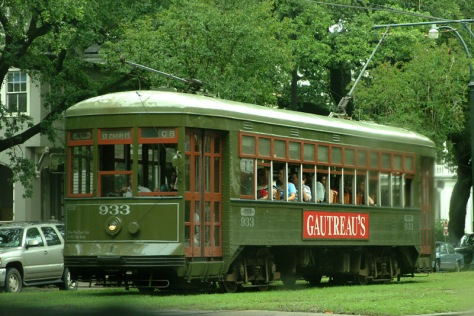
An original New Orleans vintage streetcar, still in operation today.

Along with Melbourne and Hong Kong, other cities which never shut down their streetcar lines include New Orleans in Louisiana, Toronto in Canada, Vienna in Austria, and San Francisco in California, which still maintains a total of five routes (three cable-routes, and two heritage streetcar routes running vintage streetcars imported from around the world).


One of Melbourne’s vintage, W-class trams, which were popular in the 1920s, 30s, 40s and 50s. When I was a kid, you could still find these vintage relics clattering around town. Today they’re a pretty rare sight, although you can still sometimes find them.

Why Are Streetcars Coming Back?

Honestly? Because they’re cool. And because people are finally realising the error of their ways.

While it’s true that buses are more flexible in the sense that they don’t need rails to move on, buses had a number of disadvantages which meant that they simply could not outperform trams.

Buses were limited in size, they burn fuel and emit fumes, they require regular maintenance and tire-changes and repairs, and they need to deal with all the other issues that public transport has to handle. Trams by comparison could be made very long, with lots of space inside them for passengers. They could last on the road far longer than buses, they didn’t emit fumes, and they use electricity to move around with, which can be produced from clean sources that don’t emit harmful gases.

Just like Melbourne, trams have remained a fixture of public transport in Vienna, Austria, since the 1880s.

Trams don’t have much in the way of maintenance. Apart from regular cleaning and the occasional motor-check, there’s no fuel to replace, and steel wheels and tires last a lot longer than rubber ones, and by their nature, tram-routes are typically limited to wider streets and boulevards, meaning that they’re less likely to delay traffic, even if they do break down. On top of that, tram or streetcar networks give a city in the 21st century – just as they did in the 19th century – a look of progress and modernity.

It’s for all these reasons and more, that trams are making a comeback. While some cities struggle with the idea of miniature train-lines running through their streets, the number of large cities around the world which are successfully embracing, and even expanding on their tram-networks are proof that over 100 years ago, our Victorian ancestors knew what they were on about!

Cowboys and Indians: The Truth about the Wild West


Cowboys, Indians, cattle-rustlin’, shootouts, sheriff’s posses, drinking, whoring and gambling! These are the sorts of things we think about when we imagine a time, and a place in American history known as the ‘Wild West’, also known as the ‘Old West’. But what was the Wild West? Where was it? How long did it last for? How wild did it really get? In this posting, we’re going to find out!

Before the ‘Wild West’

America in the first half of the 1800s was largely confined to the East Coast, bordering the Atlantic Ocean. From Florida in the south to northern states like New York, Rhode Island and Massachusetts, America was largely confined to the original “13 Colonies” that had been established by the British in the 1600s and 1700s. But with the end of the American Revolutionary War in the 1780s, America struck out to determine its own destiny. And part of that destiny was exploring the lands that existed beyond what was then called the “Proclamation Line” – an invisible barrier or border set up by the British to try and protect the land-rights of Native Americans back in colonial days.

The fastest way to explore this land without getting shot at was first – to buy it! This was achieved in the famous 1804 Louisiana Purchase, where France sold off its share of the North American continent (‘Louisiana’, named after King Louis) to the American republic, presided over by Thomas Jefferson at the time. From the western borders of the Louisiana Purchase, to the eastern limit of the original 13 Colonies, America had doubled in size! Explorers, hunters, trappers, cartographers and settlers seeking adventure and riches set out across this new land to find out what it contained.

The first government-sponsored expedition into this new land was the famous Lewis & Clark Expedition of 1804-1806 where Thomas Jefferson charged these two explorers with  going west, both to map the area, find out what it contained, and also see if they could chart out a reliable route from the lands west of the Mississippi River, to the Pacific Coast of the continent. Jefferson also wanted these two explorers to get there first to stop foreign powers in the area (Britain and Spain, mostly) from trying to sneak in on their new turf!

It was with land-purchases and expeditions like these that America started gradually expanding westwards. By the 1830s and 40s, conflict with Mexico increased the United States’ grasp on the continent even further. The belief in “manifest destiny” was their justification to keep on going. This was the belief that their destiny was ‘manifest’ – or pre-determined and obvious, and that they should keep expanding if the means to do so were presented.

By the 1840s and 50s, America had established settlements on the West Coast, or else had taken over old Spanish and Mexican settlements. Cities like Sacramento, Los Angeles and San Francisco were established or expanded on during this period.

The California Gold-Rush

Oh my darlin’,
Oh my darlin’,
Oh my darlin’,
Clementine,

Met a miner,
49’er,
Excavatin’…
For a mine…

Yep. When gold was discovered in California, the Great California Gold Rush was on! Ships lay idle in San Francisco Bay, and thousands of sailors, immigrants and locals fled to inland to the cry that “there’s gold in them there hills!”.

The earliest miners were popularly nicknamed ’49ers’ or ‘forty-niners’, named after the year that they arrived – 1849. And from then on, people came. Shiploads of people from all over the world rushed to California. And those who didn’t come by ship came by long, torturous wagon-trains that were pulled across the midwest and through the mountains by oxen on the so-called ‘prairie schooners’, better known as the covered wagon.

As gold was discovered and cities like Sacremento and San Francisco started to grow, people seeking opportunities surged westwards.

Or rather…they walked westwards.

See the problem was that getting from the Eastern states to the Western states was extremely difficult. Every single yard had to be trekked on foot or by using a wagon train. It could take weeks and months to get there, and walking all the time. If you didn’t want to walk, then you could take a ship!…which meant a voyage all the way down to the bottom of South America, and all the way up the West Coast! The problem with this was that you had to go past Cape Horn, the most dangerous stretch of ocean in the world! There was a very good chance that you’d never be seen again!

Um…nice knowing you…!

The Transcontinental Railroad

To make traversing the bigger, better USA a much safer and faster prospect, Abraham Lincoln authorised the construction of the Transcontinental Railroad in the 1860s. Thousands of miles of track were laid by hand through the Midwest. Tunnels were blasted out of mountainsides using nothing but gunpowder, and thousands of trees were used in constructing dozens of bridges and viaducts to get the trains through. To pay for the gigantic cost of the railroad, the government came up with the brilliant idea of selling off land that spread out from either side of the track. That way, farmers, ranchers and settlers could buy the land from the government, and the money raised would be used to pay for the railroad.

When the two halves of the Transcontinental Railroad were joined at Promontory Point, Utah, a single word was transmitted down the telegraph line in Morse Code: “DONE”, signalling the official completion of the line. It was the first live telecommunications news broadcast in the world.

With a reliable and fast mode of transport now in place, the Transcontinental Railroad allowed for the creation of towns dotted throughout the American west. With easy transport and convenient telegraph lines, anywhere that was worth settling (usually because of easy access to water, and some sort of raw resource worth making money from, like silver, gold or some other metal or mineral), was settled. Farmers and ranchers set themselves up in business, miners and prospectors got to work, and everything else that came to characterise the typical Wild West town went along with it!

The Birth of the Wild West

The period known as the ‘Wild West’ lasted from roughly the end of the Civil War in 1865, until the early 20th century, up to about the time of the First World War, in 1914. During this approximately fifty-year period, a whole mythology of the West was formed. How did it come to be? What was it? And how much of it was true?

The ‘Wild West’ was defined as the area of the United States stretching from the Pacific coast through the Midwest, up to the Mississippi river. This vast expanse of land, encompassing states such as California, Nevada, Texas, Arizona, Utah, Colorado, Kansas, Nebraska, and so on. These states were sparsely populated and far from any major centers of civilisation, such as the great coastal cities of San Francisco, Boston, and New York.

These states (or territories, as most of them were back then) which made up the ‘Wild West’ were newly opened to settlement due to land grants, the railroads and the discovery of gold, silver and other minerals buried in the mountains and rivers that flowed through these territories, but had little in the way of infrastructure or reliable communications networks and what few hubs of civilisation there were, were generally few and far between.

Such settlements and towns as existed in the Wild West were often thrown up very quickly. Many started out as tent-cities. Eventually, these were replaced by cheap, easily-erected buildings, many of them sold as prefabricated, flat-pack kits! It was easy to order an entire…cottage, general store, tavern, sheriff’s office, barbershop, or even your very own flat-pack whorehouse, from a company ‘back East’! Companies manufactured these buildings and advertised them for sale in catalogs and magazines specifically aimed at people who were heading ‘out West’ to seek their fortunes in some gold-rush boom-town or one-horse cow-town stuck in the boondocks.

To make the transition from bustling Eastern metropolis to dusty western plains easier and safer, such prefabricated buildings were created. The entire structure of the building was simply packed up in crates, loaded on a train and driven out to where-ever your town happened to be. With the help of a few friendly locals, the town’s latest watering-hole, hotel, assay-office, general store or draper’s shop could be thrown up in a matter of days. Everything you needed came with the package – doors, windows, roofing…all you did was slot it together – IKEA for buildings!

Why did the Wild West Exist?

The Wild West sprang into existence for a number of reasons. Chief among these were unemployment, mining, ranching and farming, and industry.

At the end of the Civil War, there were loads of soldiers from both the Union and the Confederacy that were looking for jobs. When jobs couldn’t be found, they had to turn their sights to something else. Many became workers and labourers building the Transcontinental Railroad, and other networks that snaked their ways across the West. They laid the groundwork for what was to come. Other men gained employment setting up telegraph stations, sinking poles into the ground alongside railroad tracks, and stringing electric telegraph wires to link towns and cities.

Towns were established where-ever it was deemed profitable to do so. Many Old West towns were mining boom-towns, digging out gold, tin, copper, silver and other raw resources. Others made money from lumber, cattle-rearing, or else grew out of way-stations and outposts set up to give aid to hunters, trappers and cowboys who handled cattle, beavers, oxen and other game and stock-animals that could be herded or hunted out west.

Apart from cattle and herding, a lot of wild west towns were established because of mining. Gold and silver mines sunk or dug into the hills and mountains of the Wild West brought in thousands of people who had probably never mined in their lives, but who were willing to risk death and destruction to have a chance at striking it rich. General stores, hotels, drapers, ironmongers, blacksmiths, farriers and moonshiners all set themselves up to do business with these miners, and turn a tidy profit while they were at it.

Getting to the ‘Wild West’

For many people, just the whole act of ‘going west’ was an adventure in and of itself. To say it was challenging was an understatement. Before the 1860s, it required a covered wagon-train, months of supplies, water, everything that you might possibly need, a team of oxen to drive the wagons, and a competent guide. There was a very good chance that you would never make it to Nevada, California, New Mexico, or Arizona – deaths from dehydration, disease, food-poisoning, and Indian attacks were common and trails through the West created by pioneers which went before you were often lined with crosses marking the graves of fallen explorers and hopefuls.

The covered wagon or “Prairie Schooner’, a common sight on the roads westwards, until the Transcontinental Railroad took over in the 1860s and 70s.

The establishment of the Transcontinental Railroad by the start of the 1870s made travel west much easier. What once took months to traverse by covered wagon could now be done in a matter of a few days by faster, more reliable steam-trains – although that said, early railroads were notoriously dangerous. Derailments, boiler-explosions and head-on collisions with other engines were common. But assuming that you made it safely to the Wild West, what could you expect?

The classic wild west train of the 1860s and 70s. Early steam-trains were what the ‘old-timers’ liked to call ‘wood-burners’ – they burned wood in their fireboxes, not coal. The conical smokestack on top of the boiler was deliberately flared out as a spark-arrestor, to stop errant smouldering cinders from flying out the top and setting the grasslands on fire as the train moved along at high speed.

Typical Wild West towns were wild and rowdy places. Drinking, gambling, whoring and fighting were common occurrences. For the newly-arrived traveler, there were hotels or inns where you could stay, possibly a bank where you could deposit your gold or money, and if you were a miner or prospector, an assay-office where you could get any pay-dirt from your claim, processed and examined (‘assayed’).

The more ‘up-market’ Western towns had the latest technologies – their own railroad stations, water-pumps (usually windmill-driven screw-pumps that siphoned up groundwater), and maybe even one or two telegraph offices, usually near the town center, or the main railroad station.

Streets in Wild West towns were rarely, if ever paved – those covered wooden pavements and walkways weren’t just there to look good – they were to stop you from getting your boots or shoes slopped up with mud when it started to rain!

Regardless of size, every western town had the staples – a tavern or bar, an inn or hotel, a whorehouse, and a sheriff’s office. But were Wild West towns really as wild as we imagine?

Law and Order in the Wild West

The popular image of the Wild West is that it was a place where anything and everything goes. Do whatever, eat whatever, drink whatever, shoot whatever! And to hell with the consequences! I mean, that’s why it’s called the ‘Wild West’ to begin with, right?

Um…not so fast.

Don’t forget that a lot of Wild West towns sprung up because of the rich resources nearby. Cattle-ranching, farming and mining. No wild west town was going to last very long if they didn’t have at least some law and order to protect these vital industries which kept the towns viable and alive. If people expected labourers, farmers, miners and prospectors to make their home in their new fledgling community, then it had to be safe!

To protect the citizenry and the merchandise, materials or wealth that they brought to the town (or created while they were there), almost every western town of note had a sheriff, and if he was lucky, a few deputies (and if he was unlucky, then he’d have to raise a posse to do things for him). Either way, it was his job to enforce the laws, and one of the first laws on his list was one which might surprise you – gun-control!

Firearms in the Old West

When you think of the Wild West, you automatically think of guns! Revolvers like the Colt Single-Action Army, the Winchester lever-action repeating rifle, and the break-open dual-barreled coaching-guns, are the weapons which typically come to mind. By the 1860s and 70s, advances in firearms technology had done away with old muzzle-loading muskets and blunderbusses, to be replaced by sleek, smooth-actioned, fast-firing, fast-loading cartridge firearms which could be shot off and reloaded in a matter of a couple of minutes.

The Winchester Lever-action Rifle, various permutations of which, were popular in the Wild West from the 1860s up to the early 1900s. Pulling the lever discharged the spent shell and reloaded a fresh round from the tube-magazine underneath the barrel.

That said, the reality of firearms and the wild west isn’t nearly as rambunctious as you might imagine.

While the popular depiction of the West was that everybody in town was packin’ heat, with cowboys wavin’ six-shooters around and damsels hiding derringers up their garters, the truth is that in many Wild West towns – carrying firearms – or indeed, any kind of weapon at all – even a large knife – was actually illegal! The notion that there were crazy shootouts and gunfights every other day of the week, and that bodies stacked up faster than freshly-split firewood, simply isn’t true. In fact, the murder-rate in most Wild West towns would be disappointingly low for anybody looking to recreate a bloodthirsty Wild West boom-town.

Talking about revolvers – here’s a little trivia question for you: 

In the Wild West, revolvers were popularly called ‘six-shooters’, because almost every revolver was capable of holding six rounds. But how many rounds did the average gunslinger actually load into his revolver? Find out at the end of the article…

The Colt Single-Action Army Revolver, popularly known as the ‘Peacemaker’, was one of the most common firearms found in the Old West. Firing large-calibre 44 and 45-cal. rounds, the gun was introduced in 1873…and has been in near-constant manufacture ever since!

So how tight was gun-control in the old west? Well, let’s take one of the most famous wild west towns as an example – Tombstone, Arizona. In 1881, Tombstone passed a law that stated in no uncertain terms, the following conditions regarding local gun-ownership:

Section 1. It is hereby declared unlawful to carry in the hand or upon the person or otherwise any deadly weapon within the limits of said city of Tombstone, without first obtaining a permit in writing.
Section 2: This prohibition does not extend to persons immediately leaving or entering the city, who, with good faith, and within reasonable time are proceeding to deposit, or take from the place of deposit such deadly weapon.
Section 3: All fire-arms of every description, and bowie knives and dirks, are included within the prohibition of this ordinance.

So if you were planning on strutting around town, pearl-grips flashing in the sun, you’d have to do some pretty fast talking to get yourself out of a very sticky situation if someone called up the sheriff on you!

Another trope of the Wild West was that death – or more specifically – death from gunfire – was a common occurrence back then. Sorry to say it, but it’s not actually true. Remember all those gun-laws I mentioned? They weren’t limited to just Tombstone – many famous Wild West towns had them, including Deadwood, That’s not to say that people didn’t die out West, but that it was rarely due to instances of unbridled showdowns with guns-a-blazin’! Deaths from gunfire in Wild West towns were surprisingly few, given how common they are in films! To take the example of Tombstone, again, during the Wild West period from the 1850s up to the 1910s or 20s, the kill-count never went above five dead bodies a year!

Tombstone was not an anomaly, either. Similar laws also existed in Dodge City, and in Wichita, Kansas. In fact, carrying an illegal or unregistered firearm in the Old West was one of the fastest ways to get you arrested, and town sheriffs enforced this law rigidly.

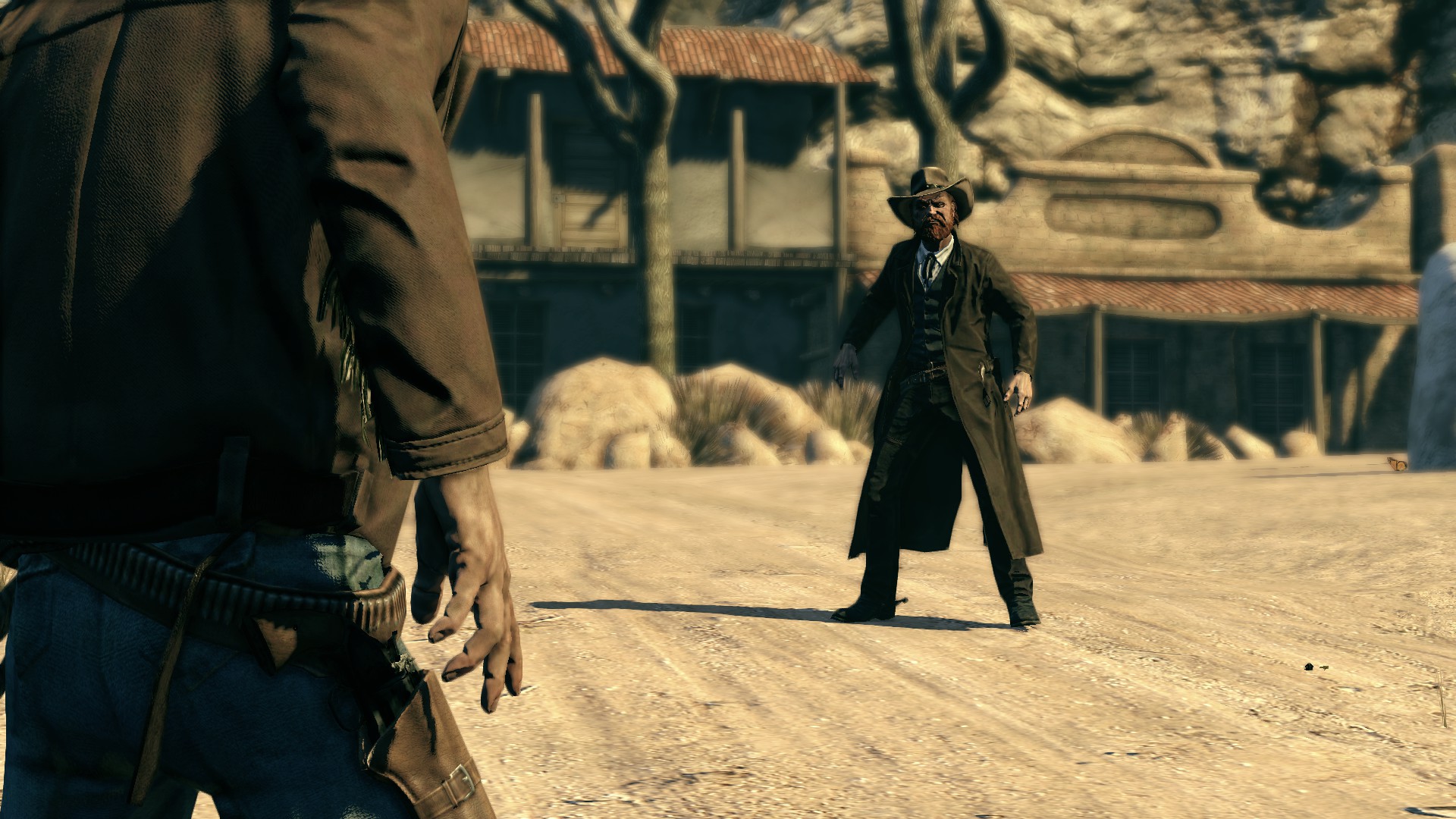
This…never happened.

Because of this, you might be thinking about another cliche of the Wild West: the classic wild west duel! You know – two men standing in the middle of Main Street, facing each other…whoever fires first and hits the target is the winner! Right?

Nope.

Historical evidence shows that the ‘classic’ wild west duel never happened. For one, in many towns it would’ve been illegal anyway, because, as I said, firearms were not allowed to be carried around. secondly, if you did sneak a gun into town without the proper permits, then chances were, people were going to raise a hell of a stink about it! In fact, it was due to the violation of the above 1881 gun-control law, that Tombstone, Arizona, saw what was possibly the first, last, only, and most famous gunfighter duel in Wild West history! You might possibly have heard of it – The Gunfight at the O.K. Corral.

The Gunfight at the O.K. Corral

A corral, for those who’ve never heard of the term, is a yard or fenced in open space, typically used for housing cattle or horses. The Old Kindersley Corral (the actual name of the ‘O.K. Corral’ of legend) in Tombstone, was the location, in October of 1881, of the most famous western shootout in history!

Right?

Sorry…wrong again.

The gunfight certainly did happen, and it did take place in Tombstone…but that’s as far as truth will take us. In real life, the gunfight took place outside a photography studio…six doors down the street from the actual corral! It took place between four lawmen and five outlaws, three of whom were killed in the duel.

On one side was Doc Holliday, and the famous Earp Brothers – Sheriff, Wyatt Earp, and his two brothers Virgil and Morgan Earp, who had come along to back him up in his defence of law and order.

On the other side were Thomas and Frank McLaury, Bill and Ike Clanton, and Billy Claiborne.

In essence, the Clanton-McLaury gang were up to no good. The Earp Brothers and their associates had tried over and over again to shut them down. Both Virgil and Wyatt had some experience, either as soldiers or lawmen, and represented law-enforcement in Tombstone for as much as it was possible for them to do so.

Fed up with the Clantons and McLaurys flagrant disobedience of the law, the Earps, along with Holliday, decided that enough was enough and went to shut them down. They decided to take advantage of the newly-introduced gun-control laws that had been enacted just a few months earlier in the year – open-carry of unlicensed firearms was an arrestable offence in Tombstone, and the Earps were ready to take them in. Unfortunately, the cowboys were never going to go quietly. In the space of just thirty seconds, dozens of shots were fired, including two massive shotgun-blasts at point-blank range.

Both McLaury brothers, and Billy Clanton (aged just 19) were shot dead. Ike Clanton (unarmed at the time) fled the scene, and later tried to get the sheriff’s posse arrested on the charge of murder. The local Justice of the Peace ruled that the Earp Brothers and Doc Holliday were only enforcing town laws, and cleared them of any wrongdoing.

Bank-Robberies in the Wild West

One of the reasons why the Wild West existed in the first place was because of gold and silver. Miners dug the gold and silver out of the ground in ore. The ore was assayed (tested), then crushed and refined, melted down and cast into either ingots (bars) or coins. This could either be kept as cash, exchanged for banknotes, or simply stored in a bank, or sent ‘back East’. But if you kept your gold or cash in town, then you would’ve kept it at the local bank. And that bank was being robbed every other week, right?

Um. No.

Believe it or not, but bank robberies were surprisingly rare in the Old West. Partially this was because of the aforementioned gun-laws, and also because banks and other similar institutions were well-guarded in those days. OK, fair point. But what about when the gold bullion or the dust or coins were being transported? What about train-robberies, didn’t they happen?

Robbers attacking shipments on the move certainly did happen, and they were a recognised risk. To deal with it, companies contracted to store and ship gold and other valuables took measures against them. One example is the Wells-Fargo Company. Recognised throughout the west thanks to its green postboxes, Wells-Fargo was a delivery company, shipping and transporting everything from Aunt Susie’s letter about her new cat, to the glittering results from Mr Donnovan’s latest claim! Because Wells-Fargo’s stagecoaches carried such valuables, they were a prize target for robbers and holdup-men. But holding up a stagecoach was no walk in the park.

A Wells Fargo stagecoach. The coach-guard with his double-barreled shotgun sat up the front (on the right) in the driver’s box, next to the coachman, giving ride to the term ‘riding shotgun’.

To protect their stagecoaches, their cargoes, and the passengers riding inside them, Wells-Fargo employed coach-guards – heavily-armed men who rode along the outside of the coach in order to keep the driver and passengers safe. Usually there was anywhere from one to three guards. Regardless of the number of them, one guard always sat up front, next to the driver. Across his lap would be a double-barreled shotgun, which he would happily deploy to deal with any would-be outlaws.

A break-open, double-barreled sawn-off shotgun, popularly called a ‘coach-gun’ for use on stagecoaches. The shorter barrel length made the gun easier to move around in a tight situation and lighter, although the lack of weight in the barrel meant that the recoil would be more powerful. While it only fired two shots at a time, the coach-gun’s widespread buckshot ammunition was unlikely to miss its target – useful when you’re on a rocking stagecoach going at speed.

Ever wondered why riding in the front seat next to the driver is called “riding shotgun”? This is where it comes from – the double-barreled shotguns carried by coach-guards in the Wild West!

Train Robberies in the Wild West!

OK, so we’ve looked at bank-robberies, but what about train-robberies? How common were they? Like bank-robberies, they did happen, but also like bank-robberies, not as frequently as you might think. Among the great train-robbers were Jesse James and his cohorts, and another famous Western outlaw – Butch Cassidy!

Trains made enticing targets for robbery because they were the fastest way to transport valuable goods. Trains were often loaded with gold, silver, coinage, banknotes, payroll-safes, and wealthy passengers. Although they were the fastest vehicles in the world at the time, they still did not go THAT fast – until the early 20th century, it was rare for a steam train to clock up over about 60 miles an hour.

That said, the typical Hollywood method of sticking up a train, by riding alongside it on horseback and jumping onto it, almost never happened. It was far easier to just get on the train at the station, and then hijack the damn thing once it was out of sight of civilisation, or else to quite literally hold up the train by creating some sort of roadblock across the tracks, forcing it to stop, or risk derailment.

To combat the risks of being robbed, train-staff often carried their own protection. Conductors and train-guards who rode along with trains carrying valuable cargo often packed some sort of firearm, either a shotgun or revolver, to discharge against would-be attackers. In one instance, a conductor and a guard even managed to call for help! Hopping out the back of their train, the two men used the latest technology to summon the police – an Ericsson field telephone!

The telephone came complete with long poles and cables. All you did was connect the cables to the poles. Then you hoisted them up into the air and hooked them onto the nearest telegraph line (which was usually alongside the railroad line). Then it was just a matter of cranking up the phone and putting a call through! Using this method, the conductor was able to contact the nearest sheriff’s office and have the train-robbers apprehended!

Cowboys and the Old West

Ah, the cowboy! Rough, tough and tumble. An iconic of hot-blooded All-American sex-appeal! Yeah?

Eh…maybe. Depends on what your sexual preferences are!

The truth is that most cowboys in the Old West, or at least a good proportion of them, were not the well-muscled, good-looking young hunks that you find plastered on the bedroom walls of teenage girls or frustrated housewives – in reality, a lot of cowboys weren’t even white!

See, being a cowboy was a hard, dirty, dangerous job with low pay. Herding hundreds or thousands of cattle long distances was a thankless, thirsty and exhausting job, and because of this, it was one that typically went to people who probably had no other choice but to drive cattle – typically Mexican immigrants, free blacks, or freed or former slaves. By some estimates, up to 25% of cowboys in the Wild West were black. Sure, white cowboys did exist, but they weren’t the only ones that you could find. On top of that, gay cowboys were far more common than you might think!

That’s right, you heard me. Gay cowboys.

Historical records show that homosexuality was pretty common ‘out on the range’. Cut off from civilisation…especially female civilisation…for weeks and months at a time, many cowboys tended to get a bit bored, and before long, even other guys started lookin’ pretty good.

But what about the attitudes to homosexuality back in the 1800s, surely that put a stop to this stuff, right?

Well…not as fast as you might think, if at all! Given that the job was so hard already (no pun intended, I swear to God!), ranchers and farmers were desperate to find good, solid men to drive their cattle long distances. The work was so demanding and difficult that they weren’t about to turn away someone just because he was more interested in what hung below than what rested on top – good help was just so hard to find that ranchers just couldn’t be so picky. And at any rate, sexual preferences, or even sexual encounters, only ever happened way out in the middle of nowhere in the middle of the night. Given that – who was ever going to know? After all, knowing how, when and why to keep stuff under your hat was an important skill to learn in those days, if you expected to live a long life.

Speaking of hats – most cowboys did not wear the classic broad-brimmed Stetson center-pinch cowboy hat, either! Oh no. Although it might look very impressive and produce an alluring silhouette, the truth is that most cowboys actually wore the much more common standard, black bowler hat.

The bowler hat was extremely common in the second half of the 1800s and was worn by everybody from street-toughs to Wall Street bankers, shopkeepers and cowboys….especially cowboys!

Why? Well, one reason why the bowler hat was so popular was because its hard felt, dome-top design meant that it was pretty decent when it came to protecting the wearer from being whacked on the head. Unlike other hats such as top-hats, or the stereotypical cowboy hat, the bowler had to be rigid in order to maintain its characteristic curved shape. Because of this, it quickly became popular as a sort of ‘everyday hard-hat’, a useful feature when being thrown from your horse at full gallop was a real possibility!

Outlaws and Robbers!

The word ‘outlaw’ comes from England, and was originally an English translation of the original Latin phrase from the Middle Ages, which was “Caput Lupinum“.

‘Caput Lupinum’ translates literally as ‘wolf’s head’. Wolves, a menace in medieval England, were notorious for killing sheep and other farm-animals back in the day. Since England’s economy rode on the sheep’s back, anybody who could kill a feral wolf would not face any penalties (as opposed to say, killing deer or sheep or cattle unlawfully).

This same concept was applied to wanted criminals. Criminals who had evaded justice could be very hard to capture in the days before CCTV, squad-cars and two-ray radio. To capture these nefarious criminals, the easiest thing to do was to declare them ‘outlaws’. This meant that the wanted person was now ‘outside the law’.

This meant that they no longer had an obligation to follow the law. It also meant that the law had no obligation to protect them! Anyone who came across an outlaw could – perfectly legally – kill him, using whatever means necessary – and – just like killing a wolf – would face no punishment. Without regular police-forces to maintain order, it was up to ordinary people to observe the ‘Hue and Cry’ and maintain their own order.

Along with the outlaw was his counterpart – the sheriff! The word ‘sheriff’ is a corruption of the original words ‘Shire Reeve’ – an elected official whose job it was to maintain law and order on a lord or baron’s lands and keep the peace. The ‘shire’ was the area of land which the ‘reeve’ oversaw. Eventually, the two words melded into one – Sheriff.

Wild West Outlaws

The Wild West is famous for its outlaws. Jesse James and his gang, John Wesley Hardin, Butch Cassidy, and Billy the Kid were all real people, and they all committed real crimes and real murders! But not everything about these larger-than-life characters is what they seem. Much of what they did, or didn’t do, has been shrouded in tall tales, half-truths and retellings that stretch back over a hundred years. Billy the Kid’s first name wasn’t even Billy! He got the name ‘Billy the Kid’ from the name William H. Bonney…which wasn’t even his real name…in fact, it was Henry McCarty.

Although Billy the Kid was often portrayed as a dangerous and reckless outlaw who killed nearly two dozen people, the truth is that by the time he was shot and killed…at the age of just 21…he’d only murdered four men. And if you believe the stories, he probably shot them with his revolver, which he held in his left hand! Well…that’s not true, either!

The belief that Billy the Kid was lefthanded came from this:

Henry McCarty, AKA Billy the Kid.

Taken in 1880, the year before he died, this is the only confirmed photograph of Billy the Kid known to exist. It’s an old tintype snapshot. In the photograph, he’s carrying two weapons – a revolver on his left hip, and a Winchester lever-action rifle in his right hand. Since the revolver was on the left side of his body, it was always assumed that Billy the Kid was lefthanded. Right?

Wrong.

The photograph is a tintype. This primitive method of photography, while effective, was deceiving. A tintype camera does not produce an exact copy of what it sees – it produces a mirror image of what it sees. That means that any photograph produced from a tintype camera has been flipped the other way around. The error was only discovered when historians examined the weapons in the photograph. The distinctive outline of the Winchester rifle made researchers realise that they’d made a vital error!

See…the Winchester has a tube-magazine underneath the barrel. To load this magazine, you feed rifle-cartridges into the gun from the breech through a spring-loaded hatch above the trigger, known as a loading-gate. If you look at the photograph of the Winchester rifle further up the page, you’ll notice that the gate is (and always has been) on the RIGHT side of the gun.

But in the photograph above of Billy the Kid…the gate is on the LEFT side of the gun – which is an impossibility because Winchester never made guns like that. When the error was finally realised and the photograph was flipped around, it was revealed that Billy the Kid was actually righthanded and that his revolver was actually on his right hip, and the rifle was on his left!

These are just a few examples of how even the outlaws of the Wild West were mythologised, and made out to be bigger, badder and meaner than they really were.

The End of the Wild West

From the early and mid 1800s, the Wild West grew and expanded. It reached its peak in the 1870s, 80s and 90s, up to the turn of the 20th century. As modern technology entered the towns, and the industries that once gave wild west towns their livelihoods, such as mining and cattle-herding, started to die away, the Wild West was consigned to history. Even as early as the turn of the century, it was becoming mythologised as a time gone by, with larger-than-life characters like Buffalo Bill Cody putting on his ‘Wild West Shows’ and touring the world with his famous act. By the end of the First World War, the Wild West had already become the stuff of myths and legends. Those who had lived their lives in the Old West moved on with their new lives. Some of them, like lawman Pat Garret, who killed Billy the Kid, wrote down their memoirs and life-stories in the 1920s and 30s. These twilight reminiscences are what give us the truth, and some of the myths, of what the Wild West was really like.

Finding out More?

If you want to know more, I can strongly recommend the documentary series “Wild West Tech”, if you can find it. Entertaining and educational all in one!

— — — —

So, did you figure out how many rounds were loaded into a revolver?

The answer is FIVE.

Although revolvers could hold six rounds, most cowboys and outlaws who carried revolvers usually only loaded five rounds into their guns (especially if they were older-style cap-and-ball blackpowder revolvers). The reason for this practice was so that the firing pin at the end of the cocking hammer always rested on an empty chamber.

When you were bouncing around in the saddle of your horse, there was a very big risk that the jolting and vibrations could cause the gun to go off accidentally! To ensure that you didn’t shoot yourself…or your horse…due to a sudden jerk that set the firing mechanism off…one chamber was always left empty, as a safeguard against accidents.

Sterling Silver “Seal-Top” Personal Spoon


The world we inhabit in the 21st century moves so fast and changes in everything from technology to social acceptability to science and our understanding of the world and life itself happen so swiftly that it’s easy to forget just how unchanging and how slow the pace of life used to be. And I was recently reminded of just that, when I picked up a curious piece of silver while mosying around at my local flea-market on a cold, blustery day, with half the stalls empty, because people were scared of the possibility of rain.

I stopped at one of the regular stalls and perused the array of nicknacks under the glass display case, and my eye was drawn to four spoons, each one slightly different. Three of them were the rather bog-standard silver ‘apostle’ or ‘saint’ spoons – silver souvenir pieces designed as trinkets for the tourist trade in some far off country. However, one spoon in particular, caught my eye, mostly because it was so unusual. It was both decorative, but also surprisingly plain. Just the sheer design of it told me that this was something different, even as far as spoons went.

To say that the spoon was different was putting it mildly. It had a very large, circular bowl, a very thin, hexagonal handle, and a strangely shaped head. It wasn’t flat or round or anything, but shaped like an upside-down wax seal. When I picked up the spoon and examined the end of the handle, I noticed it had a series of dots on it, which formed letters, and a date: 1629.

At first, I got really excited, but when I asked the price, which was surprisingly cheap, I realised that it couldn’t possibly be nearly 400 years old! But perhaps it was still silver?

I flipped the spoon over to have a look. Stamped on the handle, just behind the bowl, was a series of English hallmarks, which said the spoon was made in Sheffield, in 1926, by the famed silver firm of Mappin & Webb (a company founded in the 1700s, and still operating today!).

OK, s it wasn’t a 17th century spoon, but it was still silver, and it was still made by a famous company! After walking around the market two or three times, I decided that I wanted it, if for no other reason than the novelty factor.

So What’s so Special about this Spoon, anyway?

What you’re looking at here is a reproduction, in sterling silver, of a spoon called a ‘seal-top’ spoon, a type that was popular in Britain and Europe in the 1500s, all the way up to the mid-1600s. It’s characterised by a wide, round bowl, and a long, thin handle. It gets its name from the ‘seal’ at the end of the shaft, a popular design choice of the day (other similar spoons came with figures of animals or religious figures on their ends).

Such decorative features were usually just that – decorative. But not in the case of seal-tops. These actually served a purpose…and it wasn’t so that you could seal thank-you notes with them after dinner, either! To understand why they were so common, one needs to understand a bit about the history of cutlery (yes, cutlery has history, just like everything else).

The Deal with the Seal

The purpose the pretty, flat circular disc at the top of the seal-top spoon was to serve as a seal. Or more specifically, as a sign or identifier (which is what seals are, anyway). The purpose of this disc was so that the spoon’s owner would have somewhere convenient and tasteful to engrave their initials, name, or special date, into the spoon.

Why?

Well so that the spoon could be identified as theirs, duh!

But why on earth would that be the case? Surely people in the 1500s had as many spoons as we do now, right?

Actually, no they didn’t. And this is where the history-bit comes in.

A Brief History of the Spoon

Since the beginning of time, mankind has tried to find a way of delivering food to his mouth. This was usually done with the hands. Which was fine…if the food could be handled. If it couldn’t, then something else needed to be used in order to deliver sustenance to the body. For a long time, this was the knife. A sharp blade could be used to pierce meat, fish, vegetables and fruit and pick it up and eat it. A knife could also be used to slice and cut food into more manageable pieces.

But you can’t eat everything with a knife. What about peas? Or rice? Or soup?

To get over this shortcoming of the humble blade, people started crafting out a device which could scoop things up to bring them to the mouth for eating. Originally, such devices were whatever could be found in nature – shells and hollowed pieces of wood, for example. Eventually, the idea came about that if you put a handle on this scoopy-thing, you could use it to dig around in hot stews and soups without getting your fingers burned, or losing your scoop if it slipped out of your fingers.

The first spoons were born!

Early spoons were pretty crude. They were usually just carved out of wood, or bone, or were made from clay. You ever tried carving or shaping a spoon by hand, from scratch?

Yeah. Imagine how long that takes. Imagine how fiddly it is to make one. Imagine how frustrated you’ll be when you’ve snapped it in half, and you can’t eat again until you’ve carved yourself another one. Imagine how delicate and fragile they are and how easily they can be lost, stolen or broken!

This is precisely why for much of history, if you owned any type of eating utensil, it was a spoon, and it’s also why most people did not own more than one. They were useful and versatile, but also fragile and tricky to make. That said, by the Middle Ages, it was common for everyone to eat with spoons, and it became very common for people to have their own personal spoons. There was no such thing as having a multitude of spoons lying around, just in case you wanted to eat something – no! You had your own personal spoon that you ate things with.

This became so ingrained that if you went anywhere – to the local pub, to a friend’s house for dinner, to the lord’s manor for a grand feast or if you traveled overseas or cross-country – you never took it for granted that the place you were going to had spare spoons lying around – there was absolutely no guarantee that there would be!

Because of this culture, ownership of personal cutlery sets (‘trousses’) became very common. In both Europe and in Asia, such sets were manufactured. They differed slightly from place to place (Asian sets had a spoon, knife and chopsticks, a European one would’ve had a spoon and knife). Again, to ensure that everyone knew which set belonged to which person, it was possible to personalise your own specific set to your taste and desire.

“Being Born with a Silver Spoon in your Mouth”

We’ve all heard this expression. But what does it mean? Where does it come from? How did it come to be?

As I’ve said – for much of history, it was common for people to own their own personal spoons, sets of chopsticks, knives or other eating utensils that they carried with them, or used when they needed to eat. This became such a part of life that it became common for families to gift sets or pieces of cutlery to other family-members, specifically, to newborn infants. Chances were, the spoon the child was given at birth would be the one that they used for the rest of their lives!

Because of this, spoons had to be made of something more durable than wood or clay or porcelain. Where possible, they were made of metal. Usually, this was bronze, pewter, and maybe later on, brass. But one particular type of metal was always favoured – good old-fashioned silver!

Why Were Spoons made of Silver?

Spoons were made of silver because in times past, silver was a very important metal – far moreso than it is today. Silver was seen not only as a statement of wealth, it was also seen as a store of wealth – often, the grade of silver permissible in a particular country was the same grade that was used in the country’s coinage. This meant that in hard times, any silverware you owned could be melted down and stamped into coins, and in times of great wealth, coins could be melted down and made into silverware! This was a perfectly legal process – all you had to do was go through the right channels and it was done!

Because of this, families which wanted to be financially secure owned as much silverware as possible. That’s why you see things like silver candlesticks, silver plates, silver cups, bowls, silver trays, teapots, and of course – silver spoons.

But in an age when silver was very expensive, obviously, only the richest people (usually royalty, nobility and the wealthy mercantile classes) could afford to do this. To have something as small and as trivial as a spoon be made of silver was therefore seen as a sign of wealth and status, especially if your family was rich enough to have such a spoon made for you before you were even born!

This is how the expression ‘to be born with a silver spoon’ came to be, and why it became synonymous with being born into riches and money.

1783 “El Cazador” Shipwreck Piece of Eight


While chatting to an acquaintance-stallholder at the local flea-market, I was approached by her friend who wanted to know if I was interested in buying a coin. I’d met this fellow a couple of times before and we’d always had fascinating conversations about antiques, silverware and coins, and so I agreed to have a look at whatever it was he was willing to show me. He took a badly cracked and chipped coin-case out of a plastic bag he had with him, and presented me with a very, very, VERY worn and battered Spanish Piece of Eight encapsulated therein.

To say that the coin was in bad condition was putting it mildly. The surface was so pitted and scratched and the edges were so worn and chipped that it looked like someone had tried to sandblast it or something. And in a way, that’s exactly what had happened!

The damaged coin-case, bearing serial #3498007-073, said that the coin was from the “El Cazador” shipwreck of 1784. At once, I was interested – I’ve never owned any real shipwrecked treasure before! We haggled back and forth and finally settled on a price that I was comfortable with, and I added another piece of eight to my collection…which now numbers five pieces! (Only three more to go! Haha!!).

I decided to remove the coin from the case and add it to my collection, but I also decided to keep the case (damaged as it is) as proof of provenance, should I ever need it in the future.

So What Is This Coin and What Makes it Special?

The coin in question is a 1783 Spanish Dollar, also called an 8 Reales or Peso de Ocho coin. To most people, it goes by a far more common name, however.

The Piece of Eight.

What makes this coin stand out from other pieces of eight is that it’s a shipwreck coin. That’s why it’s in such terrible condition – it’d spent two hundred years at the bottom of the ocean! And that sort of treatment has caused the coin to take on a particular patina and toning which is unique to shipwreck coinage, and that’s what makes it more desirable and more interesting than other coins.

Even without the case, would it still be identifiable as shipwreck treasure?

Oh yeah, sure! Yes, coins like these are faked, but there are ways of telling genuine ones. Mostly, what you’re looking for are genuine signs of aging. Natural wear, grime and toning/patina which have built up over the coin over the course of hundreds of years. This is something that you cannot replicate on a fake coin (or at least, not easily). About the only way you can is to make a copy of an original shipwreck coin by making a casting of it. But that won’t work because the accumulated encrustations on the real coin would show up as metal on the fake one – which obviously wouldn’t happen if the coin had really spent the better part of two or three centuries underwater.

The blackened areas on the coin are the result of salt corrosion and discolouration from 200 years spent at the bottom of the Mexican Gulf. Even if you tried to polish this, you’d never be able to move those spots entirely, so I haven’t bothered to try.

Determining whether a coin is real or fake is a matter of close examination, the balance of probabilities, and understanding what you’re looking at, how it was made, and how metal ages over time. It’s something gained through experience and careful study.

What is “El Cazador” and what happened to it?

El Cazador (“The Hunter” in Spanish) was an 18th century warship (specifically, a brig of war), which was commissioned by the reigning king of Spain (at the time, Charles III), to deliver several tons of silver coinage from mints based in Spanish Mexico, to the capital city of Spanish Louisiana (New Orleans) in 1784. At the time, the United States was still limited to the eastern coastline and much of the Americna interior was still divided up between the French and the Spanish.

Paper currency and promissory notes being used in Spanish North America at the time were heavily prone to counterfeiting and forgery. This led to a lack of confidence in such currency, as a result, it meant that soldiers and sailors living in New Orleans at the time refused to accept it as payment since there was no guarantee that the notes were actually worth anything!

It was to prevent a complete financial meltdown that El Cazador was chartered to make this vital mission, and to restore the colony’s faith in Spanish currency, by replacing flimsy paper notes, not worth anything, with cold, hard cash that could be trusted!

The bust of King Charles III of Spain and the year “1783”. The heavily pitted and worn-down surface is the result of centuries of sand grinding against the metal as it was washed over it over and over again by the action of waves and currents. The coin was essentially sandblasted for two hundred years, which also wore down the edges of the coin, which is why they look so irregular.

To achieve this goal, the El Cazador sailed from Spain to the Mexican port city of Veracruz, where it was loaded with the silver which it would then transport to Louisiana, departing from Spain on the 20th of October, 1783, and arriving in Mexico three months later. Here, the ship was loaded with the required cargo os silver. All told, El Cazador was loaded with about 450,000 coins – Spanish Reales of various denominations. Roughly 400,000 pieces of eight, and 50,000 other Reale coins of small change – 4 Reale and 2 Real coins, etc., an amount totaling upwards of 37,500lbs (or 18.75 tons) of silver!

This coin was one of those 450,000 which vanished into the depths of history…

The Last Voyage of the El Cazador

Once loaded, the El Cazador departed Veracruz on the 11th of January, 1784, setting a course North-Northeast, across the Gulf of Mexico towards New Orleans. At the wheel was Gabriel de Campos y Pineda, a captain selected personally by the King of Spain himself, to command this vital mission.

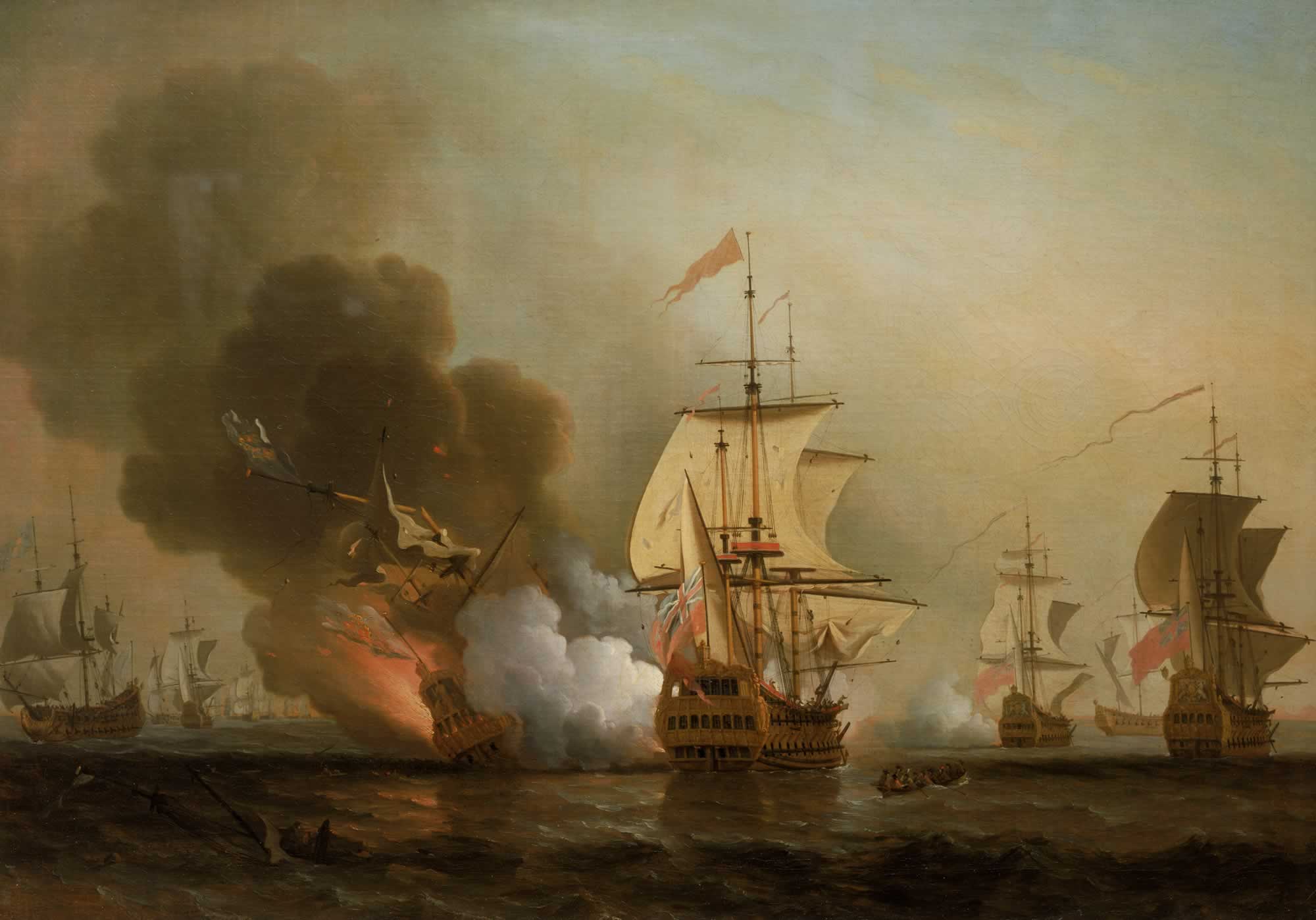
Exactly what happened to the El Cazador will never be known. Spanish treasure ships lost to hurricanes were extremely common occurrences in those days (read my post about the history of the piece of eight to see just how many fleets were lost in storms back in the 1600s and 1700s!) and it’s likely that the ship succumbed to such a storm.

“The Shipwreck that Changed the World”

The impact of the loss of the El Cazador was great. When it failed to arrive in New Orleans, divers and ships immediately went out into the Gulf of Mexico to determine what had happened to it. No trace of the ship could be found, and the loss of so much money became a disaster for the Spanish and their new world colonies. In June, 1784, the ship and its priceless cargo were officially listed as being lost at sea. While further attempts to ship silver to Louisiana were attmpted, the situation there, already so precarious due to the local distrust of the currency, finally collapsed altogether.

A few years later, the French revolution, and war with Napoleonic France only made things even worse, and eventually, Spain ceded its Louisiana colony to the French in 1800. This was the same territory which was sold to the United States in 1803, in the famous “Louisiana Purchase”. So basically, the United States of the early 1800s doubled in size because of a shipwreck.

What Happened to the El Cazador?

So, in 1784, a ship went down in the Mexican Gulf and was never heard from again. Right?

Well, sort of. The El Cazador was certainly not heard from for the better part of 200 years. This changed in 1993, when some guys out in the Gulf decided to go fishing. On a boat ironically called the Mistake, they sailed through the Gulf and tossed their nets overboard to see what they could find. When the nets snagged on something, they winched them up to find that they had caught large clumps of rock!

Initially, the men were frustrated and disappointed. That is, until one of the men broke one of the clumps open and took a closer look at it. He suddenly realised that it wasn’t a rock after all, but coins! Hundreds and hundreds of silver coins, fused together by two hundred years of corrosion and age!

Clumps of coins from the El Cazador, fused together by the sea after 200 years under water.

The Mistake’s captain, Jerry Murphy, suddenly got really excited, and rang up his lawyer as soon as he could, in order to obtain salvage rights on what he was sure, had to be a sunken ship. Further research identified the wreck as being El Cazador, and soon, huge clumps of silver coins were being winched and hoisted up from the deep, along with loads of other artifacts, including various cannons, and also the ship’s bell.

The coins were eventually cleaned and carefully pried apart. They were eventually sold off, either as single coins with certificates of authenticity, or as cased pieces in plastic frames with the name of the wreck printed on labels and stuck on them. Given that the El Cazador had 400,000 pieces of eight on board, getting your hands on one isn’t too difficult – just make sure that if you’re going to attribute your coin to the El Cazador wreck, that you get as much documentation and proof of it as you can. When it comes to antiques and history – provenance is power!

So Now What Happens?

Well, the coin is now part of my collection! Although the case is damaged, the frame with the authentication sticker is still intact, and I’ve kept it aside as proof of provenance. I’ve researched coin cases (or ‘slabs’ as they’re called in collecting circles) and removing coins from their slabs doesn’t deteriorate or damage the coin’s value or desirability in any way (provided that you keep evidence of the coin’s history, should it have any, and you didn’t damage the coin when it came out of the slab). So excited to have my first real piece of Spanish sunken treasure!

“I want a Shipwrecked Piece of Eight!…Where do I get one!?”

Believe it or not, you can just look them up online. There are a number of websites which act as official agents for various discovered shipwrecks. Simply find the right website and you’ll actually be able to buy genuine shipwreck silver coming from specific wrecks. Each coin comes with some form of authentication, either a framed certificate, or a slabbed coin in a plastic case.

Personally, I think a loose coin and a framed certificate is better, because slabbing a coin and encasing it in plastic can cause all kinds of problems later on, should you want to rehouse or re-display the coin in some other manner. Various coin-dealers I’d spoken to were all of the opinion that slabbing really isn’t the best thing to do with coins, since it can make them less desirable (what’s the point of buying a coin if you can’t pick it up, basically…).

More Information about the El Cazador and its Treasure?

Sure, here’s a few handy sites about the wreck, and its treasure, and how you might be able to buy a genuine piece of shipwreck silver or gold. These websites relate to the wreck of the El Cazador, but also to another famous Spanish treasure wreck: the galleon Atocha. If you’re interested in shipwreck treasure, then definitely check that one out!

http://artifactexchange.com/index.php/shipwrecks/el-cazador

http://www.elcazador.com/

"El Cazador" Shipwreck

The Moldacot Patent Pocket Sewing Machine (1886)


Now here is something that you absolutely do not see every day of the week. Behold the humble Moldacot – the world’s smallest (and possibly, the world’s most ineffective!) pocket-sized lockstitch sewing machine!

I purchased this more as a historical curiosity than anything else, but what a curiosity! And what a story!

The Moldacot Pocket Sewing Machine was invented in 1885, and manufacturing this tiny machine (tiny? It’s 8 inches from top to bottom!), commenced in 1886 in London. Touted to the world as the world’s most robust, and compact pocket-sized lockstitch sewing machine, it took the world by storm when it first appeared on the sewing machine market.

Featuring a bobbin-winder, optional hand-crank attachment, stitch-length adjustment, tension-adjustment and almost everything else that you expected to find on a MUCH LARGER full-sized domestic sewing machine, the Moldacot was held up upon high as being the latest, greatest thing in the world, the next big (or small) thing in sewing machine technology to come along since the needle!

Was it?

…Um…no.

For all its pomp and circumstance, the Moldacot was a TERRIBLE sewing machine! It was rushed into production and the initial design was never properly tested or quality-controlled. As a result, when it hit the open market, the resulting machine was riddled with design faults. About the only thing it had going for it was that it was, undoubtedly – the most well-built failure in history! The pieces were all milled and cast brass, instead of cheaper stamped steel or tin. But that counted for little, when you consider the fact that the machine barely worked.

Originally, the Moldacot retailed for anywhere between 10/6, all the way up to about 16/- (ten shillings sixpence, and later on, 16 shillings). It was supposed to be cheap enough for anyone to buy, and be the most robust and portable and useful machine ever made, or so the advertising material said…but because it couldn’t even do the one thing it was supposed to – sew fabric together – the machine never made it off the ground. Even in its day, it was little more than the most hyped-about laughing stock ever known in the sewing machine industry, which in the 1880s, was booming!

The TINY bobbin (left) and shuttle (right), of the Moldacot Pocket sewing machine. Many thanks to my good friends (and fellow collectors) Wayne & Judi McKail for providing me with this photo!

The sad thing was that the Moldacot was basically a scam. The idea was to build something too good to be true and make it look and sound as fantastic as possible! Get loads of people to invest in this amazing new device, and then produce a product that barely works, then take the money and run! The owners of the Moldacot boasted that they could produce an initial run of up to 5,000,000 machines!!

If only.

The Moldacot was such a terrible machine that the company directors weren’t even able to get that far! By 1888, the company had collapsed, crashing and burning and being done in by its own product’s failings.

The microscopic bobbin (top) and shuttle (bottom) of my Moldacot, removed from the shuttle-race (bottom right of the machine, slid out), and placed next to the machine, along with the bolt that holds the race into position during sewing.

In theory, the Moldacot was a brilliant idea. But with terrible management, ineffective design, poor quality control and even worse manufacturing practices, it was just never going to get off the ground. It cost too much to produce for too small a profit, and as previously mentioned – suffered grievously from design flaws. Instead of using investors’ money to improve the machine and make a better model, the company owners simply cranked out thousands of poorly-designed, albeit, impressively robust, and ultimately – useless machines – which nobody would ever want to buy!

The Moldacot came in two general categories. Earlier plunger-type machines (like mine) and a slightly modified, later model, with a hand-crank attachment on the side. Either type are pretty rare, and exactly how many Moldacots (of either type) were ever made is a hot topic of debate.

Like I said, the company that was in charge of producing Moldacot pocket machines were basically running a scam, and the kinds of production figures they threw out at the press were probably little more than fantasies. There are certainly enough out there for the really die-hard antiques collector to possibly get their hands on one, but they were certainly never made in the quantities of machines that other companies like Singer, White, Jones, etc, produced their machines.

Noted sewing-machine historian, Alex Askaroff estimates that perhaps tens of thousands of Moldacots were made…which sounds like a lot…and it is…but when you consider that thousands were probably thrown out, trashed, bombed out in wars, lost, or simply just smashed up…and that a few tens of thousands is NOTHING in comparison with the MILLIONS or even BILLIONS made by other manufacturers of sewing machines – the Moldacot is still pretty damn rare!

So Why the Hell Would you Buy One?

To sew with? Hell no! For one thing, the bobbin and shuttle are damn near microscopic, and hold only a few inches of thread! Today, the Moldacot is a pretty rare machine. It’s the type of machine that you buy to add to your collection as a historical curiosity. And they don’t get much more curious than this! The world’s smallest lockstitch sewing machine, a fantastic little gimmick and piece of late-Victorian engineering, and a great example of a retail scam that went catastrophically wrong!

If nothing else, it’s something that’s so weird and unusual that if you have this in your collection, most people will have no idea what it is! And for some, that alone, would be reason enough to have it!

Now I’m sure some of you might be asking – surely the machine wasn’t that much of a failure, was it?

Well, The Times newspaper, upon the collapse of Moldacot in 1888, called it “The Mouldy Cat” sewing machine…ouch! Talk about scathing reviews…

So in summary – the Moldacot is fascinating as a piece of industrial history, an example of Victorian ingenuity and engineering, and as a glimpse into shady business practices and how to run what coould’ve been a really interesting idea right into the ground…but it is definitely not a sewing machine! Or at least, not one that you would want to have to rely upon for anything.

Buried Treasure: Four Spanish Pieces of Eight!


Digging through albums, boxes and cases of old, crusted-up, grimy, forgotten coins from defunct entities from all around the world can often be a thankless and pointless task. You find all kinds of coins which are not particularly rare, or particularly interesting, or particularly valuable. You find all kinds of coins which are grubby, sticky, grimy, tarnished, chipped, dented and otherwise distinctly unappealing in one way or another.

But occasionally – just occasionally – you do find gems!

Finding the Coin of Destiny

This post is inspired by some coins which I found in the past month or so, while digging around at the local market.

It was on a cold, blustery morning, when I trudged through my local flea-market looking for…stuff. I stopped at the table of a regular stallholder and started burrowing through the cases and trays of coins on offer. Admittedly I don’t do this as a matter of habit – I rarely look for coins at flea-markets, and rarely bother looking through huge swathes of the things, since nine times out of ten, the coins I’m interested in are nowhere to be found, except for specialist coin-collecting stores.

But as I rummaged, I found something, buried under all the offerings of British shillings, Dutch 2 Guilder coins, Indian Rupees, grimy copper pennies and American half-dollars. Inside some simple cardboard coin-holders, crudely stapled together and with near-illegible biro-markings on the border, were three silver coins.

LARGE silver coins!

Out of sheer curiosity, I picked them up and felt them in my hand. They were heavy. Substantial pieces of silver. I examined them closely and spotted a coat of arms between two pillars with banners coiled around them, beneath a crown. Around the edges were Latin inscriptions. One of them read:

“HISPAN. ET. IND. REX. M. 8R. I. I.”

With a stupid little grin on my face, I flipped the little packet over and on the other side was:

“FERDIN. VII. DEI GRATIA” and four numbers: “1820”.

Oh boy.

Oh Boy!

OH BOY!!

A (nearly) 200-year-old silver coin. And not just any silver coin. I looked back at the other side. Sure enough, clear for everyone to see:

“8R”

As in ‘Eight Reales’ (pronounced ‘Ree-ahlz‘)

Out of all that crud and junk, I’d just picked up one of the most famous coins in the world.

A Spanish Dollar. Better known as a Piece of Eight. Fought, squabbled, traded and passed from hand to hand between pirates, traders, merchants, sailors, kings, queens, soldiers and colonials since the end of the 15th century, it is a coin of almost legendary history. A coin, rare variations of which, can fetch literally thousands of dollars – for a piece of silver no bigger than the dial of a man’s wristwatch.

I picked up another one.

“1790”

Ooooh boy!!

I picked up the third one!

“1779”

Hot dawg, we got us a winner!

I flipped the coins back and forth to check the prices and their conditions. When I saw the prices, my heart skipped a beat. They were going cheap! Real cheap!

The three Pieces of Eight (top, bottom and left) which have joined my antique coin collection, together with their brother on the right.

That was when all the alarm-bells started going off in my head. This is either the bargain of a lifetime…or it’s a very clever forgery – and yes, these coins ARE faked. I know that for a fact because I’ve bought (but managed to return) a fake, once in the past (that was a close call!).

Now, as an aside, you might ask, what does it matter? If it’s a nice one, and you can’t afford a real one, then, why not buy a fake? It doesn’t really matter, right?

Yeah, but the problem is – a fake may not matter to you, now – but it’ll matter in 50 years when your grandsons take it to the Antiques Roadshow and their five minutes of fame on international television becomes an international embarrassment when they find out that grandpa got duped with a fake coin. Nobody wants fakes. And if you just coughed up $200 for one, and can’t get it back…you’re screwed!

Anyway. Back to the coins!

Very politely, I asked to examine them. I carefully teased back the staples using a precision instrument – better known as a fingernail – and slipped them out. I popped the three coins from their covers – the three pieces of eight…and then asked to borrow the dealer’s jewelry scale.

If you’re going to be any kind of antiques collector, or dealer – I highly recommend getting one of these little pocket scales. They don’t cost much and their highly precise measurements are specifically for measuring precious metals. I turned the scale on and popped the coins on, one at a time.

A piece of eight should weigh NO MORE than 27.07g. NO LESS than 26g, unless it’s REALLY, REALLY, REALLY worn out.

Coin #1: 26g. Exactly.
Coin #2: 26.52g.
Coin #3: 26.69g.

Alright! Looks like we’re in the clear. It’s a cheap and dirty field-test, but it’s generally quite trustworthy. It’s based on the fact that specific metals have specific densities. A specific size of silver coin will always weigh a specific weight, as opposed to one made of say, nickel-silver, or steel, or some other cheap, imitation-metal like that. A nickel-silver or pewter coin won’t weigh the same amount for the same size of metal.

At first, the weight of the first coin (at only 26g) worried me. But then, that coin was the oldest, and by far the most worn-out. I figured the weight of 26g was acceptable given its condition.

The backs of the coins, showing their ages. 1779, 1790, 1802, and 1820.

Satisfied that the coins were indeed the real deal, next came the haggling. This is where visiting the same flea-market every week for 20 years, so often that people recognise you on sight, comes in handy. When you’re a friendly, regular, weekly face to the long-term dealers, they know who you are, they know what you buy, they know what you pay, they know that eventually, you will buy something from them sooner or later. This helps grease the gears of generosity.

In the end, I toddled off with the coins in my pocket. They were already dirt-cheap and I got them even better than that! Very excited! This now brings my collection (it can now be called a collection, right?) up to the giddy heights of FOUR coins! Oh my, oh my…

The History of the Piece of Eight

So, enough about buying the coins. What about the coins themselves? What exactly makes a Piece of Eight so special? Why is it called a Piece of Eight? What is it about this coin that has made it so famous for so long? Where did it come from? Where did it go? How long did it last?

The official Spanish name for the Piece of Eight was the Reale De a Ocho – Eight Reales. The Real (without the second ‘e’) was the Spanish currency from the 1300s all the way up to the middle of the 19th century! That said, the Piece of Eight or ‘Spanish Dollar’ as it’s also called, doesn’t date back that far. It shows up on the scene about 100-200 years later.

To make the Real easier to count and manage, when Ferdinand and Isabella conquered Spain in the 1490s, returning it to the realms of Christendom, they also reorganised Spain’s pre-existing monetary system. The basis for the new system was to be the 8 Reales coin.

Together, the Escudo (introduced later, in the mid-1500s) and the Real (one gold, one silver) formed the bedrock of this new currency system of the steadily-growing Kingdom (later, Empire) of Spain. They were minted in denominations of 1/2 Real, 1 Real, 2, Reales, 4 Reales, 8 Reales (the ‘Piece of Eight’), 1/2 Escudo (which was equal to one Piece of Eight), 1 Escudo (equal to two Pieces of Eight), 2 Escudo, 4 Escudo, and 8 Escudo (equal to 16 Pieces of Eight!). The 8 Escudo coin (the largest denomination coin manufactured by Spain) was also called a Doubloon.

Of all these coins, the Doubloon and the Piece of Eight became the most famous, the Doubloon for its large size and high gold content, the Piece of Eight for its near universal usage, large size, and impact on world history, which I’ll get to, further down…

Where did Pieces of Eight Come From?

Pieces of Eight were largely manufactured in the Spanish New World colonies such as Mexico, Peru, and Bolivia. The vast majority of the silver used to make Pieces of Eight was mined out of Potosi, a mountain in modern-day Bolivia which was almost completely solid silver. Thousands of tons of silver was mined out of Potosi and this silver was refined, melted and then stamped and shaped into Pieces of Eight (and their smaller denomination coins) to be shipped back to Spain in their millions.

As European powers started colonising North and South America in the 1500s and 1600s, a readily-available system of currency needed to be adopted so that transactions and trade could take place.

The 8 Reales coin, already available in abundance in South America, Mexico, and various parts of North America, became the ideal coin (and by extension, currency) for colonials to trade with. Some countries (such as Britain) actively tried to dissuade the colonists from using British (or other European-power) currency, and so foreign coins (ie: the Piece of Eight) were used instead. The Piece of Eight was almost universally accepted as currency because it was a known quantity. People knew that it was a large coin of proven silver content, and this made it ideal for trade.

Why is the Piece of Eight so Famous?

The Piece of Eight is famous for a number of reasons. The first reason is that the Piece of Eight is widely considered to be the world’s first global or international currency. From the date of its first minting until it finally went out of circulation (Ca. 1865), the Piece of Eight was accepted as currency almost all over the world. And I mean ALL over the world. Canada, America, Mexico, the Caribbean, Britain, Europe, Asia, Australia, Africa and China ALL used the Piece of Eight as a form of currency in one way or another at some point during the coin’s official run as legal tender.

Its large size, heavy weight, high silver content and easily-recognisable design, made the Piece of Eight easily accepted around the world, when no other currency was available. Even in China, where the locals probably couldn’t read (let alone understand) the Latin inscriptions around the coin’s edge, they knew silver when they saw it, and they accepted it as payment for their goods such as porcelain, tea and silk. To ensure that the coin was the real deal, Chinese merchants would test the coin by hammering a seal into the coin to check its silver content. These seals were (and still are) called ‘chops’, and the dents they left in the coins are called ‘chop-marks’. It’s not uncommon to find Pieces of Eight used in the China trade festooned with chop-marks as the coins moved from merchant-to-merchant, each one striking the coin to ensure that it was solid silver.

Pirates and Pieces of Eight

The second reason why Pieces of Eight are so famous is because of their indelible link to the Golden Age of Piracy, the Age of Colonisation, the Age of Exploration, the Age of Sail, and the Enlightenment movements of the 1600s, 1700s and early 1800s.

As I said, Pieces of Eight were largely manufactured in South America and Mexico. To get Pieces of Eight back to Spain, the Spanish government organised a system of treasure-convoys. Basically, what happened was that every few months (say, two or three times a year), a fleet of ships was sent from Spain to the Caribbean and South America. This fleet of ships carried food, water, essential supplies, trade-goods and other necessities and materials required by the colonists living in Spanish holdings in and around the Caribbean Sea.

Once the ships had been offloaded of their cargo, their holds were reloaded with thousands, millions of gold and silver coins – usually escudos, doubloons, Pieces of Eight, and their various smaller denominations – along with tons of gold and silver in the form of bars (ingots).

Thus-loaded, the ships, in convoy, would sail for home.

It was these treasure-bearing Spanish convoys that were a prime target for nominally enemy nations, such as the Netherlands, France, and especially – protestant England.

So, did pirates and privateers really attack Spanish treasure galleons or even entire fleets? Were fleets lost in storms and hurricanes during the voyage back to Spain?

Oh, you bet.

Spanish treasure fleets were lost to storms or hurricanes with surprising frequency. Fleets sank in 1622, 1708, 1715, 1733 and 1750, to name but a few! One ship which sank in the 1622 storm was the Nuestra Señora de Atocha (“Our Lady of Atocha”). The Atocha is in the Guinness Book of World Records as the most valuable shipwreck ever found – probably because it was loaded with 40 tons of gold and silver!

OK, but what about ships lost to epic sea-battles? Did those ever happen?

They certainly did. On the 8th of June, 1708, the Spanish treasure galleon the San Jose was blasted to kingdom come by English cannons during a battle during the War of the Spanish Succession (1701-1714). Eager to stop the treasure-loaded fleet from reaching Spain (and therefore funding the enemy) English warships under the command of Admiral Sir Charles Wager, attacked the Spanish off the coast of Colombia.

The San Jose (center-left) being blown to pieces by British cannonfire during the War of the Spanish Succession.

Three Spanish ships were destroyed in the engagement. One of them was the San Jose. It sank with hundreds of of gold and silver coins on board, as well as several pounds of jewels (mostly emeralds). It was discovered a few years ago, and as of 2017, salvage-operations are underway to retrieve the wreck’s vast fortune (calculated at being $17,000,000,000 – or $17 BILLION in American dollars, as of 2018).

So, that covers treasure lost in shipwrecks and to enemy action on the high seas, but were Pieces of Eight ever handled and used by actual, real-life pirates?

Absolutely.

Despite their ravenous, bloodthirsty image from popular culture such as television, films and books, pirates from the Golden Age of Piracy (roughly the 1620-1800) were surprisingly democratic and socially progressive creatures for ruthless, armed thugs. Surviving documents and books, written during the Golden Age of Piracy (largely during the late 1600s and early 1700s) state that pirates would vote and debate on almost anything and everything. To maintain order and efficiency and comfort at sea, pirate ships had lists of rules, and codes of conduct, which all pirates were expected to obey – and no, unlike in the ‘Pirates of the Caribbean’, they weren’t ‘more like guidelines’ – they were strictly adhered to!

One such regulation was the payment of health insurance! Pirates were entitled to a monetary payout (‘recompense’ as it says in the original documents) if they were injured in the course of a battle, but survived the engagement. Insurance levels varied, and depended on where you were injured, with different payouts stipulated for the loss of hands, arms, legs, fingers, or eyes.

So, how were these payments made? In Pieces of Eight, of course! And these could be very, very, VERY substantial payments. Loss of an eye was equal to 100 Pieces of Eight. Loss of an arm or leg could be up to 500 or 600 Pieces of Eight!

The Piece of Eight: The First Global Currency

Spain had colonies in Mexico, North America, South America, and the Far East. Spanish trade dominated the world from the late 1400s right up to the end of the 18th century. Because of this, the Piece of Eight was a coin that was used all over the world. Every continent permanently settled by mankind up to the start of the 19th century was touched by this coin in one way or another. It was the only coin which saw near-universal acceptance, being used as currency in Canada, America, Australia, Britain, much of South America and the Caribbean, Mexico, China, Africa and across Europe.

In America, the Piece of Eight was legal tender until 1857, when the first, truly American-made coins had been made in sufficient-enough quantities to replace it. In Australia, the Piece of Eight was legal tender until 1825. in China, the Piece of Eight was used as money up until roughly the time of the Opium Wars (1840s and 50s). In 1864, the Reale was finally retired as the Spanish unit of currency, to be replaced by the Peseta – the currency of Spain from 1869 until the country adopted the Euro, in 2001.

In China, merchants refused to trade with Europeans in anything except silver coinage. In this respect, the Piece of Eight was ideal as a system of currency. Its large size and high silver content made it highly attractive to the Chinese. But of course, the Chinese, not trusting these strange, white devils, would always test any silver coins given to them, before they accepted them as payment.

The 1779 dollar. Observe the areas circled in blue. The symbols hammered into the silver are chop marks made by Chinese merchants.

This was done by hammering a punch into the face of the coin to test its silver content, and also to mark that the coin had been independently assayed by a Chinese merchants to attest its authenticity. A coin with loads of chop-marks hammered all over it was taken to be a coin of proven silver-content, and was therefore acceptable for use as payment.

In Australia, the Piece of Eight was the nation’s first official currency after the island was colonised in the 1780s. Early in Australia’s history, rum, tobacco and other foodstuffs were used as barter, but when this became unsustainable, the governor of the day decided that foreign coins of known value would be appropriate for use as currency within the colony and a list of foreign coins was compiled. Only the coins on the list could be used as currency within Australia. These coins became known as Proclamation Coins, since they were the coins mentioned specifically in the proclamation from Government House.

The problem with these coins is that they could still be used OUTSIDE of Australia. This meant that loads of these coins were leaving the island on merchant ships which sailed to Australia to do trade with the colony. They sold their stuff to the colonists, who paid them in the valuable coinage, and then the sailors sailed off, leaving even fewer coins in the settlement.

To stop this, the next governor down the line decided that ONE type of coin would be used: The Spanish Silver Dollar or the Piece of Eight. He bought a whole heap of these coins (thousands of them) from Britain and had them shipped to Australia.

To make the coins worthless outside of Australia, he had them punched out. The larger ‘donut’ on the outside was called the “Holey Dollar” and the punched out nugget in the center became known as the ‘Dump’. The Holey Dollar was worth 5/- (five shillings), and the dump was worth 15d (fifteen pence).

In 1825, this practice was discontinued when a law was passed stipulating that ONLY British currency would be used within Australia. As a result, all the Holey Dollars and Dumps were swept up and tossed into the melter’s pot. Today, a Piece of Eight can be easily purchased online, although prices can vary wildly. By comparison, a Holey Dollar and Dump are worth THOUSANDS OF DOLLARS each, because so few of them survive today.

How Was a Piece of Eight Made?

The earliest Pieces of Eight were simply made by hacking off chunks of silver from cast bars (ingots) of silver, shaving them down until they were the prerequisite weight, and then punching the pre-carved designs (engraved into metal die-punches) into the coins, using a punch (like a stamp) and a hammer to apply the force. In this way, coins were quite literally ‘hand-struck’, and handmade, one after the other, piecemeal. Once one side of the coin had been struck, it was simply flipped over and the opposing die-punch was struck to the other side.

Coins such as these are called ‘cob’ coins and their crude methods of manufacture meant that they were often open to forgery. To have any faith in the money, even if it was solid gold or silver, merchants would routinely weigh coins to ensure that the cob in question was of the correct weight, since it wasn’t unknown for unscrupulous dealers to hack off the corners of silver coins and pass them off as whole ones, and then use the scavenged silver for something else (this practice was called ‘clipping’ the coin, since you clipped a bit off the edge each time).

The milled edges of the Pieces of Eight, an anti-clipping measure. The worn rim on the 1779 coin (left) explains why it’s a whole gram lighter than what a perfect coin would weigh.

By the 1700s, more advanced methods of coin-manufacture, similar to how coins are made today, started being devised, and anti-tampering measures such as decorated, milled edges started being introduced. With a milled or decorated edge to the coin, it was immediately obvious if it had been tampered with, thereby reducing the risk of someone wanting to ‘clip’ the coin for its silver-content.

Unless the Piece of Eight you own is EXTREMELY old (pre-1700s), it’s likely to be a milled coin rather than a cob coin.

The Anatomy of a Piece of Eight

By the 1700s, the general design of the Piece of Eight started becoming more or less standardised, with a few minor changes as the years progressed.

A typical Piece of Eight from the 1700s up through to the 1820s and 30s consisted of, on one side, the name of the reigning Spanish monarch of the day, the year of minting, and the Latin phrase “Dei Gratia” (“God’s Grace”, or “By the Grace of God”).

the other side of the coin had a crown at the top, and beneath that, a coat of arms. These consisted of castles and lion rampants set into the quarters, The Fleur de Lys of the House of Bourbon, in the middle, and beneath, a pomegranate. To either side are pillars, signifying the Pillars of Hercules, which corresponded to the Rock of Gibraltar (northern pillar) and the northwestern-most point of the African continent. Since antiquity, the Pillars of Hercules symbolised the entrance to the Mediterranean Sea.

For centuries, the Pillars of Hercules, guarding the entrance to the mighty Atlantic Ocean, were seen as the gateway to the unknown. What existed beyond them was pure conjecture. The Latin phrase “Non Plus Ultra” (“Nothing Further Beyond“) became widely associated with the pillars.

The Spanish coat of arms and the Pillars of Hercules on the coin.

This all changed in the 1490s when Christopher Columbus discovered the New World! Suddenly, there WAS something beyond the Pillars of Hercules, and with daring and tenacity, that something could be reached, colonised, explored, and exploited!

To this end, the old motto of “Non Plus Ultra” was changed to “Plus Ultra” (“Further Beyond“). It became the national motto of the Kingdom of Spain, and was added in swirling scrolls around the Pillars of Hercules on the Piece of Eight, to indicate that the wealth, power and influence of the Spanish started in Spain, and spread “Plus Ultra” – “Further Beyond” than the eyes of man could possibly see!

You will need an extremely powerful magnifying glass (and a Piece of Eight of the right vintage in good condition) but the microscopic letters are visible on the scrolls around the pillars.

Finally, around the coat of arms and the Pillars of Hercules are the words:

HISPAN. ET. IND. REX.” (“King of Spain and the Indies“), the mint-marks (in my case, an LM for Lima, and an M for Mexico City), the monetary designation of ‘8R‘ (8 Reales), and finally, the initials of the assay master overseeing production of the coins.

The Influence of the Piece of Eight

Not for nothing is the Piece of Eight, arguably the most famous coin in the world. The Chinese Yuan, the American Dollar, the Mexican Peso and countless other currencies around the world, all owe SOMETHING to the Piece of Eight. For example, when the Piece of Eight was finally pulled from circulation in the ‘States in 1857, its official replacement was the American Silver Dollar. This was a coin which was 38mm across, weighed 27g, and which was 90% solid silver.

Do those measurements sound familiar? They should – they’re the EXACT same ones used by the Piece of Eight, on which the silver dollar was based!

An American Silver Dollar (left, from 1891) next to the stack of Pieces of Eight (right). Observe the size. Not only that, they’re almost exactly the same thickness and weight. They’re also almost the same silver content.

The American system of quarters, nickels and dimes are also directly descended from the Piece of Eight. The idea of the Half Dollar and Quarter Dollar come from the original practice of quite literally – chopping up a Piece of Eight into halves, and quarters – and sometimes – even eighths! You could literally have an eighth of a Piece of Eight! These cut up silver coins were part of the basis of loose change today.

If you want more proof that the Piece of Eight is indeed, the most famous and influential coin in the world, then have you ever considered the dollar-sign? You know. This thing: “$”.

Look closely at a Piece of Eight. Here…

Notice the scrolls wrapped around the pillars of Hercules? See anything familiar there? The scrolls around the pillars was what led to the symbol for the dollar – the S with the two lines through it. Such is the influence of the Piece of Eight that MILLIONS of people use that symbol every day without even realising where it comes from.

Fake Reales – How to Tell Fake Coins from Real Coins

I openly admit to being a novice and casual coin-collector. I’ve only been doing this for two or three years at most. I like collecting coins with some sort of historical significance, either personal, or global. It was for this reason that I was attracted to seeking out Spanish Reale coins. The problem is, reales are (or can be) very expensive. Very, very, VERY expensive. Prices of $2,000-$3,000+, isn’t unheard of, for exceptionally rare or old examples. That’s why when I saw the price for this coin (which was far, far, FAR less than $2,000), I immediately became both interested, and wary of it.

So, if something seems too good to be true, and you want to make sure it IS true, how do you safeguard yourself against buying a dud coin?

There are a few quick-and-dirty ways.

Magnet Test

The first and easiest way to figure out if a coin is fake is to do a magnet-test. A steel coin purporting to be silver will snap to a magnet like flies to a cowpat. By comparison, a silver coin will not (or will not as readily) stick to a magnet. Some might, due to impurities in the metal, but it should be a slow or weak adherence.

A pair of rare-earth magnets (which are EXTREMELY POWERFUL) will do the trick. Easily purchased at your local car-supplies, or boating/fishing stores. BE SURE TO STORE THESE MAGNETS CAREFULLY – do NOT put them near electronics, mechanical watches, computers, phones or anything else like that – the extremely powerful magnetic field will damage them. Store them somewhere far away from other items, ideally in a padded cardboard or wooden box.

However, super-powerful magnets alone are not enough. You can get coins which are made of cheap, silver-like alloys (nickel-silver, for example) which will react the same way as real coins. So, what else can you do?

Weight and See!

The next test is to weigh the coin. A small (but highly-accurate) digital pocket jeweler’s scale costs very little. A few tens of dollars at your local jewelry-supply shop (where I bought mine) or online. Take it with you if you go bargain-hunting or antiquing regularly. Of course, for this to work – you need to know what the coin is SUPPOSED to weigh, in the first place. Perhaps keep a note of the coins you’re after, and their correct weights (easily found online from numismatic websites) with the scale for when you take it out with you. Then, simply weigh the coin. A coin which is SIGNIFICANTLY over-or-underweight is likely to be a fake. A coin which is exactly the correct weight, or slightly under (within one gram) is likely to be real.

For example, a Spanish Piece of Eight weighs 27.07g. That’s if you can find a PERFECT one. Very few Spanish reales are perfect. That being the case, expect SOME loss in weight. Instead of 27.07, it might be 27.00. Or 26.3, or 26.7, or 26.5, or 26.25. Unless the coin is missing a LOT of metal, it shouldn’t ever dip down into the 25g-range. If it does, approach with caution.

Unless you are absolutely certain that you can spot a fake – stay well away from any suspect coins like that. A fake Piece of Eight will weigh significantly less than 27, or even 26 grams. They can drop all the way down to 22, 25, 23 grams, etc. Any coin registering that sort of weight is a HUGE red-flag. Put it down, and walk away slowly.

Wear and Tear

Last but not least, check the physical condition of a coin. Any coin that is too perfect or too imperfect may be suspect. The exceptions to this are if the coin is really, really old, or if it’s shipwreck-salvage (yes, you can buy shipwreck coins, and it’s perfectly legal to do so). A genuine antique coin will have genuine antique wear and flaws and damage on it. Rubbed lettering, faded imagery, dents, cracks, dings – in some cases, they’ll even have chunks taken out of them. Some will have their corners or edges completely rubbed-off from decades and centuries of handling. Details like shields, facial-features like eyes, noses, mouths, hair, clothing, lettering, etc, should all show even wear. Milling or edge-decorations should show consistency.

While antique coins were handmade (or made with crude machinery) they nonetheless had to be perfect – or as near-perfect as the assayer and mint could make them. That being the case, any obvious flaws (like half the date falling off the bottom of the coin, when you can clearly see the edge-milling being intact) should serve as red flags for fake coins.

On the Edge

Another way to check whether a coin is fake or not, is to check the edging around the coin’s rim. A Piece of Eight has very distinctive circle-and-square patterning around its edge. This edging – properly called milling – was invented centuries ago as an anti-fraud device. By decorating the edges of coins, it became possible to see whether the coin had been defaced or cut up or been the victim of ‘clipping’ (where minute fragments of the coin’s precious silver had been scraped or filed off).

Fake Spanish dollars will sometimes (but not always) have markedly fake milling around the sides. If you ever see a Spanish dollar with modern corrugated milling on it – run away! Because they never did them like that! Ever!

Fine Details

Another way to figure out if a coin is fake is to compare it against a real coin. Obviously this isn’t always possible to do, but there are certain things you can look out for. Check things like character-spacing and sizing in letters, evenness of stamping, the crispness or clarity of the imagery used on the coin, and the fineness of the edges and rims.

Fake coins won’t bother with things like creases in robes, curls or strands of hair, detail to eyes and mouths on faces, and things like that. Some do, but most fraudsters are just banking on the fact that someone will be too excited by the prospect of getting a rare or famous coin, and will buy the coin too fast to examine it properly, allowing the forger to make a quick buck on a scam. Take as much time as you need to look at suspect coins.

The End of an Era

The Piece of Eight, the coin that ruled the world for three and a half CENTURIES finally came to an end in the 1860s, when in 1869, the Spanish Peseta replaced it as Spain’s official currency. By this point in time the Piece of Eight was already being phased out in other countries around the world anyway, and within a few years, its use had ended completely.

The coin was taken out of circulation and a piece of silver that once ruled the world and had circumnavigated it countless times and had visited every continent permanently settled by man, was suddenly made obsolete, to survive now only in antiques shops, private collections and in the fantasy of books, films and pirate lore…

Art Nouveau Copper Tray (Joseph Sankeys & Sons, ca. 1900).


Sometimes when you buy things at the flea-market, they can be the ugliest, most degraded, scandalising pieces of junk in the world…

This distinctly unattractive footed copper tray with the up-curving, rectangular brass handles, was for sale at one of the regular stalls. It was so tarnished and grimy that most people just walked right past it. It almost melted into the dark table-cloth around it, so it likely just sat there, unloved and sight-unseen for half the morning. In fact, when I came across it, it was so dirty that you couldn’t even tell how old it was!

It was only when I flipped the tray over to see the reverse of the pattern punched into the metal that I realised what style it was made in, and therefore, approximately how old it was. I bought it on the spot for next to nothing, and once I got home, I started the very, very arduous process of cleaning it. As you can see, there was a lot of grime on top of that beautiful patterning underneath…

I freely admit that when I was younger, Art Nouveau antiques were not to my taste. I found them too flowery and garish and over-the-top. But, as I’ve gotten older, I have come to appreciate their flowing, curving, naturalistic lines, something not found in my favourite style of design – Art Deco, which flourished from the 1920s to the 1950s.

By comparison, Art Nouveau – what came before Deco – emphasized natural forms and lines rather than the more rigid curves and angles of Deco, taking inspiration from nature and the outdoors, insects and plant-life. Popular in the dying decade of the 1800s and the first ten or twenty years of the 20th century, Art Nouveau was at its height in the early 1900s. Eventually, the scrolls, flowers, curves, loops and angles all started to look cluttered and old-fashioned, and a cleaner, simpler look, in the form of Art Deco, started taking its place by the early 20s.

One of the reasons that I kind of disliked Art Nouveau is that it was very much ‘of its time’. A piece of Deco-styled homewares, electronics, furniture, a building, an interior, etc…is pretty timeless. The clean, simple, minimalist lines translate well into modern living.

By comparison, I’ve always found that Art Nouveau styling was far too reminiscent of the Victorian obsession with over-decorating EVERYTHING. And this sort of rigidity in that Art Nouveau was so firmly rooted in turn-of-the-century styling was what sort of put me off. But at the same time, the fact that it’s so easily identifiable does lend to its charm. It adds an instantly-recognisable dash of Edwardian elegance to a collection without looking excessively overwrought.

Anyway, back to the tray.

It’s honestly not that large. It measures 8 by 14 inches, and sits on six little ball feet. It has two curving, rectangular handles and a raised edge. Apart from extensive polishing, the only other thing I had to do with it was a couple of well-placed, padded hammer-strikes, to balance out the feet and stop the damn thing from wobbling on a flat surface.

Here’s the tray, more or less completed. I still have a bit of minor polishing to do on the underside and the edges as you can see, but apart from that, it figured it was made-up enough to be ready for its closeup-shots.

One final shot, showing off the main decorations, and one of the handles, simple as it is…


Solid Brass Dunhill Lift-Arm ‘Wafer’ Cigarette Lighter (Ca. 1930)


The things you stumble across at the flea-market, hey?

Today, one of…many…things…which I stumbled across at my local market, on a cold, windy, drizzling Sunday morning, was A cute little piece of antique brassware…

The back of the lighter, showing the striker-wheel, snuffer-cap, flint-tube, and the threaded cap to the tube. Inside the flint-tube is a piece of cylindrical flint-stone, and a small flint-spring, used to adjust the pressure of the flint against the wheel, for optimum striking.

I’ve always had a thing for oldschool, lift-arm cigarette lighters. And today, I finally found one – in brass (which I love) – from one of the most prolific makers of flashy, stylish lighters in the world: A. Dunhill. I was able to haggle the price down and toddled off into the cold and blustery morning air with a really cute piece of antique smoking paraphernalia (not that I smoke or anything, I just think lighters are cool…).

Lift-arm cigarette-lighters (so-called because of the spring-loaded arm with the snuffer-cap on the end of it), were among the world’s first truly successful cigarette lighters. With the invention of standard-sized lighter-flints in the early 1900s, mankind realised that portable firelighting was now possible, and on a scale much larger than just a box of matches. Lighters could be any size, any shape, and any style, so long as they all had the major components of a striker-wheel, wick, fuel-reservoir, flint-tube, flint and snuffer-cap or lid.

Early lighters were fiddly things. They resembled lipstick-tubes. You removed the cap, spun the wheel, and once you were done with the flame, you blew it out, or snuffed it by putting the cap back onto the lighter.

This might be alright, if you didn’t need a hand free to light the candle…or a cigar, or cigarette…or lamp…or incriminating business-documents…clearly, something better needed to be devised.

Enter: The lift-arm lighter.

Lift-arms started being made roughly around the time of the First World War. Two-part lighters with a separate body and cap were still around, but obviously in combat, it’s kind of tricky to be fiddling around with stuff like that when you need to light a fuse or a lamp or a candle in a hurry.

By the 1920s, lift-arms (and variations on that theme) became the go-to lighters for the discerning smoker. The design was simple:

A spring next to the snuffer-arm held it under tension. It either kept the arm closed, or open. The spring forced the arm to assume one of two positions, with the pressure of the spring holding it in that position until it was changed.

With this design, the size of lighters could be made more compact. There was no need for removable caps anymore, and as such, the whole top half of a lighter (which would usually cover the flint-wheel and wick etc) could be made much smaller. On top of that, a cigarette lighter could now be operated easily in one hand, rather than two.

In fact, a lighter could easily be operated by one FINGER, on one hand. When holding the lighter in one’s hand, ready for use, the only digit that moves, to open the snuffer-cap and strike the wheel, is the thumb. All other fingers remain stationary.

The famous concave-shaped lift-arm, on the top of the lighter, with ‘DUNHILL’ marked on it. To the left is the snuffer-cap, to the right is the L-shaped spring that holds the arm open, or shut.

Companies like K.W. Weiden, Dunhill, and many others besides, all made variations on lift-arm lighters, which were most popular between about 1920-1939. This particular model dates to 1930. For reasons I’ve never understood, the design died out after World War Two, with very few, if any, of this particular type of lighter being made in the postwar era. Some companies (Dunhill among them) did make some right up through the 1950s, but by the 60s, they appear to have dropped off the map completely.

After that, most companies (Dunhill included) switched over to spring-loaded snuffer-cap lighters, which could be opened, and lit, all in one movement, instead of the two-movement lift-arm-and-strike-wheel motion of the older lighters (the ZIPPO, based on a pre-war, 1930s design, is about the only lighter made today which still does that).

I think it’s because this style of lighter was around for such a short period of time (probably not more than two decades between the wars), that I find it so interesting. It dominated the world for a few brief years, and then was seen no more.

The arm lifted, ready for use…

Are Lighters like this Collectible?

Yes they are. Well, all lighters are collectible, but I think people like these above some other designs just because they represent a particular era in lighter manufacturing.

Are they Rare?

Not especially. The nicer ones, which were made in sterling silver, or even solid gold, are rare, sure. But a standard brass or nickel-plated one, similar to what’s shown here, is not especially rare. That said, they do cost a bit more than your average, vintage, liquid-fuel lighter just because of their age.

I notice the cap on the flint-tube doesn’t screw in all the way. Is it broken?

Nope! It’s designed that way. As the flint wears down, you tighten the cap, which increases pressure on the spring inside the tube, which causes it to press the remaining flint harder against the striker-wheel.

So What did you Have to Do to Get it Working?

Well, a fair bit, actually. Remember, this lighter is about ninety years old!

To get it working, I removed the wick, I removed the cotton wadding inside the lighter, and using a needle, I poked at, and broke up, the old chunk of flint still left inside the lighter.

The flint-spring was long gone. I got another one of the right size from another, broken lighter, and trimmed it to the right length using a pair of pliers. Then I simply slipped it into the tube, after a fresh flint. When buying a vintage lighter, keep in mind that there’s usually a piece of old flint stuck in the tube, from when the lighter was last operational. After decades, this flint hardens up, crumbles and clogs the tube. You can’t put another one in before you remove the blockage, and this can easily be achieved by poking the old flint with a needle or pin until it crumbles to dust. Then just tap it out of the tube. The tube is clear when you can see  the corrugated striker-wheel at the other end.

The next step was to replace the wick. I’m not going to lie – replacing a wick is a real lesson in patience. First, you need to remove all the cotton wadding inside the lighter…Yes, through that tiny hole in the bottom. The wick comes out after it.

After that, you need to insert a new wick. I recommend using Zippo wicks because they come with copper wire woven into the length of wick. This is useful because you can bend, shape and twist the wire to stop the wick from bunching up and kinking. Once you’ve twisted the wick and the wire into a thin enough point, you can simply poke it through the hole in the TOP of the lighter.

You may need some tweezers to help you with this. Ideally, the wick will snake through the body of the lighter, and come out the fuel-hole in the bottom. If it doesn’t, just catch it with some tweezers and yank it through, leaving maybe a quarter-inch of wick at the top (fold the wick over using the copper wire, to stop it from being accidentally yanked through the lighter).

The next step is to re-stuff all the wadding back into the lighter. If you want, you can change this for fresh wadding (use cotton-balls), but this isn’t strictly necessary. Cram the wadding into the body of the lighter any which-way, using tweezers or something similar to stuff it in. Fold and coil the wick back into the lighter as you go along, first one way, then the other, holding it in place using the chunks of wadding as you stuff them back in.

The final task is to juice up your lighter. Fill the wadding-packed compartment with as much lighter-fuel as you can squeeze into it. Be prepared for a bit of runoff.

Finally, screw in the filler-cap.

Last but not least, take a closer look at that filler-cap. You may notice that the inside of the cap has a little ‘nipple’ on it. Twist that thing and see what happens. In most cases, the nipple will gradually unscrew. This little compartment inside the filler-cap is meant to store spare flint-stones. Depending on the size of your lighter and the cap, you can easily store one or two extra flints in here. Don’t worry, the lighter-fuel all around them won’t damage them, and at any rate, the cap will keep them dry.

My Lighter Won’t Light!

The end-result.

Yeah that’s a bitch, huh?

A vintage lighter not lighting can be due to a number of factors.

1). The striker-wheel is worn out.

This rarely happens, but it can happen. Basically, the corrugations on the striker-wheel are worn so smoothly that they no longer catch the flint. Not much you can do about this. If you can actually remove the striker-wheel (this is sometimes possible, depending on the design of the lighter), then you can try filing in new grooves, but it’s a fiddly process. In most cases, a lighter with a worn-out striker wheel is a lost cause.

2). The striker-wheel is clogged.

Basically, the striker-wheel won’t strike because the grooves in the wheel won’t catch the flint. Same as above, except this time, they won’t catch the flint because the grooves that do the catching are clogged – usually with flint-dust from hundreds of previous strikings. You can fix this by using a needle or pin to scrape out all the gunk hiding inside the grooves. To make the process easier, you can try cleaning out the gunk using lighter-fluid, and cotton-buds.

3). The lighter won’t spark, but it has a new flint…?

Yeah this can happen from time to time. Usually the reason it won’t spark is because there isn’t enough pressure between the flint, and the wheel, which is regulated by the flint-spring (mentioned above).

To increase pressure, tighten the flint-tube cap. If the spring is really tired and worn out and dead, you can increase pressure in another way – put two flints into the tube, instead of one. This isn’t always possible, but if you can do it, it’s a cheap and dirty fix.

So How old is this Lighter?

Researching a number of online collections and catalogues suggests that this lighter is from ca. 1930, with a ‘wafer-pattern’ design on the body, as made by Dunhill in gold, silver, and brass (this is the brass model), the last of which could come with gold or silver plating as a variation. I doubt this one ever had any plating, but I love it, regardless!