Seven Day Straight-Razor Cased Set (Sheffield, 1910)

For a lot of aficionados of traditional wet shaving, mastering the use of a classic cutthroat straight-edge razor is often seen as the zenith of one’s learning-curve and the peak of one’s skill-acquisition when it comes to reverting back to this more relaxed, eco-friendly, and most masculine of grooming rituals. Often perceived as being phenomenally dangerous, once mastered, the use of a cutthroat razor is both relaxing, enjoyable, and dare I say it – far more fun than shaving with a toss-out plastic cartridge razor. Cutthroat razors shave smoother, cleaner, and due to the significant length of the blade’s cutting-edge, remove more stubble with fewer strokes, than conventional modern razors. This means that they also shave much faster than modern razors.

Kept sharp, smooth and dry, stropped smoothly and honed correctly, a cutthroat razor will last for decades – even centuries, before it has to be thrown out. If ever! This, along with all its other attributes, is why the traditional straight razor is coming back into fashion with a vengeance!

Three of my antique straight razors, ivory, horn, and ivory. The strop and the toothpaste jar are also antiques. The razors are from the 1880s/1890s, the toothpaste jar is from about 1875.

I’ve been using a cutthroat razor for the past eight years. I typically shave every other day, strop each razor before and after each use, and touch up the blades every six to eight weeks, to keep them sharp. In my time, I’ve come to appreciate the amazing variety which is available when you turn to the art of using a straight razor, over that of a cartridge monstrosity. The different blade-shapes, point-styles, scale-materials, razor-sizes, blade-widths…the amount of variation found in razor to razor, even within a single manufacturer – is almost endless. This is why a lot of straight razor users claim to suffer from a condition known as “R.A.D.” – Razor Acquisition Disorder! And it’s not hard to see why – these beautiful, useful, long-lasting tools come in an almost infinite variety of sizes, styles, designs, materials and finishes.

In my time I’ve owned razors made in Germany, Britain and France. I’ve had razors from Solingen, razors from Sheffield, razors from companies that don’t even exist anymore, and razors from manufacturers whose names have gone down in history as famous cutlers. I’ve had razors with scales made of horn, snakewood, celluloid, stainless steel…even ivory!…I have two of those!

But from the very earliest days of attempting to master the use of the straight razor, of all the razors I’ve collected, sharpened, stropped, cleaned, sold or kept on, of all the razors I’ve cut myself with (Thank goodness, not many!) – there was one type of razor that I’ve always wanted…and never managed to get my hands on. Until about a month ago.

Seven Day Razor Sets

Among users and collectors of straight razors, there’s always various types of razors which people love to try and collect. The thinnest blades, the widest blades, ivory-scaled, horn-scaled, silver-scaled (yes, silver scaled razors do exist. They’re rare, but they do exist), two-razor sets, four-razor sets, the oldest, the newest, the most beautifully decorated…the list of variations, and of collecting goals and of ‘grail acquisitions’ go on, and on, and on.

And, for a lot of collectors, one of their goals is often the procurement of a classic ‘seven day set’. And that was one of my goals until a few weeks ago, when I finally got my hands on one!

What is a ‘Seven Day Set’?

A seven day set refers to a boxed set of seven identical cutthroat razors, one razor for each day of the week. Such sets were (and still are) sold as luxury male grooming accessories, and their price reflects that. Whether antique or modern, such sets often cost inordinate amounts of money. A modern seven day set, with decorated scales and handsome, wooden case, made by a well-respected company in modern times, currently retails for $3,500. By comparison, the average price of a secondhand straight razor at a flea market is anywhere from $5.00 to $50.00, depending on how old it is, its condition, and where and by whom, and of what it was made. So yes, when I said that seven day sets were expensive, I mean they’re REALLY expensive.

The full set, all lined up in its box.

And they can be rare, and if they’re antique, they can also be in questionable condition, and if they’re not, then they cost a mint to purchase. Because of all these reasons, such sets are often out of the reach and price-range of most collectors.

But, I digress.

Seven day sets date back to the earliest days of straight razors. Back when most people were unable to sharpen their razors themselves (that’s if they owned a razor at all), it was often the duty of the local barber to maintain the razors of his customers by periodically freshening up the edges. To lengthen the gap between sharpenings, men often kept two or three spare razors around to use while their main razor was being touched up at the barbershop. The practice of occasionally swapping out razors and changing them around meant that apart from needing less frequent sharpening, the bodies of the razors’ blades themselves, would last a lot longer.

The blades. They’re 5/8 extra hollow, with a rounded point. The edges are so thin that they’re almost ‘singing’ blades, meaning that they let off this high-pitched ‘sching!’ when they’re struck or rubbed on something…like when they’re being used to shave with!

Catching onto this trend, it became the fashion for cutlery firms which manufactured and sold razors, to start selling them in sets. Two- and four-razor sets are relatively common, the idea being that you could chop and change razors as you worked your way through the week, preventing excessive wear or overuse on any one blade. For those who could afford it, however, manufacturers started coming out with the much flashier-looking ‘seven day sets’ – with one razor for each day of the week. By using each razor only once every seven days, the edge of each razor’s blade was preserved and would last a lot longer between sharpenings.

Are such sets common items?

Not really. Most men only ever owned one or two razors, and simply sharpened, stropped and cleaned that one, or those two razors, for the rest of their lives. Seven day sets were often seen as luxury items, usually purchased by wealthy gentlemen who had money to burn, and who had the servants (such as a personal valet) whose job it was to maintain his master’s wardrobe and personal grooming accessories, and whose duties included sharpening and stropping their master’s seven piece razor set at regular intervals to keep the blades clean, smooth and sharp. But since such sets are generally rarer, but also of higher overall quality, they’re also highly collectible, and high-quality antique seven day sets from famous cutlers and retail establishments can fetch several hundred, or even thousands of dollars.

My Seven Day Set

As you may have surmised from what you’ve read so far, I’ve been chasing one of these sets for a long time. The better part of eight years! And after a long and exhausting hunt, I finally have one! The reason it’s taken so long for me to find one should now be pretty self-evident. They’re not exactly common, finding one in good condition can be tricky, and they’re also very, very expensive! But the gods of good fortune smiled on me, and I finally managed to get my hands on one!

The original manufacturer’s guarantee paper that came with the set. It’s 120 years old and still in such fantastic condition! Pretty incredible, huh? I’ve since laminated this slip of paper in a sheet of clear adhesive plastic, to prevent it from being torn and damaged or water-marked. I wanted it to last another 120 years, after all!

The set which I purchased – at a local flea-market – was made in the English city of Sheffield in about 1900. Sheffield, like Solingen in Germany, has had a long and proud history of manufacturing cutlery of all kinds, from scissors to pocketknives, straight razors to silverware. If you’ve purchased a bladed implement of any kind, which has the names of either of these two towns marks on it, then you can be assured that they are blades of quality!

The scales on the razors which make up my set are certainly nothing flashy – plain black celluloid plastic. Although to be honest, if the scales were made of anything else, I doubt I would be able to afford a set of any kind at all! The blades are 5/8, extra-hollow ground, with wafer thin, almost ‘singing-blade’ edges. For those who have never heard of something like this, that means that the blade edges are so thin that they vibrate and flex when the razor’s being used, causing it to emit high-pitched rasping noises. Such blades can be tricky to use just due to how thin and flexible they are, but if you can pull it off, they give the most amazing shaves…

The case itself is made of wood and covered in red Morocco leather on the outside, and soft, purple felt and velvet on the inside, with the maker’s name and model of the razor stamped on the underside of the lid in beautiful gold leaf. Although not easy to read, the spine of each razor-blade is actually marked with a day of the week on it.

The case, closed. Wine red moroccan leather, with gold leaf border around the edge.

Is it a top of the range seven day set? Probably not. Something like this was likely more in the “plain but serviceable” range of merchandise. But regardless of that, it was in great condition when I bought it. It required all the usual things done to it – clean the blades, sharpen the edges, strop the razors, blow out the dust, etc, but the razors and the box that they came in didn’t have any real issues, beyond one or two cosmetic flaws – the result of being, at a pinch, nearly 120 years old!

Along with all that, it even came with a little bonus – the original product warranty slip inside the box!…probably way out of date by now…but it is interesting to read about what constituted a product warranty or guarantee 120 years ago! Fascinating to read. One wonders if such things will happen with old iPhones in 120 years? I doubt it. Most of them barely last 120 days…

Restoring the Set

Honestly, restoring this set was pretty easy. It really didn’t need that much attention. A bit of glue to stop the leather from coming off the wooden case, blowing out the dust and lint, and the usual cleaning, polishing and sharpening and a bit of rust-removal on the blades of the razors was all that was required. I spent ages at the market just looking at the set, weighing it up and scrutinising every part of it in minute detail before I ever decided to buy it, so I was very certain that there wasn’t anything wrong with the set that I wouldn’t be able to sort out myself. Thank goodness I was right!

I want to buy a seven day set! Help me…?

Seven day razor sets are pretty easy to find – just check eBay or any of the major straight razor manufacturers which are still in business – but not so easy to buy. As I explained already, they can be prohibitively expensive…especially if you’re buying one brand-new!

Given that state of affairs, perhaps you decide that buying a secondhand set might be more within your price-range? If so, then there are a few more things that you need to consider.

First, you need to be sure that all the razors actually match. The whole point of a seven day set is that all seven razors are identical! Every razor in the box should look exactly the same (except for the days of the week, should your set have these included).

The beautiful gold leafing on the interior liner reads “The Legion (Reg’d.) Razor”. Tested Finest Grade Steel. Sheffield, England.

Check in particular for things like warped or cracked scales, chipped or cracked blades, excessive rust, blade-wear and water-spots. Antique razors are made of carbon steel, not stainless steel. This means that they can rust very, very easily. Check for “frowning” or “smiling” blades (blades with too much wear in the middle – frowning, or on either end – smiling) – this is a sign that the razor was poorly maintained and sharpened incorrectly.

Light rust can be polished or sanded off with ultrafine sandpaper or steel wool, and a touch of metal polish. Heavy rusting which would impact the structural integrity of the blade should be avoided.

The next thing to do is to check the condition of the box or case. The majority of seven day sets were sold in handsome, wooden cases, some were plain wood, some had glass lids (although this is more of a modern innovation), and some were covered in beautifully decorated Moroccan leather, with gold-leaf edges. Check for any rips, tears or wear in the leather, and any damage to the box. Minor things which can be fixed with glue and a bit of patience shouldn’t put you off. Major damage like faulty hinges, catches, or cracks should be approached with caution. If you have the skills to repair such damage, then go ahead and buy it, however.

Interiors of these boxes are usually lined in silk and velvet, if they’re lined at all (some had simple, plain wooden interiors). Make sure that the linings are undamaged and that seams aren’t split or worn (especially around the hinges). Any gold-leaf decoration should be crisp, whole and legible. In some cases, it can be touched up slightly with a gold-paint pen if you can find one of the right shade, without ruining the overall look of the box.

Of particular importance – make sure that the box’s closure mechanism is sound. You’ll be in for a nasty (and possibly very painful) shock if the box falls open accidentally when you’re carrying it or picking it up, scattering your razors all over the floor – or even worse, all over your feet! Spring-loaded catches should snap shut securely, and clasps should close firmly. A case that’s held shut with a rubber band is a case to beware of.

Fortunately, my razors and the case which they came in were largely free of issues like this, so I was able to buy them and enjoy them without investing much time and effort into their restoration and repair. There really wasn’t much to worry about, and it’s been a lot of fun writing about them, and being able to share them with the world.


Antique Russian Niello Silver Cigarette Case (Moscow, 1873)

As my blog hits its 9th anniversary (yeah that’s right, the end of October, 2018, is its NINTH year!), I decided to post about something a little different. And this year, the little different thing is something I picked up at my local market – the first time I visited the market after getting home from a recent overseas holiday.

Finding stuff at flea-markets is very hit-and-miss. Sometimes you can find amazing stuff for great prices…and sometimes all you discover is overpriced junk or cheap trash that really makes you wonder why you bothered to wake up so damn early in the first place!

Anyway, the posting for this anniversary is the beautiful, quirky little silver case or box which I picked up this week just gone. Originally a cigarette case, I decided to repurpose it for holding my peppermints – a function for which it is surprisingly well-suited! So what is this item, and what’s its history?

So, what Is It?

I bought this beautiful silver cigarette or cigarillo case at my local Sunday flea-market. It had no dents, no scratches, marks, scrapes or any other major damage. There was some loss to the decorations applied to the silver surface of the box, but was about it! The catch and spring were good and strong, the hinges were in excellent condition, and the hallmarks were sharp and crisp. A bit of haggling and arm-twisting saw a decent discount, and I became the proud owner of what is now – my second piece of Romanov-era Russian silverware!

Measuring approximately 3.5, maybe 4 inches across, and about 2 inches wide, this cute little Russian cigarette case just jumped out at me because of its distinctive decorations, which I’ll go into more detail later on. The four square little tabs or hooks on the inside of the case (for holding the straps that kept the cigarettes or cigarillos in place when the case was opened) are still there, and replacing the strap should be pretty easy, if anyone ever decides to!

The Hallmarks

As with most antique European silverware, this piece comes with hallmarks. The Russian hallmarking system is very similar to other major European hallmarking systems, so in that respect it’s pretty easy to read. It differs in that they sometimes use the Russian or Cyrillic alphabet, instead of the more conventional Roman alphabet which is common elsewhere, but still – if you know what you’re looking at, the marks are pretty easy to read.

The case came with two sets of hallmarks – one on each half of the case. As with most European hallmarking systems, the Russian layout comes with four hallmarks:

The date-mark, the purity mark, the maker’s mark, and the assay mark.

The date-mark tells you when the piece was assayed.

The purity mark tells you what purity the silver is (how much silver and how much copper is in the alloy).

The maker’s mark tells you who made the piece.

The assay mark tells you where it was assayed, and – almost unique to Russian silver – the name of the assay-master of the office where it was certified.

Part of the hallmarks. The date is ‘1873’, ’84’ is the zolotnik purity standard and the symbol at the end is the assay-mark for Moscow, Russia.

The marks on this case are the two Cyrillic letters which are the maker’s initials. This is followed by the double-mark of assay-master, and date-mark stacked on top of each other. In this case, the assay master is Veniamin Vasilyevich Savinsky, and the date of assay is 1873.

The next mark along is [84], which refers to ’84 Zolotnik’, the Russian system of grading silver-purity. A zolotnik was an old Russian coin. The name was recycled to be used as the name for the silver-grading system in the 1700s (it’s like saying that “$50.00” = 95% silver, and “$40.00” = 80% silver, etc).

In this case, ’84 Zolotnik’ = 87.5% silver purity.

The final mark is the assay-mark for the city of Moscow. Cities with assay-halls existed throughout the Russian empire, including in Kiev in the Ukraine, and of course – St. Petersburg, where the famous House of Faberge, jewelers to the Romanov Court, had their headquarters.

Niello Decoration

When it comes to antique silverware, there are many, many different types of decorating: Repousse, engraving, chasing, cloisonne, enameling…and niello. If you’ve never heard of niello (“n’yellow”), then that’s probably not too surprising, since it’s not really that common these days as a decorative technique.

So what is ‘niello’?

Niello is a fine powder or paste made up of crushed sulphur and silver, with copper or in the past – lead – added to it. Ground into dust, the powder (or sometimes, paste) is applied to engraved decorations on a piece of silverware. The piece of silver, with the niello powder applied to it, is then heated. The powder softens, melts and runs into the grooves of the engraving or any other areas hollowed out by decorating tools. When it cools, the powder hardens and is baked onto the silver underneath. It’s like a crude form of enameling.

After polishing, the applied niello turns a distinctive black or midnight-blue colour. In this way, the decorated piece of silverware takes on a contrasting two-tone dark-light or ‘black-white’ appearance, with the niello’d areas turning black or midnight-blue, and the non-applied areas retaining their silvery sheen.

The underside of the case.

Niello as a decorative technique has been around for centuries. It dates back, with stops and starts, to at least the Ancient Romans and examples of nielloware have been found in various metals (brass, bronze, copper, silver, gold etc) for thousands of years. Famous Roman author, Pliny the Younger, who gained everlasting fame for his eyewitness accounts of the eruption of Mount Vesuvius in 79AD, left a recipe for creating niello powder, which includes using silver sulphide, copper and crushed silver powder.

Niello reached a peak in the Medieval and Renaissance eras around the 1200s-1500s, lasting into the Early-Modern era of the 1600s up to 1800. A person who was competent in doing niello decorations was called a niellist.

Goldsmiths, silversmiths, engravers and niellists were important figures in the 1400s and 1500s – as workers of fine metal, they had the skills to engrave, carve and shape the pieces of type required to cast the hundreds of little blocks required for the new movable-type printing-press which came on the scene starting in the 1450s.

Russian Nielloware

Niello allowed for creativity in decoration, but it had one major drawback – just like the Ford Model T – it only came in black!…or very very very dark blue…if you angled the piece against the light…just right. Because of this, in most countries, niello started losing out in favour against other decorative techniques such as guilloche, or engine-turning, and enameling. For one thing, enameling could be transparent, and it came in all kinds of colours, patterns and styles.

While most countries in the 1800s started switching over to enamel decoration on silverware – France, Britain and most other European countries in particular, Russia held onto niello and Russian silverware is famous for its considerable use of niello decoration at a time when most silversmiths in other European countries had abandoned it for much more versatile enameling.

Niello was applied to all kinds of things by Russian silversmiths and goldsmiths. Pocketwatches, card-cases, boxes, cigarette cases, spoons, napkin-rings and especially – jewelry.

Closing Thoughts

Admittedly, niello has never REALLY been my thing. I didn’t really buy this piece because it was niello. I bought it more because of the colour, the pattern, the condition, and the fact that the case was made in Imperial Russia! I don’t know a great deal about antique Russian silver, so this is a bit of a learning experience for me. This brings my collection of antique Russian silverware up to the heady number of…

…two!

Two is a collection…right?

My other piece of antique tsarist Russian silver. This beaker was also assayed in Moscow, but back in about 1855.

Either way, I’m glad to have it, and glad to share it, and its history, with the world!


Sterling Silver “Seal-Top” Personal Spoon

The world we inhabit in the 21st century moves so fast and changes in everything from technology to social acceptability to science and our understanding of the world and life itself happen so swiftly that it’s easy to forget just how unchanging and how slow the pace of life used to be. And I was recently reminded of just that, when I picked up a curious piece of silver while mosying around at my local flea-market on a cold, blustery day, with half the stalls empty, because people were scared of the possibility of rain.

I stopped at one of the regular stalls and perused the array of nicknacks under the glass display case, and my eye was drawn to four spoons, each one slightly different. Three of them were the rather bog-standard silver ‘apostle’ or ‘saint’ spoons – silver souvenir pieces designed as trinkets for the tourist trade in some far off country. However, one spoon in particular, caught my eye, mostly because it was so unusual. It was both decorative, but also surprisingly plain. Just the sheer design of it told me that this was something different, even as far as spoons went.

To say that the spoon was different was putting it mildly. It had a very large, circular bowl, a very thin, hexagonal handle, and a strangely shaped head. It wasn’t flat or round or anything, but shaped like an upside-down wax seal. When I picked up the spoon and examined the end of the handle, I noticed it had a series of dots on it, which formed letters, and a date: 1629.

At first, I got really excited, but when I asked the price, which was surprisingly cheap, I realised that it couldn’t possibly be nearly 400 years old! But perhaps it was still silver?

I flipped the spoon over to have a look. Stamped on the handle, just behind the bowl, was a series of English hallmarks, which said the spoon was made in Sheffield, in 1926, by the famed silver firm of Mappin & Webb (a company founded in the 1700s, and still operating today!).

OK, s it wasn’t a 17th century spoon, but it was still silver, and it was still made by a famous company! After walking around the market two or three times, I decided that I wanted it, if for no other reason than the novelty factor.

So What’s so Special about this Spoon, anyway?

What you’re looking at here is a reproduction, in sterling silver, of a spoon called a ‘seal-top’ spoon, a type that was popular in Britain and Europe in the 1500s, all the way up to the mid-1600s. It’s characterised by a wide, round bowl, and a long, thin handle. It gets its name from the ‘seal’ at the end of the shaft, a popular design choice of the day (other similar spoons came with figures of animals or religious figures on their ends).

Such decorative features were usually just that – decorative. But not in the case of seal-tops. These actually served a purpose…and it wasn’t so that you could seal thank-you notes with them after dinner, either! To understand why they were so common, one needs to understand a bit about the history of cutlery (yes, cutlery has history, just like everything else).

The Deal with the Seal

The purpose the pretty, flat circular disc at the top of the seal-top spoon was to serve as a seal. Or more specifically, as a sign or identifier (which is what seals are, anyway). The purpose of this disc was so that the spoon’s owner would have somewhere convenient and tasteful to engrave their initials, name, or special date, into the spoon.

Why?

Well so that the spoon could be identified as theirs, duh!

But why on earth would that be the case? Surely people in the 1500s had as many spoons as we do now, right?

Actually, no they didn’t. And this is where the history-bit comes in.

A Brief History of the Spoon

Since the beginning of time, mankind has tried to find a way of delivering food to his mouth. This was usually done with the hands. Which was fine…if the food could be handled. If it couldn’t, then something else needed to be used in order to deliver sustenance to the body. For a long time, this was the knife. A sharp blade could be used to pierce meat, fish, vegetables and fruit and pick it up and eat it. A knife could also be used to slice and cut food into more manageable pieces.

But you can’t eat everything with a knife. What about peas? Or rice? Or soup?

To get over this shortcoming of the humble blade, people started crafting out a device which could scoop things up to bring them to the mouth for eating. Originally, such devices were whatever could be found in nature – shells and hollowed pieces of wood, for example. Eventually, the idea came about that if you put a handle on this scoopy-thing, you could use it to dig around in hot stews and soups without getting your fingers burned, or losing your scoop if it slipped out of your fingers.

The first spoons were born!

Early spoons were pretty crude. They were usually just carved out of wood, or bone, or were made from clay. You ever tried carving or shaping a spoon by hand, from scratch?

Yeah. Imagine how long that takes. Imagine how fiddly it is to make one. Imagine how frustrated you’ll be when you’ve snapped it in half, and you can’t eat again until you’ve carved yourself another one. Imagine how delicate and fragile they are and how easily they can be lost, stolen or broken!

This is precisely why for much of history, if you owned any type of eating utensil, it was a spoon, and it’s also why most people did not own more than one. They were useful and versatile, but also fragile and tricky to make. That said, by the Middle Ages, it was common for everyone to eat with spoons, and it became very common for people to have their own personal spoons. There was no such thing as having a multitude of spoons lying around, just in case you wanted to eat something – no! You had your own personal spoon that you ate things with.

This became so ingrained that if you went anywhere – to the local pub, to a friend’s house for dinner, to the lord’s manor for a grand feast or if you traveled overseas or cross-country – you never took it for granted that the place you were going to had spare spoons lying around – there was absolutely no guarantee that there would be!

Because of this culture, ownership of personal cutlery sets (‘trousses’) became very common. In both Europe and in Asia, such sets were manufactured. They differed slightly from place to place (Asian sets had a spoon, knife and chopsticks, a European one would’ve had a spoon and knife). Again, to ensure that everyone knew which set belonged to which person, it was possible to personalise your own specific set to your taste and desire.

“Being Born with a Silver Spoon in your Mouth”

We’ve all heard this expression. But what does it mean? Where does it come from? How did it come to be?

As I’ve said – for much of history, it was common for people to own their own personal spoons, sets of chopsticks, knives or other eating utensils that they carried with them, or used when they needed to eat. This became such a part of life that it became common for families to gift sets or pieces of cutlery to other family-members, specifically, to newborn infants. Chances were, the spoon the child was given at birth would be the one that they used for the rest of their lives!

Because of this, spoons had to be made of something more durable than wood or clay or porcelain. Where possible, they were made of metal. Usually, this was bronze, pewter, and maybe later on, brass. But one particular type of metal was always favoured – good old-fashioned silver!

Why Were Spoons made of Silver?

Spoons were made of silver because in times past, silver was a very important metal – far moreso than it is today. Silver was seen not only as a statement of wealth, it was also seen as a store of wealth – often, the grade of silver permissible in a particular country was the same grade that was used in the country’s coinage. This meant that in hard times, any silverware you owned could be melted down and stamped into coins, and in times of great wealth, coins could be melted down and made into silverware! This was a perfectly legal process – all you had to do was go through the right channels and it was done!

Because of this, families which wanted to be financially secure owned as much silverware as possible. That’s why you see things like silver candlesticks, silver plates, silver cups, bowls, silver trays, teapots, and of course – silver spoons.

But in an age when silver was very expensive, obviously, only the richest people (usually royalty, nobility and the wealthy mercantile classes) could afford to do this. To have something as small and as trivial as a spoon be made of silver was therefore seen as a sign of wealth and status, especially if your family was rich enough to have such a spoon made for you before you were even born!

This is how the expression ‘to be born with a silver spoon’ came to be, and why it became synonymous with being born into riches and money.


1783 “El Cazador” Shipwreck Piece of Eight

While chatting to an acquaintance-stallholder at the local flea-market, I was approached by her friend who wanted to know if I was interested in buying a coin. I’d met this fellow a couple of times before and we’d always had fascinating conversations about antiques, silverware and coins, and so I agreed to have a look at whatever it was he was willing to show me. He took a badly cracked and chipped coin-case out of a plastic bag he had with him, and presented me with a very, very, VERY worn and battered Spanish Piece of Eight encapsulated therein.

To say that the coin was in bad condition was putting it mildly. The surface was so pitted and scratched and the edges were so worn and chipped that it looked like someone had tried to sandblast it or something. And in a way, that’s exactly what had happened!

The damaged coin-case, bearing serial #3498007-073, said that the coin was from the “El Cazador” shipwreck of 1784. At once, I was interested – I’ve never owned any real shipwrecked treasure before! We haggled back and forth and finally settled on a price that I was comfortable with, and I added another piece of eight to my collection…which now numbers five pieces! (Only three more to go! Haha!!).

I decided to remove the coin from the case and add it to my collection, but I also decided to keep the case (damaged as it is) as proof of provenance, should I ever need it in the future.

So What Is This Coin and What Makes it Special?

The coin in question is a 1783 Spanish Dollar, also called an 8 Reales or Peso de Ocho coin. To most people, it goes by a far more common name, however.

The Piece of Eight.

What makes this coin stand out from other pieces of eight is that it’s a shipwreck coin. That’s why it’s in such terrible condition – it’d spent two hundred years at the bottom of the ocean! And that sort of treatment has caused the coin to take on a particular patina and toning which is unique to shipwreck coinage, and that’s what makes it more desirable and more interesting than other coins.

Even without the case, would it still be identifiable as shipwreck treasure?

Oh yeah, sure! Yes, coins like these are faked, but there are ways of telling genuine ones. Mostly, what you’re looking for are genuine signs of aging. Natural wear, grime and toning/patina which have built up over the coin over the course of hundreds of years. This is something that you cannot replicate on a fake coin (or at least, not easily). About the only way you can is to make a copy of an original shipwreck coin by making a casting of it. But that won’t work because the accumulated encrustations on the real coin would show up as metal on the fake one – which obviously wouldn’t happen if the coin had really spent the better part of two or three centuries underwater.

The blackened areas on the coin are the result of salt corrosion and discolouration from 200 years spent at the bottom of the Mexican Gulf. Even if you tried to polish this, you’d never be able to move those spots entirely, so I haven’t bothered to try.

Determining whether a coin is real or fake is a matter of close examination, the balance of probabilities, and understanding what you’re looking at, how it was made, and how metal ages over time. It’s something gained through experience and careful study.

What is “El Cazador” and what happened to it?

El Cazador (“The Hunter” in Spanish) was an 18th century warship (specifically, a brig of war), which was commissioned by the reigning king of Spain (at the time, Charles III), to deliver several tons of silver coinage from mints based in Spanish Mexico, to the capital city of Spanish Louisiana (New Orleans) in 1784. At the time, the United States was still limited to the eastern coastline and much of the Americna interior was still divided up between the French and the Spanish.

Paper currency and promissory notes being used in Spanish North America at the time were heavily prone to counterfeiting and forgery. This led to a lack of confidence in such currency, as a result, it meant that soldiers and sailors living in New Orleans at the time refused to accept it as payment since there was no guarantee that the notes were actually worth anything!

It was to prevent a complete financial meltdown that El Cazador was chartered to make this vital mission, and to restore the colony’s faith in Spanish currency, by replacing flimsy paper notes, not worth anything, with cold, hard cash that could be trusted!

The bust of King Charles III of Spain and the year “1783”. The heavily pitted and worn-down surface is the result of centuries of sand grinding against the metal as it was washed over it over and over again by the action of waves and currents. The coin was essentially sandblasted for two hundred years, which also wore down the edges of the coin, which is why they look so irregular.

To achieve this goal, the El Cazador sailed from Spain to the Mexican port city of Veracruz, where it was loaded with the silver which it would then transport to Louisiana, departing from Spain on the 20th of October, 1783, and arriving in Mexico three months later. Here, the ship was loaded with the required cargo os silver. All told, El Cazador was loaded with about 450,000 coins – Spanish Reales of various denominations. Roughly 400,000 pieces of eight, and 50,000 other Reale coins of small change – 4 Reale and 2 Real coins, etc., an amount totaling upwards of 37,500lbs (or 18.75 tons) of silver!

This coin was one of those 450,000 which vanished into the depths of history…

The Last Voyage of the El Cazador

Once loaded, the El Cazador departed Veracruz on the 11th of January, 1784, setting a course North-Northeast, across the Gulf of Mexico towards New Orleans. At the wheel was Gabriel de Campos y Pineda, a captain selected personally by the King of Spain himself, to command this vital mission.

Exactly what happened to the El Cazador will never be known. Spanish treasure ships lost to hurricanes were extremely common occurrences in those days (read my post about the history of the piece of eight to see just how many fleets were lost in storms back in the 1600s and 1700s!) and it’s likely that the ship succumbed to such a storm.

“The Shipwreck that Changed the World”

The impact of the loss of the El Cazador was great. When it failed to arrive in New Orleans, divers and ships immediately went out into the Gulf of Mexico to determine what had happened to it. No trace of the ship could be found, and the loss of so much money became a disaster for the Spanish and their new world colonies. In June, 1784, the ship and its priceless cargo were officially listed as being lost at sea. While further attempts to ship silver to Louisiana were attmpted, the situation there, already so precarious due to the local distrust of the currency, finally collapsed altogether.

A few years later, the French revolution, and war with Napoleonic France only made things even worse, and eventually, Spain ceded its Louisiana colony to the French in 1800. This was the same territory which was sold to the United States in 1803, in the famous “Louisiana Purchase”. So basically, the United States of the early 1800s doubled in size because of a shipwreck.

What Happened to the El Cazador?

So, in 1784, a ship went down in the Mexican Gulf and was never heard from again. Right?

Well, sort of. The El Cazador was certainly not heard from for the better part of 200 years. This changed in 1993, when some guys out in the Gulf decided to go fishing. On a boat ironically called the Mistake, they sailed through the Gulf and tossed their nets overboard to see what they could find. When the nets snagged on something, they winched them up to find that they had caught large clumps of rock!

Initially, the men were frustrated and disappointed. That is, until one of the men broke one of the clumps open and took a closer look at it. He suddenly realised that it wasn’t a rock after all, but coins! Hundreds and hundreds of silver coins, fused together by two hundred years of corrosion and age!

Clumps of coins from the El Cazador, fused together by the sea after 200 years under water.

The Mistake’s captain, Jerry Murphy, suddenly got really excited, and rang up his lawyer as soon as he could, in order to obtain salvage rights on what he was sure, had to be a sunken ship. Further research identified the wreck as being El Cazador, and soon, huge clumps of silver coins were being winched and hoisted up from the deep, along with loads of other artifacts, including various cannons, and also the ship’s bell.

The coins were eventually cleaned and carefully pried apart. They were eventually sold off, either as single coins with certificates of authenticity, or as cased pieces in plastic frames with the name of the wreck printed on labels and stuck on them. Given that the El Cazador had 400,000 pieces of eight on board, getting your hands on one isn’t too difficult – just make sure that if you’re going to attribute your coin to the El Cazador wreck, that you get as much documentation and proof of it as you can. When it comes to antiques and history – provenance is power!

So Now What Happens?

Well, the coin is now part of my collection! Although the case is damaged, the frame with the authentication sticker is still intact, and I’ve kept it aside as proof of provenance. I’ve researched coin cases (or ‘slabs’ as they’re called in collecting circles) and removing coins from their slabs doesn’t deteriorate or damage the coin’s value or desirability in any way (provided that you keep evidence of the coin’s history, should it have any, and you didn’t damage the coin when it came out of the slab). So excited to have my first real piece of Spanish sunken treasure!

“I want a Shipwrecked Piece of Eight!…Where do I get one!?”

Believe it or not, you can just look them up online. There are a number of websites which act as official agents for various discovered shipwrecks. Simply find the right website and you’ll actually be able to buy genuine shipwreck silver coming from specific wrecks. Each coin comes with some form of authentication, either a framed certificate, or a slabbed coin in a plastic case.

Personally, I think a loose coin and a framed certificate is better, because slabbing a coin and encasing it in plastic can cause all kinds of problems later on, should you want to rehouse or re-display the coin in some other manner. Various coin-dealers I’d spoken to were all of the opinion that slabbing really isn’t the best thing to do with coins, since it can make them less desirable (what’s the point of buying a coin if you can’t pick it up, basically…).

More Information about the El Cazador and its Treasure?

Sure, here’s a few handy sites about the wreck, and its treasure, and how you might be able to buy a genuine piece of shipwreck silver or gold. These websites relate to the wreck of the El Cazador, but also to another famous Spanish treasure wreck: the galleon Atocha. If you’re interested in shipwreck treasure, then definitely check that one out!

http://artifactexchange.com/index.php/shipwrecks/el-cazador

http://www.elcazador.com/

"El Cazador" Shipwreck


Buried Treasure: Four Spanish Pieces of Eight!

Digging through albums, boxes and cases of old, crusted-up, grimy, forgotten coins from defunct entities from all around the world can often be a thankless and pointless task. You find all kinds of coins which are not particularly rare, or particularly interesting, or particularly valuable. You find all kinds of coins which are grubby, sticky, grimy, tarnished, chipped, dented and otherwise distinctly unappealing in one way or another.

But occasionally – just occasionally – you do find gems!

Finding the Coin of Destiny

This post is inspired by some coins which I found in the past month or so, while digging around at the local market.

It was on a cold, blustery morning, when I trudged through my local flea-market looking for…stuff. I stopped at the table of a regular stallholder and started burrowing through the cases and trays of coins on offer. Admittedly I don’t do this as a matter of habit – I rarely look for coins at flea-markets, and rarely bother looking through huge swathes of the things, since nine times out of ten, the coins I’m interested in are nowhere to be found, except for specialist coin-collecting stores.

But as I rummaged, I found something, buried under all the offerings of British shillings, Dutch 2 Guilder coins, Indian Rupees, grimy copper pennies and American half-dollars. Inside some simple cardboard coin-holders, crudely stapled together and with near-illegible biro-markings on the border, were three silver coins.

LARGE silver coins!

Out of sheer curiosity, I picked them up and felt them in my hand. They were heavy. Substantial pieces of silver. I examined them closely and spotted a coat of arms between two pillars with banners coiled around them, beneath a crown. Around the edges were Latin inscriptions. One of them read:

“HISPAN. ET. IND. REX. M. 8R. I. I.”

With a stupid little grin on my face, I flipped the little packet over and on the other side was:

“FERDIN. VII. DEI GRATIA” and four numbers: “1820”.

Oh boy.

Oh Boy!

OH BOY!!

A (nearly) 200-year-old silver coin. And not just any silver coin. I looked back at the other side. Sure enough, clear for everyone to see:

“8R”

As in ‘Eight Reales’ (pronounced ‘Ree-ahlz‘)

Out of all that crud and junk, I’d just picked up one of the most famous coins in the world.

A Spanish Dollar. Better known as a Piece of Eight. Fought, squabbled, traded and passed from hand to hand between pirates, traders, merchants, sailors, kings, queens, soldiers and colonials since the end of the 15th century, it is a coin of almost legendary history. A coin, rare variations of which, can fetch literally thousands of dollars – for a piece of silver no bigger than the dial of a man’s wristwatch.

I picked up another one.

“1790”

Ooooh boy!!

I picked up the third one!

“1779”

Hot dawg, we got us a winner!

I flipped the coins back and forth to check the prices and their conditions. When I saw the prices, my heart skipped a beat. They were going cheap! Real cheap!

The three Pieces of Eight (top, bottom and left) which have joined my antique coin collection, together with their brother on the right.

That was when all the alarm-bells started going off in my head. This is either the bargain of a lifetime…or it’s a very clever forgery – and yes, these coins ARE faked. I know that for a fact because I’ve bought (but managed to return) a fake, once in the past (that was a close call!).

Now, as an aside, you might ask, what does it matter? If it’s a nice one, and you can’t afford a real one, then, why not buy a fake? It doesn’t really matter, right?

Yeah, but the problem is – a fake may not matter to you, now – but it’ll matter in 50 years when your grandsons take it to the Antiques Roadshow and their five minutes of fame on international television becomes an international embarrassment when they find out that grandpa got duped with a fake coin. Nobody wants fakes. And if you just coughed up $200 for one, and can’t get it back…you’re screwed!

Anyway. Back to the coins!

Very politely, I asked to examine them. I carefully teased back the staples using a precision instrument – better known as a fingernail – and slipped them out. I popped the three coins from their covers – the three pieces of eight…and then asked to borrow the dealer’s jewelry scale.

If you’re going to be any kind of antiques collector, or dealer – I highly recommend getting one of these little pocket scales. They don’t cost much and their highly precise measurements are specifically for measuring precious metals. I turned the scale on and popped the coins on, one at a time.

A piece of eight should weigh NO MORE than 27.07g. NO LESS than 26g, unless it’s REALLY, REALLY, REALLY worn out.

Coin #1: 26g. Exactly.
Coin #2: 26.52g.
Coin #3: 26.69g.

Alright! Looks like we’re in the clear. It’s a cheap and dirty field-test, but it’s generally quite trustworthy. It’s based on the fact that specific metals have specific densities. A specific size of silver coin will always weigh a specific weight, as opposed to one made of say, nickel-silver, or steel, or some other cheap, imitation-metal like that. A nickel-silver or pewter coin won’t weigh the same amount for the same size of metal.

At first, the weight of the first coin (at only 26g) worried me. But then, that coin was the oldest, and by far the most worn-out. I figured the weight of 26g was acceptable given its condition.

The backs of the coins, showing their ages. 1779, 1790, 1802, and 1820.

Satisfied that the coins were indeed the real deal, next came the haggling. This is where visiting the same flea-market every week for 20 years, so often that people recognise you on sight, comes in handy. When you’re a friendly, regular, weekly face to the long-term dealers, they know who you are, they know what you buy, they know what you pay, they know that eventually, you will buy something from them sooner or later. This helps grease the gears of generosity.

In the end, I toddled off with the coins in my pocket. They were already dirt-cheap and I got them even better than that! Very excited! This now brings my collection (it can now be called a collection, right?) up to the giddy heights of FOUR coins! Oh my, oh my…

The History of the Piece of Eight

So, enough about buying the coins. What about the coins themselves? What exactly makes a Piece of Eight so special? Why is it called a Piece of Eight? What is it about this coin that has made it so famous for so long? Where did it come from? Where did it go? How long did it last?

The official Spanish name for the Piece of Eight was the Reale De a Ocho – Eight Reales. The Real (without the second ‘e’) was the Spanish currency from the 1300s all the way up to the middle of the 19th century! That said, the Piece of Eight or ‘Spanish Dollar’ as it’s also called, doesn’t date back that far. It shows up on the scene about 100-200 years later.

To make the Real easier to count and manage, when Ferdinand and Isabella conquered Spain in the 1490s, returning it to the realms of Christendom, they also reorganised Spain’s pre-existing monetary system. The basis for the new system was to be the 8 Reales coin.

Together, the Escudo (introduced later, in the mid-1500s) and the Real (one gold, one silver) formed the bedrock of this new currency system of the steadily-growing Kingdom (later, Empire) of Spain. They were minted in denominations of 1/2 Real, 1 Real, 2, Reales, 4 Reales, 8 Reales (the ‘Piece of Eight’), 1/2 Escudo (which was equal to one Piece of Eight), 1 Escudo (equal to two Pieces of Eight), 2 Escudo, 4 Escudo, and 8 Escudo (equal to 16 Pieces of Eight!). The 8 Escudo coin (the largest denomination coin manufactured by Spain) was also called a Doubloon.

Of all these coins, the Doubloon and the Piece of Eight became the most famous, the Doubloon for its large size and high gold content, the Piece of Eight for its near universal usage, large size, and impact on world history, which I’ll get to, further down…

Where did Pieces of Eight Come From?

Pieces of Eight were largely manufactured in the Spanish New World colonies such as Mexico, Peru, and Bolivia. The vast majority of the silver used to make Pieces of Eight was mined out of Potosi, a mountain in modern-day Bolivia which was almost completely solid silver. Thousands of tons of silver was mined out of Potosi and this silver was refined, melted and then stamped and shaped into Pieces of Eight (and their smaller denomination coins) to be shipped back to Spain in their millions.

As European powers started colonising North and South America in the 1500s and 1600s, a readily-available system of currency needed to be adopted so that transactions and trade could take place.

The 8 Reales coin, already available in abundance in South America, Mexico, and various parts of North America, became the ideal coin (and by extension, currency) for colonials to trade with. Some countries (such as Britain) actively tried to dissuade the colonists from using British (or other European-power) currency, and so foreign coins (ie: the Piece of Eight) were used instead. The Piece of Eight was almost universally accepted as currency because it was a known quantity. People knew that it was a large coin of proven silver content, and this made it ideal for trade.

Why is the Piece of Eight so Famous?

The Piece of Eight is famous for a number of reasons. The first reason is that the Piece of Eight is widely considered to be the world’s first global or international currency. From the date of its first minting until it finally went out of circulation (Ca. 1865), the Piece of Eight was accepted as currency almost all over the world. And I mean ALL over the world. Canada, America, Mexico, the Caribbean, Britain, Europe, Asia, Australia, Africa and China ALL used the Piece of Eight as a form of currency in one way or another at some point during the coin’s official run as legal tender.

Its large size, heavy weight, high silver content and easily-recognisable design, made the Piece of Eight easily accepted around the world, when no other currency was available. Even in China, where the locals probably couldn’t read (let alone understand) the Latin inscriptions around the coin’s edge, they knew silver when they saw it, and they accepted it as payment for their goods such as porcelain, tea and silk. To ensure that the coin was the real deal, Chinese merchants would test the coin by hammering a seal into the coin to check its silver content. These seals were (and still are) called ‘chops’, and the dents they left in the coins are called ‘chop-marks’. It’s not uncommon to find Pieces of Eight used in the China trade festooned with chop-marks as the coins moved from merchant-to-merchant, each one striking the coin to ensure that it was solid silver.

Pirates and Pieces of Eight

The second reason why Pieces of Eight are so famous is because of their indelible link to the Golden Age of Piracy, the Age of Colonisation, the Age of Exploration, the Age of Sail, and the Enlightenment movements of the 1600s, 1700s and early 1800s.

As I said, Pieces of Eight were largely manufactured in South America and Mexico. To get Pieces of Eight back to Spain, the Spanish government organised a system of treasure-convoys. Basically, what happened was that every few months (say, two or three times a year), a fleet of ships was sent from Spain to the Caribbean and South America. This fleet of ships carried food, water, essential supplies, trade-goods and other necessities and materials required by the colonists living in Spanish holdings in and around the Caribbean Sea.

Once the ships had been offloaded of their cargo, their holds were reloaded with thousands, millions of gold and silver coins – usually escudos, doubloons, Pieces of Eight, and their various smaller denominations – along with tons of gold and silver in the form of bars (ingots).

Thus-loaded, the ships, in convoy, would sail for home.

It was these treasure-bearing Spanish convoys that were a prime target for nominally enemy nations, such as the Netherlands, France, and especially – protestant England.

So, did pirates and privateers really attack Spanish treasure galleons or even entire fleets? Were fleets lost in storms and hurricanes during the voyage back to Spain?

Oh, you bet.

Spanish treasure fleets were lost to storms or hurricanes with surprising frequency. Fleets sank in 1622, 1708, 1715, 1733 and 1750, to name but a few! One ship which sank in the 1622 storm was the Nuestra Señora de Atocha (“Our Lady of Atocha”). The Atocha is in the Guinness Book of World Records as the most valuable shipwreck ever found – probably because it was loaded with 40 tons of gold and silver!

OK, but what about ships lost to epic sea-battles? Did those ever happen?

They certainly did. On the 8th of June, 1708, the Spanish treasure galleon the San Jose was blasted to kingdom come by English cannons during a battle during the War of the Spanish Succession (1701-1714). Eager to stop the treasure-loaded fleet from reaching Spain (and therefore funding the enemy) English warships under the command of Admiral Sir Charles Wager, attacked the Spanish off the coast of Colombia.
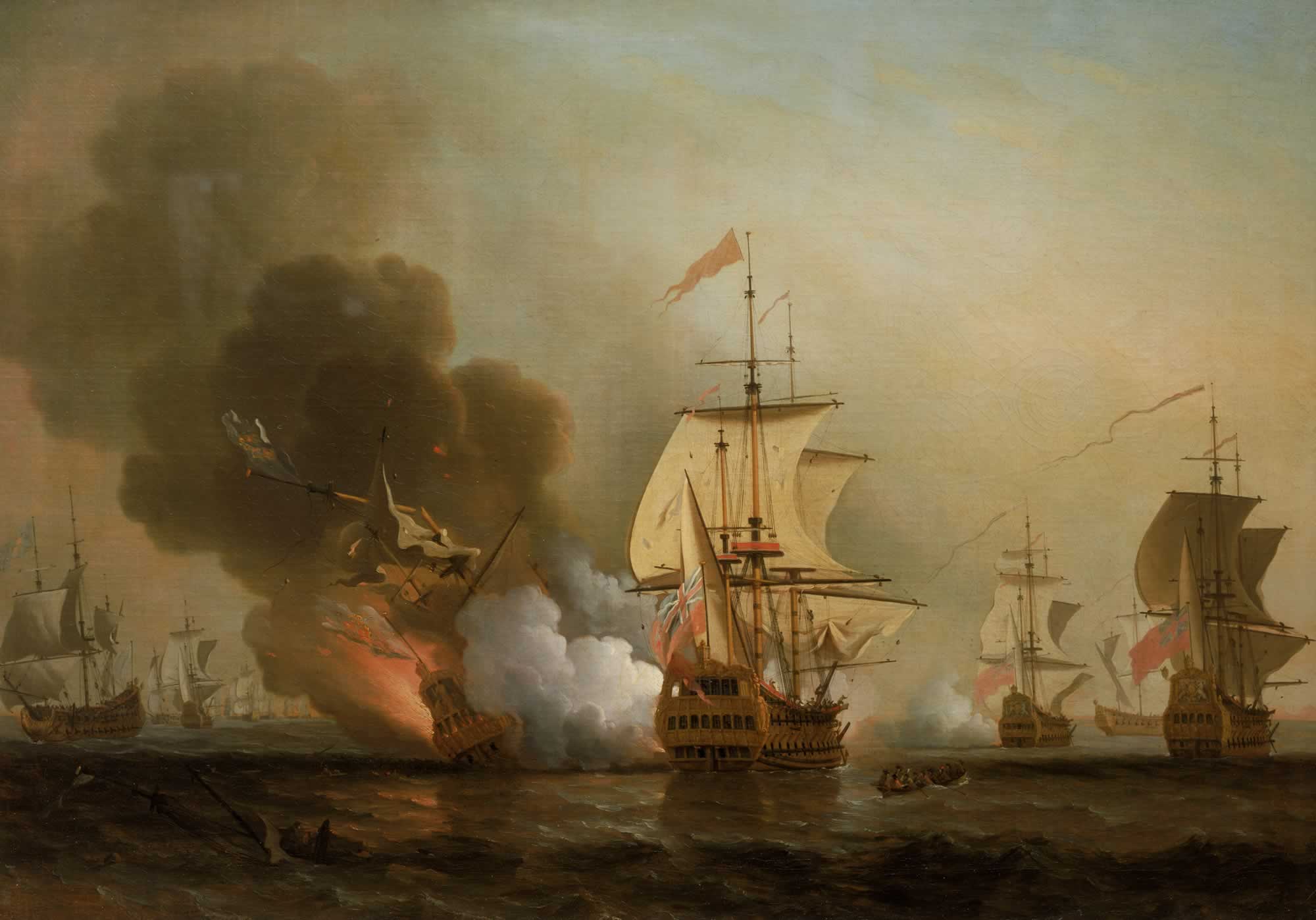
The San Jose (center-left) being blown to pieces by British cannonfire during the War of the Spanish Succession.

Three Spanish ships were destroyed in the engagement. One of them was the San Jose. It sank with hundreds of of gold and silver coins on board, as well as several pounds of jewels (mostly emeralds). It was discovered a few years ago, and as of 2017, salvage-operations are underway to retrieve the wreck’s vast fortune (calculated at being $17,000,000,000 – or $17 BILLION in American dollars, as of 2018).

So, that covers treasure lost in shipwrecks and to enemy action on the high seas, but were Pieces of Eight ever handled and used by actual, real-life pirates?

Absolutely.

Despite their ravenous, bloodthirsty image from popular culture such as television, films and books, pirates from the Golden Age of Piracy (roughly the 1620-1800) were surprisingly democratic and socially progressive creatures for ruthless, armed thugs. Surviving documents and books, written during the Golden Age of Piracy (largely during the late 1600s and early 1700s) state that pirates would vote and debate on almost anything and everything. To maintain order and efficiency and comfort at sea, pirate ships had lists of rules, and codes of conduct, which all pirates were expected to obey – and no, unlike in the ‘Pirates of the Caribbean’, they weren’t ‘more like guidelines’ – they were strictly adhered to!

One such regulation was the payment of health insurance! Pirates were entitled to a monetary payout (‘recompense’ as it says in the original documents) if they were injured in the course of a battle, but survived the engagement. Insurance levels varied, and depended on where you were injured, with different payouts stipulated for the loss of hands, arms, legs, fingers, or eyes.

So, how were these payments made? In Pieces of Eight, of course! And these could be very, very, VERY substantial payments. Loss of an eye was equal to 100 Pieces of Eight. Loss of an arm or leg could be up to 500 or 600 Pieces of Eight!

The Piece of Eight: The First Global Currency

Spain had colonies in Mexico, North America, South America, and the Far East. Spanish trade dominated the world from the late 1400s right up to the end of the 18th century. Because of this, the Piece of Eight was a coin that was used all over the world. Every continent permanently settled by mankind up to the start of the 19th century was touched by this coin in one way or another. It was the only coin which saw near-universal acceptance, being used as currency in Canada, America, Australia, Britain, much of South America and the Caribbean, Mexico, China, Africa and across Europe.

In America, the Piece of Eight was legal tender until 1857, when the first, truly American-made coins had been made in sufficient-enough quantities to replace it. In Australia, the Piece of Eight was legal tender until 1825. in China, the Piece of Eight was used as money up until roughly the time of the Opium Wars (1840s and 50s). In 1864, the Reale was finally retired as the Spanish unit of currency, to be replaced by the Peseta – the currency of Spain from 1869 until the country adopted the Euro, in 2001.

In China, merchants refused to trade with Europeans in anything except silver coinage. In this respect, the Piece of Eight was ideal as a system of currency. Its large size and high silver content made it highly attractive to the Chinese. But of course, the Chinese, not trusting these strange, white devils, would always test any silver coins given to them, before they accepted them as payment.

The 1779 dollar. Observe the areas circled in blue. The symbols hammered into the silver are chop marks made by Chinese merchants.

This was done by hammering a punch into the face of the coin to test its silver content, and also to mark that the coin had been independently assayed by a Chinese merchants to attest its authenticity. A coin with loads of chop-marks hammered all over it was taken to be a coin of proven silver-content, and was therefore acceptable for use as payment.

In Australia, the Piece of Eight was the nation’s first official currency after the island was colonised in the 1780s. Early in Australia’s history, rum, tobacco and other foodstuffs were used as barter, but when this became unsustainable, the governor of the day decided that foreign coins of known value would be appropriate for use as currency within the colony and a list of foreign coins was compiled. Only the coins on the list could be used as currency within Australia. These coins became known as Proclamation Coins, since they were the coins mentioned specifically in the proclamation from Government House.

The problem with these coins is that they could still be used OUTSIDE of Australia. This meant that loads of these coins were leaving the island on merchant ships which sailed to Australia to do trade with the colony. They sold their stuff to the colonists, who paid them in the valuable coinage, and then the sailors sailed off, leaving even fewer coins in the settlement.

To stop this, the next governor down the line decided that ONE type of coin would be used: The Spanish Silver Dollar or the Piece of Eight. He bought a whole heap of these coins (thousands of them) from Britain and had them shipped to Australia.

To make the coins worthless outside of Australia, he had them punched out. The larger ‘donut’ on the outside was called the “Holey Dollar” and the punched out nugget in the center became known as the ‘Dump’. The Holey Dollar was worth 5/- (five shillings), and the dump was worth 15d (fifteen pence).

In 1825, this practice was discontinued when a law was passed stipulating that ONLY British currency would be used within Australia. As a result, all the Holey Dollars and Dumps were swept up and tossed into the melter’s pot. Today, a Piece of Eight can be easily purchased online, although prices can vary wildly. By comparison, a Holey Dollar and Dump are worth THOUSANDS OF DOLLARS each, because so few of them survive today.

How Was a Piece of Eight Made?

The earliest Pieces of Eight were simply made by hacking off chunks of silver from cast bars (ingots) of silver, shaving them down until they were the prerequisite weight, and then punching the pre-carved designs (engraved into metal die-punches) into the coins, using a punch (like a stamp) and a hammer to apply the force. In this way, coins were quite literally ‘hand-struck’, and handmade, one after the other, piecemeal. Once one side of the coin had been struck, it was simply flipped over and the opposing die-punch was struck to the other side.

Coins such as these are called ‘cob’ coins and their crude methods of manufacture meant that they were often open to forgery. To have any faith in the money, even if it was solid gold or silver, merchants would routinely weigh coins to ensure that the cob in question was of the correct weight, since it wasn’t unknown for unscrupulous dealers to hack off the corners of silver coins and pass them off as whole ones, and then use the scavenged silver for something else (this practice was called ‘clipping’ the coin, since you clipped a bit off the edge each time).

The milled edges of the Pieces of Eight, an anti-clipping measure. The worn rim on the 1779 coin (left) explains why it’s a whole gram lighter than what a perfect coin would weigh.

By the 1700s, more advanced methods of coin-manufacture, similar to how coins are made today, started being devised, and anti-tampering measures such as decorated, milled edges started being introduced. With a milled or decorated edge to the coin, it was immediately obvious if it had been tampered with, thereby reducing the risk of someone wanting to ‘clip’ the coin for its silver-content.

Unless the Piece of Eight you own is EXTREMELY old (pre-1700s), it’s likely to be a milled coin rather than a cob coin.

The Anatomy of a Piece of Eight

By the 1700s, the general design of the Piece of Eight started becoming more or less standardised, with a few minor changes as the years progressed.

A typical Piece of Eight from the 1700s up through to the 1820s and 30s consisted of, on one side, the name of the reigning Spanish monarch of the day, the year of minting, and the Latin phrase “Dei Gratia” (“God’s Grace”, or “By the Grace of God”).

the other side of the coin had a crown at the top, and beneath that, a coat of arms. These consisted of castles and lion rampants set into the quarters, The Fleur de Lys of the House of Bourbon, in the middle, and beneath, a pomegranate. To either side are pillars, signifying the Pillars of Hercules, which corresponded to the Rock of Gibraltar (northern pillar) and the northwestern-most point of the African continent. Since antiquity, the Pillars of Hercules symbolised the entrance to the Mediterranean Sea.

For centuries, the Pillars of Hercules, guarding the entrance to the mighty Atlantic Ocean, were seen as the gateway to the unknown. What existed beyond them was pure conjecture. The Latin phrase “Non Plus Ultra” (“Nothing Further Beyond“) became widely associated with the pillars.

The Spanish coat of arms and the Pillars of Hercules on the coin.

This all changed in the 1490s when Christopher Columbus discovered the New World! Suddenly, there WAS something beyond the Pillars of Hercules, and with daring and tenacity, that something could be reached, colonised, explored, and exploited!

To this end, the old motto of “Non Plus Ultra” was changed to “Plus Ultra” (“Further Beyond“). It became the national motto of the Kingdom of Spain, and was added in swirling scrolls around the Pillars of Hercules on the Piece of Eight, to indicate that the wealth, power and influence of the Spanish started in Spain, and spread “Plus Ultra” – “Further Beyond” than the eyes of man could possibly see!

You will need an extremely powerful magnifying glass (and a Piece of Eight of the right vintage in good condition) but the microscopic letters are visible on the scrolls around the pillars.

Finally, around the coat of arms and the Pillars of Hercules are the words:

HISPAN. ET. IND. REX.” (“King of Spain and the Indies“), the mint-marks (in my case, an LM for Lima, and an M for Mexico City), the monetary designation of ‘8R‘ (8 Reales), and finally, the initials of the assay master overseeing production of the coins.

The Influence of the Piece of Eight

Not for nothing is the Piece of Eight, arguably the most famous coin in the world. The Chinese Yuan, the American Dollar, the Mexican Peso and countless other currencies around the world, all owe SOMETHING to the Piece of Eight. For example, when the Piece of Eight was finally pulled from circulation in the ‘States in 1857, its official replacement was the American Silver Dollar. This was a coin which was 38mm across, weighed 27g, and which was 90% solid silver.

Do those measurements sound familiar? They should – they’re the EXACT same ones used by the Piece of Eight, on which the silver dollar was based!

An American Silver Dollar (left, from 1891) next to the stack of Pieces of Eight (right). Observe the size. Not only that, they’re almost exactly the same thickness and weight. They’re also almost the same silver content.

The American system of quarters, nickels and dimes are also directly descended from the Piece of Eight. The idea of the Half Dollar and Quarter Dollar come from the original practice of quite literally – chopping up a Piece of Eight into halves, and quarters – and sometimes – even eighths! You could literally have an eighth of a Piece of Eight! These cut up silver coins were part of the basis of loose change today.

If you want more proof that the Piece of Eight is indeed, the most famous and influential coin in the world, then have you ever considered the dollar-sign? You know. This thing: “$”.

Look closely at a Piece of Eight. Here…

Notice the scrolls wrapped around the pillars of Hercules? See anything familiar there? The scrolls around the pillars was what led to the symbol for the dollar – the S with the two lines through it. Such is the influence of the Piece of Eight that MILLIONS of people use that symbol every day without even realising where it comes from.

Fake Reales – How to Tell Fake Coins from Real Coins

I openly admit to being a novice and casual coin-collector. I’ve only been doing this for two or three years at most. I like collecting coins with some sort of historical significance, either personal, or global. It was for this reason that I was attracted to seeking out Spanish Reale coins. The problem is, reales are (or can be) very expensive. Very, very, VERY expensive. Prices of $2,000-$3,000+, isn’t unheard of, for exceptionally rare or old examples. That’s why when I saw the price for this coin (which was far, far, FAR less than $2,000), I immediately became both interested, and wary of it.

So, if something seems too good to be true, and you want to make sure it IS true, how do you safeguard yourself against buying a dud coin?

There are a few quick-and-dirty ways.

Magnet Test

The first and easiest way to figure out if a coin is fake is to do a magnet-test. A steel coin purporting to be silver will snap to a magnet like flies to a cowpat. By comparison, a silver coin will not (or will not as readily) stick to a magnet. Some might, due to impurities in the metal, but it should be a slow or weak adherence.

A pair of rare-earth magnets (which are EXTREMELY POWERFUL) will do the trick. Easily purchased at your local car-supplies, or boating/fishing stores. BE SURE TO STORE THESE MAGNETS CAREFULLY – do NOT put them near electronics, mechanical watches, computers, phones or anything else like that – the extremely powerful magnetic field will damage them. Store them somewhere far away from other items, ideally in a padded cardboard or wooden box.

However, super-powerful magnets alone are not enough. You can get coins which are made of cheap, silver-like alloys (nickel-silver, for example) which will react the same way as real coins. So, what else can you do?

Weight and See!

The next test is to weigh the coin. A small (but highly-accurate) digital pocket jeweler’s scale costs very little. A few tens of dollars at your local jewelry-supply shop (where I bought mine) or online. Take it with you if you go bargain-hunting or antiquing regularly. Of course, for this to work – you need to know what the coin is SUPPOSED to weigh, in the first place. Perhaps keep a note of the coins you’re after, and their correct weights (easily found online from numismatic websites) with the scale for when you take it out with you. Then, simply weigh the coin. A coin which is SIGNIFICANTLY over-or-underweight is likely to be a fake. A coin which is exactly the correct weight, or slightly under (within one gram) is likely to be real.

For example, a Spanish Piece of Eight weighs 27.07g. That’s if you can find a PERFECT one. Very few Spanish reales are perfect. That being the case, expect SOME loss in weight. Instead of 27.07, it might be 27.00. Or 26.3, or 26.7, or 26.5, or 26.25. Unless the coin is missing a LOT of metal, it shouldn’t ever dip down into the 25g-range. If it does, approach with caution.

Unless you are absolutely certain that you can spot a fake – stay well away from any suspect coins like that. A fake Piece of Eight will weigh significantly less than 27, or even 26 grams. They can drop all the way down to 22, 25, 23 grams, etc. Any coin registering that sort of weight is a HUGE red-flag. Put it down, and walk away slowly.

Wear and Tear

Last but not least, check the physical condition of a coin. Any coin that is too perfect or too imperfect may be suspect. The exceptions to this are if the coin is really, really old, or if it’s shipwreck-salvage (yes, you can buy shipwreck coins, and it’s perfectly legal to do so). A genuine antique coin will have genuine antique wear and flaws and damage on it. Rubbed lettering, faded imagery, dents, cracks, dings – in some cases, they’ll even have chunks taken out of them. Some will have their corners or edges completely rubbed-off from decades and centuries of handling. Details like shields, facial-features like eyes, noses, mouths, hair, clothing, lettering, etc, should all show even wear. Milling or edge-decorations should show consistency.

While antique coins were handmade (or made with crude machinery) they nonetheless had to be perfect – or as near-perfect as the assayer and mint could make them. That being the case, any obvious flaws (like half the date falling off the bottom of the coin, when you can clearly see the edge-milling being intact) should serve as red flags for fake coins.

On the Edge

Another way to check whether a coin is fake or not, is to check the edging around the coin’s rim. A Piece of Eight has very distinctive circle-and-square patterning around its edge. This edging – properly called milling – was invented centuries ago as an anti-fraud device. By decorating the edges of coins, it became possible to see whether the coin had been defaced or cut up or been the victim of ‘clipping’ (where minute fragments of the coin’s precious silver had been scraped or filed off).

Fake Spanish dollars will sometimes (but not always) have markedly fake milling around the sides. If you ever see a Spanish dollar with modern corrugated milling on it – run away! Because they never did them like that! Ever!

Fine Details

Another way to figure out if a coin is fake is to compare it against a real coin. Obviously this isn’t always possible to do, but there are certain things you can look out for. Check things like character-spacing and sizing in letters, evenness of stamping, the crispness or clarity of the imagery used on the coin, and the fineness of the edges and rims.

Fake coins won’t bother with things like creases in robes, curls or strands of hair, detail to eyes and mouths on faces, and things like that. Some do, but most fraudsters are just banking on the fact that someone will be too excited by the prospect of getting a rare or famous coin, and will buy the coin too fast to examine it properly, allowing the forger to make a quick buck on a scam. Take as much time as you need to look at suspect coins.

The End of an Era

The Piece of Eight, the coin that ruled the world for three and a half CENTURIES finally came to an end in the 1860s, when in 1869, the Spanish Peseta replaced it as Spain’s official currency. By this point in time the Piece of Eight was already being phased out in other countries around the world anyway, and within a few years, its use had ended completely.

The coin was taken out of circulation and a piece of silver that once ruled the world and had circumnavigated it countless times and had visited every continent permanently settled by man, was suddenly made obsolete, to survive now only in antiques shops, private collections and in the fantasy of books, films and pirate lore…


Art Nouveau Copper Tray (Joseph Sankeys & Sons, ca. 1900).

Sometimes when you buy things at the flea-market, they can be the ugliest, most degraded, scandalising pieces of junk in the world…

This distinctly unattractive footed copper tray with the up-curving, rectangular brass handles, was for sale at one of the regular stalls. It was so tarnished and grimy that most people just walked right past it. It almost melted into the dark table-cloth around it, so it likely just sat there, unloved and sight-unseen for half the morning. In fact, when I came across it, it was so dirty that you couldn’t even tell how old it was!

It was only when I flipped the tray over to see the reverse of the pattern punched into the metal that I realised what style it was made in, and therefore, approximately how old it was. I bought it on the spot for next to nothing, and once I got home, I started the very, very arduous process of cleaning it. As you can see, there was a lot of grime on top of that beautiful patterning underneath…

I freely admit that when I was younger, Art Nouveau antiques were not to my taste. I found them too flowery and garish and over-the-top. But, as I’ve gotten older, I have come to appreciate their flowing, curving, naturalistic lines, something not found in my favourite style of design – Art Deco, which flourished from the 1920s to the 1950s.

By comparison, Art Nouveau – what came before Deco – emphasized natural forms and lines rather than the more rigid curves and angles of Deco, taking inspiration from nature and the outdoors, insects and plant-life. Popular in the dying decade of the 1800s and the first ten or twenty years of the 20th century, Art Nouveau was at its height in the early 1900s. Eventually, the scrolls, flowers, curves, loops and angles all started to look cluttered and old-fashioned, and a cleaner, simpler look, in the form of Art Deco, started taking its place by the early 20s.

One of the reasons that I kind of disliked Art Nouveau is that it was very much ‘of its time’. A piece of Deco-styled homewares, electronics, furniture, a building, an interior, etc…is pretty timeless. The clean, simple, minimalist lines translate well into modern living.

By comparison, I’ve always found that Art Nouveau styling was far too reminiscent of the Victorian obsession with over-decorating EVERYTHING. And this sort of rigidity in that Art Nouveau was so firmly rooted in turn-of-the-century styling was what sort of put me off. But at the same time, the fact that it’s so easily identifiable does lend to its charm. It adds an instantly-recognisable dash of Edwardian elegance to a collection without looking excessively overwrought.

Anyway, back to the tray.

It’s honestly not that large. It measures 8 by 14 inches, and sits on six little ball feet. It has two curving, rectangular handles and a raised edge. Apart from extensive polishing, the only other thing I had to do with it was a couple of well-placed, padded hammer-strikes, to balance out the feet and stop the damn thing from wobbling on a flat surface.

Here’s the tray, more or less completed. I still have a bit of minor polishing to do on the underside and the edges as you can see, but apart from that, it figured it was made-up enough to be ready for its closeup-shots.

One final shot, showing off the main decorations, and one of the handles, simple as it is…


Russian Silver Beaker (Moscow, 1850).

I think if you’re going to try and make it as an antiques dealer – even if it’s a small side-business or hobby that you do between other things, it’s good to hunt down, collect and keep the occasional trinket for yourself. A silent reminder to enjoy the things that you can come across while out hunting for stuff.

One example of this was something I picked up recently, a beautiful solid silver Russian pedestal beaker…

I’m not sure who the maker is, but this gorgeous piece of silver was manufactured in Moscow in the early 1850s, with a zolotnik mark of ’84’ on the rim (more about that, later). It’s comprised of two parts: The body, and the base, which are curved and circular in form, and soldered together at the neck. After buying it, I had a quick peek online to see what these things generally go for…and I think I got a pretty decent bargain, considering! Hahaha…Aaaaanyway…

The Russian Beaker

Let us begin at the beginning. This is a Russian silver – BEAKER. A beaker is different from a MUG in that beakers do not have handles. It’s called a pedestal beaker because it’s mounted on a pedestal, base, or foot. Not on a STEM, like a goblet, which is similar, but longer and thinner in shape.

How Was It Made?

Like most silverware, this piece was likely made using a series of hammers in a shaping process known as ‘raising’. Basically, you start out with a flat disc of silver (a ‘sheet’ as it’s called); you trace a circle on it, make a dent in the middle, to mark the center, and from the center, you work out and up, beating the sheet with a hammer in a series of concentric rings.

As you beat the silver, the metal stretches and forms, rising up as it’s manipulated by all the hammer-dents (hence ‘raising’ the silver). This builds up the sides of the cup. As the process continues, the silver would be heated (annealed) to soften it and remove brittleness. Failure to anneal the silver would mean that the constant beating would compact and harden the metal, making it brittle.

Eventually, the basic shape of the cup would be complete. A similar process would’ve been used to create the base. Once the two pieces had been made, they would’ve been planished and then burnished (smoothed out and polished), possibly on a lathe, to get uniformity of shape.

Once that was completed, the two parts would’ve been decorated – separately – before being soldered together.

The decoration on this piece is all hand-engraving. It is extremely intricate, but not exactly the best of quality – there are a variety of inconsistencies here and there around the body of the beaker. There are places where the decorations are uneven, or lines cross or cut into other decorations by accident.

Because of these inconsistencies, I suspect that this beaker was likely a practice-piece, made by an apprentice (student) silversmith, or a journeyman silversmith, who had graduated his apprenticeship but was still new to the craft, and who was attempting to show off what he had learned.

Whoever made it (the maker’s mark is unknown), the smith obviously felt that it was of sufficient quality to put on sale, because the beaker, warts-and-all, was sent off to be assayed!

Russian Hallmarks

By the 1800s, like with most other countries around Europe, Russia had established a solid system of hallmarking – the testing and certification of silverwares prior to their entrance onto the commercial market – a necessary middleman step to weed out any fraudsters and con-artists from cheating unsuspecting customers.

As with almost every other European country, the hallmarks followed a specific system: There was the place of assay, the date of assay, the purity of the silver, and the maker’s mark. This beaker includes a fifth mark, which is the mark of the Assay-Master – the name (or in this case, the initials) of the big-cheese who ran the office to which the beaker had been sent for assay.

In this case, the marks are:

[A.K.] [185-] [84] [Image of St. George and the Dragon] [Maker’s Mark in Cyrillic letters]

The hallmarks on the rim of the beaker. The fact that they’re uneven tells me that the beaker was hand-marked, using a hammer, a supporting-block, and a series of steel punches.

The A.K. stands for Andrey Anatovich Kovalsky, who was master of assay at the Moscow Assay Office until he left the post in 1856. The next mark is the ‘185-‘. This is the year of assay. I left the last number off because it’s not clear. But it still dates the beaker to a very narrow window – 1850 to 1856.

The next mark is ’84’. You would think that ’84’ is the purity – as in – 84%.

Well…yes…and no.

84 is actually the zolotniki.

“…the what?” I hear you ask.

The ‘zolotnik’ (plural ‘zolotniki’) was a Russian measurement of weight, which came from a 12th century gold coin – the zolotnik. Although the coin went out of circulation centuries ago, its name was repurposed in the 1700s for the national hallmarking of silver. There were four grades of zolotnik, starting at 96, then 90, 84, and 62 zolotniks (62 was later replaced by 72, which was replaced less than a century later, by 84, which remained the national lower-limit up to the time of the Revolution in 1917).

96 zolotniki = 100% pure silver.

90 zolotniki = 93.7% silver.

84 zolotniki = 87.5% silver.

So the mark of ’84’ on the beaker represents 87.5% silver purity.

The next mark is that of St. George slaying the dragon – a famous story from European folklore. This is the coat of arms for the City of Moscow, signifying where the piece was hallmarked.

The final mark, as with British silverware of the same era, is the maker’s mark, which was usually the maker’s initials. In this case, it’s his initials in Cyrillic (Russian) lettering. Unfortunately I don’t read Cyrillic script, and information on Russian maker’s marks can be very hard to find. We may never know who made this piece.

Closing Remarks

So is a beaker like this a rare piece? Yes and no. As a possible apprentice piece – probably. Russian silver is fairly rare, but not THAT rare. You can find it and you can definitely collect it. Although I imagine that pre-revolution pieces tend to fetch a premium.

Is it a piece of first-order manufacture? I don’t think so. I have seen other pieces online which looked even more lovely than this (and I think that’s pretty hard to beat!), but that said – the prices on those were hundreds, even thousands, of dollars more than what I paid, so I’m happy to have it! I think it’s beautiful, different and certainly unique!


A German Stockman – Restoring a Vintage Pocketknife!

I got interested in pocketknives when I was in university. I found that I was doing a lot more cutting than I did previous to that point in my life. Cutting open food-containers, cutting open boxes, slicing paper, cutting open wrappers and plastic packaging, cutting tags…all kinds of things. And I often found myself in a situation where I needed a pocketknife, but didn’t have one. And after this happened more than a couple of times, I decided that the time was right for me to actually go out and find a nice knife.

Well, that was about ten years ago, and since then, I’ve gained a minor appreciation for antique and vintage pocketknives. I wouldn’t say that I’m an active collector of pocketknives, but I know what I like, and I sometimes go hunting for them at flea-markets and antiques fairs, and if I see something nice for a good price, I buy it. Depending on how practical the knife is, or how interesting or different it is, I may either add it to my small collection, or sell it after I’ve finished tinkering with it.

My current, modest knife collection. The largest knife is four inches from bolster to bolster.

That said, I don’t have a large collection of pocketknives. Maybe three or four small ones? I used to have loads more – at my max, about eight or nine, but I sold the vast majority of them simply because I tend to be a USER more than a COLLECTOR. I don’t like owning things that I don’t use, and so because of that I sold almost all of them, except ones which I really, really liked.

I have three little pen-knives with mother-of-pearl and ivory scales (if you’re a regular follower of this blog, you might remember I did a posting about a couple of those a few months back), and I used to have four or five others – which I gradually sold over time as I found better knives to replace them.

As of the writing of this particular post, I just sold another knife (a two-bladed English Barlow-pattern) online to trim down the collection a bit.

But that’s not what this posting is about. This posting is about the knife I found, which replaced that English Barlow!

…and there it is!

The German Stockman

I bought this knife about two weeks ago for a couple of tens of dollars. I don’t exactly blow the bank when it comes to buying pocketknives, and this is probably the most I’ve ever spent on a knife in my life! It’s a three-bladed slip-joint folding pocketknife, of a style known as the ‘stockman’, so-called because this design was originally meant for use by farmers, cowboys, drovers, shepherds and livestock managers. The three blades were meant to accomplish different tasks when it came to looking after livestock (I’ll get into that later on down the line…).

I liked the knife because it was a nice, medium-sized knife with blades of decent length and thickness, and it had the sort of simple, clean look that I generally go for in things that I like to use on an everyday basis. The three blades gave me options, and the black scales were elegant without being flashy.

How Do You Know it’s from Germany?

I’m not entirely sure what company made the knife, but it comes from Solingen, Germany. This much I do know, because it’s stamped on the shank of the blade. And as the ShamWow guy says: “You know the Germans always make good stuff!”

They sure do! After all, not for nothing has Solingen been the cutlery capital of Europe for the better part of…what? Five hundred, six hundred years? The cutlery trade in Solingen dates back, quite literally – to Medieval times.

They still make surgical blades, razors, scissors, kitchen-knives and cutlery and pocketknives there today! Famous companies like DOVO (straight razors), Wusthof (kitchen knives), and Boker (more razors), are all based in Solingen. The city was originally home to a famous guild of swordsmiths back in the Middle Ages. If you’re collecting antique straight-razors or pocketknives, you can generally rest assured that any knife with ‘SOLINGEN’ stamped onto the blade is worth the money spent to get it. After all – 700-odd years worth of knife-making has to count for something, right?

I don’t know how old the knife is, exactly, but my guess is that it’s from the early 20th century, most likely before WWII. That being the case, I doubt this knife is more than about 80 or 90 years old.

The Anatomy of a Pocketknife

The classic, slip-joint, folding pocketknife comes with about half a dozen different components. So  you can follow what I’m going to write later on in this post, here’s a breakdown…

The Blades

A knife obviously starts with the blade. Most slipjoint knives have at least two blades. Some only have one, most will have two or three. Some models made by other manufacturers (such as Victorinox in Switzerland) have knives which have loads of blades and accessories folded away. But for the basic knife, one, two, or three blades – sometimes four – is standard.

A slipjoint pocketknife will have blades that have ‘nail-nicks’ cut into them. These are the little grooves that run under the spine of the blade, so that you can actually pull the blade out of the knife-handle.

The Handle

The handle of the knife is made up of about four or five different components, they are…

The Bolsters

The bolsters are the end-pieces on the ends of the knife, usually made of nickel-silver, steel, or brass.

The Liners

The liners are flat strips of metal inside the knife. They’re usually made of brass, to prevent rusting. The liners serve as washers to reduce friction between the moving parts of the knife. There is a liner between each blade, and the exterior of the knife.

The Back-Spring

The spring is the flat, flexible steel lever or leaf-spring on the knife that holds the blades open, or shut. It flexes up and down as the blades are opened and closed. The tension on this spring is what stops the blades from flopping around.

The Pins/Rivets

Knives have pins or rivets punched through them. These are here to serve as pivots or hinges for the blades, and to hold the handle components (spring, liners, blades etc) together.

The Scales

Last but not least, you have the scales. Not all pocketknives have scales. Some do, some don’t. Their purpose is to protect the liners and the rivets and other components of the knife from damage, although these days, scales are largely there for decorative purposes. Scales can be made from almost anything – celluloid, wood, bone, ivory, mother-of-pearl, tortoise-shell, and even solid silver…are very common on antique and vintage knives.

Different Knife Models

Pocketknives come in various styles and types. While these days there are loads of different variations – when you’re looking at vintage and antique knives, you’ll largely come across a set group of basic designs, although these are by NO MEANS the only types out there, and there are countless variations. Here are just three or four of the really common ones…

The Stockman.

The three blades of the stockman, from left to right: Spey, Sheep’s Foot, and Clip.

The stockman is the knife-type which I’m building this posting about. Used by livestock cowboys, farmers and shepherds in the past – hence the name. The stockman is a three-blade folding knife, typically consisting of a clip, sheepsfoot, and spey blade. They range in size from a couple of inches to four or five inches long (the one I have is four inches, closed up).

The Barlow

My old Barlow knife which the stockman has now replaced! As you can see, I like simple, clean styling.

One of the OLDEST knives around, the ‘Barlow’ style pocket-knife has two blades at one end, one long all-purpose blade, and one shorter blade, usually for cutting pen-points for quills, and sharpening pencils. Barlows go back for CENTURIES and their use is dated all the way back to the 1600s.

The Trapper!

The trapper knife comes from the knives originally used by fur-trappers back in the 1700s and 1800s. Trapper knives have two blades on one end of the handle, and the blades are long and equal-length, used for killing and skinning animals for their fur pelts.

The Canoe.

The canoe-knife is exactly what it sounds like – a knife shaped like a canoe! It’s a smaller knife, with two blades, one on each end of the handle. The body of the knife is cigar-shaped, but with a dip in the middle on one side, and curved edges at the ends, giving it the general appearance of an American Indian canoe, hence the name.

There are loads of other knife-styles out there, but these are four of the most common ones that you’re likely to find at flea-markets, antiques shops, auction-houses, etc.

Restoring Your Pocket Knife!

Keep in mind that not ALL knives can be restored. Some can, some can’t. Some are just too far gone, too broken, rusted or damaged to be repaired or revived. Here, I’ll be walking you through what I do to all the knives that I’ve ever bought, fixed and sold, or kept and used.

If you have the tools and equipment, you can literally pull a knife to pieces and clean it that way, but I’m working with the assumption that you, like me, probably don’t have most of those things, and that you’ll be cleaning and restoring your knife WITHOUT pulling it apart. Based on that assumption, let’s begin!

So, you found a really sweet pocketknife at the flea-market, or in an antiques shop, that you really love! It’s just the right size, or perhaps it’s the style or shape, or the scale-material, or maybe it’s manufactured by the same folks who made the one that grandpa gave you…which you lost as a teenager…However it happens, you found a knife! Only…it’s not in the best condition. It’s not completely dead, but it’s a bit rusty, it’s really stiff and crudded up, and it couldn’t slice melted butter. So, what do you do?

Rust-Removal.

For me, the first step is always rust removal. To do this, you need sandpaper. Get fine or ultrafine sandpaper, and a lubricant (Brasso, or sewing machine oil are generally good). Rub the lubricant over the rusty areas (usually the blades, hilts and back-springs) and start rubbing the sandpaper over it. Start coarse, and work to fine, then ultrafine. If you want to, you can also use 0000-grade ultrafine steel wool for the really soft, last cleaning. The aim is to remove the rust, and polish the blade at the same time.

If the back-springs on the knife are really rusty, then if it’s on the outside – just run the knife back and forth across your chosen polishing-abrasive to remove the rust, with oil as a lubricant. If it’s INSIDE, then you can use a popsicle stick with some really fine steel wool, or sandpaper, to try and sand out the rust on the inside of the spring between the brass liners.

This should remove most of the surface-rust on your knife, while also polishing the blade. Keep in mind that almost all antique pocketknives have CARBON STEEL BLADES. These things rust if you even sneeze at them wrong, so having restored the shine on the blade, or at least, having removed the rust – keep the blades DRY when not in use, to prevent rusting, and clean them immediately after any use involving moisture. A single drop of water is all it takes to get rust growing on these antique blades.

Cleaning Out the Guts!

Antique knives are often CLOGGED with crud! Dust, grit, pocket-lint, hair and all other kinds of CRAP usually ends up jammed up inside these things. To clean it out, open the knife entirely, and using a needle, pin, or other suitable long, thin, sharp object – clean out the grooves and gullies between the washers, the springs and the blades. This can take a while.

Cleaning under the Scales.

On the vast majority of antique pocket-knives, scales are simply riveted or pinned onto the outside of the knife and are largely decorative in purpose. But that’s no reason why they shouldn’t look nice! Loads of gunk and crud can EASILY get BEHIND the scales, between the back of the scales, and the brass liners that make the body of the knife-handle. One way to clean this crud out is to use a pin or needle.

Only do this if you can actually get the needle into the gap between the liner and the scales. If you can, simply stick the needle in and wiggle it around from side to side, up and down, back and forth. This will scrape up all the crap that’s accumulated inside there over the course of DECADES, and sweep it out when you remove the needle.

Don’t be afraid if the scales suddenly POP UP! or even worse – drop off! This is nothing to be worried about. If the scales DO fall off, simply clean them (and the liners) as best as you can (either with tissues, water, oil, or a polishing compound) and them simply pop them back on, over the same rivets that held them in, in the first place. You may need to tap the scales back on to pop them back into place. If the scales are loose – apply some glue to them (or the liners) before reattaching the scales, then simply apply pressure to ensure proper adhesion, wiping away any glue that pops out the sides.

Voila! Nice, clean scales.

Lubricating and Cleaning the Pivots and Springs

When it comes to cleaning and restoring antique or vintage folding pocketknives, this is, almost without a doubt, the one part of the restoration that can take ages. Hours. Days. Even WEEKS, if you want to do it properly!

Loads of gunk builds up inside these knives, just from decades of use, and dust and crud and lint and grime getting into the mechanisms. This can make the knives very, very, VERY stiff. This makes them hard to open, hard to close, the blades pull on your fingernails, they’re painful to use, and even worse – you could CUT yourself if the knife suddenly springs open when you’re fighting with it!

So, how to fix this?

To do this, you’ll need three or four things:

  • A bottle of sewing machine oil (you could use WD-40 as well, but you’ll be using a LOT of lubricant, and WD-40 STINKS after long use, so…it’s not my first choice…)
  • Fine and Ultrafine Sandpaper.
  • Loads of tissue paper or toilet paper, or paper-towels.
  • Cotton-buds/Q-Tips.
  • A needle or pin (optional).

So long as it’s not physically broken or damaged in some way, the main reason why the blades on your folding, antique pocketknife jam, jar and won’t open or close smoothly, is because the knife is DIRTY. REALLY, REALLY, REALLY DIRTY. To have a knife that opens and closes smoothly – this DIRT needs to be REMOVED. Dirt causes FRICTION. That’s why your damn knife ain’t workin’ properly! Capiche?

“Can’t you just…I dunno…LUBRICATE IT with OIL?”

…Yeah. But what happens when the oil dries up? You’re right back to square one. To do it properly, the gunk has to be REMOVED.

“Yeah but I don’t have any way of pulling the knife apart. How do I remove this stuff?”

Fear not, young grasshopper!

What you’re gonna do is flood the knife with oil. Then, once the knife pivots and springs are full of oil, you’re going to open and close the blades several times. This wiggling and movement spreads the oil around inside the knife, inside the pivots and springs and hinges, between the blades and liners. It also dislodges any of the crud and gunk trapped inside.

Once you’ve done that – get a paper towel or tissues or whatever – folded up a couple of times, to make an absorbent pad. Place it on a flat surface like a tabletop.

Now, put the knife, spring-side DOWN (blades facing upwards), on top of the paper. Applying as much pressure as you can – rub the knife HARD, back and forth lengthwise across the tissue-paper.

I’ll pause here for a minute, while you recoil in disgust, at the black, oily, gunky brown crud that comes seeping out of your knife…

“But my knife ain’t that dirty!”. Wanna bet? This is what about ten minutes’ cleaning of the back-springs and liners on the stockman, looks like. The black, grimy streaks is all the crud and gunk trapped inside the knife, that the oil managed to dislodge and flush out! You wonder why your knife keeps jamming? THIS IS WHY!!

See all that stuff? That’s what’s inside your knife. That’s the grunk you’re trying to get rid of. That is the stuff that’s causing your knife to jam. Remember that the oil is transparent – so anything that comes out of the knife that is NOT transparent – is grime that’s causing the knife to jam.

Repeat this process as often as you must, until the oil that seeps out onto the tissue-paper is clear and transparent (or as close to transparent as you can get it). That means that the crud between the springs and pivots has finally been removed.

If you have an ultrasonic cleaner – pop the knife in there every now and then, to flush out even MORE gunk. Just remember to DRY it really well once you fish it out of the water.

Finally – you can use sandpaper to sand down the shanks and springs when they’re exposed, to remove any surface-rust or grime, to improve the action of the knife.

To achieve results this way, it can take days, even weeks, before all the crud is removed, but once it is, your knife will open and shut as smoothly as if it were new. No more stopping, jerking, tugging, breaking finger-nails, or risking slicing your fingers off, when opening your knives, ever again! If you haven’t achieved the results you want, that means that the knife is, in all likelihood, still clogged with grime. Keep going and don’t give up on it!

Also, it’s good to repeat this process every now and then (like every few months, if you use the knife regularly) to stop gunk from building up and jamming the blades again. Finally, once the knife is opening and closing nice and smoothly, lubricate the pivots and springs with one last drop of oil, and wipe it down to clean it.

Sharpening the Blades

The final step in restoring your antique or vintage knife, is sharpening the blades! For this, you’ll need a bucket of water, two or three high-quality sharpening stones, a sink, and a towel or tissue-paper. I always recommend leaving the sharpening of your knife to the VERY END. This prevents accidental cuts during the polishing, rust-removal and lubrication stages.

Soak your sharpening stones in your bucket of water for as long as possible (overnight or longer is best) until they’re nice and wet and have soaked up the water (high quality stones are often quite porous). Then rest them on a flat surface (kitchen counter or similar) and start sharpening.

Open one blade at a time, from your knife, and rest it on the flat surface of the stone, raised slightly on the spine, and so that the edge of the blade just kisses the stone. Slide the blade back and forth along the stone, in a wide, oval or figure-eight pattern, adjusting the angle and position of the blade as you go, to sharpen its entire length, including any curves in the blade. Do this as fast as you can without damaging the blade, at least twenty times. Flip the blade over and repeat the process on the other side. If done properly, the blade will slide smoothly along the stone. If it jars or scrapes, then you’ve got the wrong angle!

Once you’ve done twenty or more strokes for each side, remove the blade, wash or wipe it down with the tissues or towel, and then start on the next blade. It can take a while to sharpen a blade successfully (especially if it’s curved) but patience will yield results!

Closing Remarks

Anyway, that just about does it for me. Hopefully these instructions were useful to you in reviving that old pocketknife you found lying around somewhere, and has restored it to being a useful tool yet again! Tinkering with stuff like this is lots of fun and it stops otherwise useful things from being discarded and tossed out. Which in the case of this knife, would’ve been a real shame…


Antique Shagreen Leather Wallet (London, 1915).

If you’re anything like me, you probably use your wallet for lots of things. Holding coins, holding cards, holding receipts, holding cash, putting little notes and reminders inside it…and it gets crammed into every pocket, bag, jacket and coat that you’ve ever owned. To say nothing of being dropped, bent, twisted, sat on…and if you’re a real klutz, it might have spent some time rolling around in the washing-machine.

However you treat your wallet, one thing is fairly certain – that you will have many wallets throughout your life. Bifolds, trifolds, ones with clasps, clips, zippers, straps, buckles…even chains! But of all the wallets you’ve ever handled, I’m fairly sure you’ll have never seen one that looks like this…

Antique wallet. London, 1915.

Made of black shagreen leather and with silver mounts to protect the edges, this antique trifold wallet from the second decade of the 1900s, and from the time of the First World War was a flea-market find like almost no-other. Considering that it’s over 100 years old, it’s in absolutely fantastic antique condition. There’s absolutely no damage on it at all, apart from a bit of rub-wear on the leather.

How Do You Know It’s from 1915?

I know, because of the hallmarks stamped on the silver corner-mountings, which protect the leather from damage. They bear London silver hallmarks for 1915. And even without the markings there, a wallet of this style and this configuration was extremely common in the early 20th century. This particular design was popular in the 1890s up to around the 1930s or 40s. This was a time when what people carried in their wallets differed greatly from what we carry today.

The three little slots at the top of the pocket are for holding postage-stamps (left and right), and a ticket-stub (for a streetcar or train) in the middle.

While some things did not change – receipts, cash and perhaps a few coins, other things were very different. For example – how many people keep ticket-stubs in their wallets? Or postage-stamps? Calling-cards? Notebooks and pencils? These differences, caused by the fact that 100 years ago, we were much more a cash-based society, influenced wallet design, and what people would put into them.

How Does it Differ from Modern Wallets?

Well, it has compartments and features that most modern wallets wouldn’t have. A ticket-pocket, pockets for stamps, pockets for calling-cards, and pockets for various denominations of cash, which, when this wallet was made, would’ve been various pound and shilling notes. On top of that, it has an in-built pencil slot, and a matching notebook for taking down notes, reminders and details – another feature not normally found on modern wallets.

One of the protective, hallmarked silver corner-tabs.

Last but not least are the silver mounts, and the silver-plated spring-clasp. These days, wallets are far more utilitarian, and are unlikely to have such decorations, and snap-buttons, tabs and zips, or simple folding-wallets, are far more common and one might daresay, practical, in the 21st century.

Are Wallets Like this Rare?

The (removable) pocketbook, and the original pencil from 1915.

Honestly? Not really. You do see them from time to time in antiques shops and flea-markets. I have seen them made of crocodile skin, leather, shagreen, and mounted in nickel, silver (like this one) and even solid gold. So are they rare? Not especially. But they ARE rare in this condition. After all, who treats their day-to-day wallet with the expectation that someone will buy it secondhand in 100 years’ time?

Interior pockets for cards, cash, receipts etc.

The fact that this thing is basically in ready-to-use condition shows that it has barely ever been used, if at all. Something like that obviously affects its price greatly, and of course, its desirably on the antiques market. In fact I actually sold this wallet while writing this article, after barely advertising it for longer than half a day. Proof that good quality antiques will always find a home somewhere, if you know how to buy them, and how to sell them.


Turn-of-the-Century Writing Case (Ca. 1905)

Sometimes, you just get lucky.

I picked up this beautiful turn-of-the-century writing case in an antiques shop earlier this week. Considering that these things usually sell for insane amounts of money, I was pleasantly surprised to see that the price was actually pretty reasonable…even moreso with a discount! There was nothing seriously wrong with it, apart from needing a cleaning, dusting, and a new key. I already had the inkwells that would need to be fitted into it to make it complete, but the next step was to replace the key which would operate the lock.

The Box in Question…

The box itself was of a design that was common during the second half of the 1800s, with an attached writing-slope, a cavity for documents, and a pop-up compartment that served as an organiser and stationery-caddy. The writing-surface has an in-built desk-blotter with tabs to hold down replaceable sheets of blotting paper. The box comes with two cavities for inkwells, and a removable pen-tray for holding pens, pencils and other accessories.

The box was covered in an unusual type of leather. While it is common for these boxes to be covered in leather, I’d never seen one in this sort of tan-orange colour before, and never with faux-crocodile on it. Most of the ones I’ve seen were plain black, sometimes with minor patterning, but nothing this elaborate. The striped interior of the box was also something new and different, and that was what compelled me to buy it (that, and the price!).

Cutting the Key

The only thing really missing from the box was the key to lock it. Digging through my dwindling stock of antique keys, I managed to find one of roughly the right size. The next step was to start filing. Ideally, you don’t want to have to pull the lock apart when you make a replacement key for an antique lock – they’re delicate things and putting them back together (while certainly possible) is a fiddly process. Where possible, I like to leave the lock in-place, and size the key up by trial and error.

After filing the key to fit the lock, I then had to file the head or bit of the key, to operate the spring and lever inside it. After determining the height of the bit (it needs to be long enough to catch and turn the bolt), I then had to determine how wide the bit had to be (so that it was narrow enough to fit into the space made for the bit).

The height of the key’s bit is determined by the size of the keyhole. You simply file the key until it fits into the keyhole.

The width of the key’s bit (how narrow it has to be to swing around and operate the spring and lever that locks and unlocks the bolt) is done by trial and error. You simply have to keep filing and testing, until the key moves freely. Depending on the key you’re filing, and the complexity of the lock, and whether you need to cut grooves for the wards, this process can take a few minutes…or it can take hours!

The key of a writing-case (or most writing cases, anyway) are pretty simple affairs. Most of them are just simple sprung locks or single ward or single lever locks. Because of this, cutting the key-bit and getting the shape right wasn’t very difficult. Or at least, it wasn’t too difficult this time, anyway!

Filling the Box

The next step in restoring the box is filling it up. I already have inkwells for it, so that’s the hardest bit done. The next step is to find stuff to put into the accessories caddy. This box was designed to hold two pencils or pens, and a ruler or page-turner. Now all I need to do is find them! Not always easy, but it can be done, with diligence!

The Last Gasp of the Writing Box

By the early 1900s, writing boxes and writing cases were fast becoming things of the past. Long considered luxury items which would’ve been owned and used by people of the professional classes, fountain pens, once leaky and unreliable, were now becoming the go-to writing instrument for people engaged in business, writing, and other white-collar occupations.

With the invention of pens which held their own ink-supplies, the whole rigmarole of needing inkwells, dip-pens, replacement nibs and all the rest of it suddenly became a thing of the past. Because of this, the first decade of the 20th century was seen as the last gasp of the traditional writing box, which up to that time, had existed for over two hundred years.

A small number of manufacturers still produced travelling cases or portable writing desks for traveling, or for the army, but these were generally much more compact than what had come before. The arrival of the first portable typewriters in the 1910s and 20s were the final nail in the coffin. Fast, lightweight machines that could be packed into a box smaller than a briefcase saw the end of the writing box, and they were thereafter consigned to the antiques shop and grandpa’s attic…