Throughout History

A blog about antiques and history!

Category Archives: Cultural & Social History

02/12/2014 by scheong

Going Up! The History of Department Stores

Department-stores. Shopping-malls. Shopping centres. Whatever you call them, in the 21st century in the developed world, department-stores are found in almost all major cities around the world. From Melbourne to Shanghai, Singapore to San Francisco. London, New York, Los Angeles, Tokyo, and Barcelona…every big city worth visiting is bound to have at least three or four worth looking at. Some department-stores have become world-famous: Macy’s. Harrods. David Jones. So, where did all these amazing symbols of Western capitalist consumerism come from?

So, as Pierce Brosnan said in “Around the World in 80 Days“:

“We’ll take twenty-thousand pounds… I trust you have some stout shoes? We may do a little walking…!”

Before the Department Store – Markets and Fairs

Department-stores as we know them today are a very recent innovation in the history of shopping. Throughout history, people with the money and time to go shopping rarely went anywhere apart from local traders and institutions. There were markets, stalls, arcades, and individual shop-fronts. Some people bought their household goods from travelling salesmen. In most cities, markets were the closest thing that most people had to a ‘department store’, where hundreds of traders would gather in one place to sell their wares and produce. But being largely open-air, these institutions were susceptible to the ravages of time and weather.

Apart from markets, the only other time where people might be able to visit a large number of traders and sellers all at once would be at a fair. Held since ancient times, fairs have changed little in the ensuing centuries. People gather at a specific place at a specific time on set dates each year, to trade and sell. It’s different from a market in the sense that fairs are held less often than market-days, and can be much, much larger.

One of the most famous fairs in the world is Scarborough Fair! Recorded for posterity by the traditional English ballad of the same name (recorded by Simon & Garfunkel in 1966),  Scarborough Fair was established by charter granted by King Henry III, on the 22nd of January, 1253. His Majesty allowed the Yorkshire town of Scarborough to host a fair once each year, for forty-five days, from the 15th of August until the 29th of September.

Scarborough Fair was a huge chance for people in Yorkshire. And for people all over the British Isles and northern Europe, to make some money! Traders and sellers, craftsmen, farmers and entertainers from all over Europe saw Scarborough Fair as one of the few chances each year, to make a real killing. Their one chance to buy, sell, trade, barter, bargain and weedle as much money out of everyone that they could, while holding onto as much of their own as possible.

The Birth of the Department Store

Department-stores as we know them today are, like so many other elements of life that we know today, a product of that great, world-changing event called the Industrial Revolution!

Starting in the 1700s, the Industrial Revolution meant that products could now be made faster, cheaper and far more plentiful than in previous centuries. The result was that with more cheap goods, more shops were needed to sell them. And better selling-methods were required!

Why have just ONE shop when you can have two? Or four? Or six? Or one BIG shop with different *gasp*…DEPARTMENTS!…which could each sell one product from a range of products produced by your company!? What a fascinating idea. Someone should research the potential of this to make lots of money!

This changing landscape of consumerism and manufacture which forced the creation of new ways of buying and selling was spurred on by such men as the famous Josiah Wedgwood, the famous manufacturer of pottery.

Mr. Wedgwood’s booming business meant that he had all these products on sale. Plates, bowls, jars, platters, vases and other decorative ceramic wares, but no way to find a market for them!

So he created one.

Wedgwood made his products desirable to the rising middle-class with money to burn, by telling them that they could own the same tea-sets, dinner-services, vases and other bits of crockery, that royalty owned! As the actual potter for the Queen of England (as well as other members of the British royal family), Wedgwood proudly put “Potter to the Queen”, and “Potter to the Duke of York” (among others) on his advertising-material. The prestige and mark of quality that this gave his products caused people to sit up and take proper notice about what they were buying. And modern marketing (and by extension, scams) were invented.

The Definition of a ‘Department Store’?

A ‘Department store’ is an enclosed structure which houses multiple retailers, each within their own premises within the larger building. The building is open to the public and features a wide selection of goods, typically homewares, clothing, stationery, food, sporting-equipment, and in more recent times, electronics, games, movies, and music.

Given this definition, how far back can we trace the roots of this fabled institution called the Department Store?

The First Arcades and Stores

The first type of department-store was the arcade. An arcade is simply a structure made up of a number of arches – hence the name – set in a straight line. A ‘shopping arcade‘, was a structure where multiple shops all fronted onto an off-street, open-ended and arch-rooved passage.

Some of the earliest ‘department-stores’ of this kind may be found in London. The most famous is the legendary Burlington Arcade (opened in 1819) in the West End.

Burlington Arcade, London.
Photographed by yours truly, during a trip to London in 2010

However, while shopping-arcades were among the first TYPES of department stores, they were not THE first department-stores. The earliest establishment still trading as a department store today is Bennett’s in Derby, England. Established in 1734, it is the oldest department-store (or establishment which eventually became a department-store) still surviving today!

As the Industrial Revolution brought about more and more ready-made goods, people could increasingly get to see them displayed in these grand new ‘department stores’. The idea of the ‘window display’ to frame and showcase these new desirable objects was born, along with the idea of ‘window-shopping’. As a rising middle class, brought about by the Industrial Revolution, began to have more money to spend, they filled their hours of leisure by strolling along the main thoroughfares of town, looking at all the magnificent goods for sale in the windows of rising department-stores.

The Growth of the Department Store

From a vague concept in the Georgian era, by the 1800s, the ‘department store’ was beginning to grow. Around the world during the first half of the 1800s, many cities and countries established department stores. In Manchester, England, ‘Kendals’ opened in 1832. In 1835 in Australia, ‘David Jones‘ was established. David Jones claims to be the oldest department store IN THE WORLD still trading under its original name (Kendals’ original name was ‘Watts’!).

In 1834, Charles Henry Harrod (1799-1885), established a department store in London’s West End. It’s still there today. I wonder what it’s called…?

Harrods Department Store, London

But the Brits can’t take all the credit! In 1858, one of the most famous department stores in the world opened! Macy’s in New York City! Owned by the Macy family until 1895, it was then famously purchased by brothers, Isidor and Nathan Straus. Nathan died in 1931 at the ripe old age of 82. His brother Isidor was not so lucky. He and his wife Ida Straus fatefully purchased a pair of first-class steamship tickets in 1912.
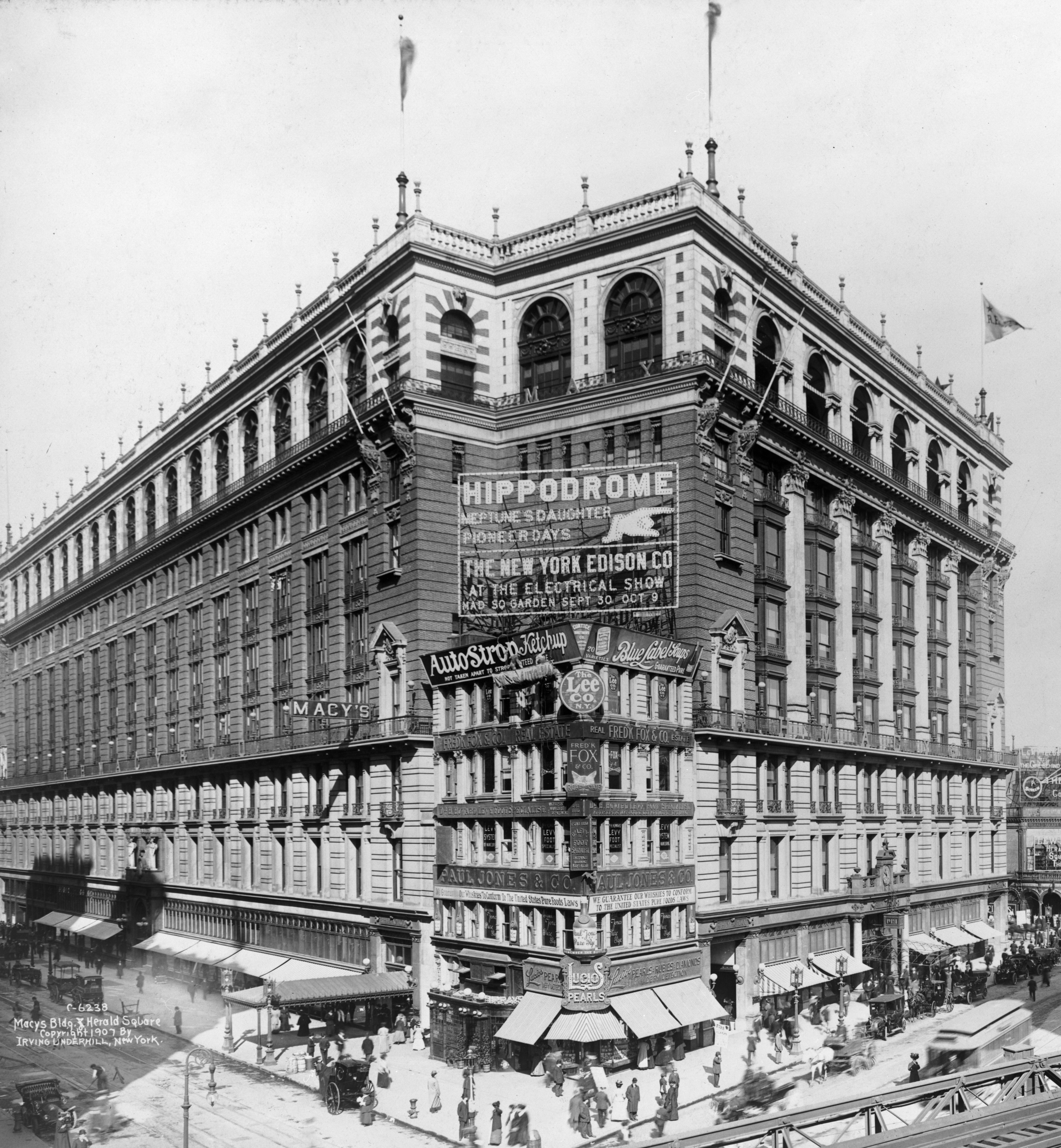
Macy’s Herald Square location in New York City, 1907

They died on the 15th of April, when the famous ocean-liner, the R.M.S. Titanic, sank after striking an iceberg during its maiden voyage. After her husband was refused entry into a lifeboat, Mrs. Straus famously declared that “Where you go, I go!“, and gave up her seat in the boat to another passenger, to remain with her husband on the sinking ship.

By the early 20th century, department-stores had become a fixture in large cities. and every major city worth its salt had at least one. Department-stores started growing larger, and larger, expanding from the old, one-or-two level stores of the 1800s, to four, five or six storey monstrosities in the 20th century. It was impractical for shoppers to walk up and down flight after flight of stairs, carrying their shopping in their arms the whole way. But as buildings got taller, so people devised means for making them easier to move through.

Escalators and Elevators

Name one major department-store which does not have at least one of these.

Without escalators and elevators, the modern department store as we know it today, probably wouldn’t exist. Because nobody could be bothered walking around, and walking up and down all those stairs, carrying their bags, all the time.

The elevator and escalator were developed as answers to the growing sizes of office-buildings in the late 1800s. The innovation of cheap, mass-produced steel meant that tall, steel-framed buildings with thin curtain-walls were now possible. As a result, everything got bigger. Apartment-blocks, office-blocks, and department-stores. But people were unwilling to walk up more than about four flights of stairs. So elevators and escalators were developed as an answer. Improved on throughout the second half of the 1800s, these two forms of people-moving were more-or-less perfected by the turn of the 20th century.

Early elevators were manually operated. Gates to the elevator-car and the shaft were opened and closed by hand. And the elevator-cars themselves were manually operated. A lever and switch was pulled to send the car up or down, and at varying speeds. It was entirely up to the skill of the person riding it, to park the elevator level with the opening in the shaft. As this was not a skill everyone had, buildings with elevators hired elevator-operators to guide elevators and their passengers, up and down in safety.

Going up? Traditional elevator-operators at work in this building’s vintage, manually-operated elevators

In department-stores with elevators, elevator-operators often acted as guides, explaining what products could be found on each floor, which shopping-departments could be found where, and what special offers or sales were on in various departments. It used to be commonplace to hear elevator-girls call out the departments as the elevator-car rose or fell. While elevators did have dials telling which floor the elevator was on, as early ones were operated manually, the elevator-operator often called out the direction of travel as well, as a courtesy to passengers.

“…Ground floor! Lobby, restaurant, hairdressers, barber’s and bookshop! Going up! First Floor! Men’s suits, hats, shirts, socks, ties and accessories! Going up! Second Floor! Ladies’ wear, handbags, shoes, hats, gloves, scarves, make-up and perfume! …”

 Escalators were dreamt up as far back as the mid-1800s. However, it was the early 20th Century before they were ever considered to be a practical and safe method of transporting people between floors. Early commercial escalators were manufactured by the Otis Company, which also one of the world leaders in early electric manual elevators.

 Consumer Booms

By the late 1800s and early 1900s, mass production and the Industrial Revolution meant that people could now buy more and more things, and department stores sprang up to facilitate this. While most middle-class people still made at least some of their own clothes using the family sewing machine, clothing stores sprang up around the world. Jewellery shops opened their doors, and toy-shops started selling things like model trains, model cars and soft, cuddly toys to children. Men purchased fountain pens, women purchased shoes and hats. In the early 20th century, fashion-magazines showcased the latest styles and modern consumer-culture began to grow.

Stores began to evolve and change to meet this need. In the 1870s and 1880s, the first cash-registers (originally called ‘Incorruptible Cashiers’) appeared. Prices were punched in, sums added, and then the handle on the side was cranked over to ring up the total amount. The bell sounded and the register-drawer or til would shoot open like a bullet!

Odd pricing appeared for the first time. Although its origins are obscure, it existed since at least the late 1800s. No longer were things $1.00, 50c. A nickel. A dime. A shilling. A penny.

Suddenly, that razor-set you wanted to buy your husband or father or brother, cost $1.99. That new fountain pen was $6.99. The pocketwatch was 99c!

Why?

Part of it was psychological, to make the customer think he was getting a bargain. The other was to ensure that all sales were logged correctly. Instead of just giving the cashier the money and then walking off, back when a penny was worth something, the cashier would have to open the cash-register to give back the penny change, thus, logging the sale in the cash-register, and letting the shopkeeper know that a transaction had been made, when the register-bell went off.

The Modern Department Store

By the 20th century, all elements of the modern department store had arrived, and shopping for pleasure and relaxation, ‘retail therapy‘ as we might call it today, was an established pastime. People went to see what was on sale, what was new, what was old, and what was discounted stock going cheap.

Advertisements for new products flooded the markets. Suddenly, people could buy typewriters, sewing machines, record-players, factory-made clothes, fountain pens, spectacles, fans, umbrellas, luggage, toys and all other sorts of things simply by going to their nearest department-store and seeing what they had in stock. Having so much merchandise available to them meant that customers were spoilt for choice. Companies worked hard to convince a customer to buy their product over that of their nearest competitors. Deals and discounts were now becoming common.

Department-stores like all businesses suffered during wartime. Governments fixed prices on goods available for public consumption…when there was anything for the public to consume, that is. And if there was anything to consume, it mostly went to the armed forces. Customers often had to do without. Rationing made once common items extremely hard to get. Items that were made out of extremely important wartime materials such as wood and metal were nigh non-existent. Even in the postwar-world, some items remained hard to get for a long time.

Parker ’51’ fountain pens, drilled into the public mind as being the best fountain pen available anywhere in the world, was almost impossible to buy during the Second World War. Sewing-machines and typewriters also became extremely rare. An old joke was a lady going into a Singer sewing-machine shop and seeking out the head salesman.

“Sir! I want to buy a new Singer!”
“Wouldn’t we all, madam? Wouldn’t we all…” 

The ‘Long Boom’ of the 1950s, 60s and 70s saw many new department-stores being built around the world. New products of all kinds flooded the market, and department-stores were seen as a way to flog these new gadgets and gizmoes to the shopping public, as well as a way of providing work for thousands of people who had returned home from the War, or who had been displaced and immigrated to other countries as a result of it.

The relative peace and prosperity of the second half of the 20th century and the start of the 21st century has caused department stores all over the world to grow in size and complexity, from humble places selling ordinary everyday nick-nacks, to sprawling mega-malls and specialist boutiques and arcades selling niche or high-end products of all kinds. Today, every major city in the world is likely to have at least one or two major department stores. They’re essentials for locals and attractions for tourists, magnets for business-owners and boost pedestrian traffic where-ever they are, encouraging other businesses like restaurants, cafes and cinemas to open up shop nearby. The department store is such a staple of modern life, it would be almost impossible to think of where we would buy our essential everyday supplies if they suddenly disappeared.
 

Share this:

  • Share on X (Opens in new window) X
  • Share on Facebook (Opens in new window) Facebook
  • Share on Pinterest (Opens in new window) Pinterest
  • Share on Tumblr (Opens in new window) Tumblr
Posted in Cultural & Social History
2 Comments
10/03/2014 by Scheong

A Rude Awakening – The History of Alarm-Clocks

BEEP BEEP BEEP BEEP!! BRRRRRRRIIIIIIIIIIINNNNGGGG!!

“…and the time now is 7:00am, on your local breakfast-radio program. Coming up next, the traffic heading into the city from the east is backed up for ten blocks because of an overturned truck transporting strawberry yogurt. Police say they’re in the midst of a very sticky situation…” 

Every morning around the world, people are jolted, jostled, jerked and jumped out of bed by sounds that vary from air-raid sirens to simulated roosters, electronic beeping to breakfast radio, to the sound of Grieg’s ‘Morning Mood’ from the Peer Gynt Suite:

In the 21st Century, we have all sorts of ways to wake us up in the morning, from jangling bells to novelty sirens to our favourite musical tracks. If you search hard enough, you’ll even find an alarm-clock voiced by Stephen Fry in his famous portrayal of Reginald Jeeves. 

Who wouldn’t want to be woken up in the morning by their own personal English valet?

The alarm-clock, in all its various permutations, has been around for about three hundred years. When, where, why and how did the alarm-clock come from, and how did it develop over the centuries? Let’s find out…

Before the Alarm-Clock

As much as we don’t like it, sometimes it is necessary to wake up earlier than we’d want to. But how to do this in the days before alarm-clocks were invented?

If early man wanted to wake up…early…then one simple method was just to drink. Drinking lots of water before bed will certainly get you up early so that you can go take a leak! Or, simply sleep where natural sunlight will wake you up with its own brightness. Some people relied on roosters, which would crow every morning at sun-up. These were among the methods used by ancient and medieval peoples, in order to wake up as early as possible, to make the most use of daylight with which to get tasks done. Candles and oil for lamps was expensive, and so were used as sparingly as possible.

For most people, knowing the actual ‘time’ was never necessary. Few people needed to know what the time was – they just needed the light to do their work. But as the world became more developed and more advanced, and clocks became better, more people started having clocks in their homes.

Early clocks were notoriously inaccurate. Even the best ones would be out by minutes a day, and hours a week, requiring frequent resetting. People relied on church-bells and large public clocks to wake them up, or tell them what the time was, since household clocks were rarely accurate, and were often expensive! Even pendulum clocks were not especially accurate – changing summer and winter temperatures affects the length of the pendulum (due to expanding and contracting metal), and therefore, also affects its accuracy.

For people living in town, who had to wake up early (for factory-jobs, for example), there was one main of doing this, if you didn’t have an alarm-clock (or if one had not yet been invented), and that was to employ a knocker-up.

A knocker-up/knocker-upper, was a man employed by a factory or company, to go around the streets before sunrise, and knock on people’s front doors or their bedroom windows, to wake them up each morning for work. Since some knocker-ups might do double-duty as lamplighters, they would beat their lamplighting-staffs against the windows to wake people up, as they did their rounds, extinguishing streetlamps as they went along.

In Tony Robinson’s TV series “The Worst Jobs in History“, he declared that being a knocker-up was a lousy job because there was nobody around to wake him up, to make sure that he woke everyone else up!

The First Alarm-Clocks

The first ‘alarm-clocks’ of a sort, have existed since ancient times. These were often large, public clocks, with mechanisms built in, to sound bells at specific times (for example, for monks, when they needed to pray). Most people still relied on the bells attached to large public clock-towers, or church bell-towers. Few people had need for anything more specific or accurate than that. The first real attempts at making an alarm-clock as we might know it today, did not show up until the 1700s.

The Industrial Revolution of the Georgian Era meant that people now had new work-patterns. You weren’t regulated by the sun, to work in the field. You were regulated by the clock, to work in a factory or workshop. And it now became necessary to wake up at a specific time each day.

The first alarm-clock produced during the early Industrial Revolution was built by Levi Hutchins, a man living in the newly-independent United States, in 1787. Hutchins built the clock to wake him up at 4:00am for his job, but the design was never patented, or mass-produced. It would be nearly another 100 years, before the first really modern alarm-clock was produced.

The Modern Alarm Clock

The first modern alarm-clock, one which an individual could own, which would both tell time, and set off an alarm which could be adjusted to any time at all, was not invented until the 1870s.

The pioneer was the Seth E. Thomas Clock Company, founded by Seth Thomas in 1813. Although Thomas himself died in 1859, the company bearing his name produced the first practical, mass-produced alarm-clock in 1876. This mechanical, hand-wound clock had an alarm-mechanism that could be set to any time. The first truly modern alarm-clock had arrived!

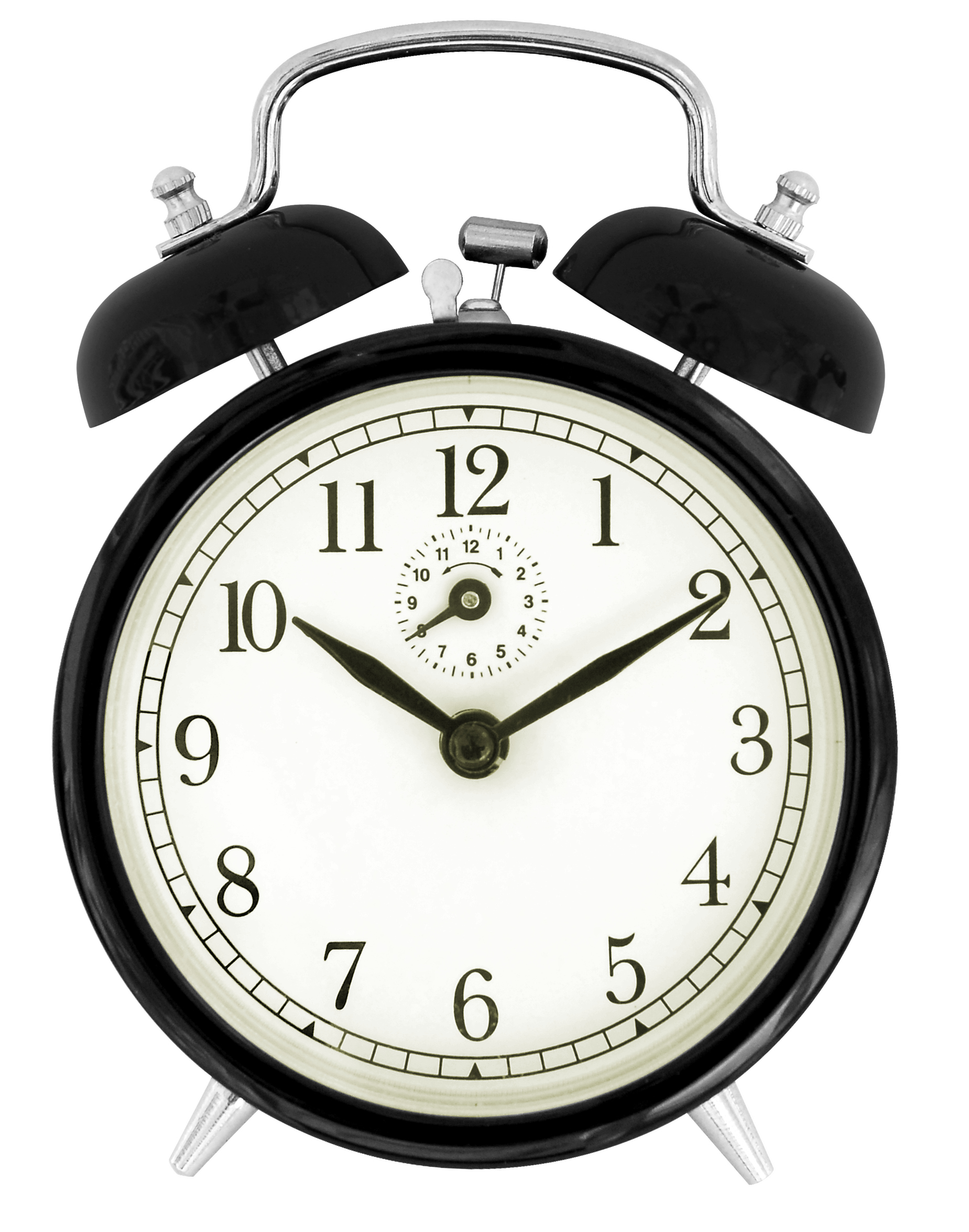
The classic, double-bell alarm-clock

Exactly when this specific style of clock came out is anyone’s guess, but it’s been around for at least 100 years, sometime probably between the 1880s-1900s. It has been manufactured by Westclox since at least the 1920s. For most people, when they imagine an alarm-clock, they picture the classic twin-bell timepiece with two keys, and two knobs, two bells, two feet, and two hands.

The classic double-bell alarm-clock has a mainspring for the time-mechanism, and a bell-spring, for the alarm. They also featured a dial at the top for the user to set the alarm to ring at whatever time they chose. These clocks ran on 36-hour springs, and had to be wound each morning (or evening). The bell-springs generally had to be wound up every two or three days, depending on how deep the sleeper happened to be!

Clocks like this came with one, or two bells on top. Or sometimes, with no bells at all!

A Westclox “Big Ben” advert from 1931

The Westclox “Big Ben” is one of the longest-lasting alarm-clock designs in the world. It came out in the early 1900s, and didn’t cease production until well into the 1960s and 70s. Its claim to fame was its neat appearance – It was easy to read, easy to operate, and without any external bells for dust to gather underneath.

Westclox Big Bens were among the first to use the patented “Bell-Back”-style of clock-case. Here, the bell-gong was actually built into the back of the clock-case, and a hammer simply struck the inside of the clock-case to sound the alarm.

Depending on the model, Big Bens came with a simple “on-off” alarm-switch, or with an additional repeater-switch, where the alarm would ring for a few seconds…stop…then ring for a few seconds…and stop…and ring for a few seconds…and stop again. Until the spring had run down. Probably the earliest ‘snooze’ function in the world!

Clocks During the War

The Second World War is almost over! Slowly, we can take things ‘off-ration’ and enjoy them as we did before the outbreak in 1939! What’s the first thing to be enjoyed en-masse once more? Chocolate? Condoms? French champagne?

Alarm-clocks.

In Britain and America during WWII, clock-companies ceased production from 1942-1945. They produced airplane parts and other important components for the war-effort. But by the end of the War, there was a surprisingly high demand for alarm-clocks! Especially in England where many homes had been bombed out, reliable, functional alarm-clocks had become rare, due to them breaking down and not being easily replaced, or being damaged in bombing-raids and not being able to be recovered or repaired.

In the United States, clockmakers couldn’t repair customers’ clocks, due to the lack of steel and brass for replacement parts (which were used for weapons and bullets in the war). The result was that more and more people missed their work-shifts, which were vital for keeping the Allies going during the War.

This appalling lack of alarm-clocks and the production-time for war-materials lost as a result, meant that alarm-clocks were one of the first things to come ‘off-ration’ in the closing months of the war. In America, the Office of Price-Administration (the OPA), a body set up to regulate prices of civilian products during the war (to prevent outrageous price-hikes by war-profiteers), allowed clock-companies to resume manufacture of civilian alarm-clocks as early as late 1944. However, Westclox produced cheap ‘Waralarm’ clocks from 1943-1944, to replace all those which had worn out during the War. Due to the severe materials-rationing, the brass and steel used to make these clocks was almost non-existent. As a result…

“…In this model the [War Production Board] specifies the use of but 7 pounds of brass for every 1000 clocks, whereas in normal production we use 300 pounds for every 1000 clocks. We have found suitable substitutes for the restricted metals.

Despite the difficulties, we believe the clock is pleasing in appearance, and will be readily acceptable by the buying public.

It has a case of moulded wood fibre, which will be lacquered. It stands 5 5/8 inches high, and is 5 1/4 inches wide, with a large, easy to read dial. It has a bell alarm, but plans call for the eventual use of a buzzer…”

– Westclox ‘Tick-Talk’ magazine, 1943. 

Alarm-Clock-Radio

The clock-radio has been a popular item on peoples’ bedside tables for decades. A way to wake up to something other than the harsh buzzing, beeping or jangling that accompanies ordinary alarms. A civilised way to wake up, to your favourite radio station, with music, or news, or early-morning talk-back.

Exactly who invented the combination of the clock-radio, and even when it was invented, appears to have been lost to history. There are conflicting reports about exactly when, and by whom, this wonderful and fascinating device was created. Its date of creation varies, from the late 1920s, up to the late 1940s. The company or person that came up with the idea is equally obscure. All indications are that first rudimentary alarm-clock radios came out in the 1930s, and slowly developed from there.

The Digital Alarm-Clock

The postwar era, the ‘Long Boom’ of the 1950s, saw design embracing new technologies and materials. No more metal, no more spring-wound mechanical clocks – Now people wanted stuff made of plastic!

Plastic before the War had been in its infancy. It was used for certain products like telephones, fountain pens, and various desk-accessories, but was in general, still a wonder-material held in-awe by most manufacturers. Metal-shortages during the War forced companies to experiment and try new materials. And in the mid-1950s, the first electronic digital clock appeared.

I say the first ELECTRONIC digital clock.

Digital clocks have been around for ages.

We must understand this. Digital clocks are not new. They have been around for well over a hundred years. The word ‘digital’ has nothing to do with electricity, but everything to do with display.

A digital clock is a clock which displays time purely through numerical arrangements, and without the aid of hands or pointers. Like “09:45”.

Such clocks (and even watches) have been around since at least the Victorian era. But analogue clocks just remained more popular. One of the first serious digital clocks of the modern era is the famous ‘flip-clock’, which has white numerals on a black background of metal (later, plastic) leaves, which flip and drop along a horizontal axis, to display the time. Developed in Italy in the late 1940s, this simple, easily-read, and much less-cluttered design made it popular and more straight-forward than a conventional analogue dial-clock of the era.

The Teasmade

The lawyer in the court-room, 
In the middle of an alimony plea,
Has gotta stop and help ’em pour,
When the clock strikes four!

Everything stops for tea… 

A “Teasmade”

Yes indeed. One of the more interesting alarm-clocks that you could possibly find is the ‘Teasmade‘. Existing in one form or another since Victorian times, this device is typically a combination alarm-clock and automatic kettle and teapot all in one. Originally a crude, mechanical, clockwork-operated device starting in the 1890s, it took off in the early 20th century and by the 1930s, the first mass-produced ‘Teesmades‘, as they were originally spelt, came onto the market, starting in 1933.

The Teasmade became incredibly popular in the postwar era during the 1970s and 80s. It died off somewhat around the turn of the century, but is steadily being revived, and today, you can still buy brand-new teasmades, online, or at retail shops in the U.K.

Electrical and Quartz Clocks

Electromagnetic clocks have existed since the 1840s, but for a long time, these were restricted to large clocks found in public buildings, as they were often too expensive for private use. The same applied for quartz clocks, which use the regular pulses generated by a quartz-crystal (when electricity is passed through it) to keep time.

Developed in the late 1920s, quartz clocks (and by extension, quartz alarm-clocks) would not become practical and cheap until the 1970s and 80s. Before then, most people relied on mechanical alarm-clocks to continue waking them up each day.

Alarm-Clocks in the 21st Century

These days, everything has an alarm-clock on it, from your mobile-phone to your laptop computer. But alarm-clocks still grace the bedside tables of millions of people around the world. Traditional, spring-driven mechanical clocks are still produced, and can be purchased cheaply and easily online. They follow a basic and classic design that hasn’t changed in over a century.

But for people looking for something with a bit more umph, there’s everything from flying alarm-clocks, exploding alarm-clocks, alarm-clocks that play air-raid sirens, and even Ticky, Tocky and Clocky, three different types of wandering alarm-clocks, that will literally roll off the end of your bedside table and roll around on the floor, beeping incessantly, forcing you to get up and chase it around to turn off the alarm.

Everyone, meet Clocky!

More Information?

Westclox “Waralarm” clocks (1943-1945)

The History of Flip-Clocks


Share this:

  • Share on X (Opens in new window) X
  • Share on Facebook (Opens in new window) Facebook
  • Share on Pinterest (Opens in new window) Pinterest
  • Share on Tumblr (Opens in new window) Tumblr
Posted in Cultural & Social History
6 Comments
10/01/2014 by Scheong

A History of the House-Call

Mommy had a baby, 
His name was Tiny Tim!
She put him in the bathtub,
To see if he could swim!

He drank up all the water,
He ate up all the soap!
He tried to eat the bath-tub,
But it got stuck in his throat!

Mommy called the doctor,
The doctor called his nurse,
His nurse called the lady,
With the alligator purse!

‘Measles!’ said the doctor,
‘Mumps!’ said the nurse,
‘Nothing!’ said the lady,
With the alligator purse!

Mommy punched the doctor,
Mommy slapped the nurse,
Mommy thanked the lady,
With the alligator purse!

This kids’ song (usually with the last verse removed!) which dates back to the 1950s is one I fondly remember from my own childhood. It’s funny and it makes you laugh. But it also made me think. It made me think of a facet of social life and history which has almost vanished from modern life.

When is the last time you saw a doctor make a house-call?

In days gone by, if someone was sick, a runner-message, a telegram, or a jingle on the pipe summoned your friendly family physician to your front door. Armed with a smile, a hat and his leather ‘Gladstone‘ bag, he’d treat you for everything from a broken arm to a case of influenza. When’s the last time you remember seeing a doctor walk along a residential street and head into a patient’s house?

Armed with his trusty Gladstone bag, Dr. Ernest Ceriani makes a house-call in the small Colorado town of Kremmling. Photograph taken in 1948

Once upon a time, it was normal for a doctor, a general practitioner, a family physician, to make house-calls. Nowadays, this ancient practice has almost ceased to exist in certain countries. Whatever happened to all that?

This posting will look at the history of house-calls. Why they happened, what for, what happened when you got one, and why they’ve almost disappeared in modern society.

Why Did Doctors Make House-Calls?

From the earliest days of professional medicine, until fairly recently, it was common for doctors to make house-calls. I still remember my family physician making house-calls when I was a child, which was not that long ago. It was perfectly normal to call him on the telephone in an emergency, and he’d drive out to see you. It was well-known that you couldn’t reach him at home, or at the office, on certain days of the week (usually the weekend), because he dedicated one day a week to visiting patients at home.

Why?

Why is it that doctors made house-calls? Why were they famous for such attention to their patients? Let’s consider the context…

For much of human history, travel was slow. Most people walked. Owning a horse and carriage, or any other horse-drawn vehicle, was expensive, like owning a car today. Only with much higher maintenance costs. Going to a doctor was not always possible.

If the patient was too ill to walk and no convenient transport could be found, it was completely impossible. Would you chance a ride on a horse in the middle of the night, when you’ve got a brain-splitting fever so bad you can hardly drag yourself to the bathroom?

I’ve had one of those. It’s so bad you can’t even stand up, let alone get on a horse. You’re so dizzy you’d break an ankle falling down the steps just trying to get to the damn stables.

Don’t forget folks…this is before the days of telephones. Before the days of ambulances and 911 and Triple-0, before the days of 999. There was no quick and simple solution back then.

In an emergency, a doctor had to be sent for. And he would have to come. In a hurry! Because a doctor had to treat all sorts of things, most of them were general practitioners, meaning that they studied everything from minor operations and surgeries, to how to deliver babies, how to take your temperature, or how to prescribe medicines for that head-cold you’ve had for four days.

It was this lack of a ‘middle-man’, the emergency-response system, that meant that house-calls were necessary. And doctors training and education, covering a wide range of areas of medicine, reflected this. Even the vehicles the doctors used to get to their patients were specially-made.

The Doctor’s Buggy

Victorian-era Physician’s Buggy

In an age when doctors did a lot of travelling around making house-calls, some of them extremely serious, they had to have reliable and safe transportation. It wasn’t safe to ride on horseback to every appointment, especially if you were transporting fragile medical equipment with you. You needed a wheeled vehicle of some kind, which was suitably designed for your purpose.

This is a Victorian-era doctor’s buggy, and it was designed for use by visiting physicians. You’ll notice a few things about it. To begin with, it’s surprisingly large for a vehicle that would carry two people at most. It’s got a wide base and a low center of gravity, and storage in the foot-well behind the dashboard. This is so that the doctor could load his equipment into the front of the buggy, and drive it at high speeds, and take corners with minimal slowing. The low center of gravity prevented rollover accidents while on the way to a medical emergency.

The buggy is simply constructed. It doesn’t have the heavy glass and wood body of a larger carriage or coach. Such extra weight was unnecessary, and only slowed the doctor down in an emergency. These buggies were made to be fast and safe.

The Gladstone Bag

My antique Gladstone bag in crocodile leather. Purchased for $25 at a local antiques shop!

It’s been decades since most physicians ever carried one of these things. But they’re still called ‘doctor’s bags’ to this day. Invented in the mid-1800s by an English bag-manufacturer known only to history as “J. G. Beard”, these leather-sided, gate-mouthed bags were named ‘Gladstones’, after the four-time British Prime Minister William Ewart Gladstone, and of whom Mr. Beard was a supporter.

Gladstone bags were carried by everyone. Tradesmen, businessmen, carpenters and laypeople of all kinds. They were used as weekend-bags and overnight bags by travelers going by train, carriage or ocean-liner, and even as equipment-bags by adventurers and archaeologists. Such a bag wouldn’t be out-of-place in one of Indiana Jones’ adventures through the deserts of Egypt or the wilds of Arabia.

Despite the Gladstone bag’s long history and numerous, numerous uses, in popular culture, it is, has, and always will be, firstly and most commonly associated with physicians. To this day, they’re still called ‘doctor’s bags’. The reason for this probably dates back to the days when they still made house-calls.

Physicians who made house-calls had to be prepared for absolutely anything. Anything. From childbirth to mumps, boils to appendicitis, influenza to rampant diphtheria. Because of this, they had to carry a wide array of equipment in their bags. Not just measuring-tapes, a thermometer and a stethoscope, but most things that doctors today wouldn’t normally carry around – surgical and amputation-kits, bottles of medicine, swabs, measuring-cups, needles, syringes, tourniquets and other nasty and potentially deadly items.

Doctors required a bag to store all these important items in. The bag had to be large, easily-opened, securely locked to prevent tampering and theft, and with an easy grab-and-carry design. The upright, gate-mouthed opening of the Gladstone Bag made it ideally suited for this purpose. Not having to fumble around with a saggy, soft-mouthed bag (for example, a haversack or a duffel-bag) made the doctor’s job easier when he had to reach inside his bag in an emergency, to find some vital piece of equipment.

Being able to open the bag, have it stay open, close the bag, lock it, pick it up and walk with it without the contents inside (which could be sharp, fragile or poisonous) shifting and breaking, was the deciding factor in why physicians carried Gladstone bags. They were simply safer to transport their dangerous equipment around, than other bag-designs of the era.

Don’t forget that until fairly recently, thermometers were still fragile glass tubes filled with mercury. Or that doctors used to carry poisonous drugs like chloroform or ether with them, if they had to sedate a patient during an operation. You wouldn’t put stuff like that in a briefcase, close the lid, lock it, pick it up, tip the contents sideways all over each other in the process, only to have the lock fail and suddenly have everything spill out onto the floor and shatter into a million pieces! The design of the Gladstone bag made such an occurrence impossible.

What Was Involved in a House-Call?

Absolutely anything, short of a heart-transplant.

In the days when it was not practical for most people to visit a doctor, and when the doctor came to the patient, the physician had to be prepared for absolutely anything that his training covered. It’s one reason why he carried his Gladstone bag with him – it was one of the few practical luggage-types of the era that could hold so many different and dangerous objects with relative safety.

Physicians called out to a patient’s home could be expected to do anything from listening to a heart-beat, taking temperatures, prescribing medicines, and checking pulses, to more serious stuff, like childbirth, re-setting broken bones, stitching up wounds, or even minor surgery, like removing a patient’s appendix!

I’m old enough that I still remember a time when doctors made house-calls. Three house-calls I remember my family physician making when I was a child, tackled everything from broken bones, to stitching up a gash to the head, and one particularly memorable house-call which involved the removal of a fish-bone from my throat…to this day I can’t stand eating fish with bones in it.

The Golden Age of the House-Call

House-calls were common throughout history, but peaked during the 19th and 20th centuries. Advances in medicine, communications and transportation made it easier and safer for physicians to make house-calls. Telephones, bicycles and motor-cars made calling a doctor faster and safer.

“Say ‘Aaah!'”

House-calls began to fall steadily as a medical priority, after the end of the Second World War. This is matched by a steady decline in the number of general practitioners, among other contributing factors.

The End of the House-Call?

In an age when medicine was far more hands-on and personal, a physician had to cover a wide range of skills, since he had no idea what he might be called out to attend to, at any hour of the day, or night. Such physicians were called ‘general practitioners’ because they did not specialise in one particular area; they covered a ‘general’ field of medicine, learning the basics of every field, to serve them in their profession.

These days, there is a much higher number of specialists than general practitioners – physicians who will concentrate on one part of the human body. Eye-doctors, hearing specialists, Ear-Nose-&-Throat doctors, cardiologists who look into heart-conditions, podiatrists, who handle your feet, dermatologists who handle skin-issues and so-forth.

This spreading-out of knowledge means that there are fewer and fewer doctors who can handle a wider range of diseases and illnesses. And this means, fewer doctors who can handle house-calls, with their unpredictable natures.

In the 1920s in the United States, three-quarters of physicians were general practitioners. By the 1980s, that had dropped to less than 1%! With so few general practitioners around, it’s hardly surprising that house-calls are rapidly becoming a thing of the past! In the 1930s, 40% of patient-physician interactions happened through house-calls. In the 2010s, that’s dropped to less than 1%.

By the 21st century, the house-call is something almost consigned to history. When’s the last time you remember a doctor making a house-call? Most physicians work in their clinics or surgeries, most specialise in one area or another, of medicine. Not all of them have the skills necessary to carry out varied demands required of an unexpected house-call. With modern emergency services and improved communications and transportation, there’s less need for physicians to make house-calls. In our increasingly litigious society, some physicians have stopped giving house-calls over fears of being sued! And yet…

The Future of House-Calls?

House-calls have never really gone away. While it’s true a smaller number of doctors still carry out house-calls, there are some physicians, such as in the United States, who are trying to revive the practice. They believe it’s beneficial for a number of reasons. It gives reassurance to the elderly, or those living alone, or who can’t travel easily. For parents, it gives them comfort to know that their family doctor can check on their children if they should fall ill in the middle of the night. Doctors enjoy the personal time spent with patients. Not being slotted into an appointment-gap means that the physician can take his time with the patient and discuss their condition in detail, without the pressure of another patient waiting for treatment.

House-calls are being carried out these days, by more people than just doctors. Nurses and some paramedics also conduct house-calls, or conduct regular house-visits to elderly, infirm or otherwise house-bound patients. It provides comfort as well as medical care, and professional treatment for non-emergency medical conditions. In the United States, there’s even the Visiting Physicians Association, providing house-calls to the elderly and infirm.

Some doctors think that making house-calls is actually more cost-effective. Not having to maintain a professional premises and being able to work out of their own home (or the homes of others, in the case of house-calls!) makes reviving this ancient practice more attractive in the 21st century. On top of that, easier access to medical care in the home makes things more comfortable for those who have transport issues. Non-emergency medical problems can be treated at home, before they deteriorate and an ambulance has to be called, instead of a doctor!

Want to know more about the history of house-calls?

History of Medicine – House-Calls

‘Healthy Debate’ article about House-Calls (2011)

Doctors Reviving House-Calls

The Benefits of House-Calls

Modern Technology and the House-Call


Share this:

  • Share on X (Opens in new window) X
  • Share on Facebook (Opens in new window) Facebook
  • Share on Pinterest (Opens in new window) Pinterest
  • Share on Tumblr (Opens in new window) Tumblr
Posted in Cultural & Social History
11 Comments
29/11/2013 by Scheong

All A Flutter – A History of the Folding Fan

On a recent trip to Singapore I purchased a very nice folding sandalwood fan. It was partially a souvenir, partially a survival-aid. Any chance to use it and cool off in the 80% humidity and 32-degree heat was exploited. While waiting to cross streets, sitting while watching outdoor performances, stopping for a drink at a cafe, or simply using it to block, or at least filter, the direct glare of the sun, it was used.

While furiously trying to prevent death from heat-stroke, it crossed my mind, the absurd simplicity of the folding fan, and the sheer endurance of such a simple and effective design. So simple and effective that they’re still manufactured in their thousands today. It made me wonder about their history.

If you’ve ever been to Chinatown, gone to a Chinese restaurant, visited any Chinese friends, or looked at old Chinese photographs, you’ve probably seen these:

Folding fan made of Sandalwood. From Australianweddingshop.com

The folding fan, also called a hand-fan or a Chinese fan, is one of the most iconic items ever to be associated with the Far East, the tropics, or hot, summer days. But where do they come from?

Surprisingly, folding fans are not actually Chinese at all. They originated in Japan! Called Ogi, the folding fan was developed in Japan ca. 670A.D., not reaching China until the 900s. The earliest folding fans were made of thin slats of wood, or bamboo, riveted together at a point, and tied together at their far ends with thread, so that they could be opened and shut, used or stored, with ease. They were said to be inspired by the folding wings of bats.

Fans were originally expensive items. They were fiddly and time-consuming to make, and could only be afforded by royalty, aristocracy, or by the well-heeled samurai warrior-classes of Feudal Japan. As fans rose in popularity due to Japan’s sometimes humid summers, professional fan-makers set up shop, and prices began to fall. By the 1400s, fans were being made, carved, painted, or otherwise decorated by dedicated craftsmen, and they started spreading around Asia.

Fans spread to Europe through the famous “Silk Road“, the trading network that ran between Europe and Asia during the Ancient and Medieval periods. Traders on the Silk Road brought fans from Asia back to Europe, where they quickly became fashionable accessories among the well-dressed about town.

By the Georgian era, fans were becoming more commonplace and even more popular. Really nice fans could be made of Mother-of-Pearl, ivory, fine woods and silk. They could be exquisitely decorated, carved or painted. Some fans even had poems written on them. Cheaper fans were made of paper glued onto a frame of wooden slats. It was now possible for people from almost all walks of life to own a fan.

Fans were used mostly by women, but that didn’t stop men from carrying them around as well. Fans were handy for keeping cool in summer, but they were also used to drive away foul odors – in an age when few people bathed regularly, and masked appalling body-odor with perfume and scent, having a fan around to stop you from passing out due to unrestrained armpit-stench was almost mandatory.

Fan Language

Starting in the 1700s, and dying out by the end of the Victorian era, ‘fan language’ was a popular, but secretive method of communication used by young ladies during the Georgian era.

In an age when decorum, manners, etiquette and strict, strict rules of protocol were expected to be followed by EVERYONE who was considered ANYONE, it could be incredibly hard for young women to hang out with young men. Especially when parents or chaperones were around. What to do?

Just like young people today, the kids back in the 1700s used a common, everyday object to send coded messages. Today, it’s internet shorthand. Back then, it was fan-language.

Imagine two sets of parents at dinner, with their son and daughter, seated around the table. How on earth could the girl tell that cute guy sitting across from her just how much she liked him, when such open displays of affection were considered strictly taboo in front of others?

Use the fan.

Opening and closing the fan, waving it in a certain position or speed, or holding it in a certain place in relation to one’s body, or handling it in a certain way, all sent messages from one person to another, usually of an amorous nature, which would probably have shocked their parents.

Fan language could convey a surprisingly large number of messages. ‘I love you’, ‘I hate you’, ‘kiss me’, ‘you’re cute’, ‘We should talk later…hint-hint’, ‘I’m just not that into you’, ‘I’m seeing someone else’, and so-on.

Georgian and Victorian Fans

During the 18th and 19th centuries, fans became extremely popular. Women, and some men, carried them everywhere with them. To the park, to people’s houses when they went visiting, to town, when they went shopping, and especially, to the theater.

In an age when light was gas-fired, oil-burning or candle-flame, and before modern air-conditioning, public buildings which held large numbers of people in close proximity, such as restaurants, club-houses and theaters, could be surprisingly hot and stuffy. Carrying a fan to the theater (and in later years, even the cinema) was almost mandatory, to ensure that you passed out because the play was boring, and not because of the intolerable heat!

A fan fit for a Queen!

Fans were also used to help revive ladies when they fainted – a common occurrence due to the rib-crushing tightness of their corsets. While a police-constable might carry a “lady reviver” (a phial of smelling-salts) for this purpose, most women carried fans to prevent their own fainting, or to revive other friends who might’ve passed out, either due to heat or the inability to breathe.

Fighting Fans!

For such a flimsy, delicate object, you might be surprised to learn that fans were once used as weapons! Prominent in Japan, Korea and China, fans were used as throwing-weapons, shields, swimming-aids, or blunt-force weapons.

To be fair, the fans used in martial-arts were not the fancy bamboo or wood-slat fans which most of us are familiar with. These fans had ribs or slats of iron or brass, capable of dealing or taking blows, blocking spears, arrows, darts, or other missiles, and capable of withstanding punches and other attacks.

In Japan, the art of fan-fighting is called Tessenjutsu, literally “Fan Method” or “Fan Technique” (‘Tessen’ is the name for the special fans manufactured for this purpose).

Buying a Good Fan

Perhaps you want to buy a fan for a friend as a present. Perhaps you want one for yourself to carry around on hot days. Perhaps you want one as a souvenir? Or maybe, like me, you wanted one because you were visiting a tropical country and wanted to carry one around to keep yourself cool during the day, or the block out sun-glare. How do you pick a good one?

As with anything, you get what you pay for.

A good fan is not expensive. But a cheap fan will be a pain in the ass.

Avoid fans with leaves or fanning-surfaces made of paper. These cheap, crummy pieces of crap are generally not worth your money. Constant creasing and uncreasing, opening and closing will cause the paper to rip and tear over time.

Fans made of cloth and wood (or cloth and plastic) are light and comfortable. They’re also able to stand up to more rugged use. Stuff-it-in-your-bag sorts of fans.

For something more elegant, refined, or classic, you might consider an all-wood fan. These are usually made of bamboo, or sandalwood (such as the fan shown above). Sandalwood is ideal because it can be cut very thin, it can be carved inticately, and it won’t crack or break in the process. Also, sandalwood is naturally scented (and yes, it smells really nice). It’s preferable to sniff the wonderful scent of tropical wood, rather than body-sweat, on a hot day. However, there is a trade-off, sandalwood fans should be handled with care, their thin wooden slats are more prone to breakage than the cheaper, wood-and-cloth fans.

A good fan is one which opens all the way, and closes completely, with just a flick of the wrist. New fans are generally stiff from lack of use. To loosen it up, simply wave the fan open and shut several times, to try and break the hold of friction between the ribs of the fan. Fans with a looser rivet or pivot-point also tend to open and shut easier.

To open and close a fan like one of those oldschool kung-fu masters, you first need a fan which is already ‘broken in’, one that will open and shut all the way, with a flick of the wrist. A fan that jams or gets stuck is just a pain in the ass.

Hold the fan in your right hand, gripping the topmost rib, or the ‘guard’ at the end of the fan, with your thumb and the bottom third of your right index-finger.

Holding the fan entirely by this grip, flick it to the left. A good fan will allow the ribs and fan-surface to fall or flick open smoothly, all the way, by momentum or gravity alone. To close the fan, simply flick it back the other way, to the right. If you do this enough times, not only will you get really good at it, but the fan will loosen up and be easier to open and close in the future.

I Want to Know More!

The Fan Museum

Origin of the Folding Fan

Japanese Fans

Japanese War Fans


Share this:

  • Share on X (Opens in new window) X
  • Share on Facebook (Opens in new window) Facebook
  • Share on Pinterest (Opens in new window) Pinterest
  • Share on Tumblr (Opens in new window) Tumblr
Posted in Cultural & Social History, History of Clothing
Tagged Feudal Japan, folding fan, Japan
1 Comment
13/11/2013 by Scheong

Tiffin Time! Classic Stacked Lunch-Pails

I love writing about weird, whimsical items. Antiques, vintage oddities, nick-nacks, and things that you just don’t see every day. Typewriters, old sewing-machines, straight-razor kits, fountain pens, old furniture, household goods…anything strange, whacky, weird, whimsical, and unusual.

While on a trip around Singapore, I got my hands on just such a thing as I have described. Weird, whimsical and unusual. On the surface it sounds like nothing that anyone might be in the least bit interested. If I told you in-essence what it was, it’d be a simple case of “Meh!…”, and then you’d go back to your Facebook page…

Don’t believe me?

Okay…It’s a lunchbox.

*Tumbleweedz*

See? I told you. What’s interesting about a lunchbox? Probably not much, but how many of you have seen one like what I’m about to show you? Probably not many, unless you grew up, or live in Southeast Asia. Here it is:

With the spread of Japanese food around the world, you may be familiar with a ‘bento box’, the traditional Japanese lunchbox used to store sushi. But have you ever seen one of these?

They’re called different things depending on where you buy them and find them. To most English-speaking people, the correct term is a Tiffin-Carrier. If you went to India, in particular the city of Bombay, most people would call them Dabbas. But what is it?

What is a Tiffin-Carrier?

A Tiffin-Carrier, Tiffin-Box, Dabba, or just a ‘Tiffin’, is a compartmentalised food-storage unit. It consists of between two-to-four (usually three, or four) bowls or tins of the same, or similar sizes, stacked up on top of each other, with a lid on the top, sealed down and clamped shut with locks down the sides or top. It’s meant to act in a similar fashion to a thermos-flask, in that it keeps hot food warm, and cold food cool…but in the middle of tropical Asia, the most important aspect of the tiffin-carrier was that it kept the flies away – and therefore prevented food from being contaminated in the midday heat!

Tiffin-carriers came in various sizes and styles. From single, lidded pots, to double-stackers, triple-stackers, and even four-stackers. Sizes of the bowls range from tiny units, with each bowl only capable of holding a couple of mouthfuls , to large units capable of feeding as many people as there are bowls in the stack. How the carrier-bowls are clamped together in their familiar stacked-up formation varies from design to design. Older tiffin-carriers use friction-clamps built into the steel frame, under the carrying-handle, to produce tight seals, but most modern tiffin-carriers have pull-down clamps built into the frames, similar to those seen on glass kitchen-jars:

The History of the Tiffin-Carrier

Uuuh…hmm.

Good question.

A very good question.

And possibly, one without an answer…

Exactly where and when they were invented is not precisely known. Most people would probably say India, since that is where they are used the most, even in the 21st century, however, others contend that they were actually designed in China.

An older-style tiffin-carrier, with a swing-down friction-clamp attached to the carrying-handle that presses against the lid to seal the contents and prevent leaking

No-matter where they were invented, tiffin-carriers have been part of Southeast Asian culture for over a hundred years. Since at least 1890, they were being used by the colonising British in major cities around India, in particular, Bombay, to store and transport their lunches. In Bombay, where they are called “Dabbas”, they were, and still are, carted around town by dedicated “Dabbawallahs”, or tiffin-couriers, who shift thousands of these metal lunch-pails around town every single day, delivering hot, home-cooked meals
to thousands of office-workers for just a few dollars a month.

These unique lunch-pails followed Indian and British migrants during their travels around Southeast Asia. Use of tiffin-carriers therefore spread to Malaya, Singapore, China, Hong Kong and Indonesia (back then known as the Dutch East Indies). In these countries, just as in India, they were (and still are) used to store and transport hot food for short periods of time.

Tiffin-carrier use peaked during the mid-20th century, in the decades immediately before and after the Second World War. Changing tastes caused its decline in certain countries, but the food of southeast Asia is ideally suited for the tiffin-carrier, for which it was primarily designed to contain!

These days, brand-new tiffin-carriers are still manufactured, and you can buy them cheaply online or from kitchenware dealers who sell Asian products. They’re still widely-used in India, particularly the city of Bombay, but remain popular around Asia as general-purpose food-storage units.

What is ‘Tiffin’?

‘Tiffin’ is an Anglo-Indian word. It’s derived from the old English slang terms of ‘tiffing’, or to ‘tiff’, meaning to have a light drink – a comparable term still in use might be ‘tipple’. From ‘tiffing’ was derived ‘tiffin’, which eventually came to mean any light drink, snack, late-morning meal, morning tea or light luncheon, and even later, just lunch itself. The metal canisters used to store and transport the food which made up these meals were called ‘tiffin boxes’, ‘tiffin carriers’, or just ‘tiffins’.

‘Tiffin’ isn’t a word you hear much anymore, but from the mid-1800s until the end of British-colonisation of Asia, it was everywhere. It virtually replaced the word ‘lunch’ for the midday-meal for anyone who spoke English in the region! You didn’t go for lunch, you went for tiffin. And tiffin could be anything from soup, curry, rice, noodles, or light snacks and cakes. Something to tide you over in the moist heat of the Far-Eastern reaches of the British Empire. These days, the word ‘Tiffin’ is only ever heard in relation to India, or to tiffin-carriers. One rare exception is Raffles Hotel in Singapore, with its famous…Tiffin Room!

The famous ‘Tiffin Room’, at Raffles Hotel, Singapore. The antique tiffin-cans stored in the display-case in the background harken back to the meal which gave this restaurant its name

Using a Tiffin-Carrier

The stacked, segmented-storage bowl system of the tiffin-carrier is ideal for storing and transporting most Asian foods for on-the-go sutations. Noodles, rice, dumplings, curry, soup, and even sushi are easily stored in these handy, cylindrical bowls.

However, what kind of foods you store inside a Tiffin-Carrier is limited only by the size of the carrier, and your imagination. One compartment might hold salad, another compartment might hold rice, and another compartment might hold curry and sauce. Or noodles, or fried-rice, or sushi-rolls, soy-sauce and wasabi, or miso soup with soba noodles.

Perhaps you don’t like Asian food? Fine. Put your sandwich inside. And some cookies. Or a small packet of chips. Or some of that leftover spaghetti from last night’s dinner. Or Caesar Salad…what you put into it is limited only by its size, and your imagination!

Filling up a Tiffin-Carrier

When filling a tiffin-carrier, there are certain rules or guidelines that should be followed for successful packing, to prevent spills or leaks. Dry food at the bottom, wet food at the top. Stuff like rice and noodles can be stored in the bottommost chamber. Curry, meat and vegetables in the middle chamber/s, and soup or sauce in the topmost bowl. With its own lid, and it being the most tightly-sealed of all the bowls, this is the most leakproof of all the compartments, and thus best reserved for fluids.

And at any rate, being the compartment closest to your hand when the carrier is being…carried…soup or sauce will not slosh around so much inside the topmost compartment, as it might in the bottommost, where jolting, shaking or swaying would affect the liquid much more.

Advantages of a Tiffin-Carrier

Tiffin-carriers have certain advantages over other forms of food-storage and transport containers which have aided in their longevity as practical and useful food-containers.

– Plastic lunchboxes are prone to warping, cracking, and leeching or outgassing, where components of the plastic can contaminate the food.

– Thermos-flasks, usually lined with a sleeve of glass, are prone to breakage if accidentally dropped. The narrow openings cane make it difficult to access food easily and cleanly.

– The ability to store food components separately, unlike with a thermos, allows a greater variety of foodstuffs to be transported in a tiffin-carrier, and generally in greater quantities.

– Being made of metal, tiffin-carriers retain heat well, and last for ages. They’ll never warp, melt, crack or fade like plastic lunchboxes will. And with proper care, one good-sized, well-designed, quality-made tiffin-carrier could last in a single family for generations.

– Being able to break a tiffin-carrier down to its component parts makes it easier to eat out of. Much easier than trying to dig into a steel tube like a thermos, with a fork, or spoon, or pair of chopsticks…I’m suddenly reminded of Aesop’s Fable of the Stork and the Fox.

What are Tiffin-Carriers Made Of?

Modern tiffin-carriers, which you can buy online, in Asian countries like India, Malaysia, Singapore or Indonesia, or at Asian kitchen and homewares shops, are typically made of plastic, or more commonly, high-quality stainless steel. Older tiffin-carriers were made of brass, aluminium, or carbon-steel, with an enamelling of paint over the top, to prevent rusting.

A collection of antique, brass tiffin-carriers. Note the specially-made spoons which slot into the handles, to make eating out of them even easier

Tiffin-carriers made of brass were prized because brass conducts heat very well, meaning that the food would stay hot. At the same time, brass does not rust, so tiffin-carriers lasted a long time, especially in the humid climates of India and Southeast Asia, where tiffin-carriers were used the most.

The Tiffin-Vendors of Bombay

The city of Bombay has a longstanding tradition of using tiffin-carriers. Long? Over 120 years! From at least 1890, specialist couriers or ‘wallahs’ transported prepacked tiffin-cans, filled with home-cooked lunches, to office-workers all around Bombay in India. Originally established by the British, the ‘Dabbawallahs’ or ‘Tiffin-Wallahs’ have continued their work well into the 21st century. Tiffin-cans are collected every morning before lunch, organised, and then packed onto trains, bicycles and carts and shunted all over town, to arrive, piping-hot, in the tiffin-carrier’s office-building on-time for lunch. Once the food is consumed, the tiffin-wallahs do another round, to pick up the tiffin-carriers, and send them BACK to their homes, where grateful housewives, daughters, sisters or mothers will clean them, in preparation for the next day’s meal.

The price for this amazing service? $6.00 a month.

The accuracy of this service? 99.99% Only ONE, in every 15-20 MILLION deliveries is ever misplaced.

Buying a Tiffin-Carrier

If you’re looking for a new or different type of lunch-storage and transporting means, and you’re sick of plastic lunchboxes, recycling takeout-boxes, ‘doggy-bags’, or having to fiddle with thermos-flasks with dinky little screw-on ‘cups’, maybe a tiffin-carrier can help you out? Strong, with large storage-capacity, they come in a wide variety of sizes, and are easily washed, used, stored, and most importantly – transported!

Tiffin-carriers are easily purchased brand-new, from online dealers, or from Asian countries, like Singapore, India, Malaysia, etc., where they’re normally found in homewares, or kitchenwares shops. If you’re looking for an older one, you might try eBay, or specialist antiques shops. If you’re intending to use an older tiffin-carrier, make sure you buy one which is clean and in usable, non-leaking condition. You don’t want to get lockjaw or food-poisoning from a rusty old tiffin-box!

I hope you enjoyed reading this little posting about tiffin-carriers, as much as I’ve had, writing it. Feel free to leave comments and ratings.

Anyway…

…its tiffin time…


Share this:

  • Share on X (Opens in new window) X
  • Share on Facebook (Opens in new window) Facebook
  • Share on Pinterest (Opens in new window) Pinterest
  • Share on Tumblr (Opens in new window) Tumblr
Posted in Cultural & Social History, History of Food
5 Comments
16/09/2013 by scheong

Staples of Village Life – Craftsmen and Professions of Old

Most of us will have heard this old nursery-rhyme:

Rub-a-dub-dub,
Three men in a tub,
And who do you think they be?

The butcher!
The baker!
The candlestick maker! 

And they all set out to sea… 

For centuries, most people did not live in cities. Mostly because it wasn’t practical and wasn’t safe. Crime, disease, overcrowding, the absence of sanitation and low employment made cities generally undesirable places to live. And the majority of people lived in the country, either on farms, in castles, or in villages or towns nearby. And for centuries, from the fall of the Roman Empire in the 400s, right up to the Industrial Revolution of the 1700s, life carried on like this, virtually unchanged for over a thousand years.

But no matter whether you lived within stone’s throw of a castle, in a country town somewhere, or in one of the few cities of any significant size, no civilised settlement at all was possible without certain tradesmen, craftsmen and professionals setting up shop first.

In this posting, we’ll have a look at some of the staple occupations in society which were necessary, for hundreds of years, for any community to flourish, grow, or even to just survive!

The Blacksmith

What’s the most important craftsman of all? The baker for the bread? The butcher for meat? The carpenter? Stonemason? The chandler? Farrier? Farmer? Miller?

None of the above.

Not for nothing is the Blacksmith known as the King of Craftsmen.

For centuries, until the 1800s, civilised life was impossible without the aid of one man. The blacksmith. On his broad, muscular shoulders rested the trades and crafts and services of all others. A lumberjack could fell, split and carve no trees without an axe and saw. A farmer grew no vegetables without a fork and shovel. The carpenter sawed no wood, screwed no screws, and couldn’t nail two planks together without the blacksmith. The blacksmith made the nails!

Ever since antiquity, the blacksmith, or the ‘village smithy’ was the hub of any community. He made everything from gates, to candlesticks, nails, screws, chains, axeheads, swords, saws, hammers, chisels and horseshoes.

The Forge

The blacksmith’s home was his FORGE. A forge is not only the building where he works, but specifically, the enormous firebox which is the heart of his world. Fueled by charcoal and powered by bellows, a blacksmith could not do a thing without his forge.

The forge was required to heat metal (usually iron) until it was hot and soft enough to be worked by the smith. Red hot iron was not good enough for anything. For it to be malleable enough, it was usually heated until yellow hot. White hot metal was usually too soft and sparkly to be of any use when working.

The Anvil and Vice

Every good blacksmith needed an anvil. Originally made of stone, most later anvils, of the kind used by Wil-E-Coyote for everything apart from smithing, were made of iron.

An Annotated Anvil

The picture above is of a typical blacksmith’s anvil. The horn and shoulder were used for bending, curving and curling metal. The step or table was also used for bending metal. The face was a general-purpose working-area, used as an impact-surface for hammer-blows.

On the face are the Hardie Hole and the Pritchel Hole. These two holes are used for slotting in various smithing-tools, such as wedges or splitters, over which the hot piece of iron was hammered and split, broken, cut or otherwise modified during its transformation. The heel, just like all other sharp edges on the anvil (the step and the edges of the face) was used to bend and shape the hot metal.

The Anvil and Vice

Accompanying the anvil was its little brother, the lesser-known blacksmith’s tool called a vice. The vice is like any other vice that you might have bolted to your workbench at home. The only difference here is that it’s designed to put up with extremely high temperatures!

The vice was used to hold a piece of metal in a particular position while it was being worked on or modified in some way. The vice was most commonly used in the process of twisting.

The elaborate twisting patterning on this fireplace poker would’ve been achieved by heating the iron yellow-hot, before clamping it in the vice and twisting it around with a pair of tongs to achieve the spiral effect.

The Hammer and Tongs

Every blacksmith needed these two basic tools. The hammer, for pounding out the metal and shaping it, and the tongs, for holding the metal and twisting and bending it. Because smithing is seen as such hard, heavy, dangerous work, done with speed and brute-force, we still have an expression that survives today – going at something “hammer and tongs“.

Seven Skills of Superior Smithing

The Blacksmith was the keystone and hub of the community for centuries. Without him, nothing could happen. He held the entire place together, and every other profession, craft and trade relied on his ability to work his magic on metal for them to do their jobs.

But to be a good blacksmith required a lot of skills. Seven in total. All major projects undertaken by a blacksmith generally involved some or all of these skills.

Skill No. 1. Splitting

The ability to punch and split a hole through bar-stock and pull it apart. You couldn’t get pitchforks without the ability to do this effectively.

Skill No. 2. Punching

Every good blacksmith had to be able to work a punch. That is, to take a punch (block) and drive it through hot metal with his hammer, to create a hole in the metal. This is how the holes in axeheads were made for the shafts, and how sword-hilts were punched open, to slide onto the ends of sword-blades.

Skill No. 3. Curling

No. Not that Canadian thing. Curling is the ability to bend and curl metal into a spiral. This doesn’t serve any practical purpose as such, and is mostly decorative.

Skill No. 4. Jumping Up/Upsetting

The ability to compact one end of bar-stock to make it thicker and denser than the other end. Nail-heads and screw-heads were made this way.

Skill No. 5. Drawing Out/Tapering


Blacksmith nails

Drawing something out involved flattening it and thinning out one end of an item, to literally draw it out and make it longer and thinner. Nails were made this way for centuries.

So far, all these skills can be seen in one common, everyday tool which most men are likely to have lying in their garden sheds.

The crowbar:

One end must be jumped up, then punched and split. Then curled over. The other end must be flattened and drawn out. And both ends must be bent and twisted to give the bar its distinctive crook-shape.

The other two skills are…

Skill No. 6. Twisting

Curling and twisting are more decorative than practical, but they’re still considered essential smithing skills. This is achieved by clamping iron bar-stock or rods (heated to a malleable temperature) in a vice and twisting them around to create the spiral shape. To open up the spirals into the cage-like appearance of the candlesticks above, the top of the twist is beaten down with a hammer, to force the spiral to break and spread apart. The whole item is then left to cool to hold the shape.

While the candlesticks above do look very pretty, there is one serious side to the smithing skill of twisting iron…where do you think all those pretty spirals in your screws used to come from?

Skill No. 7. Fire-Welding/Forge Welding


Blacksmith chain. Every link has been fire-welded shut,
to prevent breakage under heavy strain

Prior to electrical welding and blowtorches, the only way to weld anything at all was to send it to the blacksmith. And welding was a fiddly, tricky and extremely dangerous undertaking.

Welding is literally melting two pieces of metal and fusing them together by heat. Prior to the introduction of modern blowtorches and electrical welders which were capable of extremely accurate, high-temperature precision welding, the only way to do this was to fire-weld or forge-weld something together.

Let’s say you broke your sword. Or the tine on your gardening-fork snapped off. To weld it back on, the broken element, and the main body, had to be heated at the break-points, until they were literally white-hot. Once this phenomenal temperature had been achieved, the broken piece was attached back to the main body. The blacksmith then bashed away at the join with his hammer, melding the metal back together. The extremely high temperatures melted the iron, causing it to run together. Once the temperature dropped, the entire piece would be one whole item again.

The Butcher

Meat was rarely eaten by most people in medieval times. But nevertheless, the village butcher was an important man to have around. But the butcher of old was expected to know a lot more than how much to charge per-pound for sausages. He was expected to know how to make the sausages, how to get the meat, how to clean it, preserve it, sell it and store it!

Meat and the Butcher

A butcher typically handled three types of meat, which would come from cows, sheep, or pigs. From this, you would get…

Pork, bacon, and ham, from a pig.

Various cuts of steak and veal from a cow.

And lamb or mutton from a sheep.

Veal and mutton are not the same as beef and lamb. Veal is taken from young cows, beef from older cows. Mutton is taken from older sheep, lamb from younger sheep. You might be familiar with the expression: “To sell mutton dressed as lamb“, meaning to pass off an inferior product (mutton) as lamb (which was considered a much more expensive product).

Meat and Class

In older times, social status determined not only IF you ate meat (which was rare for the poor), but also WHAT type of eat you ate, if you could get it.

Not only could the wealthy eat meat more often, but they could also get the better cuts of meat. And they could also eat such prized meats as lamb, veal and venison, which were generally out-of-reach of lower classes.

Lamb is the meat of…lambs. Baby sheep. Since sheep were FAR more important as producers of WOOL, to kill a lamb for its meat was considered extremely wasteful, when it could live for years and give you tons of wool. Only someone who could sufficiently compensate the farmer for the loss of his lamb (i.e., someone rich) could afford to eat lamb. Most people ate mutton, which was from the meat of much older sheep, which had been producers of wool (the backbone of the British economy for much of the Middle Ages) for several years.

Similarly, veal was the meat of young cows. Since cows were far more important as producers of milk, killing a cow before it could produce milk was considered extravagant and wasteful. And only someone who had enough money to recompense the farmer for his extremely expensive loss, would be able to eat it.

Butchering an Animal

These days, most butchers just sell meat. But in older times, a butcher had to be able to do all kinds of things with meat, and had to be familiar with the entire butchering process. Let’s use a pig as an example.

Once a pig had been sent to the Great Pigsty in the Sky…the one with the solid gold slops-trough and diamond-encrusted hog-oiler…the butcher had to get to work.

A pig is a good example because virtually every part of a pig can be eaten, apart from its squeal. Here’s how it’s done…

First, the hog is sliced open. And all the innards are removed. This stuff is typically called “pluck”, because it’s literally the first part of the animal which is “plucked” from the body. Don’t throw that away. It’s good eatin’. You’re gonna find out just how good, later on.

Next, pork comes off. Pork comes from the belly of the pig, nice and close to the ground. The fatty, juicy meat that tastes so damn good when you roast it.

Further up on the sides and on top of the pig is…bacon! Good for breakfast, and good for EpicMealTime (baconstips’n’baconstrips’n’baconstrips…)

Then, you have the hams! Made up of the hindquarters of the pig, specifically its butt and its gigantic thunder-thighs…otherwise called legs of ham!

Everything on a pig can be eaten. Even the head. Even the ears!

Ever heard of the expression “Brains and Brawn“?

“Brains” are…Pig’s brains.

“Brawn” is the meat which is boiled off of a pig’s head. Mmmm.

Now back to them innards. Delicious, warm innards. Here, the intestines are flushed out with hot water and gotten nice and clean. What for?

Well, among other things – sausages.

And, until the invention of rubber – Condoms!

Remember folks. Prevention is the best cure. Next time you pick up that roast for dinner, ask your butcher for a pack of organic, all-natural pig-gut condoms!

Treating the Meat

The animal has been dispatched, disemboweled, and dissected. Now what?

Unless a butcher had a huge family, or was throwin’ a block-party, it was unlikely that an entire pig was eaten before it went bad (after roughly a week or so).

To ensure a pig was good for eatin’ for a long, long time…it had to be preserved or treated. There were a number of ways to do this.

1. Freezing

If the weather was right, you could pack the carcass with ice and freeze it. Freezing kills microbes and preserves the meat.

2. Salting

If the weather wasn’t right, but you had a lot of money, you could salt your pork, and bacon, and ham, by coating it in huge amounts of salt, or soaking it in brine (salt-water solution). But you needed a lot of money to do this – salt was expensive. Even today, we still have the word ‘salary‘. Salting dries out the meat, which prevents rotting. Ever wondered why bacon is so damn salty?

3. Smoking

You don’t have money? Perhaps you can smoke the meat? Stick it on a hook and hoist it up the nearest chimney (usually in the kitchen fireplace). The smoke from the wood burning far below would coat and cure the meat and give it a nice, smoky flavour. It also dries it out, which prevents rotting.

4. Candying

Can’t kindle a flame? You could try candying. Candying is a bit like pickling. But instead of drenching the food in vinegar, you smother it in…HONEY! Honey is a natural preservative, and it lasts literally for centuries…provided that it’s not contaminated. Archaeologists have dug up jars of Egyptian honey which are thousands of years old…and still good for eating!

Caution: Honey is also a natural laxative. After eating that candied ham sandwich, you better have a toilet nearby.

What about the Rest?

When food was so scarce and hard to preserve, literally no part of the animal went to waste. The butcher would’ve saved the hog’s hairs to make brushes (the first toothbrushes were made of pig-hair). He would’ve fried the ears and eaten them for dinner. Even the pig’s FEET were good for something! Boiled over, and over, and over again, strained, refined and reduced, they produced gelatin. Flavour it with fruit-juice, and you got…jelly!

Anything else that was left over was ground up, chopped up, minced, and forced through the intestines, twisted up, boiled…and sold as sausages!…or condoms.

Soon, the only thing left were the bones. And you might even use those for something if you wanted to be really thrifty. How about soup?

The Role of the Butcher

As you can see, the butcher was an important fellow. Every village had to have one. Or, a farmer had to learn how to do his own butchering. And as you can see, there was a lot to learn! Butchers didn’t just work on pigs. They worked on cows, chickens, and sheep as well. Geese, ducks, swans even! And for the extremely wealthy – deer. Only the king, and those who had earned his majesty’s good favours, were permitted to hunt and eat deer. Anyone else was charged with poaching – and faced the death penalty. And for centuries, a person’s ability to eat deer was considered a GREAT privilege.

Who wants venison?

The Baker

Throughout the western world for centuries, bread was THE staple food. Made of oats, rice, barley or wheat, when you could get it, you’d eat up to five pounds (about 9.75kg) of the stuff every day. But then, you spent that day spliting wood, furrowing fields, planting seeds, felling trees, herding sheep, milking cows, smashing away in your forge, weaving, grinding, sewing, dipping…you certainly needed the calories!

The baker was the fellow who made the bread, in his bakery.

Bakers were important staples of village life for centuries. In the days before imported food from around the country, which didn’t happen until the 1800s, everything you ate was made locally. Including the bread.

Bakers had all kinds of tricks up their sleeves. Flour was purchased from the village miller. And flour was expensive. So the baker did absolutely EVERYTHING to get the most out of his expensive flour that he could.

Bread dough was stretched (adulterated) with everything from the horrific (building-plaster!), to the mundane (sawdust), to the everyday (rice-grains).

To make bread rise, brewers yeast was used. Or if yeast was not available…apple-trees. Apples have natural yeast in them. Sticking a rising loaf of bread under a tree meant that the yeast in the apple-skins seeped into the dough, causing it to rise.

Bread wasn’t just made from wheat-flour. Wheat, especially in the Middle Ages, was expensive! It was usually taken by the lord, or the king, as part of his taxes. So most bread was made of barley, rye, oats or rice.

But even here, the baker tried to squeeze every last penny out of every loaf.

To ensure that nobody could accuse him of being dishonest (yeah, right…), the baker always baked thirteen loaves of bread (the ‘baker’s dozen’). That way, nobody could accuse him of cheating them, or shortchanging them. Which is probably just as well, because his conniving ways didn’t stop there.

Baking Bread

Pat-a-cake, pat-a-cake,
Baker’s Man, 
Bake me a cake as fast as you can.
Pat it, and prick it, and mark it with a B,
And put it in the oven for Baby and Me!

For centuries, you couldn’t bake at home. Most people had fireplaces at home. But not ovens. If you wanted to bake bread, you took it to the village baker, who baked it for you, and marked it with your initials, as in the rhyme, so that you would be assured of getting your loaf or cake, or pie, returned to you.

But how do you bake without temperature-control?

First, the oven (which is a huge, brick cave), is filled with wood and set on fire. The oven is allowed to get really hot, and the fire must fill the entire oven. Then, once the fire is burned down, the ashes are raked out, the pies and loaves are stuffed in, and a door, soaked in water (so that it swells and creates a seal, and so that it doesn’t burst into flames) is stuffed over the entrance of the oven. Spare bread-dough is used to further seal the entrance and prevent the escape of heat.


A medieval-style oven heating up, with the door open

The bread is now left to bake. It’s done when the dough on the door is also baked. There’s no temperature control, but at least you have a timer, of sorts!

Once the bread is ready, it’s removed from the oven.

But ovens aren’t very clean. A baker wasn’t going to spend all day sweeping the ashes out of his oven, before he shoved in the dough. By the time he did that, he’d lose all the heat, and the bread wouldn’t bake properly.

As a result, fresh bread always had a slightly burnt, black, crusty underside, from where it contacted the bottom of the oven.

The loaves were cut horizontally. The cheaper, burnt undercrusts were sold to the poor and the peasantry who considered themselves lucky to have them. The upper crusts were given to the the lord and his friends up at the manor house.

Another way that the baker made the most out of his flour.

To make up for his bad reputation, it probably helped that the baker had a good sense of humor. Or perhaps, it was better for his customers to have a good sense of humor. Because the baker liked to play practical jokes on people. Like filling trick-pies full of live animals and having them explode out of the crust, and fly and run and scamper all over the dinner-table!…like four and twenty blackbirds…

The Candlestick Maker

While it was the blacksmith who made the candleholders, it was up to the village chandler to make the actual candlesticks, an essential component of life for hundreds of years.

Candles were typically made in one of two ways: Dip-candling, and mold-candling.

The typical, long, slender candlesticks which we all know and love are made by the chandler using one of three different materials:

Beeswax.

Paraffin wax.

Tallow.

Paraffin wax or beeswax produces the best candles. Clean-burning and bright. Tallow is a cheap, fatty byproduct, used to make cheap, fatty candles. They don’t burn very well and they smoke like an opium-addict. Remember how the butcher had to get the most out of every animal he slaughtered? Any leftover fat (tallow), would’ve been sold to the village chandler.

Candlesticks are made out of cotton or woolen wicks constantly dipped in and out of pools of wax or tallow, and left to dry momentarily after every dipping. Usually, whole racks of wicks were dipped at once – an early form of mass-production. Once the candles had achieved an optimum thickness, the wicks were trimmed and the candles were put on sale.

Fatter, thicker pillar-candles were made by sticking the wicks into molds, and pouring molten wax into the molds and letting the wax cool and harden. Then, the mold was opened and the finished candle was removed.

Ever burnt yourself with molten wax? It hurts. A lot.

Being a chandler could be a hazardous business.

Nevertheless, the village candle-maker was an extremely important person. Although he also had to be experienced – wax was expensive and could not be wasted. But fortunately, wax is also infinitely recyclable.

The Brewster

Butcher, baker, candlestick maker, blacksmith…all jobs done by men.

Perhaps surprisingly, brewing beer was one of the few jobs carried out solely (or at least, chiefly) by women!

Remember how I said that most people lived in small communities and avoided big cities?

One of the reasons for this was because there was nothing to drink! Water was often far too polluted to even bathe in, let alone drink! So instead of drinking water, most people drank ale, or beer. And the lady who made this beverage was the brewster.

Believe it or not, beer is responsible for large gatherings of people. And not just for drunken school and university parties. But beer was often the only beverage that was safe to drink, for centuries! The “legal drinking age” was whenever your kids stopped sucking on breastmilk! Yep – even kids drank beer. There was even a low-alcohol beer made specifically for them!

The brewster was responsible for making ale and beer for her menfolk and kiddies. Brewsters could often make a tidy little business out of this. While hubby worked at the smithy, or the butchery, or felled trees, she supplemented the household income by supplying the village pub with its staple beverage! And because brewing doesn’t require any serious exertion of force, unlike a blacksmith, butcher or baker, it was ideal for older women! Yep – in the old days, social security for widows meant brewing beer!

The main ingredients of any beer are water, malted barley, yeast and hops, all things which were readily available to people living in small villages surrounded by farms.

But why drink beer?

Well, one of the key components in making beer is boiling water. Water has to be heated before it can be used to make beer. Unknown for centuries, heating water kills off bacteria – that’s why beer was safe to drink! And why straight water, often unboiled, was unsafe to drink.

Although this connection between boiling water and killing bacteria was not made until the 1800s, people back then knew that there was something about the brewing process that meant that it was a damn sight safer to drink beer than water!

Or, if you wanted to be real safe – drink wine, which has no water in it at all.

The Miller

The village miller, cooped up in his windmill, or watermill, was the chap in town who ground your wheat, oats, barley, dried corn, rye or other grain into flour.

And he was loathed as much as he was loved.

At best, people would tolerate a miller. At worst, he was a social outcast.

The reason for this was because the miller controlled the village mill. And the mill was the only place for miles around where grains could be ground to flour. And if you didn’t like the rates that the miller charged per-sack for grinding up your wheat – Tough!

Try and find someone else! We dare you!

Ah. You couldn’t, huh? You come crawling back, huh?

Yeah.

That’s why nobody liked the miller.

Of course, this wasn’t always the case, but in the days of feudalism, when the only mill in a given community was owned by the Lord of the Castle, millers were certainly not going to win any popularity contests held on the village square anytime soon. On top of everything else, he was allowed to keep a percentage of any quantity of grain that he milled!

The miller was also one of the wealthier men around town, for rather obvious reasons. And he had the house with the riverside views. And fresh water.

As much as people tended to have love-hate relationships with their local miller, if he was a decent sort of person, for a reasonable fee, he would take a load off your back, and speed up one of your most boring, mind-numbing, backbreaking chores – the “daily grind” – which was literally where the term originated from – the boring, monotonous grinding of quern-stones (milling-stones) to crush wheat into flour.


Share this:

  • Share on X (Opens in new window) X
  • Share on Facebook (Opens in new window) Facebook
  • Share on Pinterest (Opens in new window) Pinterest
  • Share on Tumblr (Opens in new window) Tumblr
Posted in Cultural & Social History, General History, Medieval Period
Leave a comment
27/08/2013 by scheong

Oh God! More Origins of Common English Phrases

“Separating the Wheat from the Chaff”

Meaning: To Single out Good Stuff from the Bad or Useless
Origin: Farming.

The saying, to separate the wheat from the chaff is a very old idiom, meaning to single out or separate something good from a mass of something that was bad, or useless. It comes from the age-old profession of wheat-farming.

Farming wheat goes through several different stages – Ploughing, sowing, reaping, threshing, and then winnowing.

Threshing and winnowing separates the grains of wheat from the stalks, and then the grains from the husks, leaving behind pure grains of wheat, which are crushed and ground up into flour. Everything that’s left behind is chaff, which is generally used as animal feed. To separate the wheat from the chaff was to separate useful parts of the crop from the less useful parts of the crop.

Traditionally, this was a slow, backbreaking process which took weeks to do. A harvested wheat-crop was first threshed (beaten repeatedly with a flail to separate the wheat from the stalks), and then winnowed, where the gathered wheat-grains were put into a basket and then tossed repeatedly into the air. Winnowing worked by having wind blow away the husks, and leaving the pure wheat-grains left in the basket.

“Making Hay while the Sun Shines”

Meaning: To get the most work done when the situation is best.
Origin: Farming.

Hay is dried grass, and a traditional feed for farm-animals. As grass would not grow through winter months, it was essential for farmers to make as much hay as possible during warmer months, to store in their barns and hay-lofts so that their animals would not starve during wintertime. As hay was often the only thing that the animals had to eat, it was vital that there was an abundant supply of it. So any and all opportunities to make hay ‘while the sun shines’ were taken advantage of.

Good hay can only be made out of grass that has been sun-dried. Wet grass just rots because of the heavy water-content, and it’s useless as animal-feed. So making as much hay while the sun was shining (and therefore, drying the hay) was essential.

“Keep several irons in the fire”

Meaning: Give yourself some options.
Origin: 18th Century.

You’ve probably heard your parents, or grandparents tell you to keep several irons in the fire, which is an idiom meaning to give yourself options.

This phrase comes from the 18th century, when people used to iron their clothes with heavy, cast-iron…irons! Made of solid lumps of iron, heavy antique flatirons were used to iron out the wrinkles and creases in clothing, well into the 1900s. They were usually sold in sets of three, four or even more, depending on how much ironing was required.

These irons were placed on top of the coal-fired range-stove in the kitchen, or around a special flatiron stove, to absorb the heat from the fire and to warm up.

An antique ironing stove, used to heat up old-fashioned cast-iron flatirons

The heat in the irons would only last for a certain amount of time before it cooled off and had to be replaced on the stove to reheat. To have ‘several irons in the fire’ meant that you didn’t have to wait for ages and ages for the same iron to heat up again before continuing with your housework – you simply put down one cold iron, picked up the hot iron next to it, and went back to your work!

“To Strike while the Iron is Hot”

Meaning: To act while the best results can be obtained.
Origin: Blacksmithing.

Not to be confused with the other ‘iron’ one above, this refers to taking advantage of something when it is the easiest to do so. It comes from the craft of blacksmithing.

To shape metal, blacksmiths would heat iron-stock in a furnace until it was yellow-hot. At that heat, the iron is malleable and could be beaten into shape using the smith’s hammer and tongs. As the heat would only last a few seconds, to ‘strike while the iron is hot‘ was to do as much work as possible in the time allowed, and to take as much advantage of the situation as possible, before the iron had to be reheated for further working.

“Beyond the Green Baize Door”

Meaning: To go beyond a certain boundary.
Origin: England, 18th Century.

If you go ‘beyond the green baize door’, it means that you’re entering a place, or have crossed a boundary which few people are allowed to go beyond. But what is baize? And what’s the door? What does it all mean?

This term dates back to the Regency era of the early 1800s. The green baize door was the traditional dividing line in a household with masters and servants.

Servants quarters, such as the butler’s pantry, kitchen, servants’ hall, store-rooms, larders, pantries and servants’ bedrooms were usually at the bottom of the house, or housed in a separate wing of a larger house. Dividing the servants quarters from the rest of the house was a door with green baize cloth tacked onto it. Baize was used to the muffle sounds and absorb smells created by the servants, which might irritate the family of the house.

Being allowed to go beyond this barrier meant being allowed to meet and mix and mingle with those of a higher social status or standing. Therefore, to go ‘beyond the green baize door’ meant to be given privileged access to an exclusive world.

“Up to Scratch”

Meaning: Up to standard. Quality-control.
Origin: England, 1700s.

If something is “up to Scratch”, it means that it has passed quality-control tests and that it is ready for the open market. But why would you want to scratch something that you want to sell?

In England, the centers of the English silverware trade, London, Birmingham and Sheffield, had the tasks of ensuring that all the silver products they produced – cutlery, silverware, plates, flagons, pots, candlesticks, trays and anything else made of silver – were certified as being made of real silver.

Having a bunch of pretty hallmarks punched onto the bottom of granny’s silver teapot was not considered sufficient to pass the test. All items had to be tested for silver content before hallmarks were hammered onto the item.

This was traditionally done using an acid touchstone test.

It still works today.

It’s done in the following manner:

An item made of silver is scratched against a touchstone. The mark left on the stone is then treated with nitric acid. If the mark on the stone is silver metal, the acid reacts with it, turning the mark creamy white.

If the item passes this test, it has literally said to be “up to scratch”.

“Drawn Out”

Meaning: Extended or prolonged.
Origin: Blacksmithing

We’ve all experienced instances where something has been ‘drawn out’. Some long, boring, mind-numbing, brain-melting event which just seems to go on, and on, and on. And you end up falling asleep because it’s just so damn boring!

But why is it ‘drawn out’? Where does this come from?

‘Drawing out’ or to be ‘drawn out’ was originally a blacksmithing term. Metal which is heated and then beaten out longer and thinner, is said to be ‘drawn out’, to increase its length, or to decrease its thickness (usually both).

“Jumped Up”

Meaning: Inflated, arrogant, bigger than he really is.
Origin: Blacksmithing.

If someone’s said to be ‘jumped up‘, like some jumped up bastard, we generally mean that someone’s an arrogant, show-offy prick. Trying to make himself look bigger, or more important than he really is!

This is another term which has its origins in smithing.

Also called ‘upsetting‘, the process of jumping something up meant to compact or compress a piece of metal, to give it a thicker profile. This was usually done by heating up the piece of iron, placing the hot end against the anvil, and then beating or ‘jumping’ (due to the vibrations) the cold end with a hammer.

The force made the hotter, softer end of the iron-stock (pressed against the anvil) more compact. This made it look thicker or larger than the rest of the bar. Hence, one end of iron bar-stock which was made thicker (through compacting) than the other, was said to be ‘jumped up‘.


Share this:

  • Share on X (Opens in new window) X
  • Share on Facebook (Opens in new window) Facebook
  • Share on Pinterest (Opens in new window) Pinterest
  • Share on Tumblr (Opens in new window) Tumblr
Posted in Cultural & Social History
Leave a comment
03/08/2013 by Scheong

A Wave of the Hand – A History of Hand-Signs and Gestures

In all cultures throughout the world, unspoken body-language, usually hand-motions, have become ways for people to show respect, friendship, aggression, fear or other emotions or feelings. But where do all these gestures, movements and aspects of body-language come from? Why, for example, do soldiers and officers salute each other? Why do we shake hands? Why do Chinese people rap their knuckles on the dining-table? Let’s find out together…

The Handshake

The handshake has been a universal greeting for centuries…literally centuries. It goes back to Ancient Greece! What is today seen as a sign of respect, greeting and friendship, evolved out of the ancient custom of displaying open hands to another person.

In shaking hands, both parties displayed a lack of weaponry (swords, daggers and other knives) with which to cause harm. This showed that each party had enough respect for the other, or felt comfortable enough in each other’s presence, not to bring weapons into a meeting or engagement. Shaking hands proved this, as it indicated that neither party was armed.

The Salute

Ah, the salute. Famously used by soldiers and army officers the world-over. But what does it actually mean?


Saluting the Flag

The salute as we know it, as a hand-movement up to the forehead and down again, is the abridged, modern version of a much older, and far more elaborate movement or gesture which existed in earlier times.

The origins of the salute vary, depending on who you talk to. Some say that it goes all the way back to Medieval times. Knights dressed in full battle-armour would raise their visors to each other, as a sign of mutual respect, and it’s suggested that this may be one origin story of the salute, despite the fact that there isn’t much evidence to support this.

Some say it goes even further back, and that it was a hand-gesture to protect one’s eyes from the glare of the sun, when ancients stared up to the skies to pay respect to the Gods.

As heroic and fascinating as these origin-stories are, the truth is actually far less complicated. The salute is actually the evolution of the removal of one’s headgear!

Back when wearing hats was far more common, it was a mutual sign of respect and politeness to remove one’s hat or cap, either in the presence of a superior, or as a greeting. It was considered rude to keep one’s hat on in the presence of others, because it meant they couldn’t see your whole face, and suggested that you weren’t paying them proper attention and courtesy.

Winston Churchill tipping or doffing* his trademark homburg,
outside 10 Downing Street

The salute therefore evolved out of the movement of reaching up to grasp the brim of one’s hat to be raised as a sign of respect or courtesy. It used to be that the hat, once removed, was swept downwards, followed by a bow. You might see this in some period movies. Obviously too time-consuming, it was eventually shortened to the modern salute – a quick, sharp movement to the hairline, before restoring the hand and arm to one’s side.

— — — —

*Doffing is an older English term, meaning to remove an article of clothing. The opposite of the still-used ‘Don‘ (as in to don one’s uniform).

Chinese Knuckle-Tapping

This is a rather obscure custom. I’d only ever read of it, and never seen it, or done it myself until a relative of mine did it while out at a family dinner.

Next time you’re out at a Chinese restaurant with friends or family, and someone pours you a cup of tea, curl the three middle fingers of your right hand and rap your knuckles twice on the table. Considered a silent ‘Thank You’ gesture (for when you can’t speak, such as when your mouth is full), this gesture and custom goes back all the way to Imperial China.

Chinese Knuckle-Tapping

It is said to have come from the Qianlong (“Ch’yen Long“) Emperor, who ruled China for much of the 18th Century (in fact, over sixty years!). The emperor enjoyed travelling incognito around China to be closer to his subjects. Accompanied by servants, he did anything to blend in as much as possible, and so instructed his servants not to bow or kowtow to him under any circumstances, so as to maintain his incognito.

The Kowtow. Literally meaning ‘Knocking Head’ (Kow – ‘Knock’, Tow – ‘Head’), this ancient Chinese form of respect lasted well into the 20th century, but is rare today
To keep up his facade of being just another Chinaman, the emperor even took to pouring tea for his servants – something completely unprecedented in Chinese history. Legend goes that the receiving servant bent three fingers and rapped his knuckles on the table two times, to represent the act of kowtowing to the emperor. His middle finger was his head, his two other fingers representing his arms.

The Middle Finger

The legend surrounding the origins of the Middle Finger supposedly date back to the Battle of Agincourt. When the French captured English longbowmen, they sliced off their middle fingers, rendering them incapable of drawing their longbows. Flicking up the finger was a sign of defiance and showing that the English still had the upper hand.

True?

Not on your life.

You can draw a bow with any fingers on your hand. So chopping one off doesn’t automatically make it impossible to fire an arrow! And besides, the origins of the Middle Finger go back even further.

Just like the handshake, the Middle Finger dates back to Ancient Greece. And it’s meaning hasn’t changed much in 2000 years!

Ever wondered why the Middle Finger is considered rude? The Greeks can tell you.

It’s because it looks like a dick.

Start ’em while they’re young…

Extending the middle finger while keeping the others curled was a crude representation of an erect penis, with the knuckles of the clenched fingers making up the testicles. Thus – giving ‘The Finger’ to someone was the same as flashing your privates in their faces!

The Straight-Arm Salute

Made famous by the Nazis in the 1930s, the straight-arm salute supposedly goes back to Roman times…

…only it doesn’t.

It’s been incorrectly assumed for centuries that the straight-arm salute, as portrayed in this painting from the 1780s…

…was a a salutation from Roman times. The only problem is…it isn’t! No reliable sources from original Roman texts, paintings, sculptures, frescoes or artworks of any kind depict anything like the gesture shown in the painting above.

In fact, it’s questioned whether or not the salute even EXISTED before 1784, which was the year in which the painting (by Jacques-Louis David) was produced!

This painting is the basis of almost all belief in the “Roman Salute”, despite the fact that there is no evidence that the Ancient Romans themselves ever used it, or invented it. And it was depicted in artwork ever since!

Its influence led to it being used in the 1920s by the Italian Fascists under Mussolini, and this eventually spread to other organisations and nations.

It was most famously adopted for use by the Nazis in the 1930s, all the way up until the end of the Second World War in Europe, in May of 1945.

In the late 1800s, up until the Second World War, the salute was used by Americans, as well! Called the ‘Bellamy Salute‘, it was used by American citizens when taking the Pledge of Allegiance!

Before the war – American school-children saluting the flag, 1941

Unsurprisingly, this practice ceased in the 1940s when American officials noticed an embarrassing similarity between their ‘Bellamy Salute’ and the Nazi Salute. It was thereafter that the now, more familiar hand-over-heart gesture was adopted. The change between salute and hand-on-heart was officially made in 1942, when the United States Flag Code was updated.

After the war – American school-children pledging allegiance to the flag, 1950s

Today, rendering this salute in Germany, Austria and the Czech Republic is illegal, and considered highly offensive for obvious reasons.

Peace/Victory Sign

Popularised by Winston Churchill during the Second World War, the “Victory” (later, the “Peace”) sign, with the split index and middle fingers raised, has become an almost universal symbol.

The ‘V’ symbol, thus created, has meant many different things over the years. In Ancient Rome, it meant the number 5 (hence why ‘5’ in Roman numerals is a ‘V’). In some countries, the back of the hand facing outwards while doing a V is considered an insult (“Up yours!” basically).

The origins of this, together with the ‘Middle Finger’ also have false origins in the medieval wars between England and France. Sticking up two fingers was a sign of defiance at still being able to shoot the enemy with a longbow. However, this assertion can only be dated back to the 1980s, and is untrue.

But the V with palm outwards, meaning peace or victory, is believed to have originated in Europe during the Second World War. Starting in 1941, many countries on the Allied side, such as Great Britain, Belgium, the Dutch and eventually, the Americans as well, used the ‘V for Victory’ signal as a sign of solidarity and defiance against the German Nazi aggressors.

This sign eventually melted into the “V for Peace” sign, common starting from the 1960s onwards, and which survives to the present day.


Share this:

  • Share on X (Opens in new window) X
  • Share on Facebook (Opens in new window) Facebook
  • Share on Pinterest (Opens in new window) Pinterest
  • Share on Tumblr (Opens in new window) Tumblr
Posted in Cultural & Social History
5 Comments
22/07/2013 by scheong

Famous Books Which Changed the World – And Why They Did

What are among mankind’s greatest achievements? Greatest inventions? Greatest triumphs of intelligence, science, technology and innovation? The telegraph, telephone, radio, television, the moving picture, the camera and photograph, the typewriter, the internet, the sewing-machine, automobile, steam-engine, the Industrial Revolution, the cotton gin, lightbulb, flashlight, fleshlight, dynamo-torches and microwave dinners…?

Mankind has had as many high-points in the history of the world as it has had depressingly low points. But of all the things that man has created, probably one of the most important is the book.

The Book??

This whole posting is gonna be about…books?

Yes.

Books.

First, a general history, but then, a deeper look at some of the most famous books in the history of books, and how they have shaped, influenced or otherwise affected the world and modern culture today.

Before Books

It’s hard to imagine that there was a time when books were unknown. But in a dim and distant past, before Justin Bieber ever existed, there was a time before books.

Slates and Tablets

When writing was first created in the Middle East and Mediterranean during the time of the ancients, writing was first produced on clay or stone tablets. This was due to the form of writing, known as cuneiform, which was made up of wedge-shapes, arranged and pressed or chipped into damp clay, or sheets of stone.

Obviously, just a few of these tablets or slates would be extremely heavy, and carrying around a whole heap of them would be a serious pain in the ass. So the idea of binding them together never occurred due to sheer impracticality. Nevertheless, in the 21st century, we’ve come full-circle, and people still carry around tablets today, albeit, ones supplemented with electricity.

Scrolls

Oooh, scrolls! Fancy!

Scrolls, made of vellum, parchment or papyrus (the ancestor of modern paper) had certain advantages over tablets. Scrolls could be rolled up and were relatively portable. They were lighter and could hold much more information than tablets. But scrolls were not without faults.

Imagine going to the famous ancient Library of Alexandria, in Egypt. This famous institution, the Ancient Roman equivalent of Google, housed innumerable thousands of scrolls, tablets and books on almost every subject imaginable – Science, mathematics, medicine, engineering, great inventions, and the works and researchers of countless great ancients. Great men such as Euclid and Archimedes (who honoured us with the first streak in history) studied, wrote and worked here.

But imagine what a huge pain in the ass it would be, to go to the library and try to find a particular scroll.

As organised as everything might be, in pigeonholes, shelves, cases and on tables, one issue now becomes apparent – With all the documents rolled up, it’s not easy to find exactly which document you want, without unrolling it, first. There’s nowhere to put a title or author’s name on the outside of a scroll. Frustrating, huh?

But on top of that, scrolls could have many, many pages. Could you imagine having to unroll scroll after scroll, page after page, to find one particular document, and having to roll them all up again…IN ORDER…when you were done?

Clearly, something more efficient had to be found.

The First Books

The first books ever created, or more properly called, ‘Codices‘, (sing. ‘Codex‘) were invented by those smart Italians – The Ancient Romans! Originally, books were made out of wooden tablets onto which information had been written. To keep things neat and tidy, holes were hammered or drilled down one side of each tablet, and they were then threaded and tied together with string, to form…a book! It was much easier to read something simply by turning a page, instead of having to unroll, roll, unroll, re-roll, separate, twist and turn scrolls all day long.

The problem was that with so much writing around, if everything was compiled into a scroll, it would be so large and cumbersome and fiddly to use, most people would give up!

A book is a collection of writing split into pages, which are bound along one side, with a front cover, a back cover, and a spine to hold everything together. Strictly speaking, while all codices are books, not all books are codices. As to be defined as a codex, a book must have hardback covers! Ooh, fancy.

The book had other advantages over the scroll. Apart from compactness and ease of access, a book was also much more efficient. A scroll is only ever written on one side of the paper or parchment. The result is that yards and yards of parchment is wasted on the other side, which is left blank. This could make scrolls expensive! A book, on the other hand, used both sides of the paper or parchment for writing, making everything more efficient and compact.

Books, ca. 700.A.D. 

Soon, everything was written in book-form. It was just so much more convenient. But there were other issues – until the mid-1400s, all books, save a very slim minority, were handwritten. Every single letter, stroke, page, paragraph and sentence. This made books phenomenally expensive! When a German goldsmith named Johannes Gutenberg showed up and created the first movable-type printing-press, suddenly, books became cheaper and faster to produce! And this is where things really started to change.

The Impact of the Press

With the printing-press, more books could be produced faster and cheaper. This meant that more people could buy them, own them and read them. This meant that literacy improved, and that learned people with ideas and information could write and produce even more books!

…What books?

Famous Books Throughout History

Let’s have a look at some of the most famous, important or influential books ever to be written, or to come off the press, and how and/or why they have impacted the world. These are not presented in any chronological order, or order of importance.

Book: The Gutenberg Bible
Author: Numerous
When Published: Ca. 1455
Where Published: Mainz, Germany.

The Gutenberg Bible is the first book of significance ever to be mass-produced. Ever to be printed!…But NOT the first book which Gutenberg produced.

Contrary to what you might think, Gutenberg, the famous inventor of the printing-press, did not start out printing the bible. The poor fellow only just got his new toy working! He wasn’t about to risk it printing something as ambitious as the BIBLE!

Instead, he tested his machine first, printing smaller, less-ambitious books, leaflets and other documents. The printing-press was finished by the 1440s. It wasn’t until at least a decade later that Johannes Gutenberg attempted something as ambitious as printing the Bible!

But printing such a famous book as the Bible proved to the doubters that printing-presses were the way of the future. The written word was out, the printed word was in! And every book which came thereafter, has been a child of that great moment in history.

Book: De Mirabilibus Mundi (“The Wonders of the World”). AKA: “The Travels of Marco Polo
Author: Rustichello da Pisa, Marco Polo
When Published: 1300
Where Published: The Republic of Venice (modern Venice, Italy).


De Mirabilibus Mundi. Copy as owned by Christopher Columbus; annotations in his own hand

In an age when travelling anywhere at all was extremely slow, dangerous and uncertain, legendary Italian explorer, Marco Polo, traveled to the far and distant Orient. While in prison, Marco Polo related his adventures to fellow prisoner and Italian, Rustichello Da Pisa (“Rustichello of Pisa”). Rustichello wrote down Marco’s tales, and when they returned to the city-state of Venice, they had the book published.

A printed copy of the book, owned by Christopher Columbus, was one of his driving forces which encouraged him to sail westwards across the Atlantic Ocean in search of Asia, but finding the Americas, instead.

Book: Inventarium sive Chirurgia Magna (“The Great Inventory of Surgery”)
Author: Guy De Chauliac
When Published: 1363
Where Published: Avignon, France.


Chirurgia Magna, by Guidonis De Cauliaco (Guy De Chauliac)

Guy De Chauliac, physician and surgeon to Pope Clement VI during the late 1340s, was the author of a great medical textbook which would become little less than the Surgical bible for the next three centuries.

In the 1340s, Europe was ravaged by the Great Plague. Countless thousands of people died each day, from as far afield as London to Rome to Constantinople.

At the time, the Catholic papacy was centered in the French city of Avignon (“Avinyon“), and Clement VI was the pope. Clement was one of the lucky survivors of the Black Death of the 1340s, possibly aided by his personal physician, Guy de Chauliac. De Chauliac advised the pope to remain in isolation, to see as few people as possible, and to have raging fires burning around him day and night, to cleanse the air and drive away pestilence.

Whether or not the fires helped, by following his doctor’s orders of quarantine, Clement survived the plague. De Chauliac was not so lucky. He was himself struck down by the disease. Without other physicians around to help, De Chauliac was forced to treat himself, and to lance his own buboes, the nasty, bloody boils which gave the “Black Death” its name. De Chauliac knew that the ‘pestilence‘ was contagious, and could be spread from person to person, or so it seemed, but like everyone else, he had no idea how it was spread, other than that it could be.

Ever the careful and methodical doctor, Guy de Chauliac wrote down everything that happened to him and everything that he did. He survived the plague, and afterwards wrote his great medical masterpiece, “Chirurgia Magna“, or “The Great Surgery”.

This enormous work, comprising seven volumes, covers everything, from bandaging, anatomy, drugs, anesthetics, bloodletting, and several diseases, symptoms and treatments – almost everything known, or unknown about medicine during the Middle Ages. It remained one of the preeminent works on medicine until the 1600s.

Book: The History of Tom Jones, a Foundling
Author: Henry Fielding
When Published: February, 1749
Where Published: London

By the 1700s, increasing literacy, and faster turnout of books thanks to the printing-press, allowed for more and more varied types of literature to be produced. Stories which were once impossible, were now possible! Forms which were once impossible, were now possible! Everything was changing.

Previously, stories, works of fiction and fancy, and suchlike, were of necessity, short. Without the ability to write stories down, most people kept stories short and swift. Fairy-tales and such. But even those people who wrote down their stories had to keep them short, since paper and ink was expensive, and copying out stories was even more expensive!

But with the printing-press, it was suddenly possible to crank out copy after copy of a document in relatively quick succession. This meant that even longer works of fiction could be shared with greater audiences. This gave rise to the modern “novel”.

Without the novel, most writers today would probably have starved to death long ago, or moved onto some other profession. And certainly, no novel such as “Tom Jones” would be possible without the printing-press!

Written by Henry Fielding in the 1740s, the book chronicles the childhood and life of the fictional “Tom Jones”, a boy who was found abandoned by a wealthy landowner. The book tells of his upbringing, and of his on-again-off-again romance with neighbour Sophia Western. Tom’s status as a foundling (and therefore, presumably, a bastard) causes all kinds of frictions and tensions throughout the story, as well as affecting Mr. Western’s willingness to let his daughter marry a man of questionable past.

Sounds straightforward enough. Except that the novel is EIGHTEEN BOOKS LONG!

Try copying THAT out by hand. You’d break your wrist before you got halfway.

The advent and spread of the printing-press was what made enormous works such as this possible for the first time in history. And as certainly one of the largest works of its kind, Tom Jones deserves a place on this list.

Book: Anatomy. Descriptive & Surgical
Author: Henry Gray
When Published: 1858
Where Published: England

Written in the 1850s, Henry Gray’s “Anatomy” is one of the most famous medical textbooks in the history of medical textbooks. If you mentioned De Chauliac’s “Chirurgia Magna“, most people would blink. But everyone has heard of “Gray’s Anatomy”.

Yes, most people know the term from the TV show “Grey’s Anatomy“, but it’s a lot more than a medical drama.

In the early 1800s, medical understanding is at a crossroads. People are shaking off the old beliefs and yearning to embrace a new, scientific study of medicine and the human body. But to treat the human body, you first need to understand the human body. And to do that, you need a body.

During the Georgian era, medical students learned about the human body from studying corpses provided by the state, or from body-snatchers. The demand for human bodies was so high that people were digging up freshly-buried corpses to sell them to anatomy schools…and anatomy schools asked no questions at all about where the bodies came from.

This was a serious problem for the British Government. It was a problem because stealing dead bodies is illegal! To try and fix this, in 1832, they passed the Anatomy Act. This allowed for a wider range of dead bodies to be available to the medical community. Previously, only the bodies of executed criminals could be used for dissection. Now, for the first time, you could chose to leave your own body to the medical community when you died!…Something which had not been allowed in the past, even if you put in your will!

Although this was a step forward, it wasn’t a very big one. Because bodies have this thing where they break down and rot and decompose. So they don’t last very long. Something better was required.

Photography in the 1830s and 40s was in its infancy. It was slow, unreliable and tricky. So having a photographic album of the human body was not a practical way of teaching students about their innards. What was needed was some cheap, effective textbook which would gather all the information about the human body into one neat package, along with some lovely, detailed and above all, accurate illustrations!

Enter Henry Gray.

Mr. Henry Gray was born in 1827. As a young, ambitious surgeon in his twenties, Gray studied anatomy in medical school. As a surgeon, having as best an understanding of the human body as possible was absolutely essential. And to ensure that all other budding surgeons had the best chance possible to study and perfect their profession, Gray wrote up an exhaustive text on the human body.

One of the most famous aspects of Gray’s “Anatomy” is not what he wrote, but rather, what was drawn. Gray had the good fortune to be acquainted with Henry Vandyke Carter, a fellow surgeon, but more importantly, an anatomical artist, or a person who drew scientific illustrations.

Together, Carter and Gray put together their masterpiece. With Gray providing the written matter, and Carter providing all the necessary illustrations of the various parts of the body, their book becomes a bestseller. As soon as they published their work in 1858, Gray and Carter started work on a second edition. It comes out in 1860, but Gray doesn’t live to see what a change his book makes the world of medicine. Three years after it’s first published, he dies of smallpox in 1861, at the age of just 34.

But his legacy lives on. And to this day, over a century after its publication, Gray’s “Anatomy” remains one of the most widely respected and widely-read medical textbooks in the world. It’s still published today, and comes in hardback, paperback, e-versions, even condensed copies for medical students. It’s latest run was in 2008, when the 40th edition was published. 

Book: Frankenstein, or the Modern Prometheus
Author: Mary Shelley
When Published: 1818
Where Published: London, England

The year is 1816. The famous “Year without Summer”, so-called due to the eruption of Mt. Tambora in the Dutch East Indies the year before.

In a lodge on the shores of Lake Geneva, in Switzerland, the literary greats of the Regency Era are gathered. Percy Shelley, Lord Byron, John Polidori, and a teenaged girl: Mary Godwin, with her first child.

The girl, introducing herself as Shelley’s wife (although they were not yet married), entered into a storytelling competition with the other authors. The challenge was for each writer to tell a horror story! Mary Shelley struggled. And thought. And struggled. Wracking her brains. But nothing came. And she had plenty of time to think – the weather was so bad (Shelley herself recalled, it rained almost nonstop) – that they didn’t leave the house for days! But then one night, she had a nightmare about a scientist who created life!  And Mary Shelley’s horror story, “Frankenstein” had been born!

“Frankenstein” is widely considered one of the first proper science-fiction novels, influenced by the burgeoning desire of the Georgians to understand their world through rational, reasonable means. The subtitle of ‘the Modern Prometheus’ refers to the Greek titan who created mankind by molding him from clay, just as Dr. Frankenstein created life by reanimating dead bodies through electricity.

Book: A Dictionary of the English Language
Author: Dr. Samuel Johnson
When Published: 1755
Where Published: England

Imagine that you were writing an essay, or an article, or a story, or a report. And you needed to know how to spell a word, or needed to know its meaning, or its correct usage. You have been taught your letters and numbers and penmanship in school, but do not have any reference-texts to learn from; only what your schoolmaster might have taught you.

How would you find out if what you’d written was correct? Who would you ask? How would you know if the answer you received was correct? How would you know if it was incorrect?

Such was life before the dictionary.

With more people able to read and write, and with the spread of newspapers, books, novels, magazines, pamphlets and other reading-material in the 18th century, with the help of the printing-press, the English language was growing. But it was growing in a messy, erratic fashion. There existed no standards of spelling, punctuation, grammar or any other guidelines. If people were to become more literate, and if others were going to understand them, a standard form of written English was required. But this would not be possible without at least one, widely-accepted text, which compiled the entire language into one place, and which could serve as a reference for everyone.

Dictionaries in the 17th and 18th centuries were poor excuses for reference-material. They were often incomplete and poorly written. In the 1740s, a group of London booksellers got so frustrated by this, that they decided to do something about it! They contacted a man named. Dr. Samuel Johnson.

Samuel Johnson was a scholar. The son of a bookseller and from a well-to-do family, he seemed the perfect sort of fellow to do what these booksellers had in mind – a complete compendium of the English Language. They wanted every single known word in the English language to be entered into a dictionary, and for it to be published for the whole world to read.

Starting in the mid-1740s, Dr. Johnson boasted that it could be done in three years. It took him nine! But it was eventually published in 1755, and was, for the next 150 years (until the Oxford English Dictionary of 1884), the preeminent dictionary of the English language. It was considered the first complete book on the English language, and contained all the words known at the time.

So monumental was this feat, in an age before instant communications, online researching and several tomes of reference, that famous biographer James Boswell, a contemporary of Dr. Johnson’s, immortalised him in his volume “The Life of Samuel Johnson“.

Although the dictionary did have issues with it (as any text of the period was bound to have), it was, nonetheless widely received, and Johnson’s formatting and layout of his dictionary set a model for all other lexicographers to follow in the decades and centuries which came after. Lexicographer Simon Winchester, who produced the next most famous dictionary, the Oxford English, said of Johnson’s work, that it became the most important book in the homes of any person of letters, learning or intelligence, rivaling the bible in popularity and importance. By the time Dr. Johnson died in 1784 at the age of 75, there were already five editions printed, with more on the way!

Book: On the Origin of Species by Means of Natural Selection, or preservation of Favoured Races and the Struggle for Life
Author: Charles Darwin
When Published: 1859
Where Published: England

Got your tongue untied yet?

More commonly just called “The Origin of Species”, Charles Darwin’s most famous publication remains one of the most important books ever written on the subject of biology, and even after the passage of over a hundred years, it continues to shape and influence our understanding of the natural world.

Famously controversial, even today, Darwin’s theory of evolution showed how animals adapt and change to suit their environments, in order to survive, and how those species which do not change, or cannot change fast enough, are left behind, and eventually die out. This has become a cornerstone of modern science and natural history, and gave birth to the study of eugenics.

Book: Dracula
Author: Abraham Stoker
When Published: 1897
Where Published: United Kingdom

As far as world-changing books go, a classic of Gothic horror isn’t something that jumps to the top of most people’s lists, but this late-Victorian classic has remained popular for over a hundred years, and its significance in literature is difficult to ignore.

‘Dracula‘ is the source-material for much of popular culture’s understanding or beliefs regarding the abilities, skills and limitations of the mythical vampire. Everything from turning into bats, wooden stakes, drinking blood, and general immortality, comes from this book.

Inspired by Eastern European folk-tales, Dracula is a strange mix of the modern and the medieval, a Victorian equivalent of a Dan Brown novel. You have the ancient mysteries and folklore, and all the latest technology of the age, with which to combat evil – typewriters, steamships, railroads, telegrams, repeating firearms, audio-recordings, even blood-transfusions. Few other novels have so defined a particular genre or subgenre of fiction.


Share this:

  • Share on X (Opens in new window) X
  • Share on Facebook (Opens in new window) Facebook
  • Share on Pinterest (Opens in new window) Pinterest
  • Share on Tumblr (Opens in new window) Tumblr
Posted in Cultural & Social History, History of Communications
2 Comments
01/07/2013 by Scheong

The Histories and Legends of Chinese Festivals

In the 21st Century, with global communications and greater access to information than at any other time in history, exposure to other cultures is easier and much more intense than it has ever been. Thanks to popular culture and literature, our awareness and understanding of the more intricate elements of other countries has grown significantly. But at the same time, so has our misunderstanding and ignorance.

Chinese culture is one of these, and what with roughly 1/6th of the world’s population being Chinese, (at last count, mainland China had 1,353,821,000, or one billion, three-hundred-and-fifty-three million, eight-hundred and twenty-one thousand people!), aspects of Chinese culture and history have spread around the world just as much in the 21st century as British culture had done in the 19th century, and American culture in the 20th.

The most that the average person knows about Chinese culture is chopsticks and Chinese New Year, mostly from restaurants, or movies and books. But just as how Western societies have their major holidays and festivals like Easter, Christmas, Halloween, Thanksgiving, Bonfire Night, and countless religious observances, the Chinese calender is equally loaded with a vast number of festivals and holiday-periods which most people have never heard of. This is a breakdown of the various Chinese festivals and their fascinating histories, legendary though some of them may be. This is not an exhaustive list of every single Chinese festival, it will cover all the major ones, and a few of the minor ones as well.

Chinese New Year/Spring Festival

Ah, Chinese New Year! If you fail your New Year’s resolution, then you get a second chance. Cool, huh?

Also called the SPRING FESTIVAL, the traditional Chinese New Year festivities last for over two weeks (officially, sixteen days). As a two-week holiday would severely disrupt the work-life balance, most people only celebrate the major elements of Chinese New Year. These include New Year’s Eve, New Year’s Day, and the famous and dazzling Chinese Lantern Festival!

Chinese Spring Festival celebrations and traditions are many, and varied. They include wearing red (a Chinese tradition which is attached to any special occasion), lighting firecrackers, giving children, spinsters and bachelors red envelopes with money (“Hong Bao“, literally ‘Red Bags’), Lion Dances, visiting friends and relations and feasting! Chinese New Year is also the traditional date reserved on the calender for family reunions.

Tradition has it that in ancient times, villagers were terrorised by a beast of great savagery and ferocity. It would emerge from the forests every New Year’s Eve to attack the villagers and eat and kill as many of them as it could. Villagers discovered that the monster was afraid of the colour red (supposedly when a little girl wearing a red dress ran through the streets), and so nailed red paper to their front doors to drive the beast away. They also lit firecrackers to scare him off.

Although the beast was eventually defeated, wearing red and lighting firecrackers on New Year’s Eve and New Year’s Day remains a tradition, to scare off evil spirits, and to bring in a safe and prosperous new year.

New Year celebrations traditionally ended after sixteen days, with the Lantern Festival, for which there are even more numerous origin-stories.

Zhonghe Festival

It’s a Chinese tradition that no housework is to be done in the days before, during, or immediately after the Chinese New Year period. This is to prevent good luck and good fortune from being thrown out of the household along with bad luck and bad fortune. The Zhonghe Festival (which takes place on the second day of the second lunar month) is the first day during which housekeeping may commence without destroying good luck for the year ahead.

Qingming Festival/All Souls Day

Known by a variety of names, Qingming Festival, also called Ancestors’ Day or All Souls Day, is the traditional annual cleaning of tombs and gravestones. Taking place in early April, families will clean and tend to the graves or tombs of their ancestors, ensuring that the family plots and cemeteries are well-maintained.

One of the more notable activities during this period is the burning of ‘Joss Paper’, or ‘Ghost Money’, at local temples, and the burning of joss sticks. This is to ward off evil, and to give ancestors spiritual cash with which to carry on their otherworldly activities. Basically it’s a spiritual pension-fund.

As joss-sticks are only ever burned and set into temples for the dead, it’s considered extremely bad manners to stick your chopsticks upright in a bowl of rice, as it’s seen as an insult to one’s ancestors to do so in jest.

The Dragon Boat Festival

Dragon-boat racing is a popular pastime and sport in China. But there is actually a festival dedicated specifically to it! Known as Longchuan Jie (literally “Dragon-Boat Festival”) in Chinese, the dragon-boat races held on this day commemorate the life of Chinese poet Qu Yuan (343-278B.C.).

Qu Yuan (“Chu Yu’an“) lived during the famous ‘Warring States Period‘ in Chinese history, an era when China was not yet unified, but was instead a hodge-podge of squabbling, infighting minor Chinese kingdoms (literally, warring states!). Under the First Emperor of the Qin Dynasty, Shi Huang Di, China was gradually unified into one empire.

Lamenting the fall of the Chu Kingdom, Qu Yuan famously committed suicide, by drowning himself in the Miluo River in modern Hunan Province. This act of patriotism earned him great posthumous respect, and to prevent his body from being eaten by fishes, so as to give it a proper burial, people threw rice into the river to distract them. They also got into their boats and raced out into the river to try and retrieve his corpse before it was washed away.

This is commemorated each year by the eating of Zhongzi (rice-parcels wrapped in banana leaves), symbolising the rice thrown into the river, and the boat-races, representing the people who tried to rescue Qu Yuan’s dead body from the water.

The Mid-Autumn Festival/Mooncake Festival

Another of the really famous Chinese festivals is the Mid-Autumn Festival, also commonly called the “Mooncake Festival”. It takes place in Mid-September each year, in the middle of…you guessed it…Autumn!

During this festival, it’s common to eat one of the most famous foods ever to come out of China – Mooncakes! These square or round, gooey-filled cakes have a history which go back centuries.

It was in the 5th century that the name “Mid-Autumn Festival” was made official, but mooncakes themselves are believed to have been developed much later, during the 14th century.

The legend is that they were used to pass secret messages between Ming revolutionaries, who were trying to overthrow the Mongol-led Yuan Dynasty (1271-1368). The Yuan Dynasty was established by Kublai Khan, grandson of the famous Genghis Khan, which was probably enough incentive for the Chinese to try and get rid of the dynasty which he had created!

Messages were pressed or stamped into the crusts of mooncakes and the cakes were then transported to the revolutionaries. Anyone who picked up a cake would see a whole heap of jibberish – that’s because the messages were never written in-sequence. To read it, you had to cut the cake into slices and rearrange them! You might think that this is pretty easily figured out, but not really.

Whenever you go out to the shops today to buy mooncakes, they’re always sold in sets of four, curious, considering that four is supposed to be an unlucky number in Chinese. But it’s actually another tradition – The coded mooncakes were always transported in sets of four. Every cake was cut into quarters, and the quarters were then rearranged to create the message. Once you’d done that, and read the message, the cake could be eaten to destroy the message…and have dessert! If even one of the cakes was destroyed, the message couldn’t be read, which kept the Ming secrets safe from Mongol spies.

Chinese Festivals as Holidays

Of all these festivals, only a handful are actually holidays. Most Asian countries, such as Hong Kong, China, Singapore, Malaysia and Taiwan will celebrate Chinese New Year and mark it as a public holiday, along with the Qingming Festival, the Dragon Boat Festival, and the Mid-Autumn Festival. All other Chinese festivals are not given holiday-status, and work continues as usual.

This is mostly because if all the Chinese festivals were holidays, combined with Western holidays and other religious and cultural events, it would seriously disrupt peoples’ working lives. As a result, most people celebrate a condensed version of the traditional set of Chinese festivals.

Finding Out More?

Not all the details of all the festivals and holidays are mentioned here, only the major ones, and a couple of the lesser-known ones. The following links will provide you with lots more information:

Traditional Chinese Festivals

“Chinese Festivals”


Share this:

  • Share on X (Opens in new window) X
  • Share on Facebook (Opens in new window) Facebook
  • Share on Pinterest (Opens in new window) Pinterest
  • Share on Tumblr (Opens in new window) Tumblr
Posted in Chinese History and Legend, Cultural & Social History
Leave a comment

Post navigation

← Older posts Newer posts →

Advertisement

Pages

  • About the Blog
  • About the Blogger
  • Article Sources
  • Contact the Blogger
  • External Links
  • Selling on eBay!
  • The Encyclopedia Sherlockia
    • Entries A-C
    • Entries D-F
    • Entries G-I
    • Entries J-L
    • Entries M-O
    • Entries P-R
    • Entries S-U
    • Entries V-Z

Recent Posts

  • THREADS OF HERITAGE – A KEBAYA SHOWCASE!
  • “TAXI!!” – An Antique Cab-Call Whistle
  • LET THERE BE LIGHT – Retrofitting a Vintage Flashlight
  • SOUTHERN SOURCES – The Origins of Modern Chinese Food
  • A PROFUSION OF PERANAKANS – How Many Are There?

Categories

  • 17th Century
  • 18th Century
  • 19th Century
  • 20th Century
  • Antique & Vintage Sewing Machines
  • Antique and Vintage Silverware
  • Antiques
  • Chinese History and Legend
  • Creative Writing
  • Criminal History
  • Cultural & Social History
  • Edwardian Era (ca. 1901-1914)
  • Entertainment History
  • Fountain Pens and Typewriters
  • General History
  • Great Disasters
  • Historic Structures & Buildings
  • History Bits
  • History of Clothing
  • History of Communications
  • History of Food
  • History of Technology
  • History of Transport
  • History of Warfare
  • Household History
  • Imperial History
  • Medieval Period
  • Musical History
  • RMS Titanic and Other Ships
  • Sherlock Holmes
  • Sight Unseen
  • The Great Depression (1929-1939)
  • The Jazz Age (1919-1929)
  • The Peranakan Straits Chinese
  • The Victorian Era (1837-1901)
  • Tudor, Stuart and Georgian Periods (1500-1800)
  • Uncategorized
  • Videos
  • WWI (1914-1918)
  • WWII (1939-1945)

Recent Comments

  • James M McArthur on STEPPING OUT – A Colonial era Export Silver & Malacca Walking Stick
  • Dave on LET THERE BE LIGHT – Retrofitting a Vintage Flashlight
  • Oscar on LET THERE BE LIGHT – Retrofitting a Vintage Flashlight
  • Don Lampery on The Wonky Wertheim Winder
  • Sandra Blaney on Old School Lift-Arm Lighter. Ca. 1932

Archives

  • June 2026
  • April 2026
  • February 2026
  • October 2025
  • June 2025
  • March 2025
  • December 2024
  • September 2024
  • August 2024
  • July 2024
  • May 2024
  • April 2024
  • March 2024
  • October 2023
  • September 2023
  • August 2023
  • June 2023
  • March 2023
  • February 2023
  • January 2023
  • December 2022
  • October 2022
  • September 2022
  • August 2022
  • July 2022
  • April 2022
  • March 2022
  • January 2022
  • December 2021
  • November 2021
  • October 2021
  • September 2021
  • August 2021
  • July 2021
  • June 2021
  • May 2021
  • April 2021
  • March 2021
  • February 2021
  • January 2021
  • December 2020
  • November 2020
  • October 2020
  • September 2020
  • August 2020
  • July 2020
  • June 2020
  • May 2020
  • April 2020
  • March 2020
  • February 2020
  • December 2019
  • November 2019
  • October 2019
  • September 2019
  • August 2019
  • July 2019
  • June 2019
  • May 2019
  • April 2019
  • March 2019
  • February 2019
  • January 2019
  • December 2018
  • October 2018
  • September 2018
  • August 2018
  • July 2018
  • June 2018
  • May 2018
  • April 2018
  • March 2018
  • January 2018
  • December 2017
  • November 2017
  • October 2017
  • September 2017
  • August 2017
  • July 2017
  • June 2017
  • May 2017
  • April 2017
  • March 2017
  • February 2017
  • January 2017
  • December 2016
  • November 2016
  • October 2016
  • September 2016
  • August 2016
  • July 2016
  • June 2016
  • May 2016
  • April 2016
  • March 2016
  • February 2016
  • January 2016
  • December 2015
  • November 2015
  • October 2015
  • September 2015
  • August 2015
  • May 2015
  • April 2015
  • March 2015
  • February 2015
  • January 2015
  • December 2014
  • September 2014
  • August 2014
  • July 2014
  • June 2014
  • May 2014
  • April 2014
  • March 2014
  • February 2014
  • January 2014
  • December 2013
  • November 2013
  • October 2013
  • September 2013
  • August 2013
  • July 2013
  • June 2013
  • May 2013
  • April 2013
  • March 2013
  • February 2013
  • January 2013
  • December 2012
  • November 2012
  • October 2012
  • September 2012
  • August 2012
  • July 2012
  • June 2012
  • May 2012
  • April 2012
  • March 2012
  • February 2012
  • January 2012
  • December 2011
  • November 2011
  • October 2011
  • September 2011
  • August 2011
  • July 2011
  • June 2011
  • May 2011
  • April 2011
  • March 2011
  • February 2011
  • January 2011
  • December 2010
  • November 2010
  • October 2010
  • September 2010
  • August 2010
  • July 2010
  • June 2010
  • May 2010
  • April 2010
  • March 2010
  • February 2010
  • January 2010
  • December 2009
  • November 2009

Meta

  • Log in
  • Entries feed
  • Comments feed
  • WordPress.org
June 2026
M T W T F S S
1234567
891011121314
15161718192021
22232425262728
2930  
« Apr    

Mailing List & Newsletter

Advertisement

Top Posts & Pages

  • The Infamous IMCO - Lighter of Mystery!
  • WERTHEIM Manual Sewing Machine. Made in Germany! Ca. 1920.
  • Traditional Forms of Address - Their Histories and Origins
  • Lighting up History: Dunhill Model A 'Sports' Lighter (ca. 1924)
  • Cowboys and Indians: The Truth about the Wild West
  • Dropping In: Sterling Silver 'Drop-Action' gravity-operated pencil-holder. Sampson Mordan & Co. 1912.
  • A Solid 9ct Gold Antique Toothpick
  • A Personal Touch - An Antique Silver Spoon (ca. 1698)
  • Antique Sewing-Machines - Cleaning the Decals
  • H. Hughes & Son "Officer-of-the-Watch" Telescope (Ca. 1920).

Subscribe to Blog via Email

Enter your email address to subscribe to this blog and receive notifications of new posts by email.

Join 52 other subscribers.
Proudly powered by WordPress | Theme: Dusk To Dawn by WordPress.com.