Throughout History

A blog about antiques and history!

Category Archives: Cultural & Social History

15/04/2017 by Scheong

Cleaning Up on Nostalgia: Scrubbing your Plushies!

I’m sure I’m not the only person here who’s been given, or who has held onto a fat, fluffy, scruffy plushie-pet or soft-toy animal. Plush-toys or soft-toys, cuddle-toys…whatever you want to call them…have been popular children’s toys and childhood keepsakes for over a hundred years!

In this post, I thought I’d talk a bit about them, where they come from, and my own little plushie-cleaning journey that I had recently.

Anyway, first, I’d like to introduce Mortimer, and Crumpets…

These two little fellows were presents to me, at different points in my life. The first one was when I was five, and was a gift from my dad. The other was when I was 25, and was a gift from some friends when I told them that my Chinese Zodiac animal was a rabbit.

Today, on a pure whim, I decided that I should give these two chaps a jolly good clean. Neither of them had been cleaned in many, many years, and they were both starting to look, and smell a bit funky. I hold onto them for sentimental reasons and whatnot, but I’d still like for them to at least look and smell clean!

After consulting a few videos on YouTube, I concluded that the best thing to do was to wash them by hand. To this end, I filled up a basin with warm water, laundry powder and liquid soap and dumped them in. Along with a scrubbing-brush, I got to work.

I have to say that this is by far the most effective way to clean plush-toys. For one thing, you can actually see how dirty they are! After less than 15 minutes in hot soapy water with plenty of squeezing and scrubbing, the water had turned from a clean, soapy white, to…um…well this:

That disgusting, toffee-brown tinge is what the water looked like after it flushed out years of sweat, drool, dust, and god-knows-what-else from inside these plushies! If you never thought plush-toys could get dirty — THEY CAN!! Oh God…!

After a lot of scrubbing and rinsing, I sat them up on a towel-rack, on top of a folded towel to drip-dry…

As you can see, the water looked pretty horrific! This was after I think, two or three rinses. I gave it at least another two or three after this, making a total of five or six rinses in total to flush out absolutely as much grime as possible! Then I sat them up on the towel-rail to dry. My friend saw this on Facebook and said that Crumpets looked like a dressed game-animal in a butcher’s shop window! 😮 Egad!

Anyway, suffice to say that if you collect plush-toys, if you have younger relatives or siblings who have plush-toys, or if you or they sleep with plush-toys (what? They’re cute!), then every few years or so, give them a damn clean! I mean do you really want to have THIS in your bed??

Bleugh!

Anyway. Plushies. Where do they come from!?

A Brief History of Plush-Toys

Plush-toys, cuddle-toys, stuffed toys, snuggle-toys…whatever you wanna call them. Vintage, antique, and even modern plushies are highly collectible among both children and adults – I have a cousin who collects them and her room is jammed full! So where do they come from!?

The first plush-toys of a kind were simple homemade, handmade affairs, made out of whatever was lying around, stuffed with whatever was soft, and accessorised with whatever was close-to-hand. These were traditionally called rag-dolls, since most of them were quite literally made of (and perhaps even stuffed with) rags.

The first commercially-manufactured plushies came out in the 1880s, manufactured by the famous German toymaker Steiff, headed by company founder, Richard Steiff. The Steiff company was among the first in the world to use a new fluffy fabric which simulated animal-fur, to make soft toys.

Most previous efforts used just…ordinary fabric, which was flat, untextured and…boring. By comparison, these new toys had bodies and fur which looked realistic, which was soft, fluffy and huggable. Some plushies had glass eyes, and articulated limbs which could move and bend so that the toy could sit up, or hold its arms in different positions. Some early toys had pull-cords on them which activated bellows or voice-boxes inside the toys, which allowed them to make various animal noises.

The Teddy Bear

We all have our favourite plushies growing up. Rabbits, kittens, mice and so-on, but the most famous plush-toy by far has to be the venerable teddy bear!

Invented in ca. 1902-1903 by Morris and Rose Michtom (candy-shop owners) in the USA, and by the Steiff Company in Germany, the animal was named after then-US-president Theodore ‘Teddy’ Roosevelt, who loved going bear-hunting. After one of his more spectacular hunts was publicised in the newspapers, both Michtom and Steiff were inspired to create a toy bear and name it after the president, calling it ‘Teddy’s Bear’.

The first American teddy bears were sold by Michtom out of his candy-shop – they sold so quickly that in 1907, Michtom and his wife set up the Ideal Toy Company, which became one of the biggest manufacturers of plush-toys in the world!

Cleaning Your Plushies!

We all have a plush-toy that we love. It’s some sort of cute, woodland animal most cases, or some TV or movie-character reincarnated in plushie-form. And we give them cutesy, cuddly names to go along with their cutesy, cuddly appearances. And in many cases, we’ve had these toys for years and years and years, we’ve grown up with them, we’ve grown old with them, and they’re often the one toy that we’d never throw out or give away, no matter how old we get! A friend of mine openly admitted that she’d held onto the same teddy-bear for sixty years!! That being the case, we should probably know a thing or two about how to look after them!

Plush-toys are highly collectible. They’re nostalgia-triggers, they’re bedtime companions, they’re thunder-buddies and stormy-night snugglers! They scare away monsters and keep us safe at night. For doing so many amazing things, one thing that you can do for your furry fantastical friend is to at least give him a damn good clean once in a while! Plush-toys are very collectible and if you ever try and sell one online, or if you collect them actively, it’s best to buy and sell and collect and own – clean toys!

So, how do you clean your own plushies? While you can just stick them into a pillowcase and toss them into the washing machine, this isn’t advisable for especially large, small or possibly delicate plush-toys, and some washing machines can be overly aggressive in their cleaning, which doesn’t do the poor little fellows any good at all!

That being the case, it’s generally better to hand-wash your plushies. Fill up a sink or a large basin with warm water – as warm as you can stand without hurting yourself – and dump in a small amount of washing powder or liquid soap. Dump the animal inside after assuring him that he’ll be just fine, and start scrubbing.

Giving Mortimer his bath! As you can see, just soaking there for a few minutes has caused the water to start to turn from clear and white to a slightly off-colour tinge. That’s all the grime coming out!

You’re trying to scrape and scrub off all the crud on the surface of the toy – so you might want to use a brush with fairly stiff bristles, but nothing so stiff that’ll damage the toy. Scrub in one direction only, so that you don’t accidentally yank out any hair or rip the toy open accidentally.

At the same time, submerge the toy fully and squeeze it firmly up and down its entire length with your hands, hard and fast, several times. This will force water and soap in and out of the toy under pressure, and will shift and force out as much grime, dust and other nastiness that might be lurking inside.

Once the initial cleaning is done, lift the toy out CAREFULLY with both hands. It will be much heavier and floppier than usual, and if it’s an old toy, it’ll have to put up with a lot of extra weight that it won’t be used to – this might be dangerous if it’s been patched up over the years or had seams resewn or reinforced.

Pour out the water and refill with fresh water to rinse. Repeat the scrubbing and squeezing to remove as much extra grime and soap as possible, changing the water as necessary until it’s as clean and as clear as you can get it. Finally, give the toy one last hose-down with a tap and then sit it on a thick, folded towel to air-dry. If necessary, rotate or fold the towel occasionally to wick away as much moisture as possible.

Last but not least, once the toy is completely dry, make sure to deliver it into the arms of its primary caregiver and instruct him or her to give the toy several deep, heartfelt cuddles – this will serve to replace any deep-seated affection which was accidentally washed out of the toy during the cleaning process.


Share this:

  • Share on X (Opens in new window) X
  • Share on Facebook (Opens in new window) Facebook
  • Share on Pinterest (Opens in new window) Pinterest
  • Share on Tumblr (Opens in new window) Tumblr
Posted in Cultural & Social History
1 Comment
08/12/2016 by Scheong

Time on The Move: A Carriage Clock for Christmas!

This week, I fulfilled a lifelong dream – and bought a carriage clock!

Ever since I was a child, I’ve wanted a carriage clock. I think it was the childish joy and fascination with getting to see the gears and wheels and springs of the clock movement clicking and ticking away inside the case, behind beautiful, beveled panels of glass that makes me love them.

Most mechanical clocks are housed in dark, wooden cases, are heavy, clunky and difficult to move around. Carriage clocks by comparison are small, cute, bright, cheerful little timepieces which just keep on keepin’ on, doin’ what they do, and they’re not ashamed to show themselves at work.

The unique design of the carriage clock has made them a perennial favourite for over two hundred years – think about that – TWO HUNDRED YEARS! Ever since they arrived on the scene in the 1790s, they have never been out of production – you can still buy them brand new today!

Who Invented the Carriage Clock?

The carriage clock was invented in the 1790s by legendary watchmaker Abraham Louis Breguet, arguably the most important and famous watchmaker in history – so important and famous that he made watches and clocks for all the crowned heads of Europe in his day – including one Napoleon Bonaparte – who commissioned Monsieur Breguet to manufacture him a small, portable timepiece which he could carry around with him while out on military campaigns.

A carriage clock made by Abraham-Louis Breguet, in the Frick Collection in the USA.

The problem was that no clocks of the era could do this. Longcase pendulum clocks were too large and heavy. Most other clocks were too bulky or too fragile. Something much smaller and more portable was needed. The answer was what Breguet called the ‘Pendule de Voyage’ – a travelling clock.

From about 1795 to his death in 1823, Abraham and his son made all kinds of incredibly complicated carriage clocks which did everything which a clock could do – strike the hours, half-hours, quarters, minutes, they had alarm-features, they had perpetual calendars, they had moonphase dials on them…impressive pieces of workmanship and artistry, considering that almost everything was made by hand!

The Appeal of the Carriage Clock

The basic shape and style of a carriage clock has not changed since this time. The vast majority of them are rectangular, with a handle on the top, a platform escapement above the movement, which is sandwiched between brass plates, a dial and hands at the front, and winding and setting arbors at the back, accessed by a little door.

The carriage clock became extremely popular. Its small size, unique design, large number of extra features, and the fact that it could be taken with you where-ever you went, meant that carriage clocks became highly fashionable during the Victorian and Edwardian eras, and for much of the first half of the 20th century.

It was this simple, elegant construction and design that made me want a carriage clock in the first place – and want one for many, many years! And this month, I finally managed to lay my hands on one.

The Clock Itself

The clock I eventually ended up buying is typical of your standard, antique time-only carriage clocks. It was made in France between about 1905-1925, features an Arabic dial, five glass panels, and what I think is a pretty swanky brass case.

I picked this clock over about half a dozen I could’ve chosen, because of a number of reasons.

The first of these was that it had big, easily-read Arabic numerals, instead of Roman numerals. These would be much easier for me to make out at a distance, with my terrible eyesight!

The second reason was the price. After doing a lot of number-crunching, I decided that buying this clock was better than trying to buy one from one of those crazy high-end retail antiques shops, where they regularly sell for WELL over $1,000 apiece…which I wasn’t about to blow on anything!

The third reason was because of the case. The cases of most carriage clocks (usually made of brass) are pretty elaborate. I mean don’t get me wrong – I’d kill to have one of those, too! But I picked this clock because it was simple, but still had a bit of flare to it. The angles and curves gave it, I felt, a rather simplistic elegance similar to Art Deco in styling, and I love Art Deco!

The fact that this clock had all five main sides faced in glass (not something which all clocks had), was another deciding factor in buying it. I like being able to see the gears!

The Manufacturer

This particular carriage clock was made by the firm of Couaillet Freres (Couaillet Brothers), near Normandy in France. The firm was established in 1892 by Armand Couaillet, and he was soon after joined by his brothers. The firm concentrated almost entirely on manufacturing carriage clocks, and had quite a turbulent history! A factory fire in early 1912 burned their manufacturing premises to the ground!

The company rebuilt, and retooled, and manufactured carriage clocks right up to 1925, when the brothers broke up and went their separate ways, each setting up his own company. During the First World War, the company manufactured equipment for the French armed forces.

The Carry-Case

Carriage clocks are pretty easy to find. You’ll see them almost anywhere – any antiques shop, auction-house, flea-market and online sales site like eBay or Gumtree is likely to have loads of them. But one thing you don’t often see are the original, wooden carry-cases. I was lucky enough to buy my clock with a case which fitted it pretty well. I’m busy trying to restore it at the moment.

When they were new, every antique carriage clock came with a carry-case. These were typically lined in velvet and felt, had a wooden body, and were covered in thin ‘Morocco’ leather. Depending on the size and style of the clock, the lid either opened upwards and folded back and down, or else a pair of doors opened to either side, a bit like the doors of a wardrobe.

There was space inside the case not just for the clock, but also the winding-key, and the removable leather-covered, wooden panel which slid down over the glass window (also removable) at the front of the case. The idea was that you could slide up the protective panel and put it inside the back of the case along with the clock. Then you closed the lid. The clock would be protected during travel, but you could still read the time by looking through the window, which added an extra layer of protection against damaging the front glass panel in the clock itself.

Cases like these usually (not always) had a carrying handle on top, made out of a leather strap. These are often missing, or broken on old cases, as they were never expected to last this long. An antique carriage clock and its carrying case, both in great condition, generally command a premium price!


Share this:

  • Share on X (Opens in new window) X
  • Share on Facebook (Opens in new window) Facebook
  • Share on Pinterest (Opens in new window) Pinterest
  • Share on Tumblr (Opens in new window) Tumblr
Posted in Antiques, Cultural & Social History
Leave a comment
25/10/2016 by Scheong

A Vanishing Culture – The Intricate World of the Peranakan

To most people around the world, the word ‘Peranakan‘ means absolutely nothing, and to some people around the world, it means little more than that. But to others, it conjours up images of elegance, grandeur, intricacy and integration – a way of life, as the movie put it: ‘…gone with the wind‘.

I admit to having a personal, if tenuous link to the Peranakan. My paternal grandmother, my grand-aunts, my grand-uncle, my great-grandmother, and my great-great grandmother, and probably going back even more generations than I care to think – were all Peranakan.

Sadly, this was something which was lost on me during the days when I knew my grandmother well. Despite being extremely close to her for many years, when she was still reasonably healthy I was too young to understand, and didn’t have the depth of interest and appreciation of history which I do now, to fully grasp what a unique and minuscule world and culture my grandmother had grown up in.

Had she been younger, or I older, and if our paths had crossed sooner than they had done, I might’ve learned more about her fascinating life. But they did not, and I didn’t. Therefore, almost everything I learned about her early life and the culture she lived in, I learned secondhand – after her death at the age of 97, in November of 2011.

My grandmother – Bertha Fu Kui Yok – was born in Singapore, the capital of the British Straits Settlements, on the 7th of May, 1914 – the first of five children – four girls and one boy. She died on the 28th of November, 2011, in Melbourne, Australia – at the age of 97.

And she was Peranakan.

In this posting, I’ll be looking at who the Peranakan were, what their lives were like, how they lived them, and what remains of the Peranakan people, their culture and their cultural identity in the modern era. Make yourself comfortable! This could be a long journey…

The Peranakan – A Name and a People

If you asked anybody outside of southeast Asia what the ‘Peranakan’ were, they’d probably no damn idea what you were talking about!…And I don’t blame them. In fact, even people within southeast Asia sometimes don’t know what you’re talking about! And that’s hardly surprising. The Peranakan, with a culture long in decline, are now gradually on the rise again in Southeast Asia, and this long-forgotten ethnic cultural group is slowly clawing its way back up to the prominence it once held in the days of the British Empire.

The Peranakan traditionally occupied a very small area of the world: Singapore, Malacca, Penang Island, and Indonesia. So it’s perhaps not surprising that most people have never heard of them, and yet their lives and the culture they created was as vibrant as any other in Asia, or even in Europe!

So, who were they?

Who and What Is ‘Peranakan’?

‘Peranakan‘ is an Indo-Malay word meaning ‘child of..’, ‘descendant’, ‘cross-breed’, or ‘native-born’, depending on what translation you take to heart. The word ‘Anak‘ literally means ‘child’ or ‘descendant’ in Indonesian.

So, who were the Peranakan, and when, and where did they come from?

To fully understand their roots, we must go back hundreds of years to the days of Imperial China, and acquaint ourselves with the traders, merchants and sailors who plied their trade between the southern provinces of the Chinese mainland, and the islands of the South Pacific.

These merchants came from the south of China – Hong Kong, Canton, etc. Their native languages were either Mandarin Chinese, Hokkien, or Canton Dialect (‘Cantonese’). They sailed down the Malay Peninsula, around Indonesia, and through the Strait of Malacca, and the Strait of Johore, skirting the coastlines of what are today – Singapore, Malaysia, and Indonesia.

In time, these traders established themselves on the Malay Penisula at Malacca and Penang, at the island of Singapore, and in Sumatra and Java on the Indonesian islands. In time, they married local women (these traders were almost invariably men), and started to raise families.

The descendants from these first marriages are the people now known as the Peranakan. They were not Chinese, not Malay, not Indonesian, and not Singaporean. They were a hodge-podge of races and cultures. They did not come from China, but spoke Chinese dialects. They spoke Malay, but were not Malaysian. They used chopsticks and ate rice, but also cooked dishes unknown on the Chinese mainland. Their language, dress, customs, culture, food, architecture, furniture and everything else about them was a mix of cultures, traditions and customs, and only ever found in Malaya, Singapore and Indonesia.

This is one of the reasons why the Peranakan are so intriguing, but also relatively unknown outside of southeast Asia. The relatively small areas in which they lived mean that people of Peranakan descent are not only rare, but rarely heard of!

The Peranakan – What’s in a Name?

In their long history, the Peranakan were called many things – the first was obviously – Peranakan. But they were also called the Baba-Nyonya, the Straits Chinese, the King’s Chinese, or even the Royal Chinese!

Why?

‘Straits Chinese‘ comes from the fact that the majority of Peranakan lived in Singapore, Penang and Malacca – near the Straits of Malacca and Johore (between Sumatra, and Singapore, respectively), and were therefore within the boundaries of the British Straits Settlements for much of the 19th century – the Straits Settlements being the collection of British colonies as part of the British Empire, to be found in Southeast Asia.

‘Royal‘ or ‘King’s Chinese‘ comes from the fact that by the 1800s, the land occupied by the Peranakan was colonised by the British. During this time, an increasing number of Peranakan, already detatched and disassociating themselves from China, began to see themselves as being British subjects – and became known as the ‘King’s Chinese’, referring to King George IV, William IV, Edward VII, George V and George VI. In time, many Peranakan learned English, and had English-style educations. Some even converted to Christianity and added typically Christian names to their more traditional Chinese ones.

Apart from these broader and more general titles, there were also other, more specific ones. For example, Peranakan men were called ‘Babas‘. Young Peranakan women were called ‘Nyonyas‘. Older Peranakan women (usually married) were called ‘Bibiks‘ – accidentally calling an older, married Peranakan woman ‘nyonya’ would’ve been extremely rude!

Because of these titles, the Peranakan – already known as the King’s Chinese, the Royal Chinese, and the Straits Chinese, also had yet another title to add to the list: the ‘Baba-Nyonya‘.

My grandmother, her sisters, her mother, and her grandmother were all nyonyas. In the case of my great-grandmother, she was also a bibik.

Peranakan Family Life and Structure

As with many cultures in the past, from China to Britain, Italy to Russia, Japan to Egypt, family life in a Peranakan household was immensely hierarchical. Every person in the household had a rank and a position, and they were expected to adhere to it.

At the top of the tree was the family patriarch – the father or ‘Baba’. He conducted business, earned money for the household and kept the family together.

Directly below him was his wife, the ‘Bibik’ – sometimes called a ‘tai-tai‘ (a Chinese and Cantonese term for the matriarch of a large household, or the leisured wife of a wealthy husband).

Part of my grandmother's family, consisting of my great-grandmother (front and center), my grandmother (second-right) and her sisters, sisters-in-law, and her brother. Although this picture was taken in the 1950s, you can see that some of the nyonyas still wear more traditional sarong-kebaya outfits (left, right & center), complete with slippers and silver belts.

Part of my grandmother’s family, consisting of my great-grandmother (front and center), my grandmother (second-right) and her sisters, sisters-in-law, and her brother. Although this picture was taken in the 1950s, you can see that some of the nyonyas still wear more traditional sarong-kebaya outfits (left, right & center), complete with slippers and silver belts.

Bibiks had a surprising level of power. They organised and ordered around the household servants, handled household accounts and finances, and, similar to society women in Europe, were expected to entertain and socialise for the benefit of themselves and their husbands.

Below the bibik came her children – any sons, and unmarried daughters, along with any daughters-in-law – the wives of her married sons. Below them, if they could afford any – came household servants, usually in the shape of one or more ‘Majie‘, ‘amahs‘ or ‘ayahs’. ‘Majie’ is Chinese for ‘Mother-Sister’.

A ‘Majie’ was a housemaid or domestic servant who took on a vow of celibacy. Their usual uniform consisted of sandals, a white tunic or blouse, and a pair of black trousers. They did everything from cooking, cleaning, child-rearing, serving food and drinks, running errands and almost anything else that the family required of them. Majie either lived-in, or rented a room in a tenement-house in a poorer part of town.

A wealthy family would have had several majie. A poorer family might only have one, colloquially called a ‘yat kiok tek‘ – Cantonese for ‘one leg kicking’ – meaning that they were all on their own and had to do all the heavy household work.

A photograph of the 'majie' that used to work for my grandparents since before the Second World War.

A photograph of the ‘majie’ that used to work for my grandparents since before the Second World War.

With familial rankings came familial obligations and expectations:

Father worked, earned money, saw to the financial security of the household and saw to the advancement of the family. Mother stayed at home and ran the household – including organising the household servants, and managing household expenditures, taken out of the allowance given to her by her husband. The patriarch of the household always handled any serious transactions but usually gave his wife a regular allowance to keep the household ticking over.

Sons who were old enough might work, or join their father in the family firm, or else go to school. Daughters were expected to learn various Peranakan crafts – cooking, cleaning, spice-grinding, sewing, etc. Mastery of these skills was meant to show that a woman was patient, attentive, creative and intelligent – Perfect material for marriage!

Unmarried daughters tended to lead very solitary lives – they were not allowed to be seen in public except on very special occasions – until after marriage!

Again from the 1950s - my grandmother's entire family. Gran is on the right, second row. To the left are her mother (great-grandma) and her grandmother (great-GREAT-grandma!). My grandfather is up the back, 1st on the left. The children arrayed down the front are my father, and my multitudes of aunts and uncles! Peranakan families were never small! For special occasions like this, you'll see that some women still held the habit of wearing sarong-kebaya.

Again from the 1950s – part of my grandmother’s family. Gran is in the second row, third on the right. To the left are her mother (great-grandma) and her grandmother (great-GREAT-grandma!). My grandfather is up the back, 1st on the left. The children arrayed down the front are my father, and my multitudes of aunts and uncles! Peranakan families were never small! I doubt this is even 10% of the entire clan! For special occasions like this, you’ll see that some women still held the habit of wearing sarong-kebaya.

The majority of Peranakan households, although it had been several generations since they’d come from China – nonetheless held onto Chinese beliefs. This included ancestor-worship, Taoism, and Buddhism, various superstitions, and Confucian-style filial piety.

Daily preoccupations of the Peranakan household generally included gambling, socialising, sewing or beading (for the women), smoking (for the men), and the chewing of betel nuts (for the women). Betel nuts and leaves are actually poisonous – long-term chewing has many of the same effects as smoking – including heightened risks of cancer!

My great-grandmother's betel-nut box. The nuts (sliced, for convenience of chewing) are in the middle compartment.

My great-grandmother’s betel-nut box. The nuts (sliced, for convenience of chewing) are in the middle compartment.

Decorative boxes were often used to house betel nuts and leaves, and spittoons were kept nearby for clean disposal of chewed nuts.

The Peranakan Home

In the heyday of the Peranakan, they lived largely in Malacca, Singapore, Penang, and the two main islands of the Dutch East Indies – Java, and Sumatra.

The physical size of islands such as Singapore and Penang, and the humid, tropical climate of Southeast Asia were two of the factors which dictated the size, style, and layout of the houses which the Peranakan (and other people in Singapore, etc), lived.

Due to the limited amount of good land for building, houses typically had small, compact frontages, but might be two or even three storeys in height, as a result.

The typical home of the Peranakan, from the early 1800s until the middle part of the 20th century was the shophouse – a design of residence dictated by Sir Thomas Stamford Raffles himself. So, what was the shophouse?

The Shophouses of Southeast Asia

The classic shophouses of Southeast Asia, found all over Malaysia, Singapore and other countries in the region (for the style was popular, and widely copied) were made up of a mix of European and Asian design styles. The interior layout of the house and the ordering of the rooms was dictated by traditional Chinese house-plans, dating back to the days of the ‘siheyuan’ (four-sided courtyard-houses of ancient China).

However, the design and stylistic features were a mix of traditional Chinese, and European styles. Open windows with ‘jealousy shutters’, and brickwork were taken from building styles and methods used in England. However, the entrance-ways, window-coverings and decorations were typically Chinese in style or inspiration – such as decorative nameplates and calligraphy panels around the doors, fu-dogs outside the entrance to guard the home, and the symmetrical layout of the doors and windows facing the street.
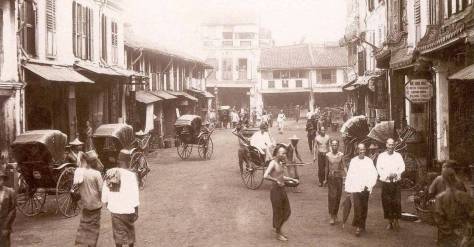
An old photograph of Singaporean shophouses, taken prior to WWII (rickshaws were banned in Singapore in 1945, after the liberation, due to health-and-safety concerns).

An old photograph of Singaporean shophouses, taken prior to WWII (rickshaws were banned in Singapore in 1945, after the liberation, due to health-and-safety concerns).

Shophouses, with their narrow frontages and (usually) multiple storeys, were always designed as terraced housing – cheap, mass-produced identical (or near-identical) dwellings built in long rows, which stretched for whole city blocks. Usually, one row of shophouses backed onto another, with an alleyway down the middle where the nightsoil men could haul away the pans and buckets of human waste each evening, without disturbing the household within. A trapdoor in the outhouse wall allowed easy, unobtrusive access at all times.

Not all shophouses had this feature – which meant having the nightsoil man haul an entire bucket of excrement through the middle of the house into the street outside – in the tropic heat! And remember, please, that nightsoil collection was not regular – it could be as infrequently as every second, or even every third day! The stench was often unbearable!

Lavatorial facilities aside, the shophouse was extremely popular. They could be deceptively large, and if well-ventilated, pretty comfortable, despite their narrow facades.

A similar style of residence was the terraced townhouse. It was similar to the shophouse in basic design, but had a couple of key differences. One was that while the shophouse had the ground floor dedicated to business, and the upper floors dedicated to living-space – townhouses were constructed solely to serve as a residence.

Peranakan-style townhouses. George Town, Penang.

Peranakan-style townhouses. George Town, Penang.

Another feature which set shophouses apart from townhouses (apart from the fact that the front room on the ground floor was used for business), was the presence of the ‘five-foot way’. This was a design feature almost exclusive to shophouses. It was a covered walkway at street-level extending out the front of the house – it was created by the extension of the upper floors over the footprint of the ground floor. This created an overhang and space for a roofed pavement below.

Shophouse windows and balcony, Singapore.

Shophouse windows and balcony, Singapore.

The five-foot way was an idea of Thomas Raffles himself! The idea was that the five-foot way would protect pedestrians from the heat, sun, rain and filth on the streets, and provide then with a safe, sheltered and paved area in which to walk. Although they were called ‘five foot ways’, their width could vary anywhere from five to six to seven or eight feet across.
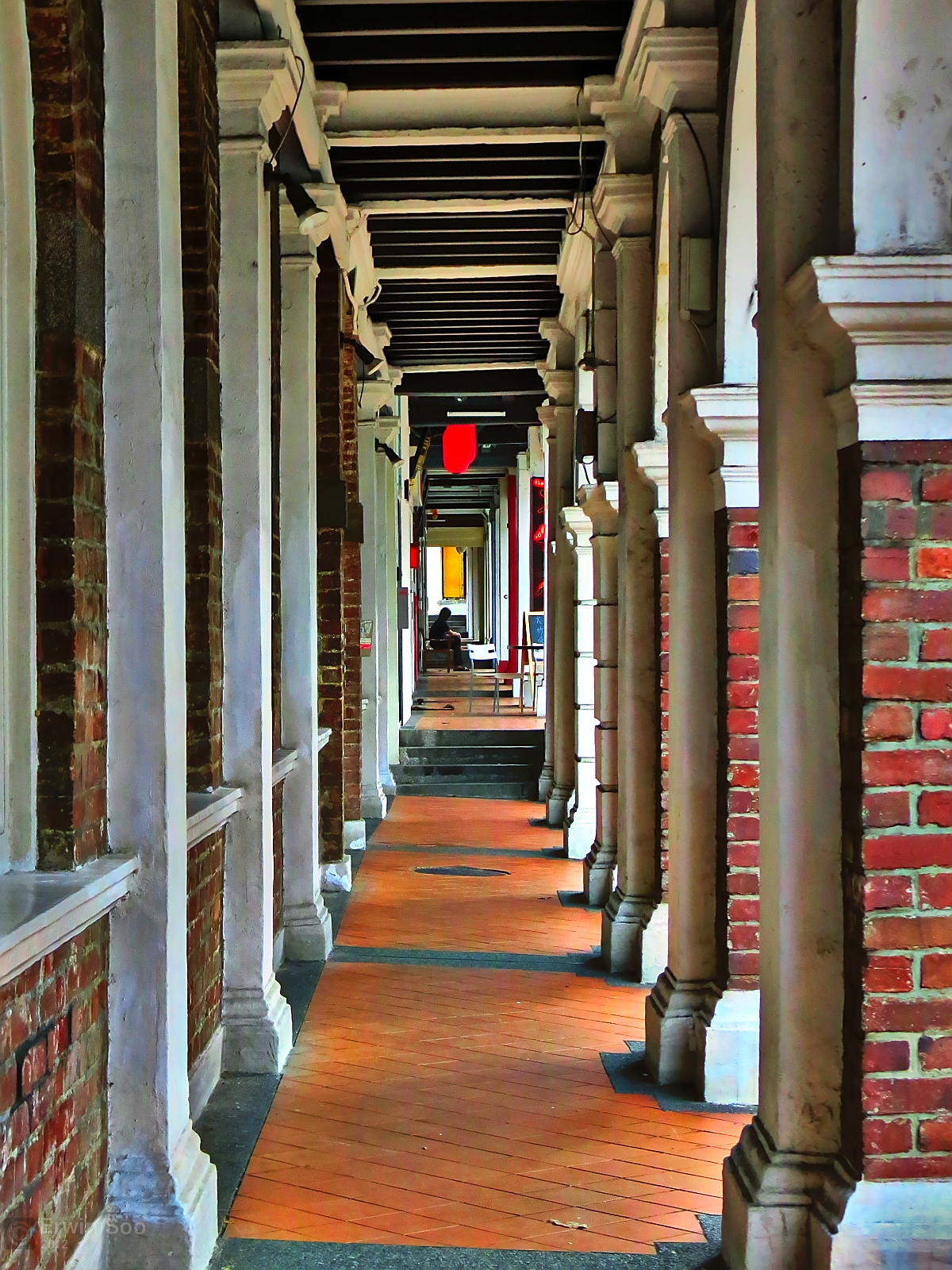
A 'five foot way' in Singapore. Despite the name, these covered walkways were not always five feet wide.

A ‘five foot way’ in Singapore. Despite the name, these covered walkways were not always five feet wide.

A common feature of shophouses and the five-foot way was that the front room on the first floor (which was built over the five-foot way in the street below), would have a removable floor-section about the size of a drinks-coaster. This peep-hole was so that you could see what was going on in the street below, see who might be knocking on your front door, or who might be coming into the shop – a primitive form of video-surveillance and communication!

Almost every shophouse contained a covered peephole in the floor of the upstairs front room, overlooking the five-foot way below. The lid could be lifted up and you could see who was downstairs in the street below.

Almost every shophouse possessed a covered peephole in the floor of the upstairs front room, overlooking the five-foot way below. The lid could be lifted up and you could see who was downstairs in the street below.

My father, uncles and aunts, who grew up in shophouses like these, remember when they were children – if they were too lazy to go downstairs to unlock the front door – they’d chuck the keys down through the hole into the five-foot way, so that visitors could unlock the door themselves! Money for street-hawkers selling fast food or other merchandise might also be chucked down the hole, to pay for goods and services!

Other than that – Peranakan townhouses and shophouses were the essentially same in that they had narrow frontages, were built side by side in long rows, and were usually 2-3 storeys high. Houses of this style were the mainstay of housing in Singapore, Malacca, Penang and other cities and towns during the colonial era, from the 1820s to the 1950s. Today – rows, or entire blocks of shophouses and terraced townhouses are heritage-protected by the Singaporean and Malaysian governments, to preserve their architectural legacy. Entire streets of them may be found in the oldest quarters of Singapore, such as Chinatown.

Peranakan Shophouses and Townhouses

Traditional terraced Peranakan townhouses.

Traditional terraced Peranakan townhouses.

Peranakan families often inhabited shophouses or townhouses such as these – and it was almost always obvious when a Peranakan family had moved in!

A typically Peranakan terraced townhouse was often brightly coloured – painted yellow, blue, green, red, or white. The entrance halls, the front courtyard, five-foot way, and much of the interior of the house would be tiled in exquisite imported tiles which were painted bright colours and patterns. A family motto would be painted onto a plaque fixed to the lintel above the front door, and words from lucky or prosperous sayings would be fixed to scrolls or panels either side of the front door.

Colonial-era shophouses like these were populated by many during the days of the Straits Settlements, but the more heavily decorated and embellished ones were typically designed, and owned by the Peranakan.

Colonial-era shophouses like these were populated by many during the days of the Straits Settlements, but the more heavily decorated and embellished ones were typically designed, and owned by the Peranakan.

Immediately inside the front door was the front reception hall – this was where men did business, greeted guests and held functions, parties and meetings.

Beyond this would be a secondary room, which would serve as a sitting room. Close family friends, visiting relations, or good business-partners might be invited in here to relax and chat.

The next feature was often a ‘lightwell’ or ‘airwell’. This was an open courtyard in the middle of the house which went from the ground floor right up to the top of the house, and which was usually open to the sky. As shophouses were often long and narrow, with houses on either side, there were few (if any) side-windows.

The lightwell brought natural light into the rooms in the middle of the house, and allowed for ventilation, to cool the house down. Rainwater was usually collected in a pool or pond, or was used to water plants. Fish might be kept in the airwell pond, as pets.

More colonial-era shophouses. Most were two storeys (ground floor business with one floor above as residence), but three-storey shophouses, as shown here, became common after 1900.

Beyond this might be the dining room, and then the back parlour, where women (married or not) might socialise and hang out. These kinds of segregations were common in Peranakan society – as with many societies around the world at the time. Here, women would eat ‘nyonya kueh’ (Peranakan desserts), drink tea, and gossip among themselves. Games like mahjong, or the Peranakan card-game – ‘Checkee’, might be played here (both are similar to gin-rummy).

Bibiks and nyonyas often gambled while playing checkee or mahjong using real money or gold (usually taken from the household-expenses fund given to them by their husbands!). It wasn’t uncommon for some women to drive up impressive gambling debts, and they would either pawn, or sell their expensive Peranakan gold and silver jewelry to pay for their addictions.

A table with checkee cards scattered across it. Along with mahjong, this was one of the most popular Peranakan games.

A table with checkee cards scattered across it. Along with mahjong, this was one of the most popular Peranakan games.

To this day, checkee and mahjong are still heavily associated in Chinese culture with endemic gambling. As a friend of mine once said: “If you don’t gamble while playing mahjong, it’s bloody boring!”

Anyway – I digress! Back to houses…

As unmarried nyonyas were not traditionally allowed to be seen, or mingle with men without permission – there were often sliding doors and screens dividing each room. These screens and doors usually had decorative gilt carvings and piercings in them – ostensibly to allow air-flow and ventilation – but they also served a second purpose – to let young girls check out the visitors which their fathers might not allow them to meet!

Near the back of the house would be a room, or a shrine dedicated to the worshipping of one’s ancestors, with offerings of fruit, water and tea, and the burning of incense sticks, as well as possibly having candles or oil-lamps. Photographs or portraits of prominent ancestors might also be included.

At the very back of the house would be the kitchen, bathroom, and toilet. The stove was usually brick-built or made of clay, and fired with wood. Food was stored in wooden food-cabinets or pantries, either propped up off of the floor, or suspended from the rafters in the ceiling. This was to keep it away from insects like ants and roaches, and rats. Food cabinets on the floor were set off of the ground inside ceramic cups, usually filled with water to trap and kill any insects trying to access the food from below.

In larger houses, kitchens were divided into ‘wet’ and ‘dry’. ‘Wet’ was where washing of eating and cooking utensils, ingredients and ceramics would take place, as well as the drawing of water. ‘Dry’ was used for cooking, preparing and serving dishes.

The upper storeys of the house contained bedrooms, communicating corridors, staircases, storage spaces, and of course, the lightwell, with wooden, shuttered windows containing jealousy shutters, which could be opened to permit in air and sunlight, or closed to protect the interior of the house from monsoonal downpours.

Although shophouses were common as the homes of most people in the British Straits Settlements, where most Peranakan or ‘Straits Chinese’ lived, not everyone lived in such accommodations. Then, just as now – those with money wanted something different from what their neighbours had – and exceptionally wealthy Peranakans often built themselves grand townhouses and mansions, using a mixture of local, and imported materials, some coming from as far away as England!

Peranakan Arts and Crafts

The Peranakan or Straits Chinese are famous for many things – their food, their jewelry, their architecture, but possibly most famously – their various arts and crafts. From beading, shoemaking, cooking, silversmithing, carpentry, porcelain, and sewing, Peranakan arts and crafts are famous for their intricacy of design, and the bright colours used in their creation.

Peranakan Beading

Peranakan beading is famous – but also impossibly finicky! Miniscule glass beads – smaller than rice-grains, are embroidered onto a sheet of thin cloth, stretched tightly across a beading-frame. The beads are like the pixels on your computer screen – it takes hundreds – thousands, even! – to make something as tiny as the embroidered upper for a traditional Peranakan slipper.

A Peranakan beading-frame. The lady in the picture is beading the highly decorative uppers for a pair of traditional slippers.

A Peranakan beading-frame. The lady in the picture is beading the highly decorative uppers for a pair of traditional slippers.

Beading was used, not only for Peranakan slippers, but also for handbags, tablecloths and wall-hangings. Thousands, even millions, of tiny, tiny glass beads were woven into the fabric with microscopically thin needles to create scenes of flowers, birds, trees, plants, fish and mythical Chinese creatures. In some cases, the beading even extended to the decorative tassles on the edges of tablecloths and wall-hangings. And every single bead was sewn in by hand!

A Peranakan beaded tablecloth at the Peranakan Museum of Singapore. Tens of thousands of minuscule glass beads were woven together to make this exquisite piece of artwork.

A Peranakan beaded tablecloth at the Peranakan Museum of Singapore. Tens of thousands of minuscule glass beads were woven together to make this exquisite piece of artwork. The entire thing is made of beads – even the tassels on the edges are thousands of tiny beads, all sewn together. 

Along with beading were other pursuits such as sewing and porcelain-making. The most common type of clothing worn by Peranakan women was the two-piece outfit known as a Sarong-Kebaya. These were usually embroidered, woven and sewn by hand at home. If a nyonya, or more likely – her husband – was wealthy enough – then they might own a sewing machine.

Peranakan Porcelain

Sewing and beading was traditionally women’s work. The shaping, spinning, firing and glazing of intricate Peranakan porcelain was traditionally done by men. The item was moulded or hand-shaped, left to dry, and then painted. And then fired. And then painted again. And then fired a second time!

Peranakan tea-tray, complete with pot, and four teacups.

Peranakan tea-tray, complete with pot, and four teacups.

Peranakan porcelain, like almost everything else in the Peranakan world – was marked by their famous intricacy of design. Traditional Chinese-style spoons, bowls, plates, teapots, serving dishes, teacups, vases and the large, ceramic jars called ‘Kamcheng’, were all made this way.

Peranakan 'kamcheng' - the knobs and holes on the sides are so that you can attach a handle (usually made of wire or rope) to the body of the kamcheng and lift it without gripping the smooth sides and accidentally dropping it.

Peranakan ‘kamcheng’ – the knobs and holes on the sides are so that you can attach a handle (usually made of wire or rope) to the body of the kamcheng and lift it without gripping the smooth sides and accidentally dropping it.

Peranakan-style Kamcheng were made in various sizes. From enormous ones the size of pumpkins, to tiny ones the size of rice-bowls. Bigger ones were used for storing drinking-water, and smaller ones for storing food, spices, sauces, and the really tiny ones were for cosmetics like face-creams and powders.

Peranakan Clothing

Peranakan clothing for women usually consisted of a two-piece outfit known as a Sarong Kebaya – the sarong was a long, ankle-or-shin-length tubular, wrap-around skirt, and the Kebaya was a close-fitting jacket or blouse, usually worn over a camisole or other supporting undergarment. Traditionally, these were made by the women themselves. Men either wore traditional Malay or Chinese-inspired outfits, or else wore Western-style clothing.

My late Aunty Noni, dressed in Sarong Kebaya. Ca. 1950.

My late Aunty Noni, dressed in Sarong Kebaya. Ca. 1950.

Neither the kebaya nor the sarong came with any fixtures or fastenings – no buttons, clasps, straps or drawstrings. The sarong was kept together with a metal belt, traditionally made of either gold, or silver. The kebaya was held shut with a series of three brooches linked on a chain, variously spelled either as ‘Kerosang’ or ‘Kerongsang’ (the latter is the Malay spelling). Both are considered correct.

There is some speculation that the clothes were designed this way so that wealthy Peranakan husbands would have to buy their wives flashy jewelry to wear all the time!

On top of that, the sleeves of the kebaya were traditionally much shorter than sleeves worn today – they usually came to only halfway up the forearm, stopping before the wrist. If you look at the photograph of my aunt, you’ll see just how short the sleeves on the kebaya actually are. This again, was to show off any rings, bracelets or bangles which a husband could afford to buy his wife. Flaunting one’s wealth and affluence was very much part of Peranakan culture!

Although now thought of as being ‘traditional nyonya’ clothing, in truth, the Sarong-Kebaya combination only started taking over in the early 20th century, from around the 1910s/1920s, as women looked for a lighter, more comfortable daily outfit, made of thin, breathable materials in the humid atmosphere of Southeast Asia where they lived.

Peranakan Silver and Gold

Peranakan necklace, earrings, belt, rings, and the three 'kerongsang' on their chain.

Peranakan necklace, earrings, belt, rings, and the three ‘kerongsang’ on their chain.

Some Peranakan could be extremely wealthy, and it wasn’t uncommon for Peranakan men to buy jewelry for their wives or sweethearts. Traditional items were rings, bracelets or bangles, necklaces, sarong belts and Kerongsangs. Other items might include watches, earrings, handbags, and long hairpins called ‘cucuk sangul‘, used to secure women’s hair-buns, a popular style of the time.

Peranakan jewelry on display at the Penang Peranakan Museum in George Town.

Peranakan jewelry on display at the Penang Peranakan Museum in George Town.

All these things were made of gold or silver. As all the customers were different, all the various pieces of jewelry were custom-made by a Peranakan silversmith or goldsmith. Because of this, every single piece of Peranakan jewelry was a unique, one-off creation.

Nyonya belt, with a pair of antique keyholders clipped onto it.

Nyonya belt, with a pair of antique keyholders clipped onto it.

That’s not to say that silversmiths, goldsmiths and jewelers did not follow particular styles and designs, which changed and rose and fell with the times, but each piece was always an individual, as different from the next one as it was from the last one.

Peranakan Furniture

Peranakan furniture was almost always made of wood. Influenced by Chinese and local Malay styles, their furniture was typically made of hard, dark woods, usually inlaid with ivory, mother-of-pearl, or patternated with lighter woods on top, or else fitted with marble slabs. Marble was cooling to the touch, making it comfortable to sit on, as well as being attractive to look at. Peranakan furniture comprised of tables, chairs, foot-stools, cabinets, day-beds and couches.

One of the most unique pieces of Peranakan furniture is the pillow. Although this is not any pillow that you’re likely to have ever seen – Peranakan pillows were made of wood!

A Peranakan day-bed. The red and black block on the left is a traditional Peranakan pillow. The black ends were usually decorated with plaques made of gold or silver, which were secured onto the sides with nails.

A Peranakan day-bed. The red and black block on the left is a traditional Peranakan pillow. The black ends were usually decorated with plaques made of gold or silver, which were secured onto the sides with nails.

Peranakan pillows were rectangular or squarish in shape, with round, square, or rectangular ends – which, like almost everything else in the Peraakan world, was highly decorated. Often, pillow-ends were in the form of gold or silver plaques riveted or nailed into the ends of each pillow.

Pairs of Peranakan pillow-ends. They would've been nailed onto the pre-shaped ends of the wooden pillows commonly found in Peranakan households. Wooden pillows were cooler, and did not absorb sweat, like normal pillows would, making them more hygienic.

Pairs of Peranakan pillow-ends. They would’ve been nailed onto the pre-shaped ends of the wooden pillows commonly found in Peranakan households. Wooden pillows were cooler, and did not absorb sweat, like normal pillows would, making them more hygienic.

Peranakan Food

One could hardly talk about the Peranakan without mentioning their food! When I told my relations I was writing this article, it was something that many of my cousins, uncles and aunts were quick to point out, whether they were Peranakan or not!

So, Peranakan food. Where to begin?

Along with clothing, language, home-life, crafts and beliefs, the Peranakan also differed from mainland Chinese in terms of their cuisine. Like almost everything else about the Peranakan – their food was delicious, intricate, beautiful, and time-consuming to produce! While some dishes had clear links back to China, others would’ve been completely alien to the mainland Chinese.

Peranakan food is arguably the most famous aspect of Peranakan culture, and many Peranakan dishes remain famous to this day throughout southeast Asia. Intricate, spicy, beautifully cooked and presented, Peranakan food covers a whole range of tastes across the spectrum from sweet, spicy, cold, hot, tangy, warm, sour and salty.

Peranakan food is traditionally called ‘nyonya cuisine‘, since it was the nyonya (women) who usually did the cooking. The dessert snacks, cakes, buns and biscuits were called ‘nyonya kueh‘ (‘women’s cakes’), and the term is sometimes used as a catch-all phrase for all Peranakan sweet dessert cakes and buns.

So what are some of the more famous dishes associated with the Peranakan?

Rendang, a dry curry usually made of beef or chicken is a perennnial favourite. Although it was Indonesian in origin, it was extremely popular with the Peranakan, who did settle in Indonesia, after all.

A lot of Peranakan cooking is notoriously labour-intensive, and Rendang is no exception. The meat must be slow-cooked and simmered for hours to make it soft and tender, and also to cook the curry sauce that goes with it! These days, you can make rendang with special rendang curry pastes and sauces that you buy from the supermarket, but in the old days, the spices used in the sauces, and the sauces themselves, had to be laboriously ground, crushed and pounded by hand.

Much Peranakan cooking makes extensive use of spices – knowing how to crush, grind and mix them effectively was extremely important, as nyonyas were expected to be good cooks for their husbands. Mastery of the mortar and pestle was an essential part of the nyonya’s domestic education.

That said, the nyonyas were also famous, perhaps even more so, for their desserts!

Popular nyonya desserts include ‘ang ku kueh’, ‘Kueh Lapis’, and ‘ondeh ondeh’. 

Probably the most famous is ‘ang ku kueh‘ – literally ‘red tortoise cake’ – so-called because of its small, oval shape, and the patterns pressed into the surface, making it look like a tortoise’s shell. They have a soft, sweet, chewy, gooey surface, and the interiors are usually stuffed with sweet mung-bean paste.

Antique ang ku kueh moulds. The mould was filled with flour, knocked empty, filled with the prepared balls of dough-and-filling, pressed, and then knocked empty once more, impressing the decorations onto the outside of each dumpling.

Antique wooden ang ku kueh moulds (modern ones are made of plastic). The mould was filled with flour, knocked empty, filled with the prepared balls of dough-and-filling, pressed, and then knocked empty once more, impressing the decorations onto the outside of each dumpling.

Like the rendang, and almost everything else about Peranakan cuisine, ang ku kueh are extremely labour-intensive to make. The filling has to be mixed and pounded into an extremely soft paste. The dough has to be mixed and kneaded until soft. The dough has to be pressed flat and the filling has to be rolled into balls.

The balls are then wrapped in dough and then pressed into intricately carved moulds to shape and decorate them. The moulds are dusted in flour before each pressing. They’re then slammed onto the table to release the freshly-pressed kueh onto banana-leaves which you pre-cut, and brushed with olive-oil earlier on!

…that’s the process to produce ONE ang ku kueh, about the size of a golf ball.

Imagine how long it takes to produce three or four dozen for a formal dinner party…without modern food-processors!

Another popular nyonya dessert is ‘ondeh ondeh’, sweet little dough-balls rolled in crushed coconut, and filled with an extremely sweet palm-sugar syrup. These things are about the size of large marbles and can be eaten warm or cool. Biting into one causes a flood of sweet warm or cold palm-sugar syrup to go all over the inside of your mouth – and it is amazing!…just don’t tell your dentist!

Ondeh-ondeh - delicious beyond measure, even if excessive consumption is likely to corrode your teeth in a hurry!

Ondeh-ondeh – delicious beyond measure, even if excessive consumption is likely to corrode your teeth in a hurry!

As delicious as they are, like the ang ku kueh before them, these are extremely labour-intensive and time-consuming to produce! Snacks like these were often served only during really special events, or when guests were present, just because of the effort required to make them.

‘Kueh lapis’, literallly ‘layered cake’, is another popular Peranakan dessert – comprised of thin layers of sweet pastes made from various fruit flavourings (pandan leaves, coconut, etc), they are poured one on top of the other, and steamed in a wok to cook them. The result is sweet, gooey, and multicoloured!

When the cake is sliced open, a rainbow cross-section of anywhere from two to three, to half a dozen or more colourful layers present themselves, each one a different flavour. The cakes are usually served in square, rectangular or diamond-shaped slices, each one bite-sized for convenience.

Although nyonya cuisine was very different from mainland Chinese cooking (you try finding rendang in Beijing…go on! I dare you!), as ever, the Peranakan still held onto some vestiges of ancient Chinese beliefs. One of these was the yearly offerings of ‘nian gao’ (‘year cake’, or new year’s cake) to Zao Jun – the Chinese Kitchen God. In traditional Chinese homes, and many Peranakan homes, there was usually an alcove, shelf or cabinet which served as a shrine to the Kitchen God, said to be the spirit of a Chinese peasant who committed suicide by climbing into a burning stove.

Giving offerings to the Kitchen God ensured that he would rise to Heaven each New Year giving a sweet and palatable report of a family’s activities, graces and sins to the Jade Emperor, encouraging the Emperor to bless the family with good fortunes for the year ahead. Religious and superstitious nyonyas would pray to Zao Jun for good health and nutrition from the food cooked in his presence.
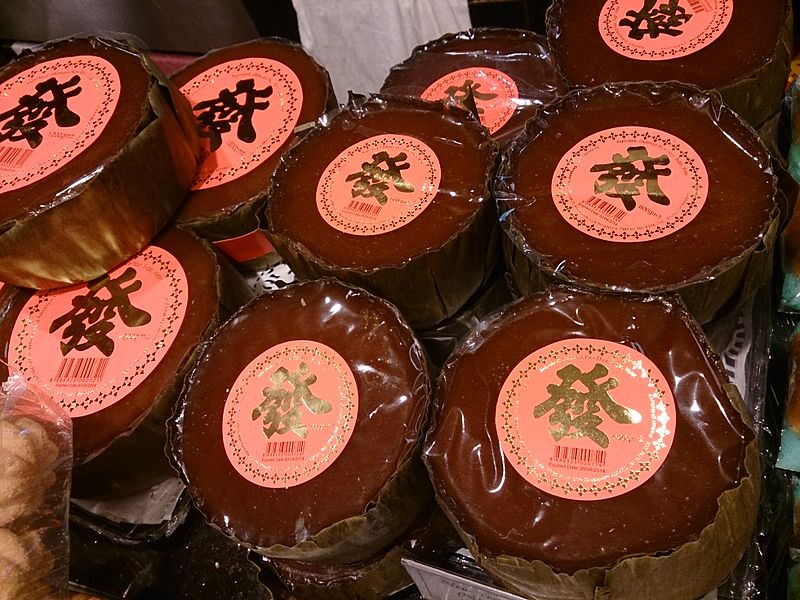
Chinese 'nian gao' or New Year's Cake.

Chinese ‘nian gao’ or New Year’s Cake.

Honey, or Nian gao was often given as an offering because it is extremely sweet and notoriously sticky! If you’ve ever eaten it, you’ll know how tricky it can be to actually chew it. It’s so incredibly sticky that you’ll spend ten minutes just trying to lever your mouth back open with a pair of chopsticks! Gluing Zao Jun’s jaws shut with cake was one way to ensure he wouldn’t be able to tell the all-powerful Jade Emperor about any misdeeds done by the family!

Transporting Food

If, for any reason, a member of the family needed to transport food (lunch for school, a picnic, taking food home, or taking food to a friend’s house, for example), then they likely carried them in a tiffin carrier. Peranakan tiffin carriers were typically made of thin, pressed steel, and coated in brightly-coloured enamel paint, which was then fired on so that it set solid. Additional decorations of flowers, birds, and lettering of various auspicious sayings (usually in Malay) were added around the outside.

Antique Peranakan tiffin-carriers (three on the right) are immediately distinguishable because of their bright colours, and floral decorations.

Antique Peranakan tiffin carriers (three on the right) are immediately distinguishable because of their bright colours, and floral decorations.

Tiffin carriers were usually of anywhere from two to five layers in height, although some extreme ones could be half a dozen or more!

Peranakan Society

In the racially-segregated and class-conscious society of the Straits Settlements, in many respects, the Peranakan stood out much more than some other social and ethnic groups. With backgrounds in fields as diverse as shipping, retail, import-export, banking, education, and real-estate and construction (those beautiful Peranakan homes didn’t build themselves!), the Peranakan were much better off than many other social and ethnic groups in colonial British Singapore and Malaya.

Because of their relative affluence, the Peranakan were able to afford things that other ethnic groups in the Straits Settlements could not – such as education in the English language – many Peranakan spoke either Cantonese, Hokkien, or Malay (usually at least two of those three), but those who could afford it also learned English as a second or third language – often becoming extremely fluent. My own grandmother spoke Malay, Cantonese, Chinese, Hokkien as well as being fluent in English! She spent her childhood being educated at a convent-school in Singapore, from 1921-1926.

Because of their command of the English language, Peranakan men (Babas) often had an advantage over other ethnic and cultural groups in the Straits Settlements. Because they spoke fluent English, but were also fluent in many local languages, they were able to translate and interpret orders and information with minimal mistakes. This fluency in languages as well as their own familiarity with local customs meant that the British often appointed babas to important government and civic positions.

The Peranakan ran the civil service, they ran Peranakan societies, they operated schools, and were often captains of industry, finance, government, commerce and high society! Some Peranakan men even became ‘Capitan Cina‘ – Chinese Captains. This was the title given to civic and community leaders in the Chinese community. The titles, and the jobs which came with them, varied depending on time and place.

In some instances, the title was more or less honourary – but in others, capitans held significant legal and political authority! Wealthy capitans who represented and worked for their communities often tried to give back to their fellow Peranakan by establishing benevolent funds, welfare projects, and funding public works projects for the improvement of their communities.

The Peranakan and the Sinkeh

By the mid-1800s, the Peranakan were well-established in the prewar British colonial society that existed in the Straits Settlements. A significant number held positions of wealth, authority and power, running, or funding civic institutions and helping to operate the local governments and communities, working and trading with the British colonial administrators.

The Peranakan had been living in what became the Straits Settlements for centuries! In some cases, two, three, or even four hundred years! Generations of them had grown up and died in this world. The Straits Settlements was their home! They were Peranakan and in their mind – the Peranakan lived in the Straits Settlements – working with, and protected by, the British colonial government, and the might of the Royal Navy and the British Empire. They were not going anywhere, thank you very much!

…And then came the arrival of the ‘sinkeh‘…

‘Sinkeh’ (pronounced ‘sin-kay’) was a term used to refer to the thousands of Chinese peasants, migrants and indentured labourers who fled China between the 1800s-1950s, trying to find new homes in Southeast Asia. They were fleeing things like the Taiping Rebellion, the Boxer Rebellion, the Chinese Civil War, famine, disease and natural disasters. Many sold everything they had for a ticket on a junk which would sail from China to the Dutch East Indies, or the British Straits Settlements to the south.

The word ‘sinkeh’ is a corruption of the Chinese words ‘Xin Ke‘ (‘New Guest’), a reference to the fact that these people arrived in Singapore, Malacca, Penang and other colonial bastions within the last few decades, whereas the Straits Chinese had been living there for dozens of generations! And despite the name given to them – they were hardly treated as guests!

Quite often, sinkeh were looked down upon by the well-entrenched Peranakan. The Straits Settlements was THEIR HOME! They’d lived here for countless generations – in some cases, dating all the way back to the 15th century! They were slow, if ever, to fully accept, or even embrace the presence of the sinkeh.

The sinkeh often carried out menial tasks and occupied themselves with what was called ‘ku li‘ – Bitter Labour – which became the English word – ‘Coolie’. Sinkeh were often night-soil men, street-hawkers, shoemakers, construction-workers, and general unskilled labourers. Perhaps their most famous jobs were as longshoremen – unloading cargo-ships and depositing their wares into warehouses, or as rickshaw pullers.

Many sinkeh coolies plied the labour-heavy, exhausting trades, such as being a rickshaw puller.

Many sinkeh coolies plied labour-heavy, exhausting trades, such as being a rickshaw puller.

Both these jobs were backbreaking, exhausting and dangerous, and they earned little more than a pittance. The wages earned by migrant rickshaw pullers between 1880-1930 hardly changed in fifty years. Many sinkeh fell to the vices of prostitution, gambling, and most famously of all – Opium.

Antique opium paraphernalia, including two pipes, a number of bowls, and a small opium-lamp (for heating the opium), all set on a tray. Opium had been a scourge to the Chinese people for centuries.

Antique opium paraphernalia, including two pipes, a number of bowls, and a small opium-lamp (for heating the opium), all set on a tray. Opium had been a scourge to the Chinese people for centuries.

By comparison with the Sinkeh, the Peranakan were tailors, shopkeepers, teachers, government officials, social and community leaders, artisans, silversmiths, craftsmen, businessmen, the owners of rubber-estates…the list was almost endless! My own grandmother was a dressmaker for almost half her life! Her brother was a pharmacist who operated an apothecary out of the ground-floor of the family shophouse…where my uncle still lives.

The family's old shophouse. This used to be where my great-grandmother lived, and where my uncle still lives. My grand-uncle's pharmacy was on the ground floor (down the stairs, and to the left). The shutters on the left, the staircase and the long, narrow profile were common features of prewar shophouses like this.

The family’s old shophouse. This used to be where my great-grandmother lived, and where my uncle still lives. My grand-uncle’s pharmacy was on the ground floor (down the stairs, and to the left). The shutters on the left, the staircase and the long, narrow profile were common features of prewar shophouses like this.

Given the massive differences between the Sinkeh and the Peranakan, you can understand the latter’s reluctance to be mistaken by the British (or anyone else!) as having absolutely ANYTHING in common with these ‘new guests’ from China! Many sinkeh often encountered open hostility and discrimination from the Peranakan, who were in most cases, completely unwilling to have anything at all to do with them!

The Fall of the Peranakan

The world in which the Peranakan lived was a world on borrowed time. For hundreds of years, the Peranakan had lived on the Malay Peninsula and Singapore with the Malays, Indonesians and Indians who also cohabited the long, narrow strip of land, and tiny island on its southern tip.

In the 1800s and 1900s, they took on a modified identity as the ‘Straits Chinese’, living alongside the Strait of Malacca, the Strait of Johore, and within the protection of the British Straits Settlements, under the governance of the British Empire.

For the most part, they co-existed peacefully with everyone else, and were among the most prominent ethnic groups in the Settlements. However, as the 20th century dawned, the Peranakan world started coming under attack from outside forces. By the 1930s, the traditional Peranakan home-life, and the arts, crafts and industries which they had kept alive for generations were starting to disappear.

The reasons for this were numerous. Outside influences from the West (movies and radio, for example), exposure to other cultures (some Peranakan traveled to Europe on massive, eight-week steamship voyages to study in British schools and universities), and exposure to new ways of living all affected how the Peranakan lived and worked.

The Peranakan, both nyonyas and babas prided themselves on their various traditional crafts. These were beautiful, but also time-consuming, labour-intensive, and difficult to learn. And more often than not, there is no automation process. Peranakan handicrafts cannot be mass-produced by machines.

The only way to keep them going is to pass down the skills from generation to generation. Silversmithing, pottery, carpentry, cabinetmaking, beading, sewing, embroidery, cooking, shoemaking, etc. From father to son, mother to daughter, grandfather and grandmother to grandson and granddaughter.

As the culture and lives of the Peranakan are steadily affected by outside influences and the Great Depression, in which many once-wealthy Peranakan families lose their fortunes, when the bottom falls out of the rubber market, it only takes one more sharp blow to finish many of them off.

The Japanese Invasion

 That blow came on the 7th of December, 1941. The day which lived in infamy. The day on which Imperial Japan attacked Hong Kong, Malaya, the Philippine Islands, Pearl Harbor, Guam, Wake Island, the International Settlement of Shanghai in China, and quite literally overnight – started a war.

Between December of 1941 until February of 1942, troops of the Imperial Japanese Army swept down the Malay Peninsula, occupying the various settlements, states and cities along the way, outmanouvering or overpowering British and colonial troops as they try to fight back the enemy.

Singapore falls in a matter of days. Despite a numerical inferiority, the Japanese were able to move fast and strike effectively. They achieved mobility and speed on bicycles and tanks, neither of which were used by the British, which put them at a distinct disadvantage. In a few short weeks, all of British-held Malaya and Singapore is in the hands of the Japanese.

As the Japanese pass through Peranakan enclaves heading down the peninsula, civilians take whatever they can pack, carry and push, and flee for Singapore. The British dynamite every bridge they can find in an attempt to slow down the Japanese. They even blast the causeway bridge between Johor and Singapore to buy them more time.

The Japanese marching through central Singapore in 1942.

The Japanese marching through central Singapore in 1942.

By now, anybody who can find an ocean-liner, yacht, tramp-steamer or any other form of water-transport hurriedly evacuates from Singapore City as fast as they can. Official evacuations organised by the British are only for British expatriates and other foreign nationals. The Peranakan have to fend for themselves or arrange their own escape as Singapore collapses around them. Anyone left behind after the last boats leave will have to contend with three and a half years of Japanese occupation.

The effect of the Japanese occupation was crippling. Between air-raids, fighting, chronic food-shortages, rationing and other deprivations, the Perankan were unable to continue the lives that they had built up over the preceding decades and centuries.

When the war ended in 1945, a long period of rebuilding began, but the old ways were lost forever. Their lives had changed so much by everything, and so many people had died, or been killed in the occupation that the ways of life and the structures which the Peranakan were familiar with were fast disappearing.

Coupled with wider outside cultural influences, overseas immigration, travel and the desire to break away from the lives shattered by the Japanese, the Peranakan started to fragment and spread. In the chaos of war, many arts and crafts which the Peranakan prided themselves on had been lost. The very skills on how to carry on these crafts were wiped out in the war.

Intricate beading, embroidery, how to create certain architectural decorations and details, lantern-making, porcelain manufacture…one by one these skills and crafts, for centuries prided by the Peranakan…were dying out. People no longer had the time, the money, the patience, or the interest to take up trades and crafts which took a lifetime to learn, and which was appreciated by an ever-dwindling pool of people. Many elements of Peranakan culture did not survive the war, and today, fewer and fewer people take up the crafts and occupations of their forefathers.

The Peranakan Today

The hell of the Japanese occupation forced the Peranakan to spread out around the world. The inadequacies of the British defenses in Malaya and Singapore had shown the ‘native populations’ that they could not rely on Europeans for their survival and protection. The Peranakan families which stayed in the Malay states or Singapore gradually melted back into mainstream society, away from the heightened perch which they had enjoyed under the British as ‘the king’s Chinese’.

That said – there is an increasing interest in the Peranakan in the 21st century. More women are interested in Sarong-Kebaya outfits, old townhouses and shophouse are being restored, or turned into Peranakan museums. Collecting Peranakan jewelry, porcelain, beaded goods and other handicrafts is slowly increasing.

Two books of my grand-aunty Sylvia's artwork, given to me by the author. She autographed them both!

Two books of my Aunty Sylvia’s (Sylvia Lee Goh’s) artwork, given to me by the author. She autographed them both! There was an exhibition of her paintings about nyonya at the National Gallery of Malaysia in Kuala Lumpur earlier this year, 

The sheer rarity of the Peranakan culture, and the people who made it possible, is what is driving up interest in this once prominent ethnic group. The fact that people can’t find out as much about the Peranakan as they’d like to, is part of the reason why so may people are interested – it’s the mystery of the unknown.

Today, many people with Peranakan roots are trying to revive their lost culture. All over the world, from Singapore, to Malaysia, to Australia, to even further afield – even the United States!…there are Peranakan or Straits Chinese associations, clubs and societies, where people with Peranakan heritage can meet and exchange information.

There’s also been a resurgence in interest in Peranakan crafts such as beadwork and porcelain, and some jewelry firms have started making traditional Peranakan jewelry (such as the Kerongsang) for commercial sale. Peranakan antiques are rising significantly in value as people learn to appreciate their cultural and historical significance.

That said – the one thing about Peranakan culture that has never really gone away is traditional nyonya cuisine – Peranakan food! Restaurants serving traditional Peranakan food have popped up all over Singapore, Malaysia, and Australia in the past few years…there used to be one down the road from my house!

Closing Remarks

In finishing, I would like to dedicate this article to the memory of my grandmother – Bertha Fu Kui Yok (1914-2011), her mother, my great-grandmother, Leong Ah-Hiong (ca. 1885-1984), and to their family, whose lives inspired the creation of this article.

Where can I Find out about the Peranakan?

Due to the small geographic area which they lived in, the Peranakan can be tricky to find information about. However, excellent museums and restored historic houses do exist in Malacca, Penang and Singapore. Peranakan associations and clubs exist wherever large numbers of Peranakan tend to congregate – especially in Malaysia, Singapore and Indonesia.

Acknowledgements

Thanks to the various members of my extended family for their assistance with this article! Thanks to…

…Cousin Joyce, for her help with betel nuts!

…Uncle Charles, and other relatives, for the family photographs!

…Aunty Sylvia, for providing information on the Peranakan, and signed copies of her books on Peranakan paintings!

…Cousin Carolyn, for her help with nyonya cuisine!

Thanks also, to the wonderful volunteers at the Peranakan Museum, on Armenian Street, Singapore, and to the incredible Peranakan Mansion, in George Town, Penang. Without these two incredible institutions, it would’ve been impossible for me to photograph so many Peranakan items in one place!


Share this:

  • Share on X (Opens in new window) X
  • Share on Facebook (Opens in new window) Facebook
  • Share on Pinterest (Opens in new window) Pinterest
  • Share on Tumblr (Opens in new window) Tumblr
Posted in 19th Century, 20th Century, Cultural & Social History, General History
18 Comments
10/10/2016 by Scheong

Unlocking the Past: Straits Chinese Keyholders (ca. 1890)

On the last day of my trip through Malaysia, Singapore and Tokyo, Japan I decided to make the most of the last few hours that I had before making the customary mad dash for the airport at the eleventh hour.

To make this a reality, I as usual, headed out bargain-hunting! I wasn’t expecting to find anything – antiques in Malaysia are usually pretty pricey and outrageous as far as value for money goes. But with nothing else with which to occupy my time, I went hunting anyway.

I’d spent about an hour or so at the Amcorp Mall flea-market (the only such market really worth visiting in KL), and was beginning to give up hope until I took a detour into a shop called “Teh Collectible” – big red sign with swirly, yellow letters on it.

The shop was jammed with all kinds of antiques, from suitcases to typewriters, sewing machines to cameras, tiffin-carriers, furniture and all kinds of dusty, kitchy junk. The display-cabinets were full of all kinds of miscellaneous bric-a-brac, from watches to porcelain and novelty drinkware.

In amongst all this detritus, I stumbled across a pair of nondescript yellow-metal items. I freely admitted that my heart skipped a beat – I knew what these things were – but I also knew that they were rare, and therefore, likel to be expensive. Like I said, most antiques in Malaysia are heavily overpriced.

Anyway, I tried my luck and after a lot of haggling, I was able to chip down a third off of the price, and came away with these:

Never seen them before? No idea what they are? Curious? Interested? Intrigued?

I’m sure you are! After all, these haven’t been made in about 100 years! But what are they? Earrings? Brooches? Hairclips?

Not even close!

What we’ve got here is a pair of Straits Chinese or ‘Peranakan’ keyholders! I wouldn’t be surprised if you’ve never heard of,  or seen them before – most people haven’t. Even those of us who are into antiques! So how do they work? What do you do with them? Why do they even exist??

Peranakan Keyholders – What are they?

Keyholders like these were made by Peranakan ‘baba’ silversmiths and goldsmiths for the Peranakan communities of southeast Asia – specifically those living in Singapore, Malaya and the Dutch East Indies. The Peranakan were famous for their desire to decorate and ornament everything that they owned – even their keyrings!

Keyholders like these are made up of a repousse frontpiece, a flat backpiece, a free-hanging keyring, and a long, flat fastening hook or clasp on the back, used to attach the keyholder to one’s clothing.

How do they work?

Keys were fitted onto the ring at the bottom of the holder. The long metal clip on the back of the holder was slipped onto a person’s belt, or the hem of their trousers, if they were men, or skirts – usually a sarong – if they were women. Here, the keyholder would remain until it was needed. Obviously holders like these could only hold a few keys at a time, but as with most things Peranakan – form tended to come before function. How pretty an item appeared was just as, or even more important, than what it actually did!

The keyholders clipped to my grandmother's nyonya belt. This is how such accessories or pieces of jewelry would've been worn by the Peranakan, back at the turn of the last century.

The keyholders clipped to my grandmother’s nyonya belt. This is how such accessories or pieces of jewelry would’ve been worn by the Peranakan, back at the turn of the last century.

How old are they?

Keyholders like these became redundant with the increasing embracement by the Peranakan, of European-style clothing. Trousers and shorts with pockets, and different styles of dressing made such accessories and trinkets  as decorative keyholders unnecessary, and by the second quarter of the 20th century, only Peranakan men or women who still retained more traditional dress-styles would’ve been able to wear such keyholders with their outfits.

This being the case, Peranakan keyholders like these would’ve dated from the late 19th century up to around 1910 or 1920. Hallmarked silver Peranakan keyholders which I’ve seen online have been dated back to the 1890s. Keyholders were unlikely to have been made beyond the start of the 1930s – the Great Depression hit many Peranakan fortunes hard, and it would’ve been hard to justify spending so much money on a keyholder!

What are they made of?

These specific keyholders are made of copper or brass, but Peranakan keyholders were also made of silver – sometimes gilt (plated in gold) to make them more attractive. Many keyholders included intricate repousse designs to their fronts, and elaborate decorations to the fasteners or hooks behind them. Holders made of silver would’ve been manufactured in the Peranakan enclaves of Singapore, Penang and Malacca. They usually had Chinese-style hallmarks stamped onto the clasps at the back, generally composed of the fineness mark denoting purity of silver, and the silversmith’s maker’s mark in Chinese characters.

Although you could buy, or have commissioned just one keyholder, they also seemed to have been sold in sets. The ones I have are a matched pair. That said, most of the others which I’ve seen online appear to be singles, each one of a unique and individual design, made of either gold, silver or copper. The sheer variety of styles in which something as simple as a key-hook could come in just shows the incredible levels of artistry to which Peranakan silversmiths and jewelers could reach.

Closing Remarks

Anyway. There we have it! Peranakan keyholders! So, are these things rare? Special? Unique? Why am I writing about them?

I’m writing about them because my grandmother and her family were all Peranakan, and their culture has fascinated me ever since I was made aware of this fact. Peranakan antiques are getting incredibly rare these days, and I really wanted to try and collect and preserve all that I can find.

Peranakan porcelain, silverware, clothing and jewelry are all pretty rare, but even if they are rare, some items are still better-known than others. Slippers, kebaya, sarong, belts, kerongsang (sets of three brooches on a chain) and tiffin-carriers are pretty well-known Peranakan antiques – keyholders on the other hand?? Not so much! That’s why I felt that they were deserving of their own post! I hope you enjoyed this and that you’ll return again soon! I’m always looking for new things to write about and post.


Share this:

  • Share on X (Opens in new window) X
  • Share on Facebook (Opens in new window) Facebook
  • Share on Pinterest (Opens in new window) Pinterest
  • Share on Tumblr (Opens in new window) Tumblr
Posted in 19th Century, Antiques, Cultural & Social History
Leave a comment
26/09/2016 by Scheong

Tarnished Treasures of the Orient – Antique Brass Tiffin Carrier!

As I write this, I’m sweltering and suffering under the obscene heat and humidity of the South Pacific. And no, I’m not talking about a certain 1950s musical created by Messrs Rodgers & Hammerstein, but rather, the oppressive climate of Malaysia and Singapore, where I’ve been seconded to light duties – AKA – on vacation!! :p

I’m actually here visiting relatives and taking in the sights – some of which I’ve seen loads of times before, but which are always worthwhile taking in again – for any number of reasons, which I won’t elaborate on – not in this posting, anyway!!

No! No, the reason for this posting is because of what happened a few days ago. I was lucky enough in my first few days in Malaysia to visit the Amcorp Mall sunday flea-market in Kuala Lumpur. For those of you who love old nicknacks, antiques and bric-a-brac, the Amcorp Mall flea market really is a lovely place – for one thing – it’s indoors, and it’s air-conditioned – even if, as my cousin said – it’s really a place where one should look and not intend to purchase!

Whatever!! My cousins and I went there and had a thoroughly enjoyable time, perusing the antiques and bric-a-brac, toys, computer-games, DVDs, brassware, watches, and other things which the dozens of sellers had, spread over many tables over three floors of the Amcorp Mall department store. And after spending about two hours there, I came away with this:

Antique brass tiffin carrier. Ca. 1900.

Antique brass tiffin carrier. Ca. 1900.

A very friendly and well-spoken elderly Indian gentleman sold this to me. He had a table loaded with all kinds of antique brassware and enamelware, including about half a dozen antique tiffin carriers of different sizes and styles.

My eyes were jumping back and forth between a big brass one, and a rather worn-out, sky-blue enamel affair with obvious links to the Straits Chinese community of Malaysia and Singapore – a subculture which I’ve long had an interest in, because of my own family history. They say a fool’s born every minute, but apparently this guy was born between fools, because he wasn’t stupid enough to not know what it was – and how valuable it was! He had a whopping price on it which was probbly justified, given its rarty, and I knew I’d never be able to get it, despite the deepest yearnings of my heart.

Heart-yearnings aside, I decided that I had to come back down off of my cloud and face reality back here on earth. I knew I couldn’t reasonably afford the Straits Chinese one, as much as I desired it, and my heart, mind and eyes turned towards the next best thing – an enormous, four-tiered antique brass affair!

There was no denying it – this tiffin carrier was pretty awesome as a runner-up. It contained four large, stacked bowls, and a lid with a built-in cup – originally for pickles – but which could be used for any condiment – chili paste, raw chili, garlic, etc. The insides of each compartment were lined in tin, and the exterior was solid brass, as was the frame, and the handle.

Although in need of some TLC, some polishing, reshaping and dent-removal, I could see potential in this piece – as well as being a good bargain. Using my nearby relations to my advantage, I was able to weedle down the price, and the seller eventually relented, agreeing to our offer. He was very gracious about the whole affair, and thanked us for our patronage.

I’ve been after a quality, working antique tiffin carrier for many years now. The problem is that they’re very hard to find in good condition – all too often the brass ones are cracked, dented, warped, broken, missing pieces, or have MASSIVE prices on them. The enamel ones are either cracked, rusted through, broken, or – like the brass ones – have enormous prices on them! It makes it difficult to find good ones at good prices. This one however – was a good one at a good price – I simply couldn’t let it get away!

So, what is tiffin…?

‘Tiffin’ is an old Anglo-Indian word meaning ‘light snack’ or ‘nibbles’, but over time, the word ‘tiffin’ evoled to mean ‘luncheon’, whereby ‘tiffin time’ meant the time for a light, refreshing midday meal. It would consist of cakes and scones, curries, rice, noodles, and local snacks common to Malaysia, Singapore, India, and many other places in southeast Asia.

…right…so what’s a ‘tiffin carrier’?

Well, if tiffin is your midday meal, then your tiffin carrier is the container you carry it around in! But tiffin carriers are not thermoses, and they are not lunchboxes – not in the conventional way, anyway.

The modern tiffin carrier, of the kind used since the 1800s, and which is still made today – evolved from an older form of device comprised of bowls stacked up and held together with a supporting framework. The idea is that each bowl or compartment held a different component of the whole meal – rice, curry, vegetables, sauces, soup, or buns, rolls, tarts and cakes – it all depends on what the food is.

My four-tier brass tiffin carrier, with condiment-container on the lid. The brass frame keeps everything braced and firm when it's being transported.

My four-tier brass tiffin carrier, with condiment-container on the lid. The brass frame keeps everything braced and firm when it’s being transported.

Tiffin carriers were traditioinally made of a variety of materials – wood and porcelain were popular for domestic models – but for ones designed to be carried around (as most of them are), the usual materials were tin or nickel-plated brass, or enameled steel. Plain steel would rust far too readily in the tropics, so it was coated in enamel paint and then fired in a kiln to harden it, to create a thick, protective layer over the steel to prevent damage, wear, and contamination of food.

Modern tiffin carriers are still made of enameled steel, and brass, but you can also find them in plastic, and stainless steel as well.

Where were tiffin carriers made?

Tiffin carriers are most commonly associated these days, with India, where they are definitely still made (as well as Thailand), but they were made all over Asia – and indeed, a number of them were actually made in Europe, and shipped out to Asia!

How were tiffin carriers used?

The securing clamp was released from the top or sides of the tiffin carrier. The lid was removed, and then the individual bowls were lifted out – this could be tricky, as they’re meant to be sealed really tight! Once the bowls are separated, they’re filled with their respective foods or condiments – and then they’re re-stacked in the correct order, then they’re clamped back down to hold everything in place – some carriers have holes in the securing clamps to put bolts or locks through, to stop things accidentally springing open during transport!

Usually, foods like noodles and rice go down the bottom – components like meat, veggies or curry go in the middle, and soup, sauces and condiments go up the top – this is so that during carriage, the wet components don’t slosh and slop around so much, since they’re closer to the handle and further away from the base – which will move much more significantly if the carrier sways back and forth during transport.

packing and transporting food like this has a few advantages over the lunchbox and the thermos, which is why it’s remained popular for so long – and why they’re still made today!

For one – the various food components are kept separate – rather than mixing and mingling and contaminating each other with their flavours, like in a lunchbox or thermos – this allows you to carry a wider range of foods.

For another thing, the fact that each compartment becomes its own individual bowl means that you can eat out of a tiffin carrier in a much more comfortable way than a thermos, not having to pour things out or dig down a steel pipe to get your food out!

For a third thing – having the food compartmentalised like this means that you can share food amongst family or friends (with as many bowls as your tiffin carrier has – some have as few as two, most have three or four, some of the really big ones have five and up!), without fear of cross-contamination between the servings.

Closing Remarks

I’m so thrilled to be able to add this piece to my collection. Once I get home, I can’t wait to fix it, clean it and put it on display. When that happens, I’ll surely have a follow-up posting to this one! So keep an eye out for something showing up around mid-October!


Share this:

  • Share on X (Opens in new window) X
  • Share on Facebook (Opens in new window) Facebook
  • Share on Pinterest (Opens in new window) Pinterest
  • Share on Tumblr (Opens in new window) Tumblr
Posted in Antiques, Cultural & Social History, General History, History of Food
1 Comment
09/09/2016 by Scheong

Back to School: A History Lesson at the Archives

A few weeks ago, I wrote a blog-entry about an old 1930s cigarette-lighter I found at my local flea-market. Although it was rather worse for wear, I was able to pull it apart, clean it, put it back together and with a bit of cotton-wadding, a fresh wick, a new flint and a squirt of lighter-fluid, was able to get it working again.

I recently got a chance to head back to my old school, and while I was there, I got the chance to visit the archives. Many thanks to Paul, the school archivist, for giving me such a detailed tour of the archives and the various record rooms filled with all kinds of historical papers and records from the school’s past.

I fully admit that the main purpose in heading to the archives was to get a better idea about the history and context of the lighter that I’d found:

It had my school’s coat of arms on it, and I wanted to know why. In going to the archives, I wanted to find out more about it, and the sort of world it came from.

The school’s museum didn’t provide a direct answer, but it did show me that old school-branded merchandise was not nearly as rare as I had first supposed. I was surprised to see that there quite a lot of school branded objects on display, including crockery, napkin-rings, an ashtray, cigarette cases, books and educational equipment, and various other pieces of bric-a-brac donated to the school over the course of many years.

Modesty forbid, but while I had known that Scotch has long had a reputation for being a rather prestigious private school, and rather an old one, I’d never realised the extent to which it went, when it came to merchandising! Nor how far back this merchandising went.

A selection of 1930s cigarette lighters, bearing the school's coat of arms. My lighter is bottom right.

A selection of 1930s cigarette lighters, bearing the school’s coat of arms. My lighter is bottom right.

One of the things I saw was a selection of antique cigarette lighters, most similar in one way or another, to my own. None of them were in working condition, but I was surprised about the extent to which the school went in selling branded products to its students, parents, and presumably – schoolmasters, back in the 1920s and 30s.

In walking through the archives, I saw all kinds of tantalising hints of the school’s history, and the sort of institution it started out as. Most of the artefacts dated to around 1916-1926, the ten-year period during which the school moved to its current campus in Hawthorn, in the eastern suburbs of Melbourne. It never really dawned on me until now, just how much Australian schools tried to model themselves on the old ‘public schools’ of England, like Eton, Harrow and St. Peter’s. They even had the boater hats!

Old Scotch College boaters. The badges on the hat-band could be removed and changed. A whole system of badges used to exist, reflecting the different student-rankings.

Paul said these classic icons of summertime headwear came and went over the decades, finally dying out after the Second World War. Apparently, some students still wear these during specific sporting events (rowing races, and so-forth), but it’s been many decades since they were a regular part of the school uniform.

Talking of things which didn’t stand the test of time, here’s another one: the school dressing gown! Bright red with decorative piping on the cuffs…wow!!

School dressing-gowns! These were worn by the boarders who resided in the school’s boarding-houses up on The Hill, at the far end of the campus.

That’s something you definitely don’t see every day!

Here’s some of the other school tobacconalia that I found:

Here we’ve got a tobacco jar, with its airtight lid, an ashtray, a matchbox holder, and a school-badged bottle-opener, which I thought was pretty neat. In the corner you can also see a cigarette case. One thing that Paul said they got a lot of was crockery and china, which you can actually see quite a lot of:

I’d like to imagine that these things were used up in the boarding houses, or in the staff-room or the headmaster’s residence, back in the 1910s and 1920s. Most of the stuff is from the 20s or 30s, easily dated by the school coat of arms, some is a bit older, again, dated by the coat of arms.

One thing which the school doesn’t really have anymore, and which I’ve never seen anyone wear, apart from junior-school students, are the school caps or hats. Personally I think this is a bit of a shame – it can get surprisingly nippy in Melbourne in winter, and blazing hot in the summer! I still remember the bloody ugly grey floppy bucket-hats we had to wear when I was in Year One! The school badges were stuck on with some sort of sloppy glue, and it peeled right off if the hat got wet.

One of the more interesting things on display at the archives was this amazing contraption:

This beast of a thing looks more at home in a machinist’s shop than a school classroom! And it’s a pretty impressive bit of kit, even if you’ve no idea what it even does!

So uh…w-what is it?

It’s a dual-purpose mechanical apple-peeler and corer! You stick the apple on the end of the spike, crank this puppy at high speed, and watch the blades peel the skin off, and drill through the middle of the apple at the same time, removing the core and seeds! I’m guessing this was used back in the days when tardy students paid for their lateness or truancy with apples for the teacher. There must’ve been quite a lot of tardy students if they needed an industrial apple-peeler to handle all the peace-offerings!

Right?

Nah! Actually this was used in the boarding-houses up on the Hill, the boarding-house area of the campus. It was used to process the hundreds of apples eaten by the boarders every day.

In looking through the archives, I was amazed to see the extent to which the school had gone to in preserving its history – and the type of history it preserved, as well! Not just uniforms and hats and badges, bags and badged paraphernalia, but also all kinds of documents.

There were two huge steel fireproof safes in the archives, loaded with old account books of school fees and admissions, record books loaded with the names, ages, addresses, and parents of students, going all the way back to the 1850s, including that of a certain…John Monash…aged 12!

After being given a truly comprehensive and impressive tour of the archives, which also included a glimpse into all the stuff they had put away in storage, it made me feel a little sad that all these items were all vying for space in such a tiny museum, made up of just two small rooms and four specially-built display towers.

While the layout and organisation of the archives and museum have certainly changed (and in my mind – improved!) since last I was there – which was a bloody long time ago!…I feel that there’s still a fair way to go. There’s so many amazing things which the students and past students, and parents could see…but can’t, because there’s nowhere to put it, nowhere to show it, and as the archivist told me himself – no chance to see it, even if there was somewhere to show it – purely because the curriculum at the school is so packed. Even in the history classes, which would be the ones most likely to make use of the archives.

Indeed, when I was in Scotch…which was over ten years ago, now…I remember visiting the archives exactly…ONCE. In thirteen years.

Rather sad, isn’t it? Hopefully in the years to come, things will change, and more students, and past students will become aware of the archive and museum, and perhaps take a bit more interest in it, although even those who want to don’t often get the chance – even when they’re at school, which I think is a shame.


Share this:

  • Share on X (Opens in new window) X
  • Share on Facebook (Opens in new window) Facebook
  • Share on Pinterest (Opens in new window) Pinterest
  • Share on Tumblr (Opens in new window) Tumblr
Posted in Antiques, Cultural & Social History, General History
Leave a comment
21/08/2016 by Scheong

Old School Lift-Arm Lighter. Ca. 1932

I woke up this morning to soggy grey clouds, blustery winds and rain dribbling down in fat, wobbly round droplets, all apparently determined to ruin my day in one way or another.

Deciding that I wasn’t going to stay at home all day, I rugged up and headed out into the cold and damp to go bargain hunting, which is my usual Sunday habit. Some people go to church on Sundays. I go to market.

I spent the morning wandering around the local antiques shops and the usual Sunday market. The rain had driven most people away. There were fewer people at the market, and fewer stallholders as well, so I didn’t really expect to find much. Until I stumbled across a grubby little metallic object on a table. It didn’t look like much, but I picked it up and decided to have a look at it anyway. It didn’t cost much, and in the end, I decided to take a gamble, and bought it.

And this is what I bought:

What we have here is an old-fashioned ‘lift-arm’ cigarette lighter, of the kind that was popular from the 1900s to the 1930s. It’s made of brass, and is plated in nickel and manufactured in Germany. Research tells me that it was retailed by a local tobacconists’s shop, probably back in the 1920s or 1930s. But that isn’t what makes it special to me and that isn’t why I bought it.

I purchased it because of the big blue crest or coat of arms that you see affixed to the front of it. I purchased it because of the big blue coat of arms for two reasons.

  1. It’s the coat of arms of my old highschool, which I attended for many years. 
  2. WHY does a cigarette lighter (and such an old one!) have my school’s coat of arms on it? 

These were the reasons I bought the lighter. It just seemed so out-of-the-ordinary and strange! I’d never seen anything like it before, and I probably never will again. I’d be amazed if there were half a dozen lighters like this in the world!

So what’s the significance of the crest?

The crest or the coat of arms on the front of the lighter is for Scotch College, the oldest continuously operating private school in the Australian state of Victoria. It was also the school I went to for thirteen years. So when I saw the lighter, all kinds of nostalgia came back to me, and for sentimental reasons, I decided I just had to have it!

After examining the lighter thoroughly, by pulling it apart and checking all the moving components, I decided it was worth the risk to see whether it worked, and bought it.

What Type of Lighter Is It?

The first practical portable cigarette lighters which didn’t explode in your pocket if you jumped on the spot too often, were created in the early 1900s. Prior to this point, most people used matches to light their cigars, pipes and cigarettes, or anything else that required lighting, such as candles, gas-lamps, oil lamps and sealing wax.

What we have here is called a ‘lift-arm’ lighter. It was one of the earliest commercially-available lighters ever produced and could be found from the 1910s right up to the 1930s and 40s, by which time the more easily-operated, and more compact press-button friction-lighters were becoming more popular.

Lift-arm lighters get their name because of the spring-loaded arm that lifts up at the top of the lighter:

The lighter is held in the right hand, and the thumb flicks the arm up to expose the wick that sticks out of a hole at the top of the lighter. The wick exposed, the user’s thumb now flicks the striker-wheel next to the wick to scrape against the small piece of flint inside the flint-tube next to the lift-arm. This creates sparks which, under ideal conditions, lights the fuel-vapours wafting off of the wick, causing the lighter to light up.

To extinguish the flames, the lift-arm is simply flicked back down again. The spring inside the arm allows it to snap down smartly on top of the wick, snuffing out the light in an instant.

Fixing the Lighter

The lighter was non-operational when I got it. Any fuel inside it would’ve long since evaporated, and the lighter itself was in a pretty grubby state. I took it home and cleaned off the majority of the grime with cotton-buds and lighter fluid, and then I pulled the lighter apart.

I unscrewed the nut that held in the spring which compressed the flint inside the flint-tube. This caused the flint-spring to come shooting out. I whacked the lighter on the desk and the original flint came tumbling out after it, along with a significant amount of dust and grit. I put all this aside.

Then I pulled the lighter apart. Inside the lighter was the wick and the cotton balls which soak up the fuel. In many respects, it works exactly the same as your standard ZIPPO lighter. Using tweezers, I yanked out the wick and the cotton balls, and then I threw the lighter into my ultrasonic cleaning machine to blast out all the microscopic gunk that might be trapped inside. I then dried the whole thing thoroughly and put it back together.

I saved the original flint and put in a fresh one, a spare I had from my ZIPPO lighter. Lighter flints have hardly changed in a hundred years, so they’re still really, really easy to find. Any good smoke-shop will have them. I dropped in the new flint, popped in the spring, screwed it all down and then flipped the lighter upside-down to fill up the insides.

The first step was to shove the wick back in. This took a lot of twisting, wriggling and poking with a needle, and tugging with a pair of pliers, but I got it in there in the end. The next step was to put in fresh cotton wool to soak up the fuel. The final step was to juice the thing up with fresh lighter-fluid, and then pop the bottom back on.

It’s a temperamental old thing…and so would you be, if you were, at a guess, eighty or ninety years old!…but I did get the lighter to light! Here’s the end result:

What Do I Know about the Lighter?

Admittedly? Not a great deal. I know a bit, but not much. How old is it? Where did it come from? Who made it? Some of this, I’ve been able to find out, some is still a mystery. Here is the course which my investigation took:

It has the school coat of arms on it. That suggests it was made for, or commissioned by the school. This would’ve been after 1926, when the school moved to its current location in Hawthorn.

It’s a lift-arm lighter, so it’s pretty old. Most likely pre-WWII.

It’s marked: “DAMMAN’S – MELBOURNE” on the bottom. Damman’s was a tobacconist’s shop in Collins Street, established in 1854, and which was in operation for at least 100 years.

It’s marked: “(K.W.) Made in Germany”. K.W. is Karl Wieden, a German manufacturer of cigarette lighters. This dates it to around 1925-1939.

Researching Karl Wieden has revealed the lighter to be Model 620/11, which dates it to ca. 1930-1933.

And that’s really all I know, until I hear back from the school archivist, who may or may not know more than I do! All I can do is wait and see. I still can’t imagine why this lighter has the crest of a school on it, prestigious or not! Did it belong to a student? A former student? A schoolmaster? Who knows!

Here’s one last shot of the lighter… 


Share this:

  • Share on X (Opens in new window) X
  • Share on Facebook (Opens in new window) Facebook
  • Share on Pinterest (Opens in new window) Pinterest
  • Share on Tumblr (Opens in new window) Tumblr
Posted in Antiques, Cultural & Social History
4 Comments
05/08/2016 by Scheong

Musical Rallying Cries: The History of Our National Anthems

As the Olympics draw near, a lot of us will probably be thinking thoughtful thoughts of national pride, and waving flags and cheering on our sportsmen and women as they battle for gold, silver and bronze medals!…Although no medals used in the Olympics have been made of actual gold or silver, for over a hundred years (Whaaat?? Oh come on…!).

Nevertheless, during the games, there will no doubt be a lot of singing of national anthems and the waving of national flags. So that’s what this posting is all about – national anthems, and their histories!

A national anthem is meant to be the defining song of a nation, a state, a culture, and a people. Its lyrics are meant to embody what that country is, what it stands for, and what it holds dear. Considering how important this stuff sounds, it might surprise you to know that most national anthems have not been around for as long as you might think. And what are they singing about, anyway!?

A Brief History of National Anthems

it may surprise you to know that the whole ‘idea’ of a nation having a specific national song, to be sung during important state occasions, is actually a pretty new one! While it is true that the songs and the lyrics used in many national anthems are centuries old, the concept of each nation having its own anthem only dates back to the 19th century, the 18th, at the very earliest.

Prior to this point in time, most nations did not have national anthems. The almost persistent state of warfare throughout the 18th and 19th centuries in Europe, and the constantly shifting national boundaries which resulted from these conflicts, probably made national anthems a waste of time!

The period of relative peace in the last quarter of the 1800s and the solidification of national boundaries during this time, is probably what led to a rise in nationalistic feelings, and increasing interest in each country having its own national song.

So, what are the histories behind some of the world’s most famous national anthems? Where did they come from? What do they mean? What the hell are they actually singing about!? Let’s have a look and listen. Here, I’ll be covering the national anthems of six nations: Australia, the United States, Britain, France, Germany and Russia, and looking into their histories and meanings.

“Advance Australia Fair”

Country: The Commonwealth of Australia.
Adopted: 1984.
Previous: “God Save the King”

Although Australia still has pretty close ties to Great Britain – we still have the Union Jack on the flag, for example – and the queen, bless her, is still the head of state – In the postwar era of the 1950s, 60s and 70s, Australia began to question its relationship with Britain. The nation’s vulnerability to invasion by the Japanese during the Second World War had highlighted to Australia that it could not rely on Britain for assistance, despite their history and shared culture.

The fact of the matter was that Australia had to grow up and stand on its own two feet, and not depend on the unreliable assistance from a mother country on the other side of the world, one of the reasons why Australia has had stronger ties to the United States since the end of the Second World War.

Because of these feelings, Australia decided to do away with its old anthem, ‘God Save the King’ in 1974, and launched a competition to find a new anthem. It took ten years and a lot of umming-and-aahing, until ‘Advance Australia Fair’ was proposed, and adopted, in 1984.

Written in the 1870s, Advance Australia Fair was meant to celebrate all that was good about this island nation. Its rich natural resources, unique place in the world, and its links with Britain. While not all verses from the original song, written by Peter Dobbs McCormick in 1878, were used, the song was intended to paint a picture of Australia as a young, strong country with a rich past, and with much to strive for in the future.

…Personally I find it hard to respect any national anthem which you can also sing to the tune of the ‘Gilligan’s Island’ theme song. We used to do it all the time when I was a kid, just to piss off our teachers in school. It was fun! If you don’t believe me, find the lyrics, and give it a shot, yourself. Still, I guess it’s better than one of the other songs which was included in the vote: ‘Waltzing Matilda’.

“The Star-Spangled Banner”

Country: The United States of America
Adopted: 1931
Previous: “Hail Columbia” (unofficial).

From 1777 to 1930, the United States of America had no national anthem which was recognised as being official throughout the land. The only one which really came close was ‘Hail Columbia‘, which dated back to the days of the Revolution (and which today, is still played for the Vice President); however, throughout the later half of the 1800s, and leading into the early 20th century, ‘The Star Spangled Banner’ had been growing in popularity. Numerous votes and petitions had been cast and signed, but it was not until 1931, in the midst of the Great Depression, that the song was officially declared the U.S. national anthem.

For a song that’s probably been featured on TV, in films, and on popular shows more times than any other, it can be surprising how many people don’t actually know what it’s about. So apart from the obvious fact that it’s about a flag, what are the song’s lyrics actually saying?

The song dates back to 1814, when it was written by Francis Scott Key, an American citizen trapped on a British warship, during the Battle of Baltimore, during September of 1814.

Part of the battle was the British bombardment of Fort McHenry, the coastal artillery battery and fort, which protected Baltimore Harbor. Despite nonstop artillery fire and bombardment by explosive shells, the fort endured, successfully holding the Royal Navy at bay, and keeping its ships far enough away from the Harbor to prevent the landing of troops.

The ‘bombs bursting in air’ and the ‘rocket’s red glare’ mentioned in the song refer to the artillery shells, and the flares which were shot at, and over the fort during the course of the battle, in order to destroy, and illuminate the target. It was the light provided by these flares that told people on both sides of the engagement whether or not ‘Old Glory’ was still flying over the fort, or whether the Americans had been forced to strike their colours and surrender to the enemy.

After days of shelling, the navy was almost out of ammunition, whereas Fort McHenry had survived relatively unscathed. The flag remained flying, and the British lost the battle. Today, the original ‘star spangled banner’ – the flag flown over the fort, is preserved at the Smithsonian Institute, donated to the museum in 1912.

While you might’ve learned all this in history class, one thing you might not know is that the tune to which the Star Spangled Banner is sung, is actually an old, English drinking song!

Written in 1780, ‘An Anacreon in Heaven‘ was the official ‘theme-song’ to the Anacreontic Society – an 18th century London gentleman’s club comprised mostly of amateur musicians. The club (and the song) got its name from Anacreon, and ancient Greek poet, and it was the song that the members of the club would sing during official meetings. Since copyright laws were almost nonexistent in the 18th century, almost anybody could steal anybody’s music back then, provided they knew how to write it, and play it – which was how it ended up as the music for the American national anthem.

In the end, The Star Spangled Banner glories in the resilience of the American people and their determination never to surrender and take down their flag, and celebrates their strength under fire.

“La Marseillaise”

Country: France
Adopted: 1795
Previous: N/A

La Marseillaise is probably the most famous national anthem in the world! And also, one of the oldest! Written in 1792 during the French Revolution, it became one of the most famous songs associated with the Revolution, and the various wars which followed, from 1792-1802.

Even if you don’t speak French, just the tune sounds triumphant, gallant, glorious, rousing and patriotic, which was exactly its point, when it was designed as a rallying cry for French soldiers when they went to war against Austria during the Revolution.

Although France has gone through numerous republics, restorations, monarchies, abdications and more republics since the 1790s, its national anthem has remained unchanged since the late 18th century.

La Marseillaise is so famous that it’s been used in countless movies and TV shows throughout the years, most famously in ‘Casablanca‘, during the ‘dueling anthems’ scene (although the other song, ‘Der Wacht Am Rhine’, ‘The Watch on the Rhine’, isn’t actually a national anthem). It was also used jokingly during the end of The Simpsons Movie, where it was played over the end-credits, with rewritten lyrics.

“Deutschlandlied”

Country: The Republic of Germany
Adopted: 1922.
Previous: N/A

“Deustchlandlied”, or ‘The Song of Germany’, or “Deutschland, Deutschland, uber Alles”, has been the official, and unofficial national anthem of Germany since the 1800s. The original song was written in the 1840s, and it has remained popular ever since.

Today, only the third verse of the song is sung as the official anthem. This is because the first and second verses had been tainted by the Nazis in the 1930s and 40s, who favoured them due to their rather overnationalistic airs, and this was seen as being inappropriate after the Second World War.

The music for “Deutschlandlied” comes from “Gott Erhalte Franz den Kaiser”, or “God Save Emperor Francis“, originally an Austrian patriotic tune written in the 1790s…you know? When France and Austria were at war? Like when France wrote “La Marseillaise”?

The song has been Germany’s official anthem since 1922, although it was drastically changed after the Second World War, with the third verse singing about freedom, unity and justice for all those living in the German Fatherland – certainly something that didn’t happen during the 1930s!

“God Save the King”

Country: The United Kingdom
Adopted: 1745
Previous: N/A

“God Save the King” (or Queen, or maybe both!) has been the unofficial national anthem of the United Kingdom since the 1740s, and is arguably one of the oldest national anthems in the world!

The song was written in 1744, but gained widespread popularity in 1745, because of the Jacobite Rising, where Charles Edward Stuart (“Bonnie Prince Charlie”), attempted to invade England from Scotland, and take the English throne. The famous Battle of Culloden, which saw the Jacobite forces slaughtered by government troops, spelled an end to that fantasy, and “God Save the King” became popular as a song of celebration throughout England. The invaders had been held back, and the monarchy had been saved for another generation!

Apart from Britain, ‘God Save the King’ was the national anthem of many of Britain’s colonies, dominions, and overseas dependencies, such as Canada, New Zealand, and Australia. Today, it’s still the royal anthem of many of these countries, but it’s since been replaced by local national anthems in many of the commonwealth realms.

“The State Anthem of the Russian Federation”

Country: The Russian Federation
Adopted: 2000
Previous: The Internationale, God Save the Tsar.

Of all the European countries, Russia is one with one of the most turbulent histories. Tsars and tyrants, invasions, wars, rising and falling fortunes, revolts and revolutions. All this is reflected in the history of the nation’s national anthems.

Russia’s first national anthem was “God Save the Tsar”, which was the official one from 1833 until 1917, when the longstanding Romanov Dynasty, which had ruled over Russia since the 17th century, was finally overthrown during the Russian Revolution.

After the fall of the Romanovs, the anthem was promptly changed. First, it was ‘The Workers’ Marseillaise’ – and it even had the same music as the French ‘La Marseillaise’! This was changed, just a year later in 1918, to ‘The Internationale’, which became a popular communist and socialist anthem throughout the 20th century.

‘The Internationale’ remained the anthem until it was changed…again!…in 1944, to the ‘State Anthem of the Soviet Union’, which was changed…AGAIN!…in 1977! The lyrics were also changed during this time. Early versions of the Soviet anthem were full of praise for Comrade Stalin. After Stalin’s death in the 1950s, many of the Stalin-centric lyrics were removed, and the anthem was rewritten, to try and blot out the damage he had done to the Russian nation.

The current Russian national anthem came out in 2000, and was yet ANOTHER reworking of the original Soviet anthem from the 1940s. Because of its controversial past, some Russians have actually protested its use, and have even refused to stand, or sing it, when it’s played on state occasions.


Share this:

  • Share on X (Opens in new window) X
  • Share on Facebook (Opens in new window) Facebook
  • Share on Pinterest (Opens in new window) Pinterest
  • Share on Tumblr (Opens in new window) Tumblr
Posted in Cultural & Social History, General History
2 Comments
28/07/2016 by Scheong

The Sound of History: Antique Whistles

For hundreds of years, noisemakers of all kinds have been used for all kinds of purposes. In this posting, I’m looking at the history and the impact of antique whistles, specifically those made from the 1700s and 1800s, up to the mid-1900s.

Whistles have been made out of innumerable materials for hundreds of years. Bone, ivory, wood, silver, steel, brass, and plastic, but it wasn’t until the 1700s that the first industrially-produced whistles started being manufactured.

For much of history, whistles had been made by hand – usually out of natural materials like wood, bone, or ivory. Except for in a few specialised industries and professions, whistles were generally regarded as toys or musical instruments, their practicality as a noisemaker unrealised, or at least unappreciated, for much of history.

Boatswain’s Pipes

One of the first industries to see a practical use for whistles beyond being playthings was the navy. Long, thin pipes with spherical bowls or balls at the end were carried by boatswains (or ‘bosuns’), and these were used by the boatswain and his assistants (boatswain’s mates) to pass orders on the crowded, noisy decks of early sailing ships. As it was impossible to hear shouted commands from one end of a ship to the other, and over the noise of the wind, waves and creaking timbers, boatswain’s pipes were used instead.

The extremely high-pitched sound of the pipes could easily be heard over even the most intense of storms, and over time, short tunes and series of pitches were used to signal various commands such as All Hands on Deck – Weigh Anchor – Boats Away, and so-on. Boatswain’s pipes are still used in the navy today, although they’re more for ceremonial use, rather than for passing orders.

Police Whistles

Organised, official, state-run police-forces started becoming a reality in the early 1800s, starting in Scotland, then spreading to London, then the rest of Britain, and eventually around the world.

Early police constables and patrolmen manned their beats and called for help using heavy, wooden rattles. Rattles were easily broken, were uncomfortable to use, were heavy, and could be taken from the officer and used as a weapon. They were also not very loud, and in a busy street, a rattle was indistinguishable from the clatter of horseshoes – rendering it virtually useless.


Metropolitan Police Whistle from the 1930s. Made by J. Hudson & Co.

Whistles had been used on and off throughout the history of policing, but it wasn’t until the 1870s and 1880s that rattles were finally phased out entirely, and replaced with whistles. Whistles were louder, smaller, lighter and easier to use. They started replacing rattles on the London Metropolitan Police force (Scotland Yard) in 1883-1884, where they were famously supplied by Joseph Hudson & Co.

Joseph Hudson made his fortune when his dual-chamber pipe whistle was presented to Scotland Yard. He won the coveted contract to supply whistles to the London police force and his company, J. Hudson & Co (today, the Acme Whistle Company) grew by leaps and bounds, to become one of the largest, and most famous whistle-companies in the world!

What Were Whistles Used For?

Once it was found out how to manufacture large amounts of whistles, people suddenly realised that they needed whistles for a lot of different reasons! Joseph Hudson & Co alone, sold whistles to the police, to the army, to the fire-department, to sporting referees, to train guards, to naval officers and sailors, to railway conductors, cyclists, the boy scouts, the girl guides, and to the general public, as well!


The Acme BOY SCOUT whistle, from about 1920.

Over time, specific shapes and styles of whistles were used for different organisations, and today, whistles with markings on them which link them to specific institutions or organisations, such as hospitals, prisons, specific police-forces, fire-departments or army units are highly collectible.

Whistles on a whole, started dying out as a practical form of communication in the last quarter of the 20th century. Walkie-talkies, portable radios and mobile-phones meant that it was no longer necessary for so many people to carry whistles anymore. Organisations that had once carried whistles for decades, such as the police, fire services, the army and the navy started giving them up.


J. Hudson & Co. General-Service Whistle issued to the British Army during WWI. Dated to 1915.

Today, whistles are still used for sporting matches, or for safety and survival, but beyond this market, their use has dropped significantly. Some people still buy them for personal safety, for training dogs, for cycling and for emergency situations, but apart from exceptional circumstances, most other organisations or people don’t use them.

My Whistles Video

To close off this posting, here’s a video I uploaded a few days ago, displaying my own whistle collection:


Share this:

  • Share on X (Opens in new window) X
  • Share on Facebook (Opens in new window) Facebook
  • Share on Pinterest (Opens in new window) Pinterest
  • Share on Tumblr (Opens in new window) Tumblr
Posted in 19th Century, 20th Century, Antiques, Cultural & Social History, General History, History of Communications, History of Technology
1 Comment
16/07/2016 by Scheong

Henry Sutton – Australia’s Unsung Inventor

Have you ever heard of a man named Henry Sutton?

Yeah I haven’t either. But apparently he was quite a guy.

Born in 1855 and dying in 1912, he was in every possible sense – a born and bred, true-blue Aussie inventor. I don’t mean that he, like so many countless millions of others, was born in England and then migrated to Australia. I mean that he was literally born in Australia – in the rural gold-rush town of Ballarat – which is one of the most Australian places you could possibly grow up in: Goldfields, native wildlife, scorching heat, freezing cold, venomous snakes, dusty earth, flies, mosquitoes, and poisonous spiders.

What could possibly be more Australian than that?

Among his many achievements, Sutton invented variations of (or made improvements on) such devices as telephones (which came to Melbourne in the 1880s), the television, early radio transmitters and receivers, batteries and dynamos, and he even had a hand in developing front-wheel drive for cars…Impressive, considering he died in 1912, when most people had hardly heard of cars, let alone owned one!

The Sutton family owned a series of musical instrument shops in Victoria, Australia at the time. No doubt being in contact with musical instruments, and all their finely-fitting mechanical parts from a young age would have shaped Henry’s mind and life, and turned him towards being the inventor that he would soon become.

It’s been my great pleasure to meet, and become friends with two of Henry Sutton’s direct descendants – His great-granddaughter, Lorayne Branch, and her cousin, the wonderful Kelly Sargent. In fact, it was from Kelly that I first heard about Henry Sutton.

When I met Lorayne last year, she told me how she bemoaned the fact that nobody had written…anything of note, really…about her illustrious ancestor…and she felt that an opportunity was being missed.

To this end, she decided to do it herself, go it alone, and write the first official biography of what is one of Australia’s most famous, but probably least-known sons. Henry Sutton. She’s even set up a GofundMe page. If you want to find out more, then visit the link and learn more about the history of this fascinating man, and donate, if you feel so-inclined 🙂


Share this:

  • Share on X (Opens in new window) X
  • Share on Facebook (Opens in new window) Facebook
  • Share on Pinterest (Opens in new window) Pinterest
  • Share on Tumblr (Opens in new window) Tumblr
Posted in 19th Century, Cultural & Social History, General History
Leave a comment

Post navigation

← Older posts Newer posts →

Advertisement

Pages

  • About the Blog
  • About the Blogger
  • Article Sources
  • Contact the Blogger
  • External Links
  • Selling on eBay!
  • The Encyclopedia Sherlockia
    • Entries A-C
    • Entries D-F
    • Entries G-I
    • Entries J-L
    • Entries M-O
    • Entries P-R
    • Entries S-U
    • Entries V-Z

Recent Posts

  • LET THERE BE LIGHT – Retrofitting a Vintage Flashlight
  • SOUTHERN SOURCES – The Origins of Modern Chinese Food
  • A PROFUSION OF PERANAKANS – How Many Are There?
  • STEPPING OUT – A Colonial era Export Silver & Malacca Walking Stick
  • TWENTY PIECES OF SILVER – A Victorian-era Peranakan Silver-Coin Belt from the Straits Settlements (ca. 1898)

Categories

  • 17th Century
  • 18th Century
  • 19th Century
  • 20th Century
  • Antique & Vintage Sewing Machines
  • Antique and Vintage Silverware
  • Antiques
  • Chinese History and Legend
  • Creative Writing
  • Criminal History
  • Cultural & Social History
  • Edwardian Era (ca. 1901-1914)
  • Entertainment History
  • Fountain Pens and Typewriters
  • General History
  • Great Disasters
  • Historic Structures & Buildings
  • History Bits
  • History of Clothing
  • History of Communications
  • History of Food
  • History of Technology
  • History of Transport
  • History of Warfare
  • Household History
  • Imperial History
  • Medieval Period
  • Musical History
  • RMS Titanic and Other Ships
  • Sherlock Holmes
  • Sight Unseen
  • The Great Depression (1929-1939)
  • The Jazz Age (1919-1929)
  • The Peranakan Straits Chinese
  • The Victorian Era (1837-1901)
  • Tudor, Stuart and Georgian Periods (1500-1800)
  • Uncategorized
  • Videos
  • WWI (1914-1918)
  • WWII (1939-1945)

Recent Comments

  • James M McArthur on STEPPING OUT – A Colonial era Export Silver & Malacca Walking Stick
  • Dave on LET THERE BE LIGHT – Retrofitting a Vintage Flashlight
  • Oscar on LET THERE BE LIGHT – Retrofitting a Vintage Flashlight
  • Don Lampery on The Wonky Wertheim Winder
  • Sandra Blaney on Old School Lift-Arm Lighter. Ca. 1932

Archives

  • April 2026
  • February 2026
  • October 2025
  • June 2025
  • March 2025
  • December 2024
  • September 2024
  • August 2024
  • July 2024
  • May 2024
  • April 2024
  • March 2024
  • October 2023
  • September 2023
  • August 2023
  • June 2023
  • March 2023
  • February 2023
  • January 2023
  • December 2022
  • October 2022
  • September 2022
  • August 2022
  • July 2022
  • April 2022
  • March 2022
  • January 2022
  • December 2021
  • November 2021
  • October 2021
  • September 2021
  • August 2021
  • July 2021
  • June 2021
  • May 2021
  • April 2021
  • March 2021
  • February 2021
  • January 2021
  • December 2020
  • November 2020
  • October 2020
  • September 2020
  • August 2020
  • July 2020
  • June 2020
  • May 2020
  • April 2020
  • March 2020
  • February 2020
  • December 2019
  • November 2019
  • October 2019
  • September 2019
  • August 2019
  • July 2019
  • June 2019
  • May 2019
  • April 2019
  • March 2019
  • February 2019
  • January 2019
  • December 2018
  • October 2018
  • September 2018
  • August 2018
  • July 2018
  • June 2018
  • May 2018
  • April 2018
  • March 2018
  • January 2018
  • December 2017
  • November 2017
  • October 2017
  • September 2017
  • August 2017
  • July 2017
  • June 2017
  • May 2017
  • April 2017
  • March 2017
  • February 2017
  • January 2017
  • December 2016
  • November 2016
  • October 2016
  • September 2016
  • August 2016
  • July 2016
  • June 2016
  • May 2016
  • April 2016
  • March 2016
  • February 2016
  • January 2016
  • December 2015
  • November 2015
  • October 2015
  • September 2015
  • August 2015
  • May 2015
  • April 2015
  • March 2015
  • February 2015
  • January 2015
  • December 2014
  • September 2014
  • August 2014
  • July 2014
  • June 2014
  • May 2014
  • April 2014
  • March 2014
  • February 2014
  • January 2014
  • December 2013
  • November 2013
  • October 2013
  • September 2013
  • August 2013
  • July 2013
  • June 2013
  • May 2013
  • April 2013
  • March 2013
  • February 2013
  • January 2013
  • December 2012
  • November 2012
  • October 2012
  • September 2012
  • August 2012
  • July 2012
  • June 2012
  • May 2012
  • April 2012
  • March 2012
  • February 2012
  • January 2012
  • December 2011
  • November 2011
  • October 2011
  • September 2011
  • August 2011
  • July 2011
  • June 2011
  • May 2011
  • April 2011
  • March 2011
  • February 2011
  • January 2011
  • December 2010
  • November 2010
  • October 2010
  • September 2010
  • August 2010
  • July 2010
  • June 2010
  • May 2010
  • April 2010
  • March 2010
  • February 2010
  • January 2010
  • December 2009
  • November 2009

Meta

  • Log in
  • Entries feed
  • Comments feed
  • WordPress.org
May 2026
M T W T F S S
 123
45678910
11121314151617
18192021222324
25262728293031
« Apr    

Mailing List & Newsletter

Advertisement

Top Posts & Pages

  • The Infamous IMCO - Lighter of Mystery!
  • A Classic of Luxury and Status: The Montblanc Meisterstuck 149 - Part II - Spotting Fake Montblancs
  • Luxury Sterling Silver Toothpick
  • A Vanishing Culture - The Intricate World of the Peranakan
  • Scuttling Along...
  • Family Heirlooms: Grandmother's Antique Silver Peranakan Nyonya Belts
  • LET THERE BE LIGHT - Retrofitting a Vintage Flashlight
  • Confucius Say! - The Four Wise Ivory Monkeys!
  • Showing your True Colours - The Naval Origins of some Popular English Phrases
  • The Montblanc Meisterstuck No. 146 Sterling Silver Le Grand Solitaire Pinstripe. Ca. 1992.

Subscribe to Blog via Email

Enter your email address to subscribe to this blog and receive notifications of new posts by email.

Join 53 other subscribers.
Proudly powered by WordPress | Theme: Dusk To Dawn by WordPress.com.