Pen Profile: Waterman #12 ‘Secretary’ eyedropper (1904)

From the 1890s until the 1950s, the Waterman Pen Company was famous for manufacturing awesome fountain pens. Their vintage pens are among the most famous and collectable in the world. I’ve always wanted one, especially one of their lovely Red Ripple hard rubber (also called ‘Woodgrain”) pens…but that was not to be.

Until recently.

No I didn’t get a woodgrain pen…but I did get something just as interesting:

This is a Waterman #12 ‘Secretary’ pen from 1904. Like all pens from the era, it’s made from hard rubber, and like almost all pens from the era, it’s an eyedropper. I like eyedroppers. Messy as they are to use, they are, nonetheless, idiotproof. Unscrew the pen-barrel, squirt in the ink, screw the barrel shut…and write! What could be more idiotproof than that?

Apparently people were stupider back then because the original box, which comes with the original instructions, have written on those instructions rather detailed steps about how to use an eyedropper pen. Although it’s probably not surprising that instructions were made that detailed – fountain pens were like iPads in 1904 and were only just becoming a commercial viablity.

I bought this pen for a variety of reasons, at the 2010 Melbourne Pen Show. The first reason is I didn’t own a vintage Waterman at the time and especially not one as cool as this. Second…I’ve never owned a pen this old that came with its original packaging and instructions! Third, it has a really sweet superflexible nib (also called a ‘wet noodle’) which oozes characteristics that most pens today would strip their gold to have.

Reading the advertising material on the box is a wonderful step into history, seeing just how Waterman marketed its products. The underside of the box is entirely devoted to warning the customer about fake Waterman fountain pens, instructing them to “make sure when buying a Waterman’s Ideal Fountain Pen, to see that our trademarks are stamped on every gold nib and on every holder”. I think it’s also very telling of how revolutionary the idea of a portable reservoir pen was at the turn of the century, when you read the instruction (that has shown up on every single pre-1910 pen-box that I’ve ever seen), that says (all in big, bold, underlined capitals):

“DO NOT REMOVE GOLD NIB FROM THE HOLDER”

When Waterman was advertising to a public which had only ever grown up using steel dip-pens with easily-broken, rusty nibs which had to be removed and replaced every few months, this instruction was very important, and again shows just how new the novelty of the fountain pen was. The pen itself is rather simple. Black, chased hard rubber with two gold bands around it. The nib is a New York Waterman’s #2 nib in 14kt gold, which is about as flexible as you could get. The pen fills easily (if messily) and writes smoothly. I love it!

Eyedropper pens such as this lasted until about 1915, when more practical self-fillers, such as Conklin’s crescent, Sheaffer’s lever and Parker’s button-filler began to replace them and become more popular with writers. But that doesn’t make those pens any better writers, just better fillers, and fountain pens of this vintage are as much fun to use as those made decades later.


The Laptop Computer is Nothing New: The History of Writing Boxes

Wouldn’t it be wonderful if someone invented a device or a storage-facility that could hold all your documents and word-processing hardware and software and lock it up safely, out of reach of fiddly hands and out of sight of prying eyes? A storage facility that was portable and light and handy and which you could take with you anywhere that you wished, and which you could, in a pinch, open and access all those documents that you so desperately needed?

“Yeah we have that. They’re called laptops”, someone might say.

But what about the days before the laptop? What if you were travelling from London to New York or New York to Los Angeles or Melbourne to Hong Kong a hundred years ago and you had a whole heap of documents to bring with you that you couldn’t just stuff into a briefcase. What then?

Enter the Georgian answer to a “Generation @” question. How to store your files and folders when you’re on the move: The Writing Box.

What is a Writing Box?

Also called a writing case, dispatch case, dispatch box, writing chest or lap-desk, a writing box was mankind’s answer to the laptop computer in the days before…well…laptops! These boxes or cases were designed to be desks or offices…packed into a box. They ranged from the plainest of plain-Jane boxes, to the most elaborate, fanciful, foppish boxes that you could imagine, inlaid with pretty woods, ivory, pearls and other wonderful materials that did absolutely nothing to the practicality of the box and only increased its weight. But, whether a banged-up ‘entry’ model or a super-deluxe model, writing boxes were designed to hold everything a 19th century professional gentleman needed for correspondence and business and were stocked with everything that one could expect to find in an office, study, den or standard bureau desk of the era.

Such boxes typically came equipped with locks, keys, a writing-surface, inkwells, lightwells, pen-trays, pidgeon-holes, storage-spaces for such essentials as paper, seals, sealing-wax, nibs, postage-stamps, envelopes, pencils, money and enough little hidden compartments to spirit away the Crown Jewels right under the nose of the queen. They really were offices in a box. They were the iPads of their day, transforming a huge, bulky thing like this…

…into a compact little thing like this, small enough to put in your steamer-trunk:

Isn’t that just lovely!?

The History of Writing Boxes

In a day before passwords, ID numbers, retina-scanners and fingerprint-readers, professional men were always on the lookout for a way to safeguard all their precious documents such as private letters, deeds, wills and testaments and other important pieces of paper…like birthday cards from mummy.

To hide these things from prying eyes (especially those birthday cards!), men would store these papers in boxes when they weren’t at their desks, and lock them to keep them secure. The first writing-boxes like these were descendant from “bible-boxes” and came into being in the 1600s. Bible-boxes were used to…as the name suggests…store bibles in, during an era when bibles were expensive, handwritten documents worth their weight in gold and liable to be stolen.

Eventually, in the second half of the 17th century, such ‘bible-boxes’ were repurposed or the design was taken and improved, and the first incarnation of the writing-box appeared on the scene, as a rectangular box with a sloping lid. The box held papers and the sloping lid was the writing surface. They looked a bit like this:


This bible-box with a sloping lid for reading and writing dates from 1673

Such boxes provided a ‘desk on the move’ for such people as merchants, members of the clergy and professional men of the turn of the 18th century. But pretty soon you’ll see a big problem with these boxes.

They’re not squared off.

In the blocky world of the 1700s, where squarish chests and trunks and boxes were stacked onto the rooves of carriages and sent rattling and bumping halfway across Europe and America, a box with an irregular, sloping lid was difficult to pack and wasted space when it came time for people to pack up their new, 2hp fourwheeled carriage for the drive from London to Bath in 1725. A better and more practical design was needed.

As the 1700s progressed, some smart fellow realised that if he sliced a rectangle in half, diagonally, and moved the cutting-line so that it was slightly off, when this was applied to a box, when the lid was opened and laid down flat, a complete, compact writing-slope could be created for anyone who wanted to use it. When business was done, the slope was simply folded up into a neat little box. Such was the basic form of the writing box for the next two hundred years.


A writing box from 1790. Note the diagonal cut on the side of the box which would allow it to be opened up to present a sloped writing-surface for the user, and the spare drawer in the side of the box for storing writing-equipment

Once the form of the box was established and the basic design had been finalised, writing boxes became wildly popular. Maybe people in their wigs, tricorne hats and long coats lined up outside the local carpenter’s shop at 4:30 in the morning to get the new iBox 1.1 in 1730 or something.

Such was the popularity of the writing box that they started being used by and for everyone and everything. Their practicality and portability allowed them to be carried on journeys, on long sea-voyages, on military campaigns, scientific and geographic expeditions and even for a trip out of town to visit the Duke for the weekend shooting-party. It was during this time that writing boxes became fine pieces of craftsmanship, handmade by cabinetmakers, carpenters and skilled artisans. They ranged from sturdy, utilitarian pieces with brass-edgings to protect the wooden corners from damage…

…to exquisite, five-star models with inlaying on the outside of the case, brass handles, beautiful leather writing-slopes and lots of secret compartments:

As time progressed, writing boxes only became more and more popular and people from all walks of life, both men and women, carried them around for their own personal use. Unlike a desk which was a piece of furniture that anybody used, a writing box was considered a personal and private accessory, like a woman’s handbag or a man’s briefcase. Only your most personal and important documents or necessities were stored within its sides.

In trying to understand why writing boxes lasted so long, one has to understand the nature of correspondence, communication and just good-old-fashioned pen-pushing back in the “good old days”. Even in the third quarter of the 19th century, writing boxes remained essential pieces of travelling kit and they were essential when you consider what they were used for.

Why, for example, were writing-boxes carried everywhere? Surely it was easier to carry a pen?

Well…the first practical fountain pens didn’t finally show up until around 1895. Before then, a dip-pen and inkwell was the only way to go. Before you could get ink that was bottled in safe, screw-top, leakproof bottles, a travelling inkwell, which had a lid that locked securely and a rubber or leather seal to prevent leakage, was the only ink supply you were likely to get. And with the dip-pen shaft came the little box of nibs or ‘pens’ as they were called then, that went with it. This was a lot of things to carry around in your pocket when all you wanted to do was write “c u back @ home 2nite” on the back of your Victorian calling-card at King’s Cross Station in London.

Writing boxes therefore carried everything that you needed to do business. Mostly though, they were used for correspondence. Most likely, their contents included seals and sealing-wax, stamps, a couple of envelopes, notepaper, nibs or quills and a pen-shaft. All writing-boxes also had a dedicated slot or alcove where a sealed inkwell would sit. Such wells usually came with the box as a set.

Apart from the fact that writing on the move was rather tricky before the invention of the fountain pen, the fact of the matter was that a lot of Victorians and Georgians carried around a frightful amount of paper with them, especially when travelling. Before the age of the electric telegraph in the 1840s and 50s, sending a letter was easy. Receiving a reply could take months! To cope with likely memory-loss, most people wrote two letters! One for themselves and one to send to their friend or member of their family. That’s why all those old-fashioned desks have those pidgeon-holes. When it took three months to get a reply, you wanted to be damn sure you remembered what you mentioned in your letter in the first place! This accounts for why writing-boxes had so many cubbyholes and storage-spaces underneath the writing-slopes.

The Victorian Writing Box

Writing boxes in all honesty, probably didn’t die out until well into the 20th century and each era had its own special designs of writing-boxes. Elaborate Victorian boxes looked very different from their Stuart grandparents in the 1660s, since the Victorians were communicating faster with more people and had more papers and documents to store. Telegrams and letters meant that news moved faster and secrets had to be kept even safer. While secrecy was still important and it wasn’t uncommon for such boxes to have secret compartments, emphasis moved more to storage and organisation than anything else.

Here is a series of photos detailing what a writing box belonging to a businessman or other wealthy professional who did a good deal of travelling, would have looked like in the 1880s up to the turn of the 20th century:

Typical in design of most boxes from the middle-Georgian era up to the turn of the 20th century, this three-fold writing box is representative of the fine, top-quality boxes made during the the heyday of this unique piece of office-equipment. Swathed in black leather on the outside and navy blue leather inside, this box measures 10.5in. wide by 6.5in. high and 15in. long. It is fitted with brass hinges, propping hinges, locks and a folding handle on the lid.

Unlocking the box and raising the lid reveals the three smooth panels of ivory which collectively were called an “aide memoire” (Latin. Literally ‘Memory Aide’) which was basically a really fancy notebook for you to jot down any quick notes that you needed to remember, with a pencil. These pencil-marks could later be erased with the wipe of a damp cloth. The dark blue leather is also visible along with the pen-tray and the two boxes for “LIGHT” (matches) and “INK” (a travelling inkwell).

When opened, the underside of the lid reveals compartments for storing papers as well as sleeves for holding the writing box’s original desktop implements, made of elephant-tusk ivory:

This panel on the underside of the lid slides into a recess behind it so that the top of the box can close and lock smoothly down upon the part below it. The ivory utensils comprise of a letter-opener, a paper-folder, an old pencil (sadly, not made of ivory!) and an ivory-shafted parchment-scraping knife, used to remove dried ink from paper by scraping the edge of the knifeblade over the parchment to remove the stained paper-fibres. The black, leather sheath is marked with “JOSEPH RODGERS & SONS / CUTLERS TO HER MAJESTY”. The Joseph Rodgers company was a famous manufacturer of cutlery, ranging from first-class silverware to paperknives to fine gentlemen’s grooming equipment (err…straight razors!).

The paper or parchment-folder (the thin piece of ivory above the pencil) is an interesting implement used by only a few people today…mostly book-restorers and bookbinders…and which was used to help fold letters and handmade envelopes back in the 18th and 19th centuries. Modern envelopes are a relatively new invention and before their arrival, most letters were themselves folded into their own, handmade envelopes before the whole thing was sealed with wax, addressed and posted. A paper-folder such as that one was used to make sure that the lines and folds of the letter were clean and crisp and as tight as possible, so that it could be folded up to make its own envelope.

Removing the pen-tray from between the “LIGHT” and “INK” boxes reveals the secret compartment underneath (which these boxes were famous for having), which served as extra storage-space for writing necesities such as nibs, extra pen-shafts, sealing-wax and sealing-stamps. Postage-stamps might also be stored down there.

Modern matchsticks as we know them today, were invented in the 1820s and they were soon given their own little boxes in writing boxes, along with their partners, the travelling inkwell:


These matches are the original strike-anywhere ‘vesta’ matches. The inkwell has had a modern, plastic insert put inside it to replace the original liner (probably made of either glass or ceramic) which has been lost over the last hundred or so years. Matchboxes like the one pictured also came with a specially inbuilt striking-surface and match-holder to put the lit match in while lighting a cigarette or, as was probably more common, lighting a candle or a stick of sealing wax:

The match-holder is the small, round hole in the bottom right of the matchbox, below the striking-surface.

Another famous feature of all writing boxes was that the leather writing-slopes had leaves which could be lifted up to reveal extra storage for paper underneath. And this one is no exception:


Another common feature on boxes such as this was the catch on the bottom leaf of the writing-slope, to prevent the leaf from falling open when the box was folded up and locked:

This particular box was manufactured by the Toulmin & Gale Company of London and dates to about 1885-1890 and it’s part of my personal collection of writing instruments and paraphernalia. It was also the inspiration for this article.

Writing Boxes Today

Once an essential piece of luggage for anyone travelling further than six feet from a desk or a public inkwell, writing boxes eventually died out as practical pieces of office-equipment and convenient desks-in-a-box during the 20th century. The invention of the fountain pen and the growing popularity of the mechanical typewriter meant that it was easier to write and correspond on the move without carrying around what would soon become a historical curiosity. As reservoir fountain pens became cheaper and more widely available, boxes such as the one above were soon forgotten. Their very historical significance was forgotten the moment the latest Parker or Sheaffer or Waterman hit the shelves of stationers’ shops all over the world and many were shoved away into attics, basements or just plain thrown out. For that reason, they can be treasured and valuable antiques today, worth anywhere from a few hundred to several thousand dollars. Many writing-boxes were simply trashed, smashed and thrashed, their locks broken, leaves ripped out, inkwells smashed or lost and their secret compartments destroyed. Some were repurposed as sewing-boxes, piggybanks, nick-nack nooks and other, more practical things.

Many of the surviving examples from the Georgian or Victorian era, such as the ones featured in this article, are more often than not, locked away in museums behind glass cases where people can see them and appreciate them from a distance. Boxes of a quality such as the one in my collection are quite rare and are usually museum-pieces. Boxes which are as in good a condition as mine and which as complete as mine are rarer still – many of them have all their utensils broken, broken up or just plain lost over the fifty or more years since these boxes were ever used as desks on the move.

If you own a writing box such as one that might be featured in this article, be it one that you bought at an antiques shop or which you inherited from family…Look after it. They are rare and beautiful pieces of writing history which should be treasured for centuries to come.


“There Will Be No Escapes from This Camp!” The Story of the Great Escape

Green fields. A road. Then, a convoy of motorcycles with sidecars, automobiles and large trucks break onto the scene. Dozens of vehicles driving towards a sprawling, fenced-in compound, the ultimate wartime elementary-school summer camp.

Or that’s how Hollywood portrayed it, anyway.

The Great Escape is one of the most famous stories of the Second World War. It was a daring and ballsy attempt by nearly a thousand Allied POWs to smuggle nearly three hundred prisoners out of Stalag Luft III in Poland, and get them to Allied countries or in touch with resistance-movements and to disrupt the German war-effort. Most people who are familiar with this story will probably only know the Hollywood version with Steve McQueen and his famous motorcycle border-jump and that catchy, militaristic theme-tune. But what was the truth behind it? What was the Great Escape really like and what was it about? What happened and how was it done?

This article explores and details the history of one of the greatest events and greatest escapes of the Second World War.

Stalag Luft III, Sagan, Poland

Stammlager Luft III. Prisoner of War Camp for Allied Airmen #3. This is where it all took place. This is where it happened. And this was the event that would make this prison-camp the most famous German prison-camp outside of Auschwitz. But what was it and where was it located? And what did it hold?

“Stalag Luft III” as it was more commonly known, was a POW camp specifically constructed for the internment of Allied airmen. It was a massive complex, with dozens of huts, miles of barbed wire, watchtowers, delousing chambers, officers’ quarters, a ‘cooler’, a theatre and of course…thousands of prisoners. It was watched over by hundreds of German guards, all of whom had been specially selected for the task. Stalag Luft III was meant to be the most comfortable, relaxing and peaceful POW camp in German-occupied Europe. It was also meant to be the most escape-proof. The Germans had designed the camp so that the Allied enemies could just sit back, relax and wait for the war to end, and thereby keep their mind off of escaping.

Stalag Luft III held the most escape-hungry of all the Allied POW airmen. As it was said in the film, “We have put all our rotten eggs in one basket. And we intend to watch this basket carefully“. The only problem with putting all your rotten eggs in one basket is that soon, the stink becomes intolerable. With all the brightest and brainiest of POW airmen in one place, it was probably rather obvious that soon, instead of being the ultimate escape-proof camp, the Germans had done nothing but created the world’s biggest challenge to the world’s smartest group of escape-artists. And with nothing but time on their hands, these escape-artists were going to make the Germans look like total idiots.

Anti-Escape Measures

To try and dissuade the Allies from escaping from Stalag Luft III, their German captors had put in a number of anti-escape measures to make their camp as ‘escape-proof’ as possible. These included…

– Several barbed wire fences.
– Microphones buried underground to detect tunnelling.
– Huts raised on stilts to prevent access to the ground for tunnelling.
– A clear zone between the camp and the forest that surrounded the camp.
– A clear zone between the huts and the perimeter fences.
– Watchtowers with searchlights and armed guards.
– A “trip-wire” that ran around the inner perimeter of the camp. Stepping over the warning-wire resulted in a warning-shot by one of the guards.
– Locating the camp on an area of land with very sandy subsoil. Any tunnelling would be immediately obvious due to the yellow sand contrasting with the grey, dusty topsoil. Furthermore, the crumbly, dry sand would cave in if the prisoners tried to dig tunnels.

Plans of Escape

During the Second World War, there were hundreds of escape-attempts from German prison-camps by Allied POWs, but very few of these were ever successful. In 1943, Roger Bushell, a South-African born Englishman who was a fighter-pilot with the RAF, decided to hatch a plan. It would be the most amazing and daring escape-plan in the history of the Second World War. And it was all his idea.

Bushell knew that escapees had a very small chance of ever actually getting home. The German anti-escape network was extensive, and any escaped prisoners would more than likely be recaptured. His plan therefore was not to actually get people home (although it would be awesome if that happened), but rather to disrupt the German war-effort. With hundreds of German troops searching for escaped POWs, it would cause a massive lag in the German war-effort and thereby give the Allies some small chance in winning the war that little bit sooner.

To pull off this ‘master plan’, Bushell and his fellow POWs decided that they would wait until they were taken to this new “Stalag Luft III” (which started taking in prisoners in 1942) before digging to victory. The new camp was so “escape-proof” that the Germans would never expect the Allies to try and break out of it, which is exactly what Bushell wanted them to think.

Bushell’s plan was to get out as many prisoners as possible. He set a total escapee-number of 250 men. To get this number of men out of the camp, he would require an escape-committee (a group of POWs whose job it was to handle proposed escape-ideas) unlike any other. It consisted of hundreds of men doing almost anything you could imagine to aid prisoners in their escapes. They manufactured civilian clothes, they forged travel-documents, they created maps, passports, knives, wirecutters, compasses and countless other things! But…they also dug the escape-tunnels.

Preparing the Tunnels

If the Great Escape was famous for anything at all, it was its sheer scale of operation. Most tunnels were just a few feet below the surface and a few hundred yards long. The tunnels of the Great Escape would be massive! And there wouldn’t be just one of them, either.

There would be three tunnels in the Great Escape, codenamed “Tom”, “Dick”, and “Harry”. Bushell said he would court-martial anyone who dared say the name ‘Tunnel’. The tunnels were Tom, Dick and Harry, and they would only ever be referred to as Tom, Dick and Harry.

Of course, wanting to dig three escape tunnels is ambitious enough. But trying to hide three escape-tunnels is even harder. The Germans had a group of guards called “Ferrets”, whose job it was to ‘ferret’ out tunnels and escape-attempts. That was what they were there for, and that was the only thing that they were there to do. To hide the tunnels from the ferrets, their entrances had to be exceptionally well-hidden.

The tunnels were dug from three different huts in the North Compound of Stalag Luft III. There were fifteen huts in North Compound, they numbered 101-112 (ommitting #111) and 119-123. The tunnels were dug from huts 123 (Tom), 122 (Dick) and 104 (Harry). 123 was selected because it was an outside hut, and it was as close to the barbed wire as any other hut in the camp. 122 was selected because it was an inside hut, further away from the wire. Its distance from the wire meant that it was unlikely to be an escape-hut, and therefore the Germans wouldn’t suspect it as much. Both Tom and Dick would be dug in a westerly direction. Hut 104, at the northern end of the camp, would be dug in a northerly direction, going under two barbed wire fences and the camp “Cooler”, which was a slang-term for “Prison”, the camp prison where misbehaving POWs were sent to “cool off” (hence the name) after causing a disruption.

Having selected the huts that would house the tunnel-entrances, the prisoners then had to create the entrances themselves! This was far from easy. The huts were raised off the ground on stilts, to discourage tunnelling, and there were only a few places in the huts where there was contact with the ground. Each dormitory room inside each of the huts had a concrete foundation for the woodburning stove on which the prisoners could cook their food and warm their rooms in winter. There were also concrete foundations for each of the bathroom-blocks at the end of each hut, housing drains and showers. Only in these places could tunnels be dug, by breaking through the concrete into the soil and sand below. But, having broken the surface, the tunnel-entrances then had to be disguised so that German ferrets, who conducted regular hut-searches to find escape-tunnels, would never find them.

The disguised entrances to the tunnels were as ingenious as the tunnels themselves. The entrance to ‘Tom’ was in a dark corner of a room in 123 with concrete foundations. Only with bright and powerful lights would the Germans ever manage to find the outline of the trapdoor entrance to the tunnel.

‘Dick’s entrance was in the bathroom of hut 122. This one was really something. In the middle of the hut’s bathroom was a large, square drain, about two feet square. Beneath the grille was a drainage-pipe in the wall of the drainshaft, but the pipe wasn’t right at the bottom of this shaft, which meant that there was always two feet of stagnant water inside the drainshaft which the pipe couldn’t remove. The prisoners pulled off the square grille, bailed out the water and cut away the concrete bottom of the shaft and started digging the tunnel through there. If the ferrets started tunnel-hunting, the prisoners tossed the concrete bottom of the drainshaft back in, sealed it to make it watertight, put the drainage grille back on and tipped a bucket of water down the drain and the Germans would never suspect a thing.

‘Harry’s entrance was underneath the stove in one of the rooms in hut 104. The stove was set on top of a square, tiled platform which itself was above the concrete foundation. The prisoners moved the stove and hoisted up the platform and put hinges in it, to make the trapdoor. They broke away the concrete foundation underneath to gain entrance to their tunnel and then put the tiled platform back on top and put the stove on top of that. To prevent the ferrets from tampering with the stove, the prisoners kept a fire burning in it all day long.

Digging the Tunnels

On the 11th of April, 1943, all the tunnel entrances had been picked and in the days and weeks afterwards, tunnelling began.

Digging the tunnels was an ambitious task for many reasons. One of the main reasons was their sheer length! Every tunnel had to have a shaft that went down thirty feet (nine meters). The shaft would be two feet square, shored up by scraps of wood all the way down, with a ladder nailed to one side. The tunnels were excavated using makeshift trowels made from “Klim” tins. “Klim” was the powdered milk that the International Red Cross sent to the camp. The name is actually just “Milk” written backwards. Tins of ‘Klim’ weighed exactly a pound when full, so the prisoners would have been shovelling about half a pound to a pound of soil with every scoop of their Klim trowels.


‘Harry’s entrance-shaft. Thirty feet all the way to the bottom

Disposing of the yellow subsoil was tricky. The prisoners couldn’t just tip it out the window, because it would clash so obviously with the grey topsoil that it would be visible from a mile away. The prisoners came up with all kinds of ingenous ways to dispose of it as discreetly as possible. They dug gardens outside each of their huts. The mixed up soil from the gardens would easily conceal the yellow subsoil and the ferrets would never notice anything. To get the tunnel sand to the gardens, the prisoners created their own sand-dispersement system. Using a pair of long johns underwear, the prisoners created the ultimate in discreet sand-dispodal devices. They filled the long-johns with sand as it came out of the tunnel and then the “Penguins” as the sand-dispersers were known, would head out to find a garden or an already-disturbed area of land and deposit their little loads there.

The bottoms of the long-johns were held shut by pins which had strings tied to them. When the ‘Penguins’ wanted to empty their sand, they pulled on the strings (which were accessed by holes in the pockets of their trousers), releasing the pins, which let the sand pour out of their long-johns (worn inside their trousers), down over their shoes onto the ground. Using mainly this method, the ‘Penguins’ managed to disperse over 200 tons of sand.

Shoring (supporting and bracing) the tunnel walls and rooves, as well as the shafts, was essential. The soft, dry, shifting sand and the great depths at which the prisoners worked meant that it would have been impossible to dig the tunnels without them caving in constantly, a great hazard so many feet below the surface. The prisoners shored up the tunnels with whatever scrapwood they could find. Most of the shoring came from their beds and tables. Bed-slats, table-legs, chair-legs, planks, skirting boards and whatever other scrap wood they could find was sacrificed for the sake of the tunnels. The wood-shortage became so bad that one of the prisoners started weaving hammocks for the men to sleep in because their beds had run out of bedboards to rest their mattresses on!


Diagram of the completed escape-tunnel, ‘Harry’, from Hut 104

Digging the tunnels was a major challenge, filled with innumerable dangers, which were resolved with increasingly ingenious devices. To keep the air fresh in the tunnels, the prisoners constructed manual air-pumps using wooden boxes, kit-bags (for the bellows), table-tennis paddles and Klim tins, sealed end-to-end to make the long, metal air-pipes. Chambers were dug underground to store important documents, money and clothing, as well as to provide space for the air-pump and the prisoner in charge of operating it. To speed up the removal of sand, a railroad was installed, with wooden tracks nailed to the floorboards of the tunnel. Little flat cars ran along the rails, carrying containers of sand and the rail-cars were pulled back and forth by long lengths of string by men at the tunnel-shaft and the men at the face.


The underground railroad. The tunnel is two feet wide by two feet high. Blankets were nailed over the wooden railroad lines to muffle the sounds of the railcars running along them

Illumination in the tunnels was essential. Prisoners made simple oil-lamps out of fat, pyjama-cords (for wicks) and of course…Klim tins to form the bodies of the lamps. Eventually, up to a thousand feet of electrical wiring was smuggled down the tunnels and hooked up to the camp’s electrical grid, giving the tunnels full electric lighting.

Escape-Aids and How they were Made

Digging the tunnels was just one small part of the escape-operation. Once out of the camp, the escaped prisoners would need a whole heap of equipment to help them find their way to freedom. Secretive workshops were set up all over the camp, making almost anything and everything that the prisoners would need to help them in their escapes. POWs with a flair for clothing, or who had a background in the clothing industry set up a tailor-shop, using whatever cloth they could find (as well as spare uniforms) to create civilian suits. All POWs were imprisoned wearing their military uniforms, so escaping into the world outside the camp still wearing them was not an option. Templates for suits and other clothing were cut out of newspaper and the tailors measured up over two hundred suits and other articles of clothing.

Along with clothing, the prisoners also required paperwork. Crossing German-Occupied Europe was not so much about the right people to know, but also the right papers to carry. Mostly through pickpocketing the guards’ pockets, prisoners stole, forged and copied every single travel-document they could find, from simple passports to business-letters and travel-permits. All the forging was done by hand with dip-pens and bottles of ink. Paper was sourced from the flyleaves of books, dyes were sourced from book-covers soaked in water, or from boot-polish.

The book-cover dyes were used to dye cards and papers certain colours so that they would match the tint of paper on various travel documents. To test their skill, forgers would take two copies of the same document and present them to another prisoner and ask them to pick the fake…more often than not, both documents were forged.

Compasses, necessary for the men to find their way across the European countryside, were manufactured from gramophone-records. The records were melted down and poured and pressed into a mould. Glass for the compass-tops were sourced from windows and the compass-needles were ordinary sewing-needles which were magnetised.

Bribing the Guards

Surprisingly, a great deal of the stuff that the prisoners required was actually obtained through the very guards that were trying to stop them escaping. Either through trickery, thievery, blackmail or bribery, the POWs managed to get what they needed from the guards. Camp ‘currency’ was stuff like cigarettes, coffee, chocolate and anything else that the Allies could get their hands on through the Red Cross or special ‘escape-packages’ sent to them by Secret Service organisations such as MI-9, and which the Germans couldn’t get. These things were such a rarity that it was easy for the POWs to bribe their German captors to get them almost anything that they needed – Documents, money and even a camera, film and developing fluids, which the prisoners used to photograph and develop ID snapshots for their passports. Prisoners got guards to sign receipts for stuff that they had accepted as bribes from the prisoners, which were then used to blackmail them. The POWs would be setnt to the ‘Cooler’ for bad behaviour, but the German guard could risk execution for fraternising with the enemy.

The Great Escape

It took the better part of a year to complete everything that needed to be done. The clothing, documents, money, escape-tools, luggage, food and the tunnels themselves took around six hundred men a year or so to finish. But when it was finished, a date had to be set for the escape.

The prisoners selected the 24th of March, 1944 as their escape-date. Some key, incorruptable guards would be in parts of the camp that were away from the escape-hut and there would be no moon. That evening, prisoners, dressed in civilian clothes and carrying cardboard suitcases, boxes, rolled up blankets and kitbags all prepared themselves for escape.

Things went bad from the start.

To begin with, the weather was terrible. It was the coldest winter in Poland for thirty years. It was so cold that the ground was frozen solid and the prisoners were stuck, digging and hacking away at the last few inches of soil that covered the escape-shaft at the end of the tunnel for nearly an hour. When at last the topsoil was broken through and stars could be seen above, the prisoners discovered their next blunder.

The length of the tunnel and how long it would have to be to reach the safety of the trees was figured out through trigonometry, and it was the camp’s POW surveyors who did all the calculations. The surveyors had screwed up their calculations, and as a result, the mouth of the tunnel was not actually deep inside the woods, it was actually twenty feet short of it, right out in the open! Because of this, any careless prisoners getting out of the tunnel could potentially be spotted by the guards in the camp! The prisoners quickly rigged up an alternative escape-system whereby one prisoner, hiding in the woods, would pull on a rope attached to the ladder in the escape-shaft of the tunnel, to signal to the waiting prisoners when it was safe to come out.

In all, two hundred and fifty men were expecting to escape that night. They were all hidden inside the escape-hut and were told to keep quiet and to talk about nothing except the weather. They were all given numbers and were sent down the tunnel in batches of five or ten men at a time. They were sent along the tunnel lying on their stomachs on top of the flat railcars which were once used to cart out the excavated sand. Roger Bushell had hoped to get a man out of the tunnel every minute or so, but because of the surveying blunder and the necessity to escape much more carefully than had previously been thought, progress in the escape was now frustratingly slow. Problems with the prisoners who had blanket-rolls only added to the bottle-necking problems. The blanket-rolls were ordinary blankets rolled up with all the prisoner’s necesities tucked inside it. The rolled up blanket was tied up with string and the string was slung over the prisoner’s neck and shoulders. The problem was that if the blanket-rolls weren’t rolled and tied properly, they became too bulky and they got jammed inside the two-foot-wide tunnel, causing delays and risking cave-ins. The tunnel-shoring was held up purely by friction and the downward force of the sand…there were no nails or screws to act as a backup.


‘Harry’ today

Things eventually fell into a rhythm of sorts, and the prisoners were able to escape from the camp rather smoothly. Everything went pear-shaped at 5:00am on the 25th of March, though. A guard stumbled across the hole in the earth created by the open mouth of the escape-tunnel (although how it was not discovered sooner was a mystery to some prisoners, as the heat from the tunnel and the chilly air outside meant that there was a column of steam coming up from below!) and blew his whistle and fired warning-shots. The prisoners in the tunnel quickly backed up into the hut while prisoners awaiting escape in the hut were told to start burning their civilian clothing and escape-documents and aids. Prisoners were sent out to the parade-grounds for counting and in the end, it was determined that seventy-six prisoners had escaped.

The Escapees

In terms of escaping from a POW camp during WWII, escaping the camp itself was fairly easy. It was escaping from German-occupied Europe that was hard. Of the seventy-six prisoners who got out, fifty were recaptured and executed, twenty-three were recaptured and sent back to various prison-camps, from Stalag Luft III to Colditz and three escaped to freedom.

When Hitler had heard of the mass-escape of Allied POWs, he flew into a rage. He originally ordered that everyone be shot. Not just the prisoners, but even the camp kommandant and even the guards on duty that night! Hitler’s advisors managed to convince him that such an act would destroy Germany’s reputation in the eyes of the world forever (not like that hadn’t already been done by that point), and advised him to take a less aggressive line of action. Hitler then ordered that “more than half” of the prisoners should be shot.

Orders were sent out and a list was compiled. It was said that all the prisoners that were captured and which were marked for death, were to be told that they’d be driven back to Stalag Luft III, but that on the way, some excuse would be made, usually that the trip would be a long one and that the prisoners (usually in groups of two or three) would be let out of the cars or trucks to have a drink or to relieve their bladders. It would be at this point that the German guards would be instructed to shoot them in the back of the heads. Their bodies would then be cremated to destroy evidence of manner of death, and the message passed on that the prisoners had been “shot while resisting arrest” or that they had attempted “further escape after arrest”.

Although the escape didn’t get everyone home, it did achieve one of its chief aims – To distract the Germans from the war-effort. Paul Brickhill, the famous Australian soldier, POW and writer who penned the original “Great Escape” account in 1950, estimated that at least five MILLION German troops were deployed to track down the escapees, and that most of them were tracking them down full time!

At the end of the war, the British made the arrest and prosecution of all the guards and soldiers who had killed the fifty escapees marked for death, one of their main tasks. Most Germans didn’t want to kill the escapees, they probably didn’t see any real point in it, but they knew that if they didn’t do it, they’d be shot for disobeying orders. The trials for the prosecuted Germans lasted fifty days, one for each of the killed escapees.

Although it wasn’t a total success, although it was a horrific waste of life, although only three out of nearly a hundred men made it to freedom, the Great Escape remains one of the most famous stories of the Second World War. And it remains that famous to this day.


The memorial to the fifty Allied airmen who were murdered by the Germans in the days and weeks after the Great Escape. It is located a couple of miles away from the site of the camp, near the Polish town of Sagan (spelt ‘Zagan’ today)

To the Fifty


The Great Wall of China: The Original Rabbit-Proof Fence

The Great Wall of China is as synonymous with China as the Tower Bridge is with Great Britain, the Statue of Liberty to the United States or the Sydney Harbour Bridge to Australia. The difference between the Great Wall and all those other things, though, is that the Great Wall came first.

Shrouded in mystery, myth, legend and history, what is the Great Wall, why was it built? How long has it been around and what is it made of? Who built it and to what purpose?

A Note on the Title

For the unknowing and curious readers who have puzzled over the title of this posting, I took inspiration for the title from this famous Australian BigPond Broadband Internet advertisement and the title of the film “The Rabbit-Proof Fence”.

The Purpose of the Great Wall

The Great Wall is not just one structure. It is in fact a series of walls that were built along China’s northern borders, starting in the 5th Century BCE and ending in the 1500s. The walls were built in an attempt to prevent invasions from barbarians, nomadic tribes and Mongolian armies from the north. Several provinces and states in northern China had constructed earthwork and wood defences along their borders as protection against each other as well as for protection against neighbouring countries. In the roughly 200 years before the Birth of Christ, Emperor Qin Shi Huang founded the Qin Dynasty, and so began Chinese Imperial rule, a form of rulership that would continue for centuries, well into the 20th century. In 221 BC, Emperor Shi Huang ordered that all individual state borders and defences be destroyed. It was his desire to unify China as one country and for that one country to defend itself. Building on the ideas of his subjects, Emperor Shi Huang ordered the construction of the first Great Wall.

Very little of that original Great Wall still exsists today. Most of it was destroyed by the elements over the centuries, or was incorporated into additions made to the wall by other emperors during subsequent reigns and dynasties. It’s believed that over a million construction-workers died while building these initial segments of the Great Wall.

Over the next few centuries, Mongolian warriors grew more powerful. The Han and Ming Dynasties added considerably to the wall, due to the increase in attempted invasions by Manchurian armies from the north, starting in the early 1600s. From the start to the end of the Ming Dynasty, nearly 5,000 extra miles of wall was built to combat the threats of invasion from the north.

Building the Great Wall

Because the Great Wall is centuries old, it isn’t actually built out of any one material. Sections of the wall have been built using anything and everything from rubble, specially cut stones, wood, bricks and even rammed earth. The earliest incarnations of the Great Wall were built out of rubble, stones and wood. Rammed earth was also used. It wasn’t until much later that bricks entered the construction site.

Rammed earth construction is what a significant portion of the Great Wall was made of. This is unique construction-technique that has been known since ancient times. Combining ordinary soil, gravel, chalk and other natural materials, the earth is rammed to form the structure it will be building. Rammed earth is packed, pummelled and rammed…hence the name…until it has become extremely compact and dense. This construction method meant that the Great Wall was extremely strong and solid, as well as being impervious to fire…an obvious benefit when constructing a defensive barrier. Rammed earth construction was easy to do, but was extremely labour-intensive, and the Great Wall required millions of labourers to aid in its construction.

It was in later times, around the 16th and 17th centuries, that the Great Wall started taking on the shape that we know it for today, built out of bricks and with wide walkways and watchtowers along its length. Bricks were easier to produce and faster to shape than stones. This readily-available building material meant that the wall could be built faster and stronger.

Of course, for the Great Wall to be built of bricks, it had to have mortar to bind and hold the bricks together. Believe it or not, but the ancient Chinese had already devised a mortar for their bricks. And it wasn’t cement, either. Ancient Chinese mortar was made of rice and eggs! Prepared properly, this simple mixture, which could easily be mistaken for the worker’s lunchbreak snacks, is a substance of surprising strength, and it is still used today in the restoration of ancient Chinese buildings.

The Greatness of the Wall

The Great Wall of China would never be called the Great Wall if there was nothing for it to be great about…would there?

So, what is so great about this wall, anyway?

Including trenches, valleys, rivers and the manmade structure itself, the Great Wall is 8,851km long (5,500mi).
It has over 700 beacon-towers and over 7,000 lookout towers.
Although this obvious varies along its length, the Great Wall is an average of about 20-24ft high.
The wall is 15-30ft wide at the base, and correspondingly, 9-12ft wide at the top. Wide enough for columns of troops, or wagons, to drive along the wall.

The Wall’s name in Chinese is the Wan Li Chang Cheng. “Changcheng” translates into English as “Long fortress” or “Long Wall”. “Wan” is the number ‘10,000’. The word “Li” was a traditional Chinese unit of measurement. In modern measurements, 1Li is 500 meters.

It has long been rumored that the Great Wall is so great that it is actually visible from the moon. This is not true. The colour of the wall’s bricks blends in too easily with the colour of the surrounding earth, making the Wall impossible to see from space, and more than impossible to see from the moon! Testimony from famous astronauts such as Neil Armstrong confirmed the fact that the Great Wall is not actually visible from space at all.

The Great Wall of China ceased being a defensive structure after the 18th century. The Qing or Manchu Dynasty (the last dynasty of Imperial China) was made up of a group of invading Manchus from the north. Their presence in China made the wall’s purpose (keeping out invaders) obsolete and no further additions were made to the wall after this point. The Great Wall was recognised as a significant historical and cultural icon in the second half of the 20th century, and the UNESCO World Heritage Committee made it a World Heritage Site in 1987. Although the ‘touristy’ areas of the Great Wall are renovated, repaired and restored, both for tourist, historic and safety reasons, many sections of the Great Wall, far away from the big cities of northern China, are in disrepair due to natural elements as well as various other factors, such as the wall’s bricks being removed by local villagers for use in construction of homes and roads. Nevertheless, the Great Wall of China remains one of the most famous structures in the world.


The Story of the Brooklyn Bridge: A Roebling Family Production

The Brooklyn Bridge is one of the most famous landmarks in the Five Boroughs of New York City. For over a hundred years, it has been the main crossing-point of the East River for New Yorkers and Brooklynites, heading to each other’s part of town for work and play. Yet, in the scope of history, the Brooklyn bridge hasn’t been around that long at all. When its construction was finished in 1883, it was the biggest suspension-bridge in the United States, but the story behind its construction is one that is even more amazing that the structure that resulted from it. It took fourteen years, hundreds of men, cost one man his life, another man his mobility and thrust an unprepared housewife into the harrowing man’s world of engineering, construction and design, a world which she knew nothing about. This is the story of the Brooklyn Bridge.

Before the Bridge

New York City in the 1860s was a powerhouse. Being at the gateway to the United States from the Atlantic Ocean, it received thousands of immigrants who travelled to the New World from the old one, seeking work, freedom, wealth and prosperity. As a result, New York City’s population skyrocketed. From 49,000 in 1790 to 1,478,100 people in 1870. Manhattan, Queens, Brooklyn, the Bronx and Staten Island were overflowing with people, and more people were coming every year. The end of the Civil War and the freedom of the slaves meant that there was a massive migration to the North which swelled New York City’s ranks. A full 300,000 people flooded into the Five Boroughs between 1860-1870 and New York was struggling to cope. There were few bridges crossing the Hudson and East Rivers, and people travelling between Brooklyn, the Bronx, Queens and Manhattan relied largely on river-ferries.


A map of Lower Manhattan, Brooklyn and Queens, dated 1860. The lack of bridges meant that commuters had to take long, slow boat-rides across the East River to reach their destinations

River-ferries were slow and inefficient, hardly suitable for an emerging economic powerhouse such as New York. What was needed was a bridge. A real bridge. Something that would stand the test of time and that would allow New Yorkers to travel to and from Manhattan as they pleased without hindrance from water. What they needed was a man named John Augustus Roebling.

The Roebling Family

The Roebling Family came from Germany. J.A. Roebling’s original name was Johann August Robling and he was born in Germany in July of 1806. By the 1860s, Roebling had moved to America and had established himself as a wealthy and prominent civil engineer. It was his ambition to build a bridge from Brooklyn to Manhattan and spare Manhattanites and Brooklynites the daily commute by ferry between the two boroughs. By the late 1860s, Roebling was a civil engineer of considerable experience, having already built several successful suspension-bridges. It was after the American Civil War that he decided that New York City required a proper crossing of the East River. Such an important American city could not possibly survive on slow, inefficient and river-choking ferries to transport its citizens back and forth from home to work every day. They needed a bridge so that they could walk, ride and drive across the river between home and work and save time on their daily communte and be more productive members of society.

Sadly, John Roebling never saw the finished product of the dream that he had. In 1869, while walking along the riverbank of the East River, he became the victim of a horrific ferry-accident. He was scouting for possible locations where the bridge’s two towers would be built when a passenger-ferry crashed into the ferry-landing where he was standing, crushing one of his feet and leaving him paralysed. His toes were amputated from his foot but Roebling refused to have his injury treated further, believing in water-therapy to cure him instead. Water-therapy involved a continual drip of cold, clean water onto the wound; this was supposed to keep the area clean and uninfected. Unfortunately it didn’t work and Roebling died on the 22nd of July, 1869, aged just 63.

After his death, John Roebling’s son, Washington Roebling (born 1837, died 1926) became the chief engineer in charge of the construction of the Brooklyn Bridge. Washington was thirty-two when his father died, but had already seen much of life. He had been a soldier in the United States Army (the Union) during the Civil War and had seen much action, especially during the Battle of Gettysburg. Washington had originally been Assistant-Engineer, with his father being Chief Engineer, but after John’s death, Washington found out that he had been promoted!

Construction of the Bridge

Even back in 1869, construction was never going to be a cheap task. $1,500,000 (one and a half million dollars) had been set aside as construction-costs for the Brooklyn Bridge and six hundred workers were recruited to help build this monumental structure. It would take fourteen years and twenty-seven men would die in the process.

Construction of the Brooklyn Bridge started on the Second of January of 1870 on the Brooklyn side of the East River, with the construction of the Brooklyn-side bridge-tower. As this was going to be a suspension-bridge, the two towers that would hold the cables that would hold up the bridge’s roadway were going to be the most crucial parts of the bridge’s construction. They had to be phenomenally tall and incredibly strong and stable. To do this, the towers would have to be sunk right down through the riverbed, down to the bedrock that lay below. The towers weighed a staggering 120,000,000lbs each, or 60,000 tons apiece!

To achieve this, Washington Roebling ordered the construction of caissons. A caisson is a sealed, watertight, airtight chamber. This chamber, made of wood, would be dumped into the East River, over the proposed site of the tower. It would be sunk down to the riverbed and then all the water inside the caisson would be pumped out. Men could enter the caisson and work in the massive air-bubble that was left behind, digging out the foundations. As the foundations were dug, the caisson would sink deeper and deeper, until they reached bedrock.

But you try this in your bathtub at home. Get a drinking-glass, invert it and force it underwater. Then, let go. The air-pocket trapped inside the upturned glass would force it upwards. It would pop and float up to the top before filling with water and sinking again. If this happened to the caisson, dozens, even hundreds of men, would die, drowned in a matter of seconds as water rushes into the flooding caisson.

To combat this potentially lethal problem, while one set of men dug out the foundations, another set of men would start building the Brooklyn-side tower for the bridge on top of the caisson. As the tower grew progressively higher, its weight would cause it to sink below the waterline and this would keep the caisson in position, preventing it from being forced up to the surface by the air-pressure inside. Once the caisson reached the bedrock and had been embedded sufficiently into it, the caisson would be evacuated and then flooded with cement to seal it and create a solid foundation.

The caissons used for the sinking of the bridge-tower foundations were marvels of engineering in themselves. They contained two shafts for pumping out water, two shafts for men to go into and out of the bottom of the caisson, two supply-shafts to haul away excavated material and send down tools and other excavating-equipment and pipes for air, clean drinking-water and even gas-pipes to provide lighting!


A diagram drawn by Washington Roebling, detailing the interiors of the caissons

Working Underwater

Working under water is scary for anyone. But try working under water in a dark, damp, wooden chamber, buried over fifty feet down under water, mud and sand. This was the reality faced by the hundreds of excavation-workers who dug out the foundations for the Brooklyn-side tower of the Brooklyn Bridge. Progress was frustratingly slow. Six inches a WEEK was considered top speed. And to achieve that six-inches-a-week rate, apart from excavating enough debris from below, workers on top of the caisson had to mortar and lay three courses (levels) of stone to provide sufficient weight to force the caisson down far enough into that six inches. Not enough weight and a serious blowout could occur. In fact, a blowout did occur in autumn of 1870. Soil, rocks and sand were ejected out of the caisson and were blasted five hundred feet into the sky!

Apart from the threats posed by water down in the caissons, there was also the threat of fire. Even though the caisson was literally surrounded on all sides by water, the hot, sweaty, dim atmosphere inside the caisson was just ripe for fire. In December of 1870, a fire was discovered burning inside the Brooklyn caisson. Men with fire-hoses and water-pumps struggled to put it out. If the structural integrity of the caisson was compromised, water could come gushing in. Or even worse, the caisson could weaken, causing the Brooklyn bridge-tower to come crashing down through the caisson-roof, into the river, killing the men instantly, crushing them under tons of bricks, stone, cement and mortar!

The other major danger of working underwater and so far underground is one that is familiar to many divers. In the day of the Roeblings, this was an unknown illness, a mysterious medical condition that seemed to come from nowhere, but which played havoc with the workmen’s health. Today, we call it “Decompression Sickness” or “The Bends”.

In Roebling’s day, it was called “Caisson Disease” or “Caisson Sickness”.

“Caisson’s Disease” was caused by the differing air-pressures inside and outside of the caissons and the differing air-pressures that arose due to the great depths that the men had to travel to reach the bottom of the caissons. In March of 1871, the Brooklyn-side caisson of the bridge had reached bedrock. The caisson was flooded with cement and sealed shut while work continued to complete the rest of the tower. At the same time, construction began on the Manhattan-side tower and caisson.

Like many engineers, Roebling had a very hands-on approach to his work. He spent several hours a day, several days a week, several weeks a year down in the caissons, keeping an eye on day-to-day construction. This constant abuse of his body and prolonged affects of ‘Caisson Sickness’ had disasterous effects. He became paralysed and was bound to a wheelchair as a paraplegic for the rest of his life. Unable to work anymore, Washington Roebling could do nothing but sit in his bedroom at his Brooklyn Heights apartment and watch the construction of his family’s masterpiece through a telescope.

Behind Every Great Man is a Great Woman

This is an oft-used phrase, but fewer times has it been more true than in this instance. And not only was there a great woman behind this great man, but a great woman who did great things, not only for her great man, but for the great city where she and her husband lived and worked.

Emily Warren Roebling.

Emily was Washington’s wife. In 1872 when Washington became paralysed due to Caisson Sickness, Emily not only cared for her husband, but also became his “assistant engineer”. She oversaw the daily running of the bridge’s construction, she relayed Washington’s orders to his on-site assistants and made sure that everything ran as smoothly as possible.

And she was only twenty-nine years old.

Washington was not idle in his wheelchair, though. He knew that if his wife was going to help him to complete the bridge that his father had designed and that he was constructing, she was going to have to know as much as he did. By degrees, Washington taught his wife anything and everything that he (and probably any other civil engineer at that time) knew about how to construct a suspension-bridge. Emily drank it all in and became determined to see the bridge completed.

The construction of the towers took years. It wasn’t until 1875 and 1876 that the Brooklyn and Manhattan towers were completed. And even then, the bridge was only a third completed! They still had to do the roadways and all the cables!

The cables are the most important part of any suspension-bridge. They hold up the road-deck that allows traffic to cross what’s underneath the bridge. If the cables fail, then the bridge collapses. Imagine then, this catastrophe: A world-famous bridge made of inferior steel cables which could snap at any second, sending hundreds of people to their deaths within a matter of minutes.

That was the fate of the Brooklyn Bridge, and would be now, and would have been a long time ago, were it not for swift and decisive intervention.

Wanting to cut corners and save money, unscrupulous assistants and business-partners of the Roeblings were attempting to line their pockets with cash by using substandard steel cables to hold up the roadway of the Brooklyn Bridge. Steel was deliberately purchased that was cheap in price and poor in quality. When the deception was discovered, there was uproar. It was 1878 and the “H.M.S Pinafore” by Gilbert and Sullivan was premiering in London. Construction on the Brooklyn Bridge continued as always, until one of the steel cables on the bridge…snapped.

There was an immediate police-investigation. Whoever was supplying substandard cables for the bridge had to be found out and dealt with…harshly. If the bridge was completed with such inferior materials, it was putting peoples’ lives at risk! What if the bridge collapsed during peak rush-hour? Or when there was a ship passing underneath it? The J. Lloyd Haigh Company, manufacturer and supplier of steel cables, was found at fault and other cable-suppliers were soon found to replace it. Construction on the roadways continued smoothly for the next several years. J. L. Haigh himself was convicted for his fraudulent activities concerning the substandard steel cables and was jailed in 1880.

By 1882, with his health still not improving, Washington Roebling was in serious danger of losing his job. It was by a narrow vote, and much campaigning, imploring and speechmaking by his wife, Emily, that Washington was allowed to keep his position as Chief Engineer.

Completion of the Bridge

The Brooklyn Bridge was completed in 1883. The official opening day was the 24th of May, at 2:00pm. Barricades were erected, police-officers lined the streets and spanned across the approaches to the bridge to prevent unauthorised access. Shops closed, bells tolled and people from all over came to witness this grand event…including President Chester A. Arthur. The Irish in New York started rioting because the 24th of May was also the birthday of Queen Victoria!

In honour of her efforts in seeing the bridge’s completion through to the end, Mrs. Emily Warren Roebling was to be the first person to cross the new structure. In a carriage, Emily was driven across the bridge and the first crossing of the East River was declared officially open.

This was a big event. The toll for crossing the bridge on the Opening Day was one penny. This was increased to three pennies for every day thereafter. 150,300 people walked across Brooklyn Bridge on its first day, and 1,800 vehicles drove across it! That’s a phenomenal amount, when you consider that the bridge was only opened to traffic at 5:00pm that afternoon!

Brooklyn Bridge Facts

The Brooklyn Bridge is so famous and so easily recognisable that there’s bound to be lots of fact and fiction about it. Here’s some of the factual stuff…

– The Brooklyn Bridge has four main cables, each one is 15.75in thick.
– The steel cables were designed to be six times stronger than necessary to hold the bridge and its traffic. Tests done by Roebling himself determined that the substandard steel already in use before the scandal was discovered, was five times stronger than necessary. This was considered sufficient, but Roebling still insisted on changing steel-suppliers.
– 27 workers died in the bridge’s construction.
– The Brooklyn Bridge broke the world record for being the first bridge to have steel cables (all the others had cables of iron).
– It was once rumored that the bridge was going to collapse. This caused a stampede that killed a dozen people. Circus ringmaster P.T. Barnum sent twenty-one of his circus-elephants across the bridge to prove its strength to the public.


The Four Great Chinese Inventions

The Chinese are famous for all kinds of things. Kicking butt, cooking weird and wonderful food (fried grasshopper, sir?) and the One Child Policy. But for centuries, the Chinese have also been famous as a country of inventors, bringing us such wonderful things as pasta, fortune-cookies and mahjong.

Okay I lied. Only one of those inventions are actually Chinese. Pasta was invented in Italy and fortune-cookies were invented in California, USA. Neither of them is actually Chinese. Mahjong, the famous Chinese tabletop game with a reputation for gambling, was invented by a Chinese empress to play with her servants when they were bored, with the distinctive rectangular blocks first being made out of ivory.

But of all the things that the Chinese gave the world, the four most famous and probably, most important ones, are paper, gunpowder, the compass and woodblock printing. These four things are traditionally called the “Four Great Inventions of Ancient China”. In Chinese, they’re called the ‘Si Da Ming‘ (literally “four big inventions”). Without them, the modern world as we know it today, probably wouldn’t exist. How could we have our printers and scanners without paper? Or how would a German guy named Gutenberg have gotten the idea for the moveable-type printing-press if he hadn’t known that the Chinese could print first? How would all our ships and planes and boy-scouts have found their way around without compasses and most importantly, how could we have produced better weapons without the invention of gunpowder?

China’s a massive country. It really is. See if you can find it on a map, and you’ll see what I’m talking about. It seemed fairly obvious that with so many people crammed into one tiny place, the Chinese were bound to invent something sooner or later, to improve their hectic lives. Which of the four inventions came first?

Papermaking

Paper. So simple. So wonderful. So versatile. Used to wrap parcels, cover walls, write on, fold intricate cutesy shapes out of and the answer to the prayers of millions of people on the millions of toilets all over the world. What is paper and how did the Chinese invent it?

As any tree-hugger will tell you, paper is made from wood. The first kind of ‘paper’ was called ‘papyrus’ and it was invented in Ancient Egypt. It was made from the reeds of the papyrus tree, which grew near the River Nile. Of course…papyrus trees don’t just grow anywhere, so people needed a better material than papyrus. Vellum (calfskin leather) was excellent quality for writing, but it would be like writing on silk. Very pretty, but damned expensive. The world needed something better. Something easier to make. Something cheaper. Something like…paper.

Enter a guy named Cai Lun (pronounced ‘Chai Lunn’). Cai Lun was a smart guy. He lived from 50-121AD, allowing the Mortal Coil to springboard him up to the Cloudy Place at the ripe old age of 71. He had to be smart to live that long! And he had to be smart to get his job, too! What was his job? Cai Lun was doing very nicely for himself as a courtier to Emperor He, fourth emperor of the Eastern Han Dynasty. Of course, being a courtier to the Chinese emperor meant that Cai Lun wasn’t a complete man…ahem. Chinese law dictated that the only men living in the Imperial Household were the Emperor and his male family members. Cai Lun was a eunuch.

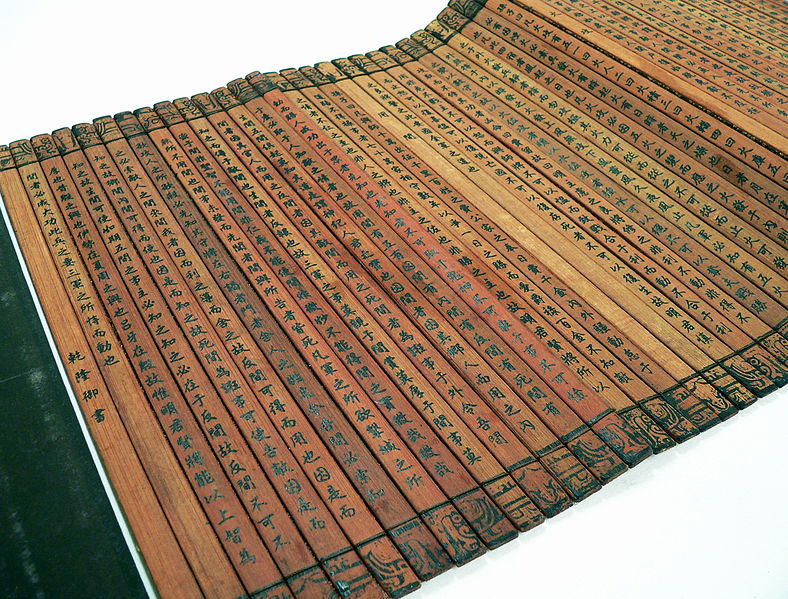
Although he had no physical ones to speak of, Cai Lun had a lot of stones. This guy invented paper! Prior to Cai Lun’s existence, most documents were written on bamboo. A bamboo shaft was chopped up and the characters of the text were written on it in vertical shafts and these shafts were then sewn together. Completed, a bamboo-text looked like this:

Although it looks pretty darn cool, can you imagine having an entire bookcase of this stuff? The damn thing would collapse! The Chinese wanted something that was easier to make, faster to make and of course…lighter! Lighter than the huge fagots of text that they were carrying around!…And a fagot is a bundle of sticks, if you’re wondering…go ahead, look it up in the dictionary.

Traditional Chinese paper, as invented by Cai Lun in the year AD105, was made up of…junk. Basically. He used plant-fibres, particularly, the fibres of the mullberry tree (favourite diet of the silkworm) and the fibres that come from hemp, along with other junk, like old rags and fishnets. Ground up, mixed up, pounded out and left to dry on a flat surface, Cai Lun was able to make paper out of all this trash. Of course…these days paper isn’t quite made the same way, but Cai Lun showed us all that it was possible. Over the years, he and others like him, refined the papermaking process until we have what we have today.

Note that I type ‘years’. Not months. Not weeks. Years. Chinese paper, though easy in theory, was notoriously difficult to make. Although the Chinese had mastered the art of papermaking, they were exceedingly adverse to anyone trying to pinch their ideas. Other countries such as Korea, Siam and Japan all tried to copy the Chinese, but without the proper instructions, they failed. One possible reason for this was because Chinese paper was incredibly thin. So thin that it was only possible to write on one side of it. This delicacy added to the difficulty experienced in making it.

It took centuries, but eventually, paper spread around the world, appearing in Europe at the close of the 1300s, where it was being produced in places such as Germany, Spain and Italy.

And so Cai Lun had changed the world. Emperor He was suitably impressed by this…paper…stuff, that he rewarded Cai Lun handsomely, with the usual corporate bonuses of the day – Lots of money, a chunk of land…and an aristocratic title! Fancy, huh? Unfortunately, it didn’t last. Emperor An, the sixth emperor of the Eastern Han Dynasty was not happy with all the riches that his uncle, Emperor He, had given Cai Lun, and attempted to arrest him. Cai Lun wasn’t about to be sent to jail, so he had a bath, put on his very best clothes and committed suicide by poison in AD121. Although Cai Lun wasn’t able to live out his natural life, his invention, paper, continues to live on to this day.

Woodblock Printing

Woodblock printing comes along next during the 9th Century (the 800s). It is unclear who invented woodblock printing and likely, no one person was responsible. It was, however, the next logical step. You had paper. Now you needed a printer. And sooner or later…a computer with Windows Vista on it, as well. But for now, mankind needed a printer. Woodblock printing originated in Asia around the mid 800s. It was a tricky and delicate way to print stuff, but it did work. First, you needed a flat slab or board of wood. Then, it was necessary to carve a relief-matrix in the piece of wood. This meant carving out every single little stroke of each Chinese character so that when the block was inked and the paper was pressed, the characters would show up nice and dark and black, and everything else was white. Hard enough to do in English, almost impossible in Chinese! And then don’t forget…you had to do it in reverse, or else the text would come out in mirror-fashion! Unless you were Leonardo from Vinci, they would be completely useless!

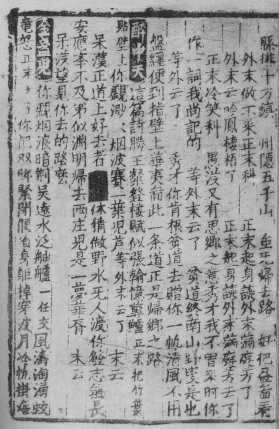
Woodblock printing took a lot of skill and time and patience, so whatever it was you wanted to print, you had to be damn sure of, first! Once the matrix had been carved and inked, it was necessary to lay down some of Cai Lun’s beautiful paper, and then press or roll it firmly over the inked matrix. The result looked something like this:

It wouldn’t be another five or six centuries until Gutenberg invented his moveable-type printing-press, but the Chinese had shown us that printing was possible. It was very difficult and expensive, but yes, it could be done.

Gunpowder

Probably everybody’s favourite classical Chinese invention is the stuff that goes ‘Boom!’. Also known as ‘gunpowder’.

Like woodblock printing, Chinese gunpowder (known today as ‘blackpowder’) was invented sometime in the 800s. It is generally believed that Chinese alchemists (an old-fashioned term for a scientist or a chemist) accidently created gunpowder while mucking around in their labs one day. It’s unclear exactly how this happened, but what is known is that the alchemists were trying to make the Elixer of Immortality. Without any philosophers stones, magical mirrors or wise, homosexual wizards around to help them, they were doing it largely by trial and error. And then, they discovered it. The Elixer of Immortality. Or at least, it did grant immortality in the sense that when you detonated enough of this stuff, it released your immortal soul to the heavens. So they did get there in the end.

The ingredients to classical Chinese gunpowder were startlingly simple. Hell, you could probably make it in your kitchen right now. Sooner or later it might show up on MasterChef (“And here’s one we prepared earlier!…”). How simple was Chinese gunpowder? It had only four ingredients! Charcoal (which you can get from your fireplace) potassium-nitrate (‘saltpetre’, which can be extracted from human urine), realgar (a form of sulphur) and…honey.

Mixed in the correct ratios and baked at 200 degrees for two hours…okay I kid…you could make gunpowder. Gunpowder was predictably, very unstable and it didn’t take much to set it off. As one text states, after mixing up those ingredients, the unfortunate alchemists could have burnt…

    “…their hands and faces…and even the whole house where they were working…”

So as you can see, pretty powerful stuff. That excerpt was taken from a 9th century Chinese religious text.

Gunpowder changed the world. With it, mankind could produce all kinds of scary weapons. Pistols, muskets, musketoons, blunderbusses, cannons, artillery-pieces, grenades and fireworks (another awesome Chinese invention). Before the invention of dynamite, gunpowder was also used in construction to blast holes in rocks!

The Compass

The compass is a tricky thing to date. Like the needle that we know it for today, its date of invention swivels and wobbles and spins around like a toddler who just discovered a revolving computer-chair. The first mentions of magnetism in Chinese texts date back to before Christ. The first practical compasses which were used for navigation, however, date from the 11th and 12th centuries, between about 1040-1120.

The traditional Chinese compass was the “ladle and bowl” or “spoon and bowl” style of compass. They looked like this:

Like all great inventors, the Chinese made things to be multifunctional. You could use the compass to find your way to the restaurant and then eat dinner with it at the same time.

Chinese studies with magnetism and its affect on metals (well, iron, really) date back to the 4th century BCE, but the compasses that we know today were born in the 1100s. The Chinese were quick to see the benefits of the compass. With a constant North-Bearing, navigation was now possible. Chinese navigational compasses had the ‘bowl’ part of the compass filled with water, with the lodestone, compass-needle or ‘spoon’ floating on top. With the lubrication of the water, the lodestone could move around freely, giving navigators a clear sense of their direction. It’s partially thanks to the compass that in ancient times, the Chinese had one of the biggest navys in the world! With such a big navy, it was necessary for the Chinese to know where they were going. So a form of the now-famous compass-rose was created. Unlike the modern one (which has 32 points), the Chinese rose had 48 different reference-points! Imperial eunuch and famous Chinese sailor, Zheng He, made frequent mention of compass-bearings during his oceanic travels.

And so there you have it. The four great inventions of Ancient China. And probably the biggest irony is…the title of the Four Great Inventions was a term coined by the ENGLISH…not the Chinese…who found out about it, and decided to pinch it for their own publicity purposes.


‘The Underland Route’ or the History of the Subway

In the 1860s in the years during and after the American Civil War, two railroad companies completed America’s first transcontinental railroad, colloquially called the “Overland Route”. This cut down the travel-time from cities such as Chicago in the East, to Los Angeles and San Francisco in the West, from several weeks or even months by wagon-train…to a few days by steam-powered locomotive. Instead of stocking up on rifles and muskets, provisions and supplies…a person could pack his steamer-trunk or suitcase, buy a ticket and ride the rails in what was then a fast, comfortable and convenient way to travel.

Around the same time that the Americans completed their “overland route”, a hop across the pond called the Atlantic Ocean to England would see the British people’s first…”underland route”…and the birth of the modern subway system.

The London Underground: The World’s First Subway

The London Underground (more commonly called ‘The Underground’ or ‘The Tube’ today), is the world’s oldest and is one of the world’s largest subway systems. It’s famous all over the world for its stations, its red, white and blue logo or ’roundel’ and the similiarly-coloured, tubular railway carriages. It’s famous for being used as air-raid shelters during the Second World War and for appearing in a James Bond movie where an invisible Aston Martin is delivered to Bond on a flatbed railway carriage.

Beneath all this fame and glory and fortune, people tend to forget that the London Underground is the world’s first and oldest underground railroad and is now nearly a hundred and fifty years old and still running. The story of the London Underground is the story of the development of the modern subway system and the story of one is generally entwined with the other.

The Need to go Under

Subway systems are not built for their novelty aspect or because “they can”. In each particular city where a subway exists, there are reasons for their construction. But what was it that led to the whole idea of the “under ground” railroad to begin with?

To understand this, we must flashback to London in the 1850s and 60s. Here, we meet a city which is the center of an empire, which is increasing in population every day due to the vast changes brought on by the Industrial Revolution and which is suffering the consequences of such rapid population-growth…traffic congestion.

By the 1850s, railroads were fast becoming the most popular way to move around. It was quick, comfortable and convenient. While cities had several large railroad stations for big, main train-lines, the problem was that once passengers arrived in town, they clogged up the roads with horse-drawn carriages and taxi-cabs. It was reasoned that if there were trains right in the heart of town, they would be able to move people around more effectively and cut down on congestion. This wasn’t easy in a city as old as London, though. Railroad lines took up a lot of space and with congestion as bad as it was, threading railroad lines all over the road was hardly the best solution. Instead, it was decided that the best method of getting trains into the city was to go underground. It would be relatively easy to follow the roads, stops and stations could be easily planned and it would provide valuable employment to the thousands of unemployed people living in London in the second half of the 19th Century.

The First Subway

The first part of the first subway, the London Underground, was born in 1863 as the Metropolitan Railway and stretched from Paddington Station north to Farringdon Station, via King’s Cross. The man responsible for this new, quite literally groundbreaking task of an ‘under ground’ railroad was Charles Pearson, a London lawyer and Member of Parliament. Throughout the 1830s, 40s and 50s, Pearson had campaigned for an ‘underground railroad’ to help ease the increasing traffic congestion in central London during the mid-19th century. After numerous government meetings, debates and discussions, an act of Parliament was passed for the construction of the first stage of what would become the world’s first subway system.


The Metropolitan Railway under construction near King’s Cross Station; February, 1861

To make things easy, the Metropolitan Railway was constructed using the ‘cut-and-cover’ method of tunnel-construction. This involves digging a huge trench in the middle of the street, right down to the level where the railroad lines would go. The rail-lines would be laid and the tunnel walls and roof would be built above it. Once the roof was completed, the excavated rubble and soil was dumped back over the top to reform the original roadway, giving the process its name of ‘cut and cover’. While relatively easy, safe and quick to carry out, Pearson probably won himself a great deal of enemies by building his railroad this way – the Cut and Cover method meant that entire roads and city blocks had to be shut down for construction-purposes. Building the railroad took nearly three years, from February, 1860 – January, 1863. Unfortunately, Pearson wouldn’t live to see his masterpiece open for operation; he would die on the 14th of September, 1862, of dropsy. He was 68 years old.

Underground Trains

Having built the subway, it was now necessary to get trains into it. Obviously, conventional steam-trains were out of the question. They were huge, bulky, noisy digusting things, far too unsuitable for subway tunnels. Instead, an entirely new form of railroad locomotive had to be invented. While still coal-fired, steam-powered engines, these new machines were significantly smaller than their above-ground counterparts.


Metropolitan Railway A-Class subway locomotive. Engine #23 was made in 1864

The steam-engines developed for the London Underground were compact, fat, low-profiled tank-engines. Despite the obvious problems of smoke and steam from these newly designed machines, the London Underground proved popular with Victorians. Nearly 27,000 passengers were using the Metropolitan Railway within the first few months of its opening in January of 1863.

Electrification of Subways

It’s hard to imagine that from the 1860s until the early 1900s, the world’s first, oldest and at the time, biggest subway system, was pulled along using nothing but steam-power. In the crowded, cramped and claustrophobic environment of the London Underground, steam-power was hardly ideal. In fact, it was very uncomfortable riding in the Underground during this period and adequate ventilation had to be installed if the Underground was to maintain a practical, working public service for the people of London. Electrification of the Underground was proposed as early as 1880, but it wasn’t until about 1905 that electrical technology and understanding had progressed far enough to make this a practicality. Starting in the early 20th century, many of the original steam-trains that pulled carriages through the Undergorund were scrapped and replaced by modern, electrically-powered locomotives. Very few of the original Underground steam-locomotives from the 1860s and 70s survive today.

Under and Outwards

With the initial success of the original Metropolitan Railway, other underground railroad companies sprang up, almost overnight. Throughout the second half of the 1800s and the early 1900s, private companies dug and developed their own subway lines throughout London. As the 20th century progressed, the subway became more and more familiar and important to London. By the end of WWI, England had over a hundred big and small railroad companies. In the end, many of these were merged together with the Railways Act of 1921. Nationalisation of the railway system was completed in 1947 with the Transport Act. By the Second World War, the London Underground had grown immensely. By the early 1940s, there were many abandoned stations and stretches of the Underground which were never completed, due to a lack of money or a lack of necessity. Stations that were too close together were considered unnecessary and were closed down. Many of these were converted to air-raid shelters during The Blitz. Many of these stations still exist today and some are set aside specifically for filming-purposes by film-production companies, so that the actual London Underground won’t be disrupted by camera-crews and actors.

The Subway Goes Global

After the success of the London Underground, the subway began to spread around the world. The next subway opened in Glasgow, Scotland in 1891. The first American subway was opened in Boston, Massachusetts in 1897! The New York City Subway system was started in 1904. Previous to this, New York City had been serviced by its famous elevated railroad (commonly called the ‘El’). A horrific blizzard in 1888 dumped several feet of snow all over New York, which brought its above-ground train-service to a screeching halt.


Manhattan’s famous elevated railroad. Started in the 1860s, it lasted until the 1960s when it was gradually destructed. This photo was taken in 1944. The affect of heavy winter snowfalls on the New York elevated railroad was what prompted the construction of the now, world-famous New York City Subway in 1904

To prevent a repeat of this, the New York City Subway was constructed. Subways continue to be popular in countries where snow can affect above-ground railroad traffic, such as in Russia, Germany and Canada. While today subways are seen as modern, bright, fast and wonderful, or at times, a pain in the ass when your train comes late or it’s cramped or overcrowded, remember that they were born in an age of steam and steel, bricks, mortar and feverish industrial revolution.


Top Floor: The History of the Modern Skyscraper

These days, the challenge to build the biggest, highest, tallest, strongest buildings is everywhere. Everyone wants to build the tallest building in the city, county, state, province, country…and of course…the tallest building in the world! In our modern megacities, where we’re surrounded by towering masses of glass, steel, concrete and wood, it’s very easy to forget that the building which makes our modern lives possible…the skyscraper…is only just over a hundred years old! In the scope of construction-technology, the skyscraper is but a child, something that we probably don’t think about very much, but it’s true.

Before the Skyscraper

It’s hard to imagine our cities without skyscrapers, isn’t it? The tallest fully-inhabitable structures were usually no more than five or six storeys tall. There was no elevator, there were no big, glossy windows and there were no handsome, artistically-carved facades of stonework to drool over. Without the invention of the elevator, the only way to move between floors was through dozens of staircases. People were unwilling to go up more than a few flights of stairs and so stairs normally stopped after only a few floors. Water-pumps were unable to build up enough water-pressure to force running water up pipes and into bathrooms and other rooms where water was necessary, beyond a certain height, and this too limited how high a practical building could be.

But the biggest thing restricting the construction of tall buildings was the lack of steel.

Although steel had existed for centuries, at the time it was difficult to mass produce. The shortage of this strong wonder-metal meant that it was too expensive to use steel to build frameworks and scaffolding for buildings. Without a strong frame to hold the building up and take the strain, the weight of the buildings was transferred to the walls. To combat the crushing weight of tons of masonary, glass and metal, early buildings which were to be built to what were then considered significant heights, had to have walls that were incredibly thick. In some extreme cases, as much as six feet of solid stone and brick!

The Development of the Modern Skyscraper

Cheap Steel

The skyscraper as we know it today was the result of several inventions and developments. Probably the first of these was the creation of a method for the mass-production of steel, which, prior to the mid 19th century, was an expensive metal and difficult and expensive to manufacture in large quantities.

Using a large, barrel-shaped device called a Bessemer Converter, English inventor Henry Bessemer was able to create a process for manufacturing steel cheaply and quickly. Molten pig-iron was poured into the open top of the Bessemer Converter and a fire which was made to burn hotter thanks to air injected into it by pipes at the bottom of the converter, allowed the pig iron to be superheated, burning or vapourising any impurities in the metal. Once the impurities had been burnt off, the huge Bessemer Converter (which, when full, could take thirty tons of pig iron!) was tipped over on the axle which attached it to a massive, secure frame built around it. When the converter was tipped over, pure steel poured out and ran into any moulds that were waiting for it. Once the metal had cooled, strong, preformed and perfect steel beams were ready for use!


A Bessemer Converter. Converters such as these lasted from the 1870s until the process was finally declared obsolete in the 1960s

The Bessemer Process was crucial for the development of the skyscraper. Without a way to quickly and cheaply manufacture steel, the skyscraper would never have existed. The thick, heavy, load-bearing walls of conventional buildings of the day would have to have been yards thick to be able to build buildings of the heights we know today. This all changed with steel.

With steel, buildings could now be built with frames first, each I-beam or girder held together by several red-hot rivets. These steel frames could be built quickly and they could be built high and they could be built strong! With the floors and the framework taking the weight of the building, the walls no longer had to be so thick. Now, walls could have more windows in them, they could have more decorative brick-and-stonework and…in the modern world…they could be made entirely of glass!

The Elevator

The modern skyscraper could not have existed without Bessemer steel. But even with Bessemer steel, it still would not have existed. In the 19th century, buildings were restricted in height due to the inconvenience of stairs! People were unwilling to go up endless flights of stairs. It was tiring, it was slow and stairwells and staircases took up an annoyiingly large amount of space inside a building. This changed when the electric safety-elevator was invented.

Elevators have been around for centuries. The Colosseum in Rome had lots of them! But these elevators were simple wood-and-rope affairs, driven by manpower or counterweights. Effective for rising up a few feet, but useless for rising up the dozens of storeys of the modern skyscraper. The electrically-powered safety-elevator allowed buildings and people to climb higher more efficiently, but these didn’t show up until the late 19th century.

An American named Elisha Otis is credited with inventing an elevator which people would feel safe on. Otis’s ‘safety elevator’ was so-called because in the event of the elevator-cable snapping, a pair of jaws and rollers at the top of the elevator-car would spring outwards and catch on the sides of the elevator shaft, thus preventing an accident. Of course, if the elevator was descending, this migh cause the safety-mechanism to trip accidently, so the elevator-brakes were speed-operated – they would only spring into action if there was a sudden drop of the elevator-car, consistent with a broken cable.

The first modern electrically-powered elevator came in the 1880s and, combined with Otis’s 1850s safety-elevator technology, the modern “lift” as we know it today, was born.

Lack of Land

People only build big and tall for two reasons: One, they can. Two, they have to. These days, skyscrapers are built because they can be built, but back in the turn of the last century, skycrapers were built because they had to be built. Cities such as San Francisco, Los Angeles, New York, Melbourne, London and Paris were becoming increasingly crowded due to factors ranging from the Industrial Revolution to immigration to gold-rushes. Cities were swelling up and unable to look down, city planners and architects started looking for ways to build higher. With cheap steel, elevators and a massive immigrant workforce, cities which made the skyscraper famous, such as New York, were born.

Where do we get the term ‘Skyscraper’ from?

Why ‘skyscraper’? Why not cloud-climber or sunkisser or moonhugger or man-mountain? Where did we get the term ‘skyscraper’ from?

The term ‘Skyscraper’ as we know it today, meaning a tall, thin building which is continuously inhabitable from the ground up, comes from the very lips of the men who built these massive structures. Many of the men who built skyscrapers around the turn of the century were sailors, men who spent weeks at sea climbing up and down the rigging of sailing-ships and who were therefore immune to the stomach-churning heights of hundreds of feet up in the air that skyscraper-builders had to face every day.

The sailors who made up the backbone of the skyscraper workforce named these new and fantastic buildings which they were constructing ‘skyscrapers’, which was the nickname for the very highest sail on a conventional, three-masted sailing-ship (the actual term is ‘Topgallant’). The name was amazingly appropriate, and it has stuck for the last a hundred and twenty odd years.


The main topgallant (‘E’ in the picture above) was colloquially called the ‘skyscraper’ by sailors, who made up the main workforce which constructed many famous early skyscrapers, and the name just stuck

Building a Tower Up to the Sun

By the first quarter of the 20th century, the skyscraper had changed the global cityscape forever. Skyscrapers were big business and they were shooting up all over the world. How big a business? Fat cats were so into building these massive structures that they did almost anything to entice construction-workers to work on their latest projects. The average construction-worker could earn twice what he usually did by agreeing to help build a skyscraper!

Although the pay for construction workers and general unskilled labourers who wanted to work on skyscrapers was double the usual rate, the work was easily a hundred times more dangerous. Construction-workers – riveters, crane-operators and general labourers, risked death every single day working at heights of a hundred, five hundred, a thousand feet and even higher up in the air!

But people do that today all the time so it’s no problem. Right?

Wrong.

From the 1890s-1940s, construction-safety as we know it today did not exist at all. At 900ft up in the air, a riveter or a general construction-worker was entirely on his own. He had no ropes. No cables. No harnesses. No winches. And certainly no hard-hat. Safety-nets? Forget it! One wrong step or one gust of wind while walking on a steel girder less than half a foot wide…and it was a freefall drop to certain death nearly a mile below. Working on a skyscraper was called “treading the steel” or “walking the steel”…because you literally had to walk around on those skinny steel beams to move around the building with absolutely no safety-gear. Experienced workers were called ‘roughnecks’ while new and inexperienced workers were nicknamed ‘snakes’. ‘Snakes’ because working with them was extremely dangerous. One wrong step, one distraction or one miscalculation…and the snake (and possibly other workers) were dead.


A famous photograph by Lewis Hine. It shows construction-workers on their lunch-break in the early 1930s. Note the lack of any safety-equipment. This photo isn’t staged and it hasn’t been retouched. The building they’re constructing is the Crysler Building, the building of which, Hines was commissioned to document with his camera

Even in the days before welding, skyscrapers were built phenomenally fast. The Empire State Building, the tallest building in New York City could rise up two or three floors a day (with a total of 102 floors!), which was amazingly fast when you consider that all the positioning, bolting, screwing and riveting was done entirely by hand! Due to the restricted size of the Manhattan streetgrid, girders which arrived at the Empire State Building would leave their delivery trucks still hot from the forge and would be winched up right away. There was nowhere on the ground to let the hot steel cool off before it was used, so instead the construction workers just hauled it up the moment it arrived and let the wind blow on it to cool it down as it rose.

The Skyscraper Today

These days, the skyscraper is a symbol of the modern world, the modern city, it’s a staple of our lives. To have a 21st century without the skyscraper is to have one without telephones, automobiles, the computer or the iPhone. And yet, while we may sometimes think of the skyscraper as a modern invention, one should also remember that it both is, and isn’t. Is it modern? Certainly. A hundred years is an eye-blink in the pages of history, but is it also old? Yes. To think that this icon of the modern city had its roots in the crowded, noisy, congested and choked streets of the late 19th century and that it has survived for so long.