“It is a habit of mine to have an exact knowledge of London” – London According to Holmes

Sherlock Holmes is famous the world-over. From Melbourne to Maine, from Singapore to Shanghai, New York to New Orleans, Paris to St. Petersburg. Everyone knows who he is and what he does, what he looks like and where he lives. Billions of people have read his exploits and wondered and mused about the places that he’s been to and to which they themselves might never go. Many famous London landmarks are mentioned in the hefty Holmesian canon (hefty? 1,408 pages in the ‘Complete Sherlock Holmes‘ published by Wordsworth), but rarely are illustrations of these great institutions ever included in any print-run of any combination of the stories contained within the Canon. So where are these places, what are they and what do they look like?

London According to Holmes…

“You know that I cannot possibly leave London!…Scotland Yard feels lonely without me, and it causes an unhealthy excitement among the criminal classes”
– Sherlock Holmes; ‘The Adventure of Lady Frances Carfax’

Holmes was addicted to London. And at any rate, as he so wisely said, it would be unwise for him to leave the metropolis for any extended period of time, and certainly never to leave the confines of the British Isles. His world was the West End of the capital of the glorious British Empire. And there he remained until he retired and became a bee-keeper. So what are these famous locations which are peppered throughout the books? Where are they and what are they all about? A great number of fictional locations and addresses such as 221B Baker Street and the Diogenes Club, of which Sherlock’s older brother Mycroft is a member, are included in the Holmesian Canon, but there is also an equally large number of actual London landmarks buildings mentioned in the five dozen stories that make up the complete Holmesian collection. This article will introduce you to as many factual London locations as are mentioned in the canon as it is possible to do. We shall start with where Sir Arthur Conan Doyle himself started…

A Note on Addresses

Where possible, the addresses of the buildings mentioned in this article have been supplied, together with their postcodes. London postcodes are determined by compass-direction. ‘N’ is North, ‘S’ is South, ‘E’ and ‘W’ are obviously ‘East’ and ‘West’ respectively. There are also postcodes starting with ‘C’ which stands for ‘Central’. So ‘EC’ stands for “East Central’, and so on. Additional letters and numbers indicate further subdivisions of postal districts within the main district.

The Criterion Restaurant

…I was standing at the Criterion Bar when someone tapped me on the shoulder…
Dr. J.H. Watson; ‘A Study in Scarlet’


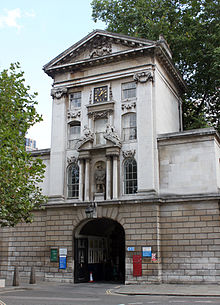
Entrance to the Criterion Restaurant

Address: 224, Piccadilly, Piccadilly W1J 9HS

The Criterion is one of the most famous restaurants in London. Founded in 1874, it has been one of the city’s greatest dining hotspots for over 130 years. Famous people such as Sir Arthur Conan Doyle, Oscar Wilde, science-fiction writer H.G. Wells and politician Sir Winston Churchill have all dined here. The restaurant is vast, grand and luxurious and the perfect place for a down-on-his-luck army surgeon such as Dr. Watson to bump into his old friend, Stamford, who would take him to meet the legendary Mr. Sherlock Holmes. The restaurant even commemorates this groundshaking and historical meeting…


The Long Bar at the Criterion Restaurant


The Long Bar of the Criterion Restaurant as it appeared in Holmes’s day

The ‘Alpha Inn’ (the Museum Tavern)

“There are a few of us who frequent the Alpha Inn, near the Museum…”
– Mr. Henry Baker; ‘The Blue Carbuncle’

Address: 49 Great Russell Street, Bloomsbury WC1B 3BA

There is no ‘Alpha Inn’ contained within the confines of London (at least, not in Holmes’s day), however, following the directions in ‘The Red Headed League’, we do arrive at the Museum Tavern, a popular restaurant and drinking establishment across the road from the British Museum, from which the building derives its name. The Museum Tavern was one of Doyle’s favourite drinking-spots and he most likely used it as the model for the Alpha in his stories. Directly across Great Russell Street is…

The British Museum

“…we are to be found in the Museum itself during the day…”
– Mr. Henry Baker; ‘The Red-Headed League’

Address: Great Russell Street, WC1

Established in 1753, the British Museum is one of the largest museums of history and culture in the world, with over seven million display-pieces. The Museum also used to house the British Library, until 1997 when that institution moved to its own premises. The British Museum underwent many changes over the centuries and has been expanded several times. At one point due to expansion projects, the land around the Museum was the largest construction-site in Europe.

The Admiralty

“…As to the Admiralty, it is buzzing like an overturned beehive…”
– Mycroft Holmes; ‘The Bruce-Partington Plans’

Address: 26 Whitehall, London

The Old Admiralty Building (and the nearby Admiralty Arch) were the office-buildings that up until the 1960s, housed the Admiralty, the government department that oversaw the running and management of the British Royal Navy. The Admiralty was replaced in 1964 by a new body, the Admiralty Board, which still uses the assembled Admiralty buildings today.


The Admiralty Arch

The Anerley Arms Hotel

“…I spent the night at the Anerley Arms…”
– Mr. John Hector McFarlane; ‘The Norwood Builder’

Address: 2, Ridsdale Road, Anerley, SE20 8AG

A hotel and public house in Anerley, London. This is where John Hector McFarlane stayed after his long night working with Mr. Jonas Oldacre, who tried to frame him for murder.

St. Bartholomew’s Hospital

“…I recognised young Stamford, who had been a dresser under me at Barts…”
– Dr. J.H. Watson; ‘A Study in Scarlet’


St. Bartholomew’s Hospital, London. Main Entrance

Address: West Smithfield, EC1A, 7BE

Known simply as ‘Barts’ to most Londoners, St. Bartholomew’s Hospital is one of the oldest medical institutions in London. It is the oldest hospital still in operation in London and the buildings that make up the wings of the hospital were built in the mid-18th century, even though the hospital’s existence on its current site goes back to 1123 AD. The medical college at Barts was founded in 1843 and would’ve been familiar institution to a physician such as Sir Arthur Conan Doyle.

The Carlton Club

“…The Carlton Club will find me…”
– Sir James Damery; ‘The Illustrious Client’

Address: 69, St. James’s Street

The Carlton Club is a prominent London gentleman’s club for members of the British conservative political party. The club was founded in 1832 and has moved premises three times since its creation. The first clubhouse was too small and the members moved to another clubhouse in 1835, next door to another famous London club, the Reform Club. Here the club remained (although the clubhouse building itself was rebuilt and redesigned several times) until 1940. The Carlton Club suffered a direct hit during an air-raid of the Blitz on London during the Second World War. So complete was the destruction that the members did not bother trying to rebuild, but instead moved to their third and current location at 69 St. James’s, the building pictured above.

Charing Cross Hospital

“I would suggest, for example, that a presentation to a doctor is more likely to come from a hospital than from a hunt. When the initials C.C. are placed before that hospital, the words ‘Charing Cross’ very naturally suggest themselves”
– Sherlock Holmes; ‘The Hound of the Baskervilles’


Charing Cross Hospital, London; 1939

Address: Fulham Palace Road W6 8RF

Charing Cross Hospital was founded in 1823 to serve the medical needs of the West End of London. Originally called the West London Infirmary, it received its current name in 1827. It moved from its original location near Charing Cross in London, in 1834 and moved again in the years following World War Two. The current hospital structure is built on the site of the old Fullham Hospital on Fullham Palace Road. Despite the change in location, the hospital has retained its ‘Charing Cross’ name.

Charing Cross Station

“…My collection of ‘M’s is a fine one…and here is…Matthews, who knocked out my left canine in the waiting room at Charing Cross”
– Sherlock Holmes; The Empty House’

Address: Charing Cross Station, the Strand WC2N 5HS

Opened in 1864, Charing Cross Station is one of the main railway stations that service the city of London. In operation for over a hundred and forty years, Charing Cross has undergone numerous renovations and restorations in its long history, from general maintenance-work to full restorations, such as the one carried out on the station between November 2009 and August of 2010.

Claridges Hotel

“You can report to me tomorrow in London, Martha, at Claridges Hotel”
– Sherlock Holmes; ‘His Last Bow’

Address: Cnr. Brook Street and Davies Street, Mayfair, W1K 4HR

Claridges is one of the most famous grand hotels in London. Opened in 1812, it received the name Claridges in 1854. The original Claridges Hotel was deemed too small and was demolished in 1894. A more modern hotel with elevators, running water and private en-suite bathrooms for every room, was opened in 1898. Claridges has had a long association with British royalty and aristoracy starting in the Victorian era, but increasing markedly after World War One. The hotel was expanded in the 1920s and enjoys patronage in more recent times, by a different kind of royalty…the kind that hails from Hollywood. Big names such as Cary Grant, Alfred Hitchcock, Brad Pitt and Audrey Hepburn have all stayed at Claridges over the years.

The Imperial Theatre

“My Father is dead, Mr Holmes. He was James Smith, who conducted the orchestra at the old Imperial Theatre.”
– Violet Smith; ‘The Solitary Cyclist’

Address: Westminster, SW1H 9NH

The Imperial Theatre (previously called the Aquarium Theatre) was opened in April of 1876. It had a seating capacity of 1,300 people. It was demolished in 1907.

St. James’s Hall

“When I saw him that afternoon, so enwrapped in the music at St. James’s Hall I felt that an evil time might be coming upon those whom he had set himself to hunt down”
– Dr. J.H. Watson; ‘The Red-Headed League’

Address: Regent Street

St. James’s Hall was a prominent concert hall in London during the Victorian and Edwardian eras. It was opened on the 25th of March, 1858 and could hold over 2,000 concert-goers for each performance. For the next forty-seven years, St. James’s was one of the most popular musical performance venues in London. Even Charles Dickens went there to give public readings of his famous novels. The hall was closed in the 1900s and was eventually pulled down in 1905. The photo above is of the interior of St. James’s as it appeared during its last concert in its closing year.

King’s College Hospital

“After I graduated, I continued to devote myself to research, occupying a minor position in King’s College Hospital…’
– Dr. Percy Trevelyan; ‘The Resident Patient’

Address: Denmark Hill, SE5 9RS

The King’s College Hospital was opened in 1840 as a small teaching hospital for medical students studying at the King’s College, London, operating out of the St. Clements Dane workhouse on Portugal Street. The hospital was overcrowded and constantly busy. Joseph Lister, the pioneer of modern safe surgery through the introduction of sterilisation, performed some of his first successful operations at the King’s College Hospital in the 1870s. Due to changing circumstances, the hospital moved to new, purpose-built facilities in 1909, with innovations such as electrical power for telephones and electrical lighting. The hospital treated several civilian injuries sustained by bombing during the Blitz of 1940-1941.

The Langham Hotel

“He telegraphed to me from London…and directed me to come down at once, giving the Langham Hotel as his address”
– Mary Morstan; ‘A Sign of Four’

“You will find me at the Langham under the name of the Count Von Kramm”
– The King of Bohemia; ‘A Scandal in Bohemia’

Address: 1C Portland Place, Regent Street, W1B

The Langham Hotel is one of the grandest and oldest hotels in London. And for its time, it was also one of the most modern. Opened in 1865, it featured innovations that wouldn’t be seen in other hotels for decades to come, things like private bathrooms, elevators and even electrical lighting, commencing in the 1870s. The hotel has proved incredibly popular throughout the decades and celebrity guests included the Duchess of Windsor, Wallis Simpson, cricketer Don Bradman, Diana, Princess of Wales, Winston Churchill, French president Charles de Gaulle and actor Charlie Sheen (not even the best five-star hotel in the world is perfect). Due to its high-class customers, the Langham very nearly went bust during the Great Depression, but survived to become one of London’s most famous hotels.

Lowther Arcade

“…Drive to the Strand end of the Lowther Arcade…”
– Sherlock Holmes; ‘The Final Problem’

Address: 437 Strand, London

The Lowther Arcade was a popular shopping-arcade in London during the Victorian era (comparable with the famous Burlington Arcade), and was full of all kinds of speciality shops, from jewellery, musical instruments and children’s toys.

The Lyceum Theatre

“Be at the third pillar from the left outside the Lyceum Theatre tonight at seven o’clock…”
– Thaddeus Sholto; ‘The Sign of Four’

Address: Wellingon St, WC2E, 7RQ

The Lyceum is one of London’s most famous West End theatres. A playhouse called the Lyceum has existed on Wellington St. since 1772. At first, the theatre struggled and only by constantly changing could it hope to ever make a success of itself. Its first stroke of luck came in the year 1809. The Theatre Royal, Drury Lane, caught fire and the theatre’s company moved to the Lyceum while their own theatre was being rebuilt. It was at this time that the Lord Chamberlain (the man in charge of theatres) granted the Lyceum official status as a performing theatre.

In 1830, the Lyceum burnt down and was rebuilt and reopened in 1834. Now, the theatre’s fortunes began to change. Big names started working at the Lyceum, such as W.S. Gilbert of Gilbert & Sullivan fame and most famously of all, the actor and eventual manager of the Lyceum, Sir Henry Irving, one of the greatest stage actors of the late Victorian period.

Fire ripped through the Lyceum once again at the turn of the century and it was decided that the building could not be saved. It was pulled down and gradually rebuilt, starting in 1904 and reopening in 1907. The Victorian-era facade remains, but the theatre’s interior had been completely redesigned. The Lyceum was almost demolished outright in 1939 due to plans to widen Wellington Street, but these plans fell through and the theatre survives to this day.

Northumberland Hotel (‘Sherlock Holmes’ public house)

“…The address: ‘Sir Henry Baskerville, Northumberland Hotel’, was printed in rough characters…”
– Dr. J.H. Watson; ‘The Hound of the Baskervilles’

Address: 10-11, Northumberland Street, Westminster, WC2N 5DB

The Northumberland Hotel as an establishment no longer exists. The building it occupied still stands, however, and it has been transformed into the Sherlock Holmes public house, dedicated to all things Holmesian. It even has a recreation of Holmes and Watson’s sitting-room in it and a menu comprised entirely of Holmesian-style dishes and dish-names! How about trying the Thor Bridge angus burger with tomatoes, gherkins and chips for ten pounds, twenty-five pence?

Paddington Station

“I happened to live at no very great distance from Paddington”
– Dr. J.H. Watson; ‘The Engineer’s Thumb’


Paddington Station in Holmes’s day

Address: Paddington Station, W2 1RH

Paddington Station is one of the most famous buildings in London. A station has existed on the site since 1838, but a permanent railway station called Paddington didn’t finally materialise until 1854. In popular culture, Paddington is closely tied to the children’s character ‘Paddington Bear’ and to the book ‘4:50 from Paddington’ by Agatha Christie.

Scotland Yard (Old Scotland Yard)

“We’re not jealous of you at Scotland Yard”
– Inspector Lestrade; ‘The Six Napoleons’

Address: 4, Whitehall Place.

Scotland Yard is the name of the headquarters of the London Metropolitan Police Service (which was established in 1829). The Metropolitan Police have moved their headquarters since Holmes’s day, but in Victorian times, they were located at a suite of buildings on Whitehall Place and were located there between 1887 until 1967, when they moved to their new (and current) headquarters, which had more space for the growing police-force.

Simpsons in the Strand

“When we have finished at the police station I think that something nutritious at Simpson’s would not be out of place.”
– Sherlock Holmes; ‘The Dying Detective’

“I met him by appointment that evening at Simpson’s”
– Dr. J.H. Watson; ‘The Illustrious Client’


Address: 100 Strand, WC2R 0EW

Simpsons in the Strand is probably the most famous restaurant in London. Simpsons opened in 1828 and was originally a chess-club and coffeehouse, but it quickly grew into a London dining institution, at which only the best and most notable people of their day ever sat down to have dinner. Men like George Bernard Shaw, prime ministers Benjamin Disraeli and William Gladstone, Charles Dickens, artist Vincent Van Gough and of course, famous pair of fictional sleuths, messers Sherlock Holmes and his best friend, John Hamish Watson, M.D.


The main dining-room, Simpsons in the Strand, London

The restaurant gets its name from the forward-thinking caterer, Mr. John Simpson, who had grand visions for this place and who wanted to make it more than just a simple coffeehouse. Simpsons in the Strand can give thanks to chef Thomas Davey, who insisted that only the best British food should ever be served there, although knowing the international stereotype of British food, one has to wonder what kind of ‘best’ that is. But regardless, Simpsons’ reputation has endured for nearly two hundred years. So insistent was Davey on the ‘Britishness’ of Simpsons that he refuesd even to allow the cards on the dining-tables to be called ‘menus’. Instead, they were to be known, and only known, as ‘Bills of Fare’.

10 Downing Street

“We were fortunate in finding that Lord Holdhurst was still in his chambers at Downing Street”
– Dr. J.H. Watson; ‘The Naval Treaty’

Address: Downing Street, London.

Number 10, Downing Street, has been the official Lonon residence to the British Prime Minister (who also holds the office of First Lord of the Treasury) since the mid 1700s. It has been restored and rebuilt several times over the last two-hundred odd years due to neglect, age and at least two instances of bomb-attacks. One attack during the Blitz saw the kitchen of Downing Street destroyed by a direct hit from a German bomb. Only quick thinking on the part of Winston Churchill, who had ordered all staff out of the kitchen minutes before, prevented a potentially devastating loss of life.

One of the more curious offices held at 10 Downing Street is that of Chief Mouser to the Cabinet Office. That’s right…A cat! Almost continuously since 1924, a cat has been ’employed’ at 10 Downing Street, holding the office of Chief Mouser, whose job it is to keep mice away from the Prime Minister’s residence. The current chief mouser is Larry, pictured below:

Waterloo Station

“[Advise] me as to what I should do with Sir Henry Baskerville, who arrives at Waterloo Station” – Dr. Mortimer looked at his watch – “in exactly one hour and a quarter”
– Mr. James Mortimer, M.R.C.S; ‘The Hound of the Baskervilles’

Address: Waterloo Station, City of London SE1 8SW

Waterloo Station was opened in London in 1848, originally called Waterloo Bridge Station. It was renamed to its current title in 1886. The main reason for naming the station ‘Waterloo Bridge’ was because there were already a number of other stations nearby also called ‘Waterloo’, which created untold and immeasurable confusion for travellers in the earlier years of the station’s operation. The station was hit heavily by bombs during the Second World War, but the limited amount of damage meant that the station was restored to its original condition with relative ease in postwar years.

Woolwich Arsenal (Royal Arsenal, Woolwich)

“The man’s name was Arthur Cadogan West, twenty-seven years of age, unmarried and a clerk at Woolwich Arsenal”
– Dr. J.H. Watson; ‘The Bruce-Partington Plans’

Address: Woolwich SE18 6SP

The Royal Arsenal, Woolwich (pronounced ‘Woolich’)  has existed since Stuart times in the 1670s. It wasn’t until 1805, however, that it was named the Royal Arsenal. The Arsenal played important roles during the Crimean, First and Second World Wars. Parts of the arsenal were shut down over the years after the Second World War and the site ceased to have an active military role in 1994, after which the Arsenal was turned into a military museum.

Acknowledgements

I’d like to extend my personal thanks to my fellow members of the Holmesian.net Sherlock Holmes fan-forum who provided me with the suggestions and information which aided in the completion of this posting.


Arbeit Macht Frei: The Real Schindler’s List

Oskar Schindler – An industrialist, a war-profiteer, a German and a member of the Nazi Party. A saviour of over a thousand lives.

The story of Oskar Schindler is one of paradox; a Nazi saving Jews. Whoever heard of such a ridiculous thing? And yet, it is true. And it is one of the most famous stories to come out of the hell of the Second World War. It is a story of unimaginable hardship, terror, uncertainty, panic, hope and desperation. It’s a story that’s centered around row after row of letters typewritten onto a sheaf of notepaper. It’s about luck, chance and amazing fortune. It is almost fantastical, in the truest sense of the word.

Who was Oskar Schindler?

Oskar Schindler was a German industrialist. He was born on the 28th of April, 1908. He married his wife, Emilie, in March of 1928 and eleven years later, joined the German National Socialist Worker’s Partry…the Nazis.


Oskar Schindler; 1946. Photographed with some of the Schindlerjuden. He’s standing on the right, holding his hat in his left hand

Schindler had been a businessman before the outbreak of the Second World War, but never a successful one. During the Depression he started many businesses but for one reason or another, they all went bankrupt. This all changed when Germany invaded Poland in September of 1939, starting the Second World War.

After the Nazi occupation of Poland, Schindler moved East and got involved in the black market. Being a member of the Nazi Party meant that he could mix and mingle with the Gestapo, the S.S. and prominent Nazis in Poland. His connections meant that he was able to purchase an “Aryanised business”…that is to say, a Jewish business that had been turned over to non-Jewish (usually German) businessmen. Schindler eventually found himself as the director of a factory in the Polish city of Krakow which manufactured enamelware cooking equipment, the Deutsche Emaillewarenfabrik. With this factory, Schindler would slowly start to rise, after years of failure.

Schindler and the Jews

Schindler was nothing if not an opportunist. If something good came his way, he jumped at it. When he saw his chance to join a powerful political party, he jumped at it. When he saw his chance to make his fortune in Poland, he jumped at it. When he saw his chance to take over ownership of a Jewish factory, he jumped at it. And when he saw his chance to get cheap labour from the Jews…you bet he jumped on that too. Someone buy this guy a trampoline…

Schindler was completely indifferent to the suffering of the Jews. He didn’t care. Why should he? They were an inferior race and of no interest to him. But…they were cheaper to employ than non-Jews. And always out to save a few Zloty somewhere to make more somewhere else, Schindler started employing them, purely as a cost-cutting measure. Zloty, by the way, is the currency of Poland, although it would’ve been German currency (the Deutschmark) at the time. Jewish Poles were cheap and they were plentiful. Much cheaper than employing non-Jewish Poles, which is where it all started.

The Jews in Schindler’s factory were grateful for their jobs. By the early 1940s, the Nazis were establishing ghettos in Poland where all Jews were forced to live. There was a ghetto in Warsaw, a ghetto in Lodz and you bet…there was a ghetto in Krakow as well. But luckily for Schindler’s workers, his factory was located outside the boundaries fo the ghetto, which meant that they could leave the confines of the ghetto each day and go to work and at the same time, do some black-market trading and buy whateve they needed, sometimes using the goods that they manufactured in the factory for bartering.

Employing the Jews

Schindler was not interested in saving the Jews. He saw them as his workforce. As a way to make money. And if the Jews were taken away, he would lose money. He would have to employ non-Jewish Poles, which would cost him more and lose him more money. If he lost a worker, he would have to train another worker to do the same job, which wasted time, and which lost him more money…the cycle goes on.

But this all changed in 1942.

Starting at the end of May, 1942, Jews in the Krakow Ghetto were being deported to the surrounding death-camps and labour-camps. Belzec and Plazsow respectively. When he witnessed Jews being shot in the streets of Krakow, Schindler suddenly realised how delicate everything was. Over night, he could lose his entire workforce! And he began to feel terrible about what was happening to the Jews, deciding that he had to do something to save them.

Schindler did this the only way he knew how. By getting them to work. Just like you see in Spielberg’s famous movie, passes, work-permits and identity papers were forged on a vast scale. Schindler was doing everything he could, using his position as a member of the Nazi Party, to save as many Jews as he could. He turned writers, musicians, teachers, professors, lawyers, rabbis and other ordinary Polish Jews into…metal-workers, machine-operators, mechanics, welders, riveters, smithies, carpenters…he gave them any kind of tradesman’s job that he could think of, that would mean that they were “essential workers”. To be an “essential worker” meant that your occupation was essential to the German war-effort. To Schindler’s Jews, this was literally a matter of life and death. Thanks to Schindler’s intervention, hundreds of Jews were saved from going to the Belzec Extermination Camp.

Instead, they ended up in Plazsow, the labour camp. Plazsow was no Florida funpark, but it was a damn sight better than Belzec. Schindler even managed to get his Jews segregated from the other labourers in the camp so that they could live amongst themselves and feel safe. Having his own sub-camp for his Jews was essential to Schindler. He impressed on the camp commandant, Amon Goeth, that production would suffer severely if he had to pick his workers out of the thousands of others in the main camp at Plazsow every morning for work! It would be much more convenient for everyone if they had their own camp. Goeth agreed to this. What he didn’t know was that, by having his own camp, Schindler could smuggle food, medicine, clothing and other essential supplies to his Jews to keep them safe and healthy.
Schindler’s enamelware factory in Krakow as it appears today

All the while, Schindler was bribing people left, right and center in order to keep his Jews safe; everyone from Amon Goeth the camp commandant, right down to the guards who patrolled the camp. They were now over a thousand Jews working for Schindler, ranging in ages from children aged ten or younger, all the way up to retired grandparents in their sixties or seventies. Most of them were Polish, although Jews from other countries also found themselves working for Schindler. In some cases, entire families were saved and mothers and fathers worked together in the factory alongside their children. This was largely due to the influence of Stern who deliberately gave jobs to his fellow Jews to save them from the death camps.

Itzhak Stern

Portrayed in the 1993 film by the marvellous Ben Kingsley, Itzhak Stern was Schindler’s Jewish accountant. Stern was responsible for the daily running of many of Schindler’s operations and it was he who helped create all the forged employment papers that would save so many Jews from deportations to death camps, and instead, find them working in the relative safety of Schindler’s enamelware factory. He kept Schindler’s books in order and made sure that everything ran smoothly. He helped Schindler run his black-market operations and the bribes that he would give to other Germans to ensure that his factory and his Jews were kept safe. Together, Schindler and Stern worked the factory, striving to protect the Jews. Hundreds flocked to the enamelware factory, even if they had never worked in a factory in their lives.

Stern and Schindler worked under layer after layer of lies, deceit and deception, all a necessary cover to protect their growing role in saving the Jews of Krakow. Apart from giving ‘non-essential’ Jews the false paperwork to allow them to move out of the ghetto and work in the factory, Stern and Schindler even falsified the factory’s employment books! Employment-lists which had the names of every single worker written on them, were all altered or changed in one way or another. The elderly working within the factory had their dates of birth changed. Instead of being seventy, they were now fifty. Instead of being a librarian, they were now a welder. Children as young as ten suddenly became young men and women in their mid-twenties who instead of being schoolboys and schoolgirls, were suddenly metal-polishers, buffers and grinders. If the Gestapo ever took it upon themselves to examine the books…they would see a perfect German Aryan factory run by a German who employed Jews who were all professionals in their respective fields, even if they’d never picked up a welding-torch, riveting-gun or operated a metal punch-press in their lives.

Schindler’s List

The most famous part of Schindler’s efforts to save the Jews is his LIST. The famous list of over 1,000 ‘Schindlerjuden’ (literally, ‘Schindler’s Jews’), who were supposedly “essential workers” in his factory. Where did the list come from and what is its significance in this story?

The year is 1944. Schindler and Stern are struggling to keep up appearances. Schindler continues to bribe prominent Gestapo and S.S. officers and continues to try and protect his workers from everything that he can, from starvation, disease and brutal mistreatment at the hands of the camp guards and officers in Plazsow, who would visit the factory frequently to torment the workers. Schindler objected vehemently to such treatment. Short of actually showing sympathy to the Jews, he used the cover that the guards constant visits made his workers fearful. This, in turn, effected worker-morale which in turn, effected the factory’s output, which in turn, effected the factory’s contributions to the war-effort and to the overall good of der Vaterland – ‘The Fatherland’ – Germany.

It was around this time that the winds of change started blowing. Labour-camps such as Treblinka, Majdanek and Plazsow were being shut down. Along with the ghettos, they too were being ‘liquidated’, a wonderfully euphamistic term that meant that all the Jews contained within these institutions would be sent directly to the death camps, most likely Auschwitz-Berkinau. Schindler began to realise that time was running out.

Writing the List

It was blatantly clear to Schindler, Stern and every single one of the factory-workers, what would happen. The camp would be liquidated and all the Jews, without exception, would be sent to Auschwitz. Desperate to try anything, Schindler gained control of a German munitions factory. He would move his Jews there. He explained to Goeth that since ‘his Jews’ were already experienced and talented metalworkers, machinists and press-operators, it would make much more sense that he move them to the new factory and camp, instead of sending them off to Auschwitz. If that happened, then Schindler would have to find a whole new labour-force and train them from scratch, about how to operate machines and work metal and polish shell-casings so that they would fit into the cannon-breeches properly and a whole heap of other piddly things. And, it would be disastrous for the Fatherland if production of munitions would fall behind schedule, wouldn’t it?

To ensure that he could keep his Jews, Schindler needed a record of them. He needed documented proof of every single worker under his factory roof. He needed to know their names, ages (real or imagined), professions (again, real or imagined), he had to know their religions and their nationalities. He needed…

A list.

It was this list, every single last letter typed up by Itzhak Stern himself, that saved 1,200 Jewish lives from almost certain death in Auschwitz. Stern’s entry of his own name lists him as:

STERN – Isak – 25.1.01 (date of birth) – Bilanzbuchalter (Accountant).

The significance of the list is that every name on it was listed as an ‘essential worker’ for the German war-effort and therefore would be spared from extermination. Being on the list was literally life or death for hundreds of Schindler’s Jews. As the Schindlerjuden lined up to board the train going to the new camp and factory, they prayed that Stern hadn’t accidently forgotten to include them on the list!

The Schindlerjuden were packed into cattle-cars and transported by train to their new munitions factory in Czechoslovakia. The trains wre all divided up. One held men with their wives and children. Another train held women exclusively. It must’ve been absolute horror to Schindler and his Jews when the womens’ train took a wrong turn and ended up in the very place that everyone dreaded! – Auschwitz! It was only very hasty action and a lot of bribing on Schindler’s part, as well as his personal intervention at Auschwitz, that saved them all from death.

Away from the eyes of the S.S. and the Gestapo, Schindler and his Jews finally found a haven. They lived and worked in the new munitions factory. All of them. Even Schindler and his wife, Emilie. They could have lived in the villa provided for them in the hill overlooking the factory, but Schindler was so terrified of the S.S. bursting into the factory in the middle of the night to cart off his workforce that he never lived there, spending every night in his office.

Life settled into a sort of rhythm now. They would work all day and relax at night. Jewish holidays were observed and time off was given to celebrate them. The Sabbath was observed and work would cease on Sundays. Workers who died in the factory (either through accident, illness or old age…never through the intervention of the factory’s guards) were given traditional Jewish funerals, even though this was illegal under Nazi rule.

But in and amongst all this relative tranquilty and peace, Schindler was still playing games with the Gestapo the S.S. and other Nazis. As Liam Neeson famously said in the film ‘Schindler’s List’ – “If this factory ever makes a shell that can actually be fired, I’ll be a very unhappy man“.

And he was true to his word.

Schindler deliberately sabotaged the German war-effort. Every morning he would wander around the factory, fiddling with the machines. He would remove parts to make them break down. He would recalibrate them and readjust them so that the casings that they made for the shells were just that little bit too big, or too small, so that they wouldn’t fit into the guns they were meant to be fired out of. Screws were missing. Blasting-caps would suddenly not work. He did everything he could to make sure that not a single round of ammunition manufactured by his factory would ever pass quality-control.

The End of the War

Schindler and his Jews had no illusions about what would happen to Schindler and his wife when the War ended. As a Nazi and as a profiteer of slave-labour, as a persecutor of the Jews, he would be hunted by everyone – the Russians, the British, the French, the Americans…he had to escape.

Knowing that Schindler’s chances of survival were slim, the Schindlerjuden banded together. They drafted a letter that they hoped, would explain to any Allied soldiers or to other Jews, who Schindler was and the nature of his work, sparing him from death or imprisonment. This letter, translated into English, may be read here. Schindler even gave a speech to his workers before leaving. He gave the women cloth to make clothes or to sell on the black market. He gave them all a bottle of wine each, again to sell on the black market for badly needed money. He implored on his Jews to resist the temptation to take out revenge-attacks on Nazis and Germans after the end of the War and then, he and his wife fled into the night.

Schindler after the War

For all the good he did during the War, Schindler’s luck never changed. In the 1930s he was a failing businessman. In the 1950s and 60s, he continued to be  failure of a businessman. Every venture he tried led to nothing. He even set up a cement-making factory with the help of his former Jewish workers, but even that petered out to nothing. He died on the 9th of October, 1974 at the age of sixty-six. Schindler’s accountant, and eventually, lifelong friend, Itzhak Stern, died in 1969 at the age of 68.


Schindler’s Grave. It is a Jewish tradition to place a rock on or around a gravestone when paying respects to the deceased

The List Today

Amazingly, Schindler’s List survives to this day. Two copies are known to exist. One was typed up around 1942 and listed all the workers employed in Schindler’s enamelware factory. This one was discovered in 1999. A second list was discovered ten years later. This one is dated April, 1945 and listed all the Jewish workers employed in Schindler’s defective munitions factory. The original texts of Schindler’s List, along with thousands of other Schindler-related documents including photographs, speeches and Schindler’s personal papers, are now preserved in the Yad Vashem Holocaust Museum in Israel.

Do you want to read the list? The original German text is here, and a scan of the original 1945 list may be read here. The 1945 list ends at 801 entries, but the true number of people saved is nearly 1,200.


The Shortest Day: The Start of the Second World War

Just a few days ago, we passed the sixth of June, 2011; the anniversary of “D-Day” and the beginning of the Allied push to destroy Nazi Germany and liberate the oppressed peoples of the European continent. Everyone knows what happened on that day; how they stormed the beaches and faced remarkable resistence, how fighter-planes dominated the skies above, keeping the ground-troops protected from potential enemy air-attacks and how Tom Hanks and a group of Yanks blasted a hole through the German defenses using nothing but balls, brains and a few feet of Bangalore Torpedo.

But what about the other end of the story? What was it like on the very first day of the Second World War? We all know the big facts, but what about the little facts hidden in between them? For example, did you know that within hours of war being declared, it was military personnel halfway around the world in Australia, who fired the first Allied shots of the War? Or that a British ocean-liner was sunk by a German U-boat just hours after Britain declared war against Germany? Or that air-raid sirens were tested in London, causing mass panic? It’s all true.

Preparations for War

On the First of September, 1939, Germany invaded Poland after it was declared that the Poles had attacked German border-posts (a falsehood; no such attacks were ever launched by the Poles). Great Britain and France, allies of the Polish nation, were obliged to take action for the defence of Poland and began making military preparations, ordering the mobilisation of their armed forces. In England, evacuation of children and expectant or young mothers was already underway in the appropriately-named ‘Operation Pied-Piper’. A blackout was enforced all over England starting on the 1st of September and it would remain in place unil April of 1945.

Germany did not declare war on Poland formally and no declaration of war was ever signed by Germany against Poland. World War Two starting as a formal declaration of the commencement of hostilities by one country against another did not start until the third of September, 1939. But a lot more things happened on that day than the signing of a simple piece of paper. What follows is a breakdown of the significant events of that first day of the Second World War…

The Shortest Day

All times are in Greenwich Mean Time.

Sunday, 3rd September, 1939

9:00am – ENGLAND – Sir Nevile Henderson, British Ambassador to Germany, sends his final diplomatic note to the German government, calling for an immediate cease of all German military action in Poland.

11:15am – ENGLAND – Sir Neville Chamberlain, the British Prime Minister of the time, goes on national radio and addresses the British people. He delivers the now-famous words that “…consequently, this country is at war with Germany”.

11:30am – ENGLAND – Air-raid sirens sound across London, but it is a false-alarm. Jangled by the news of war, Londoners panic as they believe their city is under attack and run for cover.

12:30pm – FRANCE – The French government issues an ultimatum to Germany to cease all military action. Germany refuses.

3:00pm – FRANCE – The French government formally declares war on Germany.

6:00pm – ENGLAND – King George VI broadcasts his first wartime speech to the nation, live from Buckingham Palace.


A (staged) photograph of King George VI giving his famous, first wartime speech. For the actual broadcast, the king was standing, sans jacket, in front of a lectern in a small room that was specially prepared for the occasion. This snapshot was taken after the broadcast was made.

7:40pm – ENGLAND – British cruiseship, the S.S. Athenia, is torpedoed by German submarine U-30. It is the first British shipping-loss of the Second World War.


The S.S. Athenia as she appeared in 1933, docked here in Montreal Harbour, Canada. 117 people died when she was sunk in 1939

9:15pm – AUSTRALIA – The first Allied shot of the Second World War is fired. Being alerted that Australia was at war, troops manning the powerful coastal artillery-cannon at Fort Nepean near Melbourne, Australia, fire a shot-across-the-bow (a warning-shot) at a vessel steaming into Port Phillip Bay, which refused to stop for inspection. The ship turned out to be an Australian freight-ship.

Interesting Note: The main gun at Fort Nepean also fired the first Allied shot of the First World War back on the 4th of August, 1914, when it ordered an escaping German cargo-ship to heave-to. If it failed to do so, orders were given that the next shot fired was to be done so in order to sink her…wisely, the ship’s captain turned around and steamed back to Melbourne. He and his crew were arrested and imprisoned.


The Guns of Nepean. Through these two gun-barrels, were fired the first Allied shots of both World Wars. The one on the left fired the first shot of the First World War, the one on the right fired the first shot of the Second World War

By the end of the first day, the United Kingdom, France, Australia, New Zealand and India had declared war on Germany and had started a conflict that would last for nearly six years. It is to this day, the largest armed conflict ever seen. On the evening of the Third of September, 1939, everyone on earth went to bed knowing that when they woke up the next day, the world would never be the same again.


Pen Profile: Vest Pocket Fountain Pens

Admittedly, the range of fountain pens we have around today is pretty small. They’re all roughly the same size, they all hold roughly the same amount of ink and they all have the same selection of nibs.

Back when fountain pens were new, things were a lot different.

Fountain pens were once luxury items. To own one was a big status-symbol. Most people at the turn of the last century were still using steel-nibbed dip-pens to do the majority of their writing. Schools in many countries continued using dip-pens well into the 1940s. Fountain pens were expensive things to own and the people who were lucky enough to afford one of these newfangled ‘reservoir pens’ usually only owned one pen, which they used endlessly until it broke, before they purchased another.

As fountain pens became more common and gradually, cheaper, towards the early 1900s when mass production increased output and design-improvements made fountain pens more desirable, more people started wanting them. And they wanted different styles and types of pens as well. As the fountain pen became more and more essential to everyday life, people saw the necessity for keeping one near them at all times.

This was tricky when you consider that most fountain pens made between the 1880s-1910s…didn’t come with pocket-clips, the kind that all pens have today. Such fancy and mindblowing additions to the pen as a pocket-clip wouldn’t show up until the First World War. That’s where the ringtop fountain pen comes in.

Ringtop vest-pocket pens

Without the presence of pocket-clips, it was necessary to find other ways to keep pens from running away from their owners. One of the main methods of keeping a tab on your pen was to have a ring attached to the top of the cap (something that became possible when threaded, screw-on caps were invented, that held onto the body of the pen much more securely than comparable slip-on caps of the period).

There’s a big misconception that ringtop pens are all women’s pens. THIS IS NOT TRUE.

Ringtop fountain pens were common for only a very short period of time, from the 1900s up until the end of the 1920s and they were marketed (and manufactured) for both men and women. It’s easy to tell the difference between men’s and women’s pens purely from their lengths. Women’s pens were longer (four inches or more); they were worn with a chain or a ribbon around the neck, like a necklace. Men’s ringtop pens are significantly smaller, generally being no longer than about three and a half inches.

Why?

If the history of consumer-goods has taught us anything, it’s that women’s products are almost always smaller than men’s. Women’s watches are smaller. Women’s pens are smaller. Rings and chains for women’s jewellery are usually much thinner than men’s jewellery. So why are men’s pens in the case of ringtops, smaller than women’s?

Ringtop pens for men were designed as ‘vest-pocket’ pens. They usually had the code-letter ‘V’ or ‘VP’ (for Vest/Vest-Pocket) heat-stamped or engraved into them. Pens like this were deliberately kept smaller than women’s pens because they were designed to be clipped to a man’s double albert watch-chain and worn in one of the two watch-pockets of his waistcoat (or ‘vest’). On a watch-chain along with a pocket-watch, the setup would look like this:


My vest-pocket fountain pen and pocketwatch. Pen: 1925 Wahl Art Deco vest-pocket fountain pen. Watch: 1950s Ball railroad chronometer

In the days when men still wore waistcoats (a stylistic choice I still carry on) and pocketwatches were still popular (another stylistic choice I keep alive), vest-pocket pens were a popular writing-instrument. Compact, convenient and nigh impossible to lose; even if the pen did fall out of your pocket, the chain clipped to the ring on the cap would prevent it from getting lost.

The End of Ringtop Pens

Ringtop pens for men died out by the 1930s. Pocketwatches were still being made, waistcoats were still popular and people were still combining the two, but the truth was that demand for this pen, which had become little more of a novelty by this time, was dropping fast. The arrival in the mid-1910s of pens with permanent pocket-clips meant that keeping a pen securely about your person with a ringtop cap and chain was no longer necessary. By the mid-1930s, production of both men’s and women’s ringtop pens had come to an end.

Today, ringtop pens are no-longer made as there’s no market for them. They do still exist, as curious reminders of a bygone age, if as nothing else, though. You can still buy them at pen-shows, vintage pen shops and online from pen-dealers and repairers, but unless you’re intending to wear it on a ribbon or necklace around your throat or on the end of a watch-chain, they’ll probably have to make up part of your desktop pen inventory due to the risk of them falling out of your pocket (unless you store them in a pen-pouch when you’re carrying them around).


D-Day and the Battle of Normandy

With the anniversary of D-Day coming up, this article is written to commemorate the original and most famous of all D-Days…the sixth of June, 1944.

The Second World War is famous for a lot of reasons. It was the most expensive war, it was the costliest war in human lives, it had the weirdest national leaders at the helm at the time (a paraplegic Yank, a chainsmoking, paintbrush-brandishing MP, a mustachioed Russian lunatic and a crazy Austrian guy with a toothbrush moustache and half his sexual equipment hanging around beneath him)…but the Second World War also holds the record of being the war with the biggest ever seaborne invasion. No, not the Battle of Dunkirk…that was the biggest seaborne evacuation; but the Battle of Normandy, specifically, the naval landings on the beaches of France.

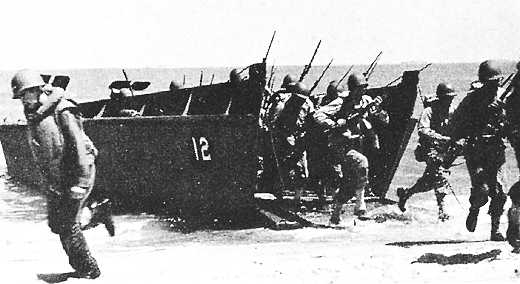
The Allied attempt to liberate northern France and to start the process of beating back the Germans and driving them out of lands which were not their own  was codenamed “Operation Overlord”. However, the actual beach-landings were given the codename “Operation Neptune”. It was during Operation Neptune that all those famous photographs were taken…like this one:

Seaborne Invasions

In warfare, invasions by sea have always been the most difficult to pull off. Airborne invasions involve planes strafing and bombing the target-area and then sending in paratroopers. Land-invasions are done using infantry and tanks, possibly with air-support. In both instances, getting onto dry, solid ground is pretty easy. Either you’re already there…or you soon will be.

Seaborne invasions, however, have always been tricky. A soldier sloshing through the surf with his uniform, his rifle, his ammunition, his helmet, his kit, his boots and other necessities was liable to be bogged down in the soft, shifting sand beneath the waves. This makes him a sitting duck for any defending soldiers, who can stick out their rifles and shoot him. Added to this is the problem that to get the attacking soldiers near to the beach, you need small boats. Small boats that are fast, light and which can go right up to the sand without running aground. Prior to the Second World War…no such boats existed! From the time of Napoleon right up to WWI, warships were forced to use regular wooden ship’s rowboats to ferry their troops ashore. This was slow, dangerous and catastrophic. Because these boats couldn’t go right up onto the beach, soldiers had to jump over the sides of the boats and wade through water that could be up to their waists, to get to the sand! This wasted time and made the men easy targets for enemy soldiers on land.

Operations Covered in This Article

In my mind, and probably in the minds of thousands of others…It is a great mistake to call the invasion of Normandy a single battle or operation. It sure as hell was not. The Invasion of Normandy was a concerted effort by thousands of people doing dozens of tiny little things and a few big things to pull off the most audacious and ridiculous and fantastic beach-assault in history. Covered in this article will be the following ‘Operations’ that made up the various elements of the Normandy Invasion.

Operation Overlord – The Battle of Normandy.
Operation Neptune – The Storming of the Beaches (more famously known as “D-Day”)
Operation Mulberry – The creation of a floating harbour off the coast of France.
Operation Cobra – The breakout from the beachhead to commence the liberation of Europe and the defeat of Nazi Germany.

Specialised Invasion Equipment

Folks fighting the Second World War realised pretty quickly that if they intended to win the war by an invasion of Europe by sea, they would need a lot of specialised fighting equipment with which to do it. What kinds of mechanical curiosities did people whip up to put an axe to the axis back in the 1940s?

Higgins Boats

The Higgins boat…which is the more people-friendly name of the water-craft also known as the “LCVP” (Landing Craft: Vehicles & Personnel), was one of the most famous and vital inventions of the Second World War, without which, the large-scale naval invasions such as those in Italy and France, would not have been possible.

The Higgins Boat was invented by an American chap named Andrew Higgins. The problem at the time was that since conventional boats needed keels to slice through the water, they were not able to get right up onto the beach during naval assaults: The keel would dig into the sand and strand the boat out in the surf, unable to move inland any further. To combat this, Higgins created a flat-bottomed boat which he based on the boats then used in navigating swamps and marshes in the United States. Having a flat bottom meant that his craft could go right up onto the beach and not get bogged in the surf.


Although referred to as ‘Higgins boats’ in this article for reasons of simplicity, they went by a variety of names. One of them was the ‘LCVP’ (Landing Craft: Vehicles & Personnel)

The other feature of the Higgins boat was its famous ramp-front. Another problem of the time was getting soldiers out of their boats as quickly as possible. Because of their high sides, it was hard for soldiers to get out of regular row-boats quickly enough, and this meant that they could be killed easily by enemy gunfire. Having a boat with a ramp that dropped down meant that soldiers could run right off the boat, onto the beach and find cover. The ramp also allowed vehicles such as Jeeps, small, wheeled artillery pieces and small tanks, to be driven right off the boats and onto the beach.

Higgins was quick to see the necessity for his new invention. Production of them started in 1941! Higgins boats were not fast (12kt), not pretty and certainly not comfortable (with the flat bottom, the Higgins boat bellyflopped across the waves with all the grace of a seal), but it was important! The war would not have been won without it, and Normandy would’ve been a disaster.

D-D Tanks

Duplex Drive tanks (shortened to ‘DD Tanks’ or jokingly…Donald Duck tanks) were the Allies’ solution to getting tanks and the necessary firepower and speed that they brought with them…onto the beaches of Normandy as fast as possible.

DD tanks were invented in the early 1940s. The Allies knew that it would be asking too much if they kindly asked the Wehrmarcht if they might, pretty-please, park a few of their tanks on the shores of France for them to use when they came ashore and blasted through their defenses. Instead, they needed to find a way to get their own tanks to France. The problem was, to get tanks onto land, the Allies would need a harbour. But to get a harbour, they first had to capture it. And to capture it, they needed tanks, but to get tanks, they needed a harbour and…you get the idea.

To get tanks ashore without a harbour, the Allies decided to create a floating tank (hence the alternate name ‘Donald Duck tank’). The tanks floated thanks to inflatable screens which were placed around them, and were propelled thanks to rather weak (though effective) outboard motors. The inflatable and collapsable screens, used to give the tanks the necessary boyancy so that they could float ashore, were made of waterproofed canvas. The tanks were offloaded from warships and were then sailed towards the beaches. Once the tanks reached the beaches, the inflatable screens were deflated. They collasped around the sides of the tank, giving the tank-crews the ability to just drive ahead and blast the hell out of the enemy.

“Ducks”

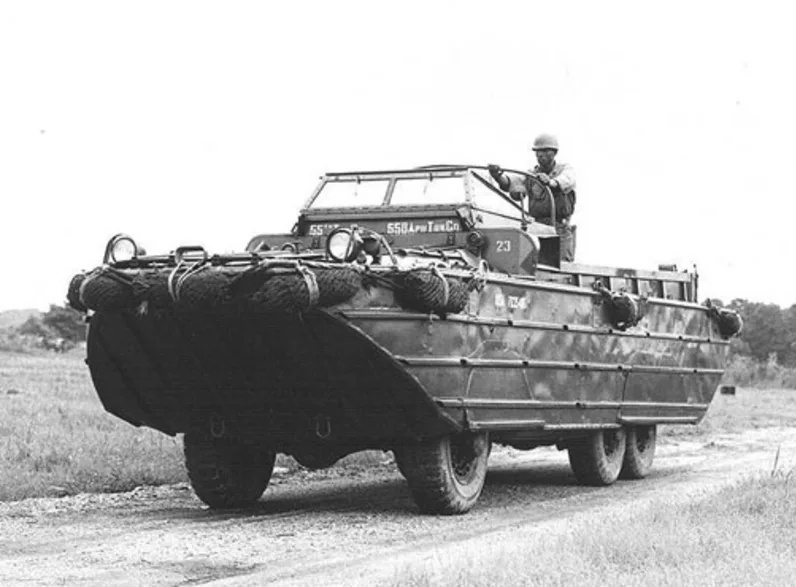
Officially called the ‘DUKW’ (utility vehicle with all-wheel drive designed in 1942), the ‘Duck’ as it was affectionately called, was one of the most important machines invented for the Invasion of Normandy. Based off of an ordinary truck which had its body removed from its chassis to be replaced by a watertight, boat-shaped hull, the ‘Duck’ was an amphibious delivery vehicle, able to power itself through the water and drive out of the surf onto the beach. These floating pickup-trucks were essential to the Nornandy invasion in that they were able to ferry cargo from ships docked at sea, to land-forces fighting on the beaches and then go straight back out into the water again. Twenty-one thousand ‘Ducks’ were manufactured during the War.

Hobart’s Funnies

The Allies had been planning to charge into Normandy for years…and the Axis knew that the Allies were going to come charging in. The only thing was, the Axis didn’t know where the Allies would come ashore. Because of this, the Axis barricaded, reinforced, booby-trapped and built up every single square yard of sand which made up the French coastline, to impede the Allied advance. To break through the multiple layers of defences, from sea-mines to hedgehogs to barbed wire, machine-gun nests, defensive bunkers, sea-walls and barbed wire, the Allies knew that they needed tanks. But not just any kinds of tanks. They needed tanks that could do a variety of tasks – Tanks that could blow holes in stuff, tanks that could clear minefields, tanks that could cross trenches and ditches, tanks that could clear away the rubble of the stuff that other tanks blew up!

The number of tanks that were developed were phenomenal. And the Allies had to know how to operate every single one of them. The man responsible for gathering the armour and firepower, and whose duty it was to train the tank-crews who would use them, was Sir Percy Hobart. Hobart was a military engineer and an armoured-warfare expert, the perfect man to teach the Brits how to use their newest playthings. Because the tanks were just so weird, soldiers named the tanks after the man who taught them how to use them, and they became collectively known as “Hobart’s Funnies”.

The number of tanks that the British Army developed was phenomenal. Here’s a few of the more famous tanks and what they could do…

The Crocodile.


The Crocodile. The trailer behind the tank carried the 400gal of fuel that allowed this beast to breathe fire!

Awesome name, huh? The Crocodile was modified so that instead of a central, main gun (like what most tanks have), it had a massive, fire-belching flamethrower on the front! How cool is that!? Fed from a tank that held four hundred gallons of petrol, the Crocodile could shoot flames a hundred and twenty yards! Although somewhat inaccurate and hard to aim, the Crocodile scared the daylights out of the Krauts and was excellent at roasting the enemy alive inside the confined spaces of German machine-gun bunkers.

AVRE.

ARMOURED VEHICLE, ROYAL ENGINEERS. Not very interesting. Or is it? The AVRE, like all the other tanks, was modified for a specific purpose. This one fired huge mortar-rounds at anything that the Allies considered an impediment to their progress across Germany, namely roadblocks, buildings or bunkers. The AVRE fired massive, high-explosive shells from its main gun, capable of blowing the shit out of whatever it touched.

ARK.

Armoured Ramp Carrier. A special tank that carried a pair of ramps on its roof. It was designed to act as a bridge on wheels. If the army approached an obstacle such as a trench, the ARK would drive ahead, deploy its ramps and then park itself there and let other tanks drive over the top of it!

Crab

The crab…probably given that name because of the two arms that stuck out in front of it…was the British Army’s minesweeping and mine-clearing tank. It had two metal arms that stuck out in front of it with a long, metal cylinder between them. Attached to the cylinder was a series of chains. At the flip of a switch, the cylinder spun around and the chains whirled out in front, whipping up the ground as the tank drove ahead. The chains would strike and detonate any mines which were in the tank’s path, and provide a safe route for soldiers to follow behind.

German Beach-Defences

In the truest spirit of German efficiency, the Krauts were not just sitting around twiddling their thumbs, wondering what the Yanks and the Limeys and the Frogs were getting up to. They knew something was going to happen. They knew that an invasion of France…ONE DAY…was going to be inevitable. To shore themselves up against this inevitablity, the Germans built an enormous collection of fortifications along the northern shores of Europe, stretching alongside the English Channel and up past the North Sea. Officially called the “Atlantic Wall”, this series of defences comprised of everything from powerful anti-tank mines, miles of barbed wire, huge pillboxes and machine-gun nests, anti-tank ditches, long-range artillery cannons (set several hundred yards back, which would fire down on the landing-beaches), mines on stakes that they drove into the sand, designed to go off if a landing-craft hit it, blowing the boat and its passengers to pieces and most famously of all…these things:

Those square-looking spikey things are synonymous with beach-warfare. They’re called Czech Hedgehogs (or simply ‘hedgehogs’) and they’re an anti-tank obstacle. Incredibly easy to make and nigh unshiftable. They’re three lengths of steel beam riveted or welded together in a rough cross-shape and then just scattered all over the beach. Cheap, simple and effective. The problem with them is that if you drove a tank into one…you couldn’t crush it, and because it had no actual base, you couldn’t topple it over and just shove it out of your way. To the troops storming the beaches of Normandy, Czech hedgehogs were a mix of frustration and lifesaver all in one. They might have been a pain in the ass for the tank-crews who couldn’t drive over them or shove them out of the way, but to the infantry they were lifesavers in disguise. Allied soldiers would hide behind them and use them for cover while they fired on German machine-gun nests with their submachine-guns and rifles. They were lucky that the hedgehogs were there, for there was precious little else on the beaches that would have given them sufficient cover from the powerful counterfire of the German MG-42 belt-fed machine-gun.

The Battle of Normandy

The Guiness Book of World Records, once a noble institution of fact and intelligence, now sadly degenerated into a compendium of useless information such as who created the world’s biggest ice-cream pyramid…says that the Battle of Normandy holds the record of being the biggest ever seaborne invasion. And it’s right. Take a look at these numbers:

Planes: 12,000.
Ships: 7,000.
Troops: 160,000.

All these men and machines took part in the initial assault on the beaches on the 6th of June, 1944. And they won! But not without a lot of problems, first.

The order of battle was pretty simple – Planes go overhead, drop off surprise-packages for the Germans, ships come, deploy tanks and men, tanks and men go ashore and blow the hell out of the Krauts, who are already too busy dealing with the surprise-parcels dropped off thanks to the RAF and the Army Air Corps. The battle started with parachute-troops being dropped behind enemy lines. Their jobs were to secure important locations such as villages, roads and airfields. They were to link up and create a barrier so that reinforcements couldn’t get to the beaches as quickly as they might. Bombers would fly over the beaches and perform saturation-bombing of the coastline. This was to knock out as many enemy bunkers as possible, but also to provide some nice hidey-holes for the Allied troops when they came ashore.

The coastline of Normandy was divided into six specific beaches, all codenamed. In order, they were…

Utah, Omaha, Gold, Juno and Sword, as seen on this map:

Once the airborne troops were dropped behind enemy lines, they went about their objectives, linking up and then spreading out in groups. They secured important roads, bridges and railroad lines. They also tried to disrupt enemy movements as much as possible, attacking German troops and sabotaging German artillery-positions, which were located further inland than other Allies could reach. By blowing up the German artillery-guns, the airborne units stopped shells being rained down on the beaches, giving their fellow fighters a chance at the enemy.

Not everything went perfectly, though. Omaha Beach especially, was a mess. The D-D tanks, deployed too far out in the ocean, sank before they could reach land. The aerial-bombardment had failed to knock the German machine-gun nests out of commission and the beach was as flat as a pancake when the soldiers arrived. With no shell-craters for them to take cover in, the Americans were sitting ducks for the Germans who machine-gunned them down in their hundreds. Omaha became known as “Bloody Omaha” after the war.

The Battle of Normandy started in the pre-dawn of the morning of the 6th of June, 1944. An allied armada, a naval and aerial taskforce the size of which the world had never seen before and which it has never seen again, charged towards the French coast after crossing the English Channel from a number of British seaports.

The objectives of the battle were to destroy German coastal defences, liberate France and establish a secure beach-head for the Allies so that extra troops and supplies could be driven and shipped onto the battlegrounds. The fighting, as depicted in films such as “The Longest Day” and “Saving Private Ryan” was fierce and prolonged. The Germans knew that the moment the Allies broke through their defences, they would come steamrolling in like the neighbours from hell, destroying everything in their path.

Once the Allies had destroyed the German defences and liberated some of the coastal villages, they were able to set up bases. Since no harbour (or at least, no harbour sufficient for warships) existed in Normandy, the Allies knew they would have to build one. Floating in huge pontoons, they were able to hastily construct a manmade breakwater and piers which led out deep enough into the English Channel for ships to dock and offload their cargos. Called “Operation Mulberry”, it was one of the most essential elements of the D-Day invasion. Without a port (even if it sounded like one you might buy from IKEA), the invasion would have ground to a halt. Once the beach-head was established, without a constant stream of supplies, men, ammunition, food, fuel and firearms, the invashion would have ground to a halt. All very imporant reasons for the creation of a floating harbours. With this vital entrance to Europe secured, the Allies could now push forward in their liberation of Europe. It was one of the most crucial battles of the Second World War. It meant that now, the Germans were fighting a war on two fronts (France and Russia) and this caused the German Army to split up its resources, meaning that the Allies would be able to beat them easier.

The Air-Battle for Normandy

Normandy was many things. It wasn’t just storming the beaches. It also wasn’t just an attack by ground-forces. It wasn’t just a naval assault. It was also a huge aerial pre-emptive strike by the Allies.

Knowing that they wouldn’t succeed at Normandy without dominance of the air, the Allies spent weeks in advance attacking German-occupied France using the combined power of the United States Army Air-Force and the Royal Air Force. Their objectives were to blow up bridges, destroy railway lines, attack aircraft factories and destroy every single airworthy flying-machine within attacking-distance of Normandy. They strafed and gunned and bombed airfields left, right and center, destroying hangars and airfields, runways and as many enemy planes as they could find. They also bombed the beaches  that the landings were to take place on.

Raiding the beaches was an essential element of the air-assault on the north of France. Although the Allies knew that destroying the German machine-gun bunkers through carpet-bombing was going to be only marginally successful at best, bombing the beaches would have the advantage of giving their advancing ground-troops plenty of fox-holes in the sand in which to hide from enemy gunfire. Without this crucial attack on the beaches, the British, Canadian, American and Commonwealth troops storming the beaches would be sitting ducks for the Germans, who had mined, barricaded and wired every square inch of the Normandy coastline…at least, every square inch that wasn’t flat and smooth as a billiard table to serve as an unobstructed killing-field.

The End of the Battle

There are conflicting dates for the end of the Battle of Normandy and of Operation Overlord in general. The most accepted view is that it was the 25th of August, 1944, with the liberation of the French capital of Paris. After a battle that lasted six days, the Germans were finally overwhelmed by a mix of Free French forces, American infantry and French resistence fighters within the city and were forced to surrender. The fact that many of Paris’s historical buildings such as the Eiffel Tower, the Louvre Museum, the Arc D’Triomphe and the Cathedral of Notre Dame still survive today, is due wholly to the occupying Nazi governor’s decision to ignore Hitler’s famous command that Paris be razed to the ground to try and destroy Allied morale.


X Marks the Spot: Being a Brief & Concise Examination of the Popular Views of the Golden Age of Piracy

Ah, pirates. We love pirates! I love pirates! Don’t you love pirates? We all love pirates!

But like me…you probably don’t know a damn thing about them. So that’s what this article is for. It’s a look into what pirates were and when they existed. It’s an examination of the times in which they lived, how they lived, what they did and how they did it…during the Golden Age of Piracy.

What do we ‘know’ about pirates?

Pirates have existed for centuries, even the 21st century, what with Somalian pirates being in the news of late, attacking ships and holding their captains and crews hostage and with the navys of the world’s superpowers trying to put a stop to their felonious, maritime activities. But when most people think of pirates, we think of the classic pirate – Peg-leg, eyepatch, hook-hand, bandana, boots, buckles, belts, striped shirt, waistcoat, neckerchief, pistol and cutlass. We think that pirates sailed around attacking ships, killing their crews or stealing them of their cargoes, which they would later bury on tropical island paradises, going back there later with maps to dig up their hordes of booty and then sail off into retirement.

But how much of this is true? What were classic pirates really like? A lot of what we think of pirates comes from popular fiction, like Robert Louis Stevenson’s “Treasure Island” and “The Pirates of the Carribean” or “Hook” and the stories of Peter Pan by J.M. Barrie. We think that pirates drank rum and that they spoke a strange language full of phrases that nobody else would understand, like “Pieces of Eight” and “Avast” and “walking the plank”. They say that all myth has a basis in fact. But which facts and how many of these ‘facts’ are actually real?

Pirating Times

The ‘Golden Age of Piracy’ ran, with stops and starts, from about 1620 until about 1780, a period of roughly a hundred and sixty years. Pirates came from all countries, including Great Britain, Colonial America, France and Spain. During this era, which was occasionally interrupted by wars, outbreaks of disease or fantastic natural disasters, pirates sailed around attacking ships, stealing their cargo and either killing the crews and sinking their ships or marooning them on an island and sailing off their newer, much better ship (the one with central heating and surround-sound home-theater).

What kind of people were Pirates?

In many cases, pirates were actually privateers. A privateer was a bit like a ‘government pirate’. You were given a letter of authority (officially, a “Letter of Marque”) that said you could hunt down, attack, capture or sink any ships bearing an enemy flag. Privateers were often spawn during warfare as an easy way to deprive the enemy of its weapons, foodstuffs, ammunition and other essential wartime supplies. But what happened when the war ended? Privateers were out of a job! So the natural thing to do was to put your seafaring skills to good use and turn into the oceangoing version of a highway robber, sticking up ships on the open seas and stealing their treasures. In the days before government social security, this was pretty much the only way a sailor out of work could ensure his own ‘social security’. Like most desperate criminals, pirates had a lot to gain and nothing to lose and plenty of time to do one and not the other.

As I mentioned earlier, pirates came from all over what was then the known world, although the majority of pirates (about one third, according to my research) were English, probably not surprising when you consider that the Royal Navy was the most powerful in the world at the time. Indeed, one of the main reasons why people became pirates was to escape the harsh realities of naval life. You didn’t have to be flogged, you could get better food and you could sail to where-ever it was you wished to go.

Common Pirate Stereotypes

Pirates have been so swamped in literary and filmic fantasy that it’s sometimes hard to determine fact from fiction with piracy. So how many of the famous aspects of piracy are actually true?

The Jolly Roger is the classic pirate flag. A black rectangle with a skull and a pair of bones in a diagonal ‘St. Andrews’-style cross. It’s believed that this flag was probably created in the late 17th century, but it was by no means the only pirate flag that existed. Variations of black flags with skulls, skeletons or swords existed throughout the Golden Age of Piracy and each pirate ship and captain had his own particular design. In general, a black pirate flag (with or without its morbid artwork) was used as a sign to the enemy that the crew onboard would fight to the death and were beholden to no laws other than their own.

Peglegs and hook-hands really were part of pirate folklore. Sea-battles were fierce and dangerous affairs and it wasn’t uncommon for pirates to lose limbs or to have them so badly injured that they’d require them to be amputated later. Most pirate ships had absolutely no professional medical help onboard at all, except for the ship’s cook (the only person around with any experience with knives). The ship’s cook would perform the amputation, after which the bloody stump would be bandaged and cauterised using blackpowder. Pouring gunpowder on a bleeding stump and lighting it was a quick and dirty way to stop bleeding. The intense heat from the burning powder would sear the wound shut and prevent continued bleeding and eventual infection. Afterwards, a prosthetic limb such as a hook-hand or a peg-leg would be fashioned out of whatever spare wood, metal and leather (to act as a securing strap) that the pirates could lay their hands on.

Eyepatches were used, both for covering an eye-socket when someone lost an eye in a fight, or, as was actually more common, to preserve sight when moving around the ship. It was often dark inside ships and very bright outside. Due to the extreme contrast between the different light-levels, wearing an eyepatch was a way of ensuring that a pirate’s eyes could adapt quickly between extreme brightness and extremely low light.

“Pieces of Eight” refers to money. Traditionally, prize-money at sea was divided up into eighths and shared out among the crew accordingly. ‘Pieces of Eight’ were also Spanish dollars, Spanish gold being a popular target of English pirates during the 17th century.

Parrots are as commonly associated with pirates as dogs are with the blind. Pirates travelled all over the world so it is possible that they picked up parrots and kept them as pets during their travels.

Tropical Locations are always associated with pirates. And you can hardly blame them. After all that pirating, you would want to relax in a tropical island paradise for a few years. And the Johnny Depp film franchise would have us believe that pirates loved hanging out under the Carribbean sun when they weren’t doing anything else. But is this true? Probably yes. Pirates preyed on ships sailing around the equatorial Atlantic Ocean, sailing along the “Triangle of Trade”. Ships sailed from England to Africa to pick up slaves (stop one), then across to the southern reaches of North America (stop two) to drop off slaves, before provisioning their ships, picking up spices and cloth and other goodies, like the latest bootleg DVDs, and then sailing back to England (stop three). Hanging around in waters like these, it’s not hard to see why pirates are associated with tropical locales such as the Carribbean.

Pirates love Drinking Rum! It’s well-known that pirates (and maritime types in general) loved drinking rum and grog! Is this true? The answer is probably yes. Rum, an alcoholic beverage created from molasses, has been distilled since the mid 1600s, right around when pirates were rocking the waves. It was produced in sugar-growing areas of the world such as the southern areas of North America and the Carribbean, where pirates were known to hang out.

Rum started being given to British seamen in 1655, replacing their previous tipple, brandy, so successfully that by the 1740s, rum had to be watered down, creating the slightly less alcoholic beverage…grog. The introduction of rum was directly linked to the British colonisation of Jamaica. Sailors took such a liking to rum that when they turned into pirates, they kept rum around them at all times. Attacking ships is thirsty work, after all.

Buried Treasure! Everyone knows that pirates buried their treasure! They parked off of a tropical island, dug a hole, chucked in their gold, buried it, drew a map to its location and then sailed off, coming back years later when it became a necessity to access their little nest-egg. But is this true?


“Treasure Island” as drawn by Robert Louis Stevenson

Sorry folks. No it isn’t. History (and reliable records) says that only ONE pirate…Captain Kidd (Capt. William Kidd; 1645-1701) ever buried any treasure at all (the location is believed to be Long Island, New York). But this was hardly a widespread practice, so for all intents and purposes, no, pirates did not bury their treasure, and as Indiana Jones said: “X never, ever marks the spot”.

Pirates were all ruthless cutthroats and indeed they were. At least, to other seafarers. In actuality though, pirates were a pretty disciplined bunch. Surprising, huh? Below, you will see a partial list of rules and regulations from various Pirating Codes that existed throughout the 17th and 18th centuries.

Walking the Plank was a pirate’s favourite way of getting rid of troublesome people. Again, not nearly as common as we’d like to think. Although instances of walking the plank have been recorded throughout history, it appears that it wasn’t a widespread practice and was rarely used by pirates. It was most likely glamorised by writers and Hollywood.

There was such thing as a Pirates’ Code In “Pirates of the Carribbean: The Curse of the Black Pearl”, we are told that there is a ‘Brethren Code’. Did such a code ever exist? Research suggests that a code (or more likely, several codes) did exist, and that these codes were the rules that pirates were obliged to follow. Sadly, no original written documents of such codes from the 1600s survive, but copies stated that among other things…

    – Fighting was forbidden onboard ship. Any such arguments or disagreements that might arise were to be settled onshore in the prescribed gentlemanly manner (ehm…duelling).
    – Fighting onboard ship was punishable by flogging.
    – Smoking tobacco or using a naked flame without also using a protective cover was punishable by flogging (fire was a big hazard on wooden sailing-ships).
    – Thievery was punishable by marooning or death.
    – In instances of marooning, a pirate would be given a bottle of water, a charge of blackpowder, a single shot and a flintlock pistol.
    – Rape was not to be tolerated. Any pirate caught raping (or even having consensual sex) with a female faced death by shooting.
    – It was against the rules to stay up past a certain hour. All lights to be doused at 8:00pm SHARP.
    – Gambling was strictly forbidden.
    – All members of the crew were expected to have their pistols and swords (and any other appropriate weaponry) in good repair and in working order for battle at all times.
    – Any members of the crew who provided entertainment through the playing of musical instruments were allowed every Sunday off, as was their right.
    – The right of an enemy or rival captain to demand Parley (‘negotiations’) with the master of the ship and his expectation not to be harmed, was to be upheld at all times.
    – A pirate injured in the course of his duties was entitled to compensation! Loss of an eye or a finger was 100 pieces of eight. Loss of the right hand was 600 pieces of eight. Loss of right leg was 500 pieces of eight. Loss of left arm was 500 pieces of eight. Loss of left leg was 400 pieces of eight. Most pirates who fulfilled the job of ‘Ship’s Cook’ was usually a pirate who had been injured and was unfit to do any other kind of meaningful (and more phsyical) labour.

Pirates of the Carribbean

What is Port Royal?

Port Royal was a city located in British Jamaica. It was built and colonised during the second half of the 1600s. It was a safe haven for pirates during this time and pirates were even called upon by the Port’s governor to help defend the city in the case of Spanish or French naval attacks. In its time, Port Royal was famous for whoring, boozing, drunken brawls and alcoholism…charming place. There was said to be a public house, tavern, bar or other less-than-reputable drinking-establishment for every ten people that lived in Port Royal. When you consider that Port Royal was once home to about 6,500 people, that’s a hell of a lot of drinking. In 1687, Port Royal tried to clean up its act and passsed Anti-Piracy laws. Dozens of pirates were arrested and hanged for their crimes. The Port was destroyed in 1692 by a powerful earthquake, which many believed was God’s punishment for all the prostitution, drinking, gambling and vice that existed in the city. Port Royal barely exists as a city today. It was destroyed again by earthquake in January of 1907 and the city has struggled ever since.

Where is Tortuga?

Ilsa Tortuga, the Island of Turtles, is located off of the coast of Haiti, northeast of the Jamaican city of Port Royal. Colonised in 1625, it was a notorious pirate hangout during the 17th century. French and English pirates existed in an uneasy harmony here for several years. It was attacked in 1654 by the Spanish and by 1670, pirating connections with Tortuga were in serious decline. Pirates who used Tortuga as a home-base began to turn to legitimate work in the years that followed since piracy wasn’t exactly bringing in the gold anymore.

Were Pirates Really Marooned on Desert Islands?

Yes indeed they were. As mentioned above (although not in great detail), marooning a pirate on a desert island was a genuine pirate punishment of the 17th century. The offending party was lowered on a ship’s boat, rowed ashore and then the rest of the pirates rowed back to the ship and sailed off. The marooned party was given a bottle of water (or rum; whichever was more readily available), a flintlock pistol, a round of pistol-shot and a charge of blackpowder. The decision was simple, really. You could drink the water and ration it out and see how long you survived until you starved to death…Or you could load the pistol and commit suicide and have it all over in a heartbeat.

What is the ‘Black Spot’?

Jack Sparrow is given the Black Spot in one of the PotC movies. In the film, Jack Sparrow has the mark on the palm of his hand, but in real life, the Black Spot was either a black, filled-in circle on a sheet of paper, or the Ace of Spades out of a deck of cards. The Black Spot was given to someone suspected of being a government informer or a traitor to his pirate brethren.

Some Famous Pirates

So, who are some famous pirates that we know of? Captain Jack Sparrow? Long John Silver? Captain Hook? Captain Feathersword!? Pffft. Here’s some real pirates for yah…

Blackbeard!

Real Name: Edward Teach.
Born: Ca. 1680, England.
Died: 22nd Nov., 1718, of twenty sword-wounds and five bullet-wounds sustained in battle.

Notes:

– Blackbeard is believed to have had over a dozen wives!
– Blackbeard blockaded the city of Charles Town (Charleston) South Carolina and threatened to open fire on it with his ships and kill hostages (prominent city officials) unless his ransom (a chest of medical supplies) was met. The supplies were produced and Blackbeard set sail without firing a single shot.
– Always ready for action, Blackbeard carried no less than three braces of pistols on him during battles (‘brace’ is an old term for a pair. So in all…six pistols).

Captain Kidd

Real Name: William Kidd.
Born: 1645.
Died: 23rd May, 1701.

Notes:

– One of the few pirates who actually buried treasure.
– Was once a privateer for the English government.
– Tried to bribe his way out of the charge of piracy.
– Eventually arrested, brought back to England from Colonial America.
– He was found guilty of five counts of piracy and one count of murder. He was hanged in London.

Black Sam

Real Name: Samuel Bellamy.
Born: 23rd February, 1689.
Died: 27th April, 1717.

Notes:

– Called ‘The Prince of Pirates’ for showing mercy to prisoners.
– Ammassed one of the greatest pirate fortunes ever.
– His flagship, the Whydah Gally sank off of Cape Cod, Massachusetts. It was rediscovered in 1984.

The End of Piracy

To be fair…piracy never really ended. The classic, romantic, Hollywood swashbuckling pirate is still alive…in classic, romantic Hollywood films. And piracy is still a big threat today in the waters around the African continent. But classic piracy of the kind we associate with ‘Treasure Island’ did eventually peter out as the 18th century progressed. In 1717, King George I of England issued an amnesty to all pirates, basically saying that all their crimes would be absolved, on the condition that they stopped being pirates. Some pirates were glad to give up the life and took advantage of His Majesty’s mercy. Others stuck their tongues out at the king and went right on pirating.


The Biggest Maritime Disaster Ever: The M.V. Wilhelm Gustloff

Disasters at sea will always be famous. The R.M.S. Lusitania, the R.M.S. Titanic, the H.M.H.S Britannic and the Oceanos, to name but a few. And they’re all famous for different reasons – War, luxury, mischance, cowardice and bravery…and yet, none of these is the biggest maritime disaster of all. No, not even the Titanic, which this year commemorates the 99th anniversary of its sinking.

This unfortunate honour: The biggest maritime disaster in the world to date, goes to the ill-fated German ocean-liner, the M.V. Wilhelm Gustloff.

What was the Wilhelm Gustloff?

The M.V. (motor vessel) Wilhelm Gustloff was built between 1936 and 1938. Originally, she was a cruise-ship and was named for the asassinated leader of the Nazi Party in Switzerland, who was killed just months before construction was due to begin. The Gustloff was launched on the fifth of May, 1937 in Hamburg, Germany.


Photograph of the Gustloff being launched

The Gustloff had been envisioned as one of the most luxurious cruise-ships of the day. She was to have large communal halls and open decks so that passengers could make optimum use of the space offered by the ship. As near as was possible, her cabins were all to be the same size. This was the same for both passengers and crew, to create a feeling of equality onboard ship…although only the passenger cabins would be permitted to have oceanfront views. To continue the feeling of equality, there would only be one class onboard ship – the cruise-class.

The Wilhelm Gustloff was 684ft long (nearly a full 200ft shorter than the Titanic), she weighed 26,000GRT (Gross Registered Tons), a little more than half of the Titanic and she carried 417 crew and 1,460 passengers, making for a total complement of 1,877. By comparison, the Titanic could take over three thousand passengers and crew. She had eight decks, a top speed of fifteen knots (18mph) thanks to two propellers and engines capable of producing 9,500hp. She had twenty two lifeboats and twelve transverse bulkheads creating thirteen watertight compartments

With all these characteristics, Hitler hoped that the Wilhelm Gustloff would be a floating pleasure-ship, taking Germans all around Europe. She would be comfortable, open and safe to travel on and would be a symbol of German superiority and ingenuity. She was designed to be a cruise-ship for the masses, for ordinary German working men and women, a sign that the Fuhreur and the Reich cared about the ordinary, hardworking German citizen. To the German worker, the Gustloff was to be the ultimate prize and reward as a holiday for all his hard work. But sadly, it was not to be.


In the company of the captain, Hitler (extreme left) tours the recently-completed Wilhelm Gustloff in 1938

Wilhelm Gustloff – Hospital Ship

Whatever Hitler’s plans were for the Wilhelm Gustloff, they barely reached fruition, if indeed they ever did. Barely a year after the ship’s maiden voyage on the Thursday of the 24th of March, 1938, Germany would be plunged into the hell of the Second World War and all thoughts of the Wilhelm Gustloff being the People’s Cruise-Ship were smashed to pieces.

Once the pride of the German KdF (Kraft Durch Freude, “Strength through Joy”) shipping fleet, after several successful cruises throughout 1938 and early 1939, the Wilhelm Gustloff was turned over to the German navy, the Kriegsmarine in September 1939 with the outbreak of World War Two.

In the German Navy, the Wilhelm Gustloff was turned into a hospital ship, a role which she played from September 1939 until November of 1940. After that, she became a floating barracks for German U-boat crews.


The Wilhelm Gustloff as a hospital ship off the coast of Oslo, Norway; 1940

Operation Hannibal and the Last Voyage

For four years, between 1941-1945, the Gustloff had remained at anchor. During this time, it was used mostly to house sailors and submariners, but by 1944 and the Invasion of Normandy in June of that year, the War started going bad for Germany, especially on the Eastern Front. Operation Barbarossa, the attempt by Hitler to invade the Soviet Union, was a complete disaster and now the Russians wanted revenge. By January 1945, the German army was fighting off Italy, Russia, England, America, Commonwealth troops, Free French fighters and resistence-fighters on almost every front imaginable and it was rapidly losing the war.

As the Russian army pushed westward across Eastern Europe towards Poland, Operation Hannibal was executed.

Operation Hannibal was nothing less than the biggest seaborne evacuation in military history. It even eclipsed the famous Dunkirk Evacuation when the “little ships” were used to evacuate Allied soldiers from the beaches of France in 1940. In total, Operation Hannibal was going to try and evacuate about one and a quarter to two million people in roughly a thousand ships over the course of fifteen weeks.

One of those ships, was the M.V. Wilhelm Gustloff.

On the 22nd of January, 1945, the Wilhelm Gustloff is given the order to prepare to take on thousands of escaping German refugees. Many are women, children and wounded soldiers. German civilians are terrified of what retributions the Russians might unleash as they sweep westwards and many want to escape back to Germany as fast as possible. The Wilhelm Gustloff is at anchor in the port city of Gdynia, German-Occuped Poland. The crew are worried. Apart from the fact that they have to house so many thousands of people, they are worried about the mechanical strain; the Gustloff’s engines have been cold for the past four years while it was in harbour, and there is no time to run the necessary maintenance and safety-checks.

On the 28th of January, the Gustloff’s crew receive the order to prepare for evacuation. Thousands of refugees, mostly sailors, nurses, civilians and wounded soldiers file onboard, each person bearing a permit of travel that allows them refugee status and permission to board the Gustloff.

Gustloff’s last voyage took place on the 30th of January, 1945. On this day, the ship is ordered to raise anchor and steam westwards towards the German city of Kiel. The official passenger manifest lists about 3,000 people onboard (the Gustloff is rated to carry only 1,800 passengers and crew), but even this is not even close. In the panic of evacuations, thousands of people who aren’t supposed to be there, force their way onboard the already dangerously overcrowded ship. Even as the Gustloff leaves the harbour, people are offloaded onto the ship from harbour-tugs which pull up alongside while their passengers climb on, using the ship’s boarding-stairs. In total, the Gustloff is carrying about ten and a half thousand people.


January 30th, 1945. The Gustloff leaves Poland. This is the last photograph ever taken of the ship

Onboard the Gustloff, things are far from easy. The ship is crammed so far beyond capacity that even with extra safety-equipment onboard, there is only enough lifeboats, flotation-vests and life-rings for less than half the ship’s full complement of passengers and crew. The passenger-quarters are so full that any space at all is fair-game as a sleeping-area during the voyage back to Germany.

On the bridge, the Gustloff is in the combined command of four captains, three civilian captains and one military one. They argue constantly on the best precautions to take. Do they turn off the ship’s lights to prevent detection? Do they stay near the coast where Soviet submarines will find it harder to patrol? Do they go into deeper water away from the shoreline where lights from cities will certainly outline the shape of the ship? Do they go straight ahead to make the most of what short time they have, or do they steer a conventional wartime zig-zag course to try and throw off enemy submarines who might try and torpedo them?

The only thing that the captains seemed to agree on was that their escort was wholly inadequate. All they had was one torpedo-boat, the Lowe, to protect them from the formidable force of the Russians and anything that they could throw against them. The ship was a sitting duck.


The Lowe, originally a torpedo-boat in the Royal Norwegian Navy. It was captured by the Germans in 1940 and was returned to the Norwegians in 1945 at the end of the War

The Sinking

With such disagreements over defensive actions and with such a useless escort-vessel, the Wilhelm Gustloff was easy pickings for the Russian submariners who hunted down fleeing German shipping. The submarine that’s after the Gustloff is the S-13, under the command of Capt. Alexander Marinesko.

Just before 8:00pm on the 30th of January, the S-13 spots the Wilhelm Gustloff. It’s in deep water with all its lights on, as a warning to other shipping, but to the crew of the Russian submarine, it’s a big, fat target. For a whole hour, Capt. Marinesko orders that no actions be taken. The Wilhelm Gustloff is a big prize and the Russians must be patient, lining up the perfect shot before they try and take the ship down.

Eventually, shortly after 9:00pm, Capt. Marinesko gives the order to fire. The S-13 lets loose three of a possible four torpodoes into the water. The fourth torpedo misfires and jams in its torpedo-tube. Quick thinking on the part of the S-13’s crew prevents the malfunctioning torpedo from exploding and destroying the submarine. The captain has no idea what his target is because it’s so dark outside. All he knows is that it’s a big German ocean-liner with all its lights on.

At 9:16pm, disaster strikes.

The first torpedo slams into the Wilhelm Gustloff, forward of the bridge, blowing a hole in her port bow. The second torpedo strikes the ship further back, below the ship’s swimming-pool. The third torpedo hits the vessel amidships, destroying the engine-rooms.

To prevent the ship from sinking, the captains order all watertight doors to be closed at once. This unwittingly drowns many of the ship’s crew who would have been essential in manning lifeboats and organising evacuations. The second torpedo kills hundreds of the Women’s Naval Auxilliary who have used the empty ship’s swimming-pool as a sleeping-area. The third torpedo arguably creates the most damage of all.

By striking the ship’s engine-room, the third torpedo simultaneously disables the ship and isolates it from the outside world. With the engines crippled, the Wilhelm Gustloff is unable to move, but even more unfortunately, the damaged engines will no longer power the ship’s generators – all electrical power, from lights to telephones and even the ship’s wireless radio, suddenly lose power, plunging everything into darkness. If not for the ship’s emergency generator (for the wireless-room only), the Gustloff would have sunk without anyone knowing what had ever happened to it.

Although the wireless-radio is still operational (if just barely), its transmission range is only two kilometers. Within that radius, only the Gustloff’s escort-vessel, the Lowe, picks up the ship’s desperate S.O.S message. It immediately steams towards the ship.

Onboard the Gustloff, panic reigns supreme.

Whatever people are not immediately killed or drowned in the opening minutes of the attack are now desperate to get off the ship. There are barely enough lifejackets to go around and certainly not enough lifeboats. The three huge holes in the ship’s hull causes a dangerous list to Port and the ice on the ship’s boat-deck sends many people sliding into the freezing January waters. Whatever lifeboats there are, become next to useless because they are frozen to their davits by the freezing temperatures. Any crew who might be able to free them and lower them safely are probably dead already, trapped inside the ship’s hull.

In the chaos, only one lifeboat is lowered successfully. Most people just jump or slide into the water where lifebelts provide little protection against the freezing water. People jumping into the water wearing one of the few life-vests that are available are susceptable to broken necks. As their bodies hit the water and sink, their chins hit the floating vest, whipping their heads back and causing spinal injuries. What few lifeboats are lowered are done so incorrectly or haphazardly, causing them to break free from the ship and crash into the water. At least one lifeboat is smashed to pieces when an anti-aircraft gun on the boat-deck breaks loose as the Gustloff continues a steady list to port.

The Gustloff’s woefully underpowered wireless set only manages to raise the Lowe, the Gustloff’s one and only escort-vessel, which is able to reach the stricken cruise-ship’s side within fifteen minutes. She manages to rescue 472 people in the water and in lifeboats. The Gustloff continues to sink. The severe list to port means that it becomes impossible for people to get out of the ship. Stairways and corridors are packed with panicking passengers who can’t find their way up to the boat deck due to the lack of lights and the inability to climb the stairs due to the tilting of the ship. Soon, it is a case of “Every man for himself” as people take their lives in their hands and fight to find any way off the ship and on to safety. Soldiers and sailors shoot their own families and then commit suicide rather than freeze to death in the water. Firearms are also used by the ship’s officers to try and maintain order on the boat deck, but in a scenario where even the “Birkenhead Drill” (more famously known as “Women and Children First”) is being ignored by everyone, they do little more than add more panic to the already frantic situation unfolding all around them.

In less than forty-five minutes, the Gustloff had been struck by three torpedoes, it had listed to port, capsized and finally, vanished beneath the waves.

In total, nine ships and boats of varying sizes rush to the Gustloff’s aid. Between them, they save a total of 1,252 people. The last person to be rescued was a baby which was found alive in one of the Gustloff’s lifeboats, seven hours after the ship went down. Of approximately 10,500 people onboard the Gustloff, anywhere from 9,200 to 9,500 people (the exact figure is unknown because no official record exists of how many people were really onboard) either drowned inside the Gustloff when it went down, or froze to death in the water trying to escape. It remains to this day, the biggest loss of life at sea from a single disaster.

The Aftermath of the Sinking

Despite the appalling loss of life, the Wilhelm Gustloff is probably the most forgettable and unknown maritime disaster in the world. The reasons for this are numerous and some of them are more obvious than others.

– The Wilhelm Gustloff sunk during the dying months of the Second World War. There was little interest in the popular news press about anything that wasn’t directly related to an eventual Allied victory in Europe.
– The Gustloff was an ‘enemy ship’ carrying ‘enemy soldiers’ and civillians. It wasn’t in the best interests of the Allies to take notice, or care.
– Dozens of ships were being sunk every day during the War. One more barely made a difference.
– The German government, already aware that their country would lose the war, suppressed the news, fearful of what it would do to already-shattered German morale.
– The Gustloff carried no famous celebrities, unlike the Titanic, which carried nearly all the movers-and-shakers, socialites and big businessmen of the Edwardian era.

Capt. Alexander Marinesko, the Soviet submarine-commander who torpedoed the Gustloff was shunned by almost everyone, even in Russia! Within years of his successful action against the Gustloff, Marinesko had been…

– Discharged from the Soviet Navy.
– Arrested and sent to Siberia for three years’ hard labour.
– Diagnosed with cancer.
– Reinstated with his title of captain.
– Given a military pension.
– Given a ceremony honouring his actions during the Second World War.

Just three weeks after these last three incidents, Marinesko died, in October of 1963. He was fifty years old.

Today, the Wilhelm Gustloff is a protected war-grave. It lies in 44 meters of water, off the northwest coast of Poland.


Taking the Waters: The History of the Modern Soft-Drink

Soft drinks are something we take for granted today. Everything from sparkling mineral-water, soda-water, tonic-water, lemonade, Sprite, 7-Up, Fanta, Solo, Irn Bru and the most famous soft-drink of all…Coca Cola.

But where did all this start? How did mankind one day discover that cold liquids would suddenly taste amazing and refreshing if they were merely carbonated? When were the first soft-drinks created and what did they originate as? How did they develop from curiosities and cures, to one of our most beloved and addictive beverages today?

This article tracks the development of the modern soft-drink from its birth as a medicine in the 18th century, to its mass consumption by its worldwide fizzy fandom in the 21st.

The Birth of Hydrotherapy

In the 18th and 19th centuries, medicine was crude. It was a mix of folklore, misguided science and age-old superstitions which on the whole…did nothing. Medical theory was advancing in this time, but cures for disease were few and far between and were of wildly varying effectiveness. People who suffered from anything from asthma to stomach-pains to muscle-pains would take a whole range of weird and scary potions, pills and concoctions to try and alleviate their discomfort and pain. However, the medicines prescribed by pharmacists and doctors were often unpleasant, either to look at, or to taste…in many cases, both!

It was in an effort to find cleaner, more comfortable ways to medicate the body that hydrotherapy was developed.

Hydrotherapy, or ‘water-therapy’, is the use of naturally mineralised waters, to cure various complaints. Mostly, it was used for muscle and joint pains. In cities such as Bath in England, it became fashionable to visit large public baths and springs which were filled with natural mineral-water to soothe joint-pains. This activity was known as ‘taking the waters’, from which the title of this article is derived.

The Rise of Medicinal Water

As hydrotherapy progressed, bathhouses and spa-retreats started popping up. Combined with a good diet and regular exercise, people began to recognise the benefits of water. Immersing oneself in a bath of cold water had the effect of increasing the heartrate, stimulating muscles and relieving joint-pain. Mineralised water was considered so beneficial that people began drinking it, as well as bathing in it. As early as 1661, the natural mineral-water available in the city of Bath was being bottled and sold for its ‘healthful benefits’.

However, there was some truth to mineralised and medicated water. And we should like to hope so. For without it, modern soft-drinks would not exist.

The first of these new waters was ‘soda water’.

Also called sparkling water or carbonated water, soda-water was created in the mid 18th century by a man named Joseph Priestly. In an experiment conducted in 1767, Priestly held a bowl of water above a vat of fermenting beer. The carbon dioxide released from the beer was impregnated into the water. Priestly called this vapour ‘fixed air’, and wrote about his experiements. He soon discovered that cold water impregnated with carbon dioxide had a pleasant, fizzy and sweet taste, and so experimented with finding a way to reproduce this effect. By dripping oil of vitriol (an old name for sulphuric acid) onto chalk, he could create carbon dioxide gas. By forcing this gas into water, he could create the world’s first soft-drink…

…soda water.

Although Priestly invented soda-water, the world’s first soft-drink, and recognised that it tasted wonderful, that was more or less all he did. It would take another man to put a marketing angle on Priestly’s invention and introduce it to the world. That man was an 18th century German watchmaker and scientist. A man named Johann…Jacob…Schweppe! And so…the world’s first soft-drink manufacturer, Schweppes, was founded in 1783.

The next step up from plain soda-water was a step away from commercial beverage-manufacturing, and a return to mankind’s original experiments with mineralised waters…to find cures for disease. Their first major breakthrough came in the mid 19th century with the invention of…

Tonic-water.

The word ‘tonic’, although rarely used today, still has medicinal connotations. And well it might, for that was precisely what it was meant to do. Tonic-water was invented when chemists put a small amount of quinine-powder into carbonated water. As quinine is very potent, only a small amount of it was added to a relatively large amount of water (only a few grains to each bottle), but the effect was amazing.

Apart from giving the water a distinct and slightly bitter taste…that tonic-water still has today…the water, thus treated with quinine, was now very effective in combating one of the most feared diseases that ravaged the African continent (and other tropical areas) during the 19th century – Malaria. It was for this reason that this quinine-infused water became known as ‘tonic-water’, because it was quite literally a ‘tonic’ (medicine) for malaria.

Tonic-water is relatively easy to make. You add quinine-powder, citric acid and baking-soda to a bottle of water. You seal the bottle tightly and invert it to mix the powders and dilute them in the water. The quinine is diluted with the water while the baking-soda reacts with the citric acid to let off carbon-dioxide gas. The gas, sealed inside the bottle, carbonates the water, thus creating carbonated tonic-water. Although a relatively easy process, the somewhat trial-and-error nature of making carbonated water this way was that the pressure of the gas could vary according to the quantities of baking-soda to water. If the pressure was too high, the bottle could explode in your hands!


One risk of bottling soda-water was that the corks used to seal the bottles could dry out and shrink, compromising the seal (and turning the cork into a dangerous missile if the pressure in the bottle managed to shoot it out). Some soda-water bottles were deliberately designed so that they couldn’t stand up straight. That way, the soda-water kept the cork damp and the swollen cork would keep the bottle tightly sealed.

Citrus Drinks

The next step up from creating cold, fizzy water was…creating cold fizzy water with flavour! With methods for safely and effectively manufacturing carbonated water now in place, the 18th and 19th century saw the rise of our first flavoured soft-drinks. The most famous of these was…lemonade!

Lemonade is created in several ways. Some use carbonated water, some use still water. In recipes calling for still water, baking soda was used to carbonate the water and lemon-juice and sugar was used to give it that sweet and sour lemony-taste that we all recognise today. Other fruits such as oranges and limes were also used to give plain carbonated water a different and more interesting taste.

The Most Famous of All: Coca Cola

Although famous today for being sickeningly sweet, conspicuously browny-red and for causing everything from pimples to dental problems to obesity and for being used for everything other than drinking, from cleaning toilets to removing blood…Coca Cola was actually invented as a medicine!

Coca-cola, or ‘Coke’ was invented in the state of Georgia in the United States in 1886. It was originally an alcoholic beverage called ‘Pemberton’s French Wine Cola’ and was created by a chemist named…John Pemberton.

Coca-Cola changed from its alcoholic form to its non-alcoholic form in the very year it was invented. In 1886, the temperance movement was beginning to gather steam and prohibition came to Georgia. Unable to sell alcoholic beverages, Pemberton instead marketed his new wonder-beverage as a medicine. Among other things, Coca-Cola was designed to cure headaches, impotence and drug-addictions!…An interesting claim when you consider that the drink famously gets is name ‘Coca-Cola’ because one of the main ingredients was…cocaine!


Mmmm…Healthy!

Originally sold over-the-counter by the glass, Coca-Cola was sold in bottles starting in 1894. Cocaine was removed from the drink’s recipe in 1903, but nevertheless, the name ‘Coca-Cola’ remained.

Drinks for a New Century

From their birth in the 18th century to their acceptance as a refreshing drink in the 20th century, soft-drinks underwent many changes. By the early 1900s, soft-drinks really began to rise in popularity. Temperence movements around the world meant that people, unable to buy alcohol, started drinking soft-drinks instead. Soda-fountains, manned by the ‘soda-jerk’ (so called because of the jerking-action used to operate the levers which carbonated the drinks with gas and which dispensed the aerated beverages) became increasingly popular. Soft-drinks were cheap, refreshing, delicious and easy to buy. A bottle of Coca-Cola cost about five cents in the early 20th century.

But why are soft-drinks called ‘soft’ drinks? This name was given to them to differentiate them from ‘hard’ drinks, meaning alcoholic beverages, as opposed to ‘soft drinks’, those which were non-alcoholic.

Soon, new flavours and brands of soft-drinks began to emerge, both on shelves and under soda-fountain counters all around the world. ‘Pepsi’ was first established in 1898, ‘7Up’ was created in 1929. ‘Fanta’ was invented during the Second World War in 1941. ‘Sprite’ and ‘Sunkist’ showed up in the 1960s and 70s. In keeping with soft-drink’s ‘medicinal origins’, ‘Pepsi’ (named for the pepsin enzyme which it contained) was supposed to aid the digestion of those who drank it. Of course, like Coca-Cola it didn’t actually do this, but Caleb Bradman, the man who invented Pepsi, liked to think that it did.

In the 21st century, soft-drinks continue to be enjoyed by millions of people all over the world, every single day. From its beginnings as a health-drink and tonic through its evolution as a healthy and tasty beverage, to a refreshing and invigorating drink to everyone’s favourite fizzy thirst-quencher, soft-drinks have remained in the public eye for the best part of nearly three centuries.


Bringing out the Dead: The Life of a Body-Snatcher

After I found a book on this subject at one of the local junk-shops, I thought that an article on the crime of body-snatching would make a fascinating little bit of morbid reading. It’s one of those old-fashioned crimes that we often read about in history books, like witchcraft or poisoning wells or being transported for stealing a loaf of bread. Body-snatching is one of those crimes and like all crimes, it makes people ask the question ‘Why?’ Why was it done? Why was it necessary? Why would you want to do it and who were the people who that committed crimes like this?

What Is Body-Snatching?

Body-snatching is the crime of disinterring a corpse. Or in layman’s speech…digging up dead bodies. Ain’t that cuddly? In the form that most people would understand it, body-snatching is the crime of digging up dead bodies which would then be sold. To medical colleges, teaching-hospitals, anatomical colleges, doctors and surgeons, to be precise. It was a crime prevelant in many countries in the 18th and 19th centuries. In the United Kingdom, especially, it was at epidemic proportions before the 1830s. If you’ve ever seen those old Georgian-era churchyards and cemetaries and seen the fenced-in burial-plots or those huge, wrough-iron fences with the adorable, razor-sharp spikes on top that are built around the perimeter of graveyards, those aren’t just there for morbid decoration. They were designed as a deterrent for body-snatchers, who would raid cemeteries at night to steal freshly-buried corpses!

For those of you who have heard of the saying of ‘doing the graveyard shift’, the crime of body-snatching was what made this shift so necessary. City watchmen and constables would perform the graveyard shift in churchyards and cemeteries at night to stop people digging up corpses! You can imagine how rife this must’ve been if the phrase ‘the graveyard shift’ has survived over two hundred years to be still used in the 21st Century!

Why would people want to Snatch Bodies?

As I’ve explained, ‘body-snatching’ is the crime of digging up freshly-buried corpses, and that this crime was particularly rife during the Georgian and Regency Era.

But why?

You have to admit that willingly wanting to break into a churchyard at night to dig up a dead guy is not something most people would want to do, hardened criminal or not. So why was this crime so popular?

Legislation is designed to prevent crime and aid humanity, but sometimes, and sometimes more often than not, it, aids crime and prevents humanity. In this case, legislation prevented humanity from learning all that it could about…humanity. And it aided criminals who were willing to help humanity better understand itself.

In the 18th century, medical science was advancing at a slow, if steady rate. Slowly, people were casting off the old-fashioned medical beliefs that had been taught and passed down for centuries since ancient times. Medical students were not interested in humors or blood-letting or spells and potions. They were interested in finding out how the human body was composed and how it worked. To aid curious and hungry growing medical minds, anatomical colleges and great medical teaching hospitals were created in the 17th and 18th and early 19th centuries. Doctors and surgeons or medical students flooded to these institutions so that they might learn more about how the human body worked and how they could better treat and cure it.

But for people to understand how the human body worked they first needed bodies.

An old operating or dissection theatre. If you’ve ever wondered why they were called ‘operating THEATRES’, it’s because these were the chambers where medical students would go to watch their lecturers put on a show about the human body and they were set out, quite literally, like theatres. Students would stand on the tiers above and around the central stage to observe the doctor or surgeon dissecting or operating on the body below (which would be on an operating or dissection table). The wooden rails were there so that students could lean on them and be more comfortable

The problem was, in 18th century England, bodies were notoriously hard to come by. The only bodies that could be given to such medical instruction schools for the purposes of studying anatomy were those of murderers, suiciders or the destitute who had died by execution, their own hand or through neglect and poor health. All well and good, but how many people are hanged each year? Or commit suicide? Or are found dead on the streets? Probably a fair few, but that was few enough. These were the ONLY way that such medical institutions could get their hands on bodies. Even if someone DIED and had stated in their WILL that they desired their remains to be left for the purposes of science and learning, this was against the law. There simply were not enough ‘state-provided’ corpses to be sent to medical colleges for professors and doctors to teach their students about the intricacies of the human body. They needed more bodies. And they didn’t really ask questions about where the bodies came from…if you get my drift.

Enter: The Ressurectionist. Also called ressurection-men or ‘body-snatchers’, these men would break into churchyards and cemeteries under cover of darkness to dig up corpses that had been recently buried, and send them off to doctors and surgeons who could use them to teach their students about the human body. There was big business in body-snatching. Of course, doctors have always been wealthy people, and they could…and would…pay generously for a really nice ‘specimen’. This led to the rise of the body-snatcher in the 18th century.

How was Body-Snatching Done?

It was just as well that stealing bodies paid really well (or well enough, at least), because stealing them in the first place was pretty damn hard. To begin with, you needed to find a graveyard. Having found it, you had to get over the numerous obstacles that protected it. Gates were locked at night, bars couldn’t be squeezed through and it could be tricky climbing over the sharp, wrought-iron railings. Coupled with that, there were often watchmen or police-constables on patrol, doing “the graveyard shift”. There were even watch-towers in larger cemeteries!


The tower in the middle of this cemetery (round, white building) was built for watchmen to stand guard in, and keep an eye out for body-snatchers at night

If you got past all these obstacles and barricades, you still had to dig up the body. And there was a lot of digging. To be ‘six feet under’ isn’t just a euphamism for death, it was also quite literally how deep a coffin was buried under ground! At a rough calculation, you would have to dig out about 72 cubic feet of soil with nothing but a shovel, by lamplight, risking discovery with each shovelful of earth. And once you found the coffin, you had to get it open. Coffins were often nailed shut and would have to be forced open with a crowbar. Having gotten the coffin open, you had to get the body out (a dead weight of say, 200lbs, less or more, depending on the individual) and then you’d have to close the coffin and then bury the empty coffin all over again in an operation that could take over an hour! And even then you still had to smuggle the corpse out of the cemetery!

Body-snatching, rather obviously, was against the law. Punishments for body-snatching ranged from fines to terms of imprisonment. Occasionally, body-snatching even resulted in execution. The famous body-snatchers, Williams Burke and Hare, who were Irish immigrants in Scotland, would actually murder people so that they could sell the corpses to Dr. John Knox, who ran an anatomy school in Edinburgh, Scotland. Burke was hanged for murder in January, 1829, after Hare testified against him. Hare was never prosecuted for murder and went free, but Burke’s body, as with all bodies that were hanged…was donated to a medical college for dissection. A rather fitting end.

The End of the Body-Snatchers

The crime of body-snatching, in the United Kingdom, at least, ended in 1832. The Burke and Hare murders had highlighted to the population that there was a serious and legitimate need of dead bodies, by medical instruction colleges. Doctors, surgeons and anatomists needed dead bodies if they were to teach medical students about their own bodies. In order to further the cause of medical science and to prevent further cases of body-snatching, the British parliament passed the Anatomy Act in 1832.

Under the Murder Act of 1752, only the bodies of executed criminals could be used for medical dissections. By the passage of the Anatomy Act of 1832, Parliament allowed, amongst other things…

— People to donate their remains to science in their wills (unless the family objected, and if they did, then the body would be interred).
— Doctors and surgeons the legal right to claim any unclaimed corpses from prisons or workhouses, for the purposes of medical science.
— For proper regulation of anatomical teachers (who were thereafter required to register a license as a lawful teacher of human anatomy).


Pen Profile: Waterman #12 ‘Secretary’ eyedropper (1904)

From the 1890s until the 1950s, the Waterman Pen Company was famous for manufacturing awesome fountain pens. Their vintage pens are among the most famous and collectable in the world. I’ve always wanted one, especially one of their lovely Red Ripple hard rubber (also called ‘Woodgrain”) pens…but that was not to be.

Until recently.

No I didn’t get a woodgrain pen…but I did get something just as interesting:

This is a Waterman #12 ‘Secretary’ pen from 1904. Like all pens from the era, it’s made from hard rubber, and like almost all pens from the era, it’s an eyedropper. I like eyedroppers. Messy as they are to use, they are, nonetheless, idiotproof. Unscrew the pen-barrel, squirt in the ink, screw the barrel shut…and write! What could be more idiotproof than that?

Apparently people were stupider back then because the original box, which comes with the original instructions, have written on those instructions rather detailed steps about how to use an eyedropper pen. Although it’s probably not surprising that instructions were made that detailed – fountain pens were like iPads in 1904 and were only just becoming a commercial viablity.

I bought this pen for a variety of reasons, at the 2010 Melbourne Pen Show. The first reason is I didn’t own a vintage Waterman at the time and especially not one as cool as this. Second…I’ve never owned a pen this old that came with its original packaging and instructions! Third, it has a really sweet superflexible nib (also called a ‘wet noodle’) which oozes characteristics that most pens today would strip their gold to have.

Reading the advertising material on the box is a wonderful step into history, seeing just how Waterman marketed its products. The underside of the box is entirely devoted to warning the customer about fake Waterman fountain pens, instructing them to “make sure when buying a Waterman’s Ideal Fountain Pen, to see that our trademarks are stamped on every gold nib and on every holder”. I think it’s also very telling of how revolutionary the idea of a portable reservoir pen was at the turn of the century, when you read the instruction (that has shown up on every single pre-1910 pen-box that I’ve ever seen), that says (all in big, bold, underlined capitals):

“DO NOT REMOVE GOLD NIB FROM THE HOLDER”

When Waterman was advertising to a public which had only ever grown up using steel dip-pens with easily-broken, rusty nibs which had to be removed and replaced every few months, this instruction was very important, and again shows just how new the novelty of the fountain pen was. The pen itself is rather simple. Black, chased hard rubber with two gold bands around it. The nib is a New York Waterman’s #2 nib in 14kt gold, which is about as flexible as you could get. The pen fills easily (if messily) and writes smoothly. I love it!

Eyedropper pens such as this lasted until about 1915, when more practical self-fillers, such as Conklin’s crescent, Sheaffer’s lever and Parker’s button-filler began to replace them and become more popular with writers. But that doesn’t make those pens any better writers, just better fillers, and fountain pens of this vintage are as much fun to use as those made decades later.