The Story of the Rape of Nanking

“Nanking”. A beautiful name, isn’t it? In Chinese, it means ‘Southern Capital’, similiar to how ‘Peking’ means ‘Northern Capital’. In the 21st Century, the city of Nanjing (it’s modern spelling) is one of the biggest and most important cities in all of China, just as it was back in the 1930s, when soldiers from the Japanese Imperial Army overran the city and murdered, burned, raped and pillaged it to the ground in one of the most horrendous war-crimes in the history of the world. The infamous ‘Rape of Nanking’ is one of the most brutal and controversial war-crimes ever. But what actually happened?

For the purposes of continuity, the original Wade-Giles spelling of ‘Nanking‘ will be used throughout this posting.

What Was Nanking?

Nanking was and is one of the most important cities in China. Built along the famous Yangtze River in southern China, it has been a major center for culture, trade, commerce, politics and government for centuries. After the fall of the Qing Dynasty, the last of the great Imperial Chinese dynasties, which for countless centuries, had ruled over the lands of ‘Zhongguo‘…the Central Kingdom…the new Republic of China nationalist government, the Kuomintang, set up shop in Nanking. This ancient and proud city was to be the capital of the new, capitalist, democratic China. After much thumb-twiddling, um-ing, ah-ing and foot-shuffling, in 1927, Nanking became the new capital of the new China.

Nanking, like almost every other major city in China at the time, played host to a significant Western expatriate community. Just like in Peking and Shanghai, Western businessmen, religious leaders, reporters, journalists, artists, writers and families descended on Nanking, carving out their own portions of the city where they lived alongside the local and native Chinese population.

The Second Sino-Japanese War

In 1931, the Japanese began their assault on China. By degrees, they claimed larger and larger swathes of Chinese land for themselves, starting with Manchuria in 1931. In 1932, they unwisely attempted to invade the city of Shanghai, an important sea-port. The Chinese Nationalist Army fought them off and kept the city safe for another five years.

In August, 1937, the Japanese Imperial Army invaded Chinese Shanghai. The city was then divided into two sectors – the Chinese sector on the outsides of town, and the famous Shanghai International Settlement, the vast expatriate zone, in the heart of the city. Not wanting to draw Western powers into the war (yet), Japanese troops only attacked Chinese Shanghai. After fierce fighting for three months, the city fell in October of 1937. Thousands of Shanghai Chinese fled into the Settlement, secure in the knowledge that the Japanese would not dare attack them within its boundaries, for fears of bringing British and American troops on their heads.

After the fall and occupation of Chinese Shanghai, and the road now clear into the interior, the Japanese headed westwards, seeking out the Nationalist capital, the ancient Chinese city of Nanking.

The Battle of Nanking

Nanking was the next great city that the Japanese attacked, after capturing Peking and Shanghai. The battle started on the 9th of December, 1937.

Back in September, the Japanese had carried out extensive air-raids on Nanking, softening it up for the impending invasion. Heavy raids were carried out for weeks on end. When Shanghai fell in October, the Nationalist Army abandoned the city and retreated to Nanking, to try and defend the capital.

It was soon realised that defending the capital against hardened Japanese troops was pointless. Although most Chinese officers had received the most modern military training (mostly in Russia), the majority of regular soldiers were uneducated peasants or working-class Chinese with only mediocre training, hardly fit to take on the strength of the Japanese.

Rather than risk his entire army being gobbled up by the Japanese, Chiang Kai-Shek ordered it to retreat even further into the Chinese interior, while leaving a small force behind to stall the Japanese.

By November, bombing-raids on Nanking had intensified and it was at this time that everyone who could leave, did leave. Wealthy Chinese of means, businessmen, Western expatriates and anyone who could find a car, boat, bicycle, horse and cart or had a decent pair of shoes fled the city to escape the Japanese.

The Japanese overran Nanking in a matter of weeks. The Chinese defense-strategies collapsed as inexperienced Chinese soldiers fled from the Japanese. Although there were pockets of resistance, the Japanese annihilated Nanking even easier than Shanghai. In early December, the city was placed under siege. The Chinese defenders were given an ultimatum of surrendering the city, or facing an all-out Japanese assault. When a surrender was not given, the Japanese began their invasion-proper, of the city of Nanking.

The city’s ancient defensive walls were blasted aside by the Japanese. Once they’d gained control of the city by mid-December, 1937, the most infamous Japanese war-crime in history began.

The Rape of Nanking

It’s called by many names. The ‘Nanking Incident’, the ‘Nanjing Massacre’…but most people will know it by its most famous name.

The Rape of Nanking.

Starting on the 13th of December, 1937, and lasting for six weeks until the end of January, Japanese soldiers raped, killed, pillaged, looted, burned and destroyed anything and everyone left within the confines of the city of Nanking. Men, women, children, the elderly, the babies, the walking-wounded, were all shot, clubbed, bayoneted, raped, burned alive, buried alive, decapitated or drowned in an orgy of destruction that went for a month and a half without end. Estimates of victims range from 40,000…to 200,000….to 320,000 Chinese civilians of all ages. That sounds even bigger when you consider the fact that in 1937, the population of Nanking about a million people.

It was the most horrific Japanese war-crime ever. And even today, seventy years later, it’s still not taught in Japanese schools. Japanese schoolchildren have never heard of it. Never read about it in their textbooks, and their teachers have never told them about it. They’ll learn about the battle and the siege and the invasion…but the rape is suspiciously absent.

During the war, the Japanese Imperial Army was notorious for ignoring the rules of war, more commonly known as the Geneva Conventions. Chinese prisoners of war were executed along with civilians, and no quarter was given to anyone.

The Chinese civilians still left within the confines of Nanking would search for anywhere to hide. Cellars, bunkers, bombed out buildings…but most famously, about 250,000 of them managed to find security…for a time at least…in the unofficial D.M.Z. in the middle of Nanking.

The Nanking Safety Zone

With the Japanese invasion imminent, Western expatriates still within the city (mostly religious leaders, diplomats and medical staff) took it upon themselves to try and set up a D.M.Z within the city…a demilitarised zone.

It was given the rather misleading title of the “Nanking Safety Zone”.

It might be a zone.

It might be in Nanking.

But it certainly didn’t guarantee safety.

The Japanese were not willing to attack Western institutions or persons, for fear of bringing Western powers into ‘their war’. To try and use this to their advantage, the Westerners attempted to set up a safety-zone in the middle of Nanking. The Japanese had said that they would not attack any part of Nanking where no threat existed (i.e: Where there weren’t any Chinese soldiers).

To that end, Chinese soldiers evacuated an area of the city about 8.5 square kilometers in size. Within that space were established about twenty to thirty individual refugee-camps, which took up about 3.8 square kilometers. For the sake of comparison, Central Park in Manhattan is 3.4 square kilometers in area.

Into this space was crammed roughly 250,000 Chinese refugees. Surveying the entire project were all the Western expatriates then left in the city, about 27-30 of them, all told.

One of the men who was central to the establishment and operation of the Nanking Safety Zone was a German. His name was John Rabe. He was a businessman, which some people might know…and he was a Nazi, which some people might not know.

Despite the name, the Nanking Safety Zone, the zone did not automatically provide ‘safety’.

The Japanese agreed not to attack any place which did not pose a threat to their interests. But at the same time, they did not recognise the fact that the Safety Zone existed at all. To them, it was just another part of the city for them to loot and pillage. So remaining within the Safety Zone did not mean that you were entirely secure. The Japanese were well-known for entering the Zone when it took their fancy, snatch up a few hundred men and women and either haul them off and execute them or rape them, or just shoot them dead where they stood. Unlike the International Settlement in Shanghai, the Japanese had no qualms about just going in and causing havoc.

At the end of January, 1938, the Japanese claimed to have ‘restored order’ to Nanking. The Nanking Safety-Zone was forcibly disbanded and everyone was made to return to their homes. Although not entirely effective, John Rabe, commonly known as the “Good Nazi of Nanking“, is credited with saving the lives of approximately 250,000 people.

Want to know more?

I suggest you read this website dedicated to the Battle of Nanking.


Australia: From Colonies to Country

Some of you may remember that I wrote this posting for Australia Day, back in January. At the end of it, you may recall that I said I’d write about more Australian history sometime in the future.

Well, the future is now. So let’s get cracking.

Colonial Australia

For all of the 19th century, Australia was an island of colonies. They were given names such as “Van Diemen’s Land”, “Victoria”, “New South Wales”, and “Queensland”. Admittedly, the remaining colonies of South Australia, Western Australia and the Northern Territory were hardly the most poetic of names to go along with the names of the other colonies, but I digress…

In the second half of the 19th century, Australia had finally broken out of the phase of being “Terra Australis Incognitia“, the great unknown southern land. It was now firmly established that an island south of Asia did exist, and that it was inhabitable, and that it now had a name. “Australia”.

Australia was seen as a great social experiment. Prior to this, no Western civilisation had colonised a landmass further south than this great, empty sandpit in the bottom left of the Pacific Ocean. The British Government was quick to realise that having Australia as a British colony would be very useful. It would be able to secure British dominance in the Southeast Asian region, along with their holdings in Singapore and Hong Kong. This would balance out the colonial scale, since nearby, the French, the Dutch and the Germans also had colonies. Colonies like French Indochina (Vietnam), the Dutch East Indies (Indonesia) and the German-held Papua New Guinea.

Colonial Australia was a hard and dangerous place to live. Summers are hot, scorching and dry. Cities were still mostly made up of wooden buildings, two storeys high, and streets were largely unpaved. Also, then, as now, Australia played host to the largest number of dangerous animals in the world – Spiders, sharks, snakes, and the vicious Spotted Quoll:

…D’awwwww…

The Victorian Gold Rush

Life in colonial Australia cheered up in the 1850s, though. Gold had been found sporadically for years, but in 1851, the great Victorian Gold Rush hit Australia. And it was a rush, alright. People from all over the world came to Australia, to go to Victoria, to find gold! The population of Victoria’s capital city, Melbourne, went from 10,000 people in 1840, to 123,000 people by the mid-1850s!

Towns like Bendigo and Ballarat popped up overnight and became booming centers of trade. Just like in almost every other gold-rush in history, in California, or Canada…a significant amount of the money made came, not from mining, but from merchants and shopkeepers who sold equipment to the miners at inflated prices. Shovels, buckets, pans, tents, billys (kettles, that is), bedrolls and countless other things were in high demand, and the scheming and unscrupulous shopkeepers could make a pretty penny or two from “mining the miners” for their hard-saved money.

The Victorian Gold Rush allowed Melbourne to grow at a fantastic rate, and it soon rivaled Sydney, the oldest city in Australia, in population, if not yet in size.

The Rush allowed Melbourne to build magnificent public buildings, like the state library, the town hall, the state parliament building, treasury, and several bridges across the Yarra River in the middle of town.

Australia slowly cast off the criminal element of its past and began to grow. Famous people came to Australia to look around. Prince Alfred, son of Queen Victoria, came for a look in 1868. Two hospitals (one in Sydney, one in Melbourne) were named after him. And it’s probably just as well that there were hospitals around, because the prince was the target of an assassination attempt while he was there! He was shot in the back, but the bullet was recovered and the prince made a full recovery.

Towards a Country

Australia was a ‘country’, but not yet a nation. It had separate colonial militias, but no national army. It had lots of railroads, but it was not possible to travel all around the continent without changing trains at each border, since each colony used a different gauge of rails. As the 19th century drew to a close, Australians wanted more and more to become their own country, their own nation and their own people.

Much like the United States, a hundred and thirty years before.

But unlike the United States, Australians didn’t start stockpiling rifles and muskets.

By the 1880s, there was increasing nationalism in Australia. A higher and higher percentage of people who lived in Australia were actually born there, instead of coming to Australia from overseas. Fewer people saw themselves as being “British” but as being “Australian”. Improved communications in the 1800s, such as finally, a nationwide telegraphic network in 1872, allowed them to communicate with each other faster and easier. This brought people closer together, and strengthened the ideas that Australia should become a nation.

To that end, in the 1880s, the Federal Council was formed, a body of men whose job it was to make Australia a nation. The Federal Council was the closest thing to a national government that existed before Federation itself.

Colonies were not all in favor of federation, however. They worried that having a big national government would mean that colonies with larger populations would bully those with smaller populations. They feared that individual colonial laws, taxes and tariffs would be stamped out by a more powerful national government. They were also scared that giving power over the country to one body, instead of splitting it up amongst lots of small ones, would cause problems, since any decision made by the national government would affect everyone. In the 1870s and 80s, the American Civil War was still very fresh, and Australians didn’t want to have their own civil war!

As the years ticked by, however, federation started looking more and more interesting, and in referendums held in each state, a higher and higher percentage of people were voting for the creation of the Australian nation.

1901 – Australian Federation

On the 1st of January, 1901, the 20th Century began. And so did Australia. It was now its own nation. Its colonies were now states, and it had its own national government. It was now the Commonwealth of Australia.

It still is.

Australia was the new kid on the block in the world stage. And it wanted to do things differently. Much differently. Australia was seen as the great big new social experiment that the world would gather around to watch. Things would be done differently here and the global community sat back to watch the results of this new experiment, this new country, this new nation called Australia. Laws were enacted in Australia which were never seen in England, or indeed, in any other country on earth at the time. Some laws were popular. Some were not. Some were incredibly controversial, even for the time! Australia in the 21st Century might pride itself on multiculturalism, but it wasn’t always like that…

Immigration Restriction Act (1901)

A similar law existed in America. It was called the Asian Exclusion Act of 1924. But Australia was the first country to implement a law such as this.

What was it?

The Immigration Restriction Act of 1901 was an act that regulated who could come into Australia. They didn’t want any undesirable people in this great social experiment that Australia was! They wanted Australia to be pure, clean, innocent and…

…white.

Incredibly white.

More bleach was air-dropped into Australia before 1965 than any other country on earth.

The Immigration Restriction Act of 1901 was designed to keep out undesirable people from the Australian nation. Asians. Jews. Africans. Americans. Anyone seen as undesirable. How did they do this?

Simple. They asked them if they could speak English!

There wasn’t going to be any other language in this new country other than English, so if you wanted to live here, you had to speak English. If you couldn’t, you couldn’t come in. Simple!

This was primarily designed to keep out Asians. I’m here, so it obviously didn’t work.

The problem was that a surprisingly large number of foreigners spoke English.

So much for that idea. To try and add a few more tripwires in this new immigration law, the government started changing the conditions of entry. How did they do this?

When you arrived in Australia, you had to take an English test to evaluate your language-skills. When it was found out that this wasn’t effective in keeping out the global rabble, the law was…altered.

Instead of giving a test in English, a test could now be given in ANY European language. And I do mean ANY language. German. French. Italian. Polish. Russian. Latish. Czech. Spanish!

…it still didn’t work. But it’s what they tried.

Pacific Island Labourers Act (1901)

Along with the Immigration Restriction Act of 1901, there was also the Pacific Island Labourers Act of 1901. This was designed to kick out of Australia any persons living there who came from islands near to Australia. Again, this backfired. While several thousand Pacific-Islanders were indeed shipped out of Australia, a significant portion of them were able to apply to stay in Australia.

How?

Simple. Because they weren’t from the Pacific Islands. Their parents, or grandparents were. But they were born in Australia! It wasn’t legal to send them back to some place which they weren’t from in the first place, so the government had to let them stay put.

And there were a lot of them in Australia. They’d been brought over starting in the 1860s to work in Queensland, on the sugar-plantations. They were dark-skinned people, after all, and they were surely much better at working in the harsh, humid, hot and sunny Queensland climate than white folks. But then it was decided that they just had to leave.

The “White Australia Policy”

All these acts and laws and regulations were designed to create something unique in the history of the world. A completely white country. It wasn’t like America where blacks and whites were simply segregated…no. In Australia, they wanted to make sure that the whole country was white from the very start!…The Aborigines didn’t count, though…

There was a lot of support for a White Australia, but just was just as much dissent. And a significant amount of dissent came from Britain.

Why?

Australia was part of the British Empire. And the British expected Australia to trade with other countries within the Empire. Countries like Singapore, Hong Kong and India. The White Australia Policy irritated the British and they weren’t happy with the fact that it existed, because it meant that non-white subjects from British colonies couldn’t live and work in Australia, an act that was sometimes necessary for purposes of trade and business. This was why the British objected to the White Australia Policy. But then, Australia was by now its own country and nation…it could do what it liked without having to listen to England.

The White Australia Policy survived for decades, strengthening and weakening and gaining and losing support through the years. During the 1930s, fears of the Japanese and a second coming of the “Yellow Peril” increased support for a White Australia. However, after the Second World War, the need to repopulate Australia caused the Policy to be significantly relaxed, when the government realised that it could not afford to be picky about who it allowed into the country if they expected Australia to survive. It was during the postwar years that the White Australia Policy began to crumble in earnest.

The fact was that the policy had never really been any good. Non-whites had been trickling into Australia for years, and the policy never completely kept unwanted foreigners off of Australian soil. On top of that, Australia needed a larger population in the postwar era to fill up the gaps left by all the dead soldiers from the War. It was unreasonable and impossible to ask all red-blooded Australian males to do their patriotic duty and shag like rabbits on Viagra, and copulate for the good of the nation, so the Australian Government had to look…overseas! (horror of horrors!)…for more people!

The popular slogan became: “Populate, or Perish!”

This meant that Australia had to increase its population if it expected to survive in the dangerous and uncertain postwar world. Massive tourism and immigration campaigns started, encouraging people from everywhere (so long as it was white) to come to Australia!

A large percentage of the new arrivals in Australia were refugees from the Second World War. European Jews, British war-brides, displaced persons with nowhere else to go. But in the 1950s, 60s and 70s, more and more Asians started flooding into Australia. Trouble in Asia was encouraging people to leave and move south. The Chinese Civil War, the Korean War and the Vietnam War were driving people out of Asia towards Australia.

The White Australia Policy finally collapsed when international events made it impossible to implement – the numbers of Korean, Chinese and Vietnamese refugees pouring into Australia made the Policy a joke, and it was officially ended in 1966.

Universal Female Suffrage

Australia, the great social experiment, while it may not have been as forward thinking in issues of race and culture, was certainly more open to other ideas…such as the shocking notion of allowing women to…vote!

In 1902, Australian women were allowed to vote alongside men.

…Yeah. So what’s the big deal?

The deal is that Australia was the first country in the Western world to do this!

Britain? Nope. 1918.

America? Try again. 1920.

Germany? 1918.

France? Good luck. Not until 1944.

China? Surely, communists with all their equality and whatnot? Nope. 1947.

Canada? 1917.

Australia was the first! (Okay, second. New Zealand – 1893…damn Kiwis…).

Australia’s Place in the World

In 1901, Australia officially became a nation. It could go to war, it could run its own affairs, create its own laws, set its own taxes and was no-longer tied to Britain!…Except that it still (and still does) have the Queen as its head of state, and the Governor-General as the Queen’s representative in the Land Down Under.

Australia was a big exporter…and importer. It sent out shiploads of gold, iron, wool, wheat and leather, and in came things such as consumer-goods from England and America.

Australia was miles from England…it took two months to get there by ocean-liner…but a lot of Australians saw themselves still as being British. They supported Britain in wartime and peacetime. When Britain went to war with the Dutch South-Africans (the Boers) in 1899, Australia sent troops off to fight. When Britain went to war with Germany in 1914, Australia sent troops off to fight. When Britain went to war with Germany (again!) in 1939, Australia sent troops off to fight.

Why?

Australia is on the other side of the world, for God’s sake! Why on earth would it get involved in British wars?

Popular opinion in Australia listed reasons such as…

– Similar cultures.
– Helping “Mother England”.
– Failure to hep England in her time of need would result in England being too weak to help Australia in hers.

In the Edwardian-era, imperial pride and ties to “Mother England” still ran strong through the fabric of Australian culture and society. When soldiers fought and died in the First World War, they died in service of “The Empire”, not Australia. Indeed, such was Australia’s closeness to Britain that when the First World War came around in 1914, over sixty thousand Australians signed up to go to war.

The interesting bit?

Not a single one of them was a career-soldier.

Australia was the only country to participate in the First World War, which had a completely volunteer army. Shopkeepers, schoolteachers, engine-drivers, cable-car gripmen, farmers, shearers, bank-tellers and waiters rushed to sign up for the army. The most experience that Australia really had of fighting in big wars was in the Boer War of 1899 (during which, Australian soldier Harry ‘Breaker’ Morant was tried…and executed…for trumped-up charges of ‘Treason’, disobeying orders, and killing innocent noncombatant Boers).

After the Second World War, Australia stopped looking to Britain for aid, and turned increasingly towards the United States. Colonialism died a slow death as the European powers grudgingly (in the case of France, incredibly so!) gave up their colonial posessions. Australia joined the British Commonwealth, the collection of countries which shared historic, colonial ties with Britain.


They’re Coming to Take Me Away! – A Compact History of Mental Illness

Mental illness is a horrifying thing. It has had a long, long, long, troubled past, full of superstition, horror, misunderstanding, experimentation, mistreatment, pain, suffering, abuse and conjecture. It’s the stuff of horror movies like “House on Haunted Hill”. For centuries, the mad and insane have suffered, some in silence…others, not so much.

This is the history of madness. A look at how mental illness has been viewed throughout the centuries, and how people attempted to treat it, control it and cure it.

The Nature of Madness

Mental illness has been around for as long as mankind, and for as long as it has existed, there have been explanations for it, reasons for it, cures and treatments for it, whether they be right, wrong, effective, ineffective or just plain crazy!

How far mental illness can be traced is totally unknown. Only since the dawn of the written word and reliable records can we can even begin to guess at how many centuries mental illnesses have existed for, or how far back certain specific illnesses can be traced.

The Cause of Insanity

People have been trying to figure out what caused mental illnesses for as long as they’ve been around. One of the earliest explanations was that it was related to the movements, phases and positions of the Moon. The Latin word ‘Luna’, or ‘Moon’, has given us the words ‘lunacy’ and ‘lunatic’.

Other common beliefs included posession by devils, demons, evil spirits…or that the person was a witch. In the last case, the most expedient ‘cure’ involved a large stake, lots of wood and a burning torch. To deal with ‘evil spirits’ or ‘demons’, the most common ‘cures’ were either an exorcism, or a terrifying operation called a trephination or a trepanning.

Trepanning was the practice of gaining access to the brain by means of making an incision in the organ’s outer casing.

In other words…drilling a hole in your head.

Trepanning is still practiced today, but its benefits (relieving pressure on a damaged and swelling brain) are much better understood now, than they were back in the Middle Ages, when this treatment was used to ‘cure’ insanity and release a person’s demons from their soul.

Trepanning was carried out using one of a variety of drilling or boring tools…such as this delightful instrument:

Stay very still and don’t sneeze…

The procedure was typically carried out in the following manner:

1. The patient was seated (or laid) on a chair or bed and secured in-place (either with straps or with the aid of surgeon’s assistants).
2. The head (or the necessary portion of it), was shaved smooth.
3. A Y-shaped cut was made into the skin, and the skin then peeled back.
4. A mark was made on the bare skull and the drill placed thereon.
5. Start drilling.

Oh…and if you’re the patient, you get the unique firsthand experience of watching everything that happens. Because there’s no anesthetics.

Trepanning was used to treat more regular health-issues, such as migraines, headaches and so-forth, but it was most famously used for the treatment of mental illness.

As folklore, superstition and religion slowly gave way to reason, logic, science and medicine towards the 1700s, a greater understanding was sought of the lunatic. What caused someone to go mad, what they should do with him, how he should be treated and what might happen to him. In Georgian England, the answer lay in one word.

Bedlam.

Or, as it is properly called, the Bethlehem Royal Hospital.

The Bethlehem Royal Hospital, or as it was more commonly called,Bedlam, was…and is (it’s still around today!)…the most famous mental hospital in the world. It’s also one of the oldest. Its existence goes all the way back to the early 14th century, when it was established in 1330.

Like Bedlam

The Royal Bethlehem Hospital, or Bedlam, was, is, and remains, the world’s most famous mental hospital. Even today, a phrase survives. A place that is rowdy, noisy, out of control and crowded with people is described to be “like Bedlam”. As indeed, the hospital was, during its most famous and notorious period, in the 1700s.

Previous to this time, the inhabitants of Bedlam were referred to as ‘inmates’, as if it was a prison for the mentally ill. In 1700, the inhabitants (also nicknamed ‘Bedlamites’) were called ‘patients’ for the first time. Between 1725-1734, ‘Curable’ and ‘Incurable’ wards were opened, where patients were supposedly housed accordingly. But despite the apparent show of progress, Bedlam was a hellhole.

In the 1500s and 1600s, the hospital was filthy and patient-care was almost nonexistent. Barely anything changed by the Georgian era. Patients were often chained to walls, locked in filthy cells or subjected to brutal ‘treatments’, such as ‘The Chair’.

It didn’t DO anything. You were strapped in an armchair. Tied down. Secured. Then the chair was hoisted up into the air and spun around…and around…and around…and around…and around…It was supposed to punish you for being ‘mad’, hoping that you would repent of your wicked and sinful ways and be an upstanding citizen once more.

Unsurprisingly…it didn’t work. Unless the purpose of the treatment was to make you expel your lunch, that is.

For almost the entirety of the 1700s, Bedlam was a popular tourist-attraction in London. It was common for the wealthy, upwardly mobile classes of British society to take in the sights…and one of them was a trip to the Bedlam Hospital, where, for a small fee, you could be granted admission to the wards. Here, you could view the lunatics and bedlamites and if you wished, you could poke them through the bars of their cells with your walking-stick to watch their reactions. It’s fun, trust me. Bring the kiddies…It should always be a family outing, a trip to a lunatic asylum.

One of the most famous depictions of the Bedlam Hospital is the final painting in a series by Georgian artist, William Hogarth, titled ‘A Rake’s Progress’. Painted in the early 1730s, this is what the notorious lunatic asylum looked like in the 18th century

By the turn of the century and the coming of the Victorian era, views on mental health were (gradually) changing and conditions at Bedlam did eventually improve. Government inquiries, reports and investigations brought to light the shocking conditions inside Bedlam and by the dawn of the 19th century, the regular tours had died away after surviving as a London fixture for nearly a century. The patients were given proper care and attention and the buildings improved.

The Maddest of them All

The most famous mad Georgian of them all was one of the kings who gave his name to the era. King George III. Up to 1788, he was a sharp, intelligent, learned man. He enjoyed science, technology, mechanics, farming and nature. He had a lovely and loving wife and a HUGE family (fifteen children in total!). But from then on, attacks of mental illness eventually robbed him of his senses. He died, blind, deaf and insane, locked in a tower in 1820. When his beloved wife, Queen Charlotte, died in 1818…nobody even bothered to tell him.

Mad Words

The Georgian era gave us a number of our most commonly-used words when describing mental illness – “Crazy”, and “Insane”, from Middle English meaning ‘cracked‘, and from the Latin word ‘Insanus‘ (‘Unhealthy’). ‘Psychiatry as a discipline, was first practiced in 1808, when the word was coined by a German physician, Dr. Johann Christian Reil, from the Greek words meaning “Medical Treatment of the Mind”.

A Victorian View of Madness

Mental illness was not widely understood in Victorian times, but things were gradually improving. The Industrial Revolution made life faster. For the first time, things could truly be mass-produced.

And lunatic asylums were no exception. As a partial list, we have:

The Hanwell County Asylum (built 1830).

The Surrey County Asylum (built 1838).

The Royal Bethlehem Hospital (extended, 1837).

The City of London Lunatic Asylum (opened 1866).

Guy’s Hospital (Lunatic Ward, opened 1844).

The list goes on. And this is just in England.

Thanks largely to reforms at the turn of the century, the Victorian-era lunatic was handled with much greater care, but probably with just as much misunderstanding. Causes, and treatments for, mental illnesses…and indeed, the distinctions between one illness and another…were still very much muddled up. But progress was…slowly…being made.

The increase in number, and size, of asylums and hospitals around the world, as well as the number of patients, caused problems. Although chaining patients up was no longer an acceptable method of restraint, something was needed to stop patients from hurting themselves. If they couldn’t be drugged up with heroin, opium, laudanum and morphine (common Victorian drugs for calming someone down!), then they had to be rendered a negligible force in some other manner.

Its existence predates the Victorian era, but the straightjacket was the most common method.

Invented in 1790 in France, it was first used at the Bicetre Hospital in the southern suburbs of Paris. Bicetre was not a place where you wanted lunatics to run wild. It wasn’t just a hospital. It was a lunatic asylum, a prison and an orphanage as well!

The straightjacket was used regularly on mentally ill patients, even before the Victorian era. It was the only way that badly understaffed mental asylums could control all their patients at once. But a straightjacket isn’t supposed to be worn for a long period of time (restricting the limbs like that causes blood-clots and other nasty things…perhaps why Houdini wanted to break out of them so often). Bicetre Hospital was one of the first mental asylums, along with Bedlam, to introduce humane treatment methods for the mentally ill during the sweeping social and moral reforms that spread around Europe and the United Kingdom in the 1790s.

Research and theorising into the causes and possible treatments of mental illness started in earnest in the 1800s. Pioneers such as the famous Dr. Sigmund Freud, helped to guide the way. Freud, a Jewish German, fled Nazism in the 1930s and settled in England. He was on the hit-list of people to kill when the Germans invaded Britain. Fortunately for Freud, the Germans never invaded. And even if they had, it wouldn’t have done them any good. He died less than a month after the war started.

Phrenology

Perhaps you might have seen one of these?

These days, people buy them as paperweights, bookends, curiosities, dust-collectors, souveniers, decorations and hat-holders. But back in the Victorian era, these things were used to understand the brain.

Or something like that.

Shakespeare once wisely said that there was “no art to finding the mind’s construction in the face” (taken from ‘Macbeth‘, that was, in case you’re wondering). What the Bard meant was that it’s impossible to just look at someone, study their face, and then automatically know what’s going on inside their head.

Apparently, Victorian psychiatrists, doctors and psychologists…disagreed with the great playwright, because for most of the 19th century, phrenology held sway as the latest way to read and understand the workings of the human brain. And they were onto something!

…or not.

Phrenology has absolutely NO medical or scientific fact to back it up at all. It was dismissed as quackery by the end of the Victorian era and was declared to be of no practical benefit at all to the fields of medicine or science.

But what was phrenology?

The ‘Science’…so-called…of Phrenology, supposed that a person’s personality and traits, his mannerisms and so-forth, could be determined, or even predicted, by studying the shape of his head. If you’ve ever heard of ‘death-masks’ (masks or busts made of prisoner’s heads after their executions), they were made to try and study the heads (and minds) of the “criminal class”, as it was called in Victorian times. It was hoped that by studying the heads of criminals, their shapes, their foreheads, positions of ears and so-forth, a general list of  ‘characteristics’ could be compiled, showing the public the typical face (and traits) of someone who is (or would become) a criminal.

Phrenology advocated the belief that the brain is divided into segments or “organs”. Each organ controlled an emotion, or trait, such as lust, hope, curiosity, aggressiveness, gentility, connivance and so-forth. It was believed that by examining the head of a person, you could map or determine his personality traits.

How?

Using a pair of phrenology calipers. They look like this:

You can stop sucking in your belly. They’re not for measuring body-fat.

The calipers were used to measure the head. By examining the size of the cranium (that’s fancy medical talk for your skull) the phrenologist could pick up on any abnormalities. He was looking for bumps or strange inconsistencies on your head. The positions of these bumps on your head were transferred to a chart (or to a phrenology head) where a number would be printed. The number corresponded with a trait, printed on an accompanying list. The bumps indicated the areas of the brain which were, supposedly, the most developed, and by extension, the personality traits that were most developed within your brain. This could determine your mood, temperment, likelihood for criminal behaviour, propensity towards violence, drunkenness, abusiveness, gaiety…all kinds of things! Fascinating!

Did it work?

No.

But it sure makes for interesting blog-material.

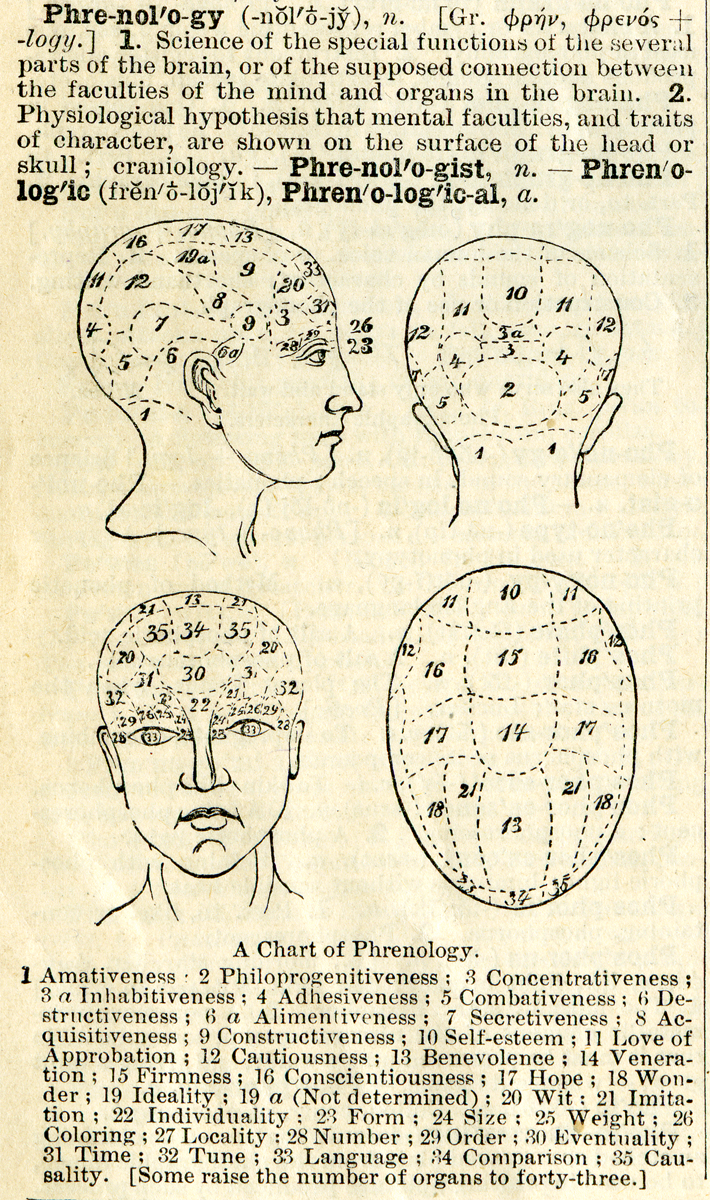
Phrenologists, as they were called, believed that each section of the brain controlled or housed a particular trait or emotion. You can see that here in this chart from 1895:

As you can see, phrenology didn’t last very long. This page is taken from a medical dictionary from 1895. Note the opening passage, that phrenology was the “…science of the special functions of the several parts of the brain, or of the supposed connection between the faculties of the mind and the organs of the brain…”.

Phrenology continued to linger long after it was dismissed as quackery by the respected medical community. It’s mentioned in “Dracula”, by Bram Stoker, and in numerous Sherlock Holmes stories by Sir Arthur Conan Doyle. Most notably, in “The Hound of the Baskervilles”, where Dr. James Mortimer confesses to an interest in phrenology…specifically, in a close examination of Holmes’s head! (“A cast of your skull, sir, until the original becomes available!”).

Want to know more about phrenology? Here’s an interesting and rather funny lecture given by Prof. John Strachan of Northumbria University in England. Enjoy!…Oh, this is just Part 1. If you want the rest, click on the video and it’ll take you to YouTube, where you can see the rest of it.

A New Century

The Great War of 1914 brought a new horror to the world of mental illness. It was given the title ‘Shell shock’, and was believed to be caused by the deterioration of the mental state, caused by the constant bombardment of artillery shells. The unrelenting stress thus created, it was believed, caused the affected person’s brain to just snap and blow a fuse.

It was in the first half of the 1900s that mental illnesses started getting names. Names like…

Catatonia (1874).

Schizophrenia (1908), from the Greek words that described a ‘split mind’.

Melancholia (An older term. ‘Depression’ today).

Bipolar Disorder (1957). Previously called ‘Manic Depression’ (1952) and ‘Circular Insanity’ (1854).

The 20th century also brought forth a new and terrifying treatment. One which had no sure and certain outcome and which could, if performed poorly (or performed at all!), leave the patient as a comatose vegetable. It was called the lobotomy.

Tinkering with what does the thinking, has been a fascination for centuries…just look at medieval trepanning. The lobotomy had its roots in late-Victorian scientific and medical experimentation. Great strides were being made in medicine during the turn of the 20th century. New drugs, new ways of doing things, new understanding, new technologies, were making the treatment of patients faster, safer, cleaner and more effective. Why not might the same be done for the human brain?

Mostly because the results were almost always a failure.

The Lobotomy

Ah, the lobotomy. Famous in horror films for turning monsters into angels, angels into monsters, and right-thinking people into perfect vegetables. But what is it?

The lobotomy as is most commonly thought of, was developed in the mid-1930s by Antonio Egas Moniz. In 1935 and 1936, Moniz ‘perfected’ one of the most controversial medical treatments in the history of medical treatments…and that’s saying a lot.

A lobotomy involves making two incisions (holes) in the front of the head and inserting a pair of blades into the brain, whereafter two cuts or slices are made into the frontal lobes (quarters) of the brain. This was supposed to alter the workings of the brain, calm the patient down and affect a remarkable change in personality.

…or not.

Some lobotomies were pulled off with relative success. Others became tragic failures. Because the lobotomy required small, precise slices or cuts into the brain, a small, precise instrument was used. Originally, that instrument was one of these:

The scientific term is an ‘orbitoclast’, but its similarity to the axes and picks used by mountain-climbers…

…caused people to call operations carried out with these instruments, ‘ice-pick lobotomies’.

Unsurprisingly, lobotomies were incredibly risky. Patients risked everything from death, paralysis, becoming a vegetable, losing their faculties, their ability to speak, see, function properly in society…It makes you wonder why such a treatment was ever devised in the first place! One of the most famous people to receive a lobotomy was a 12-year-old boy named Howard Dully. He’s still alive today. He was born in 1948. The lobotomy was performed on him with the permission of his parents. The damage was so severe that it took him his whole life for his brain to recover and for him to be able to function properly in society again. The lobotomy is such a mythical procedure in medicine today that he wrote a book about what it was like to have one, and the effects that it had on his life. His memoir is titled “My Lobotomy”.

The effects (and benefits, if any) of lobotomies were disputed almost immediately. Even by the 1940s, people were questioning whether or not this ‘procedure’ did anything useful at all. The Soviet Union made the performing of lobotomies illegal as early as 1950. By the 1970s, most other countries had followed suit. During the heyday of the lobotomy (the 1940s and 50s), up to 18,000 people were lobotomised in the United States alone.

Electroshock Treatment

Electroshock treatment or therapy dates back to 1938. It was devised by Italian psychiatrists Ugo Cerletti and Lucio Bini. Cerletti first experimented on animals, as all good scientists did back in those days, before moving onto human patients.

Why on earth would zapping someone with electricity be considered a good thing?

Cerletti believed so because he noted a remarkable change in his aggressive, mentally ill patients. Once zapped, aggressive patients tended to be calmer and more manageable. This was seen as a good thing (who wouldn’t agree?) and electroshock therapy was slowly introduced around the world, to treat those who had mental illnesses that caused them to be a danger to those around them, such as the “criminally insane”.

Electroshock therapy is obviously dangerous. Improper use of the therapy can lead to brain-damage, most notably, temporary or permanent memory-loss. It was often prescribed for violent criminals to calm them down, or for mentally ill patients who posed a physical danger to those around them. It’s still used today, to treat extreme depression, although in the 21st century, it’s much safer. It can still result in varying levels of memory-loss however…so if your doctor decides to prescribe you this treatment…think twice before saying ‘Yes’.

Looking for more Information?

Index of British Lunatic Asylums

The History of Phrenology

Documentary Film:Bedlam: The History of Bethlehem Hospital“.

History of the Bethlehem Royal Hospital

“What is a Lobotomy?”

“What is a Lobotomy?” (WiseGeek.com)


Choking or Charming? The History of Ties and How to Tie One

Ties. They can look flashy, fashionable and snappy, or they can bring back visions of boardrooms, the office, school or military dress-uniforms. They can be stylish and colourful, or they can be choking and restrictive, or possibly inducive of autoerotic asphyxiation…which might not be a bad thing. But I digress; fewer articles of clothing are more polarising to men other than whether you would, do, would not, or do not, choose to wear a tie.

Some people wear ties on a regular basis as part of a uniform. Some men wear ties because they’re part of their personal style or ‘look’. Personally, I’m in the camp of the latter. I started regularly wearing ties again about two years ago, and I’m still wearing them regularly today. In fact, I’m wearing one right now as I type this.

But how long have men been putting things around their necks? Where did they come from? Why on earth would someone do this?

The History of Neckwear

People have been putting on neckcloths for centuries. The modern necktie and its cousin, the bowtie, the two most common neck-coverings today, were descendants of one of the most common neck-coverings of the 17th century – the Cravat.

The cravat, a wide, scarf-like neck-cloth tied loosely around the throat, was the neck-covering of choice from the 1600s up to the 1800s. Some people who want a more loose and loungey, casual look in their neckwear still wear cravats, and their cousins, the neckerchieves, today. The word ‘cravat’ came from the French  ‘cravate’, which was a corruption of the word ‘Croat’, from the country of…Croatia, where the cravat was born in the 1630s.

The original purpose of these neck-coverings and cloths (be they cravats, kerchiefs or ties), was actually to hold the shirtfront shut, and to stop wind and cold air from blowing down into your clothes and onto your chest…it was a comfort thing.

The Birth of the Tie

By the mid-1800s, the cravat, a staple of men’s wardrobes for the past two centuries, was beginning to get a bit raggedy around the edges. As with a lot of other elements of men’s clothing at the time, people started wanting simpler, better-fitting, less flamboyant clothing. The cravat was being seen as a relic of the Regency era of the 1810s and it was quickly becoming sooo last century.

So the modern necktie was born. While the cravat and the neckerchief never really went away, by the last quarter of the 1800s, they were beginning to do serious battle with the new kid on the block – the necktie.

The necktie was popular for a number of reasons.

– The cravat is generally tied loosely and floppily around the throat. This was fine…so long as you didn’t have to keep tightening it up all the time. In the increasingly mechanised world of the late 1800s, the loose, wavy cravat was a liability. If it unluckily unravelled over a piece of whirring machinery, it could strangle the wearer to death! The necktie was done up so that it provided a tighter, safer knot.

– The necktie was simpler and didn’t take up so much real-estate. Cravats are like icebergs – three quarters of the cloth is stuffed down your shirtfront. And cravats are big, bulky things – that leads to a lot of excess material. Neckties were slim and simple, without wasted fabric.

– The necktie was easier to put on. A cravat had a lot of fabric and tying one could be frustrating. A necktie was thinner and had less to fuss around with, making it faster and more convenient to tie.

Tie Knots

There’s a multitude of tie-knots out there. According to author Thomas Fink, who did a study of the necktie, there are no fewer than 85 ways to tie a necktie. Screw that! I’m only going to talk about two knots.

Not all shirts are the same and not all collars are the same. So you should always know at least two tie-knots. One of the most common knots is the Four-in-Hand.

Four-in-Hand Knot

The four-in-hand knot is probably the simplest knot ever. Supposedly, it was named after coachmen, who would tie up the reins of their carriage-horses in a similar way, to stop them from tangling up during long drives. If you’ve never tied a tie and you really need to know how, this is the fastest way:

1. The tie’s draped around the popped-up collar and over your shoulders, with the right side longer than the left (and with the wider side on the right).

2. The right side of the tie is crossed over the front of the left and then pulled behind it to the right.

3. Then the right side of the tie is crossed over the left side again.

4. Then, it’s pulled up through the gap below your neck.

5. Using your fingers, wriggle a hole through the last of the two loops that you made around the skinnier portion of the tie.

6. Stuff the wide end of the tie down through that new hole you wiggled open with your fingers. Pull it down so that it’s nice and tight.

7. Close the gap below your neck by pulling on the short end of the tie to draw the knot up.

Note: As this is the knot that generally uses the least amount of material, you might end up with a tie that hangs down too low. If it does, untie and do it again. Simply repeat step 3 two or three more times. This uses up the extra fabric so that you don’t have so much left over when the knot’s done up.

The four-in-hand knot is best used with shirts with spearpoint collars, that leave only a small space between the ends of the collar. This is because the knot that results from tying a tie in this fasion is rather long and skinny (unless you wrapped the tie around the knot a few more times to use up the extra fabric like I mentioned up above).

The Windsor Knots

The knots which are collectively called the Windsor knots, go by many names. But the general style was named after the dapper Duke of Windsor (who caused a scandal in 1936 when he abdicated the British throne). However, the knot itself was actually invented by his father (King George V), who had a reputation of being a strict dresscode adherent.

Windsor knots are also called Full Windsors, Double Windsors and Half-Windsors.

What the hell is the difference?

Full Windsor and Double Windsor are the same thing.

Half-Windsor is…a…half-Windsor.

So how do you tie one?

The Windsor-knot is famous, not only because of its royal connections, but because it’s a fat, chunky knot with a lot of symmetry. Here’s how you do one up.

1. Drape your tie over your shoulders and around your popped-up collar. Longer, wider side on the right, skinnier and shorter side on your left.

2. Cross the long side over the short side (left).

3. Loop the long side behind, and then up, through the gap below your neck, and outwards. Then, pull down. The front of the wider end of the tie should now be hanging down, on your left-hand side.

4. Cross the wide side of the tie back behind the knot again, but this time, pull it right across to the right side of your body.

5. Pull it up and stick it through the gap below your neck, keeping to the right side, this time. Pull it down. This is similar to step 3, only in reverse and on the other side of the knot. In this case, the BACK side of the wide end of the tie should be facing outwards.

6. Draw the wide end of the tie across the front of the knot to the left, and then poke it through the gap below your neck from behind, again (as in step 3).

7. Toss the wide end of the tie back over your left shoulder. Stick your finger down the front of the knot to make a hole there. Stuff the rest of the wide end of your tie down that hole and pull tight.

8. Pull the shorter, back end of the tie down to close the knot.

If you’ve done it right, then you should have a fat, triangular knot. Also, there should be a little dimple in your tie just below the knot – a distinctive trademark of a Windsor knot.

Alright. You’ve just done a Full or Double Windsor knot. Again, as with the four-in-hand knot, if you’ve left with too much fabric, undo the tie, readjust and tie again, but repeating steps 3 and 5 one or two more times to use up the extra fabric to make the finished length more correct.

So how do you do a Half-Windsor knot?

Easy. Just do half the steps. That’s why it’s called a Half-Windsor!

Do steps 1-3. Then instead of doing step 4 (bringing the tie around the back of the knot to the front to the right and stuffing it down the neck-gap again), simply bring it around the back, all the way around the front and to the back again (in a loop), then do steps 3, 7 and 8. Done.

The Four-in-Hand, the Full/Double and Half-Windsor knots are the most commonly-used tie-knots. The Windsor knots, because of their chunkier results, are best tied on shirts with spread collars, where a knot that takes up a lot of shirt real-estate is preferrable.

The Bowtie

Like the necktie, the bowtie is descendant from the granddaddy of all neck-cloths, the cravat. Okay. I won’t go into all that again.

Doing up a necktie is easy. Most boys learn how to do one up for school uniforms and the like. But a bowtie can be daunting and scary and intimidating!

It isn’t.

Bowties carry certain connotations – You’re a professor, banker, teacher, doctor, Hercule Poirot, or if you wear thick-rimmed glasses, have buck-teeth and wear a shortsleeved shirt – a nerd. But bowties can also carry a connotation of skill…mostly because they’re perceived as being impossible to tie.


Agatha Christie’s dandy Belgian detective, Hercule Poirot (portrayed by David Suchet), with his trademark bowtie

They’re not.

And this is how you do it.

I’ll be honest. There are a bazillion video-tutorials on YouTube that show you how to do up a bowtie. And you could disregard everything here that’s to come, and just go and watch one of those. But one reason why there’s so many of those videos is because they all show you how to tie a bowtie…but they don’t tell you. “You do this, then this, then this, then this, then this…voila!”

Yeah. Slow down. The video’s over in two minutes and you’re standing there with a piece of crap tied around your neck and your big fancy Black-Tie dinner is in half an hour. You’re screwed.

Tying a bowtie is easy – I got it after just three attempts. If a doofus like me can do it, anyone can. Here’s how:

1. Pop up your collar.

2. Adjust the length of your tie. Quality bowties have a cinch or an adjuster on them. Use this to get the length of the tie right.

How long does the tie have to be? Well, if it’s draped over your chest and around your neck, the left end of the tie should be at your nipple or at the top of your sternum. The right end should be about an inch or so longer than that. Adjust the tie’s length so that this is achieved (the short end of the tie is always on the left, the long side is on the right). Go ahead. I’ll wait…

3. Okay, done that? Now, to tie stuff up. Cross the long end of the tie over the short end (to the left). Stick the long end up behind the knot and pull up, firmly. The long end of the tie is now on your left shoulder and it should’ve looped around there from behind the left part of the tie. Yes? Good. Leave it there.

4. The other half of the tie is now pointing straight down. It should be shaped like a fish, with the tail pointing down and the head pointing up. Fold the tie in half across the middle of the head. Then twist this part of the tie to the left. You should have a nice, bowtie-looking shape under your chin if you’re looking in the mirror.

5. Keeping this position, flop the other part of the tie (on your shoulder) down over the middle of this bowtie shape.

6. Pinch the head and tail of the fishy bow which you created in step 4, together, and pull outwards. You’ll now have two holes. One between your neck and the tie itself, and one smaller one in front of that, just big enough for your finger to poke through.

7. The long half of your bowtie is now hanging down just like the other half was, with the fishtail pointing down and the head pointing up. Do as you did with the other half of the tie – Fold the head in half and twist it to the left.

8. Now for the tricky bit. Remember that little hole I mentioned at the end of step 6? You’re now gonna shove the folded head of your other fishy through that hole. I find it helps to fold the fish again, lengthwise, to fit it through here.

9. Done that? Now you should have:

Front bow – folded side on the left. Fishtail on the right.
Back bow – Folded side on the right. Fishtail on the left.

During this procedure, the middle of your bowtie knot might become a bit twisted. You can untwist it slightly to make it a little neater.

Now, to tighten and neaten.

Pull on the two fishheads to tighten the knot, and on the two tails to loosen the knot. Keeping pulling on the heads and the tails until symmetry and a comfortable tightness has been attained. Straighten out the fish-heads (especially the inner right one, which may have become a little crinkled in the exercise), and you’ve got a perfect bowtie!

Now you’re ready for that school formal or prom or that Black Tie family reunion or that fancy dress party which you’re attending as a Computer Nerd.

To undo the tie later, simply pull on the fishtails, and the whole thing just comes apart.

Note: Don’t worry if the tie isn’t absolutely super-duper crazy mega-perfect. No self-tied bowtie ever is. But you can try to get close.


“Ah Watson! The Needle!” – Sherlock Holmes and Drugs

“Which is it today? Morphine or cocaine?”
“It is cocaine. A seven-per-cent solution. Would you care to try it?”

– Dr. Watson speaking to Sherlock Holmes, ‘The Sign of Four’

Sherlock Holmes is famous for a lot of things. His deerstalker cap, his pipe, his address (“Two-twenty-one B…Baker Street”), his phenomenal deductive powers and of course…his drug-use. That’s what this posting is about.

The Holmesian Canon (the collection of short stories and the novels), was written by Sir Arthur Conan Doyle, who was knighted in 1902 for services rendered during the Second Boer War (1899-1902). But before the Boer War, Doyle enjoyed the use of another title.

Dr. Arthur Conan Doyle.

That’s right. He was a physician.

He wrote the Holmes stories in the considerable amounts of spare time that he had between appointments and consultations, to make the extra money that his medical practice failed to provide.

It’s probably not surprising then, that medicine and drugs play a big role in the Canon, since after all, the stories were written by a doctor.

Sherlock Holmes and Drugs

The Holmesian canon gives us a window into the world of Victorian England, at the end of the 19th century. We see clothing, transport, social attitudes, science and technology. And we also get a glimpse into Victorian medicine. How many of the characters are doctors or surgeons? Dr. Mortimer, Dr. Watson, Dr. Trevelyan, Dr. Carthew…the list goes on.

But Holmes’s closest association with medicine (apart from Dr. Watson), is his use of drugs.

I will say this once. So pay close attention.

Sherlock Holmes was not a drug-addict.

He says so himself. Holmes’s brain is overactive. It is constantly whirring around looking for things to occupy itself with. When he’s working on a case, his brain is occupied with problems, facts, deductions, inferences and pieces of evidence.

When Holmes doesn’t have a case, his brain has nothing to work on. Nothing to stimulate it. He gets bored and cranky. Hence the drugs. They serve to keep his brain occupied and stimulated when he doesn’t have a case. He hops off them the moment that he does have one. At best, you might say that Holmes was a recreational drug-user. But certainly not an addict. If he was, he’d be huffing on opium and shooting up heroin all day long, even if he was on a case…which he has never done.

“…My mind rebels at stagnation. Give me problems, give me work, give me the most abstruse cryptogram, or the most intricate analysis, and I am in my own proper atmosphere. I can dispense then with artificial stimulants. But I abhor the dull routine of existence. I crave for mental exaltation…”

– Sherlock Holmes, ‘The Sign of Four’

Now, I will sit back while I’m broadsided by a group of angry people screaming at their computer-screens, saying how Holmes is a drug addict because he shot himself up with cocaine and morphine, how he did tobacco, how he huffed opium and did heroin and every other kind of illicit drug imaginable. Of course he was a druggie. Those are all illegal drugs!

…No they’re not.

Drugs in Victorian England

You have to understand that we read the Holmesian stories through modern eyes. Through the eyes of people living in the 21st Century. When these stories were written, some well over a hundred years ago, things were very different.

The most important difference, for the purposes of this posting, is that in Victorian times, opium, morphine, cocaine, laudanum and heroin were all completely legal.

Yes they were. Believe it, or not.

You could go into your Boots chemist in London on Fleet Street and buy a bottle of opium or morphine just as easily in 1885, as buying a bottle of aspirin pills is today. Nothing was thought of it and nothing was said. It was as easy as that. And 100% legal. Owning, using, purchasing and selling these drugs was as common as cough-drops. There was almost no regulation or laws surrounding these substances…mostly because at the time, their side-effects were less well-understood than they are today.

Opiates, especially (opiates are the drugs derived from the opium poppy), were used extensively in Victorian times, either as sedatives, sleeping drafts or painkillers. Sleeping-tablets contained opium or morphine. Sedatives (drugs to help you relax) most likely also contained opium or one of its related drugs.

The most common painkiller of the time was a powerful drug sold in bottles and which was used to treat everything from toothaches, headaches, joint-pains and back-ache. Called ‘Tincture of Laudanum’, this highly potent cocktail of alcohol and opium was powerful and effective…but also extremely addictive. And it was sold as freely in Victorian times as any other non-prescription pain-relief medication is sold today.

The Status of Drugs

In Victorian times, when the Holmesian canon was written, there was almost no regulation about drugs and poisons. The closest thing you had was the pharmacist’s ‘Poison Book’.

By law, pharmacists had to keep a record-book of poisons. Anyone wanting to purchase poison would have to fill out a line in the book. Their name, address, reason for purchasing poison and so-on…and sign their entry in the book. That was pretty much it.

But the drugs which, in the 21st century are illegal, had no regulation in Victorian times. Their side-effects were not understood and they were so widely used by everyone from doctors and surgeons to parents treating their sick children, that nobody thought anything of it.

It would not be until 1920, with the passing of the Dangerous Drugs Act, that drugs like cocaine and heroin would finally be outlawed in England.

Holmes’s Use of Drugs

At best, Holmes was a recreational drug-user. He shot himself up with morphine and cocaine to alleviate the agonising spells of boredom he had between the cases which were his real addiction. Opium is occasionally mentioned in the canon (most notably in ‘The Man with the Twisted Lip‘), and its famous side-effect of drowsiness (which is what made it so popular as a painkiller and sleeping-agent) was recorded therein, but no mention is made of Holmes ever actually taking the drug.

Whatever you might think of Holmes and the use of the drugs mentioned in the canon, you need to understand the historical context of the stories and the manner in which drugs were viewed at the time, and how they were used by Holmes, both very different from how they’re handled and used today.


The Good Germans: Having a Nazi in the Family

The names Hitler, Goering and Heydrich will forever be drenched in blood. Forever mocked. Teased. Spat on. Have songs sung about them regarding various states of testicular development…or underdevelopment.

The actions and inactions carried or not carried out by three of the most reviled men in history have been condemned an infinity of times by survivors, soldiers, historians, ordinary people, politicians, students, teachers, professors, freedom-fighters…and even…their own families.

This is the story of the members of the Families Hitler, Himmler and Goering, who turned their back on the black sheep of their name, who would forever tarnish whatever good reputation they might once have had, or might possibly have had in the future. This is the story of how members from the families of the three most hated men in history worked against their relatives’ revolting actions to try and attone for the sins and misdeeds that would forever be linked to their names.

Just in case you don’t know who these men are (unlikely), here’s a brief rundown:

Adolf Hitler – Chancellor or ‘Fuehrer’ of Germany. Leader of the Nazi Party which ruled Germany from 1933-1945.

Hermann Goering – One of Hitler’s right-hand men. Head of the German ‘Luftwaffe’ (airforce).

Reinhard Heydrich – Senior S.S. general. He chaired the infamous “Wannsee Conference” where high-ranking German officials gathered to discuss the details of the “Final Solution”.

The Good Germans

This is a legitimate article about actual historical events and persons. All the people mentioned in this posting are real and they really did what they did. None of this is made up. Members from the families of Adolf Hitler, Hermann Goering and Reinhard Heydrich, really did conspire against them and worked against the Nazi war-machine during the Second World War. Their stories have been drowned by nearly seven decades of blood, but they are remarkable…and true.

So, let us begin.

William Patrick Hitler (1911-1987)

Related to: Adolf Hitler

Familial Connection: Nephew

William Patrick Hitler was born in Liverpool, England, in 1911. His father was Alois Hitler, half-brother to Adolf Hitler. His mother was an Irishwoman named Bridget Dowling.

The Hitler family is hardly conventional. It’s full of failed marriages, deaths, half-siblings and bastards (literally and figuratively).

William Patrick Hitler grew up in England. His father abandoned him at a young age and went back to Germany; William was raised by his mother, and he wouldn’t see his father again for nearly twenty years. When the First World War ended, William went to the new German ‘Weimar Republic’, the new Germany that had sprung up out of the dust and smoke of the end of the Great War. By now, it was 1929. In a few years, William’s uncle Adolf would seize power, in 1933.

William initially tried to take advantage of ‘Uncle Adolf’s new and powerful position as the new leader of Germany, but he became more and more dissatisfied with what he saw. He wanted Uncle Adolf to give him more to do, perhaps feeling that someone as influential as Adolf Hitler would have more influence. William even tried to blackmail his uncle. When this backfired on him, William fled to the United Kingdom in January of 1939. It was during this time that he wrote an article for a popular magazine, entitled “Why I Hate My Uncle”. Shortly afterwards, William and his mother moved to the United States of America.

When the Second World War started a few months later, William and his mother were trapped in the U.S.A. With German U-boats prowling the Atlantic Ocean looking to attack Allied shipping, it was too dangerous to sail back to England. Eventually (and understandably, after quite a bit of fuss), William managed to join the U.S. Navy, where he worked as a hospital corpsman.

After the War, William changed his name from the German ‘Hitler’ to the more English-sounding ‘Stuart-Houston’. He married and had four sons.

He died in the United States in 1987. He was 76 years old.

William P. Hitler had a sibling – A half-brother named Heinz Hitler (born to his father’s second wife, in Germany). Unlike William, Heinz joined the Nazis. He was captured by the Russians and tortured to death in 1942. He was 21 years old.

Albert Goering (1895-1966)

Related to: Hermann Goering (Nazi officer)

Familial Connection: Brother

Unlike his older brother Hermann, Albert Goering was a rather quiet, gentle sort of fellow. He hated the Nazis and the brutal tactics that they employed. He wanted to live the quiet life of a wealthy, German aristocratic gentleman, living somewhere in the countryside. Of course, having someone like Hermann Goering for a brother made these beautiful dreams rather harder to attain than usual.

Albert was so upset by what the Nazis were doing that he began to actively defy them…probably one of the few people who could do so, and get away with it. He helped Jews and political prisoners escape from Germany to countries of safety by getting them out of jail or by getting them essential travel-documents and money. He used to forge his brother’s signature regularly on important papers to help Jews escape.

So as not to be seen doing things that were suspicious, Albert would occasionally “help” the Nazis…in quite possibly the most unhelpful ways possible! He might sometimes be put in charge of Jewish transports. Only, trucks transporting Jews might never reach their work-assignments, prisons or labour-camps. Instead, they’d drive off a side-road, park in some quiet spot, and then Albert would turn a blind eye while all the prisoners hopped off the trucks and ran away into hiding, or tried to escape.

On occasions when Albert was arrested, he always managed to use his brother’s position as a top Nazi to get himself off the hook.

When the war ended, Albert was picked up by the Allies and interrogated extensively. But when all his supporters (mostly Jews) came to his defence, charges of Nazism were finally dropped.

Albert made a modest living as a writer after the war. He died in Germany in 1966. He was 71 years old.

Heinz Heydrich (1905-1944)

Related to: Reinhard Heydrich (S.S. General)

Familial Connection: Brother

Heinz Heydrich was the younger brother of Reinhard Heydrich, a respected general in the German S.S., the paramilitary organisation that was so heavily involved in the carrying out of the “Final Solution to the Jewish Question”; nothing less than the complete anihilation of the entire Jewish population of Europe.

Heinz Heydrich was a lieutenant in the S.S. Originally, he was very proud of his Nazi association and his older brother’s position within this unique organisation. He was a journalist by trade, and published the party newspaper. He continued his active association with the S.S. until June of 1942.

Early in June, Heinz’s older brother Reinhard died, asassinated by resistence-members in Czechosolvakia. His car was ambushed at a blind corner in a road and he was mortally wounded, dying a few days later in hospital.

It was this event that changed everything. Almost overnight, Heinz received a bundle of Reinhard’s personal papers and files…included in these were detailed plans about the “Final Solution”, in which Reinhard had been heavily involved.

Realising fully for the first time what he’d signed up for when he joined the S.S., Heinz was horrified. He burnt most of the papers in disgust.

Soon after this event, Heinz began to realise that he was in a truly unique position. Being the brother of a prominent S.S. general (albeit, a dead one), and being the editor of the party newspaper meant that he had a lot of influence. He used this to help as many Jews as possible escape from Germany. As a writer and editor of the party newspaper, Heinz had access to a commercial printing-press. He used this to print fake travel-documents which he signed and forged and stamped, and gave to Jewish families, so that they could escape from occupied Europe to countries of safety.

Heinz continued this work for two years, and might have lived out the war and be acquitted at the Nuremberg trials, if not for an event in November of 1944.

An investigation was launched into the goings-on at the S.S.’s newspaper offices. It was a pretty mundane thing – They just wanted to know why there was such a shortage of paper (in 1944 Germany, a lot of things were in short supply). Heinz, terrified that he’d be found out, committed suicide, shooting himself in the head.

He was 39 years old, and left a wife and five children behind.

Want to know more? Or perhaps you don’t believe me that all this is possible?

“Why I Hate My Uncle” – by William Patrick Hitler

“The Good Brother: Albert Goering”


Raining Hell: Surviving the Blitz

Back in December of 2009, I wrote a two-part article about the British home-front of the Second World War. Although I covered a lot of things, upon reviewing that posting, it’s become apparent to me that I didn’t really write that much about the Blitz, the concentrated aerial bombardment of British cities by the German Luftwaffe from 1940-1941.

This posting will concentrate on the purpose, aims and effects of the Blitz on London during the Second World War.

What was the Blitz?

The Blitz is probably the most famous event of the Second World War. Although it was by no means the first time that civilians were exposed to aerial attacks, it is certainly the most memorable.

The Blitz was the deliberate and concentrated bombing of British cities and towns (although the main target was London), by the German Luftwaffe in the period between the 7th of September, 1940 to the 10th of May, 1941.

The Blitz gets its name from the German word “Blitzkrieg“, ‘Lightning War’. This new, mobile form of warfare brought the war to the enemy, instead of waiting for the enemy to make the first move. The whole point was to strike first and strike fast. Just like lightning does, hence the name.

The Purpose of the Blitz

After the fall of France in mid-1940, the German war machine turned its attention to the British Isles. It was the German intention to invade Britain, but they realised that an invasion would be impossible if they didn’t manage to knock out at least one of the Britain’s two most formidable fighting forces.

Great Britain was defended by the Royal Air Force (the RAF), and the Royal Navy, then the most powerful blue-water navy in the world (and had been for the past 200 years).

The Germans knew that they couldn’t hope to fight and win against the Royal Navy, but they hoped that they would be able to attack and destroy the Royal Air Force. So began the Battle of Britain.

The Battle of Britain was supposed to knock out British air-superiority and allow the Germans to launch their invasion of Britain with unchallenged air-support. Unfortunately for the Germans, the British were made of tougher stuff than they’d supposed, and after several weeks of vicious aerial combat, the Germans were forced to surrender. It was the first battle in the war that the Germans had lost.

Unable to beat the RAF, the Luftwaffe decided instead to try and destroy British cities and towns to demoralise the British people. The Nazis thought that, by doing this, they could force the British to surrender to the might of the Aryans and cease their hopeless and useless attempts to struggle onwards in vain. So began the Blitz.

Preparing for the Blitz

The British Government planned for months for the coming of the Blitz. They never expected the Germans to play nice, so they had plans for every eventuality and scenario, including large-scale aerial bombardment of heavily populated cities.

Amongst these preparations were…

– Evacuation of children, babies, toddlers, expectant mothers, the ill and the elderly from towns along the south coast and major cities, to country towns further north, out of the effective range of German bomber-planes. This mass evacuation, which started on the 1st of September, 1939, was called Operation Pied Piper. It was the first of several evacuations from large British cities throughout the war.

– Issuing everyone, man, woman, child and even babies, with gas-masks. The British fully expected the Germans to bomb them with mustard gas, chlorine gas and other nasty and potentially deadly gases. No such gas-bombings ever took place, but nevertheless, civilians were urged to carry their gas-masks with them everywhere they went, and were reminded to keep them in a place at night where they would be instantly accessible.

– Enforcing a blackout throughout England. Street-lights were turned off. Car-lights were covered. Bicycle-lamps shielded. Thick, heavy blackout curtains were distributed to every single home and business and every night, these curtains had to be put up over a building’s windows so that not a single streak of light could be seen. The blackout was enforced with amazing strictness. You could be fined for showing even the smallest amount of light!…Even the glowing tip of a cigarette!

– Issuing the public with personal air-raid shelters. Anderson Shelters and Morrison Shelters (more about those later).

– Inflating enormous barrage-balloons. Barrage-balloons were huge, gas-filled floating balloons that were shaped like blimps. They floated above the cities and towns of England (and other allied countries) to protect people from low-flying enemy aircraft. If a low-flying German plane appeared, it would have to fly around, or over the barrage balloon, or risk crashing into it and having the balloon’s tethering-cables wrap around its propellers, causing it to stall and crash. Some balloons had explosive charges on them, so that any plane that crashed into them set off the charges and the balloon exploded, taking the plane down with it.


Barrage balloons floating over central London during the War. The building at the bottom of the photograph is Buckingham Palace

Surviving the Blitz

So…what happened during an air-raid?

Fortunately for the British, they were equipped with a new wonder-technology. It was called Radar. Or correctly, R.A.D.A.R, which stands for “RAdio Detection And Ranging”. Although it was in its relative infancy at the start of the war, RADAR allowed the British to monitor enemy airplanes. Where they were, how many there were, how high they were and where they were going. The Germans never figured out what RADAR was until after the war. They never equated the huge radio towers on the south coast of England with aircraft detection.

RADAR allowed the British to keep an eye on enemy planes. And most importantly, it allowed the British to warn large cities of incoming enemy air-raids. RADAR posts would be contacted by radio and telephone and then the warnings went out in the form of air-raid sirens.

There were two types of air-raid sirens in the war. The smaller, hand-cranked ones which could be operated by one man, or larger, electromechanical ones which were powered by electricity. There were a number of warnings that these sirens could give out, but the two most common ones were “Red Danger” or “Red Alert” (continuous high-low tone), and “All Clear”, (continuous high-pitched tone).

Even with radar. Even with sirens. Even moving as fast as you could, the chances of being caught in the wrong place at the wrong time during a raid could be pretty high. From the moment that the sirens went off, you had between 10-15 minutes to make it to an air-raid shelter before the bombs started to fall.

To give you an idea of just how terrifying a raid was, imagine the following scenario:

You finish work early and go home. During the war, businesses closed shop early so that people could get home in time for air-raid preparations. Perhaps you have to walk, tripping over rubble, broken glass, wood, masonary, blown up cars, around cordoned off streets…in the dark, because there’s no street-lights burning…and the Underground is out of action from power-shortages and bombing.

Imagine getting home to a small, rationed dinner, putting up the blackout curtains and going upstairs to bed in your cold bedroom. It’s cold because like everything else, coal is rationed, so you can’t keep your furnace burning all the time like you used to.

You fall asleep. Exhausted. You’re woken up at one o’clock in the morning by the steady, wailing, high-low tones of the nearest air-raid siren. You’re groggy, dizzy, tired. You can’t see straight in the half-light, and you’re only dressed in your night-clothes…and you have ten minutes to run out of your house with all the things you hold dear…and make it to a bomb-shelter before your house is blown to pieces and you become another statistic. If you live with your family, imagine having to round up the kids…your wife, your husband, your brothers, sisters, your parents, grandparents…and getting them all up and moving and out of the house in the middle of the night when they’re all asleep..in ten minutes. In fact make that five minutes. Because after ten minutes, you’re dead.

Imagine staying in your shelter during the raid. You can’t sleep because of the sirens, the fires, the explosions, the rattling of the flak-guns and the reports of anti-aircraft cannons going off, mixing with the sound of aircraft engines overhead.

You stay up all night, wondering if the next bomb has your name on it. When the raid is over, you leave the shelter and wonder if your house is still standing. Whether your friends are still alive, whether that one person who didn’t make it into the shelter on time is dead or not, or whether they managed to hide somewhere and survive. Imagine having to clear away rubble and pick through the remains of your destroyed house. Imagine not being allowed to go back home because there was an unexploded bomb in the middle of your street.


Newsreel footage of the Blitz

Imagine having to do this for seven months. That was how long the Blitz lasted.

Imagine having to do this every single night, after night, after night, after night, for two and a half months without pause. That was how long the Blitz concentrated on London alone.

That was the reality of the Blitz.

Air Raid Precautions

Now that you have a mental picture of the panic of an air-raid, you can imagine the sheer terror that gripped people when those sirens went off every single night.

So how did they cope with it?

Well, enter the A.R.P.

A.R.P. stands for “Air Raid Precautions”.

The ARP was responsible for the safety of civilians during air-raids in Britain during the Second World War. They evacuated people from their houses, they did head-counts, they directed people to shelters, they assisted with raid-related emergencies such as fires, rescues, unexploded bombs (or UXBs as they were called) and collapsed buildings.

The men on the ground doing the work for the ARP were the ARP wardens, with their metal Bodie-style helmets and dark blue uniforms.

Apart from the above-mentioned duties, ARP wardens also enforced the blackout. “Put that light out!” was a common thing to say if a light was visible from the street. Wardens also issued gas-masks, personal air-raid shelters, patrolling the streets at night, and handling bomb-damage. ARP wardens and fire-watchers would carry buckets of sand with them during an air-raid to put out incendiary bombs that had exploded and set things on fire. Incendiary bombs were firebombs filled with nasty liquids that would fizzle, burn and explode if you tried to put the bomb out with water, so sand was thrown on them instead to prevent the fire from spreading. ARP wardens also gave raid-victims first-aid and would help the police and firemen recover dead bodies from destroyed buildings and shelters. Apart from their helmets, ARP wardens were also given handbells and specially-manufactured Metropolitan police-whistles with “A.R.P” stamped onto them, to use as alarm and attention-attracting devices during a raid.


An ARP helmet, bell and metropolitan-style ‘ARP’ police whistle

Amazingly, the ARP existed long before the War ever started. It was formed back in 1924!

Why?

Well, during the First World War, London was bombed by German zepplins and bomber-planes. During these early raids, there was no prescribed way of handling the situation, since it was completely new in the history of warfare. Determined to be prepared if it happened again, the ARP was established to assist people during an air-raid if London was ever bombed again in the future.

The ARP wardens had among the most dangerous jobs in England during the War. Imagine having to run from your house in a raid to find a shelter in the pitch black when the sirens went off. Imagine having to roam around the streets directing human traffic, having to order people around, having to calm hysterical women, screaming children and panicking men while sirens scream and bombs explode around you, knowing that at any second, a bomb could go off, a building could collapse or catch fire, and you’d be dead. Imagine having to try and herd dozens, hundreds, of panicking people into an air-raid shelter in the height of the chaos, with only your hands and your police-whistle to direct people and get attention – Don’t bother shouting out orders – nobody would hear you over the sound of the explosions and sirens.

Such was the reality of being an air-raid warden.

Air-Raid Shelters

So what exactly were you supposed to do when the air-raid sirens went off?

Well, in the five or ten precious minutes of warning that RADAR and sirens were able to give you, you had to snatch all your worldly belongings, gather the people of your household, get your gas-mask (you HAD to take it. No exceptions. Even the Queen Mum carried hers with her everywhere she went) and run for the nearest shelter.

What kinds of shelters were available to people during the War?

In Britain, air-raid shelters varied significantly. They might be railroad bridges, church crypts, the cellars and basements of big buildings, or most famously – Underground Tube stations. Seventy nine of them were converted into air-raid shelters and underground workshops during the War.

But what if you couldn’t make it to a public air-raid shelter or gathering-point in time? What did you do then? Perhaps the nearest shelter was four blocks away.

Can you run four blocks in two minutes?

If you couldn’t, then you had to rely on the government-issued air-raid shelters. They came in two styles. The Anderson Shelter and the Morrison Shelter.

Anderson Shelter

Designed in 1938, a year before the war even started, this crude air-raid shelter was named for Sir John Anderson, the chap in charge of air-raid precuations.

The Anderson Shelter was a cheap, D.I.Y. shelter. It came delivered to your house (or you could go out and buy one) in fourteen prefabricated parts: Six roof-panels, six side panels, and two end-panels (one with a door, to create an entrance).

When properly assembled, the Anderson shelter was designed to hold six people. The shelters were six feet high, four and a half feet wide, and six and a half feet long. And it wasn’t just a matter of bolting them together in the garden as a children’s cubbyhouse. You had to dig a hole in the back yard! Six and a half feet long, four and a half feet wide (for the length and breadth of the shelter), and four feet deep! You assembled the shelter in the hole, with additional space for the door, and then you covered the entire thing with earth to provide shock-protection.

Despite how flimsy the whole construction sounded…these things did save lives.

But what if you didn’t have a garden, and you lived miles from the nearest public shelter?

Then you used the…

Morrison Shelter

The Morrison Shelter was named for Herbert Morrison, then Minister of Home Security. The Morrison shelter was a heavy, steel table with wire sides between the legs and base. It was designed to hold two to three people and protect them in the event of a raid. Because of their design, Morrison shelters often doubled as coffee-tables or dining-tables in people’s living-rooms during the War. In a pinch, you could open the side of the shelter, crawl in and slam it shut behind you.

The Purpose of the Shelters

Duuuh. To protect you against bombs!

Ehm…no.

Anderson Shelters and Morrison Shelters were not, and never were, designed to protect you against bombs.

Be serious. Is a metal table or a few sheets of corrugated steel, going to protect you against a bomb weighing thounds of pounds?

Of course not.

Well then what was the point of having them?

The point of these shelters was not to protect you from bombs. They were never designed to take a direct hit. Instead, they were designed to protect you from shrapnel.

When a bomb drops and explodes, it sends out heaps of shrapnel. The metal shell-casing, bricks, glass, wood, mortar, chunks of concrete and all other kinds of flying debris. Every single one of these things is a potentially lethal missile. If they hit the sides of the Anderson Shelter, you would be safe. This was why the shelters were dug into the ground and covered with soil. To protect against shrapnel.

Morrison shelters protected you from above. They were designed to withstand the force of the house collapsing on top of you if it was bombed. The table-shelter would give you a ‘safe-zone’ in which to hide, protected from the rubble, until ARP wardens and fire-watchers could extinguish the flames and get you out alive.

Public Shelters

If you didn’t have a garden or space for a Morrison Shelter in your apartment, then in an air-raid, you could use a public air-raid shelter. The most famous public air-raid shelters were the seventy nine Tube stations that were converted into bomb-shelters and underground workshops during the War. Some stations which were no-longer used might be converted into storage-areas or workshops. But other stations which still received regular traffic were used as air-raid shelters.

Ducking down in the Tube was hardly pleasant. How would you like to spend the night in a cold, draughty, piss-soaked subway station with dozens of other people, with blankets and cold food and no toilets and rats and water and the wailing of the sirens, the blasting of anti-aircraft cannons and the explosions of bombs up above you all night?

The British Government initially dissuaded people from using the Tube as an air-raid shelter. They were scared that, once everyone went underground, they’d never want to come out again.

When these fears were proved groundless, the government picked out the nearly eighty stations across London that could be used to house people in air-raids. They were fitted with extra toilets, lights, running water, bunk-beds and even special trains that came by with hot food! At night, Tube workers would cut the power so that Londoners could sleep on the railway tracks without getting electrocuted by the current that ran along the third rail which powered the subway trains.

Of course…you had to be able to wake up on time in the morning, otherwise you might get run over by the morning rush-hour!

People kept their spirits up down in the Tube with songs and games. Many people would actually arrive early! They’d show up in the station after work with their wives and husbands and kids, tea and sandwiches, blankets, coats and pillows, and pick out the best spots in the station to bunk down for the night.

Other public air-raid gathering points included basements, cellars, church-crypts and bridges. While none of these provided complete safety from aerial attack (almost nothing could protect you from a direct hit), they were made available for those people who had nowhere else to run.

Despite the provision of private shelters and the setting-up of public ones, a significant number of Londoners actually chose to sleep in their own homes during the air-raids. Since sleeping in the shelters didn’t guarantee safety, some Londoners decided that if they were going to die anyway, they’d prefer to die in their own homes.

The Baedeker Blitz

The main body of the Blitz on the United Kingdom was over by mid-1941. However, that didn’t mean that the danger had completely passed, and throughout the war, the Germans continued to conduct air-raids on British cities and towns. The next most famous set of raids were collectively called the Baedeker Blitz.

These air-raids were named after the famous Baedeker (pronounced ‘Bay-Decker’) guidebooks. The Baedeker Co. (ironically, a German company!), was famous for printing in-depth guidebooks of famous countries and cities for the travelling public, covering everything from England to France, Italy to China. They were the Lonely Planet of their day.

These raids, which took place between April-June of 1942, targeted the famous tourist and cultural centers of the British Isles, such places as would be mentioned in the famous Baedeker Guidebooks (hence the name).

Cities targeted included York, Bath, Norwich, Exeter and Canterbury. The famous Canterbury Cathedral was one of the targets during the Baedeker Blitz. Fortunately for the British, the bomber missed the Cathedral (although not by much). Unfortunately for the British, the bomb struck the cathedral’s archives building, destroying it in a direct hit.

V1s and V2s

By the last year or so of the war, the Germans were in deep trouble. The Allies were closing in from the East and West. From France, British, Canadian, French, Polish and American forces were charging towards Berlin. In the East, the Russians were steamrolling the Germans back, taking bloody revenge for their fallen comrades, whom the Germans had previously captured…and killed…in their hundreds of thousands.

But that didn’t stop the Germans from trying to strike at England. In 1944 and 1945, they developed and launched first the V1, and then the V2 rockets. These crude weapons were the predecessors to today’s guided missiles.

Launched starting shortly after D-Day, the V1s were nicknamed ‘Doodlebugs’ because of the buzzing noise they made when they flew overhead. Although probably a powerful psychological weapon, in reality they were not as effective as the Germans had hoped. Doodlebugs were slow and cumbersome. British anti-aircraft cannons could take them out with relative ease. And even when the Germans launched doodlebugs en-masse, only one in four ever made it past the anti-aircraft guns.


The V-1 ‘Doodlebug’

The V2s, much faster and more accurate, were so advanced for the day that they were beyond the capabilities of anti-aircraft gunners to shoot down. Deciding that it was impossible to destroy the rockets once they were in the air, and unable to destroy the launching areas (hidden and well-protected), the British instead relied on disinformation and espionage to defeat the Germans and their fearsome new Weapon of Mass Destruction.

For the duration of the war, the British had been training a large number of spies. Some spies were British. Other spies were Germans who spied for Germany, but who were captured by the British and turned into double-agents, spying for both countries, but only supplying useful information to the British. Some German spies actually hated the Nazis. They would sign up for spy-duties, get sent to England, and the moment they could, they would hand themselves into British authorities, divulge their mission-details and any handy bits of information, and then switch sides and spy for the British.

This complex network of spies and misinformation was called the Double Cross System. And the British used their extensive network of agents and spies to screw up the Germans and their V1s and V2s.

Because of the crudeness of these early missiles, the Germans had to rely on their agents in England to tell them how successful the weapons were. Egged on the British, the German double-agents would send back misleading reports.

If a missile missed London (or another prominent target), information sent back to Berlin was that the missile was on target and that nothing should be changed.

If a missile hit its target, then a message sent back to Berlin would say that the missile had been ranged too long (or short) and that corrections would have to be made. These ‘corrections’ would in fact result in the previously-accurate missiles going off-target and striking smaller communities or exploding harmlessly in the countryside.

Using these tactics, the British were able to redirect the majority of German V-2 rockets into less-populated (or completely unpopulated) parts of the country, where a bomb-explosion was less likely to kill someone.

By early 1945, with the Allies closing in on Germany on all fronts, and the Germans running short on everything from food, to water, fuel, ammunition and more essential things like lederhosen, their campaigns of terror against Britain finally ceased.

Cities all over the British Isles were devasted by the bombing. Streets were cordoned off, buildings were demolished, entire families might be wiped out. Apart from London, probably the hardest-hit city was that of Coventry, where almost the entire city was flattened by German bombing in one night. So intense was the bombing that the Germans invented a new word to describe the sheer level of destruction – Koventrieren – to Coventrate – or to destroy something completely.

Few people today can imagine the terror of exploding bombs, the scream of air-raid sirens and living in constant, daily fear. For many people, it’s something they read about in history-books, see in movies or in episodes of ‘Foyle’s War’…But it did happen.


Behind Closed Doors – Upstairs and Downstairs

There’s always a lot of costume dramas and historical TV shows on the air. The new series of “Upstairs, Downstairs”, the immensely popular “Downton Abbey” and of course, older series such as the original “Upstairs, Downstairs”, “Jeeves and Wooster” and “Lord Peter Wimsey”. Add to this movies such as “Gosford Park” and so-forth, and it seems that film and television producers can never get enough of the “good old days” of servants, bells, starched collars and telegrams delivered on silver trays.

The natural habitat of such shows always alternates between the English country manor-house and the terraced London townhouse, both locales with plenty of space to accomodate the goings-on both above and below stairs. But given that a lot of these shows take place in a time-period almost out of living memory, what were all the rooms that were central to this way of life? Of masters and servants? What were their functions? And why did you have so many rooms?

Here are some of the more well-known rooms that you might come across when watching a period costume drama set in a large house or an aflluent townhouse in the Victorian era or in the first half of the 20th Century. This posting will cover some of the more obscure rooms that you might find mentioned in movies, TV shows or old books. They’re are not presented in any specific order, so don’t try to find any! The more common (and obvious) rooms aren’t included.

The Drawing Room

No costume drama would be without its drawing room. It’s unthinkable! But what is a drawing room?

Despite the name, it is not a chamber meant for painting, writing, drawing or any other kind of artistic pursuit.

The drawing room comes from the word ‘Withdrawing’. In large, formal households, the drawing room is where people would withdraw to, after dinner or other substantial meal, for quiet conversation or relaxation. In most houses, the drawing room did double-duty as the general living-room for entertaining or receiving guests and visitors. On formal occasions, parties might be held in the drawing room.

The Morning Room

The morning room is the chamber in a house with multiple rooms, which was typically used during the early hours of the day (hence the name ‘Morning Room’). It was any reception-room built with the windows facing east, so as to make the most use of the morning sun. The room most commonly shown in the TV series ‘Upstairs Downstairs‘, is the morning room.

The Library

What a library is, is rather obvious. It’s where books are stored. In times past, books were significantly more expensive than they are today. Don’t forget that it was only until after the Industrial Revolution of the 1800s that books could be mass-produced by steam-powered printing and binding-presses. Prior to this, books were laboriously printed, cut and bound by hand, making them significantly more expensive than they are today. Any house with a significant collection of books would store them in their own room, the library, where they could be read in comfort and returned once reading was finished, to prevent them being lost. In some libraries, books were locked in glass-fronted bookcases to prevent damage and theft. The library might do double-duty as the study or office of the house because of easy access to reference materials and information. Particularly large libraries might come equipped with a specially-made set of library stairs.

Library stairs ranged from simple folding stepladders (that might or might not also double as stools), to long ladders on casters, affixed at the top to a rail that ran along the top of the bookcases, or they might literally be a set of movable stairs on caster-wheels:


A set of antique library stairs, with casters for moving them around the library and accessing high shelves

The Long Gallery

The gallery was the long passageway inside many large houses that date back to the medieval era. It would be the main corridor that would connect one or more wings of the house and was often brightly illuminated by large windows on one side (and possibly, on either end). Because Long Galleries could be rather boring if all they were, were connecting passages, some rich folks tried to dress them up a bit by hanging pictures on the walls. This gave us the modern “Art Gallery”.

The Larder

Ah, the larder! It’s where Mrs. Patmore and Mrs. Bridges put all their food. It’s the place where the kids in the Famous Five and the Secret Seven go to pinch all the choicest leftovers before going off on their adventures. It’s the magical room which kids (and if Jeeves and Wooster is to be believed, Tuppy Glossop) go to steal food from after midnight for a little nibble.

But what is a larder?

First off, a larder is not a pantry.

A pantry is a room or a large store-cupboard where bread and baked goods are stored. It’s cool and dry and free of vermin.

A larder takes this one step further. In essence, a larder is a cold-store. A specially-designed, specially-constructed room (or in some cases, building), which is made to be as cold as possible. Larders are built of stone to keep in the cold. Good circulation to keep out the heat. And with shelves and ceiling-beams with hooks to keep the food away from the vermin.

Before the days of effective, electrically-powered home-refrigerators, the larder was where you stored all your perishable foods such as dairy-products (milk, cream, cheese etc) and meat and poultry, such as sausages, meat, fish, steaks and any leftover food from dinner.

Although the residential icebox did exist at the same time, you have to consider that ice wasn’t accessible in every part of the world, all-year-round. Or even in every part of a particular country all year round. So homes without ice-based refrigeration (or for homes for which such refrigeration was impossible or too impractical and expensive), the larder was their fridge. Effective electric fridges of the kind we have today didn’t show up until the 1930s.

The Scullery

The Scullery is the domain of the scullery maid. Said maiden being the lowest-ranking of the female servants in a wealthy household. The scullery is the washroom. In larger houses, the scullery and laundry might be two different rooms (one for dishes, one for clothes and linen), but in smaller houses, the scullery did double-duty as the wash-up room for the silverware, glassware, China, kettles, pots and pans, and as the laundry for towels, bedsheets, clothes and undergarments.

The Butler’s Pantry

A ‘pantry’ is the room in which bread is stored. Originally, it was the domain of the ‘pantler’ or the servant in charge of bread (from the Latin ‘Pannus’; ‘Bread’). The butler’s pantry has nothing to do with bread. Or food.

The Butler’s Pantry was the domain of the butler. The head of the servants. In the pantry were stored such things as the family silverware and silver-cleaning implements and chemicals. Just understand, please, that the family ‘silver’ was a lot more than just knives and forks. Silverware could include ANYTHING made of silver. Candlesticks. Trays. Serving-trolleys. Tureens. Platters. Jugs. Cups. Saucers. Cake-servers. Cake-stands. Gravy-boats. ladles. Chocolate and coffee-pots. Milk-jugs. Cream jugs. A wealthy family might have a small fortune of silver stored away down in the servants’ quarters. And all of it had to be locked in the Butler’s Pantry, under the watchful eye of the Butler. Every single piece that went out had to be accounted for, and every single piece that went back had to be checked. If so much as a single teaspoon went missing, then the ENTIRE house would be searched for it. And the servants would be locked outside while the search happened!

So the pantry would house the silver-cupboard, the butler’s bedroom and private quarters, as well as important keys and important documents such as account-books, the silver-book and the wine-book, all of which had to be checked and updated regularly.

The Servants’ Hall

The servants’ hall is the main room for domestic servants in a wealthy household. You see it in ‘Upstairs, Downstairs’, in ‘Downton Abbey’, ‘Gosford Park’, and it’s mentioned in other TV shows such as ‘Jeeves and Wooster’. It must be a pretty important room. But what is it?

The servants’ hall is the break-room. It’s the room where servants would eat their meals and spend leisure-time. It’s the room where most of the work was carried out as well. In some houses, the servants’ hall was a separate chamber. In smaller houses, the kitchen might double as the servants’ hall.

The servants’ hall was the domain of the unfortunate Hallboy. The hallboy was the lowest-ranking male servant. He had the unenviable task s of doing all the heavy labour. Carrying coal. Firewood. Cleaning the servants’ hall and doing just as much housework as any of the female staff. Because he was the lowest of the low in the male servantry, the hallboy might not even have a bedroom. If he didn’t, he’d sleep in the hall as well!

The main panel of servants’ bells (which connected through wires and cables to the bell-pulls in the rooms upstairs), might be located in the servants’ hall or in the kitchen, where there would always be at least one person to keep an eye on the bells.

The Ballroom

The ballroom was the chamber reserved (in the largest of houses) for formal dance and parties (balls). In smaller houses, the drawing-room might double as the ballroom. Specially-built ballrooms came with their own dancefloors and musician’s galleries, where orchestras or bands could perform to project the music around the room, but keep out of the way of the party-guests.

The Parlour

The parlour is a reception-room in a house with multiple reception-rooms. Often, it was near the front of the house and was the room in which visitors would be shown into when they arrived. It comes from the French word ‘Parler‘ (‘to speak’). So it was quite literally the ‘speaking room’, or the room where you could engage in friendly discussions and conversations.

The function of the parlour changed a lot over time. These days, the parlour is a bit like the sitting-room or living-room in a modern house. In older times, when doctors still did housecalls, the parlour was also the room where funerals were held if there was a death in the household. This gave rise to the term ‘funeral parlour’.

The Nursery

The Nursery was the domain of the Nurse and her assistant (if she had one), the nursery-maid. The nursery was the room where young children and babies were looked after. In wealthy households, the lady of the house would hire a professional child-rearing nurse to take care of her newborn children if the mother couldn’t do it herself. For the sake of safety, the nurse and/or the nursery-maid would sleep in the nursery (or in a room next door) at nights to attend to the babies if they cried or woke up at odd hours.

The Gun Room

It’s pretty obvious what’s stored in here.

Found in large country manors where the masters of the house enjoyed hunting and hosting shooting-parties, the gun-room was the chamber which contained all the household’s firearms. It was a large, secure, vault-like room which was kept locked for obvious safety reasons. Firearms like shotguns, rifles, and their ammunition, accessories and cleaning-materials were stored here. As firearms could be extremely expensive, the gun-room was kept under lock and key to prevent theft just as much as to prevent injuries and death.

The Billiard Room

Billiards, Pool, Snooker and 9-Ball were all very popular during the Victorian era. And in a number of great country houses, an essential chamber for the gentlemen to retire to after dinner was the billiard-room. These rooms were of necessity, large chambers with plenty of space to move around the billiard-table. Apart from the table, the room would have the snooker scoreboard, a list of rules, a rack for the cues and cabinets and cases for the balls, the racks, the blocks of cue-chalk and possibly, spaces and cabinets for storing and playing other games. Traditionally, billiard-balls were made of elephant-tusk ivory. This made billiards almost exclusively, a game for the wealthy. It wasn’t until the invention of the first plastics in the early 1900s that billiards and pool started being played by the middle and lower classes.

The Smokehouse

Depending on the people who lived there and location of the estate, a large manor house might have a smokehouse on the premises. In larger estates where the land might be used for farming and the rearing of cattle and sheep, the smokehouse was essential.

In the days before modern food preservation, the smokehouse was where joints of meat, poultry, fish and even cheese, would be smoked. The food to be smoked would be placed in a special container or rack (called a smoker) and a fire would be lit underneath it. The smoke rising from the fire would dry, flavour and preserve the food above it. Different woods are used to provide different tastes to the food.

Once smoked, dried and possibly, salted, food might be stored in the smokehouse for a couple of weeks or even up to a year or more, before it would have to be either eaten, or thrown out.