Wierd World Wars – Things You Probably Never Knew about the two World Wars

Did you know that…

During the First World War…

Soldiers used urine for almost anything! They pissed on their boots to soften the leather. They pissed on their handkerchieves to make gas-masks. They even pissed on their machine-guns to stop them warping from overheating! Urine was ideal for several applications in the trenches. It was easily accessed and in plentiful supply. Any duties where water was not absolutely required, or where urine was an acceptable substitute, this freely available fluid was utilised. Pee for victory!

Australia had the only 100% volunteer army. While other nations that participated in WWI had standing armies, the newly-federated (1901) nation of Australia did not have an army of its own. All its troops and officers sent to fight in the Great War were volunteers drawn up from ranks of civilians. Most of them had no prior combat-experience, and received only the most basic of outdated infantry training!

The first air-raids on a large population center were carried out. In 1915, the first-ever air-raids over a major city were carried out by the German ‘Zeppelin’ airships. Although highly inaccurate, these raids brought war to a civilian population that was previously untouchable. But for the first time, the people of Britain realised that the Channel was no guarantee of safety. The raids were carried out on London and other major British cities, starting in January 1915, and lasting until August of 1918.

The Underwood Typewriter Company manufactured a gigantic, working typewriter as a marketing gimmick in 1915!…It was later melted down for the war-effort. 

Despite the fact that the war started in Europe, the first allied shot was fired from Fort Nepean in Victoria, Australia!

Just two and a half hours after the declaration of war, Australia, a country on the other side of the world, fired the first allied shot of the war, using the coastal artillery cannon at Fort Nepean.

During the Second World War…

Despite the fact that the war started in Europe, the first allied shot was fired from Fort Nepean in Victoria, Australia!…Again! 

Just as in July of 1914, on the 3rd of September, 1939, the first allied shot was fired by the coastal artillery cannon at Fort Nepean, in Victoria, Australia, on the other side of the world! By the same gun, from the same fort…and the shot was even ordered by the same man! In both instances, gun-captain, Commander Veale, ordered shots fired across the bows of two ships which refused to heave-to. In both instances, just hours after the official declarations of war.  And before any other allied nation had fired so much as a flare gun.

Cities were bombed with pianos! Okay, not really. But…Starting in 1944, pianos were parachuted into bombed out, but liberated cities across Europe, as the Allies advanced eastwards towards Berlin. Manufactured by Steinway & Sons, and called “Victory Verticals“, these lightweight, cheap, upright pianos were designed to provide a form of entertainment for troops and liberated civilians, whose own instruments were damaged by air-raids and artillery-barrages during the earlier years of the war. 2,436 Victory Vertical Steinways were manufactured.

A Steinway ‘Victory Vertical’ piano, sourced from pianoworld.com

The British tried making aircraft carriers out of ice! Those crafty Limeys. They tried concealing convoy ships as icebergs, and tried to make aircraft-carriers out of ice, to save up on precious steel.

No such ships ever made it off the drawing-board.

American psychologists produced a Freudian-style profile of Adolf Hitler. As part of trying to understand their enemy, the Americans drew up a psychological profile of Adolf Hitler. Theories about Hitler’s personality and possible future actions were built up from known facts about the Fuhreur. These were gleamed from his published works, body-language in films, and from the few people who knew him intimately and had escaped to America. One of them was Dr. Eduard Bloch!

Dr. Eduard Bloch in his medical office in Austria, 1938. Two years before he fled to America with his family

Bloch (1872-1945) was the Hitler family doctor…and a Jew. For Bloch’s attempts at treating Hitler’s mother for breast-cancer (from which she subsequently died), Hitler gave Bloch special protection from Nazi antisemitic persecution. Despite this, Bloch felt unsafe, and fled from Austria to America in 1940.

Over a three year period, from 1941-1943, he was interviewed extensively by the Office of Strategic Services or “O.S.S.”, the precursor to the CIA. He provided the Americans with valuable insight into Hitler’s personality and early life, which helped them produce their psychological profile. He told them about such things as the death of Hitler’s mother, how Hitler reacted to the news, and details about Hitler’s childhood and upbringing.

Bloch settled in New York City. He lived long enough to see the defeat of Germany, and Nazism in Europe. He died on the 1st of June, 1945, at the age of 73.

The profile drawn up by the Americans was surprisingly accurate. It correctly predicted the July 20 bomb-plot of 1944, Hitler’s increasing withdrawal from public life, and even Hitler’s suicide in 1945!

During the war, many companies ceased production of their peacetime consumer-goods, and started manufacturing materials for the war-effort. Where possible, companies were asked to build things using materials or techniques and qualities which they already had. It wasn’t always a great success.

Steinway & Sons, the piano-manufacturers, produced lightweight wooden gliders for the Allies. These were used during D-Day, for the invasion of Normandy.

The Singer Manufacturing Company, world-famous producers of sewing-machines, was tasked by the Americans to produce sidearms for the army. They were given a contract to produce 500 Colt .45 automatic pistols. The pistols did not all pass muster, and Singer did not produce any more guns for the duration of the war. It produced bomb-sights instead!

Singer lost the pistol contract to Remington-Rand, the famous typewriter manufacturer! Remington was producing M-1911 pistols from 1942 until the war ended in 1945. In total, it cranked out 877, 751 firearms for the U.S. Armed Forces!

The Royal Typewriter Company ceased all production of civilian typewriters during WWII. From 1942 until the war ended in 1945, it cranked out rifles, bullets, machine-guns, and spare parts for airplane engines! It didn’t start making typewriters again until the war had been over for two months!

The Underwood Typewriter Company produced M1 carbines for the war-effort. In the late 1930s, it manufactured a gigantic, working typewriter as a marketing stunt for the World’s Fair:

Just like in 1915…this too, was melted down for the war-effort! This typewriter was a giant version of the Underwood Master standard typewriter:

Rationing on the British Home-Front was so severe, some people came up with interesting substitutes for some rare, rationed foodstuffs and goods…

Makeup for women was in short supply. Beetroot-juice was used for lipstick, gravy and pencil-marks were used to create the illusion of stockings.

Eggs were almost nonexistent. And if you wanted them, you had to open a can of egg-powder, instead! (Eugh…) Egg-powder was mixed with water, and the resultant slurry was fried on the pan.

Restaurants continued to operate throughout the War, but were not allowed to charge more than 5s (five shillings) per dish. Vegetables were not rationed in any way at all.

Fish and Chips were not rationed. But getting plaice, cod and other regular varieties of fish was almost impossible. Instead, Britons had to eat Snoek, (“Snook”), imported from South Africa.

Winston Churchill was an impossible workaholic. He worked day and night. He worked on the toilet. He worked in the bathroom. He worked in bed. He would stay up for hours and hours at a time, working. By comparison, Hitler enjoyed his shut-eye.

The British Army had its own magician! No, I’m serious. It really did.

His name was Jasper Maskelyne (1902-1973). Born into the famous Maskelyne stage family, Jasper was originally a magician performing in London’s West End theaterland. When war broke out, Maskelyne was recruited by the British Army to provide morale-boosting performances to allied troops. He soon grew bored of this, feeling that he was not doing enough for the war-effort. He offered his services to the army as an expert in camouflage and deception. The Army was not exactly taken by the idea. They thought Maskelyne was mad!

Maskelyne’s argument was that as a stage magician, he had a lifetime of experience in deception, trickery and illusion, which could surely be handy for the Army! But they weren’t interested. To this, Maskelyne famously retorted:

“If I could fool an audience only twenty feet away, I could certainly fool the enemy, a mile away, or more!” 

Maskelyne supposedly convinced the army that he had something to offer, when he successfully created the illusion of a German battleship. He was employed as a camouflage expert, and together with his team of men (the “Magic Gang” as they were called), Maskelyne set to work putting on his greatest show ever.

Among other things, Maskelyne disguised tanks as trucks, to make military-buildups look like harmless goods-deliveries. He set up blackouts, and fake lights at night, to shift the position of Alexandria Harbour (a key attack-point for the German air-force), and most amazingly, shrouded the Suez Canal (a vital link between Britain and its Empire) beneath ‘dazzle-lights’.

Dazzle-lights were powerful searchlights aimed at the sky. Twenty-one massive search-lights would have revolving heads, each head with two dozen smaller lights. Aimed at the sky and constantly spinning, the hundreds of lights created a glittering, dazzling effect. It was very pretty, but its purpose was to disorientate German pilots. Blinded by the dazzle, they wouldn’t be able to look down from their aircraft to spot the canal, and therefore wouldn’t be able to bomb it.

The canal is still here, so it obviously worked.

So there you have it. These are just a few of the weird, whacky little facts about the two World Wars which you probably won’t find in your history books.


Neither Rain, nor Snow, nor Sleet, nor Hail: A Compact History of the Components of Mail

These days, more people send emails than letters. They use the telephone more than they send telegrams. And yet, in this day and age of frantic internet buying, with sites like eBay and Gumtree, and the countless other online businesses offering all kinds of goodies with which to suck the money out of our wallets, mail delivery is just as important now as it has ever been before.

Postal systems have been around since the dawn of writing, and to cover the development of a mail-delivery system would take an entire book…which I’m not going to write. Instead, this posting will look at the history of the various aspects which make up the modern postal system.

Why is it called a “Postal System”?

We all get mail. We all send, deliver and receive mail. But people also tend to call it ‘post’. There’s the Royal Mail in England, Australia Post in Australia, the United States Postal Service in the U.S.A. Why does it switch between ‘mail’ and ‘post’?

‘Mail’ is the cargo which a postal system transports and delivers. Letters, postcards, parcels, packets, boxes, crates and so-forth. The system which delivers this cargo is the ‘postal system’. But why is it called a postal system?

The very word comes from the earliest days of mail delivery. Back in the 1500s, when Henry VIII developed the Royal Mail in England, mail-couriers or despatch-riders literally rode, on horseback, between mail-posts, set into the roadside from town to town. To send something by the postal service was to literally meet the post-rider…at the post, the wooden stake in the road…and give him your letter which you wanted to have delivered. These days, we might be familiar with the position of “Postmaster General“. This came from the original Tudor office of ‘Master of the Posts’, literally the man who was in charge of ensuring that the post-officers remained…at their posts!…and delivered mail in a safe and efficient manner.

Mail Delivery

Ever since the first mail-services were created, delivery was extremely slow for an extremely long time. A letter posted in London could take days to reach Edinburgh, or Paris, or Berlin. A letter posted in New York could take weeks to reach San Francisco. And a letter written on one side of the world to be sent to the other, could take months to get there, often relying on trade or naval ships to transport it in their cargo-holds, if they happened to be going in that particular direction.

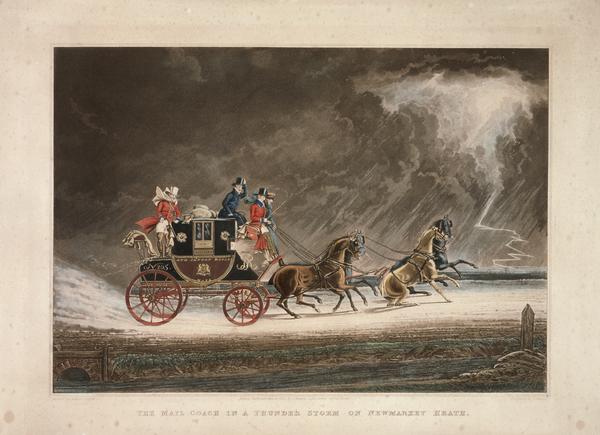
One of the first attempts at prioritising the delivery of mail was made in the 1700s. For a roughly seventy-year period between the early 1780s until the late 1850s, the British Royal Mail relied on a fleet of mail coaches to speed deliveries of mail throughout the United Kingdom.

Mail delivery had previously been very slow, and dangerous! Post-riders transported not just mail, but also parcels and packages, which might contain valuable or expensive items. It wasn’t uncommon for lone post-riders to be set upon by highwaymen who would relieve them of their cargoes, steal their valuables and even kill them!

The coordinated system of mail-coaches changed this. Not only was delivering mail by coach relatively faster, but also safer. The mail-coach always had at least four men riding on it: A driver, his assistant, and two armed post-guards, who rode on the back running-board. This way, anyone attempting to rob the coach would have to deal with four armed men, first!


An actual British mail-coach from the early 1800s. This one ran the route between London and York. Note the huge storage-trunks over the axles for carrying mail

The mail coach was also used as a sort of long-haul public transport system. Passengers could pay a fee, and ride along inside the mail-coach during its journeys, to get to their destinations much faster than what they might ordinarily. Also, since the mail-coach was working for the Royal Mail, a government agency, it was illegal for anyone to stop a coach. Toll-men, highwaymen, nobody could halt a mail-coach, and they didn’t stop for anything less than a broken axle!

Steam-Powered mail took over from horse-drawn mail in the 1850s. With the improvement and expansion of railway networks around the United Kingdom, Europe, Canada and America, mail-coach services were eventually phased out when the postal-services realised that these newfangled wood- (later, coal-) fired, steam-powered locomotive engines could speed mail to every part of a given country. Soon, post-offices and railway stations merged, so that post could be transported by rail and steam as far and as fast as was necessary and possible.

Special mail-trains were used in most cases, and their only task was the delivery of mail. To save time, letters and parcels were often sorted en-route by the mail-handlers, so that when the train reached its next drop-off point, or station, the necessary mail-sacks could just be dumped off on the platform, without time wasted in needless waiting and sorting.

To save even MORE time and to further improve the efficiency of mail-delivery, rail-mail was collected and dropped off even when the train was on the move! Specially-designed mail-cranes were built next to major railroad-routes:

Different types of mail-cranes or mail-hooks were used. Some simply held up sacks of outgoing mail for the train to snatch off it as it rocketed past. More complex ones would collect incoming mail, and send off outgoing mail at the same time.

As sacks of mail were prepared onboard trains, they were hung on hooks outside the mail-carriage. At the same time, sacks of mail waiting to be picked up were hung onto the arm of the mail-crane. As the train whizzed past the crane, the crane-arm whipped the sorted mail-sack off the side of the train. At the same time, the arm swung around, and a second hook or arm on the railroad carriage yanked the outgoing mail-sack off the crane, throwing it into the mail-carriage! Later on, the local postman would show up and pick up the dropped-off mail, and possibly hang another sack of outgoing mail onto the crane, to be collected by the next train that came hurtling by.

This silent film from 1903 shows a mail-crane in action:

https://www.youtube.com/watch?v=2lVSC4jt2R8

Steam-power also changed the nature of international mail-delivery. With faster, steam-powered ocean-ships, mail delivery was cut from months to weeks, or even days! In the United Kingdom, ships with the prefix “R.M.S.” (“Royal Mail Ship/Steamer”) were officially licensed to transport shipments of British mail. As on trains, mail-clerks onboard ships would sort the mail en-route to their port of destination.

With all these innovations, it’s not surprising that the Victorians were the ones who had among the most efficient postal systems in the world. Up to twelve deliveries a day! No worries about not getting that contest-entry form in on time, huh?

In the interwar period of the 1920s and 30s, the first experiments were made in air-delivered mail. Not having to worry about signals and tracks and waves and oceans, an airplane could fly mail from city to city, dropping it by parachute, and then landing to pick up more mail to speed onto its next destination.

Envelopes

For much of history, whenever you posted a letter, not only did you have to write it by hand, you also had to produce your own envelopes by hand! Most people would fold their letters into envelope-shaped forms, write out their letter onto it, and then simply fold the letter up and sealed it with wax, so that the letter and envelope were one and the same, which saved time.

It wasn’t until the invention of the first purpose-made envelope-folding machine in 1845, that envelopes could be purchased separately from stationer’s shops.

The classic envelope was cut and folded so that when it was assembled, it created a neat rectangular or square shape:

But have you ever wondered why envelopes have four, triangular flaps meeting in the middle?

Although you could glue the flaps down with regular paper adhesive, envelopes were originally folded and set in this manner so that a single wax seal, placed in the center of the envelope, was all that was needed to hold the entire packet neatly closed.

Most of us don’t seal our envelopes anymore, and generally rely on the paper glue that comes with the envelope, to do that for us, or we simply lick the glue to moisten it and then smash the thing shut, but nevertheless, the triangular, X-form on the back of envelopes has remained to the present day.

Stamps

It used to be that when letters were sent by post, it was the duty of the recipient to pay for the letter’s delivery. This was seen as inefficient, difficult to enforce, and frankly – rude. Why should YOU have to pay for a letter which you might not have been expecting, or which you wouldn’t want to receive, anyway?

This widespread dissatisfaction with the payment of mail-delivery charges led to widespread corruption, abuse, frustration and distrust of the postal system. To combat these issues, and to ensure payment for poastage, the introduction of the postage-stamp was made in England in the 1840s. With the new ‘Penny Black’, the first-ever postage-stamp, the sender purchased the stamp along with his envelopes, and pre-paid for the delivery, which cost…one penny!

With payment taken care of before the letter was even picked up by the mailman, there were far fewer complaints from customers about who had to pay for postage, how much and when.

Mail Boxes

With their twelve-a-day system, you can bet that it was the Victorians who invented the concept of the mail-box! There would be no other way to organise the millions of letters, envelopes, cards and parcels that sped around the U.K. at the time!

Mail-slots for incoming mail came about in the 18th century in Paris, but it wasn’t until the 1800s in Britain that the idea of a mail-slot, or a mailbox for each residence or business really took off. As part of the reforms of the postal-service (which also saw the introduction of the penny-post), Britons were encouraged to have a mail-drop point somewhere on their residence for the convenience of themselves, and the postman! In more built-up areas, a simple letter-slot, sometimes with a basket hanging on the side of the door, was sufficient. In more suburban parts of town, actual kerbside mail-boxes were installed.

Pillar-boxes, or public post-boxes for the depositing of outgoing mail came about in the Georgian era. The oldest one thought to exist dates back to 1809 in England.

In the United States, mail-boxes became popular in the 1880s, when the U.S.P.S. encouraged people to have individual mail-boxes outside their houses for the speedy delivery and pick-up of mail. Instead of large, bulky public boxes that might take up space on the street, residential mailboxes in the ‘States were used for both incoming, and outgoing mail. Raising the red flag on the mailbox told the postman that there was outgoing mail which was to be collected.

The Mail Always Gets Through…

Mail has existed for thousands of years. But the icons of mail-delivery such as stamps, envelopes, mailboxes and dedicated postal-delivery men are all relatively recent developments. Where once mail took weeks and months to get anywhere (and sometimes still does!), technological advancements have meant that in the 21st century, mail is delivered faster and with less hassle. All the more important with the heavy reliance that all of us place on the postal-service, even now in the 21st century.


A Story on Two Wheels: The History of the Bicycle

In the history of transport, fewer inventions were more compact, innovative, liberating, practical and enjoyable than that of the bicycle. And yet, the bicycle as we know it today is only just over 100 years old. What is the story behind this invention? Why was it created? And how did it reach the design which we know so well today? Let’s take a ride…

The World Before the Bicycle

Before bicycles came onto the scene with their dingling bells and rattling drive-chains, transport was slow, dependent, and/or crowded. You had ships, boats, carriages, horseback, or your own two feet.

When it came to pre-bicycle travel, you had three options available when it came to the characteristics of the journey that you were likely to receive:

Fast, Private, Comfortable.

You may pick only two.

If it was fast and comfortable, such as a railroad-train, you were resigned to sharing the carriage, and even the compartment, with others.

If it was private and comfortable, such as a carriage, then it certainly wasn’t fast. The average speed of horse-drawn transport in the 19th century was about seven or ten miles an hour at best. In the same bag is walking. Private and relatively comfortable, but don’t expect to get anywhere in a hurry.

If it was fast and private, such as riding on horseback, alone, then it certainly wasn’t going to be very comfortable, being jolted around in a saddle for hours on end.

What was needed was a fast, relatively comfortable, individual mode of transport, that relied purely on the rider for propulsion, and which didn’t need to fed, fired, stabled, stoked, sailed, steamed or otherwise externally operated.

With the internal combustion-engine still a dream, and coal-fired steam-carriages being large, loud, slow and unpredictable (to say nothing of dangerous), there was a serious market for a convenient, fast, practical machine which a rider could use for individual transport: The Bicycle.

The First Bicycles

The first serious attempt at a bicycle-like machine was the German-made ‘hobby-horse’ or ‘dandy-horse‘ machine of the 1810s.

The ‘Dandy Horse’ bicycle was a fascinating…um…experiment. It was hardly what you could call a bicycle, and it was never utilised as a serious mode of transport. It was seen more as a toy, for the use and amusement of the ‘dandy’, the well-dressed, leisured, upper-class gentleman of Regency-era Europe. As you can see, the Dandy Horse has no seat to speak of, no driving-mechanism, no pedals, not even a real handlebar! Steering and propulsion are rudimentary at best, and without any form of suspension, riding one of these on the rough, dirt roads of 1810s Europe would’ve been hard on the back and spine!

You didn’t so much ‘drive’ or ‘operate’ the dandy-horse as you ‘glided’ on it, similar to a skateboard. You kicked it along the ground with your feet to build up speed and then coasted along until the momentum gave out. An amusing gimmick for a Regency garden-party, but hardly a practical form of transport!

During this time, the word ‘bicycle’ was not even coined. And wouldn’t be for several decades. Human-powered, wheeled land-machines were called ‘Velocipedes‘, from the Latin words for ‘Fast’ (as in ‘Velocity’), and ‘Foot’ (as in ‘pedestrian’). And as the 1800s progressed, there was a growing range of fantastical and ridiculous ‘velocipede’ machines with which to delight the population of Europe.

The next advancement in bicycle technology came from France, and we look to Joseph Niepce and his contraption known as the…um…’velocipede‘.

Any long-term readers of this blog may fancy that they’ve heard the name ‘Niepce’ before on this website. And you’d be right. Apart from tinkering with bicycles, he was also instrumental in the development of modern photography. 

Joseph N. Niepce’s contribution to the bicycle came in the early 1860s, although it wasn’t a great departure from what had existed before.

The Niepce ‘velocipede’ differed from the earlier ‘dandy-horse’, but only a couple of ways: The front wheel now had pedals, and a proper seat or saddle which was adjustable to the height of the rider, along with proper handlebars and steering. But other than these minor additions and improvements, the French velocipede was not much of an improvement.

A French ‘velocipede’, as invented by Joseph Niepce. Note the presence of the handlebars and steerable front wheel, and the centrally-mounted saddle

The Ordinary Bicycle came next. Invented in the late 1860s, the Ordinary was the first machine to be specifically called a ‘bicycle‘, using the two words ‘bi’, meaning ‘two’ and ‘cycle’.  The Ordinary also introduced something which has become commonplace among all bicycles to this day: Wire-spoked wheels!

The Ordinary was variously called a High Bicycle, a Boneshaker (due to its lack of suspension), or, most famously of all – a Penny Farthing, after the largest, and smallest denomination coins in circulation in Britain at the time.

The Ordinary was the first bicycle for which there was any serious commercial success, and they became popular for personal transport, as well as being used as racing-machines!

Despite its relative popularity, the Ordinary had some serious shortcomings: There were no brakes, there was no suspension, and they were incredibly dangerous to ride! The immense front wheel could tower up to six feet in the air, which made mounting and riding these machines quite a feat of acrobatics in itself! Accidents could cause serious injury and stopping, starting, mounting and dismounting were all big problems. Something better had to be devised!

The Safety Bicycle

The Ordinary or ‘Penny Farthing‘ was one of the first practical bicycle designs, but its many shortcomings and dangers meant that something better had to be found. Enter the ‘Safety Bicycle’.

The ‘Safety Bicycle’ is the direct ancestor to all bicycles manufactured today.

The prototype ‘safety bicycle’ came out in the late 1870s, in response to the public dissatisfaction with the fast, but dangerously uncontrollable Penny Farthing.

Henry John Lawson (1852-1925) developed the first such machine in 1876. Lawson, the son of a metalworker, was used to building things, and loved tinkering around with machines.

Lawson’s machine differed from others in that the rider sat on a saddle on a metal frame. At each end of the frame were spoked wheels of equal size, with a handlebar and steering-arrangement over the front wheel. The rear wheel was powered by the use of a simple crank-and-treadle-mechanism, similar to that used on old treadle-powered sewing-machines, a technology familiar to many people at the time.

The great benefit of Lawson’s bicycle was that the front wheel was used solely for steering, and the rear wheel was used solely for propulsion, and the rider’s legs were kept well away from both of them! On top of that, the wheels were of such a size that the rider’s feet could easily reach the ground, should it be necessary to stop, or dismount the machine in an emergency. Lawson was certainly onto something!

Lawson updated his machine in 1879, with a more reliable pedal-and-chain driving-mechanism, but sadly, although innovative, his bicycle failed to catch on. All the extra parts and the radical new design meant it was hard to produce and too costly to be sold to the general public.

Although Lawson’s machine was a commercial failure, his invention spurred on the development of this new contraption: The Safety Bicycle! Building on what Lawson had already established, over the next few years inventors and tinkerers all over the world started trying to produce a bicycle that would satisfy the needs of everyone. It had to be practical, fast, easy to use, safe to ride, mount and dismount, it had to stop easily, start easily, and be easily controlled.

All manner of machines came out of the workshops of the world, but in 1885, one man made something that would blast all the others off the road.

His name was John Kemp Starley.

Starley, (1854-1901), was the man who invented the modern bicycle as we know it today. And every single one that we see on the road today, is descendant from his machine.

Building on the ideas of Mr. Lawson, Starley rolled out his appropriately-named ‘Starley Rover’ safety bicycle in 1885.

The Starley Rover was revolutionary. Like the Lawson machine, it had equal-sized (or near-equal), spoked wheels, a diamond-frame made of hollow steel, a seat over the back wheel, handles over the front wheel, and a pedal-powered chain-drive in the middle, linking the drive-wheel and the rear wheel with a long drive-chain.

By the late 1880s, the modern bicycle had arrived. It was Starley who had brought it, and he cycled off into the history books on one of these:

This model from the late 1880s has everything that a modern bicycle has, apart from a kick-stand. And this is the machine that has revolutionised the world of transport ever since!

The ‘Rover’ was so much better than everything that had come before it. It was easy to ride, easy to mount, easy to dismount. It was close to the ground, but did not compromise on speed with smaller wheels, because of the 1:2 ratio between the pedal-wheel and the rear wheel. You could reach tremendous speeds without great exertion, and you could stop just as easily!

The Bicycle Boom!

At last! A functional, fun, fast machine. Something you could ride that was safe, quick, light, portable, quiet, comfortable, practical, and which could get you almost anywhere you wanted to go!

With machines like the Rover, and the ones which came after it, all other bicycle-designs were considered obsolete! The Rover had shown the way, and others would follow.

With the success of this newly-designed bicycle came the cycling boom of the the 1890s! For the first time in history, you didn’t need a horse to get anywhere! You needn’t spoil your best shoes in the mud! You didn’t have to worry about smoke and steam and soot! Just roll your bicycle onto the road, hop on it, kick off, and down the road you went. What a dream!

With a truly practical design, the true practicality of the bicycle was at last, fully realised. At last, the ordinary man or woman on the street had a machine which they could ride anywhere! Although, that said, most bicycles in the late Victorian era were expensive toys for the wealthy. But nonetheless, they were used for everything from cycling through the park, cycling around town running errands, cycling to and from work, cycling to visit friends and relations across town, cycling to take in the sights! What a wonderful invention!

The ‘Gay Nineties‘, as this period of history is fondly called, saw the first big boom of the bicycle. Or a medium-sized one, at any rate. There were still a few problems: Bicycles were still rather expensive. And it was considered scandalous for a woman to ride a bicycle! Women opened their legs for one thing, and one thing only. How dare they sit, mounted…on a bicycle! Lord knows what other things they might be mounting next!

Women and Bicycles

A woman on a bicycle? Who’da thunk it?

The mere idea of this radical collaboration sent Victorian men into a tizz! Famously straitlaced and buttoned-up, Victorian morality dictated that a woman’s legs remained covered and obscured at all times. In fact, legs of ANY kind had to be covered at all times. Some people even draped floor-length covers over their pianos to prevent offense to visitors!

Women were generally expected to ride a horse side-saddle. But it was impossible to do this on a bicycle, since both legs were required to drive the pedals. And it was also impossible to ride a bicycle with the huge, floor-sweeping dresses and skirts of the era.  Something had to be done!

Fortunately, tailors came up with a solution!

The second half of the 1800s saw the arrival of the Rational Dress Movement, also known as the Victorian Dress Reform. Aimed mostly at women, this movement said that it was impractical for women to wear the clothes that they did, and still be expected to do all their wifely and womanly duties. The clothes were too bulky, too restricting and far too uncomfortable! Especially for such activities as sports, riding, walking and bicycling! Something had to be done! And fortunately, something was.

It came about in the 1850s, when Elizabeth Smith Miller of New York State, invented a sort of pair of baggy trousers for women. When their legs were together, they looked like a full skirt, but they parted company quite easily, for greater comfort and freedom of movement.

Women’s Rights advocate Amelia Bloomer, a strong supporter of more sensible women’s attire, liked the idea of these newfangled trousers, and they were eventually named after her: ‘Bloomers‘.

With bloomers, a woman could ride a bicycle safely and comfortably. But even if she didn’t have bloomers, a woman could still ride a bicycle in a skirt. She simply had to buy a woman’s bicycle!

Instead of a regular bicycle with a diamond-shaped frame, a woman could buy a step-through bicycle, like this one:

A step-through was identical to a regular bicycle in every way, except one. Figured it out yet?

Without a central bar between the handles and the seat, it was possible for a woman wearing a skirt to ‘step through’ the frame, so that she could get her feet either side of the pedals. Then, she simply hopped onto the seat, put her feet onto the pedals, and cycled away!

If that wasn’t handy enough, a woman could also purchase bicycle-clips, or ‘skirt-lifters’, which clipped onto the waist of her dress or skirt, and trailed down the sides of her skirt. Here, they were clipped onto the fabric to keep the hem of the skirt or dress off the road, but also, away from the pedals, where the fabric might get caught and tangled in the drive-chain!

The Safety Bicycle was ideal for women. Even with bloomers or bicycle-clips or skirt-lifters, it was almost impossible for a lady dressed in Victorian or Edwardian garb, to operate a Penny Farthing! The bikes were too big, too cumbersome, far too unstable, and generally unladylike to ride!

With the safety bicycle, a woman was able to ride with much greater comfort and security. The risk of accidents was smaller, they were easier to mount and dismount, and much easier to operate and control.

The Social Impact of the Bicycle

From the mid-1880s onwards, the bicycle became more and more popular, as safer, easier-to-ride models were invented, produced, and put on sale to the general public around the world. Bicycles caught on quickly, and were popular then, as they are now, for the very same reasons.

They provided free, motorless, quiet, smooth, quick transport, without the need of a horse. They were relatively easy to ride and control, and with a little practice, you could use one to get almost anywhere, and so much faster than walking!

A bicycle also had load-bearing capabilities, and could be used to transport and carry all kinds of things, provided that they could either fit in the front basket, or were strapped securely enough to the rear luggage-rack. Some bicycles even had side-satchels which hung over the back wheel for even greater storage.

Bicycles allowed people who previously couldn’t travel very far, the chance to explore much further afield. Women and children were no-longer restricted to riding in carriages or on railways, or horseback – they could climb onto a bicycle and ride around the village, go to the park, cycle through town, ride along the canal-paths. They did not need men, or older people around, to operate a horse and carriage, or a railroad train, or a steam-powered canal-boat. They simply needed two functional legs, and a decent sense of balance.

This ease of use and versatility allowed the bicycle to be used for almost anything. It was a commuting vehicle for office-workers and labourers. It was a cargo vehicle for anything from the weekly trip to the high street, to a day on the town. With the spread of bicycles came the rise of home-delivery and advertising. Now, bicycles could be used by butcher’s boys and apprentice bakers, shop-boys and telegraph-delivery boys, to provide effective and swift home-delivery of everything from bread, to meat, parcels, mail, telegrams and pre-ordered items of clothing or other items that might be small enough to be delivered safely on a bicycle.

Their open, light frames meant that it was possible to hang signs from the horizontal connecting-bars between the seat and the handlebars. Local businesses could paint advertisements on these signs, or on the mudguards of their store-owned bicycles. At the same time, a business could deliver merchandise or produce, and tell strangers where these things could be purchased.

Cycling clubs became incredibly popular. Friends and relations would gather and ride around the countryside for a day’s outing. They might go picnicking, or they might ride from town to town, visiting new shops, restaurants and public houses. This kind of freedom of movement had never been possible before. Not with a horse, that you had to feed and rest and saddle, not with a carriage which was slow and cumbersome. Not even with a steam locomotive and carriages, which was restricted to the railway lines. Before the rise of the automobile, only a bicycle allowed this level of freedom. No waiting, no fuss. Jump on, kick off, and pedal down the road.

Bicycles in Literature

The impact of the bicycle can be seen by its inclusion in literature of the late Victorian and Edwardian age. In ‘The Adventure of the Solitary Cyclist‘, by Sir Arthur Conan Doyle, Sherlock Holmes’ client is a piano-teacher who uses her bicycle as her main mode of transport, and who is shadowed everywhere by another cyclist.

In the mid-1890s in Australia, Andrew Barton ‘Banjo‘ Paterson, wrote the famous comic poem, “Mulga Bill’s Bicycle“. The cocky Mulga Bill declares that he can control absolutely any form of transport, even this newfangled ‘safety bicycle machine’. He purchases it from the local store and cycles off down the street with it, before losing control of the machine and spectacularly crashing it into a pond, deciding thereafter to stick to riding a horse!

The Bicycle in Wartime

During times of war, the bicycle proved to be a very popular mode of transport. Driving off-road was almost impossible, and at any rate, petrol was often in short supply and severely rationed. On the home-front and on the battlefront, civilians and soldiers often left motor-vehicles behind and fell back to the old-fashioned, reliable bicycle to get themselves around. During the First World War, British soldiers even formed bicycle infantry units! Bicycles didn’t need to be fed like horses, they were quieter, and they could get troops moving a lot faster!

During the Second World War, bicycles were used extensively by both sides. The Allies developed folding bicycles which soldiers could strap to their backs and jump out of airplanes with. Once they landed, they threw away their parachutes, unfolded their bicycles, braced them up, and cycled off to their rendezvous points.

The soldiers of the Japanese Imperial Army, maybe even to mock the British and their severe lack of preparation, invaded the Malaysian Peninsula and Singapore…on bicycles! It was impossible to drive tanks through the thick Asian jungles, but a bicycle on a dirt track could go anywhere!

As well as being used for military transport, bicycles were also highly popular on the home front. With petrol-rationing strictly enforced, driving became almost impossible. Unless you were in a reserved occupation (you had a job which was essential to the war-effort), or had some other important status which allowed you a larger petrol-ration, chances were that your car was going to be up on blocks for the duration of the war.

Bicycles don’t need petrol. They only needed whatever strength you could muster from your new diet of rationed food. At any rate, it would be easier to cycle through the bomb-shattered streets of London, Coventry, Singapore and Shanghai, than to drive a car! Most roads were so covered in craters, downed powerlines or the rubble from collapsed buildings that even if your car had fuel, it wouldn’t be able to make it down the road for all the obstructions!

Bells and Whistles

As bicycles became more and more popular during the Edwardian era, more and more features were added to them. One of the most famous additions is the bicycle-bell!

The idea of some variety of warning-device on a bicycle goes back to the 1870s, when the safety bicycle was in its infancy. The modern, thumb-operated bicycle-bell, which you clamp onto the handlebars of your machine, was invented in 1877 by John Richard Dedicoat, an inventor and eventual bicycle-manufacturer in his own right.

The bicycle bell works on a very simple spring-operated lever system. Pressing the button on the side of the bell rotates gears inside, which vibrates a pair of discs which jangle and ring when they move, a bit like a tiny pair of cymbals. This dingling noise is amplified by the bell-housing. Then, the spring simply pushes the bell-button back, ready for the next ring.

Dedicoat also invented a sort of spring-loaded step for helping people mount their bicycles. When Penny Farthings were still the rage, the step was designed to give the rider a boost into his seat. It worked rather well, but if the spring was more powerful than the rider was heavy, it might accidentally shoot him over the handlebars, instead of giving him a helping leg up onto his bicycle-seat!

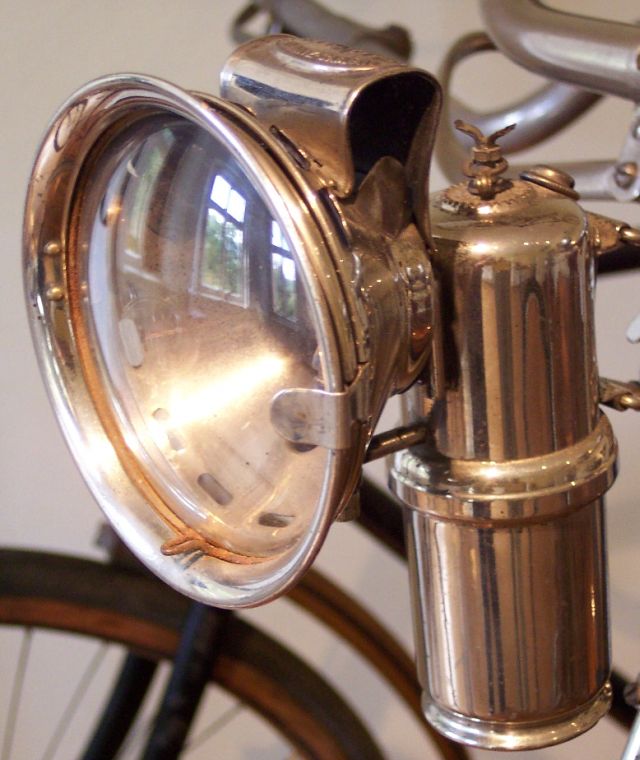
The popularity of the safety bicycle meant that it was ridden at all times of the day, and night! To make it safer to ride at night, bicycle lamps were clipped to the front shaft, underneath the handlebars.

As with automobiles of the Edwardian era, bicycle headlamps were gas-fired calcium-carbide acetylene lamps. The reaction of water and calcium-carbide produced a flammable gas which could be ignited, and produced a bright, sustained glow. These lamps and their reaction-chambers were small enough to clamp onto the handlebars of early safety bicycles.

Pellets or chunks, or even powdered calcium-carbide was stored in the lower reservoir of a two-chamber reaction-canister. Water was poured into the upper chamber, and a valve between the two chambers allowed water to drip from the top canister onto the calcium-carbide stored in the lower canister. The reaction caused the production of acetylene gas, which escaped through a valve into the headlamp, where it could be ignited, producing light.

Increasing or decreasing the amount of light coming from your bicycle lamp was a simple process of adjusting the opening of the water-valve on the reaction-canister. The more water, the greater the reaction, the greater the amount of gas, which caused the flame to burn brighter. Less water meant fewer chemical reactions, which reduced the overall supply of gas to the headlamp.

At the dawn of the 20th century, bicycles could also be fitted with dry-cell battery-powered headlamps, and alternating-current dynamo-systems. A dynamo really works very simply: You clip the headlamp to the front of the bicycle, and clip the dynamo and its lead, near to a wheel on your bicycle, usually on the mudguard, or on the frame if there isn’t a guard. Engaging the dynamo presses a small wheel against one of your bicycle wheels. As the bike wheel spins, it rotates the dynamo generator, which produces the electricity necessary to power the lamp.

The Bicycle Today

Whether it be a racing-machine, a manner of commuting, an A-to-B mode of transport, a delivery-wagon, a cargo-bicycle or a method of exercising, the humble 1885 safety bicycle remains essentially unchanged since its entrance onto the transport stage back in the closing decades of the Victorian era. The bicycle remains popular because of its simplicity, ease of use, and its seemingly endless practical advantages over various other forms of transport.

The Bicycle World Record


‘Flying Pigeon’ bicycle manufactured in China

Based in Tianjin, in northeast China, the Flying Pigeon is the most popular make of bicycle in the WORLD. In fact, it’s the most popular VEHICLE in the world. That includes motor-cars. The Flying Pigeon company was established in Tianjin in 1936. The Flying Pigeon model, after which the company was renamed, came out in 1950. The communist government in China demanded that the company produce a strong, practical, easy-to-use, and aesthetically pleasing bicycle. It had to ride good, and look good. And it’s been doing that for the past sixty-odd years. Cars were expensive in China, and bicycles were far cheaper and more practical for the average working Chinaman. So much so that the Flying Pigeon was seen as a sign of prosperity in China.

Echoing Franklin Delano Roosevelt, Chinese president Deng Xiaoping said that prosperity in China meant that every household would own its own Flying Pigeon bicycle.

Most popular car in the world: Toyota Corolla
Units made: 35,000,000+

Most popular bike in the world: Flying Pigeon
Units made: 500,000,000+

I think we have a winner.

More Information?

I found the documentary “Thoroughly Modern: ‘Bicycles‘”, to be very helpful. I wonder why…At any rate, it’s fascinating watching.

World’s Top Five Most Successful Cars


The Bombing of Darwin – Australia’s First Taste of War

Countries considered virtually untouched by the ravages of the Second World War include the United States, the Dominion of Canada, New Zealand, and the Commonwealth of Australia, even though this was not entirely true. About all that most people know about the bombing of Darwin is what’s featured in the film “Australia“, starring Hugh Jackman.

The United States naval-base at Pearl Harbor in Hawaii was hit hard in 1941 by a surprise Japanese air-raid which killed thousands of American servicemen, planes and ships. But while the surprise attack on Pearl Harbor has gone down in history as one of the most famous surprise-attacks of all time, most people have completely forgotten about another, similar, and even more devastating attack, which took place in northern Australia, in the early months of 1942.

This posting will look at the famous Darwin air-raids, the two Japanese airborne attacks on the town of Darwin in Australia’s Northern Territory during the Second World War, and the effects that these raids had on the city and its inhabitants, and the rest of Australia.

Darwin, 1942

Darwin, named after the famous naturalist, Charles Darwin, is the capital city of the Northern Territory of Australia. It was founded in 1869, and was originally named “Palmerston”. It gained the name “Darwin” in 1911. Darwin was a small-fry among Australia’s bigger and more prominent cities. Population-centers such as Melbourne and Sydney were famous around the world, they were major ports and trading-centers. Darwin, by contrast, was a sleepy backwater town that most people had never even heard of!

In the 1940s, Darwin was little more than an isolated country town at the top end of Australia. Its population in 1940 was a minuscule 5,800 people. By comparison, Melbourne at the same time had a population of over a million. This, when the population of Australia numbered some 6,900,000 people in 1939.

Darwin and the Second World War

Darwin in 1939 was an isolated country town, at the top of the nation, but at the bottom of the population-ladder. War seemed far away, and any notion that Australia might be threatened by enemy action were laughable. Germany was on the other side of the world! Who cared what happened? If anything did happen, it wasn’t going to happen in Australia, anyway! Apart from the blackout, rationing and military service, life went on more or less as it had always done.

It’s widely believed that Australia was largely untouched by the War, which is more or less true. Air-raid sirens never wailed across the city center of Melbourne, and Sydney was never rocked by Japanese bomb-blasts, but the threat, real or not, hung in the air.

In the early years of the war, the idea that Australia might be threatened were passed off as sensational and unfounded. The main aggressor, Germany, was on the other side of the world. And Japan was more interested in China than Alice Springs. But in 1941, everything changed.

With the attack against Pearl Harbor, Australia realised that its safety was threatened…probably. The Japs were never going to reach this far south! They’d be stopped at Singapore, and blasted into the sea! End of story. Roll over and go back to sleep.

Posters like this one from 1942 are believed to exaggerate the Japanese threat to Australia. However, they were probably closer to the truth than most people knew, or were willing to admit

However, the swiftness of Japanese advances struck terror into the hearts of Darwinians. Since 1937, Japan had taken Peking and Nanking. It had bombed Hawaii, invaded Shanghai, in less than a month, it had invaded and captured British Hong Kong. It invaded American possessions in the South Pacific, and was making sweeping advances down the Malay Peninsula.

In February, 1942, the island nation of Singapore, the “Gibraltar of the East”, Australia’s first, last, and only line of defense against Japanese aggression, collapsed and surrendered in just one week!

Suddenly, Darwin felt very exposed.

The Threat Against Darwin

To protect against Japanese aggression, Darwin was to be Australia’s first mainland line of defense. To this end, it had been equipped with anti-aircraft guns, an airbase with fighter-planes of the Royal Australian Air Force, and there was even a small naval-base run by the Royal Australian Navy. These were to be the two main fighting forces which would meet the Japanese threat if they ever came south to Australia.

With the attack on Pearl Harbor and the Japanese advances through Southeast Asia being swift and brutal, Australia began to feel increasingly threatened. In the days and weeks after the Japanese December-1941 offensive in the South Pacific, the vast majority of Darwin’s civilian population had been evacuated, and the town’s already small population shrank from 5,800 in 1939, to just 2,000 people in 1942. Most of the 2,000 people were essential civilians, government and military officials, and servicemen. The majority of the women and children had been evacuated from town by railway, or else, had boarded specially-charted evacuation-ships, which would steam them south, to Brisbane, Sydney or Melbourne, well out of harm’s way.

Darwin’s location at the top of Australia, its harbour, and its proximity to Japan made it a natural target for the Japanese. But as with many defense-plans in the South Pacific at this time, Darwin was not prepared for any kind of substantial and sustained attack.

British colonial bastions such as Hong Kong and Singapore had been overrun in days and weeks. The very might of the United States Navy had been challenged! What chance did a tiny, sparrow-fart town in the middle of nowhere have, against such a superior enemy?

Why the Japanese Attacked Darwin

If Darwin was such a tiny, insignificant town, with barely any armed forces or defenses to speak of, why did the Japanese see it as such a threat and target?

As with any real-estate…location, location, location.

Darwin’s location and its large harbour made it a natural base for the Allies. Any British, American or Australian forces in the area would surely gather there. They would use the harbour for their warships, and the flat ground around the town for its flak-guns and airforce bases. At the time, the Japanese wanted to destroy any and ALL competition in the area, no matter how large or small. Their next target, after China, Hong Kong, Singapore, Malaya and the islands of the South Pacific, was the Dutch East Indies (what is today, Indonesia).

To take Indonesia without any opposition, the Japanese had to attack Darwin, to knock out any chance of the Allies to mount some sort of counterattack. And this is why Darwin became a target.

Darwin’s Defenses

Despite the threat against Darwin, the town’s defense was ridiculously small. Darwin Harbour had 45 ships, and the surrounding airfields had only 30 airplanes. Of the 45 vessels in Darwin Harbour, 21 were merchant-ships. Of the other 24 ships, five were destroyers (one of these was the U.S.S. Peary), and another ship was the U.S.S. Langley, a primitive vessel launched in 1912! This was the U.S. Navy’s first aircraft-carrier, a role into which it had been converted in the 1920s.

To protect against the threat of a Japanese air-attack, Darwin was more than capably defended by 18 anti-aircraft cannons, and a smattering of WWI-era Lewis-style machine-guns.

But they had hardly any ammunition between them. And hadn’t for weeks. As a result, the guns had never been fired, and the crews to operate the guns had never been trained!

On top of everything else, Darwin had almost no air-raid precautions. It had only one operational air-raid siren, barely any shelters, no radar, and barely any lookout posts.

At any rate, even if everything was working, they still wouldn’t have been able to mount any sort of serious defense. It was estimated that to defend Darwin effectively, the town would require at least three dozen anti-aircraft cannons or guns, and at least 250 aircraft.

Instead, it had barely twenty guns, and only thirty aircraft.

In the event of an enemy air-attack on Darwin, civilian aircraft-spotters on nearby Bathurst Island (namely the local priest, Father John McGrath), were to sight the aircraft, identify them, count their numbers, and then relay this information via radio, to the authorities in Darwin. Radio-operators in Darwin would then sound Red Danger over the air-raid sirens (the famous, classic high-low wail of an air-raid siren), signalling for the population to seek cover.

The warning would only give people a few minutes to duck and cover, but it gave them a fighting chance to seek shelter before the Japanese reached Darwin. At the sound of the sirens, the flak-cannons would be manned and loaded, and the aircraft on the ground would be readied for take-off, to engage the incoming enemy.

That was how it was supposed to happen.

The Darwin Raid: 19th February, 1942

Less than a week after the fall of Singapore, on the 15th of February, Australia was about to  find out how vulnerable it really was. With a flimsy northern defense, and nearly all its soldiers fighting in Africa or the Middle East, or captured in the South Pacific, and hardly any air-power and hardly two ships to race together, Australia was ripe for the taking.

On the 19th of February, Japanese aircraft carriers sailed south towards Australia. They parked themselves a few miles off the coast, and sent in over 200 fighter and bomber aircraft. 242, to be precise.

242 aircraft of the Imperial Japanese Air Force, against just 30 aircraft belonging to the Royal Australian Air Force.

As the planes flew south towards Australia, they passed over Bathurst Island. Father McGrath, the mission priest on the island, spotted the aircraft, and radioed his warning to land-stations near Darwin, that a large concentration of aircraft were headed their way. Another aircraft-spotter on Melville Island also spotted the aircraft, and he too, sent a radio-warning to Darwin.

However, much like at Pearl Harbor, the authorities believed the aircraft to be returning American fighter-planes, which had been out on practice-runs and recon-missions. So, no heed was taken of these radio-warnings. The sirens remained silent and no guns were manned in preparation. Darwin was a sitting duck.

The First Raid

The first raid against Darwin was at 10:00am that morning. Even though the town had been warned well in advance by its aircraft spotters, no action was taken in the time between about 9:15, when the first radio-warning was sent out, and 10:00am, a period of forty-five minutes. Then, the bombs began to fall.

With no warning at all, the remaining civilian population of Darwin was bombed relentlessly by the Japanese. After the first explosions, the town’s single operational air-raid siren went off, sounding out the alarm, but it was already too late.

The ships in the harbour were bombed and strafed, and among the casualties were the U.S.S. Peary, which was hit, and sunk. It was just one of eight ships destroyed. In the town, bombs rained down, destroying vital structures as the docks (where 21 longshoremen were killed when the quays received a direct hit), and Government House. The Darwin Post Office was obliterated in a direct hit. The postmaster and his family, sheltering in the nearby air-raid shelter, were killed instantly.


The town post office after the raid

The anti-aircraft defenses of Darwin were woefully unprepared for the raid. For nearly all the soldiers there, this was the first time they’d fired any sort of gun at all! Most of the ground units had no rifles. And if they had rifles, they had no ammunition. And if they had ammunition, they had no training, so most of the shots went wild. Nevertheless, of the 188 aircraft that struck Darwin in the first raid of the day, seven were shot down by Allied flak-guns. A paltry number. The 188 planes in the first wave decimated much of the town, and destroyed the two airbases nearby, as well as wreaking havoc on the harbour and ships therein.

The Second Raid

At 10:40am, the first raid ended. But another one came at a few minutes before midday. This raid, consisting of the remaining 54 of the full force of 242 Japanese airplanes, attacked  the airbases  and town yet again, in a smaller raid lasting just 20 minutes.

At the end of the second raid, the All Clear sounded and the damage was examined. 23 of the 30 airplanes had been destroyed, and in all, 10 ships had been sunk, and another 25 were damaged. 320 people had been killed, either from drowning, burns or bombing, and another 400 people had been injured.

The Aftermath

The air-raids on Darwin were devastating on many levels. Although the majority of the population had been evacuated before the raids, poor preparations and management meant that even with a reduced population, the town suffered high casualty-rates and significant damage. Electrical power was cut, water and gas-mains destroyed and telecommunications disrupted.

The town post-office was blown to oblivion, along with the town postmaster and his family.

What followed after the raids was a complete breakdown of civil and military leadership. Soldiers raided empty houses, and evacuation-marches were bungled up. This last with the result that soldiers and airmen were scattered all over the Northern Territory with no definite rallying point.

The damage and disaster was on such a huge scale that for days, weeks, months, years and even decades after the bombings, the full extent of the catastrophe was hidden from the public.

A Dog Named Gunner

Out of the raids on Darwin came one remarkable story about a dog. An Australian Kelpie puppy called ‘Gunner’. Gunner’s claim to fame was being the canine radar for Allied military forces in the Darwin area during the Second World War.

Gunner possessed remarkably sharp hearing, and was able to detect the sound of incoming aircraft from miles away. Furthermore, he was able to differentiate between friendly Australian and American airplanes, and enemy airplanes flown by the Japanese, based on the sounds of their engines.

Gunner was injured during the raid on Darwin and was taken to the nearby hospital for treatment. The doctor on duty insisted that he couldn’t treat the dog without knowing its name, rank and serial-number! Gunner’s owner, Percy Westcott, fired off that the dog’s name and rank was that of Gunner, and that he held serial No. 0000 in the Royal Australian Air Force!

Gunner’s remarkable ability for accurately alerting ground-crews to incoming enemy attacks was soon noticed. And his success-rate at accurately picking up on enemy aircraft was so high that Westcott’s commanding officer gave him permission to operate a portable air-raid siren whenever Gunner started whining and whimpering, to alert his comrades of an incoming Japanese raid.

Gunner’s extremely sharp hearing meant that he was literally better than radar and on more than one occasion, accurately picked up on the presence of an incoming raid up to twenty minutes in advance, far outside the capabilities of radar-equipment at the time!

During the later stages of the war, Gunner’s owner, Westcott, was posted to Melbourne, and had to leave Gunner behind in Darwin. What happened to the dog remains unknown.

The Affect of the Raids

Australia had previously considered itself untouchable by the hand of war. The war was happening in Europe, anyway! And in Asia, the might of the British Empire would protect Australia from harm.

After these first raids, Australia realised its own vulnerability, and made moves towards securing its own defence. One of the most significant moves was to recall thousands of Australian troops (then fighting in the Middle East and Africa) back to their homeland, a decision made by prime minister John Curtin.

Curtin’s decision was a popular one…but only with Australians. He encountered fierce resistance from both the American and British governments, especially from Winston Churchill, who wanted to send the Australian troops to Burma to fight against the Japanese. However, Curtin was so worried about Australia’s position in the war that he insisted on overruling Churchill and to have the troops steamed home as soon as possible, something which did happen, after many lengthy exchanges through letters and telegrams.

Future Raids on Darwin

Darwin, along with other cities and town in northern Australia, were bombed repeatedly throughout the war during 1942-43. By the time the war ended, the Australian mainland had been hit by no fewer than 62 separate air-raids in the space of two years.

More Information?

Looking for more information? I strongly suggest watching the documentary: “The Bombing of Darwin: An Awkward Truth”, about the air-raids, and the cover-up which followed.

Anzacday.org website-entry.


Tales of Robin Hood – The History Around an Outlaw

Whether or not Robin Hood, the legendary outlaw of English folklore ever really ever existed…is entirely up in the air. At best, Robin Hood can be said to be an amalgamation of a variety of actual outlaws from the period, at worse, he would be seen as the romanticised figure of the age. But while Robin Hood may not have been a real person, his world and everything about it, still fascinates us to this day. Just a few years back, we watched Russell Crowe in “Robin Hood”, in 2010. So, centuries after the time he lived, we remain enthralled with this fantastical figure who may never even have lived.

Robin Hood was an outlaw, who lived in Sherwood Forest in the English midlands county of Nottinghamshire. So famous is his legend that the flag of Nottinghamshire even has a picture of Hood on there! Hood was known as an archer, a swordsman, and as a crusader of sorts, who stole from the rich to give to the poor. Here, we’ll look at the various parts of his legend and just how romantic and brave they really were.

Robin Hood: Outlaw at Large

Before Robin Hood was anything else, an archer, rider, horseman and all-round good-guy, he is most famously known as being an outlaw, living in Sherwood Forest in Nottinghamshire. Gee, it must be nice, living in the midst of nature with your band of merry men and the Maid Marion, holding up stagecoaches, and giving money and food to the needy.

…Not really.

In Medieval times, being an outlaw was a real problem. To become an outlaw, you had to have committed a crime, of course. And if the prosecuting party (the king, the local sheriff or landlord) did not want you executed, he could simply declare you to be an outlaw. Or, in the Latin legalese: Caput Lupinum.

To be an outlaw meant that the law no-longer applied to you. You were literally ‘outside’ the law. You had no obligation to follow it. However, this also meant that the law had no obligation, thereafter, to protect you! Enter ‘Caput Lupinum‘.

It literally means ‘Head of the Wolf‘, or ‘Wolf’s Head’. To be branded a wolf’s head outlaw meant that, not only were you outside the law, and its protection, it also meant that you would forever be hunted…like a wolf. And, like a wolf, anyone who killed you, no matter how it was done, no matter where it was done, automatically received the king’s royal pardon. There was no price or penalty to be paid by anyone for the death of a wolf. Or an outlaw. They were considered scum, and anyone who successfully killed an outlaw was seen as doing the king (and his subjects) a favour.

Robin Hood: The Archer

In the days of Robin Hood, the main long-range weapon was the bow and arrow. Known since antiquity, bows and arrows were simple, but lethal weapons, able to bring death to its target from several yards away. Robin Hood was supposed to be an excellent archer, able to hit targets from impossible distances with remarkable accuracy.

But what was the reality of medieval archery?

To be an archer took great skill. Skill and experience gained over years of practice. It took skill to aim and shoot reliably. But it also took great strength. No weakling would be able to simply pick up a bow, load an arrow and fire it. Considerable arm-strength was required to force the bowstring back to produce the energy required to fire an arrow over dozens of yards, and hit with enough force to kill or at least injure your enemy, or quarry.

Before the age of firearms, archers were essential in any army. Able to stand well back from the field of battle and rain down volley after volley of lethal fire from above, from the relative safety of a hilltop, or behind a castle wall. Since archers were so important, in England, the practice of archery was made a law. Anyone desirous of becoming an archer had to train from the age of seven (co-incidentally, the same age that a boy training to be a knight, also had to start from!), to build up the speed, strength and accuracy required to reliably fire a bow and arrow. In villages and towns, archery-practice was mandatory; at least two hours a day, at least once a week. Usually, this was two hours on Sundays, since that was the one time that people in the community gathered together, for church. After religious services, the men would go out for target-practice every week.

Although bows came in several shapes and sizes, for a full-grown male, the weapon of choice was usually the military longbow. Made from the wood of the yew tree, the longbow was not named-so for nothing. Up to five or six feet high, a longbow was generally designed to fire an arrowshaft up to nearly three feet long!

The first book written in English, on the subject of the longbow, and on archery in general, was produced in the mid-1540s, by Roger Ascham (1515-1568). An educated man of letters, Ascham was a private tutor, and a university lecturer. He also happened to be Princess Elizabeth’s Latin tutor; so when he wrote his book, (titled “Toxophilus“), he dedicated it to King Henry VIII, Elizabeth’s father.

The Sheriff of Nottingham

We don’t generally associate sheriffs with England, do we? They’re something you find in the United States, along with their cohorts, the sheriff’s deputy. But the sheriff actually originates in England.

Originally, areas of land in England were governed by Ealdormen. Literally ‘Elder Man’ or ‘Older man’, meaning a man of age, and therefore, experience. These men were royal officials and were in charge of keeping law and order within their allotments of land. The position survives today in the word ‘alderman’.

Eventually, the alderman died out in that capacity, and his duties were taken over by another man: The Sheriff.

The original title was “Shire Reeve”. A shire is a stretch of land, synonymous with the word ‘County’. A shire reeve was the administrative official responsible for the preservation of law and order within that shire. Eventually, the two words were melted into the one word: “Sheriff”.

Much like a modern sheriff, the sheriff of Robin Hood’s day was responsible for the upholding of the law, such as the capture of outlaws like Robin Hood.


A Random History of Popular Foodstuffs – #2

This is a continuation of a previous posting, which I wrote a couple of years back. And it will cover the histories behind more popular foods which we take for granted today.

Jelly!

Mmm, jelly. Cold, jiggly, wobbly, sweet, wiggly, wriggly jelly! Or, as the Americans call it…Jello, which is actually a brand-name, not an actual foodstuff. But jelly it certainly is.

These days, we associate jelly with dessert, with children, with ice-cream, and with catchy little TV jingles (“I like Aeroplane Jelly, Aeroplane Jelly for me…“). But for centuries, jelly was a luxury food. Incredibly laborious and time-consuming to produce, it could only be eaten by the richest of people, during only the most special of special feasts, dinners, parties, holidays or other significant occasions in a history that dates back to medieval times.

We’re familiar with jelly as that stuff that you buy in a packet. You pour the powder into a bowl, you mix it with water, you pour the sloshy, syrupy mixture into a mold, and then chuck it in the fridge or freezer to cool and set, into pretty, jiggly shapes which are red, and green, and yellow and purple, and which look like everything from flowers to pyramids.

That’s what jelly is today. But in older times, jelly was obtained only after hours and hours and hours of extremely labour-intensive work. Jelly wasn’t simply mixed with water and chucked in a cold spot. It was boiled, and strained, and purified, in a process that would eat up almost all the hours of the day. This is why it was eaten by only the wealthiest people, who could afford the servants and the time to make it.

So how do you make jelly the old fashioned way?

To make jelly as they might’ve done back in the Middle Ages, you first required gelatin. Gelatin comes from collagen, a type of protein. And you get collagen from…

…pigs.

For centuries, well up to the Georgian era, the only way to make jelly was to boil the feet of pigs or cattle. In an incredibly time-consuming process, the salvaged pig’s feet would be placed in a pot of boiling water. The pig’s feet and water would be left to boil for the better part of eight or ten hours. This intense boiling extracted the gelatin from within the pigs’ feet, and mixed it with the water. Once the gelatin had been boiled out, the entire mixture had to be strained. First, it was strained to remove the pigs’ feet. Then it was strained to remove any debris. Then it was strained to remove any fat. Then it was strained to remove any impurities. And then it was strained again. And again. And again.

The repeated straining and purification removed all the impurities from the mixture so that in the end, you were left with nothing but water, and gelatin.

Left on its own in a suitably cool spot, the gelatin would eventually solidify. If you wanted flavoured jelly, then it was simply a matter of mixing in the required fruit-juices, such as lemon, lime, orange, strawberries and so-forth. These extra ingredients being added, the entire mixture was stirred up, poured into a mold, and then dunked in the cellar (or other suitably cold room) to solidify and set.

It seems easy, but when making jelly could take the better part of the entire day, and could require the efforts of at least two people (there’s a lot of water to strain!), you can understand why, for centuries, it remained a food for the wealthy. Poor people simply did not have the time, the money, or the space to dedicate, or waste, on such a frivolous dessert.

It was not until the mid-1800s, when it was discovered that you could dry out the mixture and create gelatin powder, that it was possible to sell gelatin in a convenient packet for the average consumer. All the buyer had to do was mix it with water to help the powder congeal, flavour it to his or her taste, pour the mixture into a mold, and set it. Before that was possible, hardcore boiling and tiresome straining and purifying was the only way to make jelly.

Sausages

Oooh, we all love sausages. Beef, pork, chicken, lamb…delicious!

These days, sausages are made out of synthetic casings, although there is a significant number of sausage-makers and butcheries, which are manufacturing sausages the old-fashioned way.

We love sausages. Convenient, easy to cook, easy to hold, easy to store and easy to hang up on a peg. We even have gourmet sausages stuffed with herbs and spices and cheese. But the origin of the sausage is far from gourmet.

Imagine a cow, or sheep, or chicken, or a pig. You’ve gutted it, you’ve taken off the ham, the bacon, the ribs, the cutlets, the various cuts of steak, the wings, the legs, the breasts, and everything really worth eating. What did you do with the rest? The carcass that’s left over?

Bones might be used to boil up for soup. Feathers, wool or fur might be removed for clothing. But there’s still the leftover carcass and the organs and innards that nobody wants. Now what?

If you lived in older times, you certainly did not throw it out. Catching and killing animals was hard work, and cooks were encouraged to cook and eat every single part of an animal which was worth eating…even the organs. Or the feet (if they weren’t being saved for jelly…). Or the head. The cheeks. Anything that wasn’t already removed. The offal, basically.

But how to dress the dregs of animals so that they looked appealing?

One way to do this was to take the intestines of the animal, pump water through them, wash them clean, and then fill the intestines with ground up animal leftovers, twist them into convenient lengths…and sell that, if you were a butcher, to your unsuspecting customers, or serve it to your diners, if you were a cook. It was still meat. It was still beef. Or pork. Or chicken. Or lamb. It was just…um…’modified’.

And that’s all a sausage is.

…did I put you off of your dinner yet?

In older times, all the leftovers from a dead animal were diced, sliced and minced up. Then, these animal unmentionables were pumped into the cleaned out intestines of the animal in question. The big long sausage was twisted around, every few inches, to make sausages of convenient lengths, and then the whole thing was cooked up.

Some butchers still make sausages like that today, although most cheaper sausages use edible plastic or synthetic sausage-skins instead. But it is, nonetheless, how it was done.

…Hotdog, anyone?

Pies


Pies…Cake is the lie

Mmm. We like pies. Chicken pie, beef pie, steak and kidney, apple, blueberry, custard-cream…sweet, savory, spicy, simple, splendid. We love pies!

One of the reasons we love pies is because they’re fun to make. We love creating pretty, patterned crusts, with cris-crossing strips, vents held open by pie-birds, pastry-leaves, and pretty, rippling, wavering sides.


A pie-bird. These painted clay birdies are stuck into the middle of pies to stop the pie-crusts from sagging during baking, and to provide a vent for steam to escape

But for all the effort, we know that before long, the crust and sides will be broken up, carved up, and devoured. And all our efforts will be dashed in a flurry of gravy, cream, sugar and crumbs.

But our love-affair with pies is only the end of a very long journey.

With pies, cakes and tarts, comes an interesting history.

Takeout Pies

For a long time, pies were not even baked at home. We have a romantic image of pies cooling on the window-sill after they’ve been baked, the wonderful smells wafting around the neighbourhood. Which they may well have done; but it’s a rather modern thing.

For centuries, pies were never baked at home. Until the introduction of the range stove in the 1700s, it was well outside the ability of the ordinary man or woman to do his own baking at home. Most homes did not have ovens. They had fireplaces. Fireplaces are great for roasting meat, for cooking stews, boiling soup and providing heat and warmth, but they’re impossible for baking on. The smoke and flames and soot from the fire would destroy the pie, and the constantly wavering heat from the flames meant that the pie wouldn’t bake properly, anyway.

For a long time, pies were actually sent out to the nearest bakery to be baked. Here, the village baker would bake your pies for you. You dropped them off, and he marked the top of your pie in a manner that made it stand out (so you knew which one was yours, to differentiate it from the dozens of other pies in town!). He baked it, and then you came back later and picked it up.

The nursery-rhyme ‘Pat-a-Cake‘ recalls this era of history:

“Pat-a-cake, pat-a-cake,
Baker’s man, 
Bake me a cake as fast as you can,
Prick it, and poke it, and mark it with a B,
And put it in the oven, for baby and me!”

In the rhyme, just like in real life, a cake or pie was marked (‘with a B’, in this case), to differentiate Baby’s cake, or pie, from all the others in town, which were being baked at the same time, in the communal oven.

But before you even baked the pie, you had to put something into it. Filling! Back in medieval times, pie-fillings were a little more creative than what they are today. Two of the most common filling-choices gave us two of the most lasting, pie-related nuggets from history.

Before people got the idea of grinding up animal-guts and turning them into sausages, animal entrails were chopped up, boiled, and stuffed into a pie-casing. This pie was baked in an oven, and then served to the peasantry, low-ranking servants, and paupers. Entrails and guts and organs were called “umbles”. Serving “umble pie” to the poor gave the peasantry a constant reminder (as if they ever needed one!) that they were on the lowest rung of the social ladder, because all they could eat was…’Umble Pie”, or “humble pie”, as it eventually became to be called.

These days, we’re used to separating sweet from savoury. You’d hardly have a beef and custard pie, would you?

…would you?

Sweet’n’Savory

Believe it or not, but in medieval times, pies that mixed sweet with meat, were pretty common! Beef would be mixed with raisins and dates and prunes, and baked together in a pie. This wasn’t necessarily because people liked it…but rather because it was one of the few ways that people had, to stop food going stale!

The natural sugars found in fruit were used as a preservative to prevent the meat from going rotten. And often, fruit and meat were baked together, for this purpose.

These days, we don’t bake our meat and fruit together in a pie anymore. But we do have a leftover from that period – the Christmas “mince pie”. There isn’t any beef mince in these pies, but they’re called mince pies because they were originally made with meat, with the fruit acting as a preservative. Over time, the beef was removed, giving us a simple fruit ‘mince’ pie, the kind we know today.

Empty Shells

No, not shotgun-shells or bullet-casings…pie-casings!

The tradition of eating a pie, sweet, savoury, or a mix of the two, together with the crunchy pastry crust and casing, is actually a pretty modern development.

For much of history, when a pie was eaten, the pastry lid was removed, the contents (today, the fillings) eaten, and then the pie-casing (and the lid) was put back in the kitchen to be reused!…Again…and again…and again! For as long as the crust and casing remained fresh.

Why bother using the crust and casing when you have a pie-dish, though?

You have to understand a couple of things here…

This is a time before widespread refrigeration. Meat had to be cooked and eaten within 48 hours of being purchased fresh from the local market. There was nowhere to store it for longer than overnight without it going stale (unless you froze it, smoked it, or salted it).

To prevent meat going bad, cooks would bake it in a pie. And cooking the meat meant that it lasted longer and you could eat it, of course!

But why save the pie-crusts?

Until relatively recently, flour, the main ingredient in pie-casings, was an expensive commodity. Very expensive. In medieval times, the only way most people could get flour was to grow their own wheat, thresh their own grain, winnow their own wheatgrain, and then grind it by hand, or grind it at the mill owned by the local landlord (for which the peasantry had to pay taxes to use!). Even in later times, flour was expensive, and only the wealthy could afford to eat the fine, sifted, refined white flour which we love so much today. This was because the extra effort required to refine it made it more expensive.

The result? Most people couldn’t afford enough flour to bake a pie for every day of the week. You’d use up your flour to bake your pie and the meat inside. Then you’d use the same pie-crust over and over and over again until it started going bad, before eating it on the last night of the week. This was to make your flour last for as long as possible.

And the pie-crusts of older times are a lot different to the ones made today. Most people would complain…loudly…if you served them a pie with a crust that was too thick, since it would be impossible to crunch into, or get a fork or knife through. In the days of serfdom and lords, pie-crusts could be upwards of an inch or two in thickness! This was so that they would last through the repeated bakings without burning and charring in the oven.

Bread

Not for nothing is bread nicknamed “the staff of life”. For centuries, millenia even, all over the world, mankind has survived on bread of some variety. Whitebread, wholemeal, mixed-grain, sourdough, rice-bread, cornbread, pita-bread…the list is almost endless. But what is the history of bread?

The origins of bread go back to the dawn of civilization. And its importance is just as up-there as its history. Hell, the Romans even created a whole ROOM just for bread. Ever wondered why your kitchen has a ‘pantry’? It comes from the Latin word ‘Panna’ or…bread. A ‘pantry’ was the room in which bread, a staple of life, was stored. But here’s a few things you may not know about bread…

The Upper Crust

The “upper crust” is a common expression meaning those of a higher social status, up there in the upper-class economic group. But have you ever wondered where the term ‘upper crust’ came from?

Yep. Bread.

Before the first modern stoves were invented in the Western world (Ca. 1700), baking bread was a hot, dangerous and ashy affair. Here’s how it was done…

The dome-shaped bread oven was filled with wood, which was then set on fire. The oven door was left open and the huge fire inside the oven was allowed to burn for hours, until it finally burnt out. Once the fire was out, the baker had the unenviable task of raking out the hot ash, charcoal and cinders, and shoving in dozens of loaves of bread at a time, using those big, wooden baking-paddles (so he didn’t burn his hands).

Burning a fire in the oven, and letting it burn down to ash made the brick (or stone) inside the oven extremely hot. And it’s this heat, and not the heat from the fire, which actually bakes the bread. Once the bread was shoved in as quickly as possible, the oven door was shoved on, and extra bread-dough was stuffed around the edges of the door. This had the double-job of sealing in the heat, but also acting as an oven-timer. You could tell when the bread inside was baked by checking whether or not the dough on the door was also baked.

When the bread was baked, the door was ripped off, and the bread hauled out on paddles again.

Everything about baking bread relied on speed. It took so long to build, light and burn down the fire that bakers wanted to get the ash out of there, and the bread in there, as fast as possible. The result is that there was always a thin layer of ash on the oven-base. And during baking, this ash and soot would stick to the bottom of the loaves of bread. Eugh!

Picky rich people who wanted the best bread, would slice the loaves horizontally instead of vertically, so that the burnt, sooty bottom crust of the bread was given to the poor – the paupers, beggars and lepers, while they…the rich…kept the crunchy, soft, soot-free…upper-crust…for themselves!

Don’t Sit Under the Apple Tree…

Anyone who’s ever baked bread at home will know that one of the most frustrating things is the wait while the dough rises. After the bread-dough has been mixed and kneaded, it’s necessary to leave it alone so that the yeast inside the dough can expand and let off gas, which allows the dough to rise, before it can be put into the oven.

But what if you didn’t have yeast, one of the key ingredients in breadmaking?

If you don’t have yeast, you could do what medieval bakers used to do. Take the bread out into the back yard, or nearest available orchard, find a suitable apple tree, and stick the yet-to-rise bread-dough underneath it! And let nature take its course, as they say.

Yes. This actually works. And it works because apples, which grow on apple trees (see, you learn something reading this blog…), are full of yeast. And apples on the ground, rotting off, let off yeast fumes, which will help your flaccid loaf to fluff into life before its date with destiny. The yeast in the apples is the same reason why it’s possible to make alcoholic apple cider; yeast is also a key ingredient in beer!

Hungry for More?

The “If Walls Could Talk” documentary episode “The Kitchen”, and the documentary “Tudor Feast” will supply you with some tasty information.


What’s that Tune? The stories behind famous pieces of music

You hear them all the time on television, in kids’ cartoons, in movies, in advertisements on the radio and in the ad-breaks between your favourite TV shows. But what are the stories behind these iconic pieces of music? Here’s a selection of some of the most famous pieces of music you might not know anything about, and the stories behind them.

Title? Ride of the Valkyries
Who? Richard Wagner
When? 1870
What? From the opera “Die Walkure

Commonly used in cartoons, and TV shows to symbolise impending doom, destruction or the coming of some great conflict, the Ride of the Valkyries dates back to 1870. It was originally written for the German opera “Die Walkure” (“The Valkyries“), by Richard Wagner. The Valkyries was one of a series of four operas written by Wagner at the time.

Ride” plays at the start of the third act in the opera. Its dramatic and triumphal melody is designed to accompany the arrival of the valkyries (characters of viking mythology), whose task it is to select which viking warriors will die in battle, and the souls of which, the valkyries deliver to the god, Odin, ruler of Valhalla, the Viking world of the dead, where warriors who have died in battle are honoured for their bravery and skill.

Today, the “Ride” is most famously remembered from the film “Apocalypse Now”, but its fame dates back over a hundred years to the grand opera-houses of Germany and Austria.

Title? Tocata & Fugue in D Minor, BWV 565
Who? Johanna Sebastian Bach
When? Ca. 1704
What? Organ piece

Although most people have never listened to the whole thing, the first eight notes of Bach’s Tocata & Fugue in D Minor are recognised around the world, for their haunting, eerie, creepiness. Used in cartoons and other TV shows for setting the scenes in scary old Victorian houses, isolated haunted mansions, spooky abandoned castles, and grandmother’s dusty basement, where the lightbulb never seems to work properly, the Tocata & Fugue in D minor has remained famous for over 300 years!

Exactly WHEN Bach wrote the Tocata & Fugue is unknown. The closest date that anyone can figure is ca. 1704/5. In fact, it’s not even established that he wrote it. See, the problem with Bach’s collection of work is that he never signed any of his compositions! So it’s almost impossible to say if he wrote anything at all. The only method of determining what works can be genuinely attributed to him, is by reading the diaries, letters and other accounts left by his contemporaries.

Indeed, almost no copies of Bach’s original compositions, penned by his own hand, survive. Nearly all of the oldest copies which we have today, were once copied out by Johannes Ringk. Ringk (1717-1778), was a German composer, organist and music-teacher. And its his copies of Bach’s works which are among the oldest known to survive. Ringk’s copy of Bach’s famous organ-piece is likely taken from another copy, by Ringk’s fellow organist, Johann Peter Kellner (1705-1772), who copied the original Bach composition, ca. 1725. The original composition, which Kellner likely copied, has been lost to history, and no copies of the Tocata & Fugue, as penned by Bach, survive today.

Title? In the Hall of the Mountain King
Who? Edvard Grieg
When? 1876
What? From the Norwegian opera “Peer Gynt

One of the most famous operatic orchestral pieces in history, ‘In the Hall of the Mountain King’ is recognised instantly from its tiptoe start, its gradual increase in volume, and the eardrum-busting crescendo! But what purpose does this piece of music serve?

Mountain King” comes from the 1873 opera, “Peer Gynt“, a fantastical theater play, or…fairytale!

Originally, the story was called “Per Gynt” (“Peter Gynt”), and was a traditional Norwegian fairy-tale. Norwegian dramatist, Henrik Ibsen used the fairy-tale as the basis for his grand masterpiece theater-production, and Edvard Grieg’s famous piece of music was written for one of the scenes.

In the play, the main character, Peter Gynt, is disgraced. After dashing the hopes that his mother had held, for him to marry the daughter of a wealthy local farmer, Peter is banished from his community.

During his travels, Peter meets a wide range of people, and finds himself inside an enormous mountain, ruled by a troll-king, hence the title of the piece.

Peter meets a girl who is daughter of the troll-king. When the courtiers find out, and realise that Peter might have made her pregnant, everything goes awry, shown by the dramatic change in the piece of music during its later stages.

Title? Overture – The Barber of Seville
Who? Giaochino Rossini
When? 1816
What? From the Italian comic opera “The Barber of Seville”

The overture to the Barber of Seville is one of the most famous pieces of music in the world. To most people, it’s the soundtrack to a certain Bugs Bunny cartoon that came out in 1950…

The overture (‘opening piece’) to the Barber of Seville has remained one of the most famous and iconic pieces of music ever written, and its various elements has been used in TV, movies and commercials for years.

Title? Overture – 1812
Who? Pyotr Ilyich Tchaikovsky 
When? 181…no. 1880
What? Commemoration

Jangling church-bells and the reports of cannon-blasts going off is the most famous part of the 1812 Overture, one of Peter Tchaikovsky’s most famous works. But what is it actually about?

Contrary to popular belief, the 1812 Overture has NOTHING to do with the War of 1812. That’s a sheer coincidence.

The 1812 Overture, written in 1880, commemorates the Russian defeat of Napoleon’s forces in 1812, driving back the French emperor from the Russian homeland. The cannonfire for which the piece is so famous, commemorates the Patriotic War of 1812, the Russian name for the failed French invasion of Russia, from June to December of that year.

Title? The Typewriter
Who? Leroy Anderson
When? 1950
What? Novelty orchestral piece

‘The Typewriter’, from 1950, is one of the most famous pieces of novelty orchestral music ever written. It is unique because of the one instrument that it uses which isn’t an instrument: a typewriter.

Anderson wrote this quirky little piece to immortalise one of the most important inventions in the history of mankind, the humble typewriter. It is the typewriter’s clacking keys, the famous ring of the warning-bell, and the grating sound of the carriage being pushed back at the end of each line that people remember in this piece of music. However, there’s more to this piece than that.

To actually perform this piece, you require the orchestra, a functional typewriter, and a call-bell. The call-bell is there to facilitate the extra bell-chimes which the typewriter itself, cannot provide. And when the piece was first performed and recorded, a modified typewriter with only two functional keys, was used to provide the sound-effects!

Title? Galop – Orpheus in the Underworld
Who? Jacques Offenbach
When? 1858
What? Dance

Today, most people just know this piece as the Can-Can. Written in 1858, the Galop from the opera ‘Orpheus in the Underworld‘, by Jacques Offenbach, is one of the most famous pieces of dance-music ever produced.

A ‘galop’ is a French term, and the title of a type of dance. It comes from the word ‘gallop’, as in a galloping horse. The title reflects the lively, quick pace of a style of dance which became popular in the 1820s, which was full of speed and activity.

Title? “Music for Royal Fireworks”; ‘La Rejouissance’
Who? George Frederic Handel
When? 1749
What? Fireworks Accompaniment

George Handel’s ‘Music for Royal Fireworks‘, was written in 1749, to accompany a fireworks display being put on by King George II of England. This huge public spectacle was to celebrate the end of the War of the Austrian Succession, the year before. Sadly, the fireworks were not as spectacular as the music, which remains popular even to this day, nearly 300 years later. It’s well-known for its use in triumphal, royal scenes depicting splendor, pomp and ceremony.

Title? Symphony No. 40., in G Minor (1st Mvt)
Who? Wolfgang Amadeus Mozart
When? 1788
What? Nokia ringtone…?

Anyone who’s ever had to answer their mobile or cellphone will probably be familiar with this tune. Written by child prodigy, Wolfgang Amadeus Mozart, in 1788 (by which time he was in his 30s), this tune remains one of Mozart’s most famous compositions. It was also one of his last; Mozart died in 1791, at the age of 35.


How to Buy Straight Razors and their Gear Secondhand

In glancing over my blog, I noticed that my posting on straight razors seems to be one of the most popular ones that I’ve written so far. If you want to read it, it may be found here. 

I’m writing this as a sort of follow-up, or companion-post to my previous one. This won’t go into all the nitty gritty details of every little bit of everything, but it will cover in-depth, how to buy a straight-razor (and associated gear) for far below retail price.

The Appeal of Straight Razor Shaving

In our money-conscious, green-guilt world that we live in today, where everything must be eco-friendly and reusable and everything else, more and more men are turning to the way their fathers and grandfathers shaved, and are moving back to using a straight-razor to shave with. Some like the challenge, the skill and the patience that it takes. Some reckon that every whisker shaved off their chin grows three on their chest. Others like the nostalgia of it. Some people do it because they reckon they can save money.

On that last score, however, some would begin to wonder. A brand-new strop, razor, mug, brush and soap can cost over $200-$300!

Suddenly it’s not looking so cheap and money-saving. And this is when most men, turned on by the idea of a good, old-fashioned shave, turn away, and go back to using their vibrating Mach 5.

This is a little guide about how to get all the things you need, on the cheap.

Buying a Second-Hand Straight Razor

Straight-razors come in a dizzying array of styles and types, and it can be tricky to know exactly what kind of razor you should buy. Keep the following things in mind when looking for a second-hand straight-razor:

Always pick quality. Buy a razor that was made by a reputable company, or from a reputable country or city. In England, the best straight-razors all came from Sheffield, and for centuries, Sheffield was the center of the English cutlery trade. Anything that cut anything, came from Sheffield. Kitchen-knives, tailors’ shears, the finest silverware, and the best, barber-quality straight-razors were all made here.

While any razor from Sheffield is almost certainly a winner, keep an eye out for the name Joseph Rodgers & Sons. For well over two hundred years, J. Rodgers & Sons has produced quality cutlery, since it was founded in 1764! Everything from paper-knives to silverware and straight-razors. You can date a J. Rodgers knife by examining what is engraved on the shank of the blade.

A Victorian-era Rodgers blade will have “Cutlers to Her Majesty” (Queen Victoria). A razor made after 1901, will have “Cutlers to Their Majesties”, (King Edward & Queen Alexandra, George V).

Other respected Sheffield razor-manufacturers were Bengall, and Wade & Butcher. Keep an eye out for them, as well. But in general, any Sheffield-made razor will be of assured quality.

Any razor marked “Thiers“, will have been made in the French town of Thiers, and is another sign of quality. The company of Thiers-Issard still makes straight-razors to this day.

One of the most recognised names in cutlery is that of “Solingen“. A town in Germany, Solingen is arguably the cutlery capital of the Western world. Everything from razors to kitchen-knives and scissors of all kinds are produced in Solingen. Even surgical blades are made there. Almost without exception, any razor made in Solingen will be a winner. The German company of Dovo still makes razors there to this day.

Check for Defects in the Razor. This goes without saying, but bears mentioning. Keep an eye out for such things as cracks, chips, uneven wear (from improper or overenthusiastic sharpening), water-spots, pitting and rusting. Light rust may be removed with fine-grit sandpaper and light steel wool. The razor will then be serviceable again after sharpening and stropping. Heavy rusting, cracks, chips and uneven metal-wear are all irreversible damage to a razor, and cannot be fixed. Discard any finds in such a condition.

Some razors have cracked or damaged scales (the handle part which the blade folds into). There are repairmen out there who craft and replace broken scales with new ones. So all is not lost on this front. You could even do it yourself. All you need are the pins (the little rivets), and the right materials and skills. Razor-pin sets may be purchased online. Try eBay.

Tarnishing, water-spotting and pitting are generally cosmetic issues, and should not affect a razor’s ability to function. Light rusting, once removed, will not affect a razor’s overall quality of function. As mentioned previously, heavy rusting cannot be safely removed, and it can seriously weaken a razor. Do not attempt to resurrect a razor with extensive rust-damage. It’s not worth your while.

Features of a Razor. Not all razors have all of these features. Some might have all. Some might have some. Some might have none at all. It’s all up to you, to decide what you want in the razor that you buy.

Some razors will have ‘jimps’. Jimps are the corrugations ground into the shank of the razor-blade (the part of the blade you’ll hold in your fingers). They are there to provide you with extra grip during shaving. Some razors don’t have them at all. Some have single jimps (corrugations on the bottom side of the shank), and some have double jimps (corrugations on the upper and lower sides of the shank).

Some razors have ‘transverse stablisers’. These are found at the end of the razor-blade (opposite to the point), next to the shank. They’re sets of slots or grooves, which were punched into the razor-blade when it was being formed. They serve to provide strength to the blade, and prevent cracking from blade-warp and metal-fatigue. Like jimps, not all razors have them. Some razors only have one pair of stablisers. Others might have two.

Most razors will have a ‘shoulder‘. The ‘shoulder’ is the definitive ‘break-off’ point between the end of the blade, and the shank, which you hold in your fingers. It serves as a barrier to stop your wet fingers sliding onto the blade (and getting cut!). The shoulder meets the shank at right-angles, to provide a safe ‘slot’ to place your fingers in, to stop them getting in contact with the blade. This is also where you’ll find the stabilisers.

Make a note of what the Scales are made of. The vast majority of vintage razors will have scales made of some variety of plastic; usually celluloid. Be warned that celluloid can degrade over time. This is rare, but it can happen. So keep an eye out for any razors with warped, cracked or otherwise damaged scales. You can buy the razor for the blade, and have it re-scaled, or you can disregard it altogether.

Straight-razors with pretty ivory scales are iconic. But also rare and expensive. Most white/cream-scaled razors will be made out of “French Ivory”…a fancy term for celluloid plastic which is coloured to look like ivory. Don’t be fooled. An easy way to tell the difference is to just feel the scales with your fingers. Ivory, especially old ivory, is never perfectly smooth, and should have a grainy touch. It’s a natural product, after all. Plastic will almost always be perfectly smooth.

How Much do I Pay for a Straight Razor? Most vintage straight-razors can be bought for peanuts. In most cases, below $25.00, in good condition. Some razors which are a bit more interesting/rare etc, might cost more. But a good, serviceable, second-hand razor, which will work wonderfully after a light refurbishment, should not cost the earth. One of my razors was just five bucks, made in Germany. Never fails to give an excellent shave. The more expensive razors are typically the ones with fancy scales, the ones made of ivory, tortoise-shell, bone, etc.

Care & Maintenance of your Vintage Razor. So. You’ve bought a nice, vintage razor. It’s nothing fancy, but it was cheap, good quality, and will get the job done. Now what?

Apart from the obvious – keep the razor sharp and the edge smooth – especially with vintage razors, it’s important to keep the blade DRY BETWEEN USES. After each shave, dry the blade COMPLETELY with a towel, and make sure that there’s no water trapped inside the scales. Vintage razors were made of carbon steel. There’s nothing wrong with that, apart from the fact that carbon steel rusts. Very easily. A few drops of water left on a razor overnight, is enough to start rust going. Also, it can lead to water-spots, unsightly corrosion left by water-droplets on the blade. So to prevent that, dry the razor thoroughly after each use.

Buying Secondhand Accessories

Now that you have your razor, from the local flea-market, antiques shop or off of eBay, let’s have a look at buying other things second-hand.

The Strop

Every good razor needs a good strop. And a good strop need not cost the earth. I bought a top-quality strop for about $25.00 at the flea-market. So, what should you look for?

There are a whole heap of shortcuts around this. You can make a strop out of an old belt, out of a pair of jeans. Even out of newspaper. And they’ll all work. So if you’re trying to save a lot of money, you could try that. An old belt will have to be smooth and without patterns or embossing. A strop made out of the legs of an old pair of jeans will have to be free of seams and stitching; this would interrupt the draw of the blade, and damage the edge of the razor. A strop made of newspaper (I’m not kidding. Yes, newspaper), will need to be thick, and strong, to stop it from ripping when you pull on it, in preparation for stropping.

Every time you strop, you remove a small amount of leather from the strop. So if you’re using a belt, make sure it’s not a belt that you’re going to wear anytime soon…or at all.

In buying an actual second-hand strop, you should keep an eye out for the following:

The Condition of the Leather. Every good strop is made of leather. Sometimes, you’ll have double-sided strops, which are both leather and canvas. But sticking to leather for the time-being, ensure that it is smooth, and free of cuts, scratches and cracking (from being overly dry). Some leather can be softened using additives which you can buy at your local hardware shop. That’s fine, and should not damage the strop or the leather (it better not!). But steer clear of any strop which has serious cracks and/or cuts in the main part of the strop. These will do no good for your razor when you run it along there.

The Condition of the Connections. A typical hanging-strop has two ends (I think…). The handle, and the hook. The hook can be a simple…hook…a ring, claw-fastener, or a clip. This is used to affix the strop to the wall of your bathroom (on a towel-hook/ring, or towel-rail). At the other end, is the handle which you pull tight while stropping. Make sure that any stitching or rivets which hold these connections to the strop, are in good condition. The last thing you want is for the stitching to rip, or for the rivets to break during stropping. You’ve got three inches of lethally sharp steel in your hand and you don’t want to chance cutting yourself in an accident if the strop breaks.

The Size of the Strop. You want a strop of a decent size. At least three inches wide, and at least a foot long, if not more. If you don’t, then you won’t be able to strop the entire length of the razor-blade when it comes to using the strop.

The Brush

To use a straight-razor, you need to wet-shave. And to wet-shave, you need a brush. A badger-hair brush is best. It holds water and retains heat. And that’s what you want.

You can buy brushes second-hand, although if you do, any purchase should be THOROUGHLY cleaned first, with hot water and soap. Or you could buy a modern brush instead, if you’re a little worried about contamination. A quality badger-hair brush, purchased brand-new, might cost a bit more, but properly maintained, it will last a lifetime.

N.B.: A brand-new badger-hair brush *may* smell a bit wonky when you first open it. That’s because well…it is animal hair. You can clean it up a bit using shampoo, to remove the smell. Or you could leave it as it is…regular use and contact with shaving soap/cream will remove the smell in time.

The Stone

Every straight-razor user needs to have a decent sharpening-stone. There are people who go crazy with this stuff, and buy pastes and solutions and three, four, five or six different stones, to get their razors sharp enough to cut glass. But enough of that. This posting is about how to get started in straight-razors on a budget. So, what you want is one good razor stone which you can use easily, and which gives reliable, consistent results.

If you want to really cheap it out, you can just use a regular, rectangular knife-stone, such as what you might sharpen your kitchen-knives on. And there’s nothing wrong with that, but there are specific stones which are made just for straight-razors. Most of them are vintage/antique stones, since not many people use straight-razors anymore. You can find them at flea-markets and antiques shops and, provided they’re not cracked really badly, or worn out, they should work just fine. Razor-stones are generally a lot smaller than a regular knife-stone, for the simple fact that…razors are smaller! Always remember to keep the stone wet with water while sharpening, to reduce friction and heat, and to keep the sharpening process smooth.

Mugs, etc 

The cheapest solution for something like this is to just take a cereal-bowl, or an old coffee-mug that you don’t want to use anymore, and use it as a lathering-bowl or cup for when you want to whip up lather for your shave, and there’s nothing wrong with that. But some people find it tricky to use a bowl with no handle on it (which can be important when your hands are wet with soap and hot water), and shavers who own big bushy shaving-brushes can’t always fit them inside a regular coffee-mug.

To get you out of this mess, you might want to invest in a shaving-mug or bowl, or a shaving-scuttle. Scuttles (little jug-shaped affairs with a soap-dish on top) can be found in almost any decent flea-market or antiques shop. Unless it’s something really fancy, though, I wouldn’t pay any more than about $20-$30.00 for one.

When you buy a mug or a scuttle, make sure that the base of it is smooth and level. This is so that it won’t shake, slide or rattle on your bathroom counter while you mix up your lather. Not only is it really annoying, but it can throw off your mixing arm, because the mug, bowl or scuttle is always sliding around everywhere.

Tips, Tricks, etc. 

Here’s a few things to keep in mind when buying or using second-hand shaving equipment. A few parting words:

– The majority of vintage razors, even the ones from quality companies, are rarely worth a great deal of money. Most of their value comes either from their uniqueness, rarity and/or scale-materials. Unless there’s something that really draws you towards a razor (it’s a cased pair, or it’s a seven-day set, it’s really pretty, it’s really old, or any other reasons), don’t pay more than about $20.00. It’s not worth more than that.

– Assume that any second-hand razor will require thorough cleaning before use. You don’t know where it’s been or what it’s been used for, or what it’s had on its blade. They weren’t nicknamed ‘cut-throats‘ for nothing. Same goes for any brushes that you should purchase second-hand.

– This bears repeating…again: After each use, dry your razor-blade thoroughly. Especially with older razors, rust can start on a wet blade literally overnight. And if it gets really bad, you’ll have no choice but to throw the razor out.

– Light rusting can be removed with fine-grit sandpaper, and this will not affect the operation of the blade. Heavy rusting compromises the structural integrity of the blade. So throw it out. You don’t want a razor-blade cracking or breaking in half (and yes, that can happen in extreme circumstances) during stropping or shaving. Especially with extra-hollow-ground blades, which are very thin and bendy.

– Until you’ve learnt from experience how much is enough, always sharpen and strop your razor more than you think is necessary, just in case. In general, fifty strokes on the hone, and fifty on the strop, should be enough. It may sound like a lot, but once you’re up to speed, you’ll have it done in about five minutes.

One of the chief causes of razor-burn and cuts is shaving with a dull, unsharpened/unstropped razor. A properly sharpened and stropped razor, used correctly, will not cut you or cause razor-burn.